Thanks for subscribing.
Your gift is on the way.



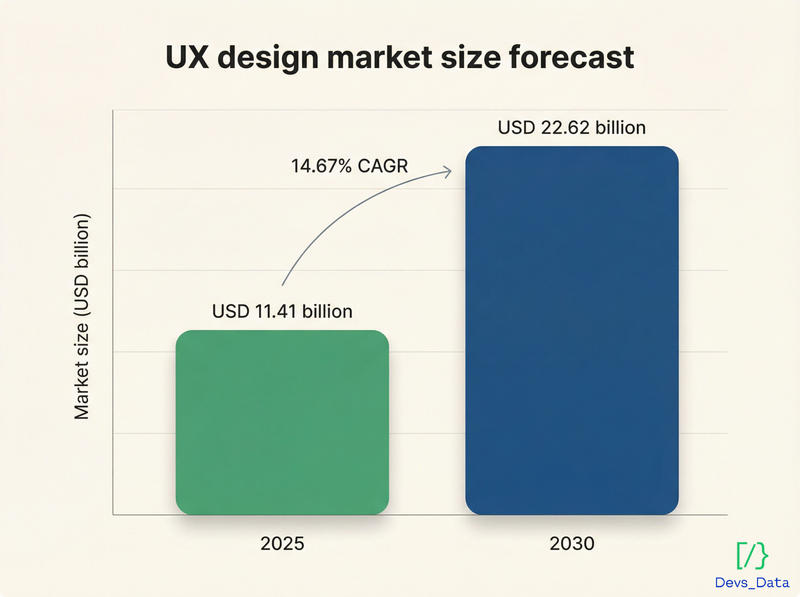
A single friction point in the checkout flow sends paying customers to a competitor. Multiply that across thousands of daily sessions, and the cost of poor interface design surfaces directly in the next monthly revenue report. That reality is driving organizations to treat UI/UX design as a revenue-generating function. The global UX design market reached USD 11.41 billion in 2025 and is projected to climb to USD 22.62 billion by 2030 at a 14.67% CAGR, according to Mordor Intelligence, as the bar chart below tracks.
The hiring side mirrors this growth. The World Economic Forum’s Future of Jobs Report 2025 ranked the UI/UX Designer as the 8th fastest-growing profession through 2030. Traditional graphic design roles did not make the same list. The ranking itself tells Hiring Managers what matters now: companies are no longer recruiting for visual output alone. They need professionals who tie user behavior research to product decisions and who operate as strategic contributors across the organization.
For Hiring Managers working through this shift, the article ahead covers how to scope the role for the right organizational fit and assess candidates beyond portfolio aesthetics. Regional salary benchmarks and the hiring mistakes that cost companies their top candidates receive equal attention. By the end, readers will have a clear method for making stronger design hires and keeping them, backed by the recruitment experience of DevsData LLC, an IT recruitment agency based in New York and Warsaw.
BCG’s 2025 research on AI leaders found that organizations advancing AI integration alongside mature design practice achieve 1.7x higher revenue growth and 3.6x greater three-year total shareholder return than laggards. The UX function sits inside that broader maturity profile rather than driving the headline number on its own.
These results stem from systemic investment in how products are conceived and built, not from a single website redesign or a one-off usability fix. Poor customer experience accelerates the financial gap from the opposite direction.
“PwC’s 2025 Customer Experience Survey reported that 52% of consumers stopped buying from a brand after a negative product or service experience.”
Another 29% walked away over poor online or in-person interactions. Nine out of ten executives believe customer loyalty has improved in recent years, yet only four in ten consumers share that view. The perception gap carries a direct revenue cost.
These figures reframe UI/UX hiring as a financial decision rather than a creative preference. A skilled Designer pinpoints where users drop out of a checkout flow and why retention falls off after onboarding. For Hiring Managers weighing the cost of a dedicated UI/UX Professional, the more accurate calculation is the revenue left on the table without one.
Do you have IT recruitment needs?
The following table outlines how a dedicated investment in UI/UX changes business outcomes across the areas that matter most to decision-makers.
| Area | With strong UI/UX | Without strong UI/UX |
|---|---|---|
| Conversion rates | Research-backed interface decisions reduce drop-offs at each step of the purchase flow. | Users abandon confusing checkout processes, leaving recoverable revenue uncaptured. |
| Customer retention | Consistent, well-tested experiences build repeat usage and reduce churn over time. | 52% of consumers leave a brand after a single negative experience, according to PwC’s 2025 survey. |
| Revenue growth | Leaders on BCG’s 2025 design plus AI maturity benchmark report 1.7x higher revenue growth. | Organizations without design integration report minimal financial returns from digital products. |
| Internal alignment | Designers bridge the gap between Product Managers, Engineers, and business stakeholders during development. | Teams ship features based on assumptions, then pay for costly post-launch corrections. |
| Brand perception | Interfaces signal credibility within the first seconds of a user’s visit. | Outdated or inconsistent layouts erode trust before a visitor reads a single word of content. |
UX and UI address different layers of the same product. Knowing where each discipline starts and stops shapes which conversion and retention problems the future hire ends up solving once they are inside the team.
UX focuses on how a product works from the user’s perspective. A UX Designer spends the majority of working hours understanding why people behave a certain way inside a product, then structuring the interface so that behavior and intent align. The output is functional. Sitemaps define the structure. Tested prototypes validate layout decisions before development begins.
The core responsibilities fall across these areas:
UI operates on the visual and interactive layer. A Visual Designer working in the UI space determines typography, color systems, spacing, component libraries, and the micro-interactions that communicate state changes to users.
Where UX asks what happens when a user taps a button, UI defines what that button looks like and whether the visual hierarchy guides the eye toward the correct next step. Both disciplines share a boundary at the prototyping stage, where structure and surface begin to merge.
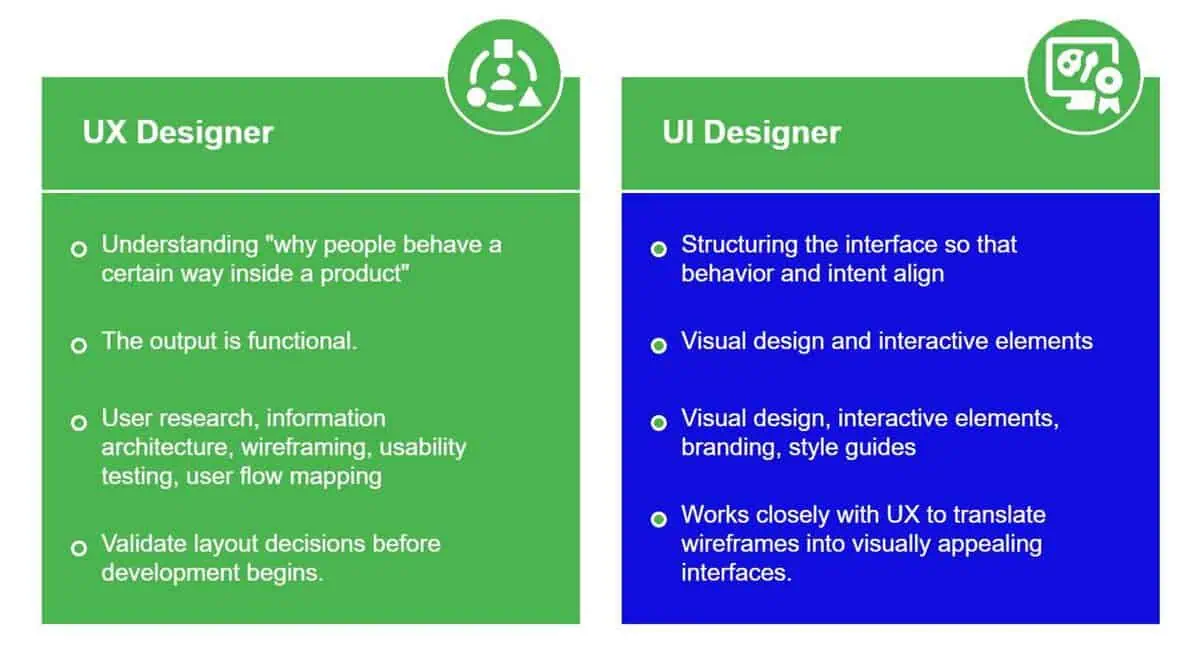
In practice, the line between these two functions has blurred. Most mid-market companies now post a single combined role rather than hiring for each side separately. Junior candidates entering the field are expected to handle both research and visual execution.
Organizations that still split the roles tend to be large product teams with established design systems, where a dedicated UX Researcher feeds findings to a separate interface Designer. Smaller teams rarely have that luxury.
A startup bringing on its first Designer needs a generalist who moves between user interviews and wireframes, then carries the work through to final visual production without waiting for a handoff from another team member. An enterprise with a mature design system needs a specialist who can extend existing component libraries and work within defined frontend collaboration patterns.
Hiring Managers who scope the role without first assessing their organization’s design maturity, meaning whether the company already runs an established design system or still builds each interface from scratch, risk writing a job description that attracts the wrong profile entirely.
Do you have IT recruitment needs?
Evaluating a Designer’s skill set goes beyond reading a list of tools on a resume. Each competency below is framed around what it signals during the hiring process and why it matters for the team receiving the hire.
Figma proficiency
The design tool market has consolidated around a single platform. AlphaSense reports that Figma holds an estimated 80-90% market share in UI/UX design. Candidates who list Adobe XD as a primary tool are referencing a product in maintenance mode with no active feature development.
Sketch has fallen below 5% adoption. During evaluation, look for fluency with Figma’s collaborative workflows and built-in prototyping features, as well as the candidate’s use of Dev Mode to hand off specifications to Engineers.
AI fluency
Figma’s 2026 hiring survey reports that 73% of hiring managers now treat AI tool proficiency as an increasing requirement, which puts this skill on the same baseline tier as Figma itself. The expectation reaches further than generating placeholder images. Evaluate whether the candidate uses AI-assisted tooling to draft layout variations against a brief, with the same fluency applied to research synthesis when interview transcripts need pattern detection at speed. Stronger Designers also know where AI judgment falls short. They keep it off final visual hierarchy decisions and off any output going to a stakeholder review without a human pass.
Prototyping within modern tools
InVision shut down in 2024. Principle covers animation polish on its own, which tells Hiring Managers little about a candidate’s end-to-end prototyping range. Candidates should demonstrate prototyping either directly in Figma or in Framer, where interactive builds translate more closely to production code.
Design systems and component-based thinking
A Designer who builds one-off screens creates visual debt that slows every future sprint. Evaluate whether candidates have contributed to or maintained a shared component library. The clearest signal of systems-level thinking is when a candidate explains how a single change to a design token propagates across an entire web application without breaking layouts.
HTML and CSS literacy
Full coding proficiency is not the expectation. What separates a strong hire from an average one is whether the Designer understands the box model, responsive breakpoints, and the constraints Frontend Developers face when translating a design file into working code. This knowledge reduces revision cycles and prevents layouts from looking correct in Figma but collapsing in a browser.
Accessibility standards
“The European Accessibility Act became enforceable in June 2025, with non-compliance fines reaching up to EUR 1000000 depending on the member state.”
WeAreDevelopers reports that 94.9% of the top one million home pages still fail to meet WCAG standards. Candidates who design with WCAG 2.1 AA compliance from the start save organizations from costly post-launch remediation. During interviews, ask how the candidate handles contrast ratios, keyboard navigation, and screen-reader compatibility in their daily workflow.
Translating research into design decisions
A portfolio full of polished screens reveals nothing about how a candidate arrived at those solutions. Ask what data informed the layout, which user behaviors the candidate observed during testing, and what changed between the first wireframe and the shipped version. The answer separates a UX Researcher mindset from a decoration-first approach.
Cross-functional communication
UI/UX Designers sit between Product Managers and Engineering teams. A candidate who speaks only in design terminology will struggle in sprint planning meetings where priorities are set in business or technical terms.
Evaluate whether the candidate adjusts vocabulary based on the audience. The strongest hires translate user research findings into language that Product Managers can act on and Developers can implement without ambiguity.
Presenting and defending design choices
Stakeholder reviews are where design decisions survive or die. Candidates who describe their process as “the client approved it” have not been operating in environments with real constraints. Look for evidence that the candidate presented competing options, explained trade-offs in light of user data, and defended a recommendation against pushback from senior leadership.
Systems thinking
This is the differentiator that separates mid-level Designers from senior ones. A systems thinker considers how a single interaction pattern simultaneously affects onboarding, retention, and support ticket volume. During the evaluation, present a scenario in which two business objectives conflict and ask how the candidate would approach the design trade-off. The response reveals whether the person designs in isolation or considers the broader product ecosystem.
The following table summarizes the two skill categories to assess during candidate evaluation.
| Technical skills | Soft skills |
|---|---|
| Figma proficiency across collaborative workflows, prototyping, and Dev Mode handoff | Translating user research findings into grounded design decisions |
| Prototyping inside Figma or Framer rather than deprecated tools like InVision or Adobe XD | Cross-functional communication with Product Managers and Engineering teams |
| Design systems and component library contribution at scale | Presenting and defending design choices under stakeholder pushback |
| HTML and CSS literacy for understanding implementation constraints during handoff | Systems thinking that connects individual interactions to broader product outcomes |
| WCAG 2.1 AA compliance knowledge, including contrast ratios and keyboard navigation | |
| AI-assisted design workflows for research synthesis and rapid iteration |
Compensation for UI/UX Designers moves first with seniority. Geography pulls the next layer of variance, and role scope, meaning whether the hire owns UX research alongside visual production, narrows the band further still. The figures below are drawn from Glassdoor salary submissions as of early 2026, supplemented by the User Interviews 2026 UX Salary Report, which is based on nearly 20000 salary records from the Levels.fyi platform. Self-reported data carries inherent limitations.
Glassdoor skews toward the US market, and sample sizes for certain regions remain small. Treat these ranges as directional benchmarks rather than fixed targets. For real-time market rates inside an active hiring window, working with a specialized UX recruitment agency gives a sharper read than any published table, since recruiters running concurrent searches see where live offers actually land before the data hits any benchmark report.
The US market ranks among the highest-paying markets globally for UI/UX Designers. Compensation rises steeply with seniority, with Senior Designers earning roughly twice as much as Junior Designers.
| Experience | Annual salary range (USD) |
|---|---|
| 0-1 years | $69000 – $128000 |
| 1-3 years | $94000 – $150000 |
| 4-6 years | $142000 – $237000 |
Source: Glassdoor US, March 2026
Germany is the strongest-paying Western European market for this role. The average UX Designer salary is €56000 per year, according to Glassdoor Germany, with a typical range of €46000 to €67000.
The User Interviews report, analyzing 283 records from Germany, reports a median of $68000 USD for junior to mid-level UX Specialists and $89000 USD for senior or Manager-level positions. The UK follows a similar pattern, with London-based Senior Designers reaching up to £80000 depending on industry.
Eastern European markets offer significantly lower base compensation, which is why they attract companies hiring internationally. In Poland, Senior UI/UX Designers earn between 17000 and 23000 PLN per month, equivalent to roughly $4200 to $5700 USD monthly.
Mid-level roles in Warsaw range from PLN 114000 to PLN 162000 per year. The Czech Republic leads the region, with salaries ranging from $2500 to $4500 monthly for the junior-to-senior range. Romania and Hungary sit lower, with Senior Designers earning around $3000 to $3500 per month.
Freelance billing and contract billing operate on different mechanics, which the section header above flags, but the published data rarely separates. Freelance UI/UX Designers in the US charge between $50 and $150 per hour, depending on specialization and portfolio strength. European freelancers working from Eastern Europe price themselves between $25 and $60 per hour for the same scope of work.
Contract rates, by contrast, typically arrive as a fixed monthly retainer or a blended day rate routed through a staffing agency, with the agency margin layered on top of the candidate’s take-home figure. A contract Designer placed through an agency on a six-month engagement reads as more expensive per month than a comparable freelance hire on paper, since the price covers the staffing partner’s screening work, along with payroll and compliance handling on the client’s side.
The gap between freelance rates and full-time salaries reflects more than geography. Freelancers absorb their own benefits costs and handle the overhead of client acquisition that a salaried role builds in. Contract engagements split that overhead between the candidate and the agency, which moves the cost comparison for companies weighing contract billing against direct full-time hiring.
Designers who conduct user research, define product strategy, and lead cross-functional collaboration command higher compensation than those focused on visual execution. This gap is not a clean skill-level distinction. The difference reflects scope and organizational impact.
A Senior UX Designer who shapes product direction and runs usability testing programs carries a broader mandate than a UI Designer executing within an existing design system.
“Figma’s 2026 hiring survey found that 56% of hiring managers report increasing demand for senior design hires, compared to 25% for junior roles.”
That pressure on the senior end of the market pushes salaries upward for Designers whose work extends beyond interface production.
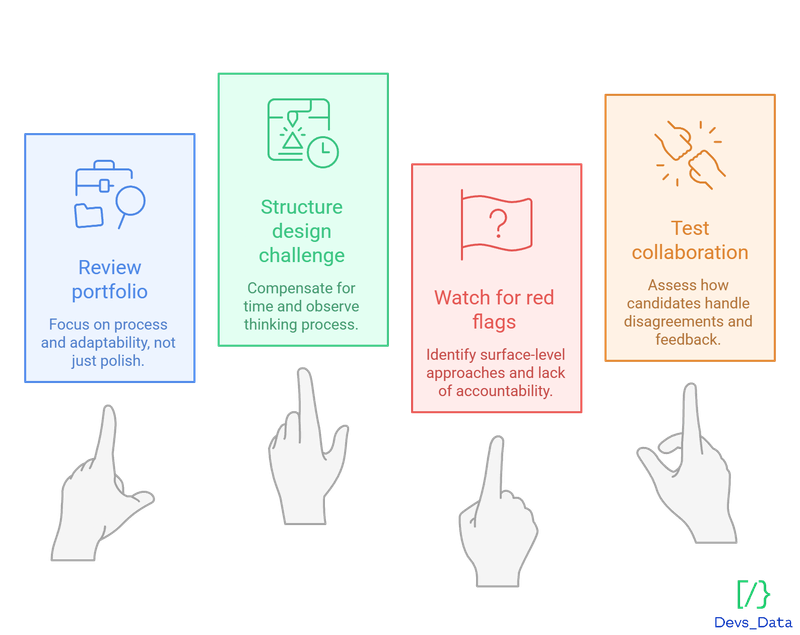
Most hiring guides treat the portfolio as the single deciding factor. A portfolio measures how well a candidate presents finished work, not how they performed under constraints or collaborated with a team. A reliable evaluation process uses the portfolio as one input alongside structured interviews and practical exercises, with reference checks closing the loop.
A strong portfolio walks the reviewer through the thinking behind each project, not the final pixels. During review, look for:
Do you have IT recruitment needs?
Candidates who describe every project as a clean-sheet success are either curating aggressively or have not worked in environments with real trade-offs.
Candidates with multiple offers increasingly decline unpaid take-home exercises. A more effective approach compensates the candidate for two to four hours of work on a fictional product. An alternative is the live whiteboard session, where the candidate walks through their approach to a design problem in real time.
Both formats produce a better signal than unsupervised tasks do, because the evaluator can see how the candidate thinks under observation.
Portfolios that display only final screens, with no process documentation, signal a surface-level approach. Candidates who cannot explain why a layout decision was made have not operated in environments with real accountability.
No mention of user research at any stage is a disqualifier. Visual polish used as a substitute for depth, where every case study reads like a marketing page, masks the absence of structured thinking.
UI/UX Designers sit between strategy and software development execution. Ask how the candidate handled a disagreement with a Developer over feasibility. Ask what happened when a stakeholder rejected a research-backed recommendation. The strongest candidates welcome follow-up questions about trade-offs.
The weakest become defensive or redirect to a different project. Running these collaboration probes inside the interview cycle takes hours that most internal teams cannot spare on every shortlist. A specialist UX recruitment agency absorbs that work upfront, pre-screening for the same trade-off reasoning before any candidate reaches the Hiring Manager’s calendar.
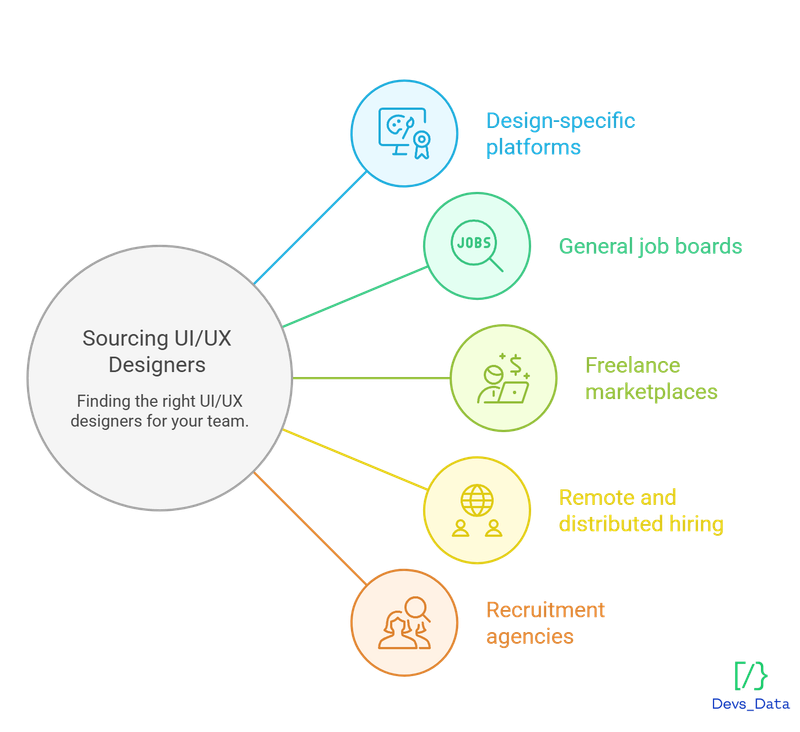
The sourcing landscape for UI/UX Designers is fragmented. Each channel attracts a different candidate profile, and choosing where to post determines the type of applicant that enters the pipeline.
Dribbble and Behance started as portfolio-sharing communities but have become saturated showcases where Designers display polished work to attract attention. The candidate pool on both platforms skews toward UI-focused talent with strong visual output. UX Researchers and Designers who lead with process over aesthetics are underrepresented. Useful for a quick visual screening pass, but limited as a primary sourcing channel.
LinkedIn and Indeed deliver volume. A posted UI/UX role on either platform generates a high number of applications within days. The trade-off is the screening burden. Without structured filtering, Hiring Managers spend hours sorting through applications from Web Developers and career-switchers alongside qualified candidates.
Toptal and Upwork serve companies that need contract-based creative work without a full-time commitment. Toptal applies a pre-vetting layer and charges a premium. Upwork leaves the vetting to the Hiring Manager. Contract hiring is well-suited to short-term projects with a defined scope. For ongoing product work that requires an embedded Designer, freelance engagements pose continuity risks.
The post-pandemic shift toward remote staffing expanded the candidate pool beyond any single city. Companies hiring from Eastern Europe or Latin America benefit from regional salary differences. Return-to-office mandates have split the market, with some organizations restricting design roles to hybrid arrangements. The decision on remote eligibility directly affects the size of the applicant pool before a single candidate enters the pipeline.
For companies that need verified candidates without running the full sourcing and screening pipeline internally, a specialized UX recruitment agency offers the most direct path. This channel absorbs the operational weight of the search and returns a shortlist of pre-qualified Professionals matched to the role’s scope.
The advantages of working with a recruitment partner on a UI/UX hire include:
The staffing agency fee varies depending on the engagement model, whether contingency or retained, with recruitment process outsourcing as a third option for higher-volume hiring. Hiring Managers should compare fee structures against the internal cost of running the search independently, including time spent by the team on sourcing and scheduling.
No single channel fits every hiring scenario. The right choice depends on how quickly the position needs to be filled and how much internal recruiting capacity is available. Companies hiring across borders face complexity that a recruitment partner absorbs. Those with a mature internal HR function may run the process on a job board. The deciding factor is which channel produces a qualified shortlist within the timeline the business requires.
Team size: ~60 employees
Founded: 2016
Headquarters: Brooklyn, NY, and Warsaw, Poland
The agency option that closes the channel discussion above operates on a different commercial model from a job-board posting or a freelance marketplace listing. A specialist recruitment partner takes the full search as scoped work, with sourcing conducted through direct outreach to passive candidates rather than reactive inbound, paired with screening that tests design-context fit before any profile reaches the client.
Compensation calibration and offer negotiation are built into the engagement, shifting the cost question from price-per-applicant to time recovered for the Hiring Manager and Product team during the active hiring window.
DevsData LLC operates this model through a recruitment practice that runs alongside a technical consulting division, with more than 60 professionals across the two operations now in the firm’s tenth year. The work concentrates on placing UI/UX Designers with organizations where interface quality directly moves revenue and user retention.
A database of 95000 verified candidates gives hiring teams fast access to Designers with documented experience across eCommerce and SaaS platforms, reaching into enterprise product environments where compliance constraints shape the brief. Clients in the US and Europe return for repeat engagements, with additional reach into Israel on select briefs. Verified 5/5 reviews on Clutch and GoodFirms confirm consistent placement outcomes across that client base.
Each recruitment project runs end-to-end. The process begins with candidate sourcing and moves through technical evaluation and structured interviews, with onboarding coordination handled in the final stage. Clients receive HR advisory support alongside legal guidance to maintain compliance at every stage of the hiring cycle. These systems serve startups scaling their first design function and enterprise operations expanding established teams at equal depth.
DevsData LLC refined its evaluation model over years of design-focused placement work. UI/UX candidates complete a 90-minute practical challenge that tests their ability to translate a vague brief into a focused interface decision under time pressure. The exercise also evaluates wireframing speed and the clarity of design rationale once the candidate explains their choices on the call.
This format favors structured thinking over visual output alone. Recruiters assess collaboration patterns and communication clarity to confirm that candidates function well within distributed teams. In-house staff lead reference verification during English-language interviews and coordinate final salary negotiations. The agency operates on a success-fee basis, collecting payment only after a candidate starts work.
Do you have IT recruitment needs?
The agency serves established enterprises alongside high-growth startups. Past clients include BCG and venture-backed companies across multiple sectors. Academic partnerships extend sourcing reach alongside connections to design and engineering communities worldwide.
DevsData LLC recruits Specialists for UX research roles and UI-focused positions. Combined UI/UX seats, where the Designer owns the full scope from user interviews through to visual production, are equally common. Dedicated Recruiters replace public job boards, adding precision to each search.
Completed engagements show how DevsData LLC addresses design hiring across different organizational contexts. A full portfolio is available on the case studies page. The assignments below involved design and frontend talent placement for companies building or scaling product teams.
DevsData LLC recruited a Graphic Design Lead and Senior Designers for this Norwegian legal publishing company. The engagement filled senior creative positions that required both visual execution capability and the ability to operate within an established brand system.
DevsData LLC partnered with a leading European automotive parts distributor on a two-year eCommerce platform redesign. The project covered UX/UI design and backend architecture, resulting in a 40-60% increase in organic traffic and approximately 5000 monthly visitors post-launch.
DevsData LLC handled the design and development of a payment portal for one of the largest trade associations in the US. The engagement required interface work that met strict usability standards for a non-technical user base processing financial transactions.
Beyond recruitment, DevsData LLC delivers consulting for startups and growth-stage companies where design and development intersect. Teams assist with mobile application builds and frontend performance work for product companies.
Project delivery keeps the recruitment practice technically current, giving Recruiters firsthand exposure to the tools and workflows that candidates describe during evaluations. The engagements below demonstrate hands-on design and development capabilities.
DevsData LLC modernized the mobile app for a Chicago-based health food retailer operating under the Now Foods brand. The project delivered a React Native rebuild with WCAG 2.2 accessibility compliance and Magento integration to synchronize product data. Geolocation-based push notifications connected online browsing to in-store visits.
A Pennsylvania retailer dealing with checkout errors and sync failures between its mobile app and Magento backend engaged DevsData LLC for a nine-week rebuild. The React Native project restored stable performance under daily traffic while adding geolocation-based store discovery and improved navigation.
Businesses seeking UI/UX Designers who match their technical and organizational requirements can reach DevsData LLC at general@devsdata.com or visit www.devsdata.com to connect with a Recruiter experienced in design roles.
Hiring a UI/UX Designer shapes how a product performs and how users respond to the experience over time. The difference between a strong hire and a mismatched one shows up in conversion rates and retention within months. That pressure is not confined to a single market.
According to the World Economic Forum’s Future of Jobs Report 2025, 82% of employers in Sweden and 81% in Argentina expect UX skills to become more important by 2030, with similar projections in France and Brazil. A structured evaluation process, paired with the right sourcing channel, reduces hiring risk before costs compound.
DevsData LLC brings over ten years of recruitment experience and holds an official, government-approved license for staffing services. The team includes US-based specialists and maintains a database of 95000 verified candidates.
The firm works with global corporate clients and high-growth startups from countries including the US and Israel. That reach, paired with a design-focused evaluation process, positions the agency to match Hiring Managers with UI/UX Designers who fit the role and the organization.
To learn more about how DevsData LLC supports design hiring, reach out at general@devsdata.com or visit www.devsdata.com.
Any questions or comments? Let me know on
Twitter/X.
Discover how IT recruitment and staffing can address your talent needs. Explore trending regions
like Poland, Portugal, Mexico, Brazil and more.
 Frequently asked questions (FAQ)
DevsData – your premium technology partner
DevsData is a boutique tech recruitment and software agency. Develop your software project with veteran engineers or scale up an in-house tech team of developers with relevant industry experience.
Free consultation with a software expert
🎧 Schedule a meeting
FEATURED IN
DevsData LLC is truly exceptional – their backend developers are some of the best I’ve ever worked with.”

Nicholas Johnson
Mentor at YC, serial entrepreneur


 Build your project with our veteran developers.
Explore the benefits of technology recruitment and tailor-made software.
Learn how to source skilled and experienced software developers.
Build your project with our veteran developers.
Explore the benefits of technology recruitment and tailor-made software.
Learn how to source skilled and experienced software developers.

Rebecca Botvin

Commercial Director

Tom Potanski
Manager




Categories: Big data, data analytics | Software and technology | IT recruitment blog | IT in Poland | Content hub (blog)














careers@devsdata.com









general@devsdata.com

"I interviewed about a dozen different firms. DevsData LLC is truly exceptional – their backend developers are some of the best I've ever worked with. I've worked with a lot of very well-qualified developers, locally in San Francisco, and remotely, so that is not a compliment I offer lightly. I appreciate their depth of knowledge and their ability to get things done quickly."

Nicholas Johnson
CEO of Orange Charger LLC,
Ex-Tesla Engineer,
Mentor at YCombinator
"DevsData reached out to us, as we've been looking to grow our engineering team in Europe and Poland. Communicating efficiently and professionally, DevsData made a strong impression with their understanding of the recruitment challenges we were facing. They designed a tailored recruitment process for our needs. I was impressed with the technical depth of their approach."

Karim Butt
Co-Founder & CTO at GlossGenius, Inc.
"Out of all the vendors we work with, DevsData clearly stands out. The quality of developers they deliver is beyond what we've received from any other vendor, and they've been able to send profile recommendations very quickly. I'm happy to be their reference for other companies from Israel and talk about their recruitment abilities and what they delivered for us."

Ran Eyal
Senior Manager at
ZIM Integrated
Shipping Services Ltd.
"DevsData demonstrated a strong degree of proactivity, taking time to thoroughly understand the problem and business perspective, and continuously suggesting performance and usability enhancements. Their app exceeded my expectations. I've worked with DevsData on numerous projects over the last 3 years and I'm very happy. Being both responsive and honest in communication."

Jonas Lee
Partner & Executive VP of Verus,
Financial LLC, Investor,
& Serial Entrepreneur
Acknowledgments