Thanks for subscribing.
Your gift is on the way.



A Website Content Writer owns the pages that carry a brand’s search visibility from week to week, turning research and briefs into published material that ranks and holds attention. The role sits apart from the SEO Copywriter, whose work centers on short conversion pages, and from the Content Strategist, who maps the editorial calendar from a distance.
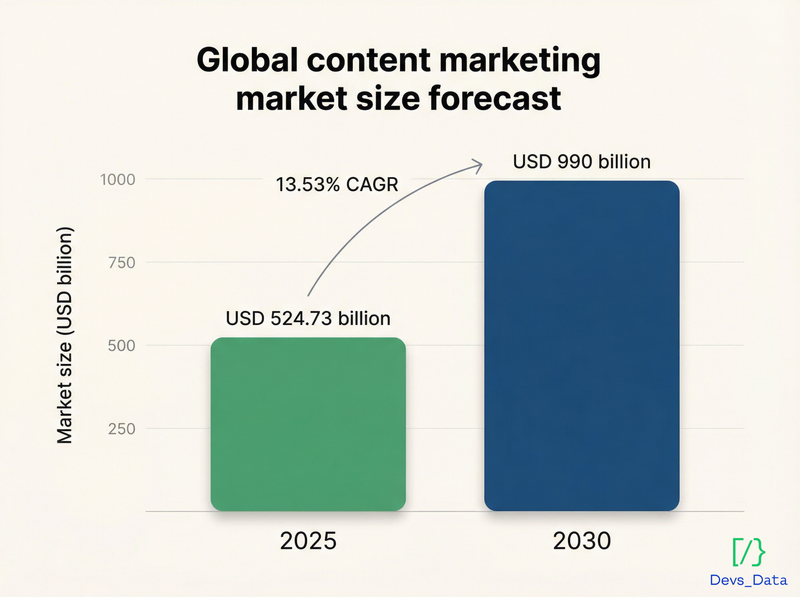
Spending behind that output has reached a scale few marketing functions match, with Mordor Intelligence valuing the global content marketing market at $524.73 billion in 2025. The bar chart below maps the projected trajectory through 2030.
Hiring for this role has grown harder as the tooling around it matures. AI drafting platforms now sit inside almost every content operation, and the screening question has shifted from whether a writer uses them at all to how disciplined that use looks in practice.
CoSchedule’s 2025 research found that 85% of marketing professionals rely on AI writing tools for content creation.
For Hiring Managers scoping a writer search for the first time in a year or two, the evaluation playbook has quietly been rewritten underneath them.
The article that follows gives a working method for defining the role against real publishing volume and filtering candidates past the resume sample before rate conversations begin. DevsData LLC, an IT recruitment agency headquartered in Brooklyn and Warsaw, built this guide from direct placement work across content and marketing briefs for clients worldwide.
Five years ago, a mid-market brand’s web content output typically ran through a single Marketing Coordinator or a junior in-house writer reporting to a Senior Marketing Lead. One person handled the editorial calendar and pushed drafts live between strategy meetings. That arrangement held as long as the publishing rhythm stayed modest and organic traffic grew in volume rather than in depth.
Publishing pressure broke the setup from two directions at once. Search algorithms began rewarding pages built on deeper research and first-hand sourcing. The word-count floor was lifted on competitive queries, and every piece moved into a longer production cycle. Brand accounts on LinkedIn and industry newsletters are expected to produce weekly output from the same team, and the editorial calendar no longer fits within the hours available to a single coordinator.
Most marketing departments responded by splitting strategy from execution. Planning and brief construction remained with senior in-house staff, while drafting was moved to contract writers working on a retainer or per-piece basis. The split freed content leads from routine keyboard time without adding a permanent salary line for every publishing vertical the brand covered.
Output quality in the new setup rests on upstream work that few Hiring Managers account for at the start of a search. A contract writer produces at the level of the brief handed over, and the Content Editor reviews the draft against it. Weak briefs and absent editing produce weak drafts regardless of who holds the pen, and rate negotiations that skip this dependency end in disappointment on both sides of the contract.
Peer-reviewed research from ScienceDirect found demand for substitutable freelance writing work on major platforms fell between 20% and 50% after widespread ChatGPT adoption.
That contraction at the low end of the market reshaped everything above it. Writers competing on generic informational output lost ground to in-house editors running AI drafts through their own cleanup passes. The contracts are still moving through the market cluster around original research and first-hand expertise, the kind of sourcing that models drawing on existing web material have not replicated. A working week within one of those engagements runs to a rhythm the old in-house coordinator never maintained.
Do you have IT recruitment needs?
Scoping a Website Content Writer role without a clear picture of the weekly output leads to misaligned rate discussions and inflated expectations on both sides. A clear read on what the writer produces between Monday and Friday sets the baseline for brief volume and the realistic word count of the retainer funds.
Editor capacity then fixes the ceiling on how much of that volume clears review each week. Content leads who skip this step end up renegotiating the engagement three weeks in, once actual throughput meets the job description on paper.
The rhythm below reflects a typical working week on an active content retainer. Real engagements flex around the brand’s publishing cadence and the vertical the writer covers. Campaign weeks carrying a product launch compress everything further still, and a B2B FinTech retainer runs more slowly per piece than a consumer lifestyle account at the same headline rate.
With that framing in place, the week tends to open on Monday with a brief intake. The writer pulls assignments from a shared editorial calendar and reads the briefs handed over by the content lead. Outline work follows, with source research running alongside where the brief leaves gaps. Drafting occupies the middle stretch. Most writers block Tuesday and Wednesday for heads-down production, moving through two to four pieces depending on length and depth. Revision against editor feedback lands on Thursday, and publishing runs on Friday once the final pass clears the editor’s queue.
The weekly retainer engagement breakdown below shows how that rhythm plays out across a standard contract.
Long-form work sits outside this weekly rhythm. A cornerstone guide or a white paper runs across two or three working weeks, and the writer weaves research and drafting into the gaps between shorter deliverables on the same retainer.
Drafting practice at the keyboard varies from one engagement to the next. Some writers produce first drafts from their own research. Others run initial passes through tools like ChatGPT or Claude before cleaning the output against the brief.
Content Marketing Institute’s 2026 B2B research found 89% of B2B marketers using generative AI apply those tools to content creation, the leading use case.
Output quality depends on how the writer handles the draft, not on where the first pass started. That same judgment applies to content refresh work, which now sits alongside new production on most editorial calendars. Older pieces lose ranking as the search results around them shift, and updating the copy with fresh data reclaims traffic without the cost of a full rewrite. A writer managing both tracks on the same retainer needs the drafting discipline covered earlier in this section applied across new pages and aging ones at the same pace.
Two filters separate strong Website Content Writers from competent generalists once the weekly rhythm is mapped. The first focuses on search fluency, the second on vertical depth, and both drive conversion rates long before any portfolio review begins.
For a stretch in the mid-2010s, SEO fluency meant counting keyword densities and following meta tag discipline. A writer who hit the target phrase the right number of times and matched the header hierarchy ranked on most informational queries. Every algorithm shift since has moved the target further from that definition.
Search engines now reward pages built on mapped user intent and structured sections that large language models parse cleanly into answer snippets. Documented experience behind the byline carries further weight on competitive queries.
A candidate who understands how to show first-hand experience inside the opening 200 words of a piece holds an edge that no keyword tool measures. That signal takes different forms depending on the vertical. A FinTech Writer might open by referencing a regulatory filing reviewed during research, naming the specific clause that shaped the argument. A B2B SaaS Writer might describe a product workflow observed during a trial account rather than restating the vendor’s feature list.
Pew Research found Google users clicked a traditional link in 8% of visits to search pages with an AI Overview, compared to 15% without one.
That compression of click-through means fewer readers reach the published page at all when an AI Overview answers the query on the results screen. The traffic line, a brand once tracked as its primary content KPI, drops without any change in ranking position. Writers who define success by traffic alone lose ground to those who measure citation presence within AI-generated answer panels, where the brand’s research surfaces as a named source even when the click never comes. A candidate discussing how to structure a piece for both human readers and LLM retrieval has already moved past the screening floor most generalists stop at.
Domain knowledge functions as a filter on which verticals a writer can produce publishable work in without leaning on the brief. A generalist with a strong research discipline can cover most B2B software categories well enough once the outline is signed off. Consumer lifestyle content rarely breaks through without an insider voice, yet a disciplined research habit carries the work across the line on both.
Other corners of the market leave no such room. Regulated verticals carry compliance weight that extends into legal liability for the publishing brand. FinTech and healthcare sit at the top of that list, with legal and pharmaceutical content sitting right alongside them.
A writer handling those briefs needs to understand the review process that determines what passes regulatory scrutiny and what gets pulled before publication. One misstated claim about a drug side effect or a financial product triggers corrections that reach beyond the page itself.
The screening question for regulated verticals turns on research discipline above all else. Writers who walk into an unfamiliar vertical and structure their own source map without hand-holding carry a different rate band than those waiting for a detailed brief before the first outline takes shape. That single trait underlies almost every compensation decision covered in the next section.
The table below maps the signals across both filters, showing where a top Website Content Writer separates from the generalist baseline.
| Filter | Top writer signal | Generalist floor |
|---|---|---|
| Search fluency | Writes for intent and LLM retrieval from the opening lines | Hits target keyword and matches header hierarchy |
| Source research | Builds its own source map in unfamiliar verticals | Works only from briefs handed over |
| Experience signaling | Shows first-hand experience inside the opening 200 words | Paraphrases secondary sources without attribution |
| Regulated content | Understands compliance review and what holds up | Writes around claims and leaves legal risk open |
| AI tool discipline | Uses drafting models as a speed layer, not a voice | Lets the model dictate tone and structure |
| Citation presence | Tracks success through AI answer panel inclusion | Tracks success through raw traffic alone |
Rate numbers for a Website Content Writer mean very little without the engagement model sitting behind them. A $200-per-piece freelance quote hides the editor time and revision cycles that a monthly retainer absorbs inside its price.
An in-house salary looks expensive on the surface until output consistency and direct brand-voice ownership are factored into the calculation. The make-versus-buy decision comes before every rate conversation, and the right answer depends on publishing volume rather than on the first candidate’s headline quote.
Four engagement models carry almost every Website Content Writer placement in the current market. The list below lists each model with a one-line readout of what’s included in the price tag.
The US Bureau of Labor Statistics recorded a median annual wage of $72270 for Writers and Authors as of May 2024.
The table below expands on that baseline by presenting experience bands drawn from Glassdoor listings reviewed in Q1 2026 during in-house search conversations.
| Experience | Salary range (USD) |
|---|---|
| 0-1 years | $48000-$62000 |
| 1-3 years | $58000-$78000 |
| 4-6 years | $72000-$110000 |
Based on DevsData LLC’s internal placement data, Filipino writers with strong English skills earn between $600 and $1500 per month on full-time retainers. Latin American talent from Brazil and Colombia bills $1500 to $3500 under the same structure, with US time-zone overlap pushing the upper end. Polish and Ukrainian candidates carry $2000 to $4000 a month when the brand voice requirement runs through the screen.
Two premiums move these numbers further. Writers in regulated verticals carry a 20% to 40% markup above baseline, a range drawn from DevsData LLC’s placement history across FinTech and healthcare briefs. Compliance review and legal liability ride on the quality of the drafting, and brands pay for the cleanup that stays off the published page.
Writers with verified AI fluency stack on top of that. Axios reported freelance earnings on AI-related projects grew 25% year over year, and AI freelancers out-earned non-AI peers by over 40% per hour. A writer carrying both verified vertical depth and disciplined AI tooling sits at the top of the combined band before the first interview opens.
Do you have IT recruitment needs?
Internal HR teams at most mid-market brands run a Website Content Writer search once or twice a year at most. That cadence sits well below the volume needed to calibrate an accurate screening bar. A generalist Recruiter reading two candidate portfolios side by side cannot always tell the one built on consistent brand-account work apart from the one stitched together from paid personal projects.
Specialization blind spots compound the volume problem. A Recruiter without a working mental model of the editorial production cycle screens on surface factors that miss the operational traits covered earlier in this piece. Writers with strong research discipline and judgment in AI tooling get filtered out by candidates who list more tools on their resumes and win on keyword density alone.
Portfolio inflation adds a third layer of noise. Candidates name Fortune 500 brands on their resumes when the real engagement was a short freelance subcontract routed through a second agency, and ghostwriting runs through the industry at a volume that breaks byline-based verification entirely. A reference check at the commissioning-agency level is the only working response, and internal teams rarely have the Rolodex to run that check in depth.
Background origin splits the candidate pool in ways internal desks rarely factor in. Writers who came up through journalism bring interview skills and primary-source research habits that writers from a marketing background often lack. Writers who came up through marketing bring brand-voice flexibility and conversion-focused instincts that writers with journalism backgrounds often miss.
Neither path wins out over the other on paper, and the right match hinges on what the retainer actually demands. The talent pool on both sides has become more dispersed over the past two years, reshaping where a sourcing effort should focus in the first place.
Agencies running continuous searches across content briefs keep live reference relationships with past clients and working editors across the verticals their candidates cover. That pipeline turns into a calibrated first-pass filter that no internal desk builds from two searches a year, and it reduces the guesswork sitting behind every portfolio review an internal team runs cold.
The speed advantage compounds once the brief lands. A Recruiter working within an agency’s active content pipeline moves from brief to shortlist in days rather than weeks, with candidates already screened against the exact traits outlined in the preceding sections.
The bullets below name the channels that pipeline taps into, along with what each surface yields in practice.
Cross-border placements add legal overhead that most content teams lack an internal process to absorb. A contract Website Content Writer based in the Philippines or Colombia is subject to payroll and tax rules specific to each jurisdiction, and misclassifying the engagement can expose the brand to back taxes and labor law claims after the fact.
Employer of Record services absorb that compliance layer by holding the legal employer relationship in each country, which clears the path for the client to work with the writer on a straightforward monthly retainer. A recruitment agency running this piece of the engagement removes the single largest source of friction a cross-border content hire carries at the contract stage.

Website: www.devsdata.com
Team size: ~60 employees
Founded: 2016
Headquarters: Brooklyn, NY, and Warsaw, Poland
That agency profile describes how DevsData LLC has operated since 2016. The firm has spent ten years building around cross-border hires for brands without the internal capacity to absorb screening and compliance load on their own. Website Content Writer searches sit inside that wider operating model, which gives the content practice direct access to the compliance infrastructure and cross-border screening the firm runs across all its hiring verticals.
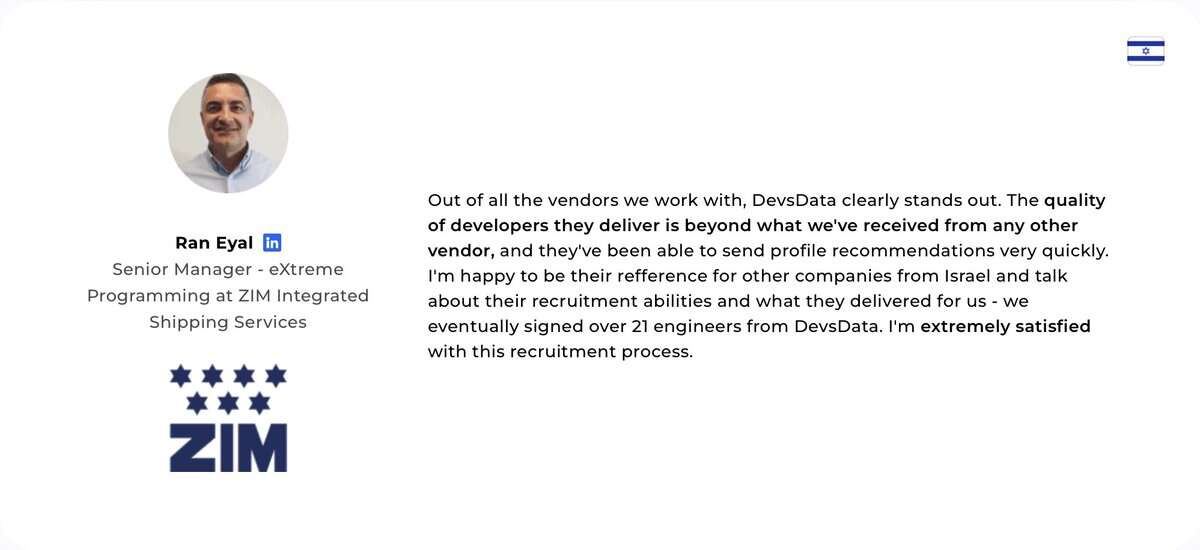
More than 60 professionals work across the IT recruitment and marketing divisions, supported by a proprietary database of roughly 95000 verified candidates drawn from searches run over the past decade. Clients across the US and Europe return for repeat engagements, with additional reach into Israel on select briefs. Ratings of 5/5 on both Clutch and GoodFirms reflect client satisfaction across completed placements.
Each engagement runs end-to-end. Candidate sourcing opens the process, followed by structured skills evaluation and interview coordination in English. Onboarding handover closes the cycle once the placement lands.
Clients receive HR advisory support alongside legal guidance throughout the hiring cycle, which keeps compliance on track at every phase. Employer of Record coverage applies to jurisdictions where the client has no legal entity, and a three-month replacement-or-refund guarantee backs every placement. The firm operates on a success-fee basis, collecting payment only after the writer begins active work on the client’s editorial brief.
The skills evaluation at the core of the process sets DevsData LLC apart from a standard content interview pipeline in one key way. Candidates complete a 90-minute practical exercise that tests how they handle a live brief under time pressure. The task asks for an opening section of a full-length piece targeting a single vertical, paired with a short written rationale that covers the source and voice choices behind the draft. That written rationale carries more weight than the draft output itself on cross-border placements. The working relationship in those engagements runs on async briefs and documented feedback rather than verbal review cycles, so the rationale becomes the primary evidence of how a candidate communicates inside a distributed editorial team.
Recruiters read how the candidate structures the written explanation alongside the draft content, which reveals whether the writer operates at a working level inside a distributed editorial team spanning several time zones.
In-house staff conduct reference verification during English-language interviews and coordinate final rate negotiations directly with the candidate. The same Recruiter who runs the screening handles the offer conversation, so the closing stage stays on a single thread without passing through an additional intermediary.
The engagements below show how DevsData LLC has handled content-adjacent hiring and delivery across different organizational contexts. The full portfolio sits on the case studies page.
Sourcing Senior Marketing professionals for a US-based AdTech firm, where the brief asked for candidates pairing brand voice fluency with analytics depth on paid channels.
Demanding tech recruitment for a Canadian publishing giant, with the search calibrated against the operational realities of a newsroom-adjacent team.
Placement of a Senior Marketing hire into an early-stage company scaling its go-to-market function from the ground up.
Beyond recruitment, DevsData LLC delivers web build and digital development work for clients whose editorial presence is aligned with product launches on the roadmap. Project delivery keeps the recruitment practice current, since the same teams sourcing Website Content Writers see firsthand what brands need from the candidates on the other side of the hire.
WordPress website development and design for a carbon capture technology company, covering the full publishing platform underneath the brand.
Extensive rebuild of a legacy WordPress site onto a current CMS foundation without losing historical content or search rankings.
End-to-end brand identity and web design for an early-stage space company preparing for market entry.
Brands evaluating cross-border Website Content Writer searches or broader editorial support can reach DevsData LLC at general@devsdata.com or at www.devsdata.com.
Do you have IT recruitment needs?
Search behavior has changed faster than most editorial teams have updated the screening bar behind their writer searches. Semrush research found that AI Overviews appeared in roughly 16% of Google queries as of 2025, following a sharp climb through the first half of the year. That single shift reshaped what ranking content looks like in practice, pulling the bar on research depth and experience signaling higher across every vertical at once.
Writers who built their careers on keyword mechanics alone have watched the ground move beneath them, and brands running content operations at any scale now face a sourcing question they once answered on instinct.
The partner standing behind a writer hire shapes outcomes that were once taken for granted, from voice consistency on the published page to the editorial rigor holding the whole operation together. DevsData LLC brings ten years of market experience, with US specialists anchoring searches for brands worldwide.
The firm holds an official, government-approved recruitment license and backs Website Content Writer placements with a structured screening process tailored to the realities of cross-border engagement.
To map a Website Content Writer brief against your current publishing volume and vertical, book a discovery call with DevsData LLC at general@devsdata.com or through www.devsdata.com.
Any questions or comments? Let me know on Twitter/X.
Discover how IT recruitment and staffing can address your talent needs. Explore trending regions like Poland, Portugal, Mexico, Brazil and more.
 Frequently asked questions (FAQ)
DevsData – your premium technology partner
DevsData is a boutique tech recruitment and software agency. Develop your software project with veteran engineers or scale up an in-house tech team of developers with relevant industry experience.
Free consultation with a software expert
🎧 Schedule a meeting
FEATURED IN


DevsData LLC is truly exceptional – their backend developers are some of the best I’ve ever worked with.”

Nicholas Johnson
Mentor at YC, serial entrepreneur


 Build your project with our veteran developers.
Explore the benefits of technology recruitment and tailor-made software.
Learn how to source skilled and experienced software developers.
Build your project with our veteran developers.
Explore the benefits of technology recruitment and tailor-made software.
Learn how to source skilled and experienced software developers.

Rebecca Botvin

Commercial Director

Tom Potanski
Manager




Categories: Big data, data analytics | Software and technology | IT recruitment blog | IT in Poland | Content hub (blog)
















careers@devsdata.com









general@devsdata.com

"I interviewed about a dozen different firms. DevsData LLC is truly exceptional – their backend developers are some of the best I've ever worked with. I've worked with a lot of very well-qualified developers, locally in San Francisco, and remotely, so that is not a compliment I offer lightly. I appreciate their depth of knowledge and their ability to get things done quickly."

Nicholas Johnson
CEO of Orange Charger LLC,
Ex-Tesla Engineer,
Mentor at YCombinator
"DevsData reached out to us, as we've been looking to grow our engineering team in Europe and Poland. Communicating efficiently and professionally, DevsData made a strong impression with their understanding of the recruitment challenges we were facing. They designed a tailored recruitment process for our needs. I was impressed with the technical depth of their approach."

Karim Butt
Co-Founder & CTO at GlossGenius, Inc.
"Out of all the vendors we work with, DevsData clearly stands out. The quality of developers they deliver is beyond what we've received from any other vendor, and they've been able to send profile recommendations very quickly. I'm happy to be their reference for other companies from Israel and talk about their recruitment abilities and what they delivered for us."

Ran Eyal
Senior Manager at
ZIM Integrated
Shipping Services Ltd.
"DevsData demonstrated a strong degree of proactivity, taking time to thoroughly understand the problem and business perspective, and continuously suggesting performance and usability enhancements. Their app exceeded my expectations. I've worked with DevsData on numerous projects over the last 3 years and I'm very happy. Being both responsive and honest in communication."

Jonas Lee
Partner & Executive VP of Verus,
Financial LLC, Investor,
& Serial Entrepreneur
Acknowledgments