
Thanks for subscribing.
Your gift is on the way.



Blockchain stopped being a buzzword when real settlement volume started flowing through live networks. The organizations processing those transactions need Blockchain Developers who have shipped code to production, and sourcing those candidates from US or Western European talent pools carries a cost that continues to climb.
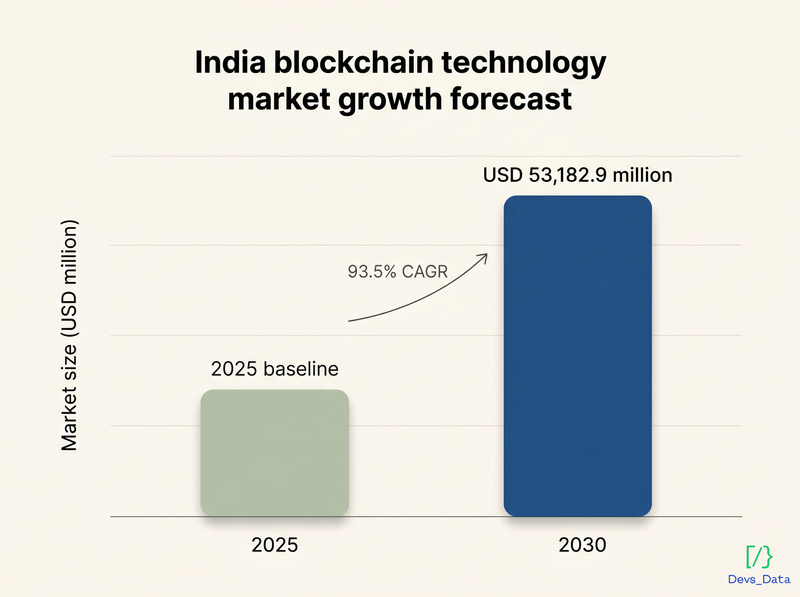
India’s blockchain sector grew alongside that institutional demand. The scale shows in the projections: Grand View Research puts the Indian blockchain technology market at USD 1042.6 million in 2024 and projects USD 53182.9 million by 2030 at a 93.5% CAGR, which works out to 3.3% of the global market at the starting point.
What sits underneath that curve is mostly state procurement rather than retail crypto activity. MeitY launched the National Blockchain Framework in September 2024, putting a Blockchain-as-a-Service layer on National Informatics Centre data centres in Bhubaneswar, Pune, and Hyderabad. Live workloads followed quickly. Property registration records, court notices and summonses, CBSE academic certificates, and a telecom ledger that TRAI runs across more than 1.13 lakh entities all now sit on that infrastructure, with over 34 crore documents verified as of October 2025. Each deployment creates recurring engineering demand rather than a one-time build, which is the mechanism converting policy into developer headcount.
The country’s IT sector supplies the engineering talent that feeds this growth. India operates one of the largest technology workforces on the planet, and blockchain-focused development has become a recognized specialization inside that ecosystem.
The numbers reflect that position: India has the world’s second-largest Web3 developer base and hosts more than 1200 Web3 startups. Set against India’s own technology workforce, though, that base is a narrow specialization rather than a mass-market skill. Electric Capital measures India at 11.7% of global crypto developers, second only to the United States at 19%.
Both readings are useful to a hiring organization. Globally, India is one of two countries where a blockchain search has real depth behind it. Domestically, blockchain remains a thin slice of the engineering population, which is why generic IT sourcing channels return weak shortlists for these roles.
Sorting qualified candidates from the rest of that pool takes real screening effort. Blockchain hiring presents a credentialing problem that India’s market volume amplifies: many applicants list the right frameworks on their CVs without having built or audited anything in production. This article provides the person running that evaluation with compensation data and hiring structure to make the search precise, based on DevsData LLC’s direct experience as a specialized IT recruitment agency placing senior Blockchain Developers for international clients.
That evaluation starts with the market in which those candidates operate. India has the world’s sixth-largest economy by nominal GDP, and the technology sector built within that economy has moved past the “offshore outsourcing” framing that still shapes how some hiring organizations picture the country. NASSCOM’s latest data puts IT industry revenue at $283 billion for fiscal year 2025, reflecting 5.1% year-on-year growth. Projections point to the sector passing $300 billion by the end of 2026. The bar chart below tracks that trajectory.
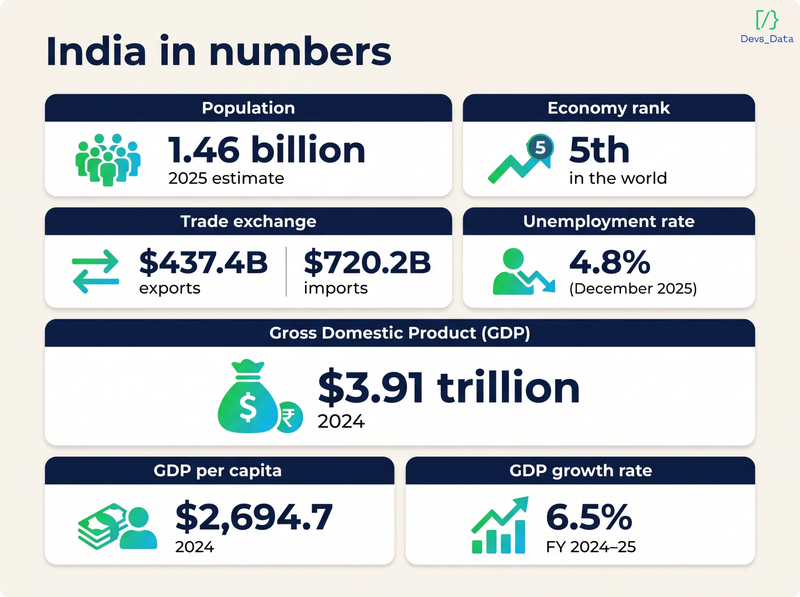
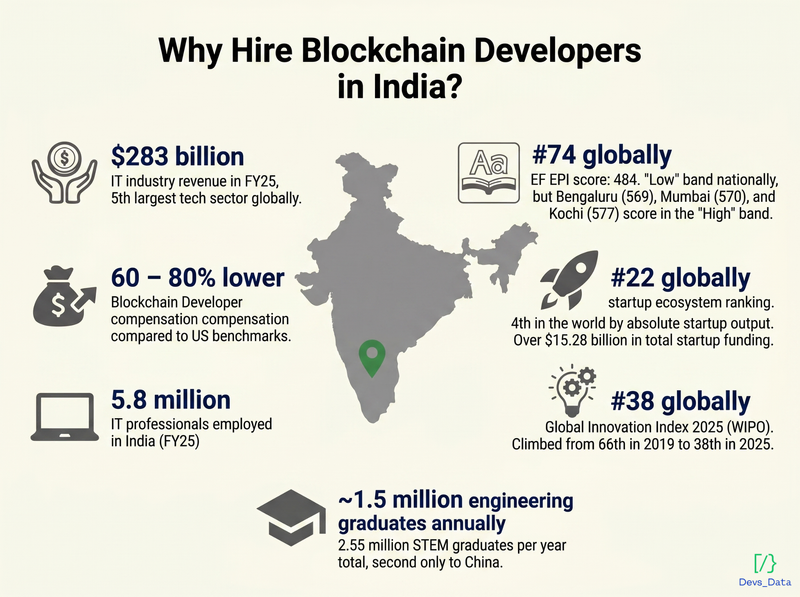
The workforce behind those numbers reached 5.8 million direct employees in 2025, with net hiring climbing to 126000 new positions and headcount growing 2.2% year on year. That expansion sits alongside revenue growth of 5.1%, meaning output per employee rose rather than simply scaling with hiring. The headcount combines IT services and business process management with a growing engineering R&D segment.
An increasing share of those professionals work inside Global Capability Centers (GCCs) that multinational corporations operate on Indian soil. A GCC is a wholly owned offshore office rather than a vendor relationship, staffed by employees of the parent company and running work the headquarters would otherwise keep at home, from product engineering through data science. The parent sets the roadmap and owns the output directly. GCCs carry weight in this context: they signal that international organizations trust Indian engineering teams to lead core product development rather than limit engagement to support functions.
India is not a peripheral participant in blockchain engineering, and the Chainalysis ranking makes the point more sharply on a second look. India took first place in the 2025 Global Crypto Adoption Index for the third consecutive year, with the United States in second. Sustained leadership of that kind separates structural adoption from a cycle-driven spike, which is what a hiring organization is implicitly betting on when it builds a team in a market.
Indian development firms and in-house teams at GCCs build on that base for financial services and supply chain clients. What makes the combination unusual is price, with senior Blockchain Developers in India working at roughly 12 to 15% of equivalent US compensation.
Scale and institutional presence describe the sector’s foundation. The hiring decision turns on what differentiates Indian Blockchain Developers from candidates available in other sourcing markets.
Do you have IT recruitment needs?
Aggregate sector data tells one story. The decision to hire a specific Blockchain Developer from India tells another. What the IT sector overview does not show is how the workforce performs at the project level, where the match between a candidate’s engineering depth and the engagement’s operating conditions determines whether the hire holds under production pressure.
The technical disciplines that blockchain projects draw on most are distributed systems architecture and cryptographic engineering. India’s IT services sector built concentrated depth in both areas through decades of enterprise delivery for global clients.
GCC project work added full stack development capacity on top of that foundation. A steady annual output of engineering graduates keeps the bench replenished, and India climbed to 38th globally in the 2025 Global Innovation Index from 66th in 2019.
India ranked first in the 2025 Crypto Adoption Index published by Chainalysis, leading across all four sub-indices that measure retail and institutional blockchain activity.
India’s national English proficiency ranking does not tell the full story for technology hiring. The country ranked 74th on the 2025 EF EPI, with a score of 484, placing it in the “Low” band at the national level. Its immediate neighbors on that table are the United Arab Emirates at 487 and Brazil at 482, with Sri Lanka and Colombia within a few points either side.
That aggregate obscures the reality within the technology workforce: IT professionals scored 487, while the metropolitan hubs where Blockchain Developers concentrate recorded substantially higher scores. Bengaluru scored 569 and Mumbai 570, both placing in the “High” proficiency band, level with Vilnius at 569 and Chisinau at 572 and ahead of Madrid at 560.
That metro-level proficiency matters specifically for cross-border blockchain work. Indian Developers in these hubs operate through structured feedback and deadline-driven work rhythms. Agile sprint cycles are the default coordination framework for most teams. Smart contract specifications and security audit findings require precise language, and misreadings at the review stage introduce vulnerabilities with real financial exposure.
India’s Blockchain Developer workforce is concentrated in defined metropolitan corridors rather than spread thinly across the country. Bengaluru leads as the primary center for product engineering and blockchain startup activity. Hyderabad hosts one of the densest concentrations of GCC firms in the country, with several blockchain and distributed ledger teams serving global financial institutions. Pune’s depth in IT services and Mumbai’s FinTech ecosystem anchor the western corridor.
Chennai and Delhi-NCR have grown as secondary technology centers. Kolkata expanded its engineering footprint over the past several years. Domestic air connectivity and digital infrastructure supporting distributed work make these hubs accessible to the person assembling a cross-city team without operational fragmentation.
The cost differential between Indian and US-based Blockchain Developers changes the hiring math for business owners at any organizational scale. Indian Developers operate at compensation levels that leave room for larger teams or longer engagement timelines without proportional reduction in engineering output.
Employer of Record frameworks allow foreign companies to hire compliantly in India without establishing a local legal entity. Special Economic Zones add tax incentives for IT operations in designated regions. India’s regulatory environment for digital assets remains less settled than in the US or EU, but for organizations hiring Blockchain Developers through EoR or contractor arrangements, the compliance requirements sit on the employment and tax side rather than the technology side. The infographic below summarizes these indicators at a glance.
None of the factors above is unique to India on its own. Eastern Europe matches the engineering depth. Latin America matches the time zone convenience for US teams. Several markets match the English proficiency found in Bengaluru and Mumbai. What distinguishes India is that the same market supplies all of it at a price point no other market with comparable depth can reach, and does so at a volume that lets a hiring organization run a genuine selection process rather than take whoever is available.
Those advantages arrive with operational considerations that differ from what organizations encounter in domestic or Western European hiring markets. The section that follows addresses those friction points directly.
India’s technical university system traces back to the Indian Institutes of Technology, a network of public research universities established from the 1950s onward to build national engineering capacity. The 2026 QS Subject Rankings placed six Indian institutions in the global top 100 for Computer Science, up from two the previous year, and the total count of Indian universities ranked in Computer Science nearly doubled over five years, rising from 23 to 44. The three highest-ranked for IT and Computer Science appear below.
1. Indian Institute of Technology Bombay (#44 in Computer Science globally, #129 overall, #1 in India for CS)
IIT Bombay ranked 44th globally for Computer Science in the 2026 QS Subject Rankings, the highest position among Indian institutions in the discipline. The institute maintains strong employer reputation scores that reflect placement outcomes across global technology firms. Graduate programs span AI and machine learning, as well as cryptographic systems, both of which are directly applicable to blockchain infrastructure work. IIT Bombay appears 30 times across the full QS subject rankings, more than any other Indian institution.
2. Indian Institute of Technology Delhi (#45 in Computer Science globally, #123 overall, #2 in India for CS)
IIT Delhi secured 123rd position in the 2026 overall rankings, its strongest global result and the top position among all Indian universities. The institute recorded six top-50 subject entries, with Computer Science at 45th globally. Research output in distributed computing and data security has expanded in recent years, producing graduates with exposure to the cryptographic foundations that underpin blockchain architectures.
3. Indian Institute of Technology Madras (#180 overall, #3 in India)
IIT Madras climbed 47 positions to reach 180th globally in the 2026 rankings, one of the largest single-year gains among Indian institutions. The university earned four top-50 global entries in engineering subjects. Its data science curriculum and partnerships with technology firms provide students with exposure to applied projects before they enter the professional workforce.
These institutions feed the pipeline that keeps India’s professional Blockchain Developer and Software Engineer base replenished each year.
The strengths outlined above hold up under scrutiny. They do not eliminate the operational complexity that surfaces once an organization commits to hiring from the Indian market for the first time. Regulatory structures and contracting norms have specifics that differ from those to which US and European hiring organizations are accustomed, and the time zone offset adds a layer of coordination on top. Knowing where those pressure points sit allows the person approving the engagement to plan around them rather than encounter them after a contract is signed.
India’s tax framework for international employers layers multiple obligations. Goods and Services Tax applies to service transactions, Tax Deducted at Source governs withholding on payments to Indian contractors, and permanent establishment risk adds a separate dimension in which foreign companies incur corporate tax liability once their engagement structure crosses thresholds set by Indian tax law.
Regulatory updates arrive at a pace that accumulates compliance costs for organizations that do not track them, so engaging local tax and legal advisors before the engagement begins reduces exposure to penalties, while routing the hire through an Employer of Record removes most of that administrative burden from the client side.
Hiring Blockchain Developers in India means choosing among engagement models with different cost profiles and legal obligations. Full-time employment under Indian labor law requires either a local entity or an Employer of Record arrangement, with employer-side Provident Fund and Employee State Insurance contributions plus a state-level professional tax. Contractor and B2B arrangements shift those obligations to the Developer, who invoices as an independent service provider under GST registration.
Experienced Indian Blockchain Developers often prefer the contractor model for tax optimization and scheduling flexibility, mirroring the B2B preference common among senior IT professionals in Poland. For any CTO budgeting the engagement, knowing which model the target candidate pool expects before recruitment begins prevents compensation mismatches and unnecessary legal exposure.
Ownership of the work product depends on what the contract says rather than on who paid for it. Under Indian law, an independent contractor retains authorship rights unless the agreement assigns them in writing, which makes an explicit assignment clause the difference between owning a smart contract and licensing it.
Exposure after deployment varies by network type. On a public chain, contract bytecode is readable by anyone and the source is frequently verified on a block explorer, so a repository leak before audit hands an attacker the map. Permissioned networks such as Hyperledger Fabric restrict both the ledger and the chaincode to member organizations, which narrows the audience but does not remove the problem, since every consortium member can read logic that may encode commercially sensitive pricing or settlement rules. Practical controls work for either case: least-privilege repository access, deployment keys and production secrets held on the client side throughout, and a third-party audit before anything reaches a live network.
Distance changes how problems surface. Teams accustomed to raising blockers directly in a standup may find that escalation runs through a Team Lead instead, which delays the moment a client learns something has stalled. Making the escalation path explicit at the start of the engagement resolves most of it. Calendar differences deserve the same treatment, since public holidays in India vary by state and notice periods written into Indian employment contracts commonly run far longer than the two weeks a US employer expects. Building both into the project plan avoids the two most common scheduling surprises.
Distance has a price even when it is not invoiced. India Standard Time runs 9.5 to 12.5 hours ahead of US time zones, which leaves a US team a narrow window for live review and pushes most coordination into writing. The offset from Central European Time narrows to 3.5 to 4.5 hours, giving EU-based organizations a working overlap most days. Organizations that plan around the gap rather than against it convert it into continuous delivery, with Indian Blockchain Developers shipping during their day and client teams reviewing each morning, a cadence that holds when handoff documentation and review checkpoints are defined in advance. Where that discipline is absent, the cost shows up as review latency on every pull request, and on blockchain work that delay lands on exactly the step that catches expensive mistakes. The table below shows the offset between India and common business locations.
| Location | Time Zone Difference |
|---|---|
| Berlin | India is 3.5 hours ahead of Berlin |
| London | India is 4.5 hours ahead of London |
| New York | India is 9.5 hours ahead of New York |
| Chicago | India is 10.5 hours ahead of Chicago |
| Austin | India is 10.5 hours ahead of Austin |
| San Francisco | India is 12.5 hours ahead of San Francisco |
Coordination overhead is one half of the total engagement cost. Salary is the other, and it is the half that decides whether the first is worth absorbing.
Do you have IT recruitment needs?
Everything above describes what an Indian hire requires. This section describes what one costs, which is the comparison that usually determines whether the preceding considerations are worth managing at all. India’s salary levels for Blockchain Developers are lower than those in every other major sourcing region, and the gap is most evident when numbers from different markets are side by side.
The table below compares annual compensation for Blockchain Developers across five regions. India’s figures are drawn from Glassdoor India reporting based on 361 submitted salaries as of May 2026.
| Region | Annual cost for Juniors | Annual cost for Seniors |
|---|---|---|
| United States | $85000-$125000 | $150000-$210000 |
| Western Europe | $55000-$85000 | $95000-$140000 |
| Poland and CEE | $30000-$50000 | $55000-$90000 |
| Latin America | $25000-$42000 | $45000-$75000 |
| India | $4000-$8000 | $16500-$32000 |
Note: USD amounts are approximate. India ranges based on Glassdoor India data (May 2026, 361 submitted salaries). Supplementary data from AmbitionBox confirms directionally consistent figures. Regional benchmarks drawn from Glassdoor and industry compensation platforms. Exchange rates and purchasing power vary by region.
Indian senior compensation is roughly 12-15% of what an equivalent US role commands. That gap does not reflect a proportional difference in engineering output or technical capability. For the person controlling the hiring budget, the arithmetic translates into larger team capacity or longer engagement runways at the same spend.
What drives the spread within India’s own salary band comes down to the depth of specialization. Protocol-level experience with consensus mechanisms and smart contract auditing pushes candidates above the midpoint. Application-layer roles, including wallet development and DeFi frontend work, sit closer to the lower bound. Security audit backgrounds and regulated financial sector experience move candidates toward the ceiling.
Compensation in India’s blockchain market has trended upward over the past several years, driven by sustained demand from GCCs and product companies competing for experienced professionals. Bengaluru commands the highest rates, with Glassdoor reporting an average salary of ₹910000 (~$10800) for Blockchain Developers in the city. Hyderabad and Pune follow closely, with Mumbai’s FinTech concentration adding upward pressure in the western corridor.
These salary benchmarks inform the sourcing budget. They do not replace a structured search, and the following section breaks that search into defined stages.
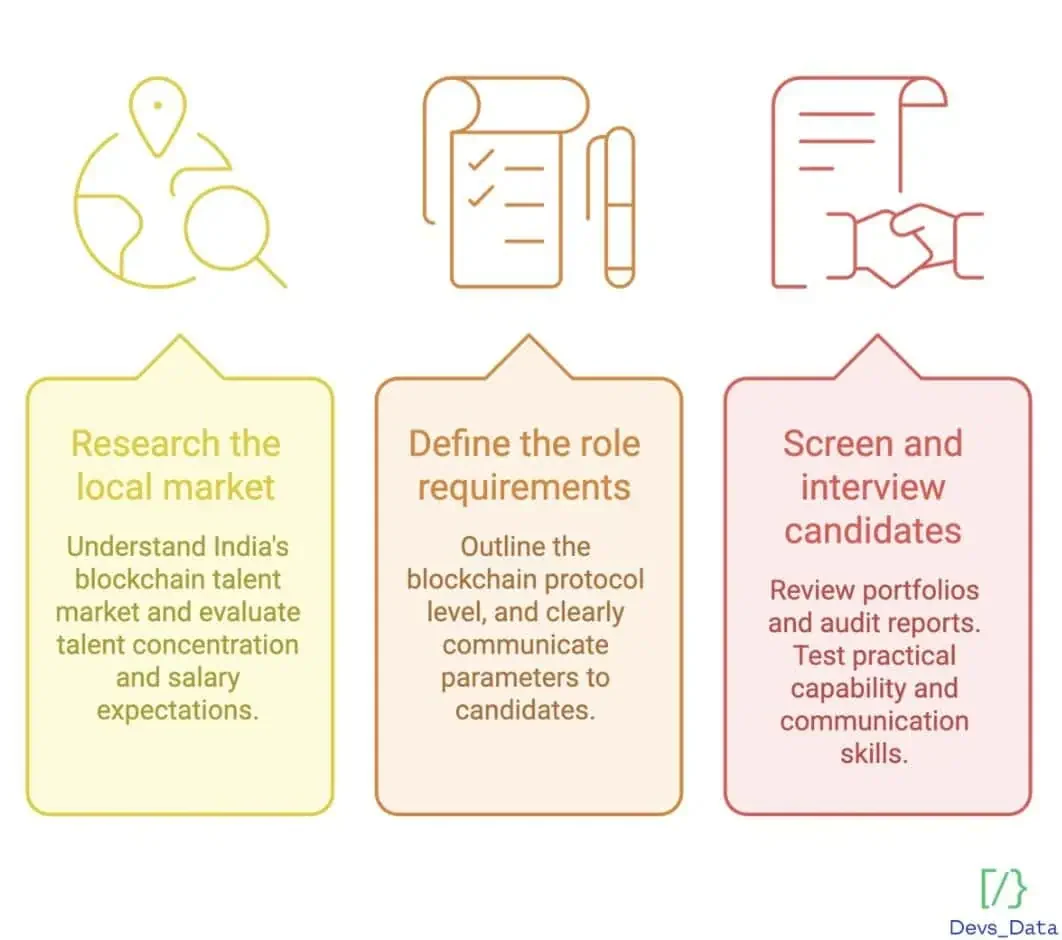
Budget figures give the hiring organization a price range. Converting that range into a signed contract with a qualified Blockchain Developer across a foreign market requires steps that most domestic hiring workflows do not cover. Dividing the process into sequential stages keeps the timeline predictable and the evaluation consistent.
Understanding India’s blockchain talent market at the ground level should come before any candidate outreach begins. Select a target hub and evaluate the concentration of blockchain talent in that area, along with salary expectations for the role’s required seniority level.
Gauge how actively other employers recruit candidates with the same protocol background by reviewing Indian job boards and blockchain developer communities. A CTO who puts this research in place before the first outreach moves faster and positions offers more accurately once qualified candidates enter the pipeline.
Monthly active open source crypto developers fell to roughly 23600 in 2024, down from a peak near 31000 in 2022, with Electric Capital data showing the figure closer to 18000 mid-2025.
Precision in the role brief determines the quality of the candidate shortlist. Outline the blockchain protocol the role sits on: an Ethereum-based smart contract position calls for a different candidate profile than a permissioned Hyperledger deployment. Specify the seniority level.
That distinction shapes where Recruiters search and what the compensation range looks like. A Hiring Manager who spells out these parameters clearly communicates professionalism to candidates. That credibility matters in a market where experienced Blockchain Developers evaluate the hiring company as closely as the company evaluates them.
Review each applicant’s portfolio for projects that align with the engagement’s scope and complexity. For blockchain roles, GitHub contribution history and smart contract audit reports carry more weight than certifications or bootcamp credentials. On-chain deployment records provide the clearest signal of production experience. Request references from previous clients or employers and verify that the candidate’s claimed protocol-level depth holds up under technical questioning.
The interview itself should test practical capability alongside communication. Transaction construction tasks and security review scenarios run under realistic time constraints reveal how the candidate operates, not only what they know. Questions that probe how a Developer handles ambiguity in project requirements separate senior-level professionals from those who perform well on scripted assessments. For Senior Blockchain Developer roles, a direct search approach produces better results. The strongest candidates seldom post profiles on public job boards.
The hiring process determines who the candidate is. The engagement model shapes how the working relationship operates, and the next section covers the options that dominate the Indian market.
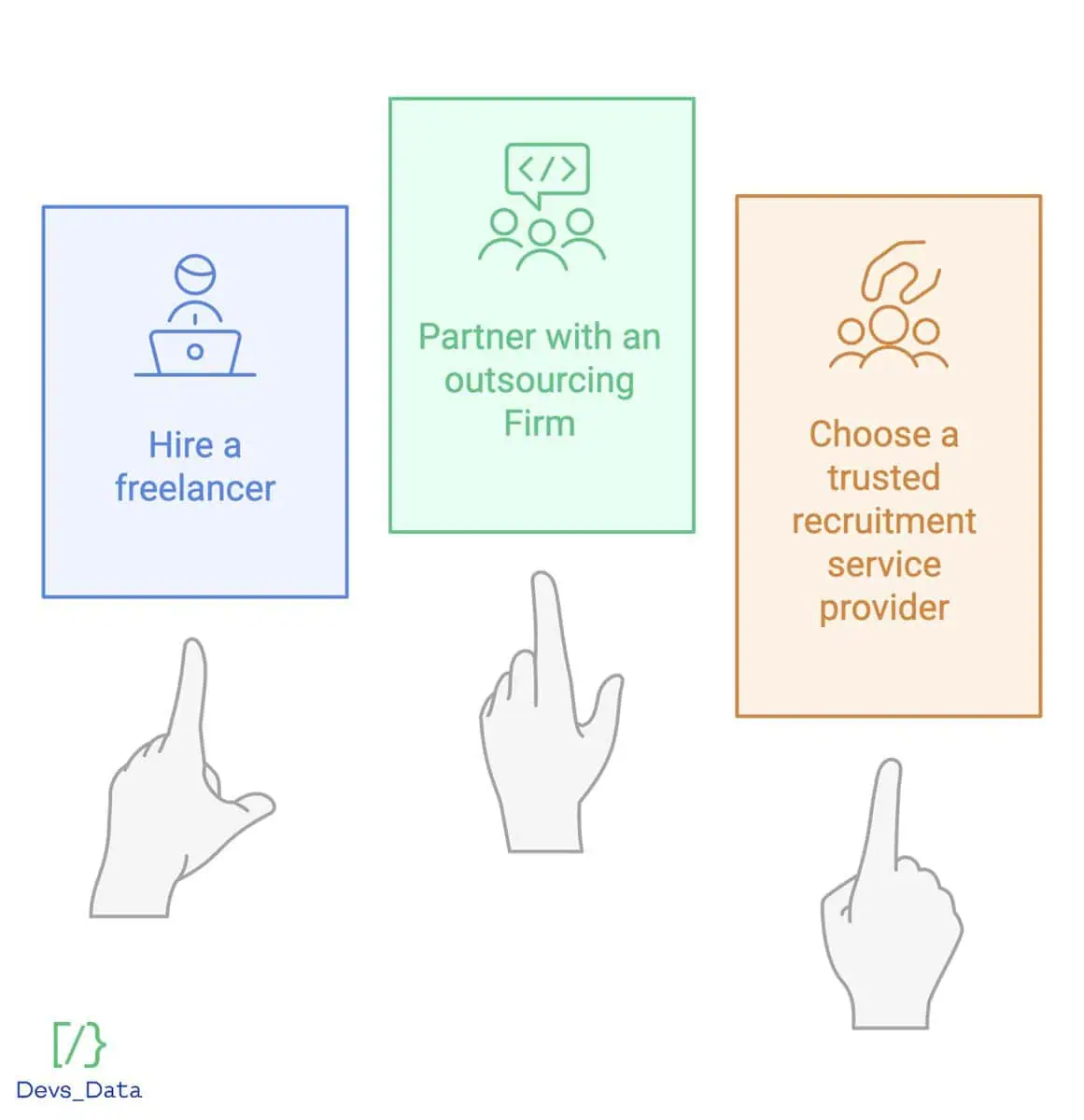
Knowing who the right candidate is covers one half of the equation. The other half is structural: how the working relationship between the hiring organization and the Blockchain Developer gets governed, and where the administrative load falls. The engagement model an organization selects shapes daily management overhead alongside intellectual property ownership. Three models dominate the Indian IT market for international clients.
Engaging an Indian Blockchain Developer as an independent contractor through a freelance arrangement removes the need for a formal employment contract. The hiring organization pays hourly or project-based rates without covering employer-side statutory contributions.
In practice this model appears far less often in blockchain work than in general software development. The reason is accountability after delivery. Code that settles value and cannot be quietly patched requires someone who remains answerable once it is live, and a freelance engagement ends at the invoice. Where it does occur, the scope is narrow and self-contained, typically a tokenization proof of concept or a short consulting engagement on an architecture decision. The trade-off is structural beyond that point, since freelancers operate outside the organization’s direct management framework and the arrangement breaks down in long-term product development where codebase continuity and institutional knowledge accumulate over time.
Organizations that need a full blockchain development team rather than an individual contributor often turn to an Indian outsourcing vendor. This model provides access to pre-assembled groups of Engineers at rates below what building an equivalent in-house team would cost. The vendor handles recruitment and day-to-day team management, reducing the administrative burden on the client side.
That convenience comes with limitations. The hiring organization has less direct control over who works on the project, and pricing transparency varies between providers. Intellectual property protections require careful contractual safeguards, since the work product originates outside the client’s legal entity. This path tends to fit non-technology businesses where blockchain supports operations rather than defines the core product.
The table below sets the three models against the factors that separate them in practice.
| Factor | Freelancer | Outsourcing firm | Recruitment provider |
|---|---|---|---|
| Cost structure | Hourly or per project, no employer contributions | Vendor day rate covering team and management | Success fee on placement, salary paid direct |
| Knowledge preservation | Leaves with the contractor | Held by the vendor, not the client | Stays inside the client’s team |
| Commitment | Task-bound, easily interrupted | Contract-bound to the vendor, not the individual | Employment-bound to the client |
| IP ownership | Requires explicit assignment | Contractual safeguards needed | Held by the client by default |
| Team control | Outside client management | Vendor selects the Engineers | Client makes the final hiring call |
For companies that want to build a dedicated blockchain development team under their own direction, working with a specialized recruitment firm in the Indian IT market offers the most control. The provider handles sourcing and screening, then presents qualified candidates for the client’s final decision. The hiring organization retains full authority over who joins the team and how the project runs.
This structure keeps intellectual property rights with the client and provides complete visibility into team composition and spending. Recruitment firms operating in the Indian market handle back-office functions such as payroll processing and contract administration, simplifying operations for companies without an Indian legal entity.
Reading the comparison table above against the specifics of blockchain work points consistently toward the third column. Knowledge preservation decides it. Smart contract systems accumulate context that lives in the heads of the people who built them, covering why a particular upgrade pattern was chosen and which assumptions a previous audit tested. A freelancer takes that with them. An outsourcing vendor keeps it behind a contract the client does not control. A recruitment partner places it inside the client’s own team, where it stays.
That is the case for the partner route in general. Choosing a specific partner is a separate exercise, and the one worth running is whether the firm can evaluate blockchain engineering itself rather than forwarding CVs for the client to assess. The section that follows describes how DevsData LLC approaches that evaluation.
Website: www.devsdata.com
Team size: ~60 employees
Founded: 2016
Headquarters: Brooklyn, New York, and Warsaw, Poland
DevsData LLC is an IT recruitment agency that places Blockchain Developers with companies in the US, Europe, and Israel, and it runs its own software engineering practice alongside the recruitment business. Candidates are assessed by engineers from that practice rather than by Recruiters working from a requirements list. A Solidity candidate is reviewed by someone who has read production Solidity, and the assessment covers whether submitted code would survive an audit rather than whether it compiles.
For the client, this means one firm handles both halves of the search. The sourcing team finds candidates and the engineering team verifies them, and the hiring organization receives a shortlist that has already passed technical review instead of a set of profiles it must evaluate itself. DevsData LLC’s recruitment and technical consulting divisions bring more than ten years of combined experience, a team of over 60 professionals, and a verified candidate database of 95000 profiles.
Blockchain and distributed ledger specialists within that database carry documented deployment histories across multiple protocols. Clients in the US and Europe rely on DevsData LLC for placements that hold, with Israeli technology firms among the client base. 5/5 ratings on Clutch and GoodFirms back that record.
For business owners entering the Indian blockchain hiring market without prior sourcing experience in the region, DevsData LLC removes the operational layer that slows cross-border recruitment. The team handles compliance with Indian employment law, advises on contract model selection for full-time and contractor engagements, and covers the administrative infrastructure a foreign employer without a local entity would otherwise build from scratch.
Candidates go through practical evaluations calibrated to the client’s protocol stack, covering smart contract construction and security review under realistic constraints. A 90-minute problem-solving challenge tests how they respond to specification gaps, tracking whether they flag missing requirements or proceed on assumptions that leave deployments exposed. In-house staff conduct English-language interviews and reference verification, then carry compensation discussions through to the final offer.
The sequence runs from CV screening to a behavioral interview, then technical evaluation by senior professionals with more than ten years of protocol-level experience, closing with a call between the candidate and the client’s leadership. Most engagements complete in under two weeks, with half of placements closing inside ten days. DevsData LLC charges a success fee based on annual compensation, collected only on confirmed placement and without an exclusivity clause, and placed candidates stay with new employers an average of two years or more.
DevsData LLC’s full case studies page documents engagements across industries and hiring contexts. The three below reflect recruitment placements most relevant to hiring Blockchain Developers.
DevsData LLC sourced Senior Engineering talent for LayerZero, a Web3 infrastructure protocol connecting blockchains at scale. The engagement required identifying Blockchain Developers with cross-chain protocol experience and production deployment records across compressed hiring timelines.
The search targeted Developers with cryptocurrency-native engineering backgrounds for Fastlane’s protocol infrastructure. DevsData LLC screened candidates who combined blockchain expertise with the security-first development practices required by the client’s architecture.
Beyond recruitment, DevsData LLC delivers software development through its in-house engineering team. That parallel practice keeps the screening process grounded in the tools and workflows Blockchain Developers encounter in production environments. The following projects highlight development work completed in areas adjacent to blockchain infrastructure.
DevsData LLC’s engineering team executed backend and big data projects for Kroll, a global risk and financial advisory firm. The work involved processing sensitive data under strict security constraints, a requirement profile that maps directly to the integrity and confidentiality standards governing blockchain deployments.
DevsData LLC developed a social platform built on a privacy-first architecture. The project prioritized end-to-end data protection and decentralized design principles, both of which are central to how blockchain applications handle user data at the protocol layer.
Organizations seeking Blockchain Developers from India through a structured, accountable recruitment process backed by protocol-level technical screening can reach DevsData LLC at general@devsdata.com or www.devsdata.com.
Do you have IT recruitment needs?
The sections above cover the strategic and screening side of hiring Blockchain Developers from India. What follows addresses the day-to-day practicalities that international employers encounter once the engagement is live: how to transfer funds to an Indian contractor’s account and how to reach someone by phone when asynchronous communication falls short.
Paying Indian contractors requires compliance with local tax and invoicing regulations. The engagement model, whether full-time employment or independent contracting, determines the administrative obligations for both parties. Organizations without an Indian legal entity face added complexity around statutory contributions and tax reporting.
Employer of Record providers simplify this by acting as the legal employer on the client’s behalf. DevsData LLC operates EoR services for international businesses hiring in India, handling employment law compliance and payroll administration, as well as HR advisory functions. Other EoR platforms, such as Deel, Remote, Oyster HR, and Multiplier, serve similar functions for companies managing distributed teams in India.
For direct contractor payments under B2B arrangements, international transfer platforms such as Wise (formerly TransferWise) and Payoneer offer competitive exchange rates with lower transaction fees than traditional bank wires. Both platforms support INR transfers and provide transparent fee structures.
International teams working with Indian Blockchain Developers occasionally need to place direct phone calls. India’s country code is 91. The dialing process differs by country of origin. For mobile numbers, dial the country code followed by the full ten-digit number without a separate area code prefix.
Dial 011 (international exit code), then 91 (India’s country code), followed by the area code and local number. A call to a Mumbai landline such as 22-1234-5678 would look like this: 011-91-22-1234-5678.
Dial 0011, then 91 (the area code), and the local number. To reach the same Mumbai number from Australia, dial 0011-91-22-1234-5678.
Dial 00, then 91, followed by the area code and local number. A call to 22-1234-5678 in Mumbai from the UK is formatted as 00-91-22-1234-5678.
Voice-over-IP platforms such as Telegram and WhatsApp offer a lower-cost alternative for regular communication. Most Indian Blockchain Developers working with international clients default to these tools for daily coordination. Google Meet serves as an additional option for scheduled video calls and screen-sharing sessions.
India’s IT workforce delivers the engineering scale and blockchain-specific depth that international organizations need to staff protocol-level and application-layer projects without the compensation pressure of US and Western European hiring markets. Screening is where the risk lies: the Indian market’s volume means more candidates per opening, and separating those with on-chain deployment experience from those whose blockchain credentials stop at the resume requires a structured evaluation process that most generalist recruitment firms lack.
DevsData LLC brings more than ten years of recruitment experience to the Indian blockchain hiring market, backed by a team of over 60 professionals and a verified candidate database of 95000 profiles. The firm holds a government-approved recruitment license and has placed senior Blockchain Developers for corporate clients and high-growth startups internationally, with engagements spanning the US and European markets, as well as with Israeli technology firms.
That combination of recruitment infrastructure and engineering evaluation depth serves organizations that treat Blockchain Developer hiring as a technical decision rather than a procurement exercise.
To explore DevsData LLC’s blockchain recruitment services in the Indian market, contact the team at general@devsdata.com or visit www.devsdata.com.
Any questions or comments? Let me know on
Twitter/X.
Discover how IT recruitment and staffing can address your talent needs. Explore trending regions
like Poland, Portugal, Mexico, Brazil and more.

 Frequently asked questions (FAQ)
DevsData – your premium technology partner
DevsData is a boutique tech recruitment and software agency. Develop your software project with veteran engineers or scale up an in-house tech team of developers with relevant industry experience.
Free consultation with a software expert
🎧 Schedule a meeting
FEATURED IN


DevsData LLC is truly exceptional – their backend developers are some of the best I’ve ever worked with.”

Nicholas Johnson
Mentor at YC, serial entrepreneur


 Build your project with our veteran developers.
Explore the benefits of technology recruitment and tailor-made software.
Learn how to source skilled and experienced software developers.

Rebecca Botvin

Commercial Director

Tom Potanski
Manager




Categories: Big data, data analytics | Software and technology | IT recruitment blog | IT in Poland | Content hub (blog)
















careers@devsdata.com





general@devsdata.com

"I interviewed about a dozen different firms. DevsData LLC is truly exceptional – their backend developers are some of the best I've ever worked with. I've worked with a lot of very well-qualified developers, locally in San Francisco, and remotely, so that is not a compliment I offer lightly. I appreciate their depth of knowledge and their ability to get things done quickly."

Nicholas Johnson
CEO of Orange Charger LLC,
Ex-Tesla Engineer,
Mentor at YCombinator
"DevsData reached out to us, as we've been looking to grow our engineering team in Europe and Poland. Communicating efficiently and professionally, DevsData made a strong impression with their understanding of the recruitment challenges we were facing. They designed a tailored recruitment process for our needs. I was impressed with the technical depth of their approach."

Karim Butt
Co-Founder & CTO at GlossGenius, Inc.
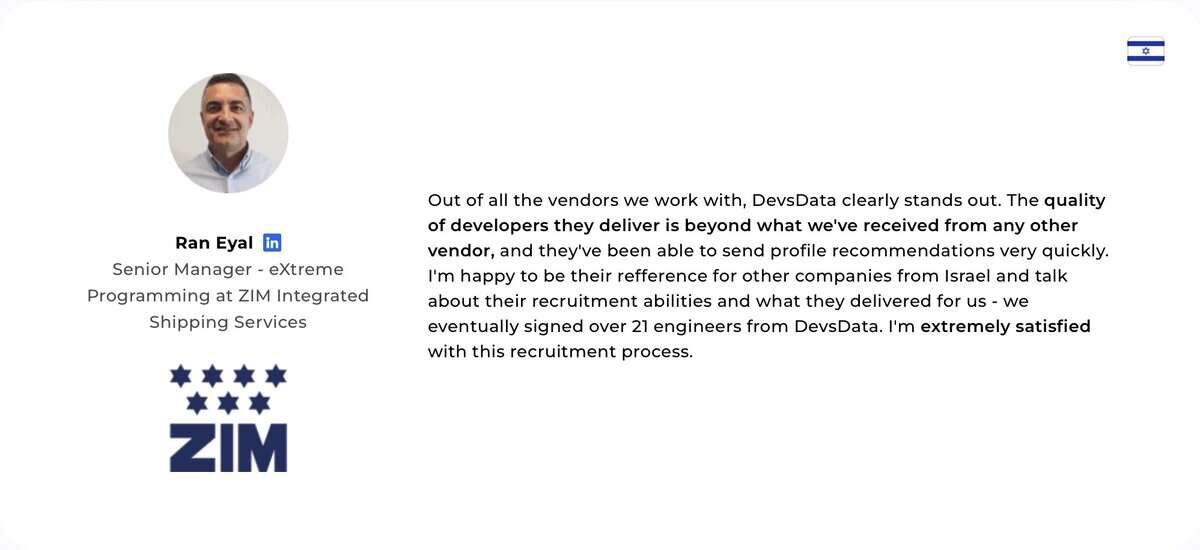
"Out of all the vendors we work with, DevsData clearly stands out. The quality of developers they deliver is beyond what we've received from any other vendor, and they've been able to send profile recommendations very quickly. I'm happy to be their reference for other companies from Israel and talk about their recruitment abilities and what they delivered for us."

Ran Eyal
Senior Manager at
ZIM Integrated
Shipping Services Ltd.
"DevsData demonstrated a strong degree of proactivity, taking time to thoroughly understand the problem and business perspective, and continuously suggesting performance and usability enhancements. Their app exceeded my expectations. I've worked with DevsData on numerous projects over the last 3 years and I'm very happy. Being both responsive and honest in communication."

Jonas Lee
Partner & Executive VP of Verus,
Financial LLC, Investor,
& Serial Entrepreneur
Acknowledgments


