Thanks for subscribing.
Your gift is on the way.



More than 60 percent of IT leaders worldwide report outsourcing their software development, a pattern that has made external delivery a structural feature of how technology firms build. The offshore market behind that figure reached $588.38 billion in 2025, expanding at a compound annual rate of 6.51 percent through 2030. Scale of that order settles nothing about ownership. A staffing contract fills a team with engineers and leaves the client owning none of the underlying capability once the project wraps.
Two routes usually present themselves at opposite ends. Staff augmentation supplies people fast and stops short of ownership. Registering a foreign subsidiary delivers ownership from the first day at the price of legal and tax setup, with recruitment trailing far behind, long before any code ships. The Build Operate Transfer model occupies the space between those extremes.
Romania has become one of the stronger places in Europe to put that model to work. Its talent pool comes with EU and GDPR alignment, clearing the regulatory friction that slows arrangements in more distant markets. DevsData LLC has been building and running dedicated teams across Eastern Europe since 2016, and the sections that follow draw on that work to trace how a Romania-based BOT engagement unfolds in practice, where it fits against staff augmentation and other delivery options, and why the country’s deepening FinTech base strengthens the case.

Build Operate Transfer is a contractual delivery model. Under the agreement, a third-party provider sets up a nearshore or offshore team for the client and manages the daily work, while the contract names in advance the point at which the team becomes the client’s own, with the local entity transferring alongside.
The structure first appeared in infrastructure finance, where a private firm financed and built an asset such as a highway or a power plant, ran it long enough to recover the outlay, then handed it to the state. Software borrowed the sequence and swapped the asset. What moves to the client now is a working engineering team carrying its own processes, tooling, and accumulated knowledge rather than a road. That swap changes how the model reads. The client does not receive a generic resource pool at the end of the arrangement. A whole operating unit transfers across, complete with its management layer and its local entity, shaped from the first day to become the client’s own.
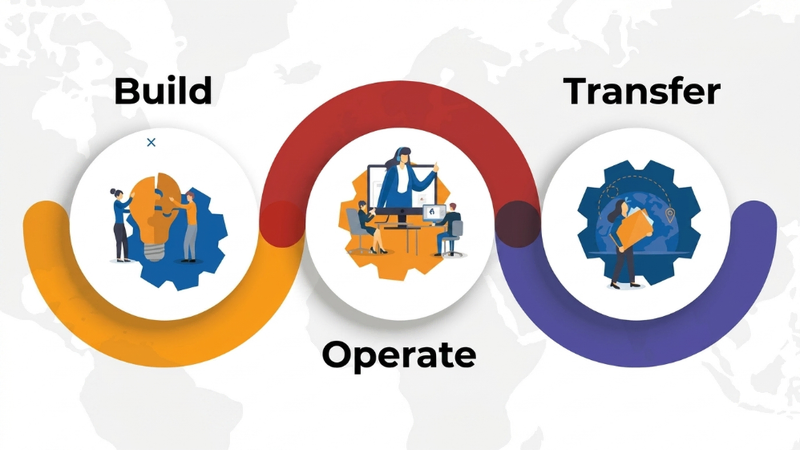
The reason a company reaches for the structure comes down to risk, cost, and timing weighed together. The provider carries the early setup risk, since hiring missteps and local compliance gaps during the first months fall under the provider’s management rather than the client’s. The initial outlay stays well below building an entity from scratch. The team reaches productive work faster than a captive subsidiary would allow. Knowledge transfer runs through the whole arrangement rather than arriving as a single document drop at the end, which is what keeps the handover from turning into a cliff edge.
Do you have IT recruitment needs?
The name spells out the sequence exactly, and each stage carries a distinct split of responsibility between provider and client.
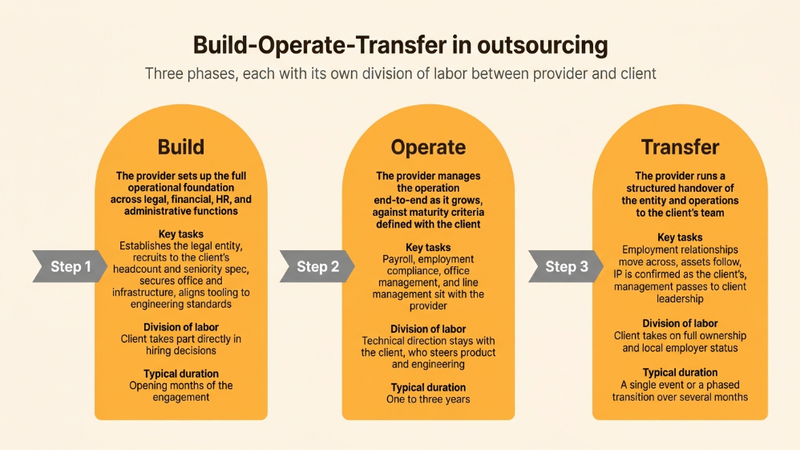
Build comes first. An experienced team handles talent acquisition and onboarding, matching specialists to the skill profile the client has set. The same phase covers staff training, infrastructure setup, and the provisioning of technical resources, running alongside the legal entity, the office, and the alignment of tooling with the client’s engineering standards. The work here lays the foundation, so it leans on close collaboration and detailed planning rather than speed alone. The client takes part directly in final hiring decisions, which means the team gets built to specification rather than to a template. In a Romanian engagement, the build commonly runs across the opening months.
Operate follows once the team forms. DevsData LLC acts as the provider in the BOT engagements described here, so daily delivery and project management sit with us through this phase, and we scale the team as the workload grows. The work stays aligned with the client’s business goals, reported back through regular status updates and scheduled progress reviews. We hold full oversight of operations, service delivery, and technical support against quality standards agreed at the outset. Payroll, employment compliance, office management, and line management stay on our side. Technical direction belongs to the client, who steers the product and the engineering roadmap. That division carries the commercial logic of the whole arrangement, since the client captures the cost advantage of nearshore delivery without absorbing the management overhead before the team is ready for it.
Across our engagements, the operate phase commonly runs one to three years, long enough for the team to build deep familiarity with the client’s codebase and internal processes, while the client’s own leaders learn the operation from the inside.
Transfer closes the cycle. Once the setup runs on its own and meets the maturity criteria set with the client, full control of the team, the infrastructure, and the operation passes across. Employment relationships move over, assets and office arrangements follow, intellectual property is confirmed as the client’s, and management responsibility shifts to the client’s nominated leadership. We carry the handover with detailed documentation and structured training, then stay available through a defined advisory window, with scheduled support sessions as the client’s team takes over. The transition happens as a single event or as a phased shift over several months, set by how ready the client is to take on local employer status. Across the full cycle, build to transfer commonly runs somewhere between 18 and 36 months.
Romania pulls together the conditions a permanent engineering unit needs to run for the long term. The case rests on more than cost, starting with the size of the talent pool. The country holds 240000 to 250000 IT professionals, reaching past general programming into the specializations a dedicated team tends to need, from backend and cloud engineering through cybersecurity and applied AI. That depth keeps senior hiring feasible at scale rather than a constant bottleneck, and the pipeline behind it stays active, with roughly 10000 ICT graduates entering the market each year and more than 7290 tech businesses concentrated in Bucharest, Cluj-Napoca, and Iași.
Demand from established multinationals shows what the market supports. Foreign direct investment projects in Romania rose 57% during 2024, from 60 to 94, at a time when the European count fell 5%. That result moved the country up four places to 13th in Europe’s attractiveness index and put it second in Central and Eastern Europe behind Poland. BMW’s European software hub in Cluj-Napoca tripled its headcount from 110 to 350 within nine months of launch. That scaling speed inside a single year tells a company evaluating its own team that the local market absorbs rapid growth without the talent supply collapsing under it.
EU membership settles the regulatory question that often complicates work with more distant locations. Romania operates under the same legal frameworks as Western Europe, GDPR included, which clears the cross-border data transfer hurdles slowing arrangements elsewhere.
The point matters directly for a BOT engagement, since the model exists to keep proprietary code inside the client’s eventual ownership. Romanian employment law draws a clear line between work created by employees, which belongs to the employer, and work supplied by external contractors, which typically remains the contractor’s unless assigned by separate agreement.
Cost rounds out the picture, though it now comes with a caveat worth understanding. The median yearly compensation for a mobile app developer in Romania is $37000. Here’s a quick comparison of average salaries for various tech professions across Romania and other Eastern European countries, calculated based on data from Glassdoor, Levels.fyi, and Payscale.
| Positions | Romania | Ukraine | Poland | Czech Republic |
|---|---|---|---|---|
| Backend Software Developer | $45000 | $45000 | $45000 | $45000 |
| Frontend Software Developer | $42000 | $40000 | $44000 | $40000 |
| Full Stack Software Developer | $50000 | $47000 | $52000 | $53000 |
| Mobile App Developer | $37000 | $35000 | $37000 | $33000 |
| AI Engineer | $42000 | $40000 | $42000 | $57000 |
| DevOps Developer | $52000 | $42000 | $52000 | $45000 |
| Blockchain Developer | $56000 | $58000 | $56000 | $60000 |
The compensation landscape shifted in 2025, when Romania removed the long-standing income tax exemption for IT employees ahead of its original 2028 schedule, which cut take-home pay and added pressure on gross salaries. A company modeling a Romanian team factors that change into its compensation budget rather than working from last year’s figures.
English proficiency reinforces the day-to-day case. Romanian engineers rank 11th globally and the highest of the leading Eastern European destinations, which keeps communication and cultural integration straightforward across a distributed team.
FinTech sits at the center of Romania’s recent technology growth, which matters for any company weighing a long-term team built around regulated or financial software. Bucharest generated 77% of Romanian FinTech turnover according to 2023 data, a concentration that positions the city as a regional center for embedded finance and AI infrastructure. Crowdfunding platforms add a further strand to that activity. The anchor for much of that activity traces back to UiPath, the process automation unicorn whose former employees and early investors back a steady pipeline of newer Romanian startups, an effect locally referred to as the UiPath effect.
A FinTech-heavy ecosystem produces engineers used to compliance rigor, secure data handling, and transaction-heavy systems, the exact profile a financial-services client wants inside a team it will eventually own. Our own work reflects how transferable that experience is. When we built a backend team for a regulated US SaaS client, we based the recruitment strategy on proven methods from earlier work with Paysera, a European FinTech company operating in a similarly compliance-driven environment. That experience taught us that region-specific market mapping is critical when sourcing talent for regulated domains in Central and Eastern Europe, and that cultural screening for discretion and security awareness matters as much as raw technical skill. Romania’s FinTech base gives a BOT engagement a candidate population already fluent in those demands, which shortens the distance between a build phase and a team capable of owning sensitive infrastructure.
A company considering BOT rarely evaluates the model in isolation. The same hiring need tends to bring other delivery options into the discussion, and setting BOT beside them shows where the trade-offs in ownership and control sit. Four models come up most often, compared below on ownership, control, risk, and long-term cost.
Staff augmentation drops external engineers into an existing team, working under the client’s own management and tools. Setup takes weeks, the upfront cost stays low, and the model fills skill gaps quickly. The management burden and retention risk stay with the client, and no route to ownership exists, so the arrangement builds no lasting asset once the contractors leave.
A dedicated team supplies full-time engineers who work only on the client’s product while the vendor handles daily operations. Control and convenience land in the middle of the range, and setup runs in weeks rather than months. The team stays under the vendor’s ownership for the life of the engagement.
Project-based outsourcing hands a fixed-scope brief to a vendor that owns delivery end to end. The fit is strongest for a well-defined build such as an MVP or a legacy module rewrite. The cost shows up as rigidity, since a mid-project change usually means renegotiating the contract.
Build Operate Transfer parts company with all three on a single structural point. The model is the only one designed from the outset to finish in full client ownership. Time to an operational team runs longer than staff augmentation yet far shorter than building a captive subsidiary from a standing start, which carries a very high upfront cost and full regulatory complexity from day one. Through the operate phase the management burden on the client stays low, the provider absorbs the regulatory work, and long-term cost settles at the lowest point among the options once the team becomes the client’s own.
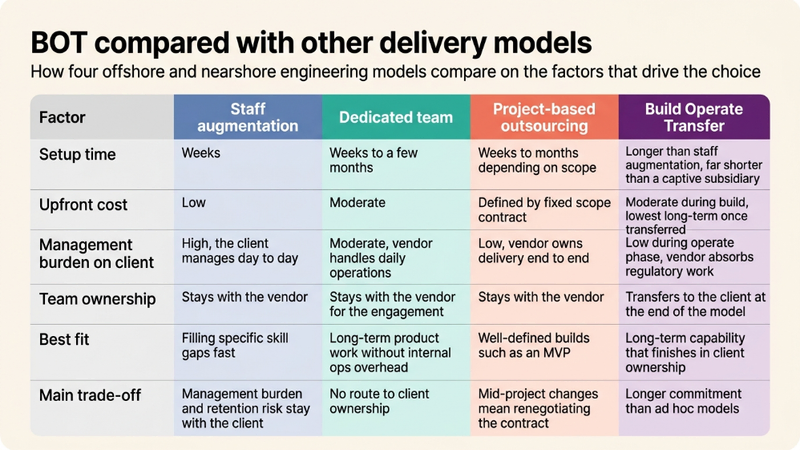
The comparison shows that an eventual owned team differs from the other models in kind, not in degree: The alternatives vary in how much management the client hands off, while BOT alone changes who owns the team at the end. Staff augmentation and a dedicated team never produce an owned asset. The company that wants proprietary software and lasting domain knowledge eventually has to build that capacity itself, and the intellectual property its work generates may stay partly outside its control in the meantime, depending on contract terms. The trade-off a BOT engagement carries is the reverse one. Ownership, IP protection under Romanian employment law, and access to the country’s R&D relief come built in, while the company absorbs a longer runway to operational scale.
A BOT agreement carries more weight than a standard outsourcing contract, since it has to cover the build, the operate period, and the handover inside one document. The transfer terms come first, naming the fee structure that compensates the provider, fixing the conditions that trigger the handover, and setting the timing so neither side debates readiness later. Intellectual property sits close behind, and the cleanest arrangement assigns all work product to the client from the moment of creation rather than at transfer. Employee transition terms spell out how staff move across and how key people are kept through the change, while post-transfer support usually runs as a defined window of advisory access and management training as the client’s leadership settles in.
The model is not risk-free, and naming the failure points keeps them from arriving as surprises. Transfer execution is the hardest part, since many engagements run well through operate, then stumble at handover on thin documentation or last-minute departures. We treat the transfer as a thread that starts on day one, with documentation built into operate-phase milestones and readiness checked at regular intervals rather than assessed once at the end. Retention of key people is the next exposure, addressed through clear communication about career paths under the new owner and continuity of compensation through the shift. Build-phase quality forms a third risk, which directs client involvement in final hiring, trial periods for new joiners, and replacement guarantees in the contract to keep in check. The last exposure sits on the client’s side, in the capacity to run the team once owned, which assigning internal leadership early in the operate phase and preparing HR and finance for cross-border operations closes well before transfer.
Company size: ~60 employees
Founding year: 2016
Website: www.devsdata.com
Headquarters: Brooklyn, NY, and Bucharest, Romania
DevsData LLC is a software development and technology recruitment company with reach across Eastern Europe and Latin America. Our presence in the region keeps us close to the Romanian talent market and local regulations. Across close to a decade in the market, we have supported clients worldwide, from large corporate organizations through to fast-scaling startups, with a distributed structure that accommodates different time zones and collaboration styles.
The recruitment side gives the build phase its weight. A proprietary database of more than 95000 pre-vetted IT professionals feeds candidate sourcing, an acceptance rate below 6 percent keeps the bar high, and a 90-minute technical interview screens for genuine depth before anyone reaches a client’s shortlist. A government-approved recruitment license backs the firm’s standing to hire. On delivery, we have completed more than 140 custom software projects for over 100 clients, hold a 5/5 rating on both Clutch and GoodFirms, and run a team that includes in-house Google-level Developers with more than ten years of experience. Core specializations run through Big Data and machine learning, matched to each client’s domain.
Our vetting process is built for senior technical hiring, weighing engineering depth, architectural judgment, secure data handling, and production readiness over surface familiarity, which matters most for the senior hires a permanent unit relies on. For a client weighing a long-term Romanian team, that combination answers the two questions the model raises most often, namely whether the provider runs the operate phase well and whether the team will be worth owning at transfer.
Do you have IT recruitment needs?

The clearest test of the build phase in Romania came from work with BioTrack, a US-based SaaS leader in cannabis compliance software that needed to establish a senior backend engineering team in the country. The brief carried genuine difficulty. The roles called for Senior Backend Developers able to refactor a complex Node.js codebase, lead the migration from legacy frameworks toward modern React-based components, and expand a retail point-of-sale system, and the first hire had to act as an informal Site Lead, setting standards and coordinating with US stakeholders. Industry stigma narrowed the pool further, since some senior engineers hesitated to engage with a cannabis-related project.
We answered with discreet, passive candidate outreach that emphasized BioTrack’s technical credibility and compliance mission, supported by detailed talent mapping focused on Cluj-Napoca and Bucharest alongside neighboring markets. A dual-layer technical screen put each candidate through a live system refactoring task on a simplified Node.js module and a simulation interview measuring fit with the client’s product and compliance stakeholders. The result placed three Senior Backend Engineers in under three weeks from initial outreach to signed offers, with a 100 percent offer acceptance rate, more than 90 percent passive sourcing, and an average time-to-offer below 14 days, well ahead of the 6 to 8 week cycles typical of senior recruitment in regulated sectors. The engagement established BioTrack’s first engineering presence in Romania and laid the cultural groundwork for future team growth, the same foundation a BOT build phase sets out to create.
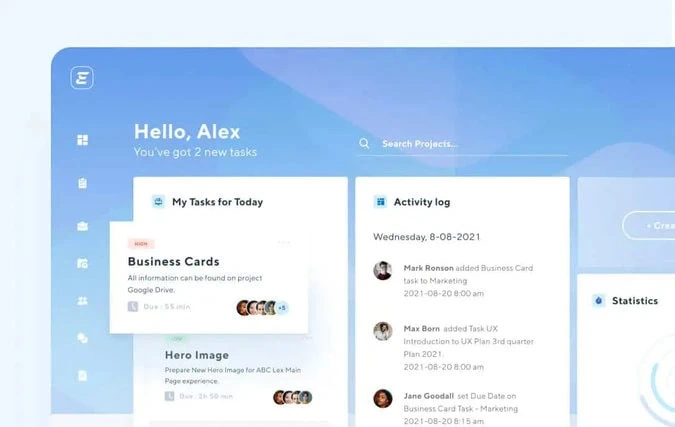
A second engagement shows the operate-phase rhythm directly. Working with a large US-based financial services company, our team built a tailored Enterprise Resource Management system pulling project oversight, advanced task management, reporting, and resource allocation into a single tool, with high expectations around usability and data security given the sensitive nature of the client’s operations. Key engineers worked across multiple time zones under a structured communication process with clearly defined milestones, drawing on US-based specialists alongside Developers from our Eastern European offices. The delivered platform replaced Jira for two departments and sharpened visibility into project progress and resource planning. That distributed team running real workflows under client direction, with reporting clear enough to support an eventual handover, is the operate-phase discipline a BOT arrangement asks for.
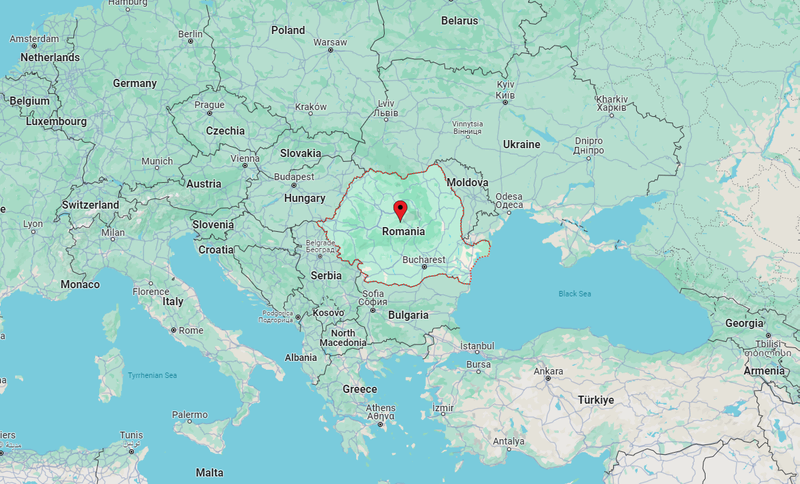
Paying contractors from Romania while complying with local laws is essential. One effective method is to use the employer of record service. Here are some EoR companies that can help with legal payment procedures and navigating Romania’s employment laws:
DevsData LLC is a trusted employer of record (EoR) provider specializing in the IT and tech sectors. The company delivers comprehensive employment solutions designed specifically for tech companies aiming to grow their operations in Romania.
As an EoR, DevsData LLC manages employment compliance, payroll processing, and business HR administration. This enables companies to establish a presence in Romania without creating a legal entity, and the firm ensures full compliance with local labor laws. It’s crucial to be well-informed about efficient money transfer methods.
For international transfers, consider platforms like Payoneer and Wise, which offer reliable and smooth transaction services.
Romania’s IT sector taxes are relatively advantageous compared to other European countries. Romania’s corporate income tax rate is 16%, one of the lowest in Europe, making the country an appealing option for foreign companies. The standard VAT rate in Romania is 21%, with an 11% reduced rates applying to specific goods and services. Romania applies a flat tax rate of 10% on personal income.
Employers in Romania carry a lighter contribution load than the headline payroll figure suggests. The employee side absorbs 35% of gross salary, made up of a 25% pension contribution (CAS) alongside 10% for health insurance (CASS), both withheld and remitted by the employer. What the company owes from its own funds is the 2.25% work insurance contribution (CAM). An additional employer pension contribution of 4% or 8% applies only where the role falls under uncommon or special work conditions, a classification that standard office-based development work does not meet.
Romania is home to several prestigious universities that produce highly skilled graduates, particularly in engineering, technology, and computer science. With a strong emphasis on technical education and research, these institutions play a crucial role in shaping the next generation of software engineers, data scientists, and IT specialists. Here are some of the leading tech-focused universities in Romania:
Do you have IT recruitment needs?
Build Operate Transfer answers one specific question. A company that wants a permanent European engineering team, yet not the cost and risk of building one from a standing start, brings in a provider to construct and run that team, then takes it over once the team has matured. The model trades a longer setup than staff augmentation for something neither augmentation nor a dedicated team offers, namely a built-in route to full ownership.
Romania supplies the talent depth, the EU regulatory alignment, the cost advantage, and the time zone fit that make the arrangement work day to day, with a deepening FinTech base that gives engagements built around regulated software a population already fluent in compliance and secure data handling. For an organization with a multi-year horizon and a real plan to become a local employer, the model remains one of the few structures designed to end with the team belonging to the client. To talk through a Romania-based engagement, email general@devsdata.com or visit www.devsdata.com.
Discover how IT recruitment and staffing can address your talent needs. Explore trending regions
like Poland, Portugal, Mexico, Brazil and more.

 Frequently asked questions (FAQ)
DevsData – your premium technology partner
DevsData is a boutique tech recruitment and software agency. Develop your software project with veteran engineers or scale up an in-house tech team of developers with relevant industry experience.
Free consultation with a software expert
🎧 Schedule a meeting
FEATURED IN


DevsData LLC is truly exceptional – their backend developers are some of the best I’ve ever worked with.”

Nicholas Johnson
Mentor at YC, serial entrepreneur


 Build your project with our veteran developers.
Explore the benefits of technology recruitment and tailor-made software.
Learn how to source skilled and experienced software developers.

Rebecca Botvin

Commercial Director

Tom Potanski
Manager




Categories: Big data, data analytics | Software and technology | IT recruitment blog | IT in Poland | Content hub (blog)
















careers@devsdata.com





general@devsdata.com

"I interviewed about a dozen different firms. DevsData LLC is truly exceptional – their backend developers are some of the best I've ever worked with. I've worked with a lot of very well-qualified developers, locally in San Francisco, and remotely, so that is not a compliment I offer lightly. I appreciate their depth of knowledge and their ability to get things done quickly."

Nicholas Johnson
CEO of Orange Charger LLC,
Ex-Tesla Engineer,
Mentor at YCombinator
"DevsData reached out to us, as we've been looking to grow our engineering team in Europe and Poland. Communicating efficiently and professionally, DevsData made a strong impression with their understanding of the recruitment challenges we were facing. They designed a tailored recruitment process for our needs. I was impressed with the technical depth of their approach."

Karim Butt
Co-Founder & CTO at GlossGenius, Inc.
"Out of all the vendors we work with, DevsData clearly stands out. The quality of developers they deliver is beyond what we've received from any other vendor, and they've been able to send profile recommendations very quickly. I'm happy to be their reference for other companies from Israel and talk about their recruitment abilities and what they delivered for us."

Ran Eyal
Senior Manager at
ZIM Integrated
Shipping Services Ltd.
"DevsData demonstrated a strong degree of proactivity, taking time to thoroughly understand the problem and business perspective, and continuously suggesting performance and usability enhancements. Their app exceeded my expectations. I've worked with DevsData on numerous projects over the last 3 years and I'm very happy. Being both responsive and honest in communication."

Jonas Lee
Partner & Executive VP of Verus,
Financial LLC, Investor,
& Serial Entrepreneur
Acknowledgments