Thanks for subscribing.
Your gift is on the way.



In recent years, nearshore outsourcing has evolved from a cost-saving tactic into a strategic response to some of the toughest challenges companies face: rising engineering costs, talent shortages in local markets, and delays caused by offshore time zone gaps. Businesses under constant pressure to innovate and deliver faster are turning to nearshore teams not only for high-quality talent but also for smoother collaboration and reduced operational friction. While businesses outsource a variety of functions, software development dominates the field, accounting for 64% of all outsourced services globally: A clear indication that technical expertise is a top priority for organizations worldwide.
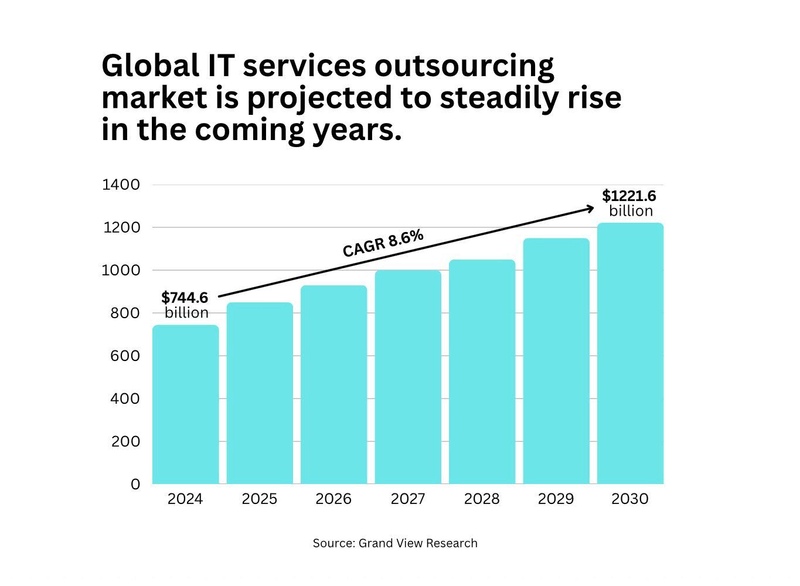
The broader picture reflects this trend. According to recent data, the global IT services outsourcing market was valued at approximately $744.6 billion in 2024. Even more telling is its projected growth: with a compound annual growth rate (CAGR) of 8.6%, the market is expected to reach $1221.6 billion by 2030. This growth reflects a broader shift in how companies approach capacity planning, with organizations increasingly favoring external teams to address talent gaps in cloud infrastructure, AI deployment, and full stack development without absorbing long-term headcount costs.
Having worked extensively with nearshore teams and clients as a software development and technology recruitment company, we have observed both the benefits and the operational challenges of this outsourcing model. The following sections outline key factors influencing the decision to outsource, compare the main nearshoring models, and provide insights from firsthand project experience. The aim is to present a grounded, practical overview of nearshore outsourcing – one informed by real-world collaboration, team management, and long-term client partnerships.
Do you have IT recruitment needs?
Outsourcing has evolved into a strategic approach for organizations aiming to scale efficiently, access hard-to-find talent, and improve delivery timelines. While not all business functions are suitable for outsourcing, there are several situations where it can provide tangible benefits:
Internal teams often face capacity issues as businesses grow. When employees are overloaded with tasks or projects consistently fall behind schedule, nearshore outsourcing can eliminate bottlenecks that slow down both new development and legacy system maintenance. It enables companies to delegate time-consuming development work to a team operating in a similar time zone, freeing up internal resources to focus on higher-value responsibilities. Accumulated technical debt from outdated code or deferred maintenance can also be addressed through nearshore teams, preventing long-term degradation of system performance. The proximity advantage of nearshoring means that coordination overhead remains lower than with offshore alternatives, allowing companies to manage capacity constraints without sacrificing communication speed.
In cases where demand is temporary, project-based, or requires niche expertise, nearshore outsourcing is often more practical than recruiting full-time staff. Hiring permanent employees adds long-term costs, training obligations, and overhead, while nearshore partners offer the flexibility to scale teams up or down without those commitments.
For time-sensitive or intensive projects, the overlapping work hours of a nearshore engagement help maintain momentum while preventing employee burnout, improving both productivity and morale across the board.
Speed-to-market is a competitive advantage, especially in industries where timing can determine the success of a product. Nearshore outsourcing allows for rapid execution by removing hiring delays and simplifying collaboration through similar time zones. Reduced communication latency compared to offshore models can accelerate sprint velocity, making nearshore setups more responsive during iterative development cycles. External partners are often well-equipped to jump into active projects with minimal onboarding. Their prior experience working across industries and technologies allows them to quickly contribute value. This setup helps organizations respond to market opportunities more swiftly and reduce product development cycles without compromising on quality or alignment.
The competition for tech talent is intense, and many regions face shortages of experienced Developers, DevOps Engineers, or Data Scientists. Nearshore outsourcing opens access to broader labor markets where skilled professionals are available at competitive rates while still operating within convenient time zones. Nearshore teams often bring a high level of expertise and experience in niche technologies that may be hard to source locally. By tapping into these regional networks, companies can fill critical roles faster and without inflating internal payrolls. This approach also helps diversify the knowledge base and encourages cross-cultural collaboration within manageable geographic proximity.
Outsourcing allows companies to reallocate their internal efforts toward activities that have the highest strategic value. For example, while the in-house team focuses on long-term product vision and customer engagement, a nearshore development team can take over routine development tasks or systems maintenance. This split ensures that energy is invested where it makes the most impact. It also minimizes context-switching, allowing internal staff to remain focused and efficient. Nearshore teams are well-positioned for this role because their time zone alignment supports real-time handoffs and rapid feedback loops with internal stakeholders.
Innovation often requires bandwidth, experimentation, and the ability to fail fast, something that is hard to achieve when internal teams are tied up with daily operations. Nearshore outsourcing creates space for experimentation by bringing in fresh talent specifically focused on research and development (R&D) or emerging tech initiatives. These external teams can work in parallel with internal staff, piloting features or launching MVPs without disturbing ongoing workstreams. The nearshore model is particularly suited to this because the cultural familiarity and real-time coordination it provides reduce the ramp-up time that typically slows innovation cycles.
Nearshore outsourcing comes in various formats, each with its own structure, cost, and level of control. Choosing the right model depends on the company’s internal capacity, project complexity, and long-term goals. Below are three common nearshore outsourcing models and how they typically function:
In the staff augmentation model, companies hire individual specialists or small teams from a nearshore partner to extend their existing in-house team. The external developers work under the client’s management and follow internal workflows, tools, and communication practices. This model is flexible and often used when internal teams are short on specific skills or need to accelerate development temporarily. It works best for bridging short-term skill gaps or scaling temporarily without long-term commitments. It provides high control over day-to-day work while minimizing recruitment time. However, it still places the responsibility for delivery and coordination on the client, which may strain internal resources if not well-managed. Knowledge retention presents an additional concern, as critical project context can be left with augmented staff once the engagement ends unless proper documentation practices are in place.
With a dedicated team model, a company partners with a nearshore provider to setup a semi-autonomous team that is fully committed to the client’s projects. This team is typically managed jointly, with strategic direction from the client and operational management by the vendor. A common arrangement follows a hybrid management structure where the vendor supplies the Technical Lead while the client retains the Product Owner role, ensuring both technical execution and business priorities stay aligned. The model works best for long-term, ongoing development needs, where a consistent group can continuously build and iterate on a product. The client benefits from continuity, deeper knowledge of the product, and efficient collaboration over time. This model also reduces internal overhead compared to staff augmentation but requires clear alignment on roles, priorities, and communication protocols.
In this model, a company outsources the entire responsibility of delivering a specific project to a nearshore partner. The vendor handles planning, execution, delivery, and often post-launch support. It is best suited for fully scoped, one-off projects that require minimal ongoing oversight. This approach works well for companies that don’t have the internal bandwidth to manage or co-lead development. It is suitable for well-scoped projects with defined deliverables and deadlines. While this model reduces the need for internal involvement, it offers less control over the process. Success relies heavily on choosing a reliable partner and establishing clear expectations at the outset.
The table below presents a comparison of the three models for you to better understand which one suits your business best.
| Model | Control level | Ideal for | Management responsibility | Flexibility | Typical case study |
|---|---|---|---|---|---|
| Staff augmentation | High | Short-term skill gaps | Client | High | Adding developers to an in-house team |
| Dedicated development team | Medium-High | Long-term, ongoing development | Shared (client + vendor) | Medium | Building or scaling a product over time |
| Project-based outsourcing | Low | Fully scoped, one-off projects | Vendor | Low | Outsourcing an MVP or standalone product delivery |
Mexico is one of the most established nearshoring destinations for North American companies, offering strong time zone alignment and cultural compatibility. The country has a growing tech workforce and is home to tech hubs like Guadalajara and Monterrey. English proficiency is high, especially among developers and project managers. The Mexican government supports the IT sector through public investments in education and innovation programs. The USMCA (T-MEC) trade agreement further strengthens the commercial relationship between the US, Mexico, and Canada, providing a regulatory framework that simplifies cross-border business operations. With strong infrastructure and competitive pricing, Mexico is especially well-suited for US companies seeking fast onboarding, minimal language barriers, and real-time collaboration with external teams.
Limitations: Companies must navigate Mexico’s complex regulatory environment, including diverse labor, tax, and environmental laws. Additionally, certain regions may experience security concerns, necessitating thorough risk assessments and robust compliance strategies.
Colombia has made major strides as a nearshore outsourcing hub, particularly for US-based businesses. Its geographic location provides excellent time zone overlap, and cities like Bogotá and Medellín have seen rapid growth in IT ecosystems. Colombia’s government has actively invested in English training and STEM education to expand its developer base, now exceeding 150000 professionals. While its rates are slightly higher than those of Asian countries, the cultural alignment, ease of travel, and growing tech scene make it a solid option for long-term collaboration. It is particularly appealing for startups and mid-sized companies focused on agile product development.
Limitations: Colombia has faced challenges related to political instability and security concerns in certain regions. Businesses must conduct thorough due diligence and implement robust security measures to mitigate potential risks.
Poland has emerged as a top destination for European and US companies seeking long-term nearshore development partnerships. It combines high education standards with strong technical expertise – particularly in Java, Python, and software architecture. Poland’s EU membership ensures legal and regulatory stability, making it attractive for compliance-conscious businesses. The workforce is highly fluent in English and generally aligned with Western business practices. While pricing is slightly higher than in Asia or Latin America, the balance of cost and quality makes Poland a preferred choice for complex, long-term projects requiring consistent delivery and communication.
Limitations: Poland’s time zone can pose challenges for North American clients requiring real-time collaboration. Moreover, strict adherence to EU regulations, such as the General Data Protection Regulation (GDPR), demands rigorous data protection measures, which may increase compliance costs.
India remains a global outsourcing heavyweight, with a deep talent pool and decades of experience working with international clients. It’s home to over five million IT professionals and thousands of outsourcing firms. The country offers highly competitive rates, with a wide range of expertise in both legacy systems and emerging technologies. Although time zone differences with North America and Europe can be challenging, mature delivery models and strong English proficiency mitigate communication risks. India is particularly effective for project-based work or high-volume delivery that demands scalability and budget efficiency.
Limitations: India’s IT sector faces high employee attrition rates, leading to potential knowledge loss and increased recruitment costs. Additionally, the growing emphasis on automation and AI may disrupt traditional outsourcing models, affecting job stability and service continuity.
Vietnam is increasingly seen as a rising star in the global outsourcing landscape. Its IT workforce is younger but rapidly expanding, with strengths in web development, mobile apps, and AI. The government supports tech growth through tax incentives and investment in digital infrastructure. While English fluency is not as widespread as in India, many teams working with international clients maintain strong communication standards. Vietnam is a strong choice for startups and SMEs seeking affordable, technically sound teams with room for growth.
Limitations: Vietnam lacks a unified data protection law, which creates uncertainties around data privacy and intellectual property rights. Furthermore, while English proficiency is improving, language barriers can still hinder effective communication in complex projects.
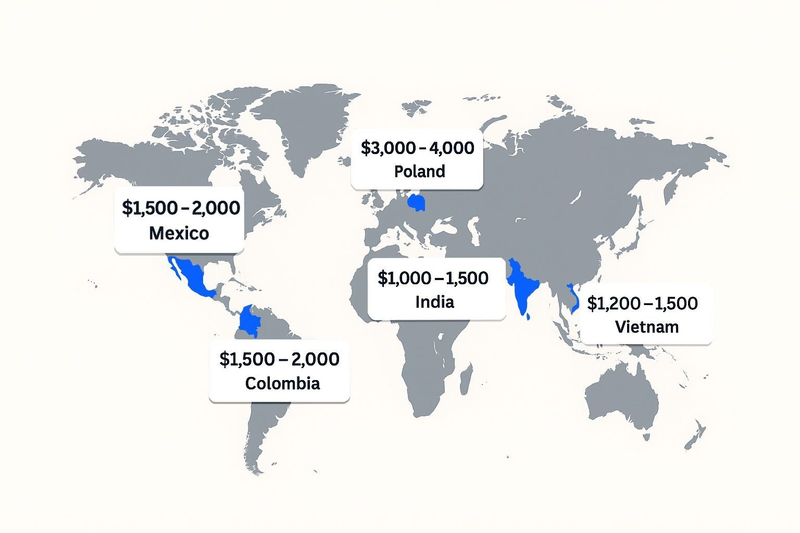
Below you can find a table comparing the average gross monthly salary in the US, Western Europe, and the countries from our top nearshoring destinations:
| Country/region | Frontend developer | Backend developer | DevOps engineer |
|---|---|---|---|
| United States | $10000-$12000 | $10000-$12000 | $9000-$11000 |
| Western Europe | $5000-$6000 | $5500-$6500 | $6000-$7000 |
| Mexico | $1500-$2000 | $2000-$2500 | $2500-$3000 |
| Poland | $3000-$4000 | $3500-$4500 | $4000-$5000 |
| India | $1000-$1500 | $1200-$1800 | $1500-$2000 |
| Vietnam | $1200-$1500 | $1400-$1700 | $1600-$1900 |
| Colombia | $1500-$2000 | $1800-$2300 | $2000-$2500 |
Note: The figures represent average monthly salaries for mid-level professionals with 2-5 years of experience. The data may vary based on a specific location, industry, job offer, etc. To explore detailed salary insights in your region, check salaries in your preferred location here.
Selecting the right destination involves more than salary comparisons alone. An experienced outsourcing partner can offer guidance on local labor market conditions, regulatory requirements, and cultural alignment to help companies identify the location that fits their operational needs and long-term goals.
Do you have IT recruitment needs?
While nearshore outsourcing offers clear operational advantages, it is not without friction. Distributed collaboration introduces specific challenges that, if left unaddressed, can erode the benefits of time zone proximity and cultural alignment. The following section outlines the most common issues we encounter in nearshore engagements and the solutions we apply to resolve them.
Challenge: Even in nearshoring setups with overlapping business hours, communication can falter due to mismatched expectations, vague requirements, or cultural nuances. These issues can lead to delays, misaligned priorities, and technical rework, especially when onboarding remote contributors to fast-paced agile teams.
Our Solution: We implement a structured communication framework from day one – this includes shared Slack channels, weekly sprint reviews, daily standups, and asynchronous updates where necessary. All stakeholders operate from the same documentation and backlog. Our nearshore engineers are also trained in proactive communication and agile practices to reduce ambiguity and keep feedback loops short.
Challenge: When collaborating across borders, development standards often vary. Without unified practices, this can result in inconsistent architecture, technical debt, or code that’s difficult to maintain – particularly when scaling teams or adding features quickly.
Our Solution: We standardize code reviews, implement CI/CD pipelines, and enforce style guides from the start of every engagement. Developers follow Git-based workflows that incorporate automated testing and linting alongside AI-driven code review tools such as SonarQube AI, which flag compliance gaps and quality issues before code reaches production. Senior engineers also lead architecture reviews and implement best practices, ensuring long-term maintainability and scalable system design. This layered approach to automated governance helps sustain consistency even as distributed teams scale.
Challenge: Nearshore teams are often treated as vendors rather than collaborators. This can lead to a lack of product ownership, misalignment with company goals, and low morale, undermining project momentum and quality.
Our Solution: We embed nearshore developers into our clients’ internal teams – they join the same Slack groups, sprint rituals, and product meetings. We also conduct regular joint retrospectives and team-building sessions to align culture and work ethic. Our aim is seamless integration, not outsourcing in the traditional sense.
Challenge: In long-term nearshore collaborations, the departure of key personnel can disrupt progress if critical knowledge isn’t properly transferred or documented. Without clear continuity plans, teams risk delays, misalignment, and repeated onboarding efforts.
Our Solution: We maintain comprehensive documentation as part of our standard delivery process. New hires receive structured onboarding packages, and we establish handover protocols that include paired programming and mentorship. Our teams operate with redundancy in mind – so knowledge isn’t siloed with one engineer.
Challenge: Cross-border work can introduce compliance and security challenges, particularly with sensitive user data, IP protection, or industry-specific regulations (like HIPAA or GDPR).
Our Solution: Security and compliance are integral to how we work. We sign NDAs and DPAs, restrict access through VPNs and role-based permissions, and use secure development environments. We also stay up to date with regional compliance requirements, enabling our clients to operate safely regardless of their jurisdiction. Where applicable, cybersecurity insurance adds a further layer of financial protection against data breaches or security incidents.
Choosing the right nearshore outsourcing partner is as important as selecting the right destination. In a nearshore engagement, where delivery depends on time zone alignment and cultural compatibility, the partner’s ability to function as an extension of your team directly affects outcomes. A well-chosen partner accelerates development cycles and reduces coordination overhead, while the wrong one introduces misalignment that offsets the benefits of geographic proximity. The following guide outlines the key aspects to evaluate when selecting a nearshore outsourcing provider.
Before speaking with nearshore vendors, outline the outcomes you want to achieve. This includes measurable goals like faster release cycles, improved code quality, or reduced costs, as well as constraints such as budget limits, security requirements, or time-to-market deadlines. In a nearshore context, it is also worth defining expectations around working-hour overlap and communication cadence, as these factors will shape how effectively the external team integrates with your daily operations. Having clear expectations allows you to evaluate partners more objectively and ensures both sides understand the scope from the start.
Security is a non-negotiable factor, especially when working across borders in a nearshore arrangement. Ask potential partners about their certifications (e.g., ISO 27001 or SOC 2) and whether they are familiar with regulations like GDPR or HIPAA. For projects involving artificial intelligence, the EU AI Act introduces additional compliance obligations that partners operating within or serving the European market should be prepared to address. Nearshore partners operating in regions like the EU or Latin America may be subject to different data protection regimes, making it important to verify how they handle cross-jurisdictional compliance. Strong data protection practices should include role-based access, secure development environments, and regular audits. A reliable partner will provide documentation, not just verbal assurances, to prove compliance.
Look beyond sales pitches and assess how the nearshore vendor ensures quality. A strong partner will have transparent processes for QA, continuous integration and deployment (CI/CD), and code reviews. Ask to see examples of testing protocols or past deliverables. These insights reveal whether the vendor can maintain long-term code quality, reduce technical debt, and scale projects without sacrificing performance. In nearshore setups, where teams iterate alongside your in-house staff in real time, consistent delivery standards are especially important to prevent bottlenecks during agile sprints.
Proximity in time zones is one of nearshoring’s primary advantages, but it is only beneficial if communication practices are well-structured. Ask how the nearshore partner organizes stand-ups, sprint reviews, and reporting. A dependable vendor will use collaboration tools like Jira, Slack, or Zoom to keep stakeholders aligned. Weekly check-ins, asynchronous updates, and a clear escalation path are signs of mature governance. Because nearshore teams share most of the workday with the client, governance frameworks should maximize synchronous collaboration rather than defaulting to asynchronous patterns more common in offshore models.
Different projects require different models, and a nearshore partner should help you select the one best suited to your delivery goals. A fixed-price agreement works for clearly defined, one-off projects, but often comes with a risk premium. Time & Materials (T&M) or a dedicated team setup is better for long-term or evolving projects that benefit from the continuity nearshore teams can provide. For organizations that prefer to hand off operational responsibility entirely, a Managed Services model delegates ongoing maintenance, monitoring, and support to the vendor under predefined service-level agreements. A trustworthy nearshore vendor will advise you on the right model for your situation and clearly outline what is and isn’t included in the cost.
Ask how the nearshore vendor recruits, screens, and retains talent in its local market. Look for information on seniority mix, technical vetting processes, and retention rates. It is also important to know how quickly they can backfill if a developer leaves, since continuity is one of the key benefits of a nearshore engagement. Transparency in these areas helps you avoid unpleasant surprises mid-project and ensures you’ll maintain team stability throughout the collaboration.
Always ask for references from clients in similar industries or with comparable team sizes who have worked with the vendor through a nearshore model. Speaking directly with past clients gives you insight into reliability, communication, and delivery quality under the specific conditions of cross-border nearshore collaboration. Reviewing case studies or sample projects can also help you assess whether the vendor’s experience aligns with your business needs and technological stack.
Contracts should clearly state that all intellectual property developed during the nearshore partnership belongs to your company. Cross-border IP arrangements require particular attention to the legal frameworks in the partner’s jurisdiction. Equally important is having a defined exit plan, especially if you consider models like Build-Operate-Transfer (BOT). This ensures a smooth transition of knowledge, assets, and processes if you decide to bring operations fully in-house later on.
Agency pricing structures vary widely across nearshore markets, so it’s crucial to understand exactly what you’re paying for. Ask for a detailed breakdown of costs, including salaries, management fees, office expenses, and potential extras. Regional cost differences are a core advantage of nearshoring, but they should be reflected in an itemized cost structure rather than bundled into opaque rates. A transparent vendor will provide a sample invoice or cost sheet upfront, which makes it easier to compare partners side by side and avoid hidden fees later.
Beyond salaries, outsourcing partnerships come with agency fees that cover recruitment, operations, and management. These costs can vary significantly depending on the engagement model. Understanding how vendors price their services and what is included will help you budget effectively and avoid unexpected expenses.
Below is an overview of the most common models and their associated fee structures.
| Engagement model | How you’re billed | Typical agency fee/markup | What’s usually included | Common extras to clarify |
|---|---|---|---|---|
| Staff augmentation | Hourly bill rate | 20-75% markup on pay rate; permanent placement 10-25% of annual salary if converted | Recruiting, HR/payroll, taxes, benefits, vendor administration | Conversion/buyout fees, overtime multipliers, minimum hours, replacement SLAs |
| Dedicated team | Monthly per FTE (blended rate) | Fee bundles service costs into one monthly charge | Salaries, benefits, local HR/payroll, equipment, office space, basic coordination | Setup fee, additional PM/BA hours, tool licenses, scaling up/down fees |
| Time and materials (T&M) | Hourly/daily rates | Margin is built into the rate; fixed-price contracts usually cost more due to a risk premium | Engineering time, QA, basic PM | Change requests, rush work, specialized compliance add-ons |
| Build-operate-transfer (BOT) | Setup + run fees, then one-time transfer cost | A transfer fee often applies at handover | Office/entity setup, recruitment, operations, and team management during the “operate” phase | Transfer payments, legal/entity costs, knowledge-transfer ramp |
These engagement models vary in cost transparency, flexibility, and responsibility sharing. Understanding how each model bills, what’s included, and which extras may apply is essential to budgeting accurately and avoiding unexpected costs.
An experienced outsourcing partner can advise on which model fits a given project’s scope and budget, offering insight into current market rates and helping clients avoid cost structures that do not match their operational reality.
Website: www.devsdata.com
Company size: ~60 employees
Headquarters: Brooklyn, NY, and Warsaw, Poland
Founded: 2016
DevsData LLC is a software development company headquartered in Brooklyn, NY, and Warsaw, Poland. For over ten years, the company has focused on nearshore outsourcing, helping clients extend their development capabilities through agile, vetted teams. The company’s delivery model combines geographic flexibility with senior-level engineering skills, enabling close collaboration with clients while maintaining cost efficiency. With US-based specialists on board, DevsData LLC ensures cultural fit, strong communication, and alignment with the business goals of North American clients.
DevsData LLC has built a network that spans major nearshoring hubs, including Latin America, Eastern Europe, India, and Vietnam – regions renowned for their robust IT ecosystems and engineering talent. The company’s global reach enables quick team assembly across time zones, while ensuring continuous delivery and knowledge transfer. Our in-house team includes Google-level engineers and developers with more than 10 years of software development experience. This technical depth supports DevsData LLC’s work on complex domains like Big Data and Machine Learning, where accuracy, scalability, and performance are critical.
Recently, DevsData LLC collaborated with a prominent financial services firm to build a tailored ERP and project management system aligned with the client’s internal operations. The project was delivered through a nearshore engagement, with team members working from Eastern Europe in close coordination with the client’s US-based stakeholders. It involved complex challenges, including secure data handling, integration of multi-layered functionalities, and adherence to strict deadlines. By assembling a skilled nearshore team with both domain knowledge and technical depth, DevsData LLC ensured seamless execution.
The collaborative model, based on geographic proximity, overlapping time zones, and shared cultural context, allowed for real-time communication, faster feedback loops, and agile delivery cycles. The final product replaced Jira in two departments, optimized task management, and significantly improved workflow transparency. Most importantly, the solution contributed to notable cost savings without compromising on performance or security.
The company’s experience spans over 100 completed projects for more than 80 clients worldwide – from high-growth startups to large international enterprises, including those in the US and Israel. DevsData LLC has a proven track record in delivering business-critical systems across industries, with a process that emphasizes quality, reliability, and transparency. The company maintains top client satisfaction scores with a 5/5 rating on platforms like Clutch and GoodFirms. With an approach rooted in both technological excellence and domain relevance, DevsData LLC continues to be a trusted partner for organizations seeking scalable and secure nearshore development solutions.
Do you have IT recruitment needs?
To connect with DevsData LLC, email us at general@devsdata.com or visit our website at www.devsdata.com.
Nearshore outsourcing has become a strategic solution for businesses aiming to expand their technical capabilities without the high costs or operational friction often associated with traditional offshore models. With the global IT outsourcing market constantly growing, the demand for efficient and scalable solutions continues to rise. Nearshoring enables teams to collaborate across similar time zones, improving communication, project velocity, and long-term alignment.
Selecting the right outsourcing model – whether team extension, dedicated development, or project-based delivery – is critical to achieving results. The top destinations, including Latin America, Eastern Europe, India, and Vietnam, offer rich talent pools and mature IT ecosystems, although each comes with its own considerations. While nearshore development comes with challenges – such as ensuring code quality, maintaining communication, or navigating security requirements – these can be mitigated by following established best practices and integrating teams thoughtfully into the client’s internal processes.
DevsData LLC has built its nearshore outsourcing services around these principles. With offices in New York and Warsaw, and access to engineering talent across Latin America, Eastern Europe, India, and Vietnam, the company combines global reach with technical depth. Our developers, including Google-level engineers and professionals with over a decade of experience, specialize in areas like Big Data and Machine Learning. Having completed 100+ projects for clients in the US, Israel, and beyond, DevsData LLC has demonstrated its ability to deliver secure, scalable solutions that align with business goals.
To connect with DevsData LLC, email us at general@devsdata.com or visit our website at www.devsdata.com.
Any questions or comments? Let me know on
Twitter/X.
Discover how IT recruitment and staffing can address your talent needs. Explore trending regions
like Poland, Portugal, Mexico, Brazil and more.
 Frequently asked questions (FAQ)
DevsData – your premium technology partner
DevsData is a boutique tech recruitment and software agency. Develop your software project with veteran engineers or scale up an in-house tech team of developers with relevant industry experience.
Free consultation with a software expert
🎧 Schedule a meeting
FEATURED IN
DevsData LLC is truly exceptional – their backend developers are some of the best I’ve ever worked with.”

Nicholas Johnson
Mentor at YC, serial entrepreneur


 Build your project with our veteran developers.
Explore the benefits of technology recruitment and tailor-made software.
Learn how to source skilled and experienced software developers.
Build your project with our veteran developers.
Explore the benefits of technology recruitment and tailor-made software.
Learn how to source skilled and experienced software developers.

Rebecca Botvin

Commercial Director

Tom Potanski
Manager




Categories: Big data, data analytics | Software and technology | IT recruitment blog | IT in Poland | Content hub (blog)














careers@devsdata.com









general@devsdata.com

"I interviewed about a dozen different firms. DevsData LLC is truly exceptional – their backend developers are some of the best I've ever worked with. I've worked with a lot of very well-qualified developers, locally in San Francisco, and remotely, so that is not a compliment I offer lightly. I appreciate their depth of knowledge and their ability to get things done quickly."

Nicholas Johnson
CEO of Orange Charger LLC,
Ex-Tesla Engineer,
Mentor at YCombinator
"DevsData reached out to us, as we've been looking to grow our engineering team in Europe and Poland. Communicating efficiently and professionally, DevsData made a strong impression with their understanding of the recruitment challenges we were facing. They designed a tailored recruitment process for our needs. I was impressed with the technical depth of their approach."

Karim Butt
Co-Founder & CTO at GlossGenius, Inc.
"Out of all the vendors we work with, DevsData clearly stands out. The quality of developers they deliver is beyond what we've received from any other vendor, and they've been able to send profile recommendations very quickly. I'm happy to be their reference for other companies from Israel and talk about their recruitment abilities and what they delivered for us."

Ran Eyal
Senior Manager at
ZIM Integrated
Shipping Services Ltd.
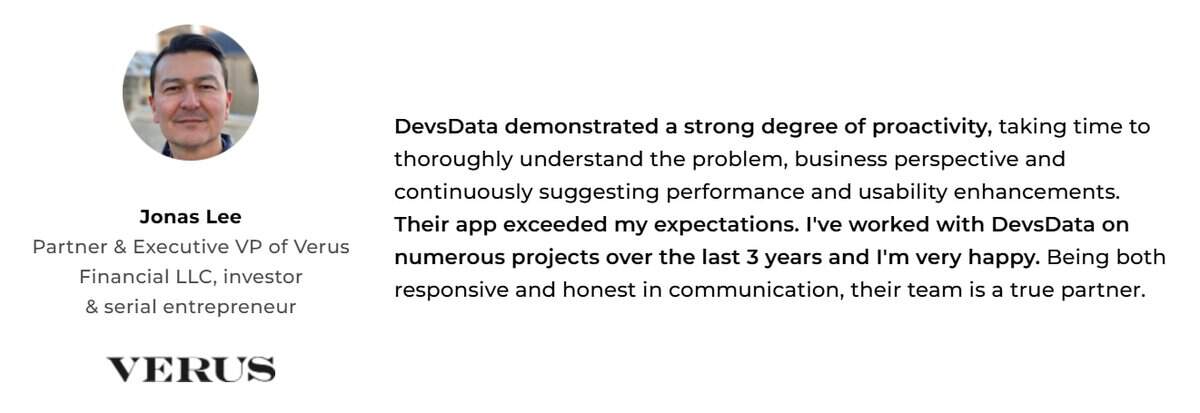
"DevsData demonstrated a strong degree of proactivity, taking time to thoroughly understand the problem and business perspective, and continuously suggesting performance and usability enhancements. Their app exceeded my expectations. I've worked with DevsData on numerous projects over the last 3 years and I'm very happy. Being both responsive and honest in communication."

Jonas Lee
Partner & Executive VP of Verus,
Financial LLC, Investor,
& Serial Entrepreneur
Acknowledgments