Thanks for subscribing.
Your gift is on the way.



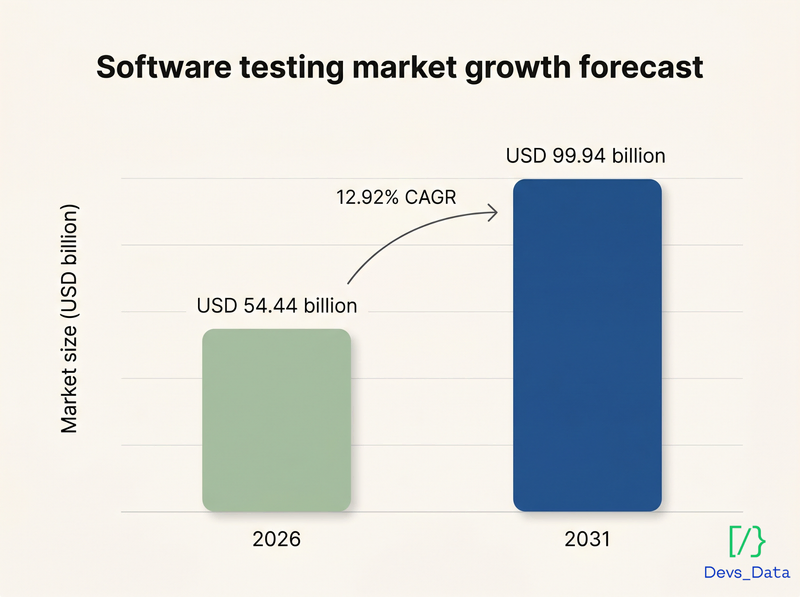
Software teams that shipped quarterly two years ago now push code to production multiple times a week, a pace set by AI-assisted development once code generation moved into daily engineering practice. The verification work behind those releases has not kept up, and the gap shows up as real cost in post-release fixes and engineering hours redirected from planned work to rework. That pressure has built a market around the problem. Mordor Intelligence valued the global software testing market at $54.44 billion in 2026, projecting it to reach $99.94 billion by 2031 at a 12.92% CAGR.
That level of investment reflects how much rides on the professionals filling these verification roles. All of that spending has not solved the quality problem.
Digital.ai found that 63% of organizations struggle to deliver high-quality software, a figure that climbed 12% points from the prior year’s survey.
Hiring practices explain part of that year-over-year climb. A QA (Quality Assurance) title on a resume encompasses everyone from Testers executing manual checklists to Engineers who build automated systems that control what reaches production. Organizations filling verification roles from the first group while release frequency rises end up with less coverage each quarter than the deployment schedule demands, which moves the reported quality figure in the direction the survey recorded. Interview cycles go to the wrong candidates, and placements break down within the first quarter.
This article provides business owners with compensation benchmarks across four geographic markets and evaluation criteria based on the distance between manual testing credentials and production-grade quality engineering. DevsData LLC, an IT recruitment agency with a decade of software development and QA placements across the US and Europe, compiled the guidance so whoever funds the next QA hire can enter the search with screening data and compensation benchmarks calibrated to this market.
A job posting that lists the right keywords pulls volume. One backed by an understanding of the role draws qualified candidates. The QA Engineer’s work within an Agile team has moved so far from the traditional testing model that the two approaches have little in common in their workflows. The person writing the requisition needs a working picture of what this hire does at the sprint level before the evaluation criteria and compensation data carry weight.
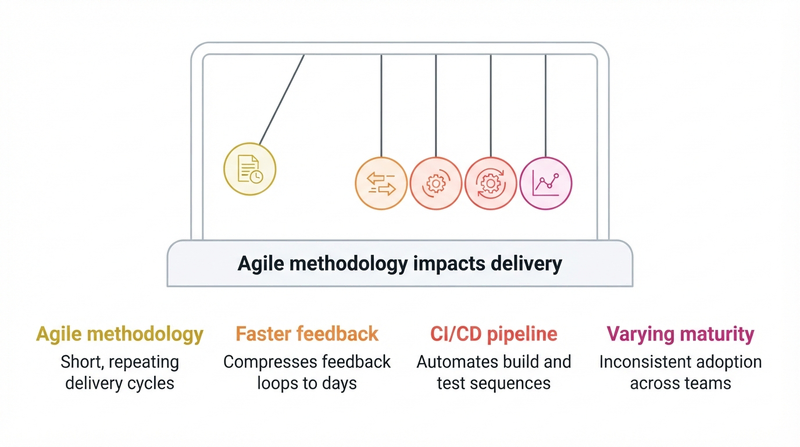
Agile organizes delivery into short, repeating cycles called sprints, each running one to four weeks. The team ships a working increment at the end of each sprint and adjusts priorities based on the feedback that follows. That rhythm replaces the waterfall model, in which coding finished first, and a separate QA team received the product to test only after development was complete. Waterfall feedback loops stretched weeks or months. Agile compresses them to days.
Scrum and Kanban are the two frameworks that business owners will most often encounter on resumes. Scrum structures work into time-boxed sprints with defined ceremonies: sprint planning sets the scope, and daily standups surface blockers before they compound.
Retrospectives close each cycle by reviewing what worked and what did not. Kanban takes a different path, treating delivery as a continuous flow with limits on how many tasks can be active at any given time.
A candidate’s depth in one or both shapes how they fit an existing team’s rhythm. An Engineer who has only run Scrum sprints often stalls on a Kanban board, where work arrives as a continuous flow with no sprint boundary to plan testing against.
Scrum and Kanban dominate resumes, though scaled models such as SAFe appear wherever several teams coordinate against a shared release train, and Extreme Programming practices persist in groups built around test-first engineering. Adoption is less uniform than those framework labels suggest. The Digital.ai 18th State of Agile Report found that only 13% of organizations have Agile deeply embedded across both business and technology operations. Most of the rest describe adoption as inconsistent or limited to individual teams.
A QA Engineer hired into that environment will encounter varying levels of maturity from one team to the next, and a candidate whose background consists only of mature Agile setups has a narrower skill set than the role demands.
The CI/CD pipeline is the infrastructure layer that makes Agile delivery run at speed. Code commits trigger automated build and test sequences before changes move toward production. The pipeline is where test automation lives in a working Agile environment, and a QA Engineer’s fluency with that infrastructure determines whether verification work governs what ships or sits entirely outside the delivery flow.
Digital.ai reported that 74% of organizations now run hybrid or customized Agile approaches, up from 50% two editions earlier in the same survey series.
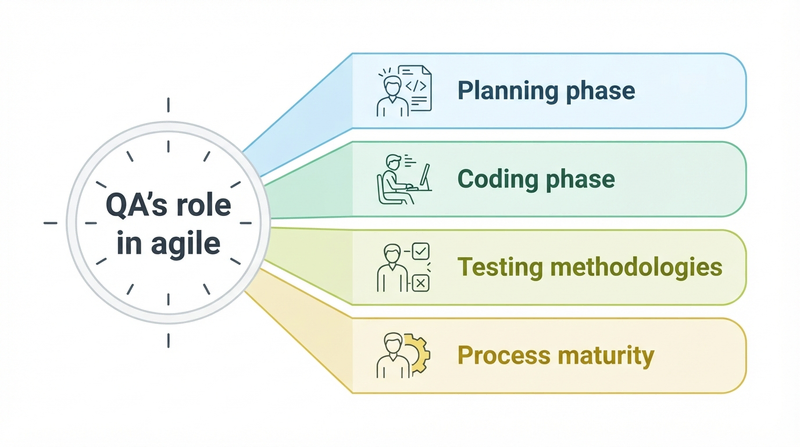
Traditional QA operated at the end of the line. A separate team received finished software, ran checks against requirements, and reported defects for Developers to fix. Agile inverts that sequence. QA Engineers participate from the moment user stories are written, reviewing requirements for testability and flagging edge cases before any code exists. The industry calls this shift-left testing: moving verification earlier on the development timeline rather than concentrating the effort after delivery.
The sprint structure distributes QA work across defined phases. During planning, QA Engineers assess user stories and flag ambiguous acceptance criteria. Edge cases surface at this stage rather than during regression runs weeks later.
Once coding begins, the Engineer writes and maintains automated test scripts that execute on every commit through the CI/CD pipeline. Pairing with Developers on testable code and reviewing pull requests for quality assurance risks are part of the daily workflow. At sprint close, defect trends and coverage data feed back into the team’s process adjustments for the next cycle.
Business owners reviewing resumes will see testing methodologies listed alongside tool proficiency. Test-driven development (TDD) means the Engineer writes tests before writing the code that those tests verify.
BDD (behavior-driven development) takes a different angle, producing test cases in plain language that non-technical readers interpret as business specifications, and ATDD (acceptance test-driven development) extends that principle by building test criteria from formalized business requirements.
Exploratory testing adds a layer of manual investigation, with the QA Engineer probing the product beyond scripted scenarios to catch issues that automated suites might miss. Each methodology signals a different level of process maturity in the candidate’s background.
The tooling ecosystem maps to these sprint activities. Automation frameworks like Selenium and Cypress run browser-based tests, with Playwright gaining ground for cross-browser coverage. Appium handles mobile. CI/CD platforms like Jenkins and GitHub Actions execute automated suites on every commit.
TestRail and similar test management tools track coverage and execution history. Postman and REST Assured handle API testing, validating backend service connections that feed the production environment. AI functionality now sits inside much of this tooling, drafting cases from user stories and grouping failures across execution history, which shifts the Engineer’s daily work toward reviewing machine-drafted output instead of writing every case by hand. A resume listing QA experience without tools from these categories suggests the candidate’s background ends at manual test execution.
The tools and practices described here align with the business outcomes that QA Engineers protect. The cost of those protections, and the cost of their absence, becomes visible when defects reach the wrong stage of the development cycle.
Do you have IT recruitment needs?
Verification at each sprint phase catches defects when the code is fresh, and fixes are cheap. When that window closes, the same bug costs more at every subsequent stage.
The IBM Systems Sciences Institute and NIST ratios, long established and still widely cited, set the baseline. A defect caught during the requirements phase costs roughly 1x to resolve. The same defect found during coding runs five to ten times higher. In production, the multiplier reaches 100x and beyond.
Emergency patches and full regression cycles drive the direct engineering cost. For organizations in financial services and healthcare, regulatory audits trace each defect back to the code change that introduced it, and compliance costs add to the fix.
The direct fix is only part of the bill. A critical bug found late in a sprint blocks the release. Over 26 sprints per year, even occasional blocked releases, add up to weeks of lost delivery. Context switching compounds the damage: a Developer who receives a bug report weeks after writing the code has to rebuild their mental model from scratch before they can begin work on the fix. Defects patched under deadline pressure receive surface-level treatment rather than structural repairs, and each patch adds technical debt that slows the next sprint’s output.
Organizations under cost pressure feel this escalation at the budget level. The Digital.ai 18th State of Agile Report found that 79% of organizations cite a shift from agility to efficiency or cost control as a factor reshaping their delivery investments. When the directive is to produce more with fewer resources, a QA hire who catches defects at the sprint level reduces the rework load that eats into the budget the directive was meant to protect.
Release frequency adds a second dimension. eCommerce platforms and FinTech operations deploy weekly or daily, and treat every release as a revenue event. A delayed deployment means delayed pricing adjustments and a slower response to customer churn. SaaS teams that run rapid product iterations lose ground to competitors that ship faster with fewer regressions. The QA Engineer who automates the verification layer keeps that deployment cadence sustainable without trading speed for stability.
Each AI-generated line requires the same validation rigor as human-written code, and the error profile differs from that of manually produced code: security vulnerabilities and hallucinated library dependencies appear in patterns that standard test suites do not flag.
Subtly incorrect business logic adds another layer of risk that only requirements-aware testing identifies. Keeping a human in the loop places a QA Engineer between the model output and the delivery pipeline, reading generated code against acceptance criteria the model never saw. The professionals who design those checks are the constraint on delivery at pace.
InfoWorld reported that a study in IEEE Security and Privacy found GitHub Copilot suggested vulnerable code approximately 40% of the time across security-critical scenarios.
Late-stage defect discovery reshapes the working relationship between engineering and QA. Developers who receive bug reports weeks after writing the code experience QA as a source of delay rather than a partner in the build. QA professionals operating at the end of the pipeline, reporting defects after development finishes, find their contribution reduced to delivering bad news.
Agile QA dissolves this pattern by distributing quality work across every phase of the sprint, turning the QA Engineer into a participant in the build rather than an auditor at the gate. AI-assisted development sharpens the argument for that position, since the human in the loop belongs where generated code is written and merged rather than weeks downstream of the commit. Everything described here assumes a QA Engineer who operates at the production level. Most candidates carrying the QA title on their resumes do not. The distance between that title and verified production capability is where hiring risk is concentrated, and the section ahead maps out where that gap lies.
That hiring risk does not stem from a shortage of candidates who list QA on their resumes. The opposite is closer to the truth. Certification programs and bootcamp curricula have produced a steady pipeline of candidates who pass keyword filters without carrying the production depth those keywords imply. The gap sits between someone who has tested software in a controlled environment and someone who has built the automated infrastructure that keeps a live delivery pipeline from shipping broken code.
ISTQB certifications and QA bootcamp programs cover testing fundamentals: test case design and defect lifecycle workflows. Test plan documentation rounds out the standard curriculum. These credentials get candidates past the initial keyword screen on a resume. Production Agile environments need Engineers who write automation code and design test architectures that integrate with CI/CD pipelines. The gap between those two profiles does not show up on a CV.
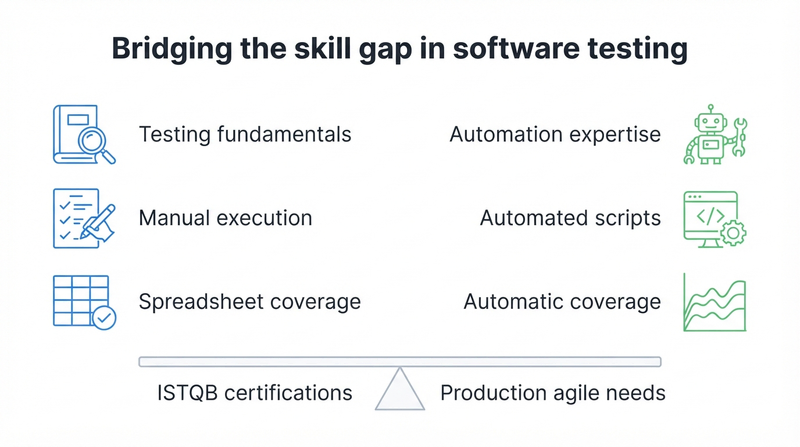
The candidate trained on manual execution writes test plans in spreadsheets. The candidate the organization needs writes automation scripts that run on every commit and block deployments when quality thresholds are not met. Coverage reports are generated automatically as part of the same workflow. That difference does not surface during onboarding.
A new hire running familiar manual checks on a development environment looks competent through the first sprint. The gap opens when the team needs regression coverage for a release candidate, and the manual approach falls behind the deployment schedule. By that point, the organization has spent onboarding time and sprint capacity on a hire whose output needs supervision that the team did not budget for.
54% of organizations have not automated the majority of their delivery processes, leaving manual workflows as the industry norm.
Manual testing does not scale with continuous delivery. A team releasing weekly or more frequently cannot sustain multi-day manual regression cycles that hold up each deployment. The QA Engineer who automates those regression suites reclaims the hours the team would otherwise spend on manual verification and eliminates the human error introduced by repetitive execution.
Performance and load testing add a second dimension to the automation divide. A Manual Tester does not design performance benchmarks or run stress tests against production-grade environments. These are engineering tasks that require tools such as JMeter and k6. Candidates without this background leave the team unable to detect performance degradation until end users report problems in production.
CI/CD integration separates otherwise capable automation Engineers from production readiness. A QA Engineer who writes automated tests in isolation, running them locally or on a separate schedule, misses the main goal: stopping bad code from reaching release without manual intervention. The point carries added weight where AI assistants generate a share of the commits, since the pipeline gate becomes the position from which a person reviews machine-written code before deployment. DevsData LLC puts candidates through CI/CD integration decisions during its practical assessment for that reason, rather than accepting a pipeline description on a resume.
The Digital.ai 18th State of Agile Report found that only 53% of organizations report their Agile and DevOps tools as well-integrated, leaving 47% with a tooling disconnect. A candidate who has never configured a quality gate, the automated checkpoint that halts a release when test results fall below set thresholds, brings a workflow that runs outside the delivery system rather than controlling the release path.
Catching these gaps during screening prevents the cost of a failed placement from compounding across sprint cycles. The criteria that separate a production-ready QA Engineer from one still working at the manual level require a structured evaluation framework, and that framework starts with distinguishing between required and preferred qualifications.
Do you have IT recruitment needs?
The same QA title on a resume appears whether the candidate automated a regression suite for a production pipeline or completed a certification exam on testing fundamentals. Generalist screening workflows pass both profiles to the interview stage without the depth to separate them, and the interview hours spent on mismatched candidates come out of sprint budgets the team is trying to protect.
Before the interview loop starts, the person building the job description settles one structural question first: whether the work is a fixed-term contract or a permanent position, then defines the technical bar that filters the rest of the search.
A one-time test automation buildout or a migration from manual to automated QA has a defined endpoint, making the engagement well-suited to a fixed-term staffing model. Ongoing QA ownership across sprint cycles requires someone who builds institutional knowledge of the codebase and the team’s testing conventions, absorbing the production environment’s failure patterns over months rather than weeks.
Structuring the recruitment process around that distinction early prevents candidates from being run through a framework that does not match the role’s demands. Whoever drafts the role requirements sets the bar that shapes every subsequent interview. The table below distinguishes between baseline requirements and preferred qualifications for QA Engineer roles in Agile delivery environments.
| Required skills | Preferred skills |
|---|---|
| Test automation framework proficiency sufficient to maintain regression suites covering AI-generated and hand-written production code | Performance and load testing experience with JMeter or k6 against AI-expanded production codebases |
| Programming depth in Python or JavaScript sufficient to review AI-generated production code | Security testing familiarity covering OWASP standards and AI-introduced vulnerability patterns |
| CI/CD integration experience configuring quality gates that hold AI-assisted commits before release | BDD framework experience (Cucumber or SpecFlow) for validating AI-drafted test documentation |
| API testing capability for validating service contracts against AI-generated integration code | Cloud platform testing across AWS or Azure environments hosting AI-assisted deployments |
| Version control through Git and proficiency with AI-enabled test management tooling | Mobile testing proficiency (Appium or equivalent) or review of AI-generated test libraries |
Programming depth in Python or JavaScript now sits in the required column rather than the preferred one across QA automation roles, the shift the skills table above reflects. Screening needs to reach beyond that filter to test the production depth that predicts on-the-job performance.
The BLS projects Software Quality Assurance Analyst and Tester employment to grow 10% to 2034, a rate classified as much faster than average across all occupations.
Preferred qualifications carry different weights depending on the organization’s operating context. Regulated industries in financial services and insurance place a premium on traceability. BDD practices using frameworks like Cucumber produce test cases in plain language that double as compliance documentation, and candidates with that background carry higher value where audits trace each test case to a business requirement.
High-velocity SaaS and eCommerce teams need QA Engineers who optimize test execution speed and handle upstream schema changes without manual intervention. Performance testing and parallel execution experience shift from preferred to near-required when deployments run daily.
Startup teams and lean enterprise engineering groups need hybrid profiles: Engineers who run manual exploratory testing and build automation, filling the full QA function without a dedicated team structure beneath them.
Familiarity with AI tools has become a screening variable over the past two years. The Digital.ai 18th State of Agile Report found that 41% of organizations are actively implementing AI tools across their teams, with 57% of adopters relying on code assistants.
Candidates who have tested alongside these tools have experience that maps to what most organizations now build: reviewing Copilot-generated code for hallucinated dependencies and security gaps that standard suites miss, and validating AI-drafted test scripts before they enter the pipeline.
The assessment that reveals production depth places the candidate in front of a realistic scenario: a feature with ambiguous acceptance criteria and a codebase with partial test coverage.
The evaluator notes whether the candidate asks clarifying questions about requirements and expected behavior, or proceeds on assumptions that leave the pipeline exposed to rework. That response pattern predicts how the hire functions when sprint priorities shift, and requirements arrive incomplete under deadline pressure.
What the market pays for production-grade QA proficiency varies by region, and the spread within each band maps to the capability dimensions tracked in the table.
Compensation turns the evaluation criteria into a budget line. The person building the sourcing strategy needs market-level data on what a QA Engineer costs across each region the organization hires from, not individual candidate expectations during offer negotiations.
The gap between junior and senior hires runs deeper than tenure: a Junior Engineer operates within existing test frameworks, and a Senior Engineer architects the automation infrastructure that the rest of the QA function depends on. Regional labor markets add a second variable to that spread.
Glassdoor and levels.fyi serve as the primary data source for the ranges below, cross-referenced with QA-specific salary benchmarks from verified compensation platforms. The US market sets the ceiling. The BLS median of $102610, documented in the preceding section, sits at the midpoint of a range that varies with automation depth and industry vertical.
The table below shows annual compensation ranges for Agile QA Engineer roles compiled from these sources as of early 2026.
| Region | Annual cost for Juniors | Annual cost for Seniors |
|---|---|---|
| United States | $70000-$110000 | $130000-$185000 |
| Western Europe | $50000-$80000 | $85000-$130000 |
| Poland and CEE | $28000-$45000 | $48000-$78000 |
| Latin America | $22000-$38000 | $40000-$65000 |
Western Europe runs roughly 25% to 35% below US rates at both tiers. Poland and Central and Eastern Europe compress that further, with senior ranges sitting at 35% to 42% of US figures. Latin America tracks close to CEE ranges for junior hires and falls slightly below at the senior level. For whoever sets the sourcing parameters, those percentage gaps shape the total cost more than any single candidate’s positioning within the band.
Cost-of-living differences account for part of the regional spread, but the concentration of QA engineering talent with automation backgrounds in each market shifts pricing in line with local demand.
Polish engineering communities hold a strong base of test automation talent relative to the wider region, with qualified candidates priced below the Western European range. Remote-first hiring across the industry has narrowed some regional differentials without closing them.
Cloud platform experience and CI/CD pipeline proficiency push candidates above the midpoint of their respective ranges. Performance testing depth and domain expertise in regulated verticals move them closer to the ceiling. An agency with compensation benchmarking data across concurrent searches helps the person approving the offer position the number competitively without overrunning the budget.
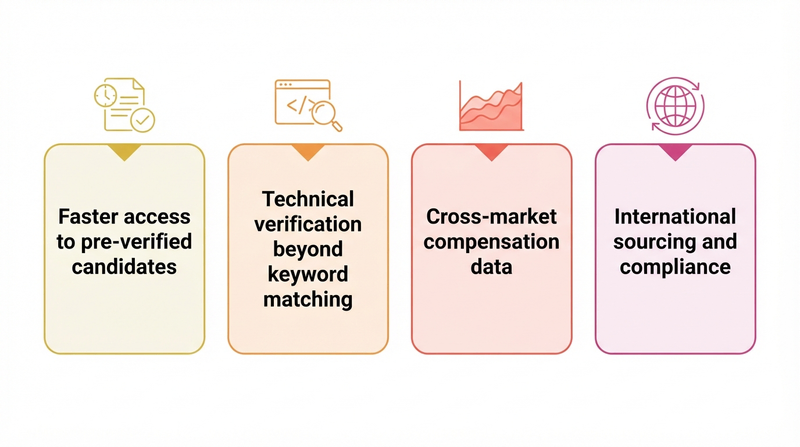
Filling a QA role within a single organization means running one search at a time, with compensation data drawn from a single market and a single seniority level. The cross-market visibility needed to position an offer against the ranges documented above requires sourcing volume that no single hiring cycle can produce.
Agencies accumulate that visibility through concurrent searches across regions and seniority tiers, building a dataset of candidate qualifications and pricing that compounds with each engagement. That accumulated data fills the visibility gap between the hiring decision and the market conditions mapped in the earlier sections.
Speed matters when a sprint deadline or product launch locks the delivery date. Agencies that maintain active databases of QA engineering professionals have pre-screened candidates through hands-on automation tasks rather than resume review, with each profile carrying a documented record of the frameworks the candidate has shipped.
Sourcing draws from this pre-verified pool rather than starting from public job board postings when a role opens. That head start compresses the window between role approval and a signed offer. For engineering teams already operating under sprint commitments, those weeks result in delayed features and missed release targets.
A resume listing QA and Agile does not confirm that the candidate has built automation frameworks or configured CI/CD quality gates. Agencies with QA recruitment depth test these distinctions through practical exercises: automation buildout tasks and pipeline integration scenarios under realistic time constraints. Defect triage rounds test how the candidate handles ambiguity when requirements shift mid-exercise.
Generalist Recruiters pass on candidates whose experience ends with manual test execution. The defects that those candidates miss surface during sprint cycles, not during onboarding. By the time the shortfall becomes visible, the team has absorbed rework across every build the flawed verification process touched.
The Digital.ai 18th State of Agile Report found that only 15% of business and executive leaders are actively involved in shaping Agile practices across their organization. When the person approving the headcount lacks delivery-side visibility, screening criteria default to keyword matching rather than capability verification.
The same report found that 50% of organizations lack AI/ML expertise within their QA teams, widening the distance between what internal screening identifies and what the role demands.
The World Quality Report found that 89% of organizations pursue generative AI in quality engineering, yet only 15% have achieved enterprise-scale deployment.
The compensation section documents range across four regions. Where a candidate falls within those ranges depends on the depth of automation and cloud platform experience. The industry vertical in which the organization operates further shifts the number. Agencies track these variables across concurrent searches, building compensation datasets that a single company filling a single role would not generate.
That data gives whoever negotiates the offer a tighter band to work within. An offer that undershoots loses the candidate. An offer that overshoots the market rate burns budget without improving the placement. Agencies operating across regions and seniority tiers calibrate both boundaries with data from live searches, not annual survey averages.
Strong concentrations of QA engineering talent with automation backgrounds exist in markets where technical communities have matured, including Eastern Europe and parts of Latin America. Business owners hiring internationally encounter contract structures and tax obligations that vary by jurisdiction.
Each country carries its own payroll registration requirements, and the compliance documentation for a single cross-border hire consumes administrative hours that the internal team would otherwise spend on candidate evaluation.
Agencies absorb this load through Employer of Record arrangements that handle payroll and tax compliance on the client’s behalf. The business owner hires a QA Engineer under a compliant contract without managing jurisdiction-specific legal work. For organizations sourcing from the Polish and CEE markets, where QA engineering talent costs 35% to 42% of US rates, the EoR model removes the administrative barrier that otherwise delays those hires.
DevsData LLC has operated across both talent placement and hands-on technical delivery for a decade, and that dual practice keeps the evaluation process current with the frameworks QA Engineers use in production.
Website: www.devsdata.com
Team size: ~60 employees
Founded: 2016
Headquarters: Brooklyn, NY, and Warsaw, Poland
The screening rigor outlined above works only when the people running the evaluations have built the same kind of automated verification infrastructure the candidates describe on their resumes. An agency recruiting QA Engineers without running its own test automation and CI/CD delivery projects tends to evaluate candidates on secondhand information.
DevsData LLC has sat on both sides of that line for a decade, placing QA and software engineering professionals in organizations where automated quality verification and pipeline reliability directly affect revenue and release schedules.
A team of more than 60 spans both divisions, with the consulting division running cloud infrastructure and test-engineering builds that keep the recruitment practice current with the tools QA Engineers use in production environments.
The firm’s verified candidate database holds 95000 profiles. QA and test automation specialists in that pool have documented histories of framework buildout and CI/CD integration at production scale. Placement outcomes hold verified 5/5 ratings on Clutch and GoodFirms.

The client sees a candidate only after they clear the 90-minute production challenge, with in-house staff handling reference checks and salary discussions before any name reaches the hiring team.
Technical evaluation feeds into structured interviews, and HR advisory support runs alongside legal compliance guidance. The process scales to what the organization requires, running lean for early-stage startups and extending through the additional review layers that enterprise hiring brings.
Practical assessment is central to how DevsData LLC distinguishes production-grade QA Engineers from candidates still building their automation depth. The 90-minute challenge places the candidate in simulated production conditions: a feature arrives with ambiguous acceptance criteria, and the existing codebase carries partial test coverage.
The candidate builds a testing approach and makes CI/CD integration decisions within the time constraint. A parallel track involves identifying defects in the existing code under the same deadline pressure. A follow-up scenario introduces an upstream code change that breaks existing tests, measuring whether the candidate restructures the test suite or patches the failure without addressing the root cause.
A second evaluation layer measures how the candidate handles incomplete requirements. Does the person flag missing specifications or proceed on assumptions that leave the pipeline exposed to rework once production data arrives?
The response pattern predicts how the hire operates when sprint priorities shift and requirements arrive incomplete under deadline pressure. In-house staff verify references during English-language interviews and manage compensation discussions through to the final offer. The engagement model includes the following terms.
BCG and venture-backed companies from the US and Israel count among past clients. Academic partnerships and connections to QA engineering communities extend the sourcing network beyond public job boards.
A full portfolio of completed engagements is available on the case studies page. The recruitment assignments below placed engineering talent in environments where QA capabilities and software quality verification formed part of the placement criteria.
Project delivery work runs alongside the recruitment practice, keeping Recruiters up to date on test engineering tools and deployment workflows. The consulting engagements below reflect that capability.
Business owners seeking Agile QA Engineers who match their technical requirements reach DevsData LLC at general@devsdata.com or visit www.devsdata.com to connect with a Recruiter experienced in QA and software engineering roles.
Do you have IT recruitment needs?
Agile QA has moved from a manual testing function into an engineering discipline that governs what reaches production on every sprint cycle. Weak automation does not fail once and stop. Defects recur on every cycle, and the manual hours spent patching them compound across quarters until the team faces a full rebuild of the testing infrastructure. Those consequences turn the hiring decision into a financial variable rather than a routine headcount fill.
Resumes carry the same QA keyword whether the candidate ran manual checklists or architected automation frameworks on a production schedule, and screening rigor against that gap decides whether a placement holds or costs a full replacement cycle inside the first quarter.
Organizations filling these roles operate in a market where automation-proficient QA Engineers remain scarce relative to demand. AI-assisted development has expanded the volume of code entering production pipelines without a corresponding growth in the number of professionals who verify that output at scale.
The candidate pool of Engineers who architect automated verification systems and configure CI/CD quality gates has not expanded at the rate QA automation adoption has spread across industries. That imbalance puts pressure on every stage of the hiring process, from sourcing through final offer.
DevsData LLC operates under an official, government-approved license for recruitment services and maintains a database of 95000 verified candidates, including QA and test automation specialists with documented histories of framework deployments and CI/CD integration. Technical assessments evaluate the automation architecture and the depth of production-grade verification before candidates reach client interviews.
To discuss Agile QA recruitment needs, reach DevsData LLC at general@devsdata.com or visit www.devsdata.com.
Any questions or comments? Let me know on
Twitter/X.
Discover how IT recruitment and staffing can address your talent needs. Explore trending regions
like Poland, Portugal, Mexico, Brazil and more.
 Frequently asked questions (FAQ)
DevsData – your premium technology partner
DevsData is a boutique tech recruitment and software agency. Develop your software project with veteran engineers or scale up an in-house tech team of developers with relevant industry experience.
Free consultation with a software expert
🎧 Schedule a meeting
FEATURED IN


DevsData LLC is truly exceptional – their backend developers are some of the best I’ve ever worked with.”

Nicholas Johnson
Mentor at YC, serial entrepreneur


 Build your project with our veteran developers.
Explore the benefits of technology recruitment and tailor-made software.
Learn how to source skilled and experienced software developers.
Build your project with our veteran developers.
Explore the benefits of technology recruitment and tailor-made software.
Learn how to source skilled and experienced software developers.

Rebecca Botvin

Commercial Director

Tom Potanski
Manager




Categories: Big data, data analytics | Software and technology | IT recruitment blog | IT in Poland | Content hub (blog)














careers@devsdata.com









general@devsdata.com

"I interviewed about a dozen different firms. DevsData LLC is truly exceptional – their backend developers are some of the best I've ever worked with. I've worked with a lot of very well-qualified developers, locally in San Francisco, and remotely, so that is not a compliment I offer lightly. I appreciate their depth of knowledge and their ability to get things done quickly."

Nicholas Johnson
CEO of Orange Charger LLC,
Ex-Tesla Engineer,
Mentor at YCombinator
"DevsData reached out to us, as we've been looking to grow our engineering team in Europe and Poland. Communicating efficiently and professionally, DevsData made a strong impression with their understanding of the recruitment challenges we were facing. They designed a tailored recruitment process for our needs. I was impressed with the technical depth of their approach."

Karim Butt
Co-Founder & CTO at GlossGenius, Inc.
"Out of all the vendors we work with, DevsData clearly stands out. The quality of developers they deliver is beyond what we've received from any other vendor, and they've been able to send profile recommendations very quickly. I'm happy to be their reference for other companies from Israel and talk about their recruitment abilities and what they delivered for us."

Ran Eyal
Senior Manager at
ZIM Integrated
Shipping Services Ltd.
"DevsData demonstrated a strong degree of proactivity, taking time to thoroughly understand the problem and business perspective, and continuously suggesting performance and usability enhancements. Their app exceeded my expectations. I've worked with DevsData on numerous projects over the last 3 years and I'm very happy. Being both responsive and honest in communication."

Jonas Lee
Partner & Executive VP of Verus,
Financial LLC, Investor,
& Serial Entrepreneur
Acknowledgments