Thanks for subscribing.
Your gift is on the way.



Today’s businesses run on digital systems. From customer platforms and file storage to analytics dashboards and payment infrastructure, these tools are designed to streamline operations, accelerate processes, and enhance efficiency. But that efficiency depends on how reliably those systems perform.
When technology fails, the disruption is immediate. A delayed patch, network error, or server crash can interrupt a sales call mid-sentence, halt a product shipment, or prevent employees from accessing the necessary tools to work. These incidents are not rare. A recent industry survey found that 82% of businesses have faced unexpected downtime in the past few years, often with little warning and significant consequences. Downtime is not just a technical issue; it’s a business risk.
The Ponemon Institute estimates the average cost of downtime at up to $9000 per minute, depending on the systems involved and the scale of operations.
To address these risks, business IT support exists to prevent disruptions, respond effectively when problems arise, and maintain reliable access to critical systems. Services range from real-time monitoring and technical assistance to structured incident response and security support.
Evidence shows the value of this approach. Companies with full stack observability, meaning they continuously monitor performance, errors, and usage across applications, servers, networks, and cloud infrastructure, experience 79% less downtime and 92% lower outage costs annually. Elsewhere, businesses investing in redundant systems and regular IT testing protocols reduce downtime by an average of 71%. Meanwhile, the managed IT services market continues to grow steadily, with projections reaching nearly $879 billion by 2032.
This guide explains how business IT support works, the various available service models, the functions it covers, and how companies can develop a support strategy tailored to their needs.
Business IT support refers to the ongoing services and processes that keep a company’s digital systems functional, secure, and accessible. It includes real-time monitoring, user assistance, system maintenance, and structured incident response. Rather than reacting only when something breaks, adequate IT support focuses on preventing issues, resolving them quickly when they occur, and maintaining the overall stability of business operations.
Most companies rely on a combination of tools, including cloud platforms, internal networks, business applications, and connected devices. When one part fails, the effects often ripple across departments. For example, if the company’s email server goes down, the sales team may be unable to send proposals, HR might miss candidate applications, and customer service could lose track of support tickets. Without dedicated support, minor issues can escalate, security risks increase, and productivity suffers. IT support provides companies with the structure and expertise necessary to manage these systems, minimize downtime, and operate with fewer disruptions.

Business IT support includes a range of services designed to keep digital systems running smoothly and to limit disruption when issues arise. These services cover both user-facing problems and behind-the-scenes operations that help prevent failures, maintain security, and support daily work.
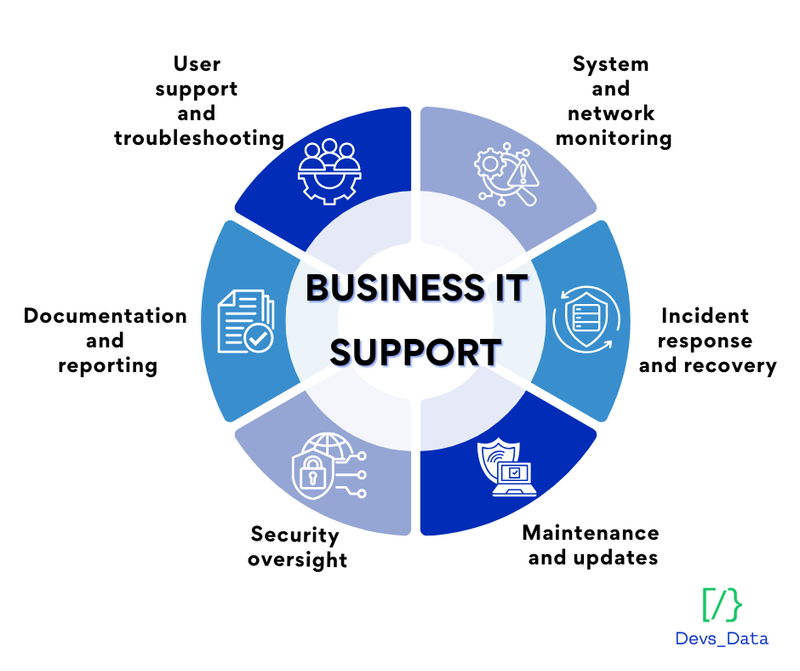
The most visible part of IT support involves helping employees resolve issues with devices, software, or access. This could include password resets, software errors, email problems, or system crashes. Fast, reliable assistance prevents delays and helps teams stay focused on their work.
Support teams monitor servers, cloud infrastructure, applications, and network traffic to detect signs of problems before users notice them. Monitoring tools send alerts when something falls outside normal behavior, allowing early intervention. This helps reduce downtime and catch issues before they escalate.
When a serious problem occurs, such as a server failure, data loss, or cyberattack, support teams act to contain the damage and restore operations. They follow predefined steps to isolate the issue, recover affected data, and bring systems back online. A clear response process limits the impact on the business and shortens recovery time.
Keeping systems secure and stable requires regular attention. This includes applying software patches, updating firmware, removing unused tools, and checking system performance. Preventive maintenance helps avoid security risks, compatibility issues, and performance bottlenecks.
Support teams help protect the business from cyber threats by monitoring for suspicious activity, managing user access, and responding to potential breaches. They also assist with implementing basic security practices like two-factor authentication and access restrictions. Without this layer of protection, systems are more vulnerable to attack.
Maintaining records of system changes, incidents, and recurring problems supports future planning and compliance efforts. Support teams document the actions taken, how issues were resolved, and patterns that may point to systemic issues. This process improves decision-making and helps the business prepare for audits or operational transitions.
Together, these functions form the foundation of effective IT support. How they are delivered in practice depends on how a company structures its support resources, which brings us to the main organizational models businesses use today.
Businesses have several options when deciding how to organize their IT support. Each model offers a different balance of control, cost, and flexibility. The right choice depends on the company’s size, structure, and technical requirements.
In this model, the company manages its own internal IT team. This allows for direct oversight, close coordination with other departments, and faster response to on-site issues. It is often preferred by businesses with strict data handling policies, custom-built systems, or a need for full control over operations.
However, building and maintaining an internal team requires significant investment. Salaries, ongoing training, and infrastructure add to long-term costs. For example, hiring just three mid-level IT specialists in the US can cost $240000-$300000 per year in salaries alone, with an additional $20000-$50000 annually for equipment, software licenses, and training. For smaller companies or those with limited technical needs, this model can be difficult to sustain.
With outsourced support, a third-party provider handles part or all of the IT responsibilities. This approach can be more cost-effective and offers access to a broader range of expertise. For instance, a small business might pay $3000-$7000 per month for a managed IT service package that covers 24/7 monitoring, help desk support, and security management – often far less than the annual cost of hiring a full in-house team. It’s beneficial for companies that need round-the-clock support or lack in-house resources to manage infrastructure and security.
While outsourcing reduces the burden on internal teams, it requires careful communication and clear service agreements. Businesses must ensure that the provider understands their systems, responds within acceptable timeframes, and offers visibility into performance and outcomes. They should also consider potential risks, such as dependency on a single vendor, limited control over critical infrastructure, and exposure to security or data protection issues if safeguards are not clearly defined.
Many organizations choose a hybrid model that combines internal staff with external support. For example, internal IT might handle daily user requests, while an outside partner manages cloud infrastructure or provides after-hours coverage.
This setup allows companies to maintain control over sensitive areas while scaling support efficiently. It’s often a practical middle ground for businesses with growing needs but limited capacity to expand their internal teams.
To make the differences clearer, the table below summarizes the main advantages, drawbacks, costs, and best-fit scenarios of each IT support model.
| Model | Key advantages | Main drawbacks | Typical cost range | Best for |
|---|---|---|---|---|
| In-house | Direct oversight, close coordination, faster on-site response, full control | High salaries, training, and infrastructure costs | About $240000-$350000 annually for a small team | Large firms, strict compliance, custom systems |
| Outsourced | Lower upfront cost, 24/7 coverage, wide expertise, scalable | Less control, dependency on vendor SLAs, requires strong communication | About $3000-$7000 per month (managed services) | SMEs, companies lacking in-house resources |
| Hybrid | Balance of control and flexibility, scalable, mix of internal focus and external expertise | Can be complex to manage responsibilities between teams | Varies depending on a mix of in-house vs. outsourced | Growing businesses with mixed needs |
In practice, the right model depends on how critical IT systems are to daily operations and how much internal capacity a company has. Businesses with complex infrastructure, strict compliance requirements, or proprietary platforms often benefit from in-house teams. Smaller organizations and fast-growing startups may prefer outsourced support to control costs and access specialized expertise quickly. Hybrid models tend to suit companies in transition, allowing them to retain internal oversight while scaling support through external partners.
Do you have IT recruitment needs?
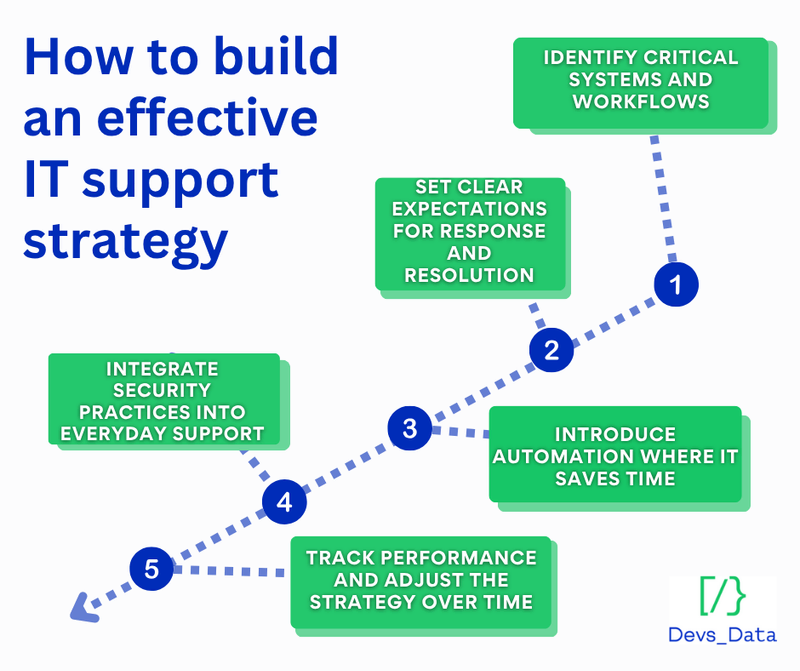
An effective IT support strategy is not just a list of tools or services; it’s a framework that reflects how a company works, what it depends on, and where its risks lie. A well-structured approach allows teams to resolve issues quickly, prevent avoidable problems, and align support resources with actual business needs.
Start by mapping out which systems are essential to day-to-day operations. These might include payment platforms, internal databases, CRM systems, or collaboration tools. It’s equally important to understand how these systems interact, where data is exchanged, and which processes depend on multiple platforms working together.
Understanding which tools and integrations directly affect revenue, service delivery, or compliance helps determine where to focus support efforts. Knowing how failures in one system can impact others allows teams to prioritize issues more accurately and avoid wasting time on less critical problems. This step helps the company define which incidents require immediate attention and which can follow a standard response.
Support works best when everyone understands how and when issues will be handled. Define how quickly support teams should respond, how problems are escalated, and what level of communication users should expect along the way.
This avoids confusion and helps manage expectations during high-pressure situations. Additionally, it provides the support team with clear guidelines for measuring their performance.
Routine tasks, such as patch deployment, password resets, or device updates, can often be automated. Doing so reduces manual workload and speeds up response times, especially for frequent, low-risk requests.
Automation frees technical staff to focus on issues that require deeper analysis or coordination. It improves consistency and reduces the risk of human error.
Support teams play a key role in identifying and containing security risks, working closely with internal or external cybersecurity specialists who define policies, monitor threats, and lead incident investigations. Whether it’s noticing an unusual login, handling a phishing report, or locking a compromised account, response speed makes a difference.
Security should not be managed separately from support. Including it in your strategy helps protect the organization and ensures that risks are addressed early.
Measure how well your support system is working using metrics like response time, resolution speed, number of repeat issues, and user satisfaction. These indicators help reveal patterns that can guide staffing, training, or process updates.
A good strategy is flexible. As the business grows or changes direction, support processes should evolve to reflect new systems, new risks, and new expectations.
Outsourcing business IT support allows companies to maintain stable systems, reduce downtime, and manage growing infrastructure without building large internal teams. Instead of reacting to technical problems as they arise, organizations gain access to structured monitoring, incident response, and preventive maintenance delivered by dedicated specialists.
Building an internal IT support function requires long-term investment in salaries, training, monitoring tools, and security systems. Partnering with an agency provides access to these capabilities through a predictable service model, without the ongoing cost of maintaining a full internal team.
IT support agencies specialize in managing complex environments that include cloud platforms, internal networks, business applications, and security controls. Their experience across multiple infrastructures allows them to resolve incidents faster, identify recurring risks, and apply proven operational practices.
As companies grow, add new systems, or expand to new regions, support demands increase. An agency can adjust staffing, coverage hours, and technical resources without disrupting daily operations. This helps businesses maintain service quality during periods of rapid change.
Many technical incidents occur outside standard business hours. IT support agencies provide structured on-call services, 24/7 monitoring, and escalation procedures that reduce recovery time and limit business disruption.
Partnering with an IT support agency gives organizations access to consistent operational support, proactive system management, and reliable incident response. The next step is understanding how to select a provider that can deliver these capabilities in practice.
Choosing an external IT support provider is more than just a technical decision. It influences how efficiently your systems run, how quickly problems are resolved, and how smoothly your business can scale in the future. Let’s look at how to make this choice in a way that improves system efficiency, speeds up problem resolution, and supports smooth business growth.
The provider should understand the types of systems your company uses and the industry you operate in. Familiarity with standard tools, compliance requirements, and operating models can reduce onboarding time and improve service quality. Ask whether they’ve supported businesses similar in size, structure, or technology stack.
Support is only useful if it’s there when you need it. Confirm coverage hours, response times for different issue levels, and how emergencies are handled. Ask how security incidents are escalated, who is responsible for containment, and how quickly compromised systems or accounts can be isolated. If your business operates across time zones or depends on late-night access, make sure the provider can match that rhythm.
A good provider should offer visibility into both operational and security-related work. Ask how they track issues, monitor system health, document security events, and communicate during incidents. Regular reports should include not only uptime metrics but also access reviews, vulnerability findings, and remediation actions.
Even outsourced support must work alongside internal IT and cybersecurity roles. Understand how handoffs happen, how sensitive access is managed, and how responsibilities are shared during incidents. A strong partner follows your security policies, access controls, and approval processes rather than bypassing them for convenience.
Your needs today may look very different in a year. Choose a partner who can grow with your business while adapting to new compliance requirements, threat patterns, and infrastructure changes. Ask how they update security practices as systems scale and whether they provide ongoing risk assessments and audits.
To see what this looks like in practice, let’s take a closer look at how DevsData LLC supports businesses through long-term IT support partnerships.
Website: www.devsdata.com
Team size: ~60 employees
Founded: 2016
Headquarters: Brooklyn, NY, and Warsaw, Poland
DevsData LLC provides structured IT support services to companies in North America, Latin America, and Europe. With over ten years of experience, the company has established itself as a trusted partner for businesses that require stable and well-managed technical operations. Our clients include early-stage startups and large multinational firms, each with specific support needs and infrastructure demands.
Our team at DevsData LLC includes professionals with 10+ years of experience in system maintenance, infrastructure oversight, and incident response. Many are Google-level engineers from Europe and the US, bringing practical knowledge and careful attention to detail to every engagement.
Support services are tailored to the tools, workflows, and environments used by each client. This includes user assistance, routine system maintenance, response planning, and long-term infrastructure monitoring. DevsData LLC collaborates closely with internal teams to define responsibilities, establish response times, and maintain clear communication channels. Familiar tools like Jira, Slack, or Microsoft Teams are used to maintain coordination and avoid unnecessary delays.
Clients receive structured reports, documented issue logs, and performance reviews based on agreed metrics. This gives businesses insight into system health and highlights areas for improvement. Contracts include specific terms that address data security, access control, and intellectual property protection. These agreements are adapted to cross-border work and reflect the operational realities of international teams.
DevsData LLC also offers a wide range of services, including web development, mobile app development, product development, cloud infrastructure, UI/UX design, Big Data, machine learning (ML), and complex backend systems.
A prime example of DevsData LLC’s expertise is a project delivered by our development and support team in Eastern Europe, where we designed and built a custom ERP and project management platform for a financial services firm and then provided ongoing operational support. The system replaced a mix of Jira and complex spreadsheets, enabling clear task and resource tracking, permission management, and automated communication.
Built with Vue.js, Node.js, and MySQL, the platform was developed with strict security requirements in mind and continues to be maintained through regular updates, performance monitoring, and incident support. Today, it serves as a central tool in the client’s daily operations, supported by structured maintenance and reliability practices.
DevsData LLC has supported companies such as Orange Charger LLC and SZIC.pl, Kroll, and MeWe, contributing to a portfolio of more than 100 successful projects delivered for over 80 clients worldwide.
Beyond support-focused projects, the company has led several technical engagements that involved both development and infrastructure coordination. Here are a few highlights:
These are just a few examples from DevsData LLC’s portfolio. If you’d like to see more, you can explore additional case studies on the DevsData LLC website.
Businesses partner with DevsData LLC for reliable, long-term IT support backed by deep technical expertise, consistent service quality, and a proven ability to adapt to diverse operational needs.
In addition to IT support and development services, DevsData LLC provides end-to-end recruitment and Employer of Record (EoR) solutions for businesses looking to expand their technical teams. With access to a wide network of vetted engineers across Eastern Europe and Latin America, the company helps clients fill critical roles quickly and compliantly. DevsData LLC manages everything from candidate sourcing and technical screening to legal employment, payroll, and local compliance, allowing companies to onboard talent without setting up a local entity.
Do you have IT recruitment needs?
IT support plays a practical role in keeping systems stable, helping teams stay productive, and reducing the risk of unexpected downtime. As companies rely more heavily on digital tools, structured support becomes a necessary part of daily operations. Whether handled internally or through a partner, a clear support strategy allows businesses to manage change, respond to issues, and maintain reliable performance over time.
DevsData LLC has over ten years of experience providing long-term IT support and infrastructure services across industries. We have delivered more than 100 successful projects for over 80 clients, including multinational corporations and fast-growing startups.
Our support work focuses on maintaining critical systems, resolving issues efficiently, and aligning with each client’s existing tools and workflows. This experience helps clients build environments that function predictably and evolve as their needs grow. With a structured support approach and strong technical expertise, DevsData LLC contributes to stable day-to-day operations and long-term business continuity.
To learn more about how DevsData LLC can support your business with IT recruitment or compliant international hiring, get in touch with the team at general@devsdata.com or visit www.devsdata.com.
Any questions or comments? Let me know on
Twitter/X.
Discover how IT recruitment and staffing can address your talent needs. Explore trending regions
like Poland, Portugal, Mexico, Brazil and more.
 Frequently asked questions (FAQ)
DevsData – your premium technology partner
DevsData is a boutique tech recruitment and software agency. Develop your software project with veteran engineers or scale up an in-house tech team of developers with relevant industry experience.
Free consultation with a software expert
🎧 Schedule a meeting
FEATURED IN
DevsData LLC is truly exceptional – their backend developers are some of the best I’ve ever worked with.”

Nicholas Johnson
Mentor at YC, serial entrepreneur


 Build your project with our veteran developers.
Explore the benefits of technology recruitment and tailor-made software.
Learn how to source skilled and experienced software developers.
Build your project with our veteran developers.
Explore the benefits of technology recruitment and tailor-made software.
Learn how to source skilled and experienced software developers.

Rebecca Botvin

Commercial Director

Tom Potanski
Manager




Categories: Big data, data analytics | Software and technology | IT recruitment blog | IT in Poland | Content hub (blog)













careers@devsdata.com









general@devsdata.com

"I interviewed about a dozen different firms. DevsData LLC is truly exceptional – their backend developers are some of the best I've ever worked with. I've worked with a lot of very well-qualified developers, locally in San Francisco, and remotely, so that is not a compliment I offer lightly. I appreciate their depth of knowledge and their ability to get things done quickly."

Nicholas Johnson
CEO of Orange Charger LLC,
Ex-Tesla Engineer,
Mentor at YCombinator
"DevsData reached out to us, as we've been looking to grow our engineering team in Europe and Poland. Communicating efficiently and professionally, DevsData made a strong impression with their understanding of the recruitment challenges we were facing. They designed a tailored recruitment process for our needs. I was impressed with the technical depth of their approach."

Karim Butt
Co-Founder & CTO at GlossGenius, Inc.
"Out of all the vendors we work with, DevsData clearly stands out. The quality of developers they deliver is beyond what we've received from any other vendor, and they've been able to send profile recommendations very quickly. I'm happy to be their reference for other companies from Israel and talk about their recruitment abilities and what they delivered for us."

Ran Eyal
Senior Manager at
ZIM Integrated
Shipping Services Ltd.
"DevsData demonstrated a strong degree of proactivity, taking time to thoroughly understand the problem and business perspective, and continuously suggesting performance and usability enhancements. Their app exceeded my expectations. I've worked with DevsData on numerous projects over the last 3 years and I'm very happy. Being both responsive and honest in communication."

Jonas Lee
Partner & Executive VP of Verus,
Financial LLC, Investor,
& Serial Entrepreneur
Acknowledgments