Thanks for subscribing.
Your gift is on the way.



Companies compete fiercely for Software Engineers, yet the number of qualified professionals entering the workforce grows at a slower rate. The expansion of digital services, cloud adoption, and automation has increased demand across nearly every sector, while universities and training programs produce far fewer graduates than companies require. As a result, vacancies remain unfilled for extended periods, projects slow down, and smaller firms struggle to compete with large employers offering higher salaries and extensive benefits.
Software engineering staffing agencies help companies address these pressures by linking them with vetted specialists who meet specific technical needs. These partnerships shorten hiring cycles, reduce the risk of mismatches, and allow internal teams to focus on development rather than prolonged recruitment.
The importance is reflected in industry forecasts: the global engineering software sector is expected to grow to $246.51 billion by 2034, at an annual rate of 18.45% from 2025. Accelerating enterprise AI adoption, the shift from on-premises to cloud infrastructure, and expanding automation requirements across regulated industries are driving this momentum.
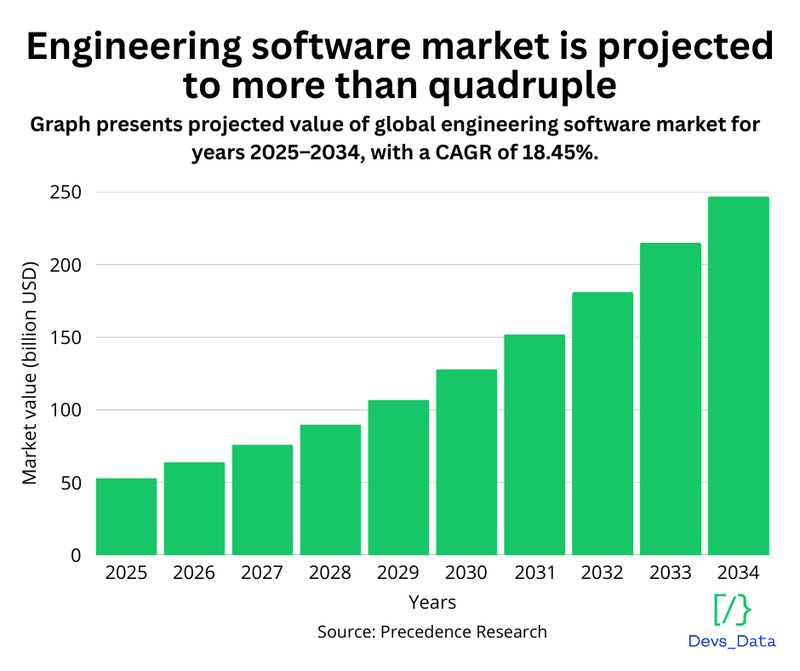
This explosive growth reflects the increasing digitalization across industries and the rising demand for specialized technical solutions.
Simultaneously, US government data anticipate 140100 new software developer positions annually, creating unprecedented recruitment challenges for technology departments nationwide.
The following sections examine what Software Engineers do, why hiring them presents unique challenges, and how DevsData LLC’s specialized staffing partnerships can deliver exceptional technical talent.
Software Engineers apply programming expertise and engineering methods to design solutions that shape modern life. Their work spans video games, business applications, operating systems, and network management tools. Engineers contribute across industries such as automotive, aviation, healthcare, telecommunications, and security, tackling projects that range from mobile apps to enterprise platforms. Roles within the field include Application Developers, System Architects, Mobile Specialists, Quality Testers, and Database Experts, each addressing different technical challenges.
The introduction of AI-powered development tools has reshaped the way these roles operate in practice. Engineers now spend less time writing code from scratch and more time reviewing AI-generated outputs, designing system architectures, and supervising automated workflows. Companies hiring for these positions evaluate a different mix of skills than they did five years ago, with prompt engineering and proficiency in AI tools appearing alongside traditional programming requirements.
While many professionals hold a bachelor’s degree in computer science or related fields, employers increasingly recognize alternative paths. Coding bootcamps, specialized certifications, and strong project experience often serve as viable entry points, reflecting the growing emphasis on practical ability over formal education. At the same time, the rise of remote work has expanded opportunities for engineers to collaborate internationally, further increasing the demand for skilled professionals worldwide.
They build new systems and maintain existing ones. Their work spans creation, testing, and ongoing support.
The typical Software Engineer’s workday might involve:
| Software Engineer’s daily tasks | Description |
|---|---|
| System design | Crafting and supporting software systems or applications. |
| Evaluation and testing | Analyzing and testing newly developed software programs. |
| Performance optimization | Refining software for maximum efficiency and growth capacity. |
| Code development | Developing and validating code components. |
| Compatibility verification | Verifying functionality across multiple operating environments. |
| Standards implementation | Establishing technical standards within an organizational infrastructure. |
| Documentation | Creating comprehensive system documentation. |
| Update management | Implementing periodic software updates. |
| Cross-team collaboration | Working with development teams, architects, and data professionals. |
These responsibilities show that Software Engineers operate across the full product lifecycle, from initial system design through long-term maintenance. Hiring decisions should reflect this breadth rather than focusing solely on coding ability.
Software Engineers receive competitive compensation due to market demand and technical capabilities.
Entry-level Software Developers in the US earn an average of $119000 annually as median total pay.
Companies compete with salary offers that outpace most other professional roles. Compensation packages reflect the critical value these professionals bring to modern organizations.
Salaries for careers with a software engineering degree:
| Career | Experience: 0-1 year | Experience: 4-6 years |
|---|---|---|
| Applications Architect | $104000-$179000 yearly | $123000-$194000 yearly |
| Computer Systems Analyst | $68000-$114000 yearly | $83000-$139000 yearly |
| Software Developer | $73000-$114000 yearly | $91000-$157000 yearly |
| Software Quality Tester | $56000-$91000 yearly | $75000-$122000 yearly |
Source: Glassdoor
Compensation for Software Engineers varies widely depending on geography, experience, and employer. Here’s a snapshot of typical averages in several global markets:
| Country | Approximate average annual salary |
|---|---|
| United States | $120000-$124000 |
| Germany | €65000 (~$75000) |
| United Kingdom | £52000 (~$68000) |
| Australia | AUD 120000 (~$82000) |
| Canada | CAD 98000 (~$75000) |
| India | ₹900000 (~$10400) |
Source: CareerFoundry
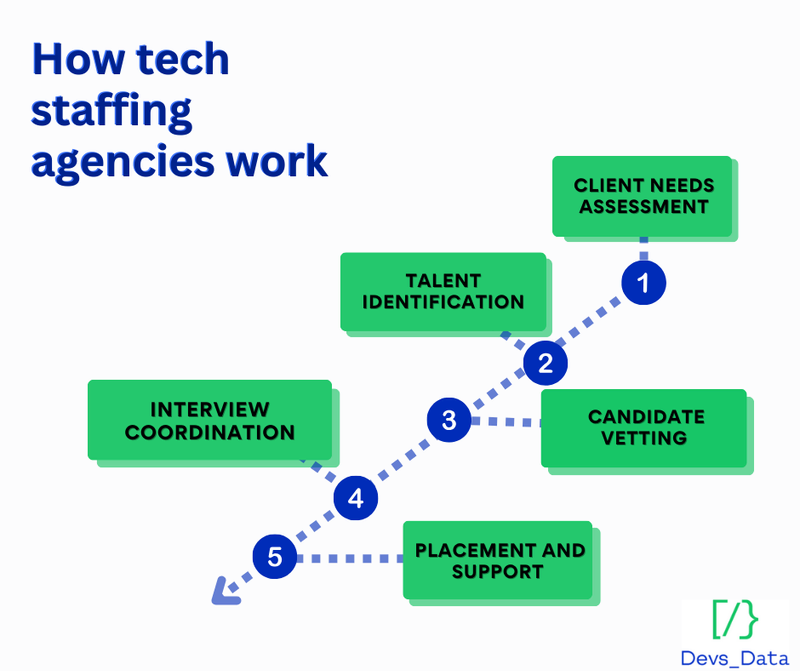
Technical recruitment firms serve as intermediaries between organizations with open engineering positions and Software Developers seeking roles that match their specialization. These agencies maintain structured workflows covering intake, sourcing, technical evaluation, and placement, each stage designed to reduce time-to-hire and improve candidate-role alignment.
Organizations reach out to tech recruiters when they require specialized developers. The recruitment firm provides details about technical skill requirements, project scope, salary ranges, and contract duration. Specific technology expertise, such as React proficiency or cloud experience, is often specified. After discussions, both parties sign an agreement that sets the service terms, payment details, and conversion options for temporary roles. Requirements now frequently include proficiency with AI-assisted development tools, experience supervising automated code-generation workflows, or the ability to integrate machine learning components into existing systems.
Recruiters tap into their existing database of vetted professionals or launch targeted searches for candidates. They maintain continuous recruitment efforts through job boards, networking events, and referral programs. This ongoing activity ensures a ready supply of developers with varied skills and experience levels. Technical professionals register with these firms, undergo preliminary assessments, and remain in the talent pool until suitable matches arise.
Technical specialists undergo thorough screening procedures upon applying. The evaluation includes skills tests, code samples review, and technical interviews. Firms verify professional backgrounds, check references, and sometimes conduct security clearances for sensitive positions. Recruiters also enhance resumes to showcase relevant projects and technical achievements that align with client needs. Screening criteria have expanded to include familiarity with AI-powered development environments and the ability to review, validate, and refine machine-generated code.
Strong candidates progress to meetings with potential employers. The staffing agency arranges these sessions and prepares both parties with relevant information. Interviews typically cover technical competencies, team dynamics, and project specifics. Recruiters share feedback on technical performance, compensation expectations, and cultural alignment, helping both sides address concerns early.
Once selected, professionals join client teams while remaining employed by the staffing firm. The agency handles administrative aspects, including payroll processing and benefits management. Meanwhile, clients direct daily work activities and technical priorities. Recruiters maintain regular contact with both parties throughout the engagement. They resolve issues, gather feedback, and sometimes provide additional training to ensure successful outcomes.
Do you have IT recruitment needs?
Software Engineers sit at the center of digital progress. Their work drives innovation and keeps companies competitive. Yet building strong development teams is far from easy. Employers face persistent obstacles in finding, evaluating, and keeping qualified talent.
Hiring qualified Software Engineers remains a challenge for many organizations, though the nature of the difficulty has shifted. Raw candidate volume has risen, yet employers struggle to find engineers whose skill sets match the demands of AI-augmented development workflows and modern cloud architectures. Salaries and benefits continue to rise, making it harder for smaller firms to match offers from major employers. Remote work has widened the competition further.
Between 2018 and 2024, median base pay for Software Developers grew by 24%, compared to 30% for all US workers, reflecting market pressures and shifts.
Staffing agencies help by maintaining pre-vetted talent pools and using their networks to connect employers with candidates they might not reach on their own.
Technical hiring cycles often extend for months. Multiple interview rounds and assessments slow decision-making, and code challenges require significant time commitments. These delays often push candidates to withdraw. Hiring managers must balance thorough evaluation with speed, but long processes strain budgets and internal resources.
Specialized staffing agencies streamline these steps by handling screenings, coordinating interviews, and presenting only qualified candidates, reducing both time-to-hire and workload for internal teams.
Technical evaluations often fail to predict on-the-job performance. Coding tests may not reflect real-world problem-solving abilities. Soft skills assessment remains subjective and difficult to standardize. Communication abilities prove critical yet challenging to measure. Team collaboration potential requires nuanced evaluation approaches.
Specialized staffing agencies streamline the process by handling skills screenings, initial interviews, and technical assessments. Their experience allows them to match candidates on technical ability, soft skills, and cultural fit, reducing time-to-hire and the risk of poor placements.
The rise of artificial intelligence is transforming how companies structure their engineering teams and the types of skills they require. As AI-powered tools take on more coding and automation tasks, organizations increasingly seek engineers who can oversee, guide, and optimize these systems. Recent data shows that job postings for Software Engineers have declined by more than one-third since 2020, and some major employers, such as Salesforce, have indicated they may reduce traditional engineering hires in favor of AI-driven productivity.
Today, companies like GitLab report that developers spend only 25% of their time coding, with the rest devoted to design, oversight, and collaboration tasks. Smaller, AI-augmented teams, like those at Linear and Bluesky, demonstrate how businesses can scale with fewer engineers. For hiring teams, recruitment efforts must focus on adaptability, creativity, and the ability to work alongside advanced technology, rather than purely traditional coding skills.
Staffing agencies responding to this shift redesign their assessment pipelines to reflect the changing nature of the role. While traditional screenings focused on writing code under timed conditions, agencies now evaluate system design thinking, proficiency with AI tools, and the ability to critically review machine-generated code. DevsData LLC, for example, conducts a 90-minute problem-solving assessment that tests analytical reasoning, communication, and programming, giving clients a view of how a candidate performs across the full scope of modern engineering work.
Retention depends less on pay and more on growth opportunities, which often prompt engineers to change roles. Company culture then becomes a decisive factor in long-term satisfaction. Mentorship and learning pathways influence staying power. Work-life balance expectations continue to evolve. Organizations struggle to build environments that foster lasting commitment.
Agencies support long-term matches by considering career growth, professional development opportunities, and team compatibility – factors that promote satisfaction and reduce turnover.
Partnering with software engineering staffing agencies offers clear advantages but comes with notable trade-offs. These firms provide pre-vetted developers and handle technical assessments, but they also introduce costs and limitations that require careful consideration. Understanding both sides helps organizations decide when agency partnerships make strategic sense.
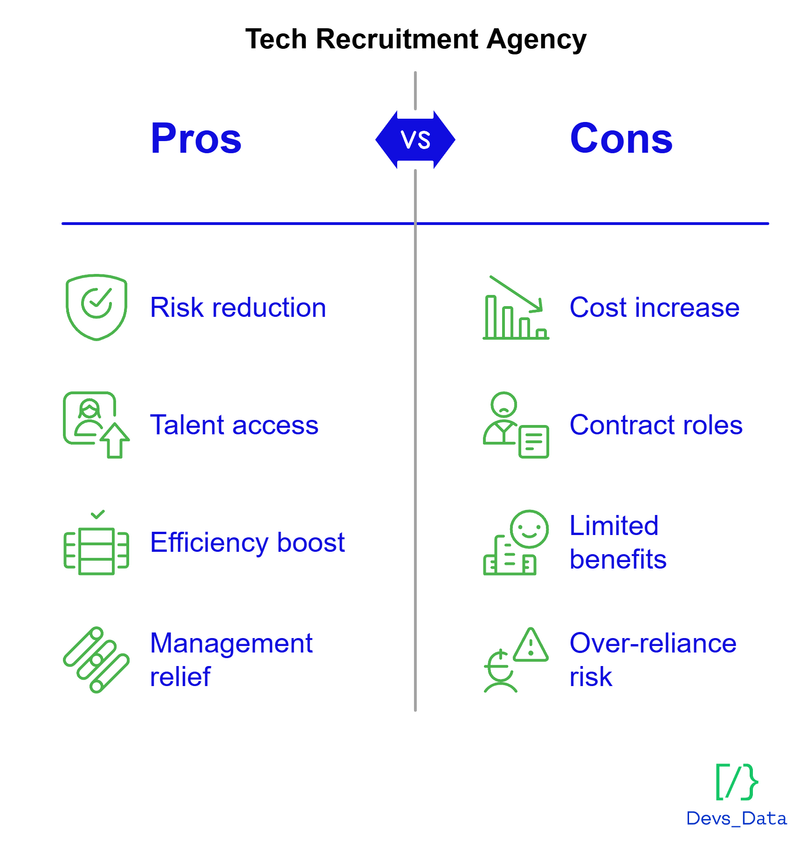
Technical recruitment firms offer distinct advantages that address common hiring bottlenecks. These benefits explain why organizations turn to specialized agencies despite the associated costs.
Agencies screen candidates through technical challenges before companies invest interview. This vetting reduces the risk of hiring failure and the financial and operational costs of placing someone who underperforms and needs to be replaced. Reference checks and code reviews happen before candidates reach your team, shifting the evaluation burden to specialists who assess developers daily.
Recruitment firms maintain databases of engineers who are not actively job searching. These passive candidates often possess stronger skills than those flooding job boards, since top performers rarely need to advertise availability. Agencies reach this hidden talent pool through referrals and long-term relationship building that individual companies cannot replicate efficiently.
Technical recruiters handle job postings, resume screening, initial interviews, and scheduling coordination. This administrative work consumes significant internal hours when managed by engineering leaders. Transferring these tasks to agencies allows technical managers to focus on architecture decisions and team development rather than recruitment logistics.
Agencies employ contract developers directly, managing payroll processing, benefits administration, and tax compliance. Companies can conduct daily operations without handling employment paperwork. This arrangement proves particularly valuable for short-term projects where a full hiring infrastructure would create unnecessary overhead.
Agency partnerships introduce tradeoffs that require careful consideration. Understanding these limitations helps organizations make informed decisions about when external recruitment support makes sense.
Agency fees typically add 20-75% above base developer rates for contract roles. An $100 hourly engineer becomes $120-175 through an agency. Permanent placements cost 10-20% of first-year salary. These premiums strain budgets, particularly for smaller organizations competing with well-funded rivals that can afford to hire direct teams.
Many agency placements involve temporary assignments rather than permanent positions. Developers working through staffing firms often lack the same level of commitment as direct employees. Project knowledge leaves when contracts end, forcing companies to restart knowledge transfer with replacement contractors. This turnover disrupts team stability.
Contract engineers typically receive fewer benefits than permanent staff. Health insurance, retirement contributions, and paid time off often fall below company standards. This disparity can create tension within mixed teams where contractors work alongside employees receiving superior compensation packages. Talented developers may leave for direct roles offering better total compensation.
Companies that depend heavily on agency talent sometimes neglect building internal recruitment capability. When agencies fail to deliver or relationships sour, organizations lack alternatives. Technical debt accumulates when temporary contractors implement quick solutions without considering long-term maintenance. Knowledge concentration among external workers weakens the company’s ability to operate independently.
Do you have IT recruitment needs?
These advantages and limitations shape how organizations approach technical staffing decisions. The cost savings from faster hiring and reduced administrative burden often justify agency premiums, while the risks of contractor turnover require mitigation through strong onboarding and knowledge management practices. Managing over-reliance starts with a clear policy: Define which roles stay internal, rotate critical system ownership away from contract-only staff, and invest in internal hiring capability alongside agency partnerships.
Pairing each contractor with a permanent team member for ongoing knowledge sharing reduces the disruption when engagements end. Success depends on selecting partners whose evaluation methods align with your technical standards and whose pricing models fit your budget constraints. The next section examines specific criteria that separate strong technical staffing agencies from mediocre alternatives.
Partnering with a technical recruitment firm benefits both employers and software professionals. Developers gain access to varied project opportunities, while companies receive vetted technical talent. Speed matters, particularly during critical development phases when technical bottlenecks can delay product launches. Timely provision of qualified engineers should be one factor among several when selecting potential agencies, alongside considerations like candidate technical proficiency, team compatibility, specialized programming knowledge, and value for investment.
Clear communication and regular progress reporting are essential. The best staffing partners keep clients updated at every stage, share candidate feedback promptly, and address any concerns as they arise. Consistent updates help align expectations and prevent misunderstandings throughout the hiring process.
Checking references is also crucial. Look for agencies with a proven track record and positive feedback from past clients. Verified references and testimonials assure the agency can deliver the quality and reliability your business needs.
Below are key elements to consider when selecting a technical staffing partner.
Does the agency focus specifically on software development recruitment? While generalist staffing firms may provide adequate candidates, those dedicated to technical recruitment typically maintain deeper pools of engineers with verified programming skills, framework experience, and development methodologies aligned with your technology stack.
Technical staffing agencies often use different pricing models depending on their niche and the complexity of their roles. At this stage, ask for precise details on their markup rates, permanent placement fees if you plan to convert contractors to full-time, and any additional technical assessments or background checks costs. We’ll explore these pricing structures in more detail later in the article.
Partnering with technical talent agencies provides streamlined access to Software Developers but requires financial consideration. These firms apply markups above the engineer’s base compensation to cover operational costs and maintain profitability. The markup ranges discussed earlier in this article apply here as well, with final rates shaped by role seniority, skill scarcity, and the pricing model each agency follows. Software engineering candidates generally receive agency representation without paying direct fees themselves.
Tech staffing partners implement various pricing structures based on several factors. The complexity of development roles, programmer qualifications, and regional demand for specific technical skills significantly influence the final cost arrangement.
| Model | Description | Example/notes |
|---|---|---|
| Standard markup | Percentage added to the developer’s hourly rate. Varies by skill set, location, and demand. | $18/hr base + 30% markup |
| Specialized talent fees | Additional fees for rare skills, niche languages, or highly competitive roles. | May apply during high demand or for rare programming languages. |
| Permanent placement conversion | The fee for converting a contract developer to direct employment is typically based on a set period after hire. | Payment may cover 3-12 months, with a possible partial refund if placement doesn’t last the full period. |
| Executive technical recruitment | Specialized services for hiring senior leaders or architects, typically charged as a percentage of annual salary. | Used for roles such as CTO, engineering director, or senior architect. |
Website: www.devsdata.com
Team size: ~60 employees
Founded: 2016
Headquarters: Brooklyn, NY, and Warsaw, Poland
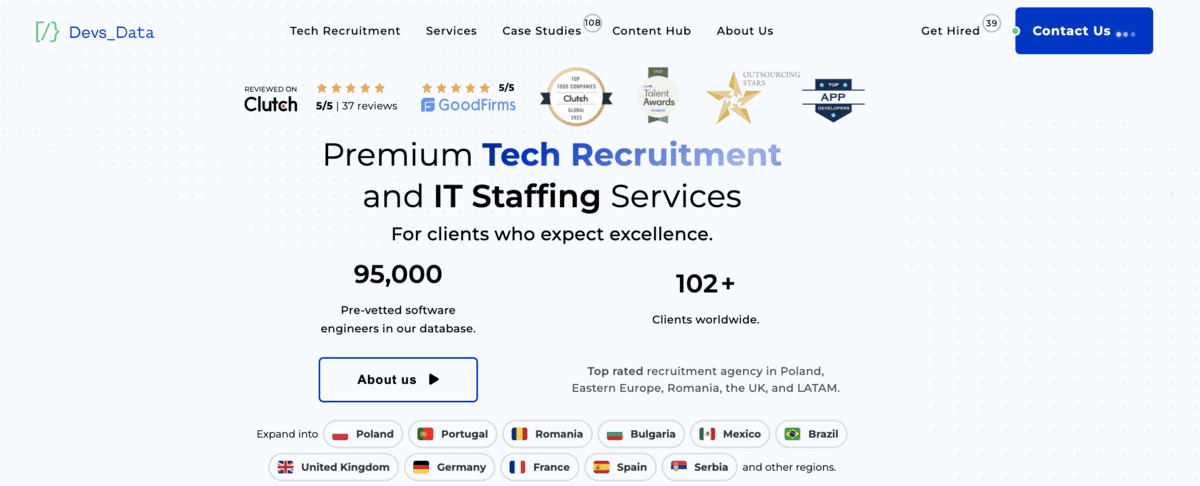
DevsData LLC has established itself in software engineer staffing with over ten years of specialized experience. Our recruitment process centers on a rigorous 90-minute problem-solving challenge conducted by qualified specialists, including US-based team members who assess both technical abilities and communication skills. This approach has built a database of 95000 pre-screened professionals, enabling precise matches between engineers and organizational needs across industries. The company’s quality commitment has earned perfect 5/5 client satisfaction ratings on Clutch and GoodFirms platforms.
With government-approved recruitment credentials, DevsData LLC connects organizations with exceptional software engineering talent worldwide. Our global perspective serves both established corporations and ambitious startups internationally, including clients throughout the United States and Israel. By identifying professionals who combine technical mastery with cultural adaptability, we address the complex staffing needs of modern development teams who collaborate across traditional boundaries and time zones.
The pricing model at DevsData LLC follows an exclusive success-fee model that eliminates initial investment for hiring organizations. Clients pay only after successfully integrating and confirming satisfaction with placed candidates, an arrangement that includes a guarantee period with replacement provisions if necessary. Our thorough assessment evaluates practical coding skills, algorithmic thinking, and architectural understanding – critical competencies that minimize the substantial risks associated with technical hiring missteps.
This approach proved essential during a recent engagement with an international fashion company struggling to compete with digital leaders like Zalando. DevsData LLC’s ability to quickly source and assemble teams in machine learning, software, UX/UI, and operations allowed the client to launch a $9 million innovation initiative on schedule. The right mix of talent enabled the development of advanced pricing and logistics platforms, directly improving operational efficiency and online sales. In this case, precise recruitment was the difference between ongoing decline and a successful digital turnaround.
Organizations aiming to enhance their software development capabilities benefit from DevsData LLC’s talent identification expertise that delivers Google-level engineering professionals. Our consultative approach balances technical requirements with team dynamics, ensuring candidates contribute effectively while integrating seamlessly.
Do you have IT recruitment needs?
Companies seeking specialized software engineering recruitment services can reach DevsData LLC at general@devsdata.com or explore our comprehensive technical staffing solutions at www.devsdata.com.
Finding and hiring exceptional software engineering talent stands as a fundamental business challenge with direct implications for product development and competitive positioning. Technical innovation depends heavily on recruiting developers with appropriate skill sets and experience levels. Organizations facing this challenge benefit substantially from specialized recruitment partnerships that streamline candidate identification and qualification processes. These collaborations reduce screening burdens and connect companies with verified talent, but they also introduce agency fees and limit direct control over candidate selection. By transferring recruitment responsibilities to dedicated experts, businesses protect valuable internal resources and maintain development momentum without interruption.
DevsData LLC applies over nine years of market experience and a rigorous evaluation process led by US-based specialists to match engineers with precision. Backed by a database of 95000 pre-screened candidates and a success-based payment model, we deliver verified talent without upfront cost or risk.
Contact DevsData LLC at general@devsdata.com or visit www.devsdata.com to strengthen your engineering team.
Any questions or comments? Let me know on
Twitter/X.
Discover how IT recruitment and staffing can address your talent needs. Explore trending regions
like Poland, Portugal, Mexico, Brazil and more.
 Frequently asked questions (FAQ)
DevsData – your premium technology partner
DevsData is a boutique tech recruitment and software agency. Develop your software project with veteran engineers or scale up an in-house tech team of developers with relevant industry experience.
Free consultation with a software expert
🎧 Schedule a meeting
FEATURED IN

DevsData LLC is truly exceptional – their backend developers are some of the best I’ve ever worked with.”

Nicholas Johnson
Mentor at YC, serial entrepreneur


 Build your project with our veteran developers.
Explore the benefits of technology recruitment and tailor-made software.
Learn how to source skilled and experienced software developers.
Build your project with our veteran developers.
Explore the benefits of technology recruitment and tailor-made software.
Learn how to source skilled and experienced software developers.

Rebecca Botvin

Commercial Director

Tom Potanski
Manager




Categories: Big data, data analytics | Software and technology | IT recruitment blog | IT in Poland | Content hub (blog)















careers@devsdata.com









general@devsdata.com

"I interviewed about a dozen different firms. DevsData LLC is truly exceptional – their backend developers are some of the best I've ever worked with. I've worked with a lot of very well-qualified developers, locally in San Francisco, and remotely, so that is not a compliment I offer lightly. I appreciate their depth of knowledge and their ability to get things done quickly."

Nicholas Johnson
CEO of Orange Charger LLC,
Ex-Tesla Engineer,
Mentor at YCombinator
"DevsData reached out to us, as we've been looking to grow our engineering team in Europe and Poland. Communicating efficiently and professionally, DevsData made a strong impression with their understanding of the recruitment challenges we were facing. They designed a tailored recruitment process for our needs. I was impressed with the technical depth of their approach."

Karim Butt
Co-Founder & CTO at GlossGenius, Inc.
"Out of all the vendors we work with, DevsData clearly stands out. The quality of developers they deliver is beyond what we've received from any other vendor, and they've been able to send profile recommendations very quickly. I'm happy to be their reference for other companies from Israel and talk about their recruitment abilities and what they delivered for us."

Ran Eyal
Senior Manager at
ZIM Integrated
Shipping Services Ltd.
"DevsData demonstrated a strong degree of proactivity, taking time to thoroughly understand the problem and business perspective, and continuously suggesting performance and usability enhancements. Their app exceeded my expectations. I've worked with DevsData on numerous projects over the last 3 years and I'm very happy. Being both responsive and honest in communication."

Jonas Lee
Partner & Executive VP of Verus,
Financial LLC, Investor,
& Serial Entrepreneur
Acknowledgments