Thanks for subscribing.
Your gift is on the way.
 Link copied



Hiring the right technical professionals has become a global challenge because demand is growing faster than local talent supply. Companies across finance, healthcare, logistics, and software services are competing for the same pool of senior developers, cloud engineers, and security specialists. In many markets, the number of open technical roles exceeds the number of qualified candidates, which extends hiring cycles and pushes salary expectations upward. As a result, businesses face longer recruitment timelines, higher compensation pressure, and reduced flexibility when scaling development teams through local hiring alone.
Offshore IT staffing offers a practical and sustainable solution. It enables companies to scale faster, tap into skilled global talent, and stay competitive by leveraging regions with strong technical education and lower labor costs.
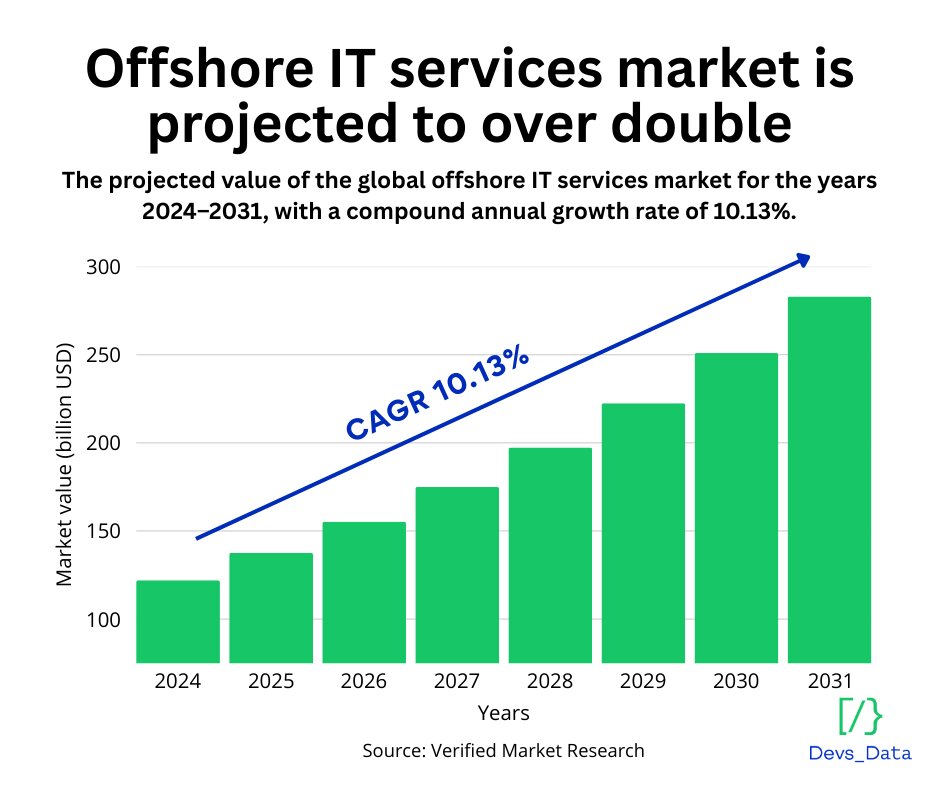
In 2024, the offshore IT services market was valued at $122 billion. It is projected to reach $283 billion by 2031, growing at a compound annual rate of more than 10%.
According to Deloitte’s Global Outsourcing Survey, 80% of executives plan to maintain or increase investment in third-party outsourcing. This trend reflects a broader move toward more flexible and efficient workforce strategies.
For many organizations, cost remains a decisive factor. On-site software development can cost up to 60% more than offshore alternatives. But the advantages go beyond savings. Offshore staffing also provides access to specialized expertise, flexibility in team size, and faster hiring across borders.
This guide takes a closer look at how offshore IT staffing works, the available models, the benefits it offers, and the key factors to consider when selecting a reliable partner.
Offshore IT staffing is a service that allows companies to hire remote technical professionals located in other countries, typically where salaries and overhead costs are lower. These professionals become an extension of the internal team and work under the direct supervision of the client.
Unlike outsourcing, where the external vendor takes full responsibility for project execution, offshore staffing allows businesses to retain control over the development process, task prioritization, and team management. This approach blends the cost benefits of international hiring with the operational control of in-house development.
Offshore professionals can join as individual contributors, be organized into full teams, or support long-term product and program work, while planning, priorities, and technical decisions remain under the client’s direct control.
Communication typically occurs through modern collaboration tools such as Slack, Microsoft Teams, and Zoom, enabling real-time coordination and transparency.
Do you have IT recruitment needs?
Companies rely on offshore staffing to fill a wide range of positions across the software development lifecycle. These include:
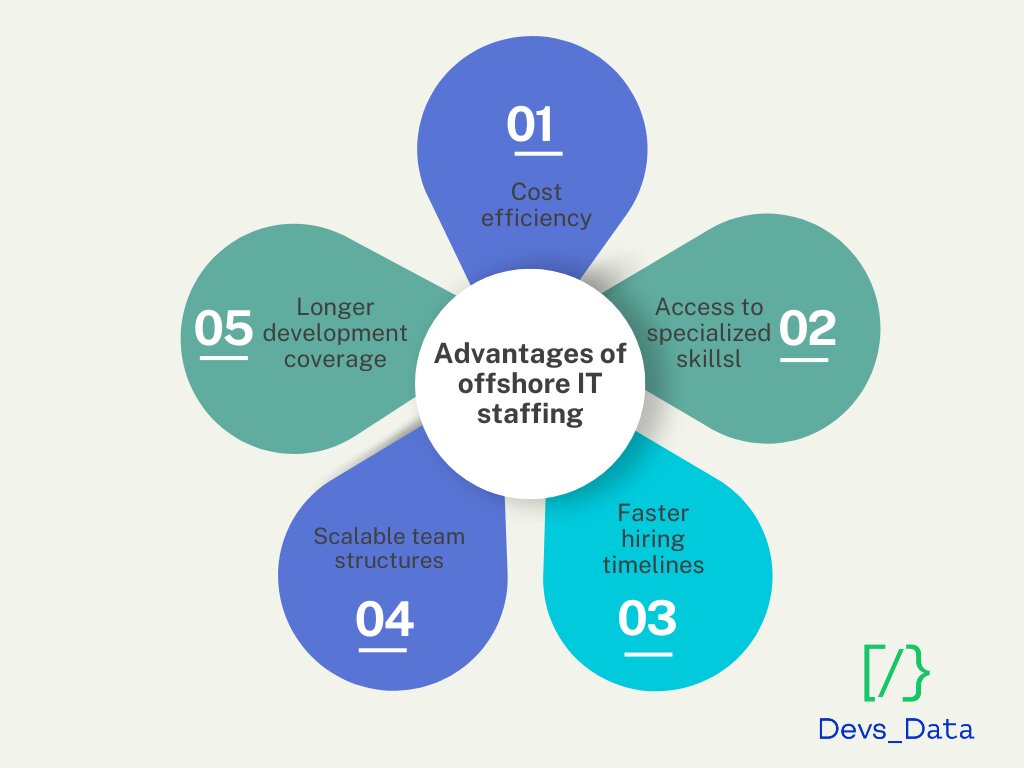
Hiring offshore reduces several categories of expenses, including salaries, office space, employee benefits, and local compliance fees. For example, a mid-level software engineer in Eastern Europe and, in many cases, Latin America, may cost 50 to 70% less than one based in the United States or Western Europe, even when fully dedicated to your team. This helps companies stay within budget while maintaining high standards in product delivery.
Many countries have invested heavily in technical education, producing graduates who are proficient in multiple programming languages and modern frameworks. Offshore staffing allows companies to recruit professionals with rare or advanced skills that may be difficult or expensive to find locally. This is particularly useful when hiring for roles in artificial intelligence, blockchain development, or cloud security.
Local hiring processes can take months, especially for in-demand roles. Offshore staffing partners often maintain ready access to a pool of vetted professionals who can begin working within weeks. This allows businesses to respond to changing priorities quickly, launch new features sooner, and avoid delays caused by talent shortages.
Offshore staffing makes it easy to expand or reduce team size in response to project needs or budget changes. Companies can onboard new team members quickly during product development phases, and scale down when focus shifts to maintenance or support. This level of flexibility is difficult to achieve through traditional hiring models.
By hiring teams across different time zones, companies can extend the hours during which development work is conducted. Tasks completed by one team at the end of their day can be picked up by another team that is just starting theirs. This results in faster bug resolution, continuous integration, and overall higher productivity.
Selecting the right country for offshore operations involves more than comparing salaries. Companies should weigh factors such as workforce skills, education quality, operating costs, legal and tax environment, language proficiency, and alignment with client time zones. These considerations determine how smoothly collaboration will work and how sustainable an offshore setup can be.
In 2025, a few locations stand out as especially practical for companies looking to build stable, long-term offshore teams.
Krakow is one of the most established offshore destinations in Europe. With a strong academic base and a pool of over 60000 IT professionals, it offers companies access to skilled labor in a stable European Union country. Poland ranks among the top globally in developer skill assessments, and the local market supports a wide range of technical and business services. Many international firms operate in Krakow to take advantage of its workforce and infrastructure.
Bangalore has long been a global hub for offshore services. It is home to more than one million professionals in technology and related fields. The city’s scale, experience, and affordability make it a preferred choice for companies needing strong technical capabilities across software, data, and support functions.
Guadalajara offers a strategic advantage for US-based companies seeking nearshore support. Its location enables real-time collaboration during standard North American business hours. The city has a growing population of over 115000 software developers and engineers, and lower operating costs compared to major US tech hubs. Its cultural proximity also supports easier communication and management.
Bucharest combines technical talent with cost advantages and access to the European market. Romania has developed a strong services sector, with 142000 IT professionals fluent in English and experienced in working with international teams. The city is well-regarded for its engineering and software talent, particularly in outsourced product development and infrastructure support.
Buenos Aires stands out in Latin America for its well-educated, bilingual workforce. Argentina, home to over 115000 IT specialists, consistently ranks highly in English proficiency and has a strong tradition in science and engineering education. The city offers competitive costs and time zone alignment with North America, making it a solid choice for both staffing and service delivery.
Do you have offshore IT staffing needs?
Offshore IT engagement models define how projects are priced, governed, and transferred between the client and the offshore provider. These models differ based on scope clarity, flexibility needs, and the level of long-term ownership a company plans to retain.
This model is based on a clear agreement set before the work begins. The client and the offshore provider define the project scope, delivery schedule, and total cost in advance. It is suitable for tasks with limited complexity and predictable requirements. While the approach offers cost predictability, changes during the project typically require a new agreement.
In this model, the client pays for the actual time spent and resources used. It works well for projects where the requirements may shift or are not fully defined at the start. This structure gives the client more room to make changes during development and adjust the direction as needed. It requires closer involvement and steady communication to keep progress aligned with goals.
The BOT model begins with the offshore provider setting up and managing a team or local operation for the client. During the initial phase, the provider handles recruitment, supervision, and daily management. Once the setup is stable and working well, full ownership is transferred to the client. This approach suits businesses planning a long-term presence in a region without taking on setup risks from the beginning.
Once the engagement model is selected, the next step is to decide how the offshore team itself will be structured. The following section describes the staffing structures companies can choose based on their project needs.
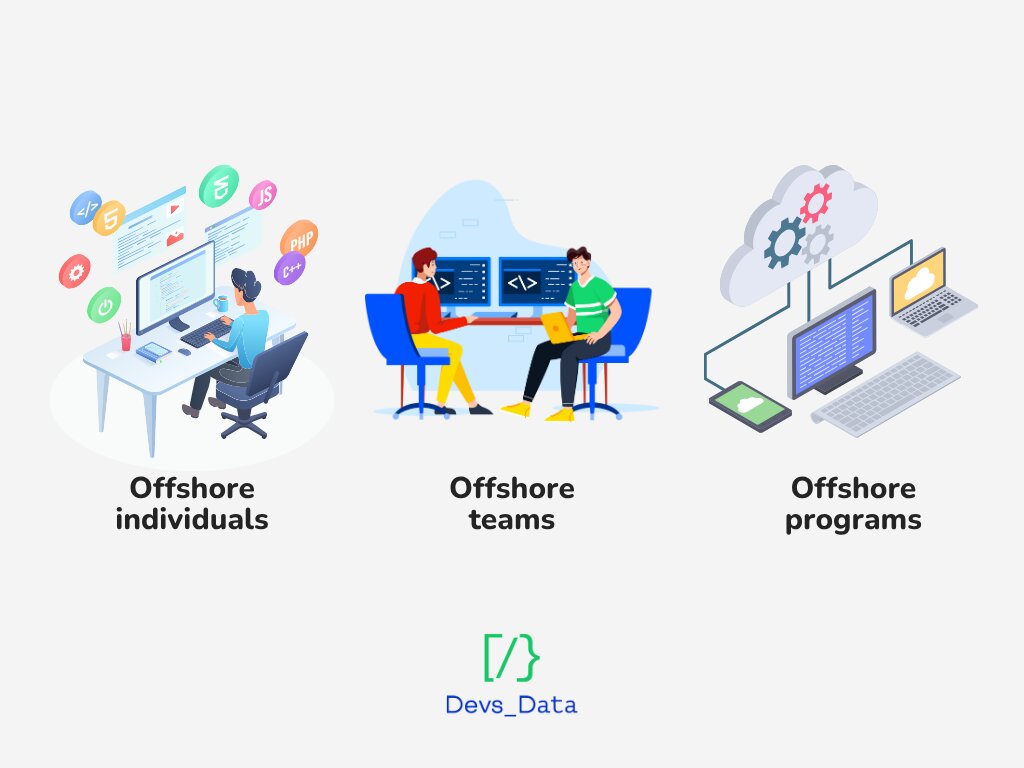
This model is ideal for companies that need to fill a specific role or add capacity to a small team. An offshore individual becomes a fully embedded member of the client’s team, participating in meetings, using the same tools, and following the same workflows. These professionals often bring years of experience and the ability to contribute independently with minimal oversight.
In cases where a project requires multiple skill sets, businesses can build a dedicated offshore team composed of Developers, Testers, Designers, and other technical staff. These teams are structured to function as a cohesive unit, often with their own Technical Lead or Delivery Manager. While they remain aligned with the client’s goals and project timelines, the offshore team provides the benefits of collaboration, shared responsibility, and continuous delivery.
Offshore programs are designed for long-term product and platform work where companies want dedicated teams but prefer to limit daily operational overhead. The offshore partner handles staffing continuity, onboarding support, and delivery coordination, while technical direction, product ownership, and prioritization remain under the client’s internal leadership. These programs support ongoing needs such as product development, platform maintenance, and systems integration without transferring project ownership to an external vendor.

Do you have IT recruitment needs?
Tracking the performance of offshore team members is essential because these teams often operate remotely, across time zones, and outside the direct oversight of in-house managers. Clear, measurable indicators help managers monitor progress, maintain accountability, and support consistent delivery across time zones and locations. While metrics vary by role, using well-defined KPIs ensures that both technical execution and communication stay aligned with project goals.
Below is a table outlining common KPIs used to evaluate offshore IT staff across different functions:
| Role | Key performance indicators (KPIs) |
|---|---|
| Software Engineers | Code quality, feature delivery speed, pull request cycle time, bug frequency |
| Mobile Developers | App performance, crash rate, store rating, feature deployment time |
| Cloud Engineers | Infrastructure uptime, provisioning speed, cost optimization, and deployment reliability |
| DevOps Engineers | Deployment success rate, incident response time, system uptime, pipeline efficiency |
| QA Engineers | Defect detection rate, test coverage, test cycle time, issue resolution time |
| UI/UX Designers | Design iteration time, usability score, stakeholder feedback, and implementation accuracy |
| Data Scientists/ML Engineers | Model accuracy, data pipeline reliability, time to insight, iteration frequency |
| Project Managers | Milestone delivery, sprint completion rate, team velocity, risk management |
| Business Analysts | Requirement clarity, documentation completeness, and stakeholder satisfaction |
When considering how to grow a software team or deliver a technology project, companies have multiple staffing models to choose from. Each option offers its own strengths depending on the organization’s goals, budget, and internal capacity. Understanding the key differences between offshore staffing, nearshore staffing, onshore staffing, and project outsourcing can help leaders make more informed decisions.
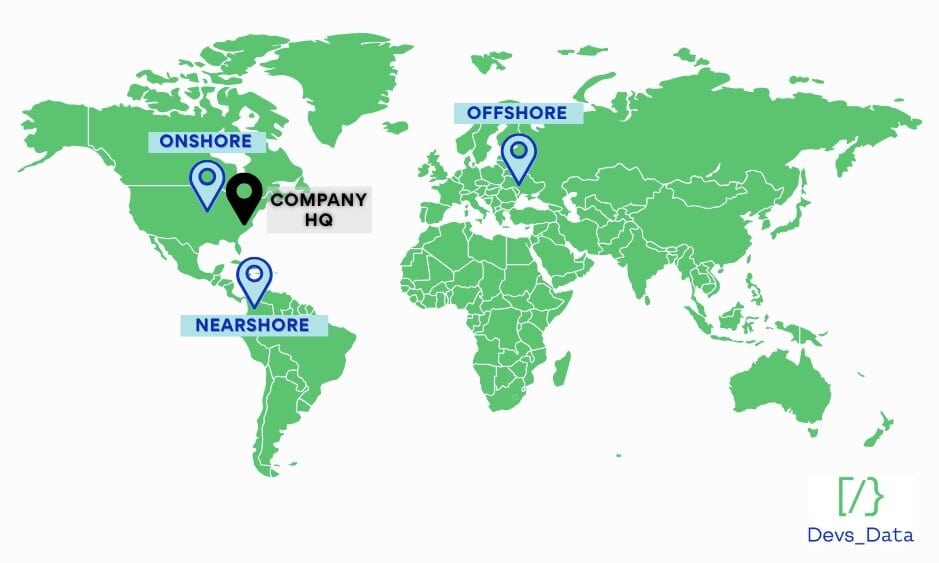
Offshore staffing refers to hiring professionals located in distant countries to work remotely as part of the company’s core development team. These professionals often operate from countries with well-developed IT sectors and lower labor costs, such as Poland, Ukraine, Argentina, or India. Offshore team members typically follow the same workflows, participate in regular meetings, and contribute alongside in-house staff. The main advantages include access to specialized talent, lower costs, and the ability to scale teams quickly. However, time zone coordination and communication habits must be managed effectively to avoid disruptions.
Nearshore staffing involves hiring from nearby countries that share a similar time zone or regional context. For example, companies in Western Europe may hire from Central or Eastern Europe, while North American businesses may look to Mexico, Colombia, or Brazil for talent. The proximity allows for easier communication, more overlapping work hours, and fewer cultural differences. While the cost savings are less than in offshore models, nearshore professionals often combine affordability with smoother collaboration. This model works exceptionally well when direct interaction is essential, and teams need to move quickly.
Onshore staffing means hiring professionals within the same country or region as the client organization. This includes both remote workers and in-office employees. Onshore staff are fully aligned in terms of work culture, legal requirements, and time zones. This model offers the highest level of control and is particularly useful for leadership roles, client-facing positions, or projects that require strict compliance with local regulations. However, onshore hiring is typically the most expensive option and may limit access to niche technical skills.
Summary table: comparison of staffing models
| Criteria | Offshore staffing | Nearshore staffing | Onshore staffing |
|---|---|---|---|
| Cost efficiency | High. Significant savings on salaries and overhead. | Moderate. Some savings with closer regional alignment. | Low. Typically, the highest cost, especially for senior roles. |
| Access to talent | Broad. Large and diverse international talent pool. | Strong. Skilled professionals available in nearby regions. | Limited. Constrained by local market availability. |
| Time zone alignment | Low. Often requires asynchronous communication. | High. Shared or overlapping hours improve collaboration. | Full alignment. Real-time coordination with local teams. |
| Integration and control | High. Offshore staff are embedded in client workflows and tools, while clients maintain oversight and direct daily activities. | High. Seamless integration with in-house processes and strong client control with easier communication access. | Full. Employees are part of the internal structure, with direct supervision and immediate feedback. |
| Best fit for | Long-term team extension and budget-conscious growth. | Agile projects and regional team expansion. | Leadership roles, client-facing tasks, and regulated environments. |
Offshore IT staffing offers strategic advantages, but to achieve lasting success, businesses must be mindful of the practical challenges associated with building distributed teams. In this section, we discuss the most common challenges and show how DevsData LLC approaches them through structured processes and proven practices.
When offshore professionals work several hours ahead or behind the client’s location, delays in response times or missed updates can affect progress. The best results come from structured communication routines, overlapping work hours, and strong documentation practices. At DevsData LLC, these methods are built into every project to keep collaboration smooth across time zones.
Different approaches to feedback, accountability, or collaboration can create friction if not managed early. Clear onboarding, documented work norms, and regular check-ins help align offshore teams with client expectations. DevsData LLC formalizes these practices through project runbooks and operating playbooks that define communication routines, escalation paths, and delivery standards from the first day of collaboration.
Remote teams can be difficult to monitor if progress and performance are not tracked closely. Transparency through reporting cycles, access to project tools, and regular reviews prevent issues from escalating. DevsData LLC incorporates these measures directly into workflows so quality is maintained throughout the project, not only at the end.
Sharing sensitive data across borders requires strict safeguards to protect systems and information. Confidentiality agreements, controlled system access, and alignment with widely used compliance frameworks such as GDPR, ISO 27001, and SOC 2 are essential to reduce operational and legal risk. DevsData LLC applies these safeguards consistently, giving clients full clarity on intellectual property ownership and data protection responsibilities.
The challenges of offshore IT staffing can all be managed, but doing so requires experience and structured processes. This is where partnering with a specialized IT staffing agency becomes valuable. Instead of solving these issues alone, businesses gain access to expertise, networks, and systems already designed to handle them.
Agencies maintain large candidate networks and proven screening processes. This makes it possible to fill roles more quickly while maintaining high standards for both technical and communication skills.
Local knowledge of salaries, regulations, and candidate availability helps avoid costly mis-hires or compliance mistakes.
An agency can ramp teams up or down as needs change, without the delays of traditional recruitment or the burden of long-term overhead.
With staffing and compliance handled externally, internal teams can concentrate on product development, customer service, or other business priorities.
These advantages show why partnering with an IT staffing agency can make a real difference. In the next section, we’ll look at how DevsData LLC puts this into practice.
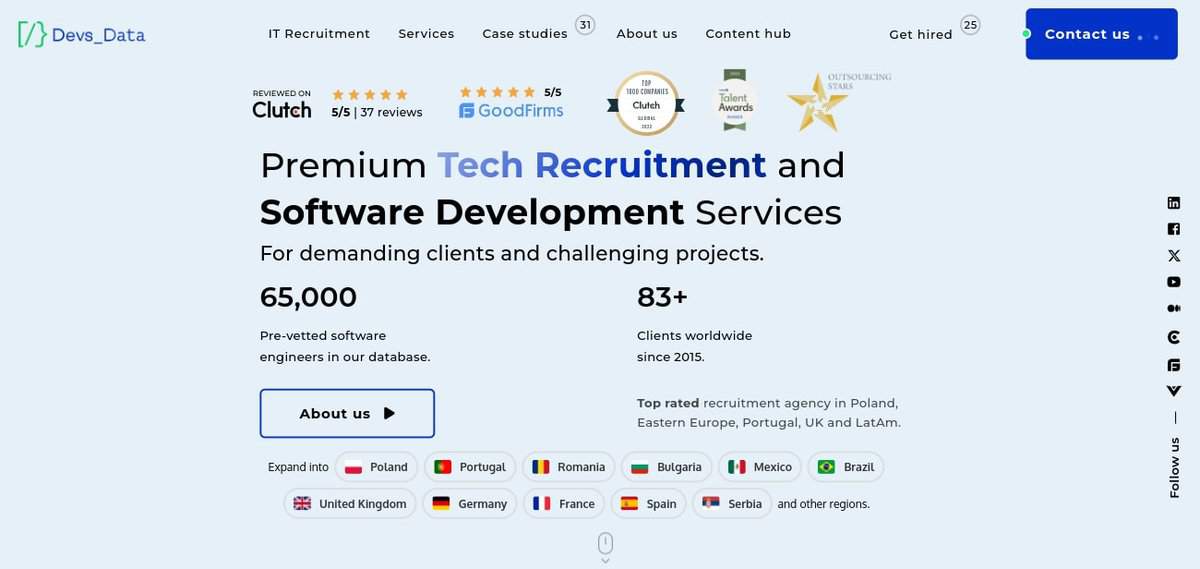
Website: www.devsdata.com
Team size: ~60 employees
Founded: 2016
Headquarters: Brooklyn, NY, and Warsaw, Poland
Managing offshore teams often involves practical barriers such as time zone gaps, uneven communication, and unfamiliar workflows. DevsData LLC helps resolve these issues by creating a structure that allows remote professionals to work in step with internal teams from the start. With offices in Europe, North America, and Latin America, the company connects businesses with top-tier technical talent from regions known for strong engineering education and cost-effective hiring.
By offering dedicated offshore staffing solutions, DevsData LLC enables organizations to build remote teams that integrate directly into their workflows. Each candidate undergoes a rigorous recruitment process that includes 90-minute technical interviews, hands-on assessments, and cultural fit evaluations. Backed by a database of over 95000 vetted professionals and a team of 40 experienced recruiters based in Europe and the US, the company consistently delivers candidates who can contribute from day one.
DevsData LLC is recognized for delivering high-quality services tailored to each client’s needs. The company holds an official, government-approved license for recruitment services and operates on a success-based pricing model, charging only after a successful placement. Clients also benefit from a replacement guarantee, which provides risk-free onboarding and long-term team stability.
Do you have offshore IT staffing needs?
Key highlights:

DevsData LLC’s track record includes building complex offshore teams for clients across finance, logistics, and eCommerce, partnering with both innovative startups and large corporations globally, including in the United States, Israel, and other key tech markets.
Offshore IT staffing is no longer just about lowering costs. It allows companies to scale quickly, access global talent, and keep projects moving without the delays of local hiring. Success depends on choosing the right partner, one that can deliver talent efficiently, manage distributed teams, and maintain compliance across borders.
DevsData LLC has built its reputation on precisely these strengths. With more than nine years of experience, a global talent network, and a structured recruitment process, the company helps clients assemble reliable offshore teams that integrate effectively with internal workflows.
In addition to offshore staffing, DevsData LLC offers Employer of Record (EoR) services to help companies manage remote teams while staying compliant with local labor laws. Its Business Process Outsourcing (BPO) solutions also assist clients in delegating operational tasks, enabling internal teams to focus on core business activities.
If you’re planning to launch a new product, scale your development capacity, or expand into new markets, DevsData LLC brings the experience and global reach needed to build reliable, high-quality offshore teams.
To learn more, visit www.devsdata.com or contact the company at general@devsdata.com.
Any questions or comments? Let me know on Twitter/X.
Discover how IT recruitment and staffing can address your talent needs. Explore trending regions like Poland, Portugal, Mexico, Brazil and more.
 Frequently asked questions (FAQ)
DevsData – your premium technology partner
DevsData is a boutique tech recruitment and software agency. Develop your software project with veteran engineers or scale up an in-house tech team of developers with relevant industry experience.
Free consultation with a software expert
🎧 Schedule a meeting
FEATURED IN

DevsData LLC is truly exceptional – their backend developers are some of the best I’ve ever worked with.”

Nicholas Johnson
Mentor at YC, serial entrepreneur


 Build your project with our veteran developers.
Explore the benefits of technology recruitment and tailor-made software.
Learn how to source skilled and experienced software developers.
Build your project with our veteran developers.
Explore the benefits of technology recruitment and tailor-made software.
Learn how to source skilled and experienced software developers.

Rebecca Botvin

Commercial Director

Tom Potanski
Manager




Categories: Big data, data analytics | Software and technology | IT recruitment blog | IT in Poland | Content hub (blog)
Email copied
And many other regional partners across Latin and North America, as well as Central and Eastern Europe. Let's talk.
















careers@devsdata.com









general@devsdata.com

"I interviewed about a dozen different firms. DevsData LLC is truly exceptional – their backend developers are some of the best I've ever worked with. I've worked with a lot of very well-qualified developers, locally in San Francisco, and remotely, so that is not a compliment I offer lightly. I appreciate their depth of knowledge and their ability to get things done quickly."

Nicholas Johnson
CEO of Orange Charger LLC,
Ex-Tesla Engineer,
Mentor at YCombinator
"DevsData reached out to us, as we've been looking to grow our engineering team in Europe and Poland. Communicating efficiently and professionally, DevsData made a strong impression with their understanding of the recruitment challenges we were facing. They designed a tailored recruitment process for our needs. I was impressed with the technical depth of their approach."

Karim Butt
Co-Founder & CTO at GlossGenius, Inc.
"Out of all the vendors we work with, DevsData clearly stands out. The quality of developers they deliver is beyond what we've received from any other vendor, and they've been able to send profile recommendations very quickly. I'm happy to be their reference for other companies from Israel and talk about their recruitment abilities and what they delivered for us."

Ran Eyal
Senior Manager at
ZIM Integrated
Shipping Services Ltd.
"DevsData demonstrated a strong degree of proactivity, taking time to thoroughly understand the problem and business perspective, and continuously suggesting performance and usability enhancements. Their app exceeded my expectations. I've worked with DevsData on numerous projects over the last 3 years and I'm very happy. Being both responsive and honest in communication."

Jonas Lee
Partner & Executive VP of Verus,
Financial LLC, Investor,
& Serial Entrepreneur
Acknowledgments