Thanks for subscribing.
Your gift is on the way.



PySpark sits at the center of how large organizations process data today. Apache Spark, the framework it runs on, now powers more than 80% of Fortune 500 big data workloads and handles petabyte-scale datasets across finance, healthcare, and retail. Demand for the engineers who build on Spark has climbed alongside that adoption, with one 2025 analysis reporting close to 50% annual growth in data engineering roles.
That demand runs straight into a supply problem. Roughly 65% of companies report a shortage of skilled Data Engineers and architects, and PwC noted a 40% shortfall in qualified Data Engineers in 2024. Finding a developer who reasons about distributed computing rather than PySpark syntax has become the real bottleneck for data initiatives. Plenty of candidates write correct Spark code. Far fewer predict how a job splits across a cluster, or what a badly chosen partition key costs once volume climbs, and that second group is the one every hiring team competes over.
This article covers the market context shaping PySpark hiring and the recruitment process DevsData LLC follows to place these specialists. Real examples from our work close the piece.
The numbers behind Big Data explain the pressure on hiring. The global big data technology market reached around 454 billion dollars in 2025 and is forecast to approach 1.4 trillion by 2034. Big data engineering services, the slice closest to PySpark work, sat near 91 billion dollars in 2025 on a path to 213 billion by 2031.
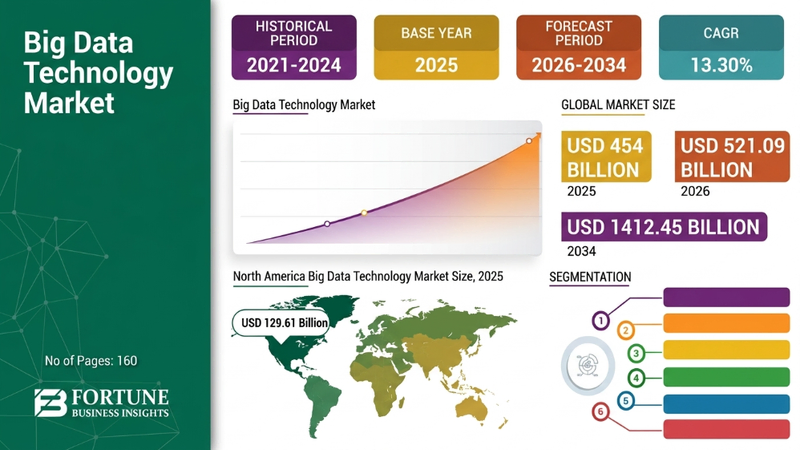
Two shifts explain most of the pressure on employers. Enterprises have moved past passive storage toward platforms that run analytics and model inference against live data, which rewrites the job description from pipeline maintenance into system design and raises what a hiring team pays for. Cloud adoption compounds that effect, since Spark workloads now sit on managed services such as Databricks or EMR, and a developer who has only run Spark on-premises arrives without the cost controls and autoscaling behaviour those platforms demand. The result is a candidate pool that looks large in aggregate and thins quickly once both requirements apply at once. Employers competing for that overlap face longer searches and stronger counteroffers, which is the practical shape of the shortage described above.
For a hiring team, the takeaway is straightforward. A slow process loses the best candidates to faster competitors, and a shallow one that checks Spark syntax while skipping distributed-systems judgment fills the seat without solving the underlying problem.
Do you have IT recruitment needs?
A PySpark Developer brings value that goes well beyond writing scripts. The framework was built for problems that overwhelm a single machine, which is exactly where these engineers earn their keep. The points below outline where their impact tends to show up first.
Data processing at scale
PySpark runs on Apache Spark, a distributed computing engine that processes datasets too large for one server’s memory, spreading the work across a cluster of machines.
Real-time streaming
Spark Structured Streaming reacts to changing conditions in near real time, which matters for fraud detection, anomaly monitoring, and live recommendations.
Machine learning integration
PySpark works directly with MLlib and connects to MLflow, TensorFlow, and PyTorch, so teams build and deploy models at the same scale as their data pipelines.
Cost efficiency
Spark’s distributed design runs on commodity hardware, and its in-memory caching with lazy evaluation keeps memory use lower than tools that load everything at once.
One unified platform
Batch processing, stream processing, SQL queries, and machine learning live in a single framework, which simplifies pipelines and reduces operational overhead.
The business return on a PySpark hire depends on the individual more than on the framework. An experienced engineer takes a poorly structured data problem and defines the schema and partitioning strategy that hold as volume grows. The output then reaches analysts and executives in a form they rely on without manual reconciliation.
Hiring for PySpark makes sense only when the workload calls for it. A common mistake is recruiting a Spark specialist for problems that a simpler tool would handle faster and cheaper. The comparison below clarifies where PySpark fits against the two alternatives teams weigh most often.
| Tool | Best fit | Where it falls short |
|---|---|---|
| Pandas | Datasets that fit in memory, roughly 1 to 2 GB, and fast local iteration | Buckles on data too large for a single machine’s RAM |
| PySpark | Large distributed datasets, ETL at scale, ML pipelines, Python-first teams | Adds overhead and a steeper learning curve for small jobs |
| Scala Spark | Ultra-high-throughput JVM-native ETL and teams with existing Scala depth | Slower to develop, narrower talent pool |
Spark Connect became the default client protocol, replacing the older Py4J bridge, so PySpark clients no longer need a local JVM and run cleanly from notebooks or containerized services. The hiring consequence matters more than the engineering one: Python-first Data Engineers now reach production Spark without the JVM operations background that once gated the role, which widens the pool a recruiter works from. Scala Spark holds its edge where a team already has Scala depth or needs compile-time type safety for complex, evolving schemas, and that choice narrows the pool accordingly.
Confirming the workload genuinely needs Spark before you hire protects the budget and sets a job description the market answers.
Strong PySpark candidates share a foundation that runs deeper than framework familiarity. Surface knowledge produces fragile pipelines, while genuine command of distributed computing produces systems that hold up under load. The visual below maps each skill area to what it covers and what to confirm during evaluation.
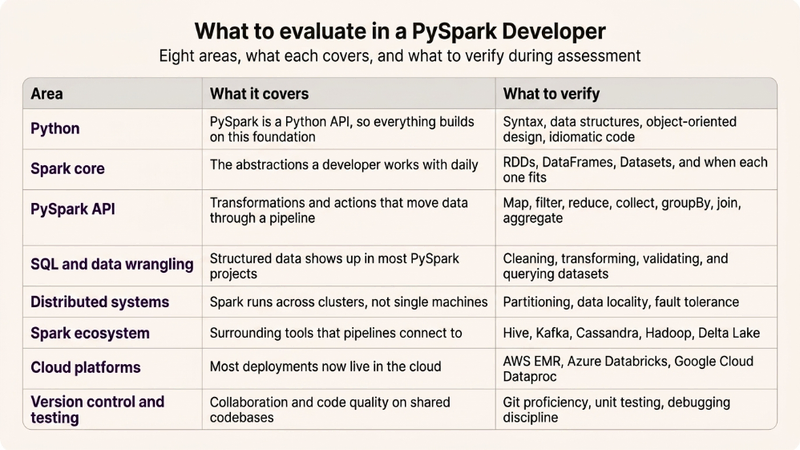
One note on Spark 4.0: RDDs are now formally deprecated and moved to legacy status, so most new pipelines use the DataFrame API exclusively. A candidate who reaches for RDDs by default on greenfield work signals dated habits worth probing.
Candidates who have shipped real PySpark projects and who explain the trade-offs they made tend to outperform those who only recite definitions.
Ruling candidates out carries the same weight as ruling them in, provided the reasoning rests on a pattern instead of a phrase. Each signal below deserves a second question before it counts against anyone.
Treating Spark like Pandas
A candidate who collects a large DataFrame to the driver, or who loops row by row over a distributed structure, is working from a single-machine model of computation. Watch what follows once the interviewer points it out. Someone who revises the approach on the spot has a gap in Spark practice, while someone who defends the habit has a gap in the model itself, which shows up later as pipelines that fail under production volume.
No grasp of partitioning
Partitioning sits underneath every performance question in Spark, so an answer that stops at a definition tells you little on its own. Ask a second time in concrete terms, such as why one stage of a job runs for hours while the rest finishes in minutes. A candidate who still offers nothing about data distribution or skewed joins lacks the base for tuning work, whatever the years of exposure on the resume suggest.
Only theoretical knowledge
Textbook answers arrive polished, which makes them easy to mistake for depth. The test is whether a shipped project ever appears behind them. Ask what broke on a system the candidate owned and how the fix landed. Someone who has run pipelines in production answers with detail no course supplies, while someone who has only studied them returns another definition, placing the skill outside production rather than inside it.
Ignoring cost and scale
Engineers who have carried responsibility for a monthly compute bill raise cost without prompting, usually inside the first design question. Silence across a full technical round is worth noting, though it deserves a direct test before it counts against anyone. Ask how the candidate would size a cluster for a job that doubles in volume. An answer with no reference to caching trade-offs or shuffle cost suggests the bill has always belonged to somebody else.
Weak communication
Data Engineers translate messy business questions into pipelines, so the ability to explain past work predicts a large part of daily performance. One muddled explanation proves little, as nerves distort the first attempt for many strong candidates. Ask again with a narrower prompt about what the pipeline fed and who depended on the output. An explanation that stays unclear on the second pass predicts the same friction with stakeholders on the job.
None of these disqualifies a candidate alone. Two of them appearing together, across separate stages of the process, is the point at which a hiring team should slow down.
Do you have IT recruitment needs?
Compensation shifts with geography, experience, and industry. Developers in high-cost markets such as Silicon Valley, New York, or London earn more, and finance and healthcare often pay above the broader average. The figures below reflect 2025 and 2026 data from Glassdoor, Salary.com, and Coursera, and they vary by company size and tech stack.
| Role | Average annual base (USD) |
|---|---|
| PySpark Developer | 105000–130000 |
| Big Data Engineer | Around 140000 |
| Top earners | Up to 160000 |
Two factors push these figures higher. Experience compounds quickly in distributed systems, where a Senior Engineer who has tuned petabyte-scale jobs commands a clear premium over someone with a year of notebook work. Industry matters too, since finance and healthcare pay above the baseline for the compliance and reliability demands they place on data work.
Treat these as reference points rather than fixed rates. Platforms such as Glassdoor, Salary.com, and PayScale publish current figures that move with demand, so check them before setting a budget.
How you bring a PySpark Developer on board shapes cost, control, and speed. The right model depends on whether you need a permanent platform owner or short-term help clearing a backlog. This comparison lays out the common options against the work each one suits.
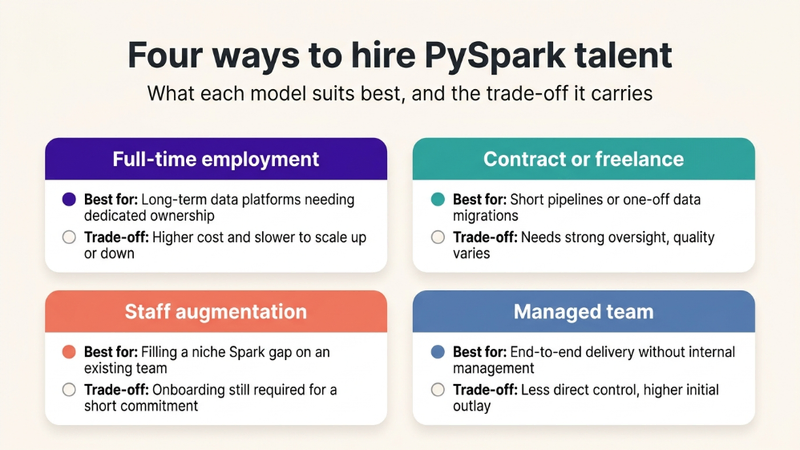
A practical pattern many teams follow is to start with a full-time hire to own the core data platform, then layer in contract or augmented specialists when a specific project spikes the workload. That keep institutional knowledge in-house while flexing capacity to match demand.
Strong candidates rarely come from a single channel. Spreading the search widens the pool and reaches people who are not actively job hunting. The sources below tend to produce the best results for data engineering roles.
Professional networks
LinkedIn carries the deepest profile data for sourcing and direct outreach, with filters precise enough to build a shortlist before writing a single message. The cost sits in response rates, as experienced Data Engineers receive similar approaches every week and most go unread. Messages that reference the specific work, such as the scale of the data or the stage the platform has reached, hold attention where a generic pitch loses it.
Technical communities
GitHub and Stack Overflow show how someone writes code with nobody supervising, which reads more honestly than a resume bullet about pipeline ownership. Commit history reveals whether a developer tests what they write and how they respond to review. Answered questions reveal how they explain a problem to a stranger. Both signals arrive before any interview, though the sourcing work stays manual and slower than filtering a profile database.
Niche job boards
Boards built for data and engineering roles, alongside remote-focused ones, trade reach for precision by returning fewer applications from people who match the stack. That trade suits teams without recruiter capacity for heavy screening, where hours saved on unqualified applications matter more than the width of the funnel. Posting alone rarely fills a senior role, so treat these boards as one input rather than as the search itself.
Referrals
Recommendations from your own engineers arrive pre-vetted by a colleague whose judgment the team already trusts, which shortens screening and lifts the response rate on first contact. Reach is the limitation, as referral networks repeat the backgrounds already present in the team. Pair the channel with outbound sourcing to widen the pool, and give the referring engineer specific detail about the role so the recommendation lands on the right people.
Specialist recruitment agencies
For senior or hard-to-fill roles, an agency with in-house engineering depth screens before presenting, which shifts the filtering cost off your team and compresses the calendar. What separates agencies is the technical layer, as a recruiter who has never written distributed code passes through candidates who name the technology without having run it at scale. Ask how the screening works before signing, and ask who conducts it.
Running several channels together, rather than waiting on one job post, keeps qualified people moving through the process. Record which source produced each hire and review the pattern each quarter, given that the channel filling backend roles at your company rarely fills data engineering roles at the same rate.
A repeatable process keeps strong candidates from slipping away to faster-moving competitors. The eight steps below move from defining the role to onboarding a new hire, and for PySpark roles the technical stage carries the most weight, often a take-home task that asks a candidate to clean and aggregate a large, messy dataset rather than answer trivia.
Documenting each stage and giving candidates timely feedback protects your reputation in a small, well-connected talent market, where a poor experience travels fast.
Interviews should test how a candidate thinks, not just what they have done. The areas below combine conceptual depth with hands-on problem-solving, which together expose whether someone truly understands Spark.
Conceptual questions
Ask how Spark rebuilds a lost partition when an executor dies mid-job, then follow with why the DataFrame API displaced RDD-first design. The first question tests whether the candidate holds a working model of fault tolerance rather than a memorized definition. The second tests whether their practice kept pace with the framework, as a developer who reaches for RDDs on new work carries habits from an earlier era of Spark.
Coding challenges
A live problem exposes the thinking behind the code in a way a take-home submission never does. Watch how the candidate structures a transformation before optimizing it, then what happens once the first attempt fails. Silence followed by a working solution tells you less than a running commentary revealing which trade-offs the person weighed. Keep the problem small enough to finish, given that an unfinished exercise measures speed rather than judgment.
Scenario-based questions
Hand over a realistic task, such as flagging suspicious activity across a large log file, and watch which trade-offs the candidate names first. Strong answers interrogate the data before proposing an approach, covering the volume and how fresh the output has to be. Weaker answers move straight to a solution shape and adjust later. The questions asked before any code appears predict how the person will behave on the first ambiguous ticket.
System design questions
Senior candidates should design a pipeline end to end, where partitioning strategy and the handling of a bottleneck reveal architectural judgment. Give them a volume target and a constraint, such as a fixed nightly window, so the design has something to push against. What matters is the reasoning about failure and cost rather than the diagram itself, as a pipeline that works on paper often carries an invoice nobody modeled.
Debugging exercises
Plant a bug in unfamiliar code and observe the reading order. Engineers with production experience orient themselves before touching anything, tracing the error back to the input that produced it. Less experienced candidates start editing lines and test whether the behavior improves. The method on display predicts on-call performance more reliably than any question about how the candidate handled a past incident.
Behavioral questions
A question about a difficult dataset surfaces how the person works with colleagues under deadline pressure. Ask who else was involved and where the disagreement sat, as the interesting part of the story is rarely the technical obstacle. Candidates who describe the work entirely in the first person, with no analyst or stakeholder appearing anywhere in the account, tend to work the same way once hired.
Tailoring the depth of these questions to the seniority of the role keeps the process fair and efficient. A mid-level pipeline developer might be asked to write a clean transformation and explain a partitioning choice, while a lead architect should be pushed on how to design a multi-stage pipeline that stays cheap and fast as data volume grows.
Website: www.devsdata.com
Team size: ~60 employees
Founded in: 2016
Headquarters: Brooklyn, NY, and Warsaw, Poland
DevsData LLC brings over ten years of IT recruitment experience to companies hiring for technically demanding roles, including data engineering. Our background in both recruitment and software development gives us an advantage few agencies hold: in-house engineers who understand what separates a competent PySpark Developer from a strong one, which shapes how we screen.
Our recruitment network includes more than 95000 vetted technology professionals. Fewer than 6% of candidates who apply pass our screening process, built around a 90-minute technical interview that hands the candidate a realistic data problem, such as diagnosing why a join has skewed and slowed a job, rather than checking familiarity with a technology name. That depth matters most for distributed systems work, where a misjudged join or a poorly partitioned dataset shows up only under production load. We hold a government-approved recruitment license and operate on a success-fee model, so clients pay only when a hire is placed.
A guarantee period backs every placement, with a replacement at no extra cost if a candidate leaves within the agreed window.
Our reach extends from the US into European and Latin American markets, with particular depth in finance and pharmaceutical hiring, from algorithmic-trading desks to teams building regulated healthcare platforms. A 5/5 rating on Clutch and GoodFirms reflects how that work has landed with the companies we serve.
Key highlights:
Do you have IT recruitment needs?
Data engineering talent has featured in several of our placements, usually inside a wider technology team rather than as a standalone PySpark hire. The examples below show how we matched companies with the engineers they needed, with the trading-firm search the closest fit to the distributed-data work this article describes.
Building an engineering team for a trading firm
A London-based investment fund focused on algorithmic trading needed engineers able to keep a cryptocurrency exchange running under heavy, real-time market-data load, paired with financial sector experience. We assigned a dedicated recruitment team and ran a multichannel search across Asia, Europe, and the US. Our process moved candidates through preliminary qualifications, timed programming challenges, soft-skills assessments, and live coding interviews. The client planned to hire one engineer at first, then, impressed by the candidates, brought on four more and opened a local engineering branch in Poland.
Placing a technical lead for a pharmaceutical platform
A global pharmaceutical company set out to build a business-critical public platform and needed a technical lead with a rare mix of engineering depth, HIPAA and GDPR familiarity, UI/UX collaboration experience, and business sense, all in a specific location. We designed a custom, multi-step process built around HR and technical interviews, algorithmic tests, and programming assignments. After a three-month search, we placed a candidate who met every requirement, and the client returned with four further assignments across international locations.
Assembling a data and engineering team for a fashion brand
An international fashion corporation faced falling revenue against online competitors and wanted to build an innovation lab. We ran a global talent search across Europe, the US, and Canada to assemble a core team spanning Machine Learning, Software Development, and UX/UI Design. That team, including Data and Machine Learning Engineers, built a unified eCommerce platform across the client’s brands and shifted the revenue mix toward online channels, outpacing the targets set for its first year.
The strongest candidates pair deep Python and Spark knowledge with distributed-systems judgment and clear communication, and a structured pipeline of sourcing, technical assessment, and reference checks surfaces them reliably. Confirming the workload truly needs Spark, setting a realistic salary against current benchmarks, choosing the right hiring model, and running a focused interview plan all feed the same goal of building a data team that holds up under real workloads.
For companies that would rather skip the search, partnering with an agency shortens time-to-hire and lowers risk in a market where 65% of firms already report a data engineering talent gap. DevsData LLC combines recruitment experience with hands-on engineering knowledge, a rigorous screening process, and a guarantee period, which makes it a dependable choice for building a PySpark team. Reach the team at general@devsdata.com or visit www.devsdata.com.
Discover how IT recruitment and staffing can address your talent needs. Explore trending regions
like Poland, Portugal, Mexico, Brazil and more.

 Frequently asked questions (FAQ)
DevsData – your premium technology partner
DevsData is a boutique tech recruitment and software agency. Develop your software project with veteran engineers or scale up an in-house tech team of developers with relevant industry experience.
Free consultation with a software expert
🎧 Schedule a meeting
FEATURED IN


DevsData LLC is truly exceptional – their backend developers are some of the best I’ve ever worked with.”

Nicholas Johnson
Mentor at YC, serial entrepreneur


 Build your project with our veteran developers.
Explore the benefits of technology recruitment and tailor-made software.
Learn how to source skilled and experienced software developers.

Rebecca Botvin

Commercial Director

Tom Potanski
Manager




Categories: Big data, data analytics | Software and technology | IT recruitment blog | IT in Poland | Content hub (blog)














careers@devsdata.com





general@devsdata.com

"I interviewed about a dozen different firms. DevsData LLC is truly exceptional – their backend developers are some of the best I've ever worked with. I've worked with a lot of very well-qualified developers, locally in San Francisco, and remotely, so that is not a compliment I offer lightly. I appreciate their depth of knowledge and their ability to get things done quickly."

Nicholas Johnson
CEO of Orange Charger LLC,
Ex-Tesla Engineer,
Mentor at YCombinator
"DevsData reached out to us, as we've been looking to grow our engineering team in Europe and Poland. Communicating efficiently and professionally, DevsData made a strong impression with their understanding of the recruitment challenges we were facing. They designed a tailored recruitment process for our needs. I was impressed with the technical depth of their approach."

Karim Butt
Co-Founder & CTO at GlossGenius, Inc.
"Out of all the vendors we work with, DevsData clearly stands out. The quality of developers they deliver is beyond what we've received from any other vendor, and they've been able to send profile recommendations very quickly. I'm happy to be their reference for other companies from Israel and talk about their recruitment abilities and what they delivered for us."

Ran Eyal
Senior Manager at
ZIM Integrated
Shipping Services Ltd.
"DevsData demonstrated a strong degree of proactivity, taking time to thoroughly understand the problem and business perspective, and continuously suggesting performance and usability enhancements. Their app exceeded my expectations. I've worked with DevsData on numerous projects over the last 3 years and I'm very happy. Being both responsive and honest in communication."

Jonas Lee
Partner & Executive VP of Verus,
Financial LLC, Investor,
& Serial Entrepreneur
Acknowledgments