Thanks for subscribing.
Your gift is on the way.



Hiring AI talent in 2026 puts a company against the tightest labor market in technology, and Hungary has become one of the European destinations where that demand meets a deep supply of trained specialists. McKinsey reports that 88% of organizations now run AI in at least one business function, a climb from 78% the year prior, which turns a research-stage interest into an operational requirement that needs people to build and maintain it. ManpowerGroup surveyed 39063 employers across 41 countries for its 2026 Talent Shortage report and found AI capabilities ranked, for the first time, as the single hardest skill set to fill worldwide, ahead of traditional engineering and IT roles. That scarcity sets the price of every hire and sends companies looking past their home markets toward places where the supply runs deeper.
Hungary answers that search with a workforce built on decades of investment in mathematics and engineering. The country’s information and communication technology sector accounts for roughly 6-7% of gross domestic product, according to International Trade Administration, with the wider digital economy reaching close to a fifth of national gross value added.
This article sets out what AI staff augmentation means in practice, the services it covers, and how the Hungarian market supports it. The discussion draws on placements DevsData LLC has delivered for clients hiring AI and engineering talent, showing where augmentation fits, what the country offers, and how a recruitment partner turns a capacity gap into a working team.
AI staff augmentation adds vetted AI and machine learning specialists to a company’s existing team, under that company’s direction, without the long commitment of a permanent hire. The company sets priorities, assigns the work, reviews the output, and owns the result, while a partner finds the talent, handles employment, and carries the contracts and compliance. What the company buys is capacity and specific skills that plug into its own process, not a finished product built somewhere else.
Control is what separates augmentation from outsourcing. An outsourcing vendor takes the whole scope and owns the result, working through its own people and methods while the client steps in mostly at the start and the finish.
Augmentation keeps control inside the client’s team, embedding external engineers in the client’s process and managing them directly, which matters when the work ties closely to internal systems or shifts as priorities move.
Direct hiring sits at the opposite end. A permanent hire goes on the payroll with full legal responsibility, the cost of benefits and severance, and a complete recruitment cycle, which suits roles at the core of the business that will last for years. Augmentation flips that trade, adding senior capability in weeks rather than months and releasing it when the work ends, at a higher hourly rate but a lower total commitment. Most companies run both models, keeping permanent staff on the long-lived core while augmented specialists absorb the spikes.
Do you have IT recruitment needs?
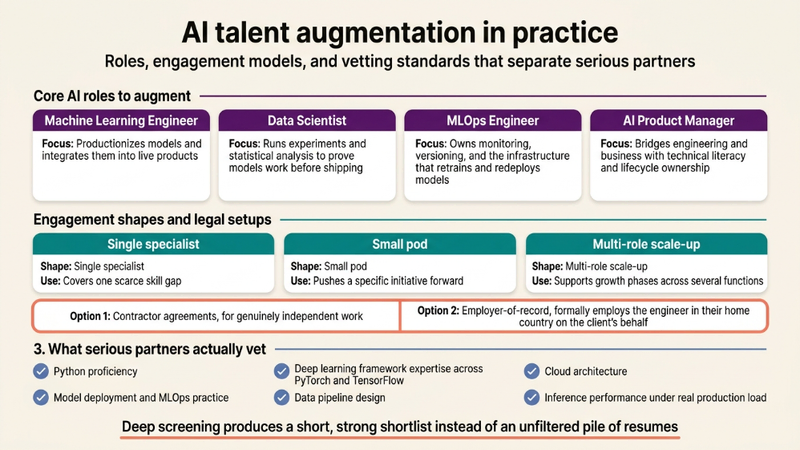
The roles a company augments map directly onto how an AI system gets built and run. Machine Learning Engineers productionize models and integrate them into live products. Data Scientists handle experimentation and statistical analysis, proving a model works before it ships. MLOps Engineers own monitoring, versioning, and the infrastructure that retrains and redeploys models as new data arrives. AI Product Managers bridge engineering and the business, carrying technical literacy alongside stakeholder communication and lifecycle ownership.
Engagement takes one of a few shapes depending on the gap. A company might bring on a single specialist to cover one scarce skill or add a small pod behind a specific initiative. Growth phases widen the same arrangement across several roles at once. Coverage reaches past model building into business analysis and change management, where an AI rollout depends on redesigned processes and teams prepared to work with what ships. The legal setup varies in step, running from contractor agreements for genuinely independent work to an employer-of-record arrangement that formally employs the engineer in their home country on the client’s behalf.
What sets AI augmentation apart from general IT staffing is the vetting. Surface familiarity with a framework tells a hiring team little about whether an engineer takes a model from a notebook to scaled deployment. A serious partner checks Python proficiency, deep learning framework expertise across PyTorch and TensorFlow, model deployment and MLOps practice, data pipeline design, cloud architecture, and inference performance under real production load. That depth of screening lets a client interview a short, strong shortlist rather than wade through an unfiltered pile of résumés.
Companies turn to augmentation for more than one reason. Timing drives most decisions, while scarce expertise and the cost of a wrong permanent hire push in the same direction, and those pressures rarely show up on their own.
Speed is the most common trigger. A permanent technical hire runs months from approval to first commit, and in a tight market the search stalls when the few qualified people are not looking to move. PwC’s 29th Annual Global CEO Survey found that nearly a quarter of chief executives already see talent shortages hurting performance, with skills availability ranking as a significant threat to growth. Augmentation cuts that timeline since the partner keeps a vetted pool and puts forward people available now, turning a roadmap commitment that hangs on missing capacity into a build that starts this month.
Specialized AI skills are too new or too scarce to keep on permanent staff, especially when the need runs intense but short. Korn Ferry projects a global talent shortage of 85.2 million workers and nearly $8.5 trillion in unrealized annual revenue by 2030, with the technology and telecommunications sector among the hardest hit.
Building that depth internally on the timeline a project runs is rarely realistic, so a company brings in an engineer who has already done the specific work and releases them when the need passes.
Augmentation lowers hiring risk in two ways. A permanent hire who turns out to be a poor fit is expensive to unwind in time, severance, and the months lost before the mismatch surfaces. Because the engagement stays flexible and the partner has already screened the person against the role, a fit that does not work gets adjusted without an internal termination, and the partner supplies an alternative. The pre-screening itself trims risk by starting the client from a smaller, stronger pool than an open search would produce.
Hungary’s strength in software did not appear by chance. The country treated mathematics and engineering as core disciplines for decades, long before short-track developer programs spread across Europe, and that groundwork now feeds a workforce international employers source directly.
Higher education anchors the supply. Eötvös Loránd University, founded in 1635, runs research-led programs in mathematics and informatics. Budapest University of Technology and Economics produces a steady cohort of engineering graduates, with the University of Debrecen adding depth from Hungary’s second-largest city.
Multinational investment lifted the technical ceiling. BlackRock and Wise built sizable Budapest operations, and Cloudera runs engineering work from the capital, drawn by a steady flow of mathematics and computer science graduates. Their presence raised local salary benchmarks and kept graduates inside the domestic market rather than leaving for Western Europe. The city hosts established industry gatherings such as Craft Conference and Startup Safari Budapest, which pull international developers into Hungary each year.
The AI demand showing up across Hungary mirrors the global picture. The Artificial Intelligence market is expected to reach $617 .62 billion in 2026, and at an annual growth rate near 14.82%, it could approach $1.42 trillion by 2032. Hungarian AI market value is projected to reach $1.575 billion by 2030. Hungarian firms like SEON and Danube Data Minds, in financial services, apply AI to fraud detection and algorithmic trading, while eCommerce operators use it for personalized recommendations and supply chain optimization, all of which feeds a need for specialists the domestic pipeline has not yet caught up with.
Several structural advantages explain why employers keep returning to Hungary for technical hires, and talent depth comes first. A workforce trained in mathematics and engineering supplies the backend, frontend, data, and cloud skills modern AI products demand, with senior engineers carrying the architectural judgment that production systems require.
Language rarely blocks collaboration. English proficiency across Hungarian technology hubs ranks 22nd on EF English Proficiency Global indexes, and many engineers speak a second European language, which smooths daily work with distributed teams. Time zone alignment helps as much as language does. Budapest runs on Central European Time, giving real-time overlap with Western European offices and a workable afternoon window with the US East Coast.
Cost-to-output is the quieter advantage. Hungarian engineers no longer come at bargain rates, yet the country still delivers senior technical quality at a meaningful discount to Western Europe and the US. Eastern and Central European markets, Hungary among them, place senior engineers in the $40000 to $65000 band, against $80000 to $120000 in Western Europe and $110000 to $150000 for mid-to-senior engineers in the US before benefits and equity. A senior engineer in Budapest often earns well under half the salary of a San Francisco counterpart while offering skills that hold up for similar roles, and the savings turn into value only when the vetting holds.
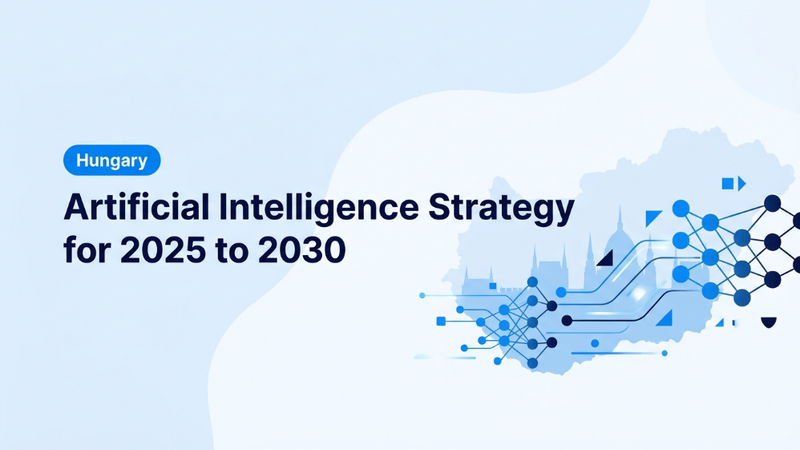
The policy direction reinforces the demand story. The Hungarian Government published its Artificial Intelligence Strategy for 2025 to 2030, developed with input from government agencies and the Artificial Intelligence Coalition, a body formed in 2018 that brings together 400 representatives from business, science, and government. The strategy rests on six pillars covering regulation and security, infrastructure, education and competence development, the data economy, research and innovation, and the encouragement of AI applications, with priority sectors running from the public sector through health care to manufacturing and agriculture.
That national push lands alongside the EU AI Act, which classifies many HR-related AI uses as high-risk and triggers strict compliance duties for the companies that deploy them. Since early 2025, the Act requires basic AI literacy from all deployers of high-risk systems, meaning HR teams and employees alike must grasp how a tool works, what it does, and which risks it carries. Hungarian labor law adds its own boundaries, restricting AI to what is necessary and proportionate for the job, limiting monitoring, and requiring works council consultation at least 15 days ahead where AI affects working conditions.
For a company hiring AI specialists in Hungary, this backdrop shapes the kind of talent worth sourcing. Engineers who grasp responsible deployment, bias testing, and the documentation the Act demands carry value beyond raw modeling skill, and a recruitment partner aware of the regulatory environment screens for that awareness rather than treating it as an afterthought.
Augmentation solves the capacity problem, yet it introduces operational realities that a company must manage to get the full benefit. DevsData LLC places vetted engineers into client teams across European markets and carries the sourcing, employment, and compliance work behind each placement, so the difficulties below appear next to the way the firm absorbs them on the client’s behalf.
Integrating external engineers into internal teams sits at the top. An augmented engineer who never quite joins the team delivers a fraction of their potential, and poorly integrated external engineers disengage first. DevsData LLC screens for working style and collaboration alongside technical skill, presenting engineers suited to slotting into an existing structure, joining the client’s daily standups and working inside the client’s own toolset rather than operating in isolation, and aligning candidates to the client’s culture and delivery model from the outset.
Communication across borders runs a close second. Cross-border teams depend on clear exchange despite distance and time zone differences, and the quality of an individual engineer’s English matters more than a country’s average. DevsData LLC evaluates command of English and the ability to work with international stakeholders during screening, building regular communication into each engagement through weekly syncs and a shared channel the client follows directly.
Finding senior AI specialists quickly is the sharpest difficulty, since the engineers most worth augmenting are exactly the ones hardest to find. DevsData LLC maintains a large database of pre-vetted candidates and runs a technical screening process built for senior roles, combining live coding tasks with architecture-oriented interviews that test real delivery capability rather than credentials alone, which lets the firm present qualified engineers from a standing pool rather than starting each search from zero.
Compliance and engagement structure complete the set. Cross-border augmentation carries obligations a company cannot afford to get wrong, from worker classification to data protection, and ownership of what an engineer produces needs to be settled in the contract before any access to proprietary models or training data begins. DevsData LLC supports international hiring with contractor arrangements or employer-of-record models as the situation requires, holding a government-approved recruitment license and operating to established compliance and data-protection standards.
Do you have IT recruitment needs?
Founding year: 2016
Website: www.devsdata.com
Headquarters: Brooklyn, NY, and Warsaw, Poland
DevsData LLC is a specialized IT recruitment firm that extends client engineering teams with vetted professionals across European markets, handling the complexities of international hiring from vetting through to compliance, rather than a vendor that supplies names. A local Budapest office lets clients meet the team in person while tapping an international recruiting network, with more than ten years of experience and a database of over 95000 pre-vetted professionals across the US and Europe, reaching into Latin America.
Selection runs deliberately tight. Out of thousands of applicants, fewer than six percent clear the full pipeline, which includes a problem-solving challenge and a 90-minute technical interview led by a senior engineer with more than ten years of experience. For AI roles, the interview tests the production-level skills described in the vetting section, through real-world problem-solving scenarios that show how a candidate reasons and troubleshoots rather than what sits on a résumé.
Speed runs alongside that rigor rather than against it. Nearly half of all placements close in under ten days and most finish inside two weeks, so an augmented engineer starts on the client’s board while a comparable internal search would still be scheduling first interviews. DevsData LLC works on a success-fee model, so payment follows a confirmed placement, and an engineer who turns out to be the wrong fit for the team is replaced under the same guarantee, which keeps the financial exposure of an engagement low.
The track record reflects the approach. DevsData LLC holds a 5 out of 5 rating on both Clutch and GoodFirms, with more than 100 completed projects for over 80 clients. Beyond recruitment, the firm offers Employer of Record services handling payroll, taxes, and compliance; AI roadmap planning that sequences key hires by project maturity, bringing a Data Scientist on at the proof-of-concept stage and an MLOps Engineer once a model heads to deployment; and business process outsourcing for clients setting up locally.
The placements below show how a structured process delivers under tight deadlines and demanding AI requirements.

DotData, Inc., a US-based company whose platform automates the most complex stages of the machine learning lifecycle, partnered with DevsData LLC to scale its international research and development capacity. The roles spanned Data Scientists, Scala Developers, DevOps Engineers, and technical writers supporting both American and Japanese teams, a profile sitting squarely in the high-premium specializations where data-infrastructure and ML deployment skills carry the steepest pay bands. Sourcing engineers capable of improving ML automation proved difficult precisely because advanced AI and data-engineering talent stays in extremely short supply. DevsData LLC placed 16 senior professionals across Poland and Japan, work that reduced deployment cycles by more than 25% and strengthened the company’s capacity for global expansion. Spreading senior hires across two regions let the client secure deep-tech capability without paying a single high-cost metro rate for every seat.

BNP Paribas had struggled for months to fill senior engineering roles through its internal hiring teams. The bank needed seven senior Java positions filled at pace, including a technical lead, inside a competitive talent market. DevsData LLC combined targeted sourcing with rigorous multi-stage technical interviews to surface candidates ready to perform from day one, filling all seven roles, the tech lead included, within four weeks, which turned a stalled internal search into a completed team.

Imagine Anything Ltd., a high-growth AI startup in the UK, needed an entire technical and creative squad rather than a single engineer, with skills running from a CTO and backend and frontend developers through to QA and a UX Designer, assembled inside five weeks. Structured role definitions paired with scenario-based assessments let the firm staff the team end-to-end on schedule, with screening frameworks aligned across functions to avoid mis-hires.
Do you have IT recruitment needs?
For companies building AI capability in Europe, Hungary stands out for the depth of its engineering talent paired with rates under Western European and US levels. Hungary stands out as a European market where that talent runs deep, built on long investment in mathematics and engineering, lifted by multinational engineering centers, and backed by a national AI strategy and EU regulatory alignment that give hiring firms a stable footing. The country pairs senior technical quality with cost levels well below Western Europe and the US, a combination that turns distributed AI teams into a strategic choice rather than a short-term way to cut costs.
The value holds only when the vetting holds, which is where a specialized partner earns its place. DevsData LLC brings a Budapest presence, a database of more than 95000 pre-vetted professionals, an AI-specific screening process, and a success-fee model that ties its incentives to client outcomes.
For a company weighing where and how to build AI capability in Hungary, that mix of local reach and compliance support turns the promise of augmentation into a working team. For more information, please visit www.devsdata.com or contact the team at general@devsdata.com.
Discover how IT recruitment and staffing can address your talent needs. Explore trending regions
like Poland, Portugal, Mexico, Brazil and more.

 Frequently asked questions (FAQ)
DevsData – your premium technology partner
DevsData is a boutique tech recruitment and software agency. Develop your software project with veteran engineers or scale up an in-house tech team of developers with relevant industry experience.
Free consultation with a software expert
🎧 Schedule a meeting
FEATURED IN


DevsData LLC is truly exceptional – their backend developers are some of the best I’ve ever worked with.”

Nicholas Johnson
Mentor at YC, serial entrepreneur


 Build your project with our veteran developers.
Explore the benefits of technology recruitment and tailor-made software.
Learn how to source skilled and experienced software developers.

Rebecca Botvin

Commercial Director

Tom Potanski
Manager




Categories: Big data, data analytics | Software and technology | IT recruitment blog | IT in Poland | Content hub (blog)
















careers@devsdata.com





general@devsdata.com

"I interviewed about a dozen different firms. DevsData LLC is truly exceptional – their backend developers are some of the best I've ever worked with. I've worked with a lot of very well-qualified developers, locally in San Francisco, and remotely, so that is not a compliment I offer lightly. I appreciate their depth of knowledge and their ability to get things done quickly."

Nicholas Johnson
CEO of Orange Charger LLC,
Ex-Tesla Engineer,
Mentor at YCombinator
"DevsData reached out to us, as we've been looking to grow our engineering team in Europe and Poland. Communicating efficiently and professionally, DevsData made a strong impression with their understanding of the recruitment challenges we were facing. They designed a tailored recruitment process for our needs. I was impressed with the technical depth of their approach."

Karim Butt
Co-Founder & CTO at GlossGenius, Inc.
"Out of all the vendors we work with, DevsData clearly stands out. The quality of developers they deliver is beyond what we've received from any other vendor, and they've been able to send profile recommendations very quickly. I'm happy to be their reference for other companies from Israel and talk about their recruitment abilities and what they delivered for us."

Ran Eyal
Senior Manager at
ZIM Integrated
Shipping Services Ltd.
"DevsData demonstrated a strong degree of proactivity, taking time to thoroughly understand the problem and business perspective, and continuously suggesting performance and usability enhancements. Their app exceeded my expectations. I've worked with DevsData on numerous projects over the last 3 years and I'm very happy. Being both responsive and honest in communication."

Jonas Lee
Partner & Executive VP of Verus,
Financial LLC, Investor,
& Serial Entrepreneur
Acknowledgments