Thanks for subscribing.
Your gift is on the way.



Mobile applications drive revenue, customer retention, and operational efficiency across industries, yet building them demands expertise split across multiple platforms, frameworks, and device ecosystems. A single product often requires native iOS knowledge, Android optimization, backend API design, and cross-platform tooling, all coordinated under tight release cycles. DevsData LLC operates as both a software delivery partner and a recruitment firm, providing access to vetted Mobile Developers through a database of over 95000 technical profiles. The company holds a government-approved recruitment license in Poland, supporting operations across European and international markets.
This article examines the mobile app development landscape through DevsData LLC’s recruitment and delivery experience, covering market demand, technical requirements, team composition, and the operational factors that determine successful mobile projects.
The global mobile application market size was valued at $298.40 billion in 2025, and the market is projected to grow from $330.02 billion in 2026 to $1017.18 billion by 2034, exhibiting a CAGR of 15.1% during the forecast period, according to Fortune Business Insights. This expansion creates continuous demand for Mobile Developers across native iOS, native Android, and cross-platform frameworks.
Beyond gaming, which accounts for over 40% of total industry revenue, the fastest-growing segments include retail, financial services, and entertainment. These sectors drive most of the demand for the Mobile Developers covered in this article. Asia Pacific leads regional adoption with 32% market share, while the US market grows at 14.1% CAGR through 2030. The UK accounts for over 26% of European mobile app market revenue.
Maintaining separate codebases for iOS and Android increases development time and cost, which has pushed cross-platform frameworks to dominate new project starts. Flutter holds approximately 46% market share among cross-platform tools, with React Native at 35%, based on the 2024 Stack Overflow Developer Survey. The top 100 apps built on Flutter and React Native generated a combined $570 million in net revenue during Q4 2024, signaling that cross-platform tools now support production-grade, revenue-generating products rather than prototypes alone.
These market dynamics translate directly into hiring requirements. Companies building new mobile products need developers fluent in Swift or Kotlin for native implementations, or specialists in Flutter and React Native for cross-platform delivery. Existing applications require maintenance teams familiar with legacy codebases, often built on older frameworks or native platforms.
Do you have software development needs?
Mobile development roles differ substantially based on platform choice, product maturity, and system dependencies. DevsData LLC’s recruitment process accounts for these distinctions when matching developers to project requirements.
New applications progress from requirements and prototyping into full development. Existing applications require technical analysis first, since the inherited architecture determines what the team can realistically add, optimize, or rebuild without destabilizing the product.
Native iOS work centers on Swift, with legacy projects occasionally requiring Objective-C knowledge. Developers need familiarity with Xcode, CocoaPods, or Swift Package Manager for dependency management, and Apple’s design guidelines. Projects involving Core ML, ARKit, or HealthKit require additional specialization.
iOS developers working on consumer applications must understand App Store review guidelines, in-app purchase implementation, and push notification infrastructure. Enterprise iOS projects often involve Mobile Device Management (MDM) integration, certificate-based authentication, and custom distribution workflows.
Android development uses Kotlin as the primary language, with some projects maintaining Java codebases. Developers work with Android Studio, Gradle for build configuration, and Jetpack libraries for architecture components. Material Design principles guide interface implementation.
Android’s device fragmentation requires developers to test across multiple screen sizes, OS versions, and manufacturer customizations. Projects targeting emerging markets often need offline-first architecture and optimization for lower-spec devices.
Flutter developers write in Dart and work with Flutter’s widget-based architecture. The framework handles rendering through its own graphics engine, which affects how developers approach UI implementation compared to native platforms. State management libraries like Riverpod or Bloc shape application architecture.
React Native developers use JavaScript or TypeScript and leverage React concepts within mobile development. The framework bridges to native modules through platform-specific code when needed. Projects often integrate native dependencies, requiring developers to understand both the JavaScript layer and the underlying iOS/Android implementation.
Cross-platform specialists need judgment about when platform-specific code becomes necessary. Bluetooth device communication, complex background processing, and high-frame-rate animations often require native modules despite using a cross-platform base, because framework abstractions introduce latency or lack full access to device APIs.
DevsData LLC applies cross-platform frameworks in projects where a single codebase serving both platforms reduces delivery time and maintenance overhead, such as MVP launches or data-driven apps with standard UI patterns. Projects requiring deep hardware access or platform-specific performance tuning default to native development.
PWA development sits between web and mobile engineering. Developers work with service workers for offline functionality, Web APIs for device features, and responsive design patterns. The technology suits content-driven applications and services prioritizing reach over device integration.
Early-stage products often begin as functional prototypes before any full build starts. Flutter’s hot reload and React Native’s Fast Refresh shorten the loop between a code change and a visible result, which makes cross-platform developers a practical fit for this phase. The judgment that matters here involves deciding which prototype code survives into full development and which gets rewritten.
AI functionality brings a separate set of requirements. On-device inference relies on Core ML for iOS and ML Kit for Android, while features built on large language models call cloud APIs and need careful handling of latency and user data. Production experience with either approach lowers the risk of features that drain batteries or stall on weak connections.
Mobile projects require coordinated work across multiple roles. Small projects with clear requirements often operate with one to two Mobile Developers, a Backend Developer for API work, and shared access to design and QA resources.
Mid-sized projects typically involve three to five Mobile Developers split between platforms, supported by dedicated Backend Developers for API and database work. Design and quality fall to a UX/UI Designer focused on mobile patterns and QA Engineers for device testing, while a Product Manager sets feature priorities and a Technical Project Manager keeps delivery on schedule.
Large-scale mobile products require specialized roles within the mobile team. Senior developers focus on architecture and performance optimization. Mid-level developers handle feature implementation. Junior developers work on UI refinement and bug fixes. The team includes dedicated DevOps engineers for CI/CD pipelines, security specialists for authentication and data protection, and product managers who understand mobile market dynamics.
DevsData LLC’s recruitment model supports flexible team formation. Companies can hire individual specialists to fill gaps in existing teams or assemble complete mobile development groups for new products. The 95000-profile database provides access to developers with specific framework expertise, industry experience, or regional availability requirements.
Company size: ~60 employees
Founding year: 2016
Website: www.devsdata.com
Headquarters: Brooklyn, NY, and Warsaw, Poland
DevsData LLC applies a screening methodology with an acceptance rate below six percent, which reduces the risk of mismatched hires and shortens the time clients spend evaluating candidates themselves. The process evaluates technical depth, problem-solving ability, and communication skills through multiple stages.
Initial screening reviews developer portfolios, GitHub repositories, and published applications. Recruiters assess code quality, architectural decisions, and project complexity. Candidates with relevant framework experience and demonstrable mobile work advance to technical evaluation.
Technical interviews test practical mobile development knowledge rather than abstract algorithms. For native developers, questions cover platform-specific patterns, memory management, threading models, and UI lifecycle handling. Cross-platform candidates explain framework architecture, state management approaches, and strategies for sharing code between platforms.
Senior roles receive additional evaluation focused on system design, team leadership, and decision-making under constraints. Candidates walk through architectural choices from past projects, explaining trade-offs between competing approaches and how technical decisions aligned with business requirements.
Communication assessment runs throughout the process. As the article’s section on mobile-backend coordination challenges describes, misaligned API design between teams creates delays and rework. Developers who explain technical constraints clearly and ask precise questions during API contract discussions prevent those breakdowns before they reach production.
The company’s government-approved recruitment license supports operations across Poland and broader European markets. This licensing affects compliance requirements, candidate verification procedures, and contract structures for international hiring.
Do you have software development needs?
DevsData LLC’s recruitment and team formation experience spans retail modernization, consumer applications, and payment systems.

ShopGarden operated a Magento-based eCommerce backend with a mobile application experiencing checkout failures and synchronization problems. The Pennsylvania-based retailer needed experienced cross-platform developers who could rebuild the mobile layer without disrupting daily sales operations or requiring backend replacement.
DevsData LLC identified and placed Mobile Developers with specific cross-platform framework expertise and eCommerce integration experience. The team needed to understand Magento’s API structure, implement error handling for inconsistent data states, and design checkout flows that remained stable under varying network conditions. Developer selection prioritized candidates familiar with WCAG 2.2 AA accessibility standards, a requirement that shaped decisions such as touch target sizing, color contrast ratios, and screen reader compatibility across the app’s navigation and checkout screens. The assembled team delivered location-aware push notifications for nearby store promotions and a rebuilt checkout process that eliminated the synchronization failures present in the previous version, all while ShopGarden continued processing orders without interruption.
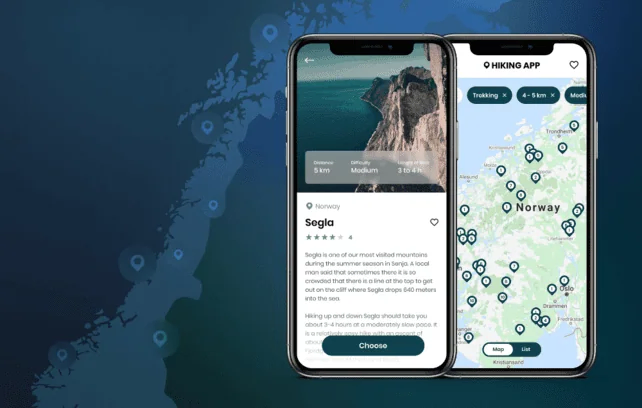
The Norwegian outdoor market required Mobile Developers experienced with interactive mapping, community features, and weather API integration. DevsData LLC screened candidates for specific technical capabilities, including mapping library expertise, offline data caching strategies for remote areas, and real-time API integration through MET Norway’s weather service.
The placed developers built an application that achieved over 13000 downloads, with ratings of 4.8 on Google Play and 4.5 on the Apple App Store, based on nearly 80 reviews. The project required DevsData LLC to identify Mobile Developers who understood efficient map rendering, offline-first architecture for areas with limited connectivity, and social features supporting group trip organization.
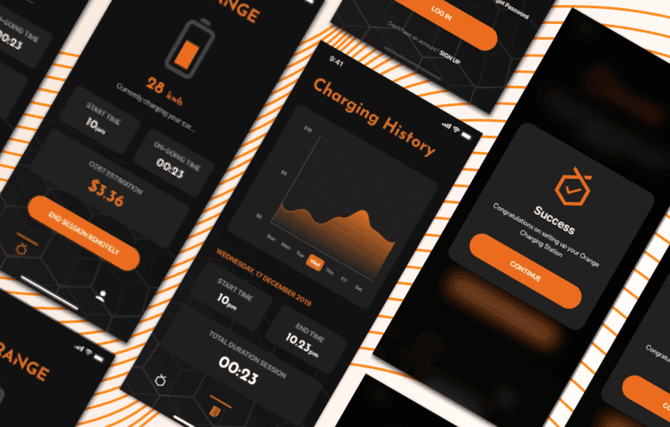
Orange Charger needed Mobile Developers experienced with payment system integration for their electric vehicle charging infrastructure serving multi-tenant residential properties. The technical requirements specified JWT-based authentication, password hashing, and 256-bit encryption for payment data, limiting the candidate pool to developers with demonstrated security implementation experience.
DevsData LLC’s screening process identified developers who had previously worked with payment processing, secure data handling, and mobile-to-backend communication under strict security constraints. The recruited team delivered user authentication, charging session monitoring, and billing workflows that met the project’s security requirements.
DevsData LLC offers multiple engagement models depending on project requirements, timeline certainty, and organizational structure.
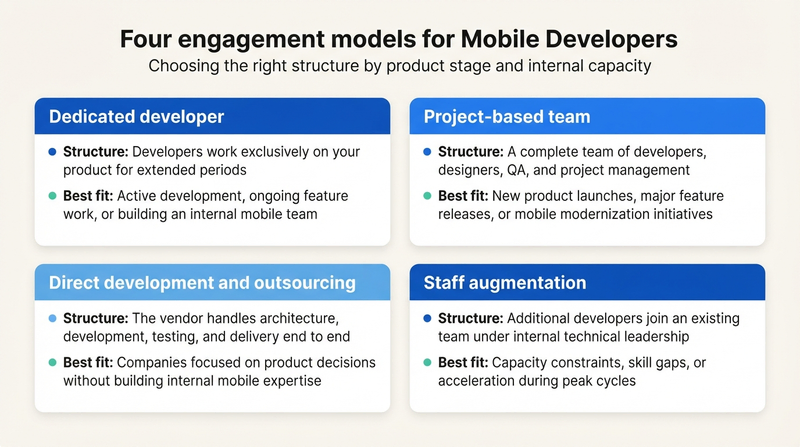
Companies hire Mobile Developers who work exclusively on their projects for extended periods. This model suits products in active development, platforms requiring ongoing feature work, or organizations building internal mobile teams. Developers integrate into existing processes, participate in planning discussions, and maintain familiarity with the codebase over time.
The dedicated model works when projects need ongoing development rather than a fixed set of deliverables. Developers understand product context, business constraints, and technical debt. This continuity reduces onboarding overhead and allows developers to propose improvements based on accumulated knowledge.
For defined scopes with clear milestones, DevsData LLC assembles complete mobile teams including developers, designers, QA engineers, and project management. The company handles team coordination, technical leadership, and delivery management. This model suits new product launches, major feature releases, or mobile modernization initiatives with specific completion targets.
Project teams operate independently or integrate with client organizations, depending on existing technical capacity. The model provides access to complete mobile expertise without requiring companies to build internal recruitment infrastructure or manage individual contractors.
Some companies prefer to hand over the entire build instead of hiring developers into their own structure. Under this model, DevsData LLC’s delivery teams take responsibility for technical architecture and development, with testing and project management handled inside the same team. The client stays focused on product decisions and receives a working application without building internal mobile expertise.
Organizations with existing mobile teams hire additional developers to address capacity constraints, fill skill gaps, or accelerate specific initiatives. Developers join existing workflows, report to internal technical leadership, and work alongside permanent staff.
This model applies when companies need React Native expertise for a new cross-platform initiative, Senior iOS Developers for performance optimization work, or additional Android capacity during peak development cycles. Developers integrate quickly because the core project structure and technical decisions already exist.
DevsData LLC operates from Brooklyn, New York, and Warsaw, Poland, with a developer database spanning multiple regions. Geographic distribution affects communication patterns, work hours overlap, and coordination complexity.
Eastern European developers provide cost advantages compared to Western European or North American markets without a drop in code quality or framework expertise. Poland, Ukraine, Romania, and other regional markets supply Mobile Developers with strong computer science education, English proficiency, and experience with international projects.
Time zone alignment matters for projects requiring real-time collaboration. European developers working with US East Coast clients overlap for several hours daily, supporting meetings, code reviews, and coordination. Asia Pacific developers suit European and Middle Eastern clients or US clients comfortable with asynchronous communication patterns.
Fully distributed mobile teams require deliberate communication practices. Documentation becomes critical for architectural decisions, API contracts, and design specifications. Asynchronous code reviews, recorded technical discussions, and detailed pull request descriptions replace ad-hoc conversations. These practices benefit projects regardless of geographic distribution but become essential when teams span multiple time zones.
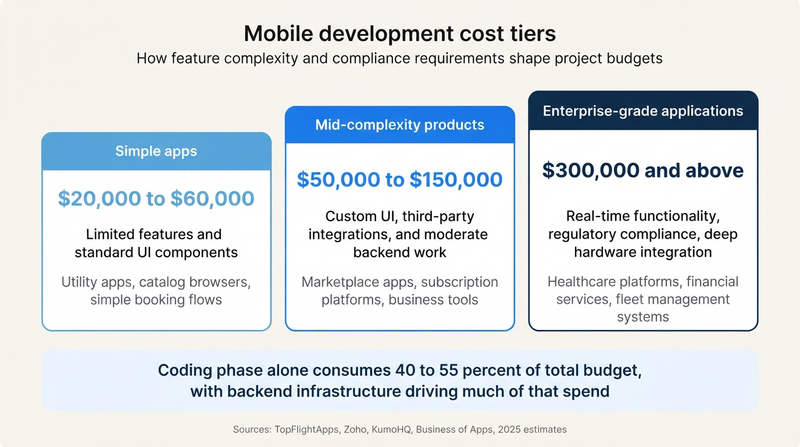
Before a company posts a single job description, the project budget has already set limits on team size and seniority mix. Most cost drivers map to a specific hire, so knowing which drivers apply tells a Hiring Manager which roles the team needs and which ones the budget covers. The main drivers are platform choice, feature complexity, backend dependencies, third-party integrations, design requirements, compliance needs, and team location.
Mobile development costs vary based on platform choice, feature complexity, backend dependencies, third-party integrations, design requirements, compliance needs, and team location. As a rough benchmark, simple apps with limited features typically cost $20000 to $60000, mid-complexity products with integrations and custom UI fall in the $50000 to $150000 range, and enterprise-grade applications with real-time functionality or regulatory requirements regularly exceed $300000 (sources: TopFlightApps, Zoho, KumoHQ, 2025 estimates).
Native development for both iOS and Android costs more than cross-platform approaches because separate codebases require parallel engineering efforts. This cost difference shrinks when applications need platform-specific features that cross-platform frameworks handle poorly.
Feature complexity affects development time more than platform choice. Simple CRUD applications with standard UI components take weeks to build. Applications requiring real-time synchronization, complex animations, offline functionality, payment processing, or hardware integration require months of development from experienced teams.
Backend API work represents a significant share of total project cost. According to Business of Apps, the coding phase (frontend and backend combined) consumes 40 to 55% of total budget, with backend infrastructure and API layers driving much of that spend. For a mid-complexity app budgeted at $100000, backend development alone can account for $30000 to $50000 once database design, authentication, server logic, and API endpoints are factored in. Mobile applications depend on these services for data exchange, user authentication, payment processing, and business logic, so no mobile project moves forward without a functioning API layer.
Third-party integrations add development time for authentication providers, payment processors, analytics platforms, mapping services, and push notification systems. Each integration requires reading documentation, implementing SDK calls, testing edge cases, and handling errors. Some services bill separately for usage, adding operational costs beyond development.
Design requirements influence budget when applications require a custom visual identity, detailed interaction design, or accessibility compliance. Mobile design differs from web design in gesture patterns, navigation structures, and platform conventions. Designers experienced with mobile constraints produce specifications that reduce developer interpretation time and design-implementation mismatches.
Compliance needs in healthcare, finance, or education sectors add development time for security audits, data encryption, user consent flows, and documentation. HIPAA compliance, PCI DSS requirements, and GDPR provisions influence architecture decisions and require ongoing maintenance.
Developer location affects rates but not in simple ways. Senior developers in high-cost markets bring experience with complex projects, established technical patterns, and ability to mentor junior team members. Mid-level developers in lower-cost regions often match technical skills while requiring more guidance on architectural decisions. The optimal cost structure depends on project complexity and available technical leadership.
Organizations hiring Mobile Developers encounter recurring obstacles that affect project timelines and outcomes.
Evaluating mobile development expertise requires understanding platform-specific patterns, framework evolution, and practical problem-solving ability. Resumes list technologies but don’t reveal code quality, architectural judgment, or debugging skills. Companies without internal mobile expertise struggle to assess candidate capabilities accurately.
One practical approach is to ask candidates to walk through a recent production problem they solved, explaining trade-offs and alternatives they considered. This reveals reasoning depth faster than abstract algorithm tests. DevsData LLC’s screening process follows a similar principle, pairing framework-specific questions with code sample reviews and real-world problem-solving scenarios. This filtering reduces the risk of hiring developers with superficial framework knowledge or limited production experience.
Organizations starting mobile projects face decisions between native and cross-platform development without clear criteria for choosing. Marketing materials emphasize framework benefits while downplaying limitations. Teams select technologies based on industry trends rather than project requirements.
Experienced Mobile Developers help evaluate trade-offs between approaches. Native development provides full platform access and optimal performance, but requires separate iOS and Android teams. Cross-platform frameworks reduce code duplication and speed initial development, but sometimes require platform-specific workarounds. The right choice depends on feature requirements, team expertise, timeline constraints, and long-term maintenance plans.
Mobile applications depend on backend APIs for data, authentication, and business logic. Misalignment between mobile and backend development creates delays, rework, and user-facing bugs. Backend teams sometimes design APIs for internal needs without considering mobile constraints around bandwidth, latency, or offline access.
Successful mobile projects establish clear API contracts early, with backend and Mobile Developers agreeing on endpoints, data structures, error handling, and versioning strategies. Mobile developers participate in API design discussions to ensure endpoints support efficient mobile implementation. Regular integration testing catches mismatches before they reach production.
Android applications run on thousands of device models with varying screen sizes, OS versions, hardware capabilities, and manufacturer customizations. iOS devices show less fragmentation but still require testing across iPhone and iPad models, iOS versions, and accessibility settings.
Manual testing across all device combinations is impractical. Teams use device farms for automated testing, prioritize testing on popular device models based on analytics data, and implement defensive coding practices that handle unexpected device behaviors gracefully. QA Engineers experienced with mobile testing design test suites that maximize coverage while remaining maintainable.
Mobile Developers receive frequent recruitment outreach because demand exceeds supply. Experienced developers with modern framework skills command competitive compensation and have multiple employment options. Organizations investing in mobile team formation face attrition risk, particularly in competitive markets.
Retention improves when developers work on technically interesting problems, receive regular feedback, and see a clear growth path within the organization. Competitive compensation matters, but studies consistently show that engineering autonomy and learning opportunities rank among the top reasons developers stay. For organizations that prefer not to manage retention directly, DevsData LLC’s flexible engagement structures offer an alternative: companies access Mobile Developers without competing for permanent hires, and scale capacity up or down based on project needs.
DevsData LLC operates both as a software development partner and a recruitment firm. This combination provides flexibility for organizations with different needs and internal capacity levels.
Companies seeking complete mobile solutions work with DevsData LLC’s delivery teams. The company handles technical architecture, development, testing, and project management. Clients receive working applications without building internal mobile expertise.
Organizations with existing development capacity but temporary resource constraints use DevsData LLC’s recruitment services. The company provides access to vetted Mobile Developers who join client teams directly. This model suits companies with established mobile practices that need additional specialists for specific frameworks or project phases.
The database of over 95000 technical profiles supports both models. Developers suitable for independent client work receive screening focused on communication, autonomy, and the ability to navigate organizational complexity. Developers joining DevsData LLC’s delivery projects emphasize technical depth, collaboration within established teams, and alignment with the company’s development practices.
Do you have software development needs?
Mobile application development creates sustained demand for specialized engineering talent across native iOS, native Android, and cross-platform frameworks. The global mobile app market’s growth from $252.89 billion in 2023 toward $626.39 billion by 2030 indicates continued expansion and an ongoing need for Mobile Developers.
DevsData LLC addresses this demand through a dual model combining software delivery and specialized recruitment. The company’s case studies across retail, consumer products, payments, mental health, and education demonstrate technical range and ability to adapt development approaches to sector-specific constraints.
Organizations planning mobile initiatives face decisions about platform choice, team structure, hiring models, and timeline expectations. The company’s database of over 95000 technical profiles, screening process with acceptance rate below 6%, and government-approved recruitment license in Poland support flexible team formation for projects with varying requirements.
For organizations evaluating mobile development partners or seeking dedicated Mobile Developers, DevsData LLC offers consultation on technical architecture, platform decisions, and team composition. Contact general@devsdata.com or visit www.devsdata.com to discuss project requirements.
Discover how IT recruitment and staffing can address your talent needs. Explore trending regions
like Poland, Portugal, Mexico, Brazil and more.
 Frequently asked questions (FAQ)
DevsData – your premium technology partner
DevsData is a boutique tech recruitment and software agency. Develop your software project with veteran engineers or scale up an in-house tech team of developers with relevant industry experience.
Free consultation with a software expert
🎧 Schedule a meeting
FEATURED IN

DevsData LLC is truly exceptional – their backend developers are some of the best I’ve ever worked with.”

Nicholas Johnson
Mentor at YC, serial entrepreneur


 Build your project with our veteran developers.
Explore the benefits of technology recruitment and tailor-made software.
Learn how to source skilled and experienced software developers.
Build your project with our veteran developers.
Explore the benefits of technology recruitment and tailor-made software.
Learn how to source skilled and experienced software developers.

Rebecca Botvin

Commercial Director

Tom Potanski
Manager




Categories: Big data, data analytics | Software and technology | IT recruitment blog | IT in Poland | Content hub (blog)















careers@devsdata.com









general@devsdata.com

"I interviewed about a dozen different firms. DevsData LLC is truly exceptional – their backend developers are some of the best I've ever worked with. I've worked with a lot of very well-qualified developers, locally in San Francisco, and remotely, so that is not a compliment I offer lightly. I appreciate their depth of knowledge and their ability to get things done quickly."

Nicholas Johnson
CEO of Orange Charger LLC,
Ex-Tesla Engineer,
Mentor at YCombinator
"DevsData reached out to us, as we've been looking to grow our engineering team in Europe and Poland. Communicating efficiently and professionally, DevsData made a strong impression with their understanding of the recruitment challenges we were facing. They designed a tailored recruitment process for our needs. I was impressed with the technical depth of their approach."

Karim Butt
Co-Founder & CTO at GlossGenius, Inc.
"Out of all the vendors we work with, DevsData clearly stands out. The quality of developers they deliver is beyond what we've received from any other vendor, and they've been able to send profile recommendations very quickly. I'm happy to be their reference for other companies from Israel and talk about their recruitment abilities and what they delivered for us."

Ran Eyal
Senior Manager at
ZIM Integrated
Shipping Services Ltd.
"DevsData demonstrated a strong degree of proactivity, taking time to thoroughly understand the problem and business perspective, and continuously suggesting performance and usability enhancements. Their app exceeded my expectations. I've worked with DevsData on numerous projects over the last 3 years and I'm very happy. Being both responsive and honest in communication."

Jonas Lee
Partner & Executive VP of Verus,
Financial LLC, Investor,
& Serial Entrepreneur
Acknowledgments