Thanks for subscribing.
Your gift is on the way.



Data Scientists have become a core part of how organizations design products, manage risk, and make operational decisions. As companies across industries expand their use of advanced analytics, predictive modeling, and machine-learning systems, data science has shifted from an experimental capability to an embedded business function supporting revenue generation, efficiency, and compliance.
This shift is reflected in labor-market indicators specific to data science roles. According to workforce projections from the US Bureau of Labor Statistics, employment of Data Scientists is expected to grow by 34% over the next decade, significantly faster than the average for all occupations. Data science also underpins the development of AI capabilities, as machine learning systems depend on the analytical foundations that Data Scientists build. At a global level, the World Economic Forum’s Future of Jobs research consistently identifies data analysts and Data Scientists among the fastest-growing professional roles, driven by increased reliance on data across both technical and non-technical sectors.
Several structural drivers underpin this demand. Organizations are integrating data science into pricing models, demand forecasting, fraud detection, customer personalization, and operational automation. At the same time, regulatory requirements around data usage, explainability, and governance, such as the EU’s AI Act, have increased expectations for how analytical models are developed and maintained. These factors have expanded the scope of data science roles and raised the bar for hiring, particularly as companies seek professionals who can operate within complex business environments rather than isolated research teams.
This article examines how the global market for Data Scientists has evolved and what that means for organizations planning to build or scale data capabilities. It explores when data science roles are necessary and how demand and competition affect recruitment. The article concludes by overviewing how hiring approaches help companies manage risk, timelines, and long-term capability development in a constrained talent market.
Data Scientists are responsible for extracting insight from data and translating it into models and analyses that support business decisions. Their work focuses on identifying patterns in large datasets, building predictive or explanatory models, and quantifying uncertainty to inform planning and execution. Unlike reporting or descriptive analytics, data science typically addresses questions about what is likely to happen, why it is happening, and how outcomes can be influenced.
From a business perspective, Data Scientists enable organizations to move from intuition-driven decisions to evidence-based ones. They support outcomes such as more accurate forecasting, improved resource allocation, and risk detection. In practice, this includes decisions around which customer segments to prioritize, how to price new products based on demand sensitivity, or when to adjust inventory levels ahead of seasonal shifts. Data Scientists also help organizations formalize decision logic, making it repeatable and measurable rather than dependent on individual judgment. As data volumes grow and decisions become more complex, this analytical structure becomes increasingly valuable.
Hiring Data Scientists is most relevant in the following business scenarios:
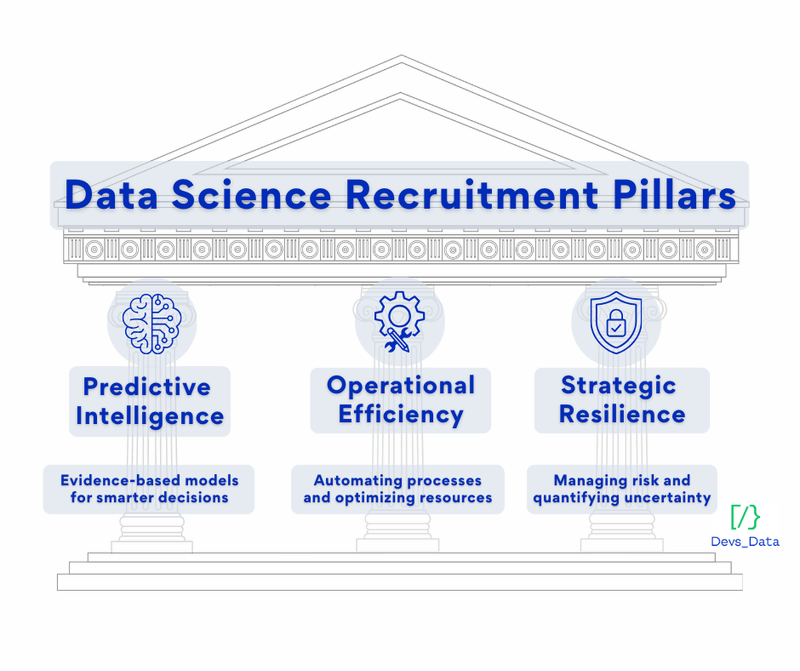
In these contexts, Data Scientists contribute beyond isolated analysis. Their work influences how organizations allocate capital, respond to change, and evaluate performance. As data becomes a core input to strategic and operational decisions, hiring Data Scientists shifts from a technical consideration to a business investment aligned with long-term growth and resilience. The infographic below illustrates the most common business scenarios where data science roles deliver measurable impact.
Global demand for Data Scientists has increased as organizations move from exploratory analytics toward systematic, production-level use of data in decision-making. Data science roles are now embedded across industries rather than confined to technology or research teams, reshaping hiring patterns and intensifying competition worldwide.
Enterprise adoption of machine learning has accelerated this demand beyond what traditional hiring pipelines can absorb. Rather than supporting isolated research projects, Data Scientists are increasingly embedded in core business systems, responsible for forecasting, pricing logic, and operational risk. This transition from experimental to production-level deployment has redefined both the scope of the role and the urgency of filling it.
While demand has expanded, talent supply has lagged. Global workforce surveys indicate that over 75% of organizations report insufficient data and analytics talent to meet current business needs. The shortage is most pronounced at mid- and senior levels, where experience with production models, governance, and business integration is required. As a result, competition for qualified Data Scientists has intensified, with extended hiring timelines and rising compensation pressure becoming common across markets.
To mitigate local talent constraints, companies increasingly recruit Data Scientists across borders. Cross-border hiring for highly skilled digital roles, including data science, has grown by over 30% year over year, reflecting the normalization of remote and distributed work models. This shift has expanded access to talent but also increased global competition, as employers from multiple regions target the same candidate pools, particularly in established analytics hubs.
Hiring processes have adapted to reflect the complexity of data science work. Research shows that data and AI roles often take six months or longer to fill, driven by the difficulty of evaluating analytical depth and real-world application. In response, organizations increasingly rely on applied case assessments, project-based evaluations, and hybrid hiring models that combine permanent and contract Data Scientists to balance speed, risk, and capability needs.
Regulatory frameworks such as the EU’s AI Act have expanded the scope of data science roles to include model explainability, data lineage, and algorithmic accountability – requirements that Data Scientists are now expected to support at the production level. This shift is visible in hiring: a Deloitte survey of C-suite executives found that 53% of organizations were already hiring or planning to hire specifically for AI ethics and compliance roles. Candidates who can navigate explainability requirements and data privacy risk have become harder to source than those with modeling skills alone, adding further pressure to an already constrained talent market.
Overall, the data science labor market is defined by sustained demand growth, constrained talent supply despite the globalization of recruitment. These structural conditions have reshaped how organizations source, evaluate, and deploy data science talent, making recruitment strategy a critical component of broader data and analytics initiatives rather than a standalone hiring activity.
Do you have IT recruitment needs?
Compensation for Data Scientists varies substantially by seniority, with the steepest jump concentrated at the senior level rather than distributed evenly across the career ladder. The figures below reflect estimated total annual pay – base salary plus bonuses, stock, and other variable compensation – as reported by Glassdoor based on tens of thousands of anonymous salary submissions from professionals worldwide.
The following table presents Glassdoor’s median estimated total pay for each seniority level, alongside the range covering the middle 50% of reported salaries.
| Seniority level | Estimated total pay (median) | Middle 50% range |
|---|---|---|
| Junior Data Scientist | $149076 | $116K – $194K |
| Mid Data Scientist | $154184 | $122K – $198K |
| Senior Data Scientist | $231855 | $191K – $287K |
The narrow gap between junior and mid-level figures reflects the composition of Glassdoor’s dataset, which skews toward US technology companies where even early-career titles carry significant compensation. The more meaningful inflection point is the transition to senior level, where total pay climbs by approximately 50% – a premium driven by stock grants and bonuses layered on top of base salary at larger employers.
For organizations evaluating offshoring or nearshoring as a cost strategy, regional data from Glassdoor shows a pronounced differential: Data Scientists in Poland earn roughly 25% of US total compensation, while those in India earn approximately 10%, making Eastern Europe and South Asia the two most common targets for cost-conscious global hiring in this role. Recruitment agencies with cross-market experience can provide salary benchmarking and compensation advisory, helping organizations calibrate offers to local expectations while remaining competitive.
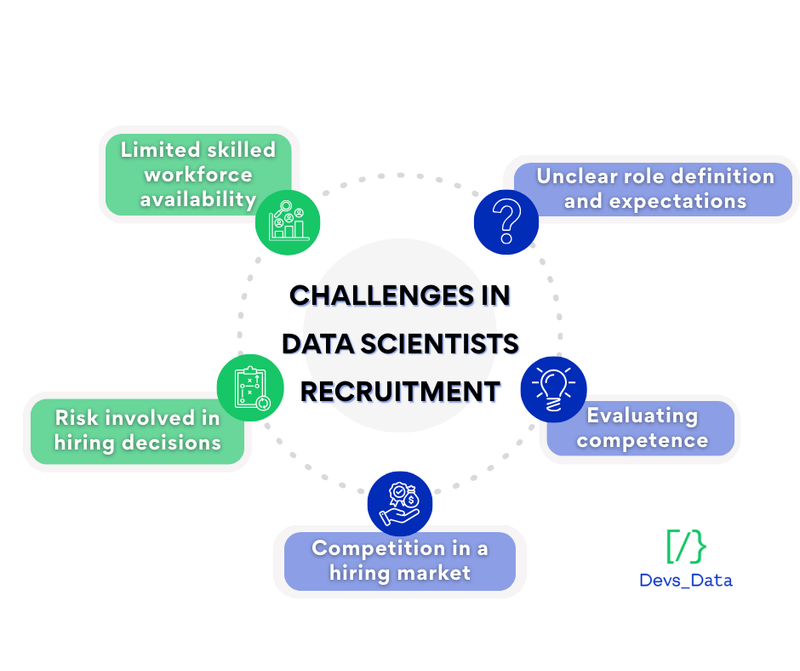
Hiring Data Scientists presents a distinct set of challenges shaped by talent scarcity, role ambiguity, and the operational complexity of deploying data science in production environments. Below are the most common challenges companies face, followed by how DevsData LLC addresses them in practice.
Many candidates have academic or experimental analytics backgrounds but limited experience deploying models in real business environments, where “production-ready” means building solutions that are integrated into live systems, support real-time or batch decision-making, and operate reliably under performance, scalability, and security constraints. In practice, this also requires ownership of the full lifecycle, including deployment pipelines, monitoring, retraining strategies, and close collaboration with engineering teams. Senior Data Scientists with end-to-end ownership experience remain scarce globally. Vacant roles delay analytics initiatives, while hiring underqualified candidates leads to stalled projects or models that never reach production.
DevsData LLC sources globally and draws from a large pre-vetted talent pool of over 95000 candidates, prioritizing candidates with demonstrated experience in applied, production-level data science rather than purely academic profiles.
“Data Scientist” is a broad title covering diverse responsibilities, from statistical modeling to business analytics or machine learning. Poorly defined roles attract mismatched candidates. Misalignment between expectations and delivered outcomes increases attrition risk and wastes time for both hiring teams and candidates.
DevsData LLC conducts upfront role scoping with clients, aligning business objectives, data maturity, and expected impact before sourcing begins, ensuring candidate profiles match actual needs.
CVs and standard interviews often fail to reveal a candidate’s ability to frame problems, work with messy data, or translate analysis into business decisions. Inaccurate evaluation increases the likelihood of mis-hires, leading to rework, technical debt, and missed insights.
Candidates undergo a structured screening process, including in-depth technical interviews and a problem-solving challenge designed to assess analytical reasoning, modeling approach, and practical application.
Data Scientists frequently receive multiple offers, especially for remote-capable roles, making hiring timelines unpredictable. Slow or fragmented recruitment processes result in candidate drop-off and lost hiring opportunities.
DevsData LLC manages the process end-to-end, compressing timelines through parallel sourcing tracks, structured candidate briefings, and coordinated scheduling that keeps decision cycles short. Pre-qualified shortlists reduce client-side review time, but the speed advantage also comes from managing feedback loops actively, so no stage waits on information that can be gathered earlier.
Data Scientists often influence strategic decisions, making hiring mistakes costly and difficult to reverse. A mis-hire can undermine data initiatives and erode confidence in analytics-led decision-making. Beyond technical fit, poor alignment with company culture compounds this risk, as Data Scientists who do not integrate into existing team dynamics are more likely to disengage or leave.
DevsData LLC operates on a success-fee model that includes a defined guarantee period, during which a replacement is provided if the placement does not meet agreed performance expectations or exits the role. The evaluation process also considers company culture alignment, assessing how candidates collaborate within cross-functional teams and adapt to an organization’s decision-making norms. The specific duration and criteria are confirmed during the engagement scoping phase, ensuring both parties have clear accountability from the outset.
In highly specialized data science roles, success depends on identifying professionals who can bridge research depth with real-world model deployment under tight timelines.
Together, these solutions reflect an approach to data science recruitment that addresses structural market constraints through global sourcing, clear role definition, rigorous evaluation, and risk-managed engagement.
Selecting a recruitment agency for Data Scientists requires confirming it can navigate a market marked by role ambiguity, intense competition, and inconsistent candidate quality. The steps below help evaluate an agency’s ability to scope roles correctly, access relevant talent pools, and apply screening processes that predict real-world performance.
A data science agency should be able to clarify what the role is meant to achieve (e.g., forecasting, optimization, risk modeling, experimentation) and translate that into responsibilities, seniority, and success criteria.
What to look for: structured discovery calls, clear role definitions, and alignment between business goals and candidate profiles.
Because data science talent is concentrated in certain regions and often already employed, agencies need proactive sourcing and international reach where relevant.
What to look for: clear explanation of sourcing channels, geographic coverage, and access to passive candidates.
Data science requires more than theoretical knowledge. A reliable agency should screen for problem framing, analytical reasoning, and the ability to work with real data constraints.
What to look for: standardized technical screens, practical case tasks, and consistent evaluation criteria, and assessments led or validated by senior Data Scientists within the agency who have hands-on production experience.
Hiring for Data Scientists is typically iterative. Agencies should provide visibility into pipeline health, candidate feedback, and realistic timelines.
What to look for: defined stages, regular reporting, and measurable pipeline updates.
Because data science roles influence decisions and outcomes, agencies should offer clear accountability mechanisms.
What to look for: transparent pricing, clear replacement/guarantee terms, and documented responsibilities on both sides.
When each hire has a direct impact on research velocity and product direction, structured role definition and rigorous evaluation become critical to reducing hiring risk.
The questions below are intended to support structured evaluation when comparing data science recruitment agencies. Each set of questions corresponds to a specific stage of the selection process and helps clarify how an agency approaches role definition, sourcing, screening, and delivery.
| Step | Questions to ask |
|---|---|
| Defining the role and success criteria | ● How do you translate business goals into a data science role definition? ● How do you distinguish between analytics, ML, and research profiles? |
| Expanding sourcing reach | ● Which regions and talent pools do you actively recruit from? ● How do you access passive candidates who are not actively applying? |
| Validating capability | ● What does your technical screening include (case tasks, modeling exercises, business framing)? ● Who evaluates the work? |
| Managing the process | ● How do you report pipeline progress? ● What is your expected cadence for updates and feedback loops? |
| Reducing hiring risk | ● How are fees structured? ● What happens if the hire does not meet expectations during the early period? |
Taken together, these questions help shift agency selection from subjective assessment to operational review. Clear, specific answers indicate whether an agency is equipped to deliver data science talent consistently in a competitive and global hiring environment. The section below examines how DevsData LLC addresses each of these evaluation criteria through its recruitment model.
Website: www.devsdata.com
Team size: ~60 employees
Founded in: 2016
Headquarters: Warsaw, Poland and Brooklyn, NY
DevsData LLC specializes in Data Science recruitment and has over ten years of experience supporting companies that rely on data-driven decision-making as part of their core operations. Its recruitment model is built around structured evaluation, global sourcing, and clearly defined accountability rather than volume-based candidate delivery.
DevsData LLC works with global corporate clients and high-growth startups across multiple regions, including the US and Israel. This exposure has shaped recruitment workflows that account for different data maturity levels, regulatory environments, and collaboration models. The team includes US-based specialists, supporting alignment with client expectations in markets where data science roles are closely tied to business accountability and governance. These workflows have been applied to data science functions spanning predictive analytics, NLP, and machine learning infrastructure, reflecting the breadth of roles the firm regularly sources.
From a sourcing perspective, DevsData LLC maintains a candidate database of over 95000 professionals, enabling access to pre-vetted data science talent beyond open-market searches. The company operates under an official, government-approved recruitment license, reinforcing compliance and operational reliability. To date, DevsData LLC has completed 100+ recruitment projects for more than 80 clients, reflecting a repeatable delivery process rather than isolated engagements.
Candidate quality is addressed through a rigorous interview framework, including a 90-minute problem-solving challenge designed to assess analytical reasoning, problem framing, and practical application of data science concepts. In addition to technical capability, candidates are evaluated for communication skills, which are critical for translating analytical outputs into actionable business insights within cross-functional teams.
Commercially, DevsData LLC operates on a success-fee model and provides a defined guarantee period, aligning incentives with successful placements and reducing hiring risk. Client feedback on independent platforms reflects this outcome-oriented approach, with the company holding a 5/5 rating on Clutch and GoodFirms.
Together, these elements position DevsData LLC as a recruitment partner structured to address the operational and market realities of hiring Data Scientists, with an emphasis on process rigor, global reach, and measurable hiring outcomes.
The following case represents one of many data science recruitment projects delivered by DevsData LLC, illustrating how its recruitment model operates in practice.
AstroMind, Inc. is a Boston-based AI company developing Physical Language Models designed to interpret complex scientific and sensor-derived data, including X-rays and other physical measurements. Operating as a lean team of fewer than ten people, the company set a deliberately high hiring bar: each new hire would directly influence research velocity, product direction, and technical architecture.
AstroMind needed to hire three senior-level specialists within a compressed timeframe: a Senior ML Researcher, a Senior Data Scientist focused on NLP, and a Machine Learning Data Pipeline Engineer. Each role required a rare combination of PhD-level academic depth, hands-on experience deploying machine learning systems, and the ability to work independently in a high-ownership environment. Competition from large AI labs and established tech firms further narrowed the candidate pool.
DevsData LLC aligned closely with the client to clarify role scope and success criteria, then applied targeted global sourcing combined with rigorous technical screening. Sourcing combined advanced LinkedIn Recruiter filtering, AI-assisted candidate matching, and targeted outreach via GitHub and Stack Overflow. The search was further expanded through niche machine learning communities and alumni networks to identify high-caliber professionals not actively visible on mainstream platforms. The process emphasized real-world research application, production readiness, and communication clarity.
All three roles were filled in under three months, with one senior ML researcher placed in under two weeks following role calibration. The hires integrated quickly, contributing to core model development and data infrastructure without extended onboarding cycles.
This engagement demonstrates how structured role definition, domain-aware sourcing, and disciplined evaluation enable effective data science recruitment in highly specialized, research-driven environments.
Do you have IT recruitment needs?
Data Scientists have become integral to how organizations translate data into operational and strategic decisions. As analytical models become integrated into core products and operational workflows, data science roles increasingly influence revenue performance, risk management, and strategic planning. This shift raises the stakes of hiring decisions and makes candidate evaluation more complex.
The current market reflects structural conditions, such as long-term shifts in technology adoption and enterprise data dependency, rather than short-term fluctuations. Demand for Data Scientists continues to expand across industries, while the availability of professionals with production-level experience remains limited. Global sourcing, clearer role definition, and more rigorous evaluation practices, such as requiring candidates to complete a live case exercise using messy, real-world data and defend their modeling decisions, have emerged as necessary responses to these constraints. Organizations that approach data science hiring with structured processes and realistic market awareness are better positioned to build teams that deliver sustained value.
Within this context, DevsData LLC supports Data Scientist recruitment through a process-driven model designed to address market scarcity, role ambiguity, and hiring risk. Its focus on global sourcing, disciplined screening, and accountable engagement structures reflects an approach aligned with the operational realities of building data science capabilities in competitive environments.
Any questions or comments? Let me know on
Twitter/X.
Discover how IT recruitment and staffing can address your talent needs. Explore trending regions
like Poland, Portugal, Mexico, Brazil and more.
 Frequently asked questions (FAQ)
DevsData – your premium technology partner
DevsData is a boutique tech recruitment and software agency. Develop your software project with veteran engineers or scale up an in-house tech team of developers with relevant industry experience.
Free consultation with a software expert
🎧 Schedule a meeting
FEATURED IN


DevsData LLC is truly exceptional – their backend developers are some of the best I’ve ever worked with.”

Nicholas Johnson
Mentor at YC, serial entrepreneur


 Build your project with our veteran developers.
Explore the benefits of technology recruitment and tailor-made software.
Learn how to source skilled and experienced software developers.
Build your project with our veteran developers.
Explore the benefits of technology recruitment and tailor-made software.
Learn how to source skilled and experienced software developers.

Rebecca Botvin

Commercial Director

Tom Potanski
Manager




Categories: Big data, data analytics | Software and technology | IT recruitment blog | IT in Poland | Content hub (blog)
















careers@devsdata.com









general@devsdata.com

"I interviewed about a dozen different firms. DevsData LLC is truly exceptional – their backend developers are some of the best I've ever worked with. I've worked with a lot of very well-qualified developers, locally in San Francisco, and remotely, so that is not a compliment I offer lightly. I appreciate their depth of knowledge and their ability to get things done quickly."

Nicholas Johnson
CEO of Orange Charger LLC,
Ex-Tesla Engineer,
Mentor at YCombinator
"DevsData reached out to us, as we've been looking to grow our engineering team in Europe and Poland. Communicating efficiently and professionally, DevsData made a strong impression with their understanding of the recruitment challenges we were facing. They designed a tailored recruitment process for our needs. I was impressed with the technical depth of their approach."

Karim Butt
Co-Founder & CTO at GlossGenius, Inc.
"Out of all the vendors we work with, DevsData clearly stands out. The quality of developers they deliver is beyond what we've received from any other vendor, and they've been able to send profile recommendations very quickly. I'm happy to be their reference for other companies from Israel and talk about their recruitment abilities and what they delivered for us."

Ran Eyal
Senior Manager at
ZIM Integrated
Shipping Services Ltd.
"DevsData demonstrated a strong degree of proactivity, taking time to thoroughly understand the problem and business perspective, and continuously suggesting performance and usability enhancements. Their app exceeded my expectations. I've worked with DevsData on numerous projects over the last 3 years and I'm very happy. Being both responsive and honest in communication."

Jonas Lee
Partner & Executive VP of Verus,
Financial LLC, Investor,
& Serial Entrepreneur
Acknowledgments