Thanks for subscribing.
Your gift is on the way.



The HR Recruiter role has moved beyond its traditional administrative scope. Regulatory fragmentation across jurisdictions, accelerating AI integration within talent acquisition workflows, and a global labor market where 71% of employers report difficulty filling positions have collectively repositioned the HR Recruiter to a direct contributor to workforce planning cycles and succession strategy rather than an administrative executor. Companies that under-invested in recruiting capability a few years ago are short on both the headcount and the specialist expertise the current market demands, and they are rebuilding it during a talent shortage rather than ahead of one. The shift is measurable, not speculative.
The US Bureau of Labor Statistics projects 6% employment growth for HR Specialists through 2034, with approximately 81800 annual openings across the United States alone. That projection represents twice the all-occupations average and reflects sustained structural demand rather than cyclical hiring. Median annual compensation for these roles reached $91000 in 2024, positioning the profession 47% above the national median for all workers.
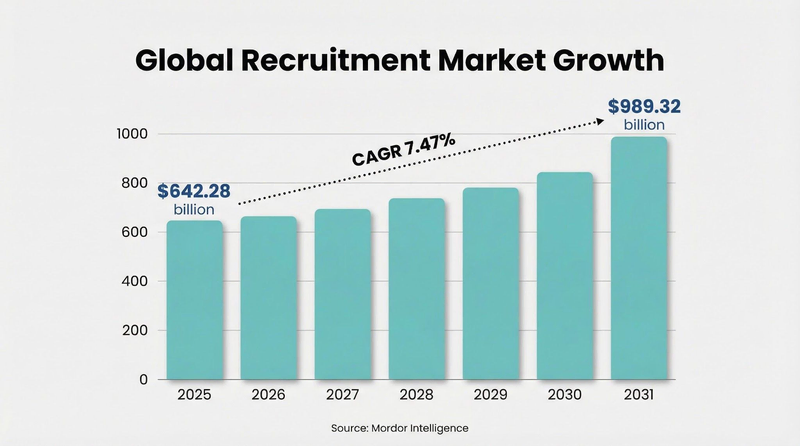
Globally, the recruiting market stood at $642.28 billion in 2025, with projections reaching $989.32 billion by 2031 at a 7.47% compound annual growth rate. North America captures 36.55% of that market, while Asia-Pacific leads regional growth at 8.12% CAGR. These figures reflect a worldwide pattern: organizations across sectors and geographies are investing more in talent acquisition infrastructure, not less, even as automation reshapes the function itself.
This article examines the current demand landscape for HR Recruiters, structural forces driving that demand, the specific challenges organizations encounter when hiring for these roles, and how to evaluate recruitment partners who specialize in this space.
Not every hiring challenge requires a dedicated HR Recruiter. Routine backfills and well-defined junior positions can often be managed internally through job boards and referral networks. An HR Recruiter owns the hiring cycle end to end, from mapping a talent market and assessing candidates through negotiating offers and holding the process to regulatory standards. The calculus for bringing one in shifts once hiring volume escalates, regulatory obligations compound, or the required candidate profile sits where strategic judgment meets operational execution. At that point, the cost of a poor hire or a slow process exceeds the cost of that specialist capacity.
Several patterns consistently signal the need for professional HR Recruiting support. The following scenarios represent conditions where generalist hiring approaches tend to underperform, and where organizations benefit most from recruiters who understand workforce strategy at a structural level.
When headcount targets increase by 30% or more within a single quarter, existing HR teams face a volume problem that compounds quickly. Each open requisition drains recruiter bandwidth from quality screening. SHRM data shows recruiters at large organizations already manage approximately 20 requisitions simultaneously. Specialist HR Recruiters absorb volume spikes without degrading candidate evaluation standards.
Every new jurisdiction introduces distinct employment law, compensation benchmarking, and compliance requirements. Cross-border hiring adds tax residency, work permit, and data protection dimensions that generalist recruiters rarely navigate daily. Organizations expanding into MENA, APAC, or Latin American markets need recruiters who understand local labor frameworks and can align hiring with regulatory constraints from day one.
Searching for a VP of People, Chief Human Resources Officer, or Head of Talent Acquisition requires discretion and market intelligence that standard job postings cannot deliver, from mapped competitor org structures through current compensation bands to an accurate read on which senior executives are approachable in a given quarter. Executive cost-per-hire has risen 113% since 2017 according to SHRM benchmarking data. These searches demand targeted outreach, stakeholder alignment across leadership teams, and evaluation criteria that extend well beyond resume screening.
AI adoption in HR tasks climbed from 26% to 43% between 2024 and 2025, yet only 17% of organizations describe their implementation as highly successful. Bridging that gap requires recruiters who understand both the technology and the human judgment it cannot replace. Organizations deploying AI-assisted screening need HR Recruiters who can validate algorithmic outputs and keep the candidate experience intact, checking automated rejections for bias and giving applicants a human point of contact instead of a silent filter.
The EU Pay Transparency Directive requires member state transposition by June 2026, while 16 US states plus Washington, D.C. have enacted their own wage disclosure laws. These regulations fundamentally alter how job descriptions are written, how salary negotiations are conducted, and how pay equity is documented. HR Recruiters versed in this evolving framework protect organizations from exposure that generalist teams may overlook.
In 2024, recruiter turnover averaged roughly six times the national average across all occupations. When internal TA professionals leave, institutional knowledge about pipelines, hiring manager preferences, and candidate relationships leaves with them. External HR Recruiters provide continuity during transitions and can rebuild capacity while the organization stabilizes its internal team.
Restructuring after layoffs while simultaneously backfilling critical roles
Tech layoffs affected 63443 workers across 147 companies in the first half of 2025 alone, yet many of those same organizations hired concurrently for AI-adjacent and compliance-focused positions. Managing the political sensitivity of simultaneous layoffs and hiring requires experienced HR Recruiters who can maintain candidate trust, protect the employer brand, and execute with appropriate discretion.
Delayed hires, compliance missteps, or poorly evaluated candidates in strategic HR positions create downstream effects that compound over quarters. Engaging specialist HR Recruiters is not a convenience. It is an operational decision driven by the recognition that talent acquisition, when executed poorly at the HR level, undermines the function responsible for every other hire the organization makes.
Do you have recruitment needs?
Deciding to hire an HR Recruiter is only useful against an accurate read of the market that supplies them, since availability, cost, and required expertise all move with it. That market reflects a profession caught between two opposing forces. Demand keeps growing as aging populations shrink labor supply across OECD economies and regulatory obligations widen, while organizations increasingly treat talent acquisition as a competitive differentiator. On the other side, automation and shared-services consolidation pressure headcount in operational HR roles. Understanding where these forces intersect and where they diverge is what separates informed workforce planning from reactive hiring.
The US remains the largest single market for recruitment services, with a $198.17 billion staffing market in 2025. Asia-Pacific, however, is where growth momentum is strongest. Vietnam ranks among the fastest-growing markets at 15% projected staffing growth, with India close behind at 11%. Japan remains the region’s largest market at $74.48 billion. The Middle East and North Africa region is projected to reach $86.1 billion in staffing by 2028 at a 9.4% CAGR, with nationalization programs in Saudi Arabia and the UAE generating sustained demand for HR professionals who understand localization mandates. Latin America’s HR technology market reached $1.17 billion in 2024 and is projected to more than double by 2033. For organizations planning international expansion, these regional dynamics directly affect where HR Recruiter talent is available, what it costs, and what regulatory knowledge is required.
AI adoption in talent acquisition has accelerated faster than in most other HR sub-functions. Gartner identifies the AI revolution as one of two primary forces driving talent acquisition trends into 2026, predicting that 75% of hiring processes will include AI proficiency certifications by 2027. Organizations not using AI in TA at all declined from 73% in 2023 to 37% in 2025. The implication for HR Recruiter hiring is direct: the required skill profile now includes competency in AI-assisted screening, algorithmic output validation, and technology-enabled candidate engagement. Recruiters who operate without these capabilities will find their market value declining as TA leaders seek hybrid profiles that combine human judgment with technical fluency.
Two regulatory frameworks will reshape HR recruitment practices within the next 12 months. The EU AI Act classifies all AI systems used for recruitment as high-risk, with full compliance obligations enforceable from August 2, 2026 to December 2, 2027 following the Digital Omnibus agreement. Breaches of these high-risk obligations carry fines up to €15 million or 3% of global annual turnover, while the steeper €35 million or 7% ceiling applies to prohibited AI practices. Simultaneously, the EU Pay Transparency Directive mandates salary range disclosure in job postings and pay equity audits, with transposition deadlines in June 2026. In the US, the regulatory trajectory follows a similar pattern at the state level. These overlapping requirements create demand for HR Recruiters who understand compliance architecture, not merely operational hiring mechanics.
The global executive search market reached $58.13 billion in 2025 and is projected to grow to $103.54 billion by 2031 at a 10.11% CAGR. CEO turnover hit 18% in Q1 2025, the highest quarterly rate in over five years. Cross-border executive searches now represent 38% of all retained assignments in Europe. For HR Recruiter hiring specifically, this growth means that organizations filling senior TA leadership positions compete in a market where retained search firms command premium fees and timelines stretch significantly. The 10.11% growth rate outpaces the broader recruiting market, indicating that leadership-level hiring complexity is increasing faster than operational recruitment volume.
Internal talent marketplace adoption jumped from 25% to 35% in 2025, with Gartner predicting HR will redirect one-third of its recruiting capacity toward internal mobility by 2026. Yet SHRM benchmarking data shows that 93% of nonexecutive positions and effectively 100% of executive roles at small and mid-sized organizations are still filled externally. This tension creates a dual requirement: organizations need HR Recruiters skilled in external market sourcing while simultaneously building internal mobility programs. Professionals who can operate across both dimensions hold disproportionate value in the current market.
The aggregate picture is sustained, structurally driven demand for more capable HR Recruiters, not fewer, since the roles being eliminated are repetitive while the roles being created require strategic judgment and cross-jurisdictional awareness. Recognizing that a company needs this profile, though, is where the difficulty starts rather than ends. Hiring an HR Recruiter well runs into obstacles that standard processes rarely handle, which is what the next section addresses.
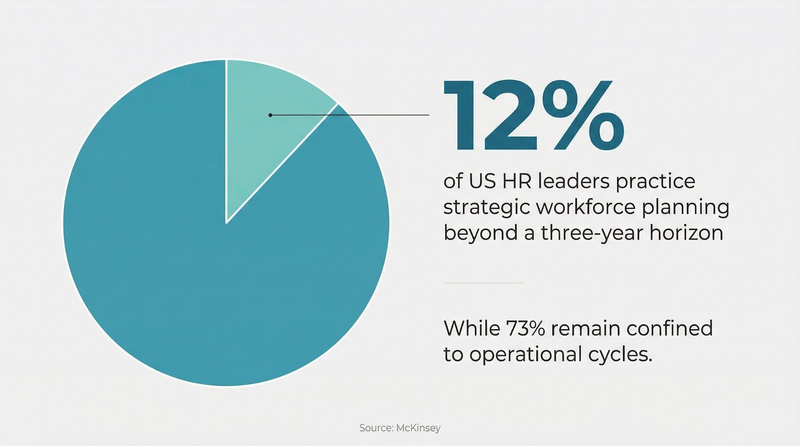
The gap is widening between what is needed from an efficient, effective HR function and what most organizations currently offer. Only 12% of US HR leaders practice strategic workforce planning with a three-year or longer horizon, while 73% remain confined to operational planning cycles.
Hiring HR Recruiters presents a distinct category of difficulty that most organizations underestimate. The role demands judgment that is difficult to assess through standard interview processes, compliance knowledge that varies by jurisdiction, and strategic capability that is easily confused with operational competence. The same talent acquisition function responsible for evaluating every other hire in the organization becomes, in this scenario, the subject of evaluation. That reflexivity introduces blind spots. The following challenges recur across industries and geographies, and each has a corresponding approach that DevsData LLC applies in its recruitment methodology.
Only 20% of organizations utilize quality-of-hire measures in 2025, a decline from 27% in 2022. That erosion is consequential when hiring recruiters themselves, because without established metrics for what constitutes a successful recruiter placement, organizations default to proxy indicators: years of experience, platform familiarity, or interview confidence. None of these reliably predict whether a new hire will reduce time-to-fill, improve candidate quality, or increase offer acceptance rates.
The problem compounds further with the rise of generative AI in the application process. A January 2025 survey found that 44% of job applicants admitted to misrepresenting information during hiring, with 24% on resumes and 19% during interviews. For recruiter candidates specifically, the ability to perform well in an interview is a baseline professional skill, not a differentiator, making verification even more challenging.
DevsData LLC applies a structured evaluation framework that includes a 90-minute technical and situational challenge, designed to test recruiter candidates on real-world scenarios rather than self-reported competencies. A typical exercise asks the candidate to source a shortlist for a difficult technical role against defined constraints, then critique a sample candidate profile and walk through how they would handle a realistic stakeholder objection, all under timed conditions. This process filters for demonstrated capability in sourcing strategy, candidate assessment rigor, and compliance awareness, providing clients with evidence-based shortlists rather than resume-matched profiles.
The McKinsey HR Monitor 2025 identifies a widening gap between what organizations need from HR and what most currently deliver. Most candidates offer operational screening ability, yet employers want people capable of contributing to workforce strategy and talent analytics at a planning level. This imbalance is reflected directly in the recruiter talent pool: most available candidates possess operational screening skills, while the market demands professionals who can contribute to workforce strategy, talent analytics, and organizational design.
Distinguishing between these profiles during a hiring process requires domain expertise that many internal teams lack, particularly when those teams are themselves under-resourced. The typical interview process surfaces operational competency effectively but fails to probe strategic depth.
DevsData LLC maintains a database of over 95000 pre-vetted professionals and applies role-specific competency matrices that differentiate strategic from operational capabilities. With ten years of experience and over 100 completed projects, the team assesses candidates against client-defined success criteria that explicitly account for the strategic-versus-operational distinction.
KPMG reports that nearly 65% of organizations view hiring across jurisdictions as a medium-to-high priority, yet more than 45% demonstrate low maturity in cross-border hiring capabilities. Only one-third have implemented a formalized cross-border hiring policy. This capability gap becomes acute when organizations seek HR Recruiters with international expertise: the candidate must understand not only recruitment methodology but also the specific regulatory environment of the jurisdictions they will serve. The EU AI Act reaches directly into how these recruiters work, classifying recruitment screening tools as high-risk and requiring documented human oversight and bias monitoring for any AI used in a hiring decision. Set alongside varying data protection frameworks and divergent employment contract requirements across APAC and MENA markets, it adds complexity that most recruitment processes do not adequately evaluate.
DevsData LLC operates with a government-approved recruitment license and serves clients across the US and Israel, giving the team direct operational experience with multi-jurisdictional compliance requirements. US-based specialists support cross-border sourcing, and the firm’s methodology incorporates regulatory screening as a standard evaluation dimension.
Median total cash compensation for Internal Recruiters reached $91000 in 2024, with bonus-receiving recruiters earning approximately $21000 more than non-bonus peers. Recruiter salaries rank among the fastest-moving compensation categories in recent surveys. Simultaneously, recruiter turnover averaged 20% in 2024, nearly doubling in solo-recruiter departments.
This combination of escalating costs and high attrition creates a frustrating cycle: organizations invest in competitive compensation packages only to see new hires leave within 12 to 18 months, triggering another costly search. SMEs face this challenge most acutely, as they compete for the same talent pool as enterprises with deeper compensation structures.
DevsData LLC operates on a success-fee model with a guarantee period, aligning financial incentives with placement quality and longevity. This structure protects clients from the costs of early attrition and ensures that compensation benchmarking is incorporated into the search process from the outset, reducing the risk of misaligned offers that contribute to post-hire turnover.
These four challenges share a structural root: the HR Recruiter role is evaluated using processes designed for the candidates that recruiters themselves typically assess, not for the assessors. Standard hiring workflows do not account for the reflexive nature of recruiting for recruiters. The measurement gap, strategic-versus-operational confusion, cross-border complexity, and compensation-retention cycle each require specialized evaluation methodology.
Organizations that apply generic hiring processes to these roles accept a level of risk that is both measurable and avoidable.
Recruiter turnover averaged 20% in 2024, approximately six times the national average across all US occupations. When internal TA professionals leave, institutional knowledge about pipelines, hiring manager preferences, and candidate relationships leaves with them.
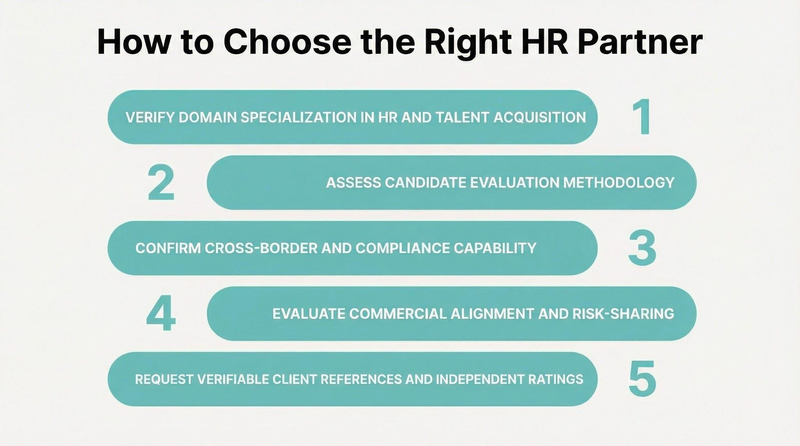
The reflexive problem behind these challenges, a talent acquisition team struggling to evaluate its own kind, is what pushes many organizations toward an external partner for these searches. A specialist brings the outside benchmark and the domain depth an internal team under evaluation pressure cannot supply for itself. Choosing that partner then requires a different evaluation lens than technical or operational hiring does. The following five steps provide a structured framework for this evaluation.
A generalist recruitment agency may have broad reach but rarely possesses the depth needed for HR Recruiter placements. Evaluate whether the partner has completed multiple engagements specifically involving talent acquisition professionals. Ask for anonymized case studies. Confirm they understand the distinction between operational and strategic HR roles, and verify their familiarity with market-specific salary benchmarks and regulatory requirements.
Given that only 20% of organizations track quality-of-hire, the partner’s evaluation process becomes a proxy for outcome reliability. Request documentation of how candidates are screened beyond resume matching. Competency-based assessments, structured interviews with standardized scoring, and scenario-based challenges all indicate a partner that invests in evaluation rigor rather than volume-driven placement.
If your organization operates across multiple jurisdictions or plans to expand internationally, the recruitment partner must demonstrate concrete experience with cross-border hiring. Ask about their approach to regulatory screening, data protection compliance, and multi-market salary calibration. Partners with formal recruitment licensing and a footprint in more than one country can be better positioned for cross-border engagements, though domestic firms with deep local expertise often remain the stronger fit for single-market searches.
Fee structures communicate risk appetite. Partners who operate on success-fee models with guarantee periods accept shared accountability for placement outcomes. Contrast this with retained-fee models where payment occurs regardless of result. For HR Recruiter placements, where retention volatility is elevated, a model that ties compensation to successful, sustained placement reduces buyer risk and aligns the partner’s economic incentive with the client’s long-term objective.
Independent platforms like Clutch and GoodFirms provide third-party validation that self-reported testimonials cannot. Request references from clients with comparable hiring requirements, ideally in similar industries or markets. A partner with consistently high ratings across multiple independent platforms demonstrates sustained performance, not isolated success.
The following table summarizes evaluation criteria with corresponding questions to guide partner selection conversations.
| Evaluation step | Questions to ask the agency |
|---|---|
| Domain specialization | ● How many HR Recruiter placements have you completed in the past two years? ● Can you share anonymized case studies? |
| Candidate evaluation | ● What does your screening process include beyond resume review? ● Do you use structured scoring or scenario-based challenges? |
| Cross-border capability | ● Do you hold recruitment licenses in relevant jurisdictions? ● How do you handle regulatory screening for multi-market roles? |
| Commercial alignment | ● Do you operate on a success-fee model? ● Is there a guarantee period? ● How is your fee structured relative to placement longevity? |
| Verifiable track record | ● What are your ratings on Clutch and GoodFirms? ● Can you provide references from clients with comparable HR hiring needs? |
The five criteria above set a deliberately high bar, and the point of the framework is to filter out partners who cannot meet it. DevsData LLC maps onto that bar directly, pairing talent acquisition domain depth with cross-border licensing, an evidence-based screen, and third-party validation, which sets up the detail that follows.
Website: www.devsdata.com
Team size: ~60 employees
Founded: 2016
Headquarters: Brooklyn, NY, and Warsaw, Poland
DevsData LLC combines technical recruitment delivery with strategic workforce advisory work. Founded ten years ago, the firm has completed over 100 projects for more than 100 clients, with a concentration in the US and Israel markets. The team includes US-based specialists who bring direct understanding of North American labor market dynamics, compensation structures, and regulatory requirements. That geographic specificity matters for HR Recruiter placements, where knowledge of local employment law and market benchmarks directly affects placement success.
The firm maintains a curated database of over 95000 pre-vetted professionals, enabling rapid shortlist development without compromising candidate quality. Each search follows a structured methodology that includes a 90-minute challenge designed to assess candidates on practical competencies rather than self-reported experience. This evaluation approach is particularly effective for HR Recruiter positions, where the ability to articulate expertise is a professional baseline rather than a meaningful differentiator.
DevsData LLC holds a government-approved recruitment license, ensuring compliance with regulatory requirements across operational jurisdictions. The firm operates on a success-fee model with a guarantee period, which aligns its financial incentives with placement quality and client satisfaction. Strong communication skills within the delivery team ensure that clients receive consistent updates, transparent reporting, and responsive stakeholder coordination throughout the search process.
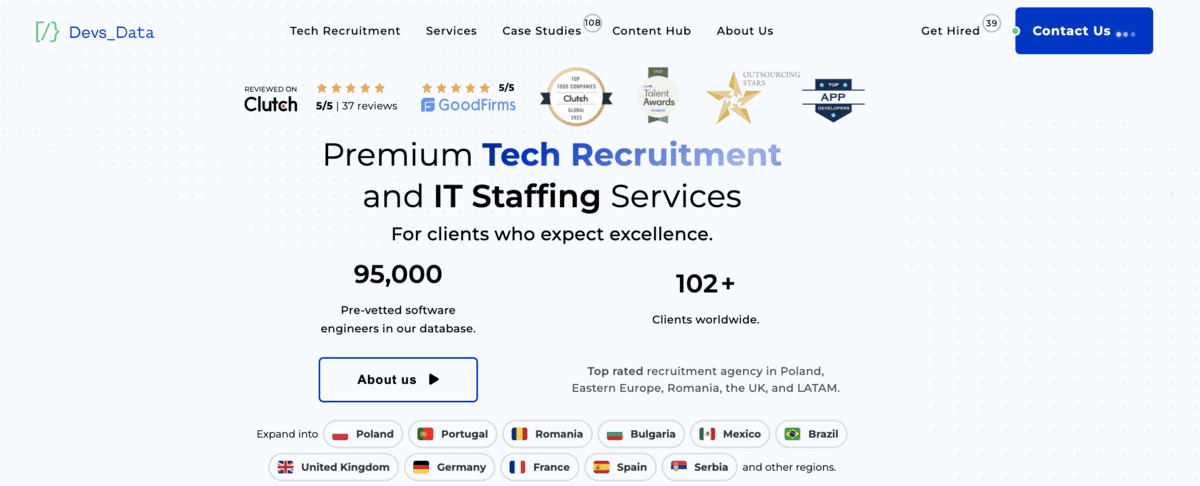
Independent verification supports these claims. DevsData LLC holds a 5 out of 5 rating on both Clutch and GoodFirms, based on verified client reviews across multiple engagement types. For organizations evaluating recruitment partners, this independent validation provides a layer of assurance that internal marketing materials alone cannot offer.
For more details and inquiries, contact DevsData LLC at general@devsdata.com or visit the company’s website at www.devsdata.com.

When T-Mobile Germany required a targeted hire for a specialized IT role, the engagement demanded the characteristics of retained executive search rather than volume recruitment. The position required precise alignment between technical capability, cultural fit within a large-enterprise environment, and geographic constraints that narrowed the available candidate pool. DevsData LLC operated as a retained headhunter partner, applying a structured methodology that prioritized confidential sourcing, market mapping, and stakeholder coordination throughout the engagement.
The engagement followed a disciplined pipeline approach.
This case illustrates the disciplined headhunting framework organizations should expect when hiring senior HR Recruiters. The same methodology, confidential sourcing, structured candidate mapping, stakeholder alignment, and rigorous qualification, applies directly to HR leadership placements where the cost of a misaligned hire is both financially and organizationally significant.
Do you have recruitment needs?
The market for HR Recruiters is shaped by structural forces that are unlikely to reverse within the next several years. Regulatory complexity continues to expand across both the EU and the United States. AI integration into talent acquisition workflows accelerates, yet implementation success remains low, creating demand for professionals who can bridge the gap between technology capability and human judgment. Geographic diversification of workforce planning, from MENA to APAC to Latin America, adds compliance and sourcing dimensions that did not exist at this scale a decade ago.
Every major segment referenced in this article, including core recruiting, executive search, cross-border hiring infrastructure, and AI-enabled workflows, is trending in the same direction, pointing to a profession whose scope and complexity continue to expand.
The forward-looking challenge is not whether organizations will need HR Recruiters, but whether they will hire the right profile. The distinction between operational and strategic capability, already visible in McKinsey and Gartner research, will widen as AI automates transactional recruitment tasks. Professionals who combine compliance expertise, AI fluency, cross-border awareness, and data-driven decision-making will command premium value. Those who remain confined to operational screening will face displacement.
DevsData LLC operates within this market as a recruitment partner whose methodology is designed specifically for these conditions. The firm’s structured evaluation framework, success-fee alignment, and government-approved operational basis provide a credible option for organizations seeking to build or strengthen their HR Recruiter capacity. For technical founders, CTOs, and talent acquisition leaders navigating these decisions, the question is not whether to invest in this function, but how to do so with the rigor and specificity the current market demands.
Any questions or comments? Let me know on Twitter/X.
Discover how IT recruitment and staffing can address your talent needs. Explore trending regions like Poland, Portugal, Mexico, Brazil and more.
 Frequently asked questions (FAQ)
DevsData – your premium technology partner
DevsData is a boutique tech recruitment and software agency. Develop your software project with veteran engineers or scale up an in-house tech team of developers with relevant industry experience.
Free consultation with a software expert
🎧 Schedule a meeting
FEATURED IN

DevsData LLC is truly exceptional – their backend developers are some of the best I’ve ever worked with.”

Nicholas Johnson
Mentor at YC, serial entrepreneur


 Build your project with our veteran developers.
Explore the benefits of technology recruitment and tailor-made software.
Learn how to source skilled and experienced software developers.
Build your project with our veteran developers.
Explore the benefits of technology recruitment and tailor-made software.
Learn how to source skilled and experienced software developers.

Rebecca Botvin

Commercial Director

Tom Potanski
Manager




Categories: Big data, data analytics | Software and technology | IT recruitment blog | IT in Poland | Content hub (blog)















careers@devsdata.com









general@devsdata.com

"I interviewed about a dozen different firms. DevsData LLC is truly exceptional – their backend developers are some of the best I've ever worked with. I've worked with a lot of very well-qualified developers, locally in San Francisco, and remotely, so that is not a compliment I offer lightly. I appreciate their depth of knowledge and their ability to get things done quickly."

Nicholas Johnson
CEO of Orange Charger LLC,
Ex-Tesla Engineer,
Mentor at YCombinator
"DevsData reached out to us, as we've been looking to grow our engineering team in Europe and Poland. Communicating efficiently and professionally, DevsData made a strong impression with their understanding of the recruitment challenges we were facing. They designed a tailored recruitment process for our needs. I was impressed with the technical depth of their approach."

Karim Butt
Co-Founder & CTO at GlossGenius, Inc.
"Out of all the vendors we work with, DevsData clearly stands out. The quality of developers they deliver is beyond what we've received from any other vendor, and they've been able to send profile recommendations very quickly. I'm happy to be their reference for other companies from Israel and talk about their recruitment abilities and what they delivered for us."

Ran Eyal
Senior Manager at
ZIM Integrated
Shipping Services Ltd.
"DevsData demonstrated a strong degree of proactivity, taking time to thoroughly understand the problem and business perspective, and continuously suggesting performance and usability enhancements. Their app exceeded my expectations. I've worked with DevsData on numerous projects over the last 3 years and I'm very happy. Being both responsive and honest in communication."

Jonas Lee
Partner & Executive VP of Verus,
Financial LLC, Investor,
& Serial Entrepreneur
Acknowledgments