Thanks for subscribing.
Your gift is on the way.



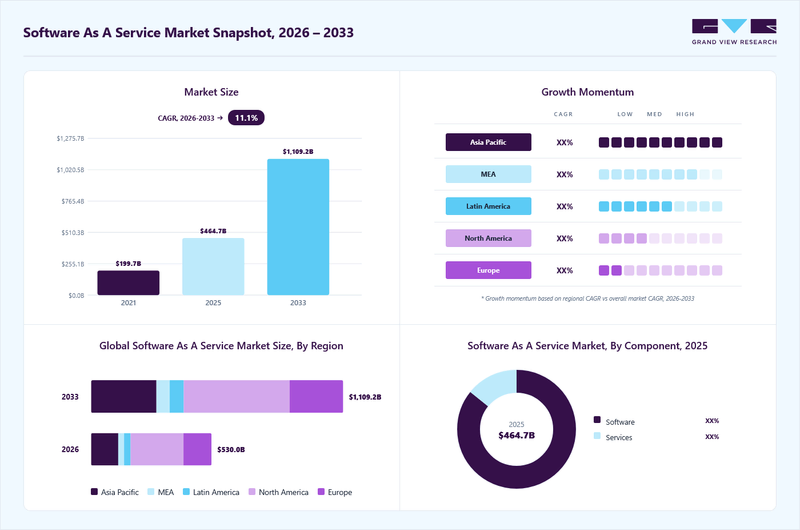
Software delivered over the internet through a subscription has reshaped how companies of every size buy and use technology. The model removes the high upfront cost of on-premises infrastructure and gives vendors a recurring revenue base, which together explain why adoption keeps widening even as buyer expectations rise. The global SaaS market reached $464.7 billion in 2025 and is projected to hit $1.109 billion by 2033, expanding at a CAGR of 11.1%. That growth comes with a tighter quality bar: as more products converge on similar features, customers evaluate on execution depth rather than capability lists.
DevsData LLC has spent years building software for clients that range from early-stage startups to established enterprises, with Senior Developers whose backgrounds span SaaS and enterprise systems. Projects in healthcare and professional services inform how we approach SaaS development. We treat it not as a category of work but as an engineering and product discipline where early architectural decisions create constraints that compound over years. The wrong choice in week three becomes a costly bottleneck in month eighteen.
This article walks through what SaaS product development involves at each stage, where the meaningful complexity sits, how AI is changing both what teams build and how they build it, what a long-term development partner actually delivers, and two real engagements from our portfolio that illustrate these principles in practice.
SaaS product development centers on building cloud-hosted applications that customers reach through a browser and pay for via a recurring subscription. The model creates predictable revenue for the vendor and removes the capital cost of infrastructure for the buyer, a structure that has held up across healthcare, finance, retail, logistics, and professional services.
Current adoption levels reflect how deep that structure has gone. Companies used an average of 106 SaaS applications in 2024, and approximately 75% of business software now runs as SaaS, with the remaining quarter still on premises. That density does not signal permanent sprawl. Separate research shows organizations are auditing their SaaS portfolios to consolidate where capability overlaps, which raises the importance of depth and reliability over breadth.
Gartner predicts that 90% of organizations will adopt a hybrid cloud approach through 2027, with data synchronization across mixed environments emerging as the most pressing near-term challenge. Products built today need to operate cleanly across multiple cloud configurations rather than assume a single public provider.
North America held 46.9% of the global market in 2025, while the fastest growth is appearing in Asia Pacific and in vertical-specific platforms aimed at healthcare, FinTech, and education. The rise of micro-SaaS is reshaping team-size expectations at the lower end: roughly 41% of SaaS startups reported focusing on niche markets in 2023, up from 18% five years earlier.
Do you have IT recruitment needs?
The conditions driving market growth also shape what every SaaS team builds and how that team gets staffed. Three forces deserve close attention because they affect cost, timeline, and quality on every project.
Customers entering the market today have used dozens of SaaS products. They notice slow page loads, broken integrations, and inconsistent uptime in a way that buyers five years ago did not. Onboarding friction that previously cost a few percentage points of activation now costs significantly more because alternatives are abundant. New entrants face a higher minimum standard for what a polished product feels like, and that standard keeps moving.
The Cloud Native Computing Foundation’s 2025 Annual Survey found that 98% of organizations have adopted cloud-native techniques, with Kubernetes production usage at 82%. A Developer with Kubernetes on their resume in 2026 is bringing the floor, not the ceiling. What separates strong candidates and strong teams now is the ability to reduce Kubernetes operational overhead, implement observability tooling that catches problems before users do, and build platform engineering functions that improve productivity across the whole team.
By 2026, 75% of SaaS companies are expected to deploy AI-driven automation for at least one major business process. In 2023, AI tooling already automated up to 30% of coding tasks, and Gartner predicts that by 2028, 90% of enterprise Software Engineers will use AI code assistants, up from less than 14% in early 2024. The productivity gain is real, but so is the new failure mode: AI-generated code requires the same review and testing as human-written code, and teams that treat AI output as a shortcut around QA accumulate technical debt faster than teams that never used the tools at all.
Building a SaaS product is not a one-time delivery. It is a continuous cycle of planning, building, shipping, measuring, and refining, where each phase introduces complexity that traditional on-premises software development does not face. The cost of skipping or rushing any stage shows up later, usually under load or in front of a customer.
The number one reason startups fail, cited in 42% of cases, is no market need for the product. User interviews, competitor analysis, and hypothesis testing at the idea stage separate products that find traction from those that never reach it. Research shows that 64% of software features are rarely or never used, which reflects weak product strategy, stakeholder-driven scope additions, and insufficient validation before build.
Once a validated direction exists, the work shifts to detailed planning. A well-constructed software requirements specification reduces ambiguity before engineering begins. Poor requirements gathering contributes to about 37% of failed projects, which is an avoidable failure mode. UI/UX work sits at this stage too, treated as a functional discipline rather than a cosmetic finish. The design of onboarding flows, pricing pages, and activation sequences directly affects whether users reach the moment of value that turns trial users into paying customers.
This is where the decisions with the longest half-life get made. Architecture, cloud provider, tech stack, and the choice between single-tenant and multi-tenant deployment all create downstream constraints.
Multi-tenant is the dominant model in SaaS because it lowers infrastructure costs, simplifies deployments, and lets updates reach every customer at once. The right call still depends on the regulatory environment, target customer, and expected growth trajectory.
Backend, frontend, and integration work all happen here. Mature SaaS products connect to external services for payments, identity, analytics, and communication rather than reinventing each capability. Quality assurance and security sit alongside development, not after it. The cost to fix a bug found post-release can be up to 100 times higher than catching it during the design phase, which makes QA an investment rather than an overhead.
Launch marks the start of the meaningful work rather than its end. Post-launch work centers on collecting user feedback and monitoring performance, and iterative updates follow from both. Maintenance accounts for 50% to 80% of total lifetime software cost, so teams that plan for maintenance from day one operate more efficiently than teams that treat support as an afterthought. Taken together, the stages show where a SaaS budget goes over time: most of the spending arrives after release, which means decisions made before release set the price of everything that follows.
Early architectural decisions do not stay in the background. They resurface in customer escalations and pricing conversations for years after the initial build. Each choice below follows the same logic: an option that saves time in the first sprint tends to cost more once the product carries real customers.
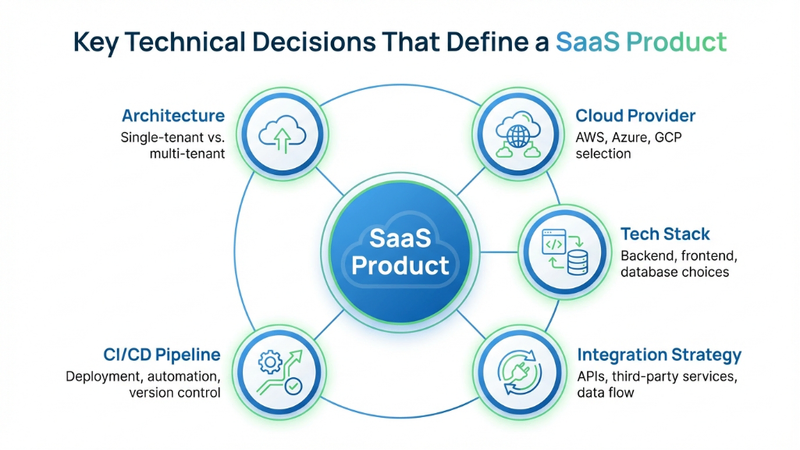
In a single-tenant setup, each customer receives a dedicated instance of the application and its data. Multi-tenant shares one application instance across customers while keeping their data logically separated. Multi-tenancy reduces infrastructure costs and allows simultaneous updates, but data isolation and access control need to be architected correctly from the start. Retrofitting tenant isolation after launch is expensive and risky. Healthcare or regulated finance products may face single-tenancy as a contractual requirement rather than a preference.
AWS leads with roughly a third of the global cloud market, followed by Microsoft Azure and Google Cloud Platform. Provider choice affects latency, regional compliance coverage, the availability of managed services that reduce engineering overhead, and long-term pricing as usage scales. Most early-stage SaaS products start on one provider and introduce multi-cloud or hybrid configurations as regulatory or customer demands require it.
Stack choices depend on project requirements, team expertise, and scalability targets. MERN suits rapid iteration cycles. Java and Spring offer enterprise-grade predictability where stability matters more than speed. The growing category of low-code platforms provides a middle path for teams prioritizing time to market over deep customization. Teams that default to familiar tools regardless of fit tend to accumulate refactoring debt within the first year.
Shipping updates reliably and often is a competitive advantage in SaaS. Elite teams with mature pipelines deploy code 208 times more frequently than low performers. Continuous integration and continuous delivery automate the build, test, and deployment cycle, reducing risk per release and allowing teams to respond to bugs or market feedback at a pace that manual deployment processes cannot match.
Mature SaaS products depend on external services for payments, identity, analytics, and messaging, so the structure of those connections determines how quickly new ones get added later. Point-to-point calls scattered through the codebase work at first and turn brittle as the number of connected systems grows. Routing external traffic through a defined integration layer keeps vendor swaps contained and stops one provider outage from spreading across the application. Every decision in this section shares one trait: reversing course grows more expensive with each customer added, and the same early discipline carries into security and compliance.
Do you have IT recruitment needs?
Security in SaaS runs through every layer of the product, from cloud infrastructure to the application interface, and those obligations carry real financial weight when they are not met.
IBM’s 2024 Cost of a Data Breach Report placed the global average cost of a data breach at $4.88 million, a 10% increase from the prior year. That figure justifies treating security competence as a first-tier evaluation criterion.
The most common point of failure is not exotic. Compromised credentials were the leading attack vector in 2024, representing 16% of all breaches, with an average cost of $4.88 million per breach and a detection-to-containment timeline of 292 days. That duration reflects how long attackers can operate inside a system before being noticed, which makes strong authentication, access monitoring, and anomaly detection an investment worth making from the first sprint.
A distinction worth internalizing is the difference between authentication and authorization. Authentication establishes who a user is, typically through credentials, biometrics, or a security token. Authorization determines what that verified user is permitted to do within the application. Confusing the two creates access control vulnerabilities that resist clean patching after deployment.
Compliance adds a parallel set of obligations. GDPR governs any product serving European users regardless of where the vendor sits. Healthcare applications operating in the US must meet HIPAA requirements. Financial services products face PCI-DSS standards. Each framework carries its own documentation, audit, and incident response obligations, and non-compliance penalties have grown substantially. Building with compliance requirements in mind from the first sprint costs considerably less than retrofitting them after a legal review.
Artificial intelligence affects SaaS development in two distinct ways worth keeping separate: what teams build into their products, and how those products get built.
On the product side, generative AI lets SaaS applications offer functionality that previously required substantial custom engineering. Content generation, predictive analytics, personalized dashboards, and AI-driven support can now reach a product through APIs rather than ground-up builds. According to Salesforce, 79% of customers expect personalized interactions, and 69% are willing to share personal information in exchange for a more tailored experience. That expectation is rewriting what buyers consider a minimum viable feature set. In categories where personalization shapes the user experience directly, such as support tooling and analytics, our project work suggests buyers read a missing AI-driven adaptation as a capability gap more often than as a deliberate design choice.
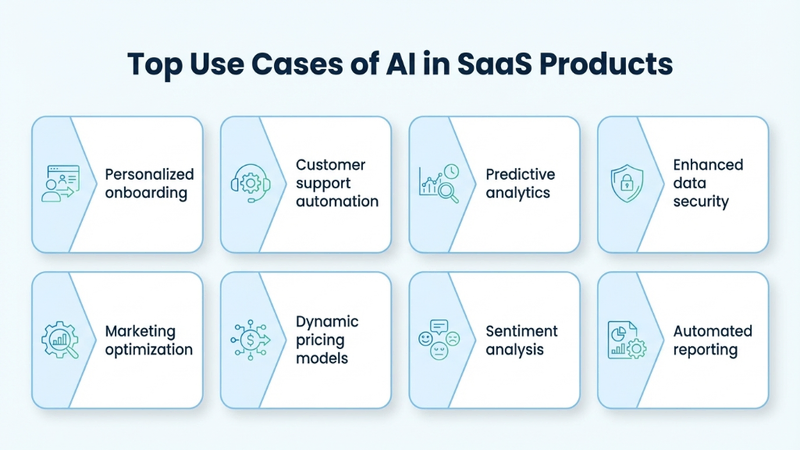
On the engineering side, AI tooling compresses timelines. Tools such as GitHub Copilot generate code suggestions and full logic blocks, which shortens repetitive implementation work and frees Developer capacity for architecture and product decisions.
How a SaaS product charges for access shapes nearly everything else about the business: the sales motion, the support model, the churn dynamics, and the unit economics that decide whether growth is sustainable.
Typically billed monthly or annually, subscription pricing produces predictable revenue and is the most widely recognized SaaS model. It works well when the value a customer receives stays relatively consistent over time and does not vary with intensity of use. Annual plans create stronger retention incentives and improve cash flow, which explains why most subscription products offer a meaningful discount for an annual commitment.
Sometimes called pay-as-you-go, usage-based pricing charges customers by consumption, whether that is API calls, data processed, active users, or transactions completed. It aligns revenue with the value a customer actually receives, lowering point-of-sale friction at the cost of revenue predictability. AWS, Twilio, and Snowflake all use variants of this model. It tends to suit infrastructure and platform products better than application products because consumption is more measurable.
Freemium offers a baseline product at no cost, with premium features unlocked through payment. The model performs well in markets where the buying cycle is long, and the product needs to demonstrate value before a purchase decision. The risk is that a large free user base can consume significant support and infrastructure resources without converting, making unit economics difficult to manage without disciplined paywall placement.
Tiered pricing presents multiple packages at different price points, usually differentiated by feature access, usage limits, or seat counts. The structure accommodates a wide range of customer sizes within a single product and creates a natural upgrade path as customers grow. The design challenge is making tier distinctions meaningful enough to drive upgrades without making lower tiers feel artificially limited.
Most mature SaaS products combine elements of more than one model, and each combination places its own demands on the codebase. A freemium entry point feeding into tiered plans requires an entitlement layer that controls feature access per account, while usage-based charges depend on accurate metering built into the product from the start. Retrofitting either one after launch forces changes to billing logic and data models that touch most of the application.
The staffing question for a SaaS build is one of the earliest decisions a founding team makes, with more downstream consequences than most founders anticipate.
The cost of developing a SaaS product ranges from $30000 to $500000, depending on scope, complexity, and required features. An MVP typically falls between $30000 and $100000, while enterprise-grade solutions often exceed $300000 due to advanced security, AI integrations, and multi-tenancy requirements. Ranges stay wide because the variables that drive cost – team location, seniority levels, specialist requirements in areas like security or AI, and timeline pressure – interact in ways specific to each project rather than predictable across projects.
A Deloitte survey found that 59% of companies outsource to cut costs and access specialized skills, with many using a hybrid approach that combines internal leadership with external delivery capacity. In-house teams offer stronger continuity and deeper product knowledge over time. Outsourcing provides a broader skill range, faster ramp-up, and the option to scale team size up or down without the fixed costs of full-time employment. The hybrid model, where a small internal product and technical leadership team works alongside an external development partner, has become the dominant structure for well-run SaaS builds. It preserves strategic control while allowing the delivery pace and specialist access most internal teams cannot sustain across all phases of development.
Team composition matters as much as team size. A SaaS build minimally requires a Product Manager, a Backend Developer with infrastructure experience, a Frontend Developer, a UX Designer, and a QA Engineer. Larger or more complex builds add Security Engineers, DevOps Specialists, Data Engineers, and additional frontend capacity. Across our engagements, the pattern we see most often is QA left understaffed while frontend gets overstaffed, which produces products that look polished yet behave unreliably under real-world load.
Feature prioritization is the discipline that keeps team effort aligned with business value. Frameworks such as MoSCoW and RICE provide structured methods for ranking what gets built in each cycle. Teams that maintain strict prioritization deliver on time more often than those that treat the backlog as a wish list.
Company size: ~60 employees
Founding year: 2016
Headquarters: Brooklyn, NY, and Warsaw, Poland
DevsData LLC is a technology recruitment and software development agency with offices in Brooklyn, Warsaw, and several other locations across the globe. The company operates at the intersection of two disciplines that are usually kept separate: placing the right technical talent and building the software products that talent needs to deliver. That dual competency shapes how we approach SaaS projects. We are not simply executing specifications handed to us by a client. We advise on architecture, validate assumptions, and apply the knowledge that comes from having seen similar problems across many engagements.
Our recruitment network includes more than 95000 vetted technology professionals. Fewer than 6% of candidates who apply pass our screening process, which centers on a 90-minute technical interview designed to assess depth of knowledge rather than surface familiarity with a technology name. That rigor reflects a conviction that the cost of a wrong hire in a SaaS build, in wasted engineering effort, accumulated technical debt, and delayed shipping, far exceeds the cost of a longer search.
On the development side, we have delivered projects across eCommerce, retail, healthcare, and professional services, working with clients ranging from early-stage startups to established enterprises. Our approach to SaaS builds follows the same principles regardless of client size: validate before building, architect for the scale you expect to reach rather than the scale you have today, treat security as a first-class concern from the first sprint, and maintain a communication cadence that surfaces problems early rather than at delivery. DevsData LLC holds 5/5 ratings on both Clutch and GoodFirms, reflecting the consistency of that approach across more than 140 projects for over 80 clients. On the recruitment side, the firm holds an official, government-approved license and operates on a success fee model with a guarantee period, which removes upfront financial risk for hiring clients.
Do you have IT recruitment needs?

ShopGarden, a Pennsylvania-based retail business, came to DevsData LLC with a mobile application that was actively damaging its operations. The existing app displayed errors during checkout, failed to sync with the Magento backend, and created navigation friction that was driving measurable revenue loss.
The technical constraint was that ShopGarden could not shut down its mobile channel during the rebuild. The Magento store continued processing daily orders while the older application stayed live, so every engineering decision had to preserve working components rather than replace the entire system.
DevsData LLC assembled a four-person team: a Senior React Native Developer with eCommerce history, a Backend Integration Specialist with deep Magento experience, a UX/UI Designer whose previous retail mobile work informed the navigation redesign, and a Technical Project Manager who translated technical constraints into business terms for the client.
The rebuild replaced the unstable checkout flow with a stable React Native application, introduced geolocation features sending location-based notifications to customers near physical stores, brought the interface into WCAG 2.2 AA compliance, and resolved the synchronization failures. The redesigned onboarding flow, built using React Hook Form, reduced abandoned sessions.
DevsData LLC delivered the updated application on schedule across nine weeks, while the business continued operating without interruption.

A high-net-worth entrepreneur with a background in scaling and exiting a company of over 100 people approached DevsData LLC with a precisely defined brief: build a premium Shopify store for a niche luxury lifestyle concept, integrate augmented reality so customers could preview products in their real environment without downloading an application, and deliver within 3.5 weeks. The product category and branding were treated as confidential throughout the engagement.
The store needed to perform flawlessly on iOS and Android, score above 90 on Lighthouse performance and accessibility audits, load pages in under 1.8 seconds on average, and communicate luxury through typography, spacing, and micro-interaction rather than promotional copy.
DevsData LLC built the team around four specialist roles: a Senior Shopify Developer who led theme customization, performance tuning, and AR deployment; a Senior Project Manager with an MBA background who acted as strategic lead and client liaison; a Senior Graphic Designer who built the full visual system from iconography through mobile-first mockups; and an Augmented Reality Specialist who handled 3D model preparation, WebAR library integration, and cross-device testing.
Work ran in two-to-three-day sprints, with client feedback delivered asynchronously through annotated design comments and recorded video reviews rather than live meetings. Product visuals were prepared in both GLB and USDZ formats to ensure AR functionality worked across Android and iOS.
The store launched on schedule. Within the first week, users interacted with the AR product preview feature over 100 times. The client presented the working storefront to more than 5 potential partners and advisors within ten days of launch and ran two lightweight marketing campaigns that generated over 300 unique sessions. Lighthouse scores came in above 90 across performance and accessibility. The architecture was built on standard Shopify with a clear upgrade path to Shopify Plus, meaning the client retained the option to scale without rebuilding.
SaaS development rewards the teams that respect the complexity of what they are building. Architecture choices made in week two show up as bottlenecks in month eighteen. Security gaps that seemed theoretical during development become incidents with real financial consequences. Pricing models that were not validated before launch produce churn patterns taking quarters to diagnose.
DevsData LLC’s experience across SaaS builds, eCommerce applications, and technical recruitment has shown consistently that clients who get the most from an engagement are those who treat the development partner as a strategic collaborator rather than an executor. That means sharing constraints openly, including budget ceilings and internal deadlines; engaging actively during discovery and planning rather than delegating those phases entirely; and building in a review cadence that keeps decision-making tight throughout delivery.
The SaaS market is not slowing down. What is changing is the quality bar that buyers apply and the sophistication of the competition that new entrants face. For companies that build thoughtfully, with the right team structure, validated assumptions, and a long-term view of the product’s evolution, that environment creates significant opportunity. For those who rush to market on weak technical foundations, it creates expensive problems that get harder to fix with each passing sprint.
If you are planning a SaaS build or looking to strengthen an existing product, reach DevsData LLC at general@devsdata.com or visit www.devsdata.com.
Discover how IT recruitment and staffing can address your talent needs. Explore trending regions
like Poland, Portugal, Mexico, Brazil and more.

 Frequently asked questions (FAQ)
DevsData – your premium technology partner
DevsData is a boutique tech recruitment and software agency. Develop your software project with veteran engineers or scale up an in-house tech team of developers with relevant industry experience.
Free consultation with a software expert
🎧 Schedule a meeting
FEATURED IN


DevsData LLC is truly exceptional – their backend developers are some of the best I’ve ever worked with.”

Nicholas Johnson
Mentor at YC, serial entrepreneur


 Build your project with our veteran developers.
Explore the benefits of technology recruitment and tailor-made software.
Learn how to source skilled and experienced software developers.

Rebecca Botvin

Commercial Director

Tom Potanski
Manager




Categories: Big data, data analytics | Software and technology | IT recruitment blog | IT in Poland | Content hub (blog)















careers@devsdata.com





general@devsdata.com

"I interviewed about a dozen different firms. DevsData LLC is truly exceptional – their backend developers are some of the best I've ever worked with. I've worked with a lot of very well-qualified developers, locally in San Francisco, and remotely, so that is not a compliment I offer lightly. I appreciate their depth of knowledge and their ability to get things done quickly."

Nicholas Johnson
CEO of Orange Charger LLC,
Ex-Tesla Engineer,
Mentor at YCombinator
"DevsData reached out to us, as we've been looking to grow our engineering team in Europe and Poland. Communicating efficiently and professionally, DevsData made a strong impression with their understanding of the recruitment challenges we were facing. They designed a tailored recruitment process for our needs. I was impressed with the technical depth of their approach."

Karim Butt
Co-Founder & CTO at GlossGenius, Inc.
"Out of all the vendors we work with, DevsData clearly stands out. The quality of developers they deliver is beyond what we've received from any other vendor, and they've been able to send profile recommendations very quickly. I'm happy to be their reference for other companies from Israel and talk about their recruitment abilities and what they delivered for us."

Ran Eyal
Senior Manager at
ZIM Integrated
Shipping Services Ltd.
"DevsData demonstrated a strong degree of proactivity, taking time to thoroughly understand the problem and business perspective, and continuously suggesting performance and usability enhancements. Their app exceeded my expectations. I've worked with DevsData on numerous projects over the last 3 years and I'm very happy. Being both responsive and honest in communication."

Jonas Lee
Partner & Executive VP of Verus,
Financial LLC, Investor,
& Serial Entrepreneur
Acknowledgments