Thanks for subscribing.
Your gift is on the way.



Employee loyalty reflects how well a company supports growth inside its own walls. The connection between internal mobility and longer tenure is well established in workforce research, and more recent data point to the same pattern: SHRM’s 2025 figures show that large organizations now fill up to 50% of executive roles internally, a structural commitment that signals to employees that advancement does not require leaving the organization.
Internal recruitment proves particularly effective in functions where institutional knowledge directly affects output quality. A Communications Manager promoted from within, for example, already understands the company’s media relationships, messaging history, and stakeholder sensitivities, reducing the ramp-up period that an external hire would need before handling a press cycle or investor update independently. This approach also reduces onboarding time and expenses, helping maintain consistency in messaging and public confidence. The broader market tells a second story:
In 2024, movement among managers and senior professionals was twice as high as among junior employees, highlighting persistent gaps in advancement opportunities.
The same dynamic plays out in communications teams. A leader promoted from within already understands the company’s media relationships and messaging history, which keeps external narratives stable. At the same time, a function without structured growth paths tends to lose the professionals who would eventually hold those leadership roles. What follows covers the methods, advantages, trade-offs, and practical strategies that define a well-run internal recruitment process, as well as how DevsData LLC approaches this work with clients.
Human Resources departments advertise job vacancies internally rather than pursuing external candidates. Only existing staff members can apply. When internal efforts fail, organizations then open the vacancy to external applicants.
Many businesses view internal recruitment as a more efficient method to fill vacancies. That efficiency is most reliable when the role requires institutional knowledge that takes months to acquire externally: a department head position, a client-facing role with existing relationships, or a technical lead vacancy on a long-running project where onboarding an outsider would delay delivery. In contrast, roles requiring skills not currently present in the organization, or leadership positions where the function needs external challenge rather than continuity, are better served by an external search.
Recruiters often weigh whether to promote someone already on staff or look beyond the organization. Filling positions internally is typically faster and less expensive, with the added advantage that candidates are already familiar with the established culture and processes.
Hiring externally, on the other hand, demands more resources but opens access to skills and backgrounds that may not exist inside the company. This broader reach brings in perspectives that challenge routine practices and strengthen organizational adaptability.
Here are the key differences between internal and external recruitment:
| Aspect | Internal recruitment | External recruitment |
|---|---|---|
| Source | Inside the organization | Wider labor market |
| Speed | Usually faster | Typically slower |
| Cost | Lower overall spend | Higher spending on ads, tools, and fees |
| Ramp-up | Short learning curve | Longer integration period |
| Skill coverage | Limited to existing capabilities | Access to new or specialized skills |
| Culture fit risk | Lower risk | Higher until proven |
| Best use cases | Backfills and progression | New functions and hard-to-find skills |
The table above maps the structural differences between the two approaches, but the more useful question for most Hiring Managers is which conditions make one preferable to the other. Internal recruitment performs best when continuity matters more than new capability: backfills, succession moves, and cross-functional transfers in which the candidate already has the organizational context the role requires.
External recruitment justifies its higher cost and longer timeline when the required skill or perspective does not exist within the organization, or when a leadership position requires challenge rather than the preservation of existing methods. Neither approach is universally better. The decision follows from what the role actually requires and what the current workforce can realistically provide.
Do you have recruitment needs?
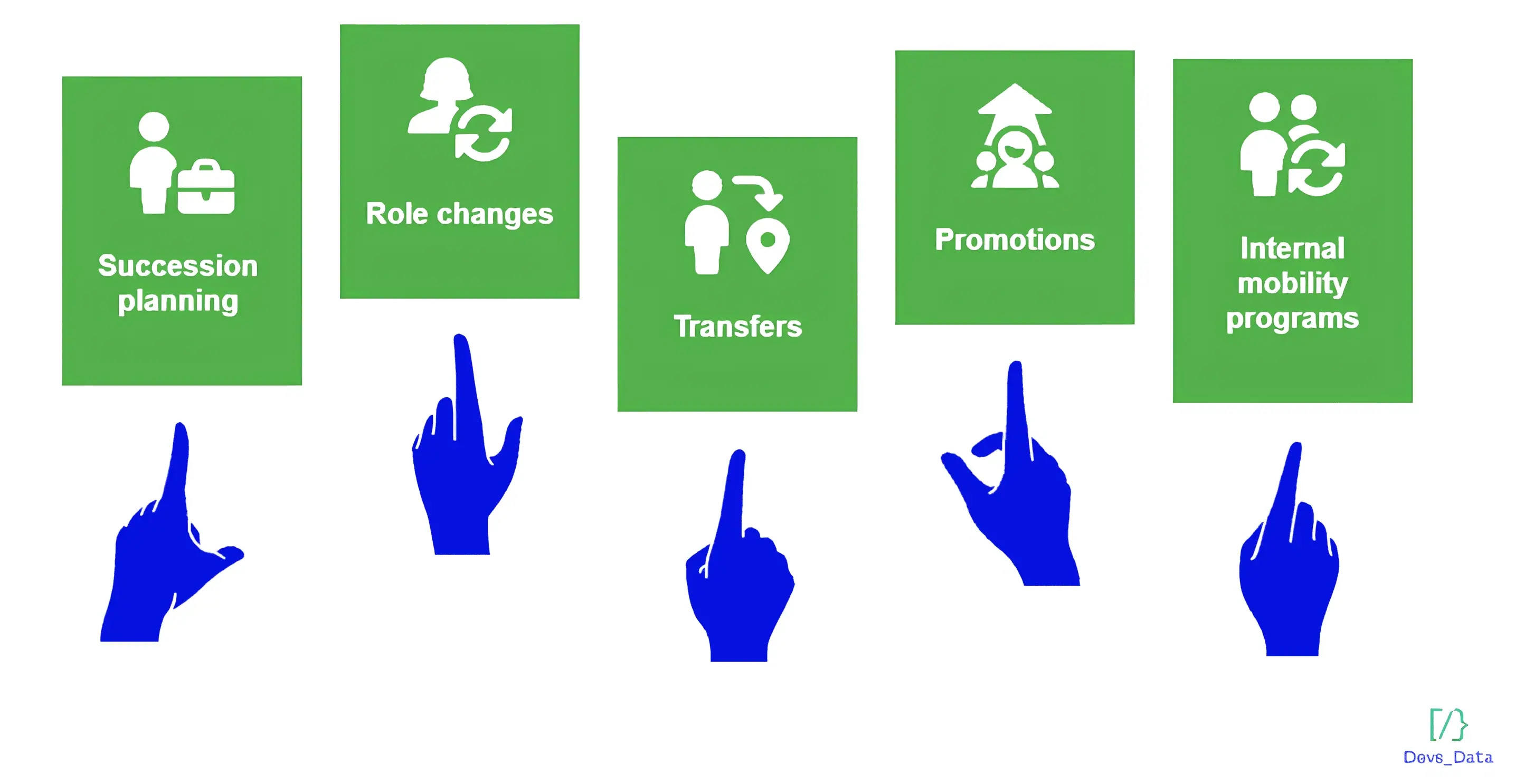
You can apply several internal recruitment methods depending on the goal and the role. One common approach is promoting a current employee to a higher position. Another option involves lateral moves, in which an employee transfers to a different department to broaden their experience and apply new skills.
Internal recruitment also includes converting temporary or part-time staff into full-time positions. Some companies supplement this with internal referral channels that prompt employees to surface qualified colleagues from other departments. Both methods tap into workforce knowledge that external referral programs targeting candidates outside the organization do not reach.
Primary types of internal recruitment include:
Example:
Preparing an Assistant Manager to step into a managerial role.
Succession planning focuses on identifying employees with leadership potential and preparing them to take on key responsibilities. This method maintains continuity and reduces the risk of leadership gaps.
| Pros | Cons |
|---|---|
| Ensures stable leadership during transitions. | It can create expectations of automatic promotion among senior employees. |
| Reduces the time and cost of sourcing external talent. | May overlook external applicants who could introduce new methods or ideas. |
Example:
Moving a Sales Representative into a customer service position.
Role changes allow employees to move into different roles across departments. The adjustment can be horizontal or involve new duties without a change in title.
| Pros | Cons |
|---|---|
| Expands employee knowledge across departments. | May cause uncertainty if responsibilities are not clearly defined. |
| Helps match individuals to positions that fit their strengths. | It may require extra training or mentoring to adapt. |
Example:
Assigning a Branch Manager to another location.
Transfers relocate employees within the same organization to balance workloads or fill urgent vacancies. The employee’s position and responsibilities remain the same, only the location changes.
| Pros | Cons |
|---|---|
| Provides exposure to new environments and challenges. | May interrupt personal routines or relocation stability. |
| Balances staffing needs across locations or units. | It can temporarily reduce performance while the employee adjusts. |
Example:
Elevating a Team Leader to a department manager position.
Promotions reward strong performance by assigning greater responsibility and usually higher pay. They signal opportunity and reinforce achievement culture.
| Pros | Cons |
|---|---|
| Strengthens engagement and retention by recognizing performance. | May lead to rivalry among employees competing for advancement. |
| Encourages goal setting and performance improvement. | Risks of advancing an employee beyond their effective capability, known as the Peter Principle. |
Example:
Employees taking part in rotational assignments across departments.
These programs structure movement between roles through project rotations, short-term assignments, or cross-functional collaborations.
| Pros | Cons |
|---|---|
| Builds versatile skills and adaptability through real work. | Requires precise coordination to prevent project delays. |
| Keeps employees motivated and reduces the risk of turnover. | It may strain resources if backfills are not managed in a timely manner. |
The five methods above cover the full range of internal recruitment approaches, from planned leadership succession to structured cross-functional mobility. What they share is a reliance on the organization’s existing talent base, which means their effectiveness is bound by the depth and diversity of that base. A company with a strong internal talent pipeline and visible promotion history gets the most from all five. One where career paths are opaque or advancement is infrequent will find that even well-structured programs produce limited results because the underlying culture does not support them. The next section examines the specific advantages internal recruitment delivers when that foundation is in place, and the disadvantages that emerge when it is not.
Do you have recruitment needs?
The decision to hire internally or externally affects four areas that managers should evaluate before posting a role: retention impact, time to productivity, hiring cost, and whether the required skills already exist on the team. The advantages and trade-offs below are organized around these criteria.
In 2024, 43% of companies plan to backfill roles internally or externally due to turnover or movements.
Evaluating the specific advantages and limitations of internal recruitment helps determine when this strategy serves organizational objectives.
Internal recruitment earns its reputation for efficiency by compressing the hiring timeline across multiple stages. An internal candidate has already cleared the cultural fit question, knows the tools and workflows, and holds working relationships with the team they are joining. HR can skip significant portions of the qualification process without increasing risk. On cost, advertising disappears, background screening draws from existing records, and salary negotiations typically land below what an external candidate with market leverage would require.
The engagement benefit carries more long-term weight than the cost argument. Staff who see colleagues progressing internally receive a consistent signal that advancement does not require leaving the organization. That signal suppresses passive job-seeking in a way that compensation adjustments alone do not replicate.
The disadvantages are most usefully understood as connected rather than separate. The relational dimension surfaces first. A promotion changes the authority structure within a team that previously operated at the same level, and that adjustment does not resolve itself automatically. Transition management matters here more than organizations typically anticipate.
The structural disadvantage follows. Every promotion creates a vacancy, and the speed advantage of internal recruitment erodes quickly if backfill is not already underway. Organizations that treat the original placement as complete and the downstream opening as a separate problem tend to find the cost savings absorbed by the delay.
Over a longer horizon, the constraint becomes a ceiling. A team that advances primarily from within eventually reaches the limits of its existing capabilities. When a role requires skills or perspectives the current workforce does not hold, continuing to hire internally preserves the organization’s existing orientation rather than advancing it. That is the point where external recruitment, supported by a specialist partner like DevsData LLC, delivers its clearest return.
Since the advantages and disadvantages of internal recruitment are now clear, the next step is to address how organizations can manage the associated risks. Many issues stem from a lack of planning and communication rather than the process itself.
Research shows that 38% of employees leave their jobs within one year, often citing a lack of career development opportunities or poor work-life balance.
Internal mobility programs address the first of these drivers directly by giving employees a visible path to advancement without changing employers. Addressing these factors through structured internal programs can prevent similar outcomes. The following measures help reduce common challenges and maintain employee confidence during the hiring cycle.
Use recognition systems that go beyond promotions. Add short-term learning programs, targeted training, or job rotation to build variety. Include simple reward structures such as public acknowledgment or direct bonuses for consistent performance.
Stay transparent from the start of each hiring round. Tell applicants whether the company is also running an external search and how many internal participants are involved. If a staff member is not chosen, discuss the reasons directly and offer feedback for improvement.
Train supervisors to identify growth potential early. Keep updated records of individual skills and interests. This helps match the right person to the right opportunity when new positions appear.
If a preferred candidate already exists, confirm their interest before sharing the job broadly. Doing so prevents frustration among others who might apply without a real chance.
Align the hiring method with the role’s purpose. Review current capabilities and decide whether the team needs continuity or new expertise. For time-sensitive roles, run both internal and external recruitment simultaneously to reach the best outcome.

Recruitment agencies serve a different purpose than managing an organization’s internal mobility. Their value becomes apparent when internal options have been exhausted or when the role requires a profile that the existing workforce does not possess. A newly created function, a senior position demanding cross-industry experience, or a specialized technical role are all situations where running an internal search wastes time the organization does not have.
DevsData LLC addresses these situations directly by sourcing externally vetted candidates when the internal pipeline cannot produce a qualified match, and doing so within the same evaluation framework and process standards that the organization expects for its internal promotion decisions.
Their neutrality is useful where promotion decisions may cause tension or bias. Agencies can manage assessments objectively and provide consistent evaluation criteria. They also bring market insight, advising on salary benchmarks and skill availability. This becomes important when internal recruitment reaches its limits or when specialized roles need to be filled quickly.
Global talent shortages remain significant; three in four organizations reported difficulty recruiting full-time positions in 2024, making this blended approach increasingly practical.
When companies must expand the search, agencies connect existing internal processes with external sourcing. They manage both talent streams under one framework, preserving fairness for internal candidates while supplying qualified external profiles when internal options fall short. This continuity keeps hiring efficient and consistent across the organization.
Website: www.devsdata.com
Team size: ~60 employees
Founded: 2016
Headquarters: Brooklyn, NY, and Warsaw, Poland
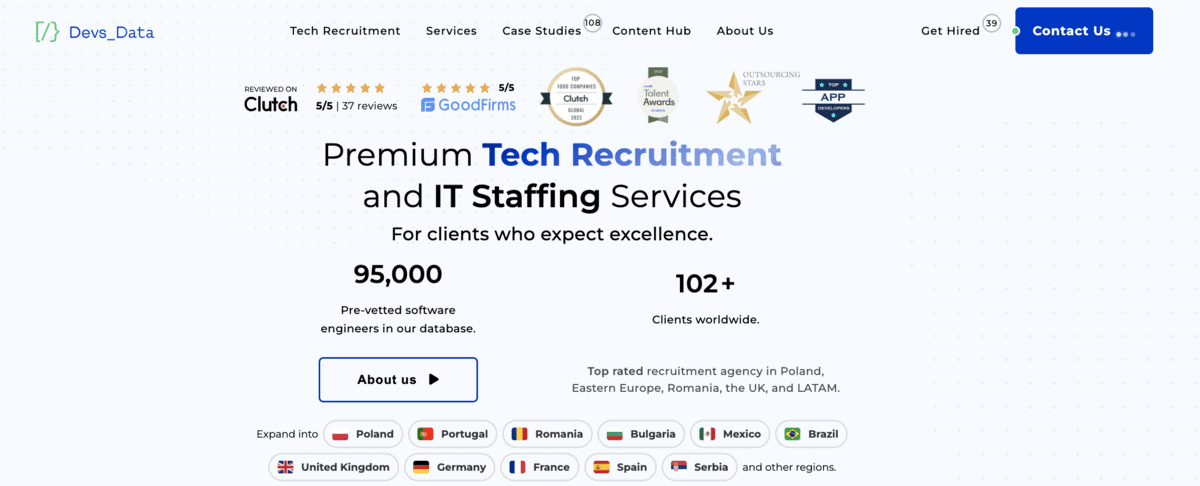
Engaging the right recruitment partner is key to managing internal hiring with precision. DevsData LLC brings over ten years of experience, supported by a 60-person team and an extensive database now exceeding 95000 candidates. The firm operates across major markets, including the US and the UK, while assisting both multinational clients and emerging startups. Consistent 5/5 satisfaction scores on Clutch and GoodFirms demonstrate its reliability and disciplined process.
The company’s structure is grounded in transparency. Clients can review documentation and feedback at every stage of the hiring process, which keeps the internal promotion process traceable and fair. This level of openness distinguishes DevsData LLC from agencies that restrict access to evaluation details. As a result, decision-makers remain confident and informed at every step.
DevsData LLC’s evaluation process applies to external candidates it sources on behalf of clients, not to the management of an organization’s existing workforce. Each candidate completes a 90-minute analytical reasoning task, alongside structured interviews assessing communication and adaptability to the specific role requirements. US-based specialists run this process to verify that candidates presented for client review have been assessed against the actual demands of the position rather than evaluated through a generic screening workflow.
Beyond hiring support, DevsData LLC offers HR and operational consulting. Its experts assist with legal and tax compliance, labor regulations, and business process management. Employer of Record (EOR) services help organizations transfer employees across borders while maintaining compliance and efficiency. These capabilities enable companies to expand internal mobility safely and consistently.
A relevant case involved Johnson & Johnson’s Warsaw R&D hub, where device work supported real surgeries and cardiac care. DevsData LLC coordinated with decision makers in Israel and ran an internal mobility review to surface engineers ready for expanded scope in C++ or data roles. Within three months, promotions and targeted reassignments were completed, keeping development on schedule while limiting the need for outside hiring.
Do you have recruitment needs?
To enhance your internal recruitment and accelerate employee growth, contact DevsData LLC at general@devsdata.com or visit www.devsdata.com.
Internal recruitment defines how organizations retain experience, motivate employees, and sustain operational continuity. It offers a structured route for growth, linking career progression with company stability. Yet the process can become complex without a defined system for candidate evaluation and transparent communication. A capable recruitment partner can support HR teams by formalizing these steps, helping maintain fairness while reducing time-to-fill for critical roles. With structured internal mobility, companies strengthen workforce engagement and ensure leadership pipelines remain active.
DevsData LLC supports internal recruitment through globally coordinated operations, including the US and Israel. The company has more than ten years in the market, a team that includes US specialists, and a database of 95000 verified professionals. By combining evaluation frameworks with proven hiring systems, DevsData LLC assists enterprises and startups in refining internal promotion structures and retention planning. This balance of process knowledge and global reach positions the firm as a dependable partner for modern internal hiring.
Any questions or comments? Let me know on
Twitter/X.
Discover how IT recruitment and staffing can address your talent needs. Explore trending regions
like Poland, Portugal, Mexico, Brazil and more.
 Frequently asked questions (FAQ)
DevsData – your premium technology partner
DevsData is a boutique tech recruitment and software agency. Develop your software project with veteran engineers or scale up an in-house tech team of developers with relevant industry experience.
Free consultation with a software expert
🎧 Schedule a meeting
FEATURED IN


DevsData LLC is truly exceptional – their backend developers are some of the best I’ve ever worked with.”

Nicholas Johnson
Mentor at YC, serial entrepreneur


 Build your project with our veteran developers.
Explore the benefits of technology recruitment and tailor-made software.
Learn how to source skilled and experienced software developers.

Rebecca Botvin

Commercial Director

Tom Potanski
Manager




Categories: Big data, data analytics | Software and technology | IT recruitment blog | IT in Poland | Content hub (blog)













careers@devsdata.com





general@devsdata.com

"I interviewed about a dozen different firms. DevsData LLC is truly exceptional – their backend developers are some of the best I've ever worked with. I've worked with a lot of very well-qualified developers, locally in San Francisco, and remotely, so that is not a compliment I offer lightly. I appreciate their depth of knowledge and their ability to get things done quickly."

Nicholas Johnson
CEO of Orange Charger LLC,
Ex-Tesla Engineer,
Mentor at YCombinator
"DevsData reached out to us, as we've been looking to grow our engineering team in Europe and Poland. Communicating efficiently and professionally, DevsData made a strong impression with their understanding of the recruitment challenges we were facing. They designed a tailored recruitment process for our needs. I was impressed with the technical depth of their approach."

Karim Butt
Co-Founder & CTO at GlossGenius, Inc.
"Out of all the vendors we work with, DevsData clearly stands out. The quality of developers they deliver is beyond what we've received from any other vendor, and they've been able to send profile recommendations very quickly. I'm happy to be their reference for other companies from Israel and talk about their recruitment abilities and what they delivered for us."

Ran Eyal
Senior Manager at
ZIM Integrated
Shipping Services Ltd.
"DevsData demonstrated a strong degree of proactivity, taking time to thoroughly understand the problem and business perspective, and continuously suggesting performance and usability enhancements. Their app exceeded my expectations. I've worked with DevsData on numerous projects over the last 3 years and I'm very happy. Being both responsive and honest in communication."

Jonas Lee
Partner & Executive VP of Verus,
Financial LLC, Investor,
& Serial Entrepreneur
Acknowledgments