Thanks for subscribing.
Your gift is on the way.



PHP has been a core technology for the web since the mid-1990s and continues to power some of the largest platforms in the world, including WordPress and Wikipedia. PHP 8.4, released in late 2024, introduced property hooks and asymmetric visibility, two features that bring the language closer to modern object-oriented standards. That trajectory reinforces PHP’s long-term relevance for maintaining large codebases, building API-driven platforms, and scaling content-heavy or transaction-based web systems.
In 2026, PHP remains one of the most widely used server-side languages. According to W3Techs, 73.7% of all websites whose server-side language is known use PHP. WordPress, a PHP application, alone accounts for approximately 43% of all active websites. Many companies continue to rely on PHP not only for maintaining long-standing systems but also for developing new products using modern frameworks such as Laravel, Symfony, and CodeIgniter.
According to recent surveys, 18.2% of developers choose PHP as their primary programming language.
As demand for PHP expertise remains steady, many companies face limited availability of framework-experienced developers in local markets, which pushes hiring timelines out and increases salary pressure. Offshore PHP developers provide a way to access skilled talent in regions with strong technical communities, competitive rates, and diverse project experience. For organizations balancing quality, cost, and speed, offshore hiring can be a practical approach to building and scaling development teams without being limited by location.
Offshore PHP developers not only bring technical expertise at competitive rates but can also extend development coverage across time zones, accelerating delivery for global projects.
This article explains why PHP remains relevant today, how to hire skilled offshore PHP developers, and how DevsData LLC has helped companies secure talent that drives results.
PHP’s relevance in 2026 is reinforced by its mature frameworks, strong community support, and ongoing technical improvements. The combination of regular updates, stable architecture, and a large developer base creates steady demand that often exceeds the supply available in local markets, which is why companies increasingly look offshore for PHP talent.
The language powers a vast portion of the internet. Platforms such as WordPress, Magento, and Drupal remain widely used, and all are built on PHP. For businesses, PHP’s relevance in 2026 comes down to several key factors:
PHP has one of the largest developer communities in the world, with more than 2.1 million active developers globally working across web, SaaS, and enterprise systems. That depth directly reduces the bus factor: when a PHP developer leaves, qualified replacements are available across multiple regions and time zones, lowering the risk of project stalls or knowledge gaps. For companies that need to scale quickly or protect continuity, this wide reach removes dependence on any single individual or local talent market.
Frameworks such as Laravel, Symfony, and CodeIgniter are software layers built on top of PHP that provide a structured way to develop web applications. Instead of writing all functionality from scratch, developers use these frameworks to organise code, follow established architectural patterns, and reuse proven components. Laravel, in particular, extends this value with tools like Forge, Vapor, and Pulse, which handle server provisioning, serverless deployment, and application monitoring respectively. These DevOps-adjacent capabilities reduce the need for dedicated infrastructure engineers, lowering overhead for teams without dedicated platform specialists.
Most major hosting providers offer built-in PHP support, which means applications can be deployed without custom server configuration. This reduces setup time and removes the need for specialised hosting environments. Teams can choose from a wide range of providers and infrastructure options based on cost, performance, and location rather than being tied to a specific platform.
The need for experienced PHP professionals remains strong in 2026. Many organizations rely on PHP to maintain and expand their existing platforms, while others continue to choose it for new projects due to its stability, flexibility, and cost-effectiveness. This demand spans multiple industries and types of applications. In many regions, companies report limited availability of experienced developers, which often pushes hiring teams to expand their search to offshore talent pools.
Many SaaS platforms use modern PHP frameworks for backend development. These frameworks support structured development, built-in security features, and scalable architectures, making them a practical choice for both startups and established businesses.
Do you have IT recruitment needs?
Corporate intranets, CRM solutions, and ERP systems frequently use PHP for backend logic. Developers working on these systems handle data management, user authentication, and integration with third-party tools.
As projects grow in scope and delivery timelines tighten, offshore PHP developers are increasingly used to maintain development capacity without slowing release cycles. They provide access to a broader talent pool, competitive rate ranges, and the ability to sustain development momentum beyond local hiring limits.

When choosing a backend technology, companies often compare PHP with other widely used server-side languages and frameworks. Each option has strengths depending on project scope, budget, and long-term goals. A total cost of ownership view helps clarify these differences beyond raw performance metrics. The table below compares four languages across four dimensions that directly affect project costs.
PHP is primarily used for server-side rendering, content-driven platforms, and backend-heavy websites. It integrates easily with hosting providers and traditional web stacks. PHP 8.x addressed a longstanding limitation through JIT (Just-in-Time) compilation, which improves performance on CPU-bound tasks such as image processing, data transformation, and computation-heavy logic.
JavaScript with Node.js is typically used for real-time applications, single-page apps, and event-driven systems that run one language across frontend and backend.
PHP was designed natively for the web, which means it runs directly in most shared and managed hosting environments without additional server configuration. Python, by contrast, requires WSGI or ASGI middleware to serve web traffic, adding setup steps that increase both time and infrastructure cost. For teams focused on time-to-market for standard web products, PHP’s lower setup complexity is a direct TCO advantage. Python remains the stronger choice for data science, machine learning, and analytics-heavy applications where those capabilities are central to the product.
PHP focuses on rapid development, lower infrastructure costs, and flexible deployment. It is well-suited for startups, mid-sized companies, and content-focused platforms.
Java is commonly used in large enterprise systems that require strict architecture, long-term stability, and complex integrations. It often involves higher development and maintenance costs.
PHP is preferred for faster delivery and lower setup complexity. Java is chosen for large-scale corporate systems with strict governance requirements.
PHP offers broader hosting support and a larger global talent pool. It is widely used in commercial and enterprise web environments.
Ruby is known for developer productivity and clean syntax but has a smaller ecosystem and talent market in many regions.
PHP is typically easier to scale teams with and maintain over time. Ruby is often chosen for early-stage startups focused on rapid prototyping.
PHP is particularly well-suited for:
Companies often choose PHP when they need reliable performance, predictable costs, and access to a large pool of experienced developers.
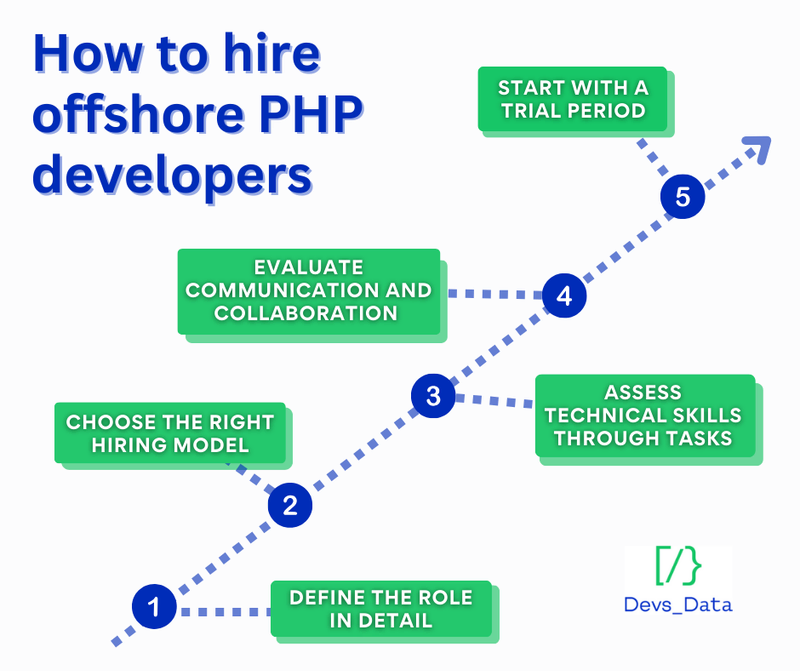
Hiring offshore PHP developers requires a structured approach that focuses on technical requirements, cultural compatibility, and long-term collaboration potential. A clear process reduces the risk of mismatched hires and ensures that projects move forward without delays.
Start by specifying the PHP version, frameworks, and tools your project requires. Include information on expected tasks, database systems in use, integration needs, and any experience with APIs or cloud services. Security literacy is worth listing explicitly: candidates should demonstrate familiarity with OWASP guidelines, input validation practices, and secure session management. A well-defined description that covers both technical scope and security expectations helps attract candidates with the exact skill set you need.
Practical tip: review your existing codebase and roadmap before writing the job description, and involve a senior developer to confirm which skills are truly essential.
Determine whether you need full-time employees, project-based contractors, or dedicated offshore team members. Long-term projects may benefit from full-time hires, while shorter initiatives might be better served by contract work.
Practical tip: estimate workload for the next six to twelve months and choose a model that matches long-term demand, not just short-term pressure.
Go beyond standard interviews by testing candidates with real-world assignments. Ask them to solve problems similar to those in your project, such as building an API endpoint, optimising a database query, or integrating a third-party service. Evaluations should also probe familiarity with code quality tools: ask candidates whether they write tests in PHPUnit or Pest, and whether they run static analysis with PHPStan. Proficiency with these tools indicates whether a developer maintains code at a standard that holds up over time.
Practical tip: use small, time-limited tasks based on real scenarios instead of generic coding challenges to evaluate practical problem-solving ability.
Offshore work relies heavily on clear communication. Look for candidates who can explain technical decisions, provide regular updates, and work effectively with distributed teams.
Practical tip: include at least one live discussion or collaborative session to observe how candidates communicate under real working conditions.
A short trial period, which can be one to three months, allows both sides to confirm compatibility before committing to a long-term arrangement. This period can be used to evaluate productivity, code quality, and teamwork.
Practical tip: define clear performance goals for the trial phase, such as delivery milestones, documentation quality, and responsiveness.
By following these steps, companies can build offshore PHP teams that deliver high-quality work, meet deadlines, and integrate smoothly with existing workflows.
Compensation for offshore PHP developers depends on location, experience, and project specifics. The table below summarizes typical 2026 ranges for mid‑ and senior‑level roles, along with freelance hourly rates:
| Region / Country | Mid-Level Salary (USD, Annual) | Senior Salary (USD, Annual) | Freelance Rate (USD/hour) |
|---|---|---|---|
| United States | $70000-$100000 | $105000-$140000+ | $60 – $110 |
| United Kingdom | $55000-$80000 | $80000-$110000 | $45-$85 |
| Germany | $55000-$75000 | $75000-$100000 | $45-$80 |
| Eastern Europe | $25000-$45000 | $40000-$65000 | $20-$50 |
| Latin America | $23000-$40000 | $38000-$58000 | $20-$45 |
| Asia (India, SEA) | $18000-$32000 | $30000-$50000 | $15-$40 |
While salary ranges are an important factor, offshore destinations also differ in terms of technical maturity, communication style, time zone alignment, and project experience. Developers in the United States and the United Kingdom are often chosen for complex systems and leadership roles but come with higher costs. Western European markets, including Germany, are valued for strong engineering standards and regulatory awareness.
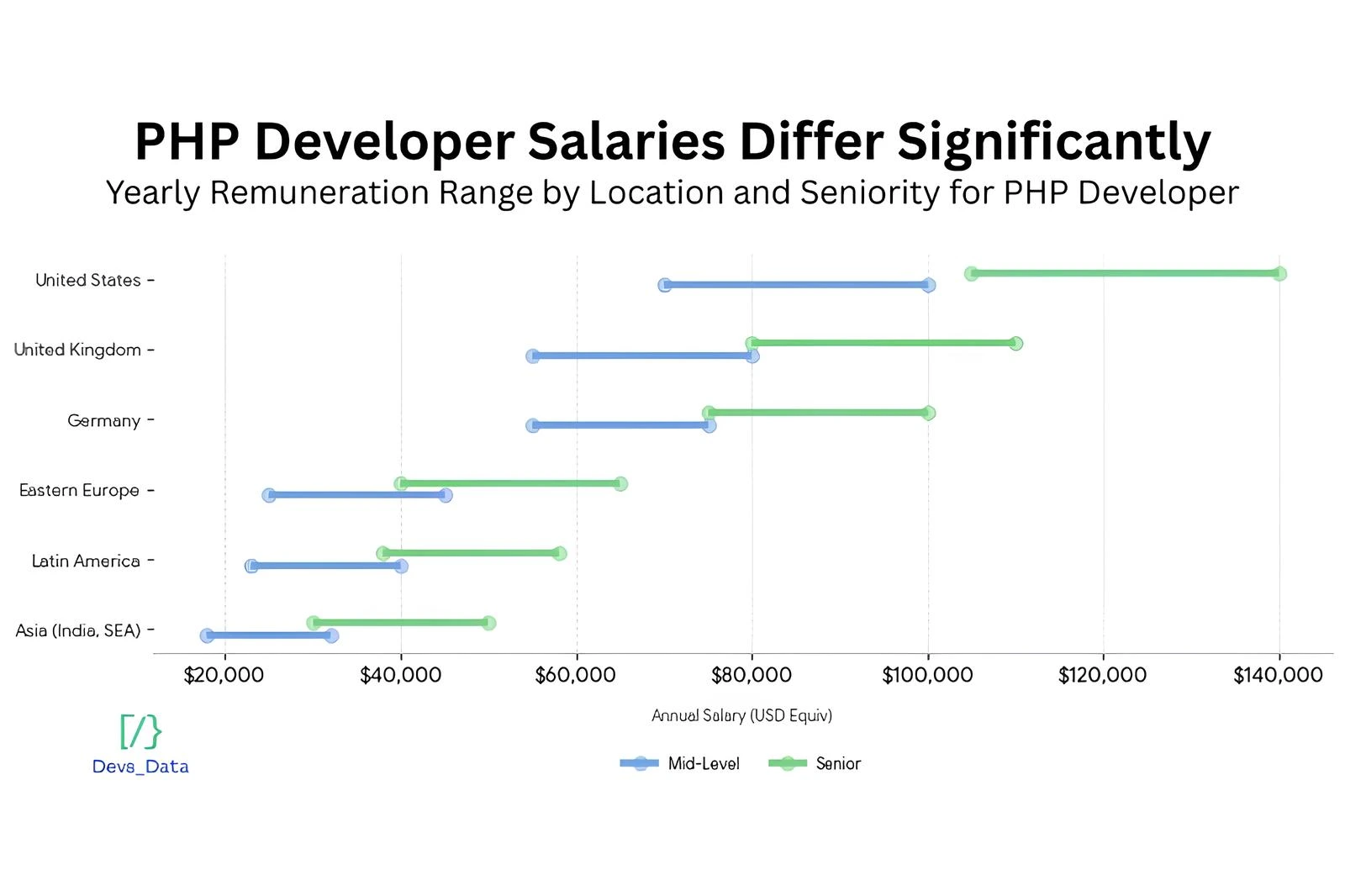
Eastern Europe combines solid technical education with competitive pricing and extensive experience working with international teams. Latin America is frequently selected for its time zone alignment with North America and collaborative working culture. Asian markets, including India and Southeast Asia, offer large talent pools and cost-efficient rates, making them suitable for high-volume development and long-term maintenance projects when supported by clear management processes.
These figures represent typical mid- and senior-level offshore compensation bands. For broader market benchmarks that combine junior, mid, and senior roles, and for city-specific updates, consult verified resources such as PayScale, Glassdoor, or Levels.fyi.
Although PHP is one of the most widely used server-side languages globally, hiring experienced offshore PHP developers is rarely straightforward. The apparent abundance of talent often results in a large volume of applications, but quantity does not equal suitability.
Many candidates list PHP experience, yet differ significantly in depth. Some are limited to basic CMS work, while others have built scalable backend systems using frameworks such as Laravel or Symfony in production environments. Distinguishing between these profiles requires structured technical evaluation rather than resume screening alone.
Several practical challenges commonly arise in PHP recruitment:
For companies without dedicated technical recruiters, these steps significantly extend hiring timelines. Internal teams often underestimate the effort required to verify production-grade experience, especially when scaling quickly.
A recruitment agency focused on software development roles can simplify this process in several ways:
Agencies maintain databases of developers whose skills and experience have already been reviewed. This allows companies to start the interview process with a shortlist of qualified professionals instead of filtering through dozens of unsuitable applications.
Specialised recruiters can evaluate candidates not only for their PHP expertise but also for their knowledge of frameworks, databases, and integration methods. This ensures that only capable developers progress to client interviews.
By using existing networks and proven sourcing methods, agencies can often present suitable candidates within days or weeks, compared to months for in-house recruitment efforts.
Offshore hiring may involve different employment laws, tax rules, and payment arrangements. Agencies can guide companies through these requirements and help set up compliant agreements.
Choosing the right partner can materially affect offshore hiring outcomes. An experienced agency such as DevsData LLC manages sourcing, screening, and cross-border coordination, reducing the operational burden on internal teams while maintaining hiring standards.
Do you have IT recruitment needs?
Website: www.devsdata.com
Team size: ~60 employees
Founded: 2016
Headquarters: Brooklyn, NY, and Warsaw, Poland
With more than nine years of experience in technical recruitment, DevsData LLC supports businesses across North America, Latin America, and Europe in hiring PHP developers who are a strong fit both technically and culturally. The company has worked with clients ranging from early-stage startups to multinational corporations, including Memory AS, BNP Paribas, and Paysera.
In addition to recruitment, DevsData LLC offers offshore software development services through its in-house engineering team. With over 100 completed projects for more than 80 clients, the company’s expertise covers web development, mobile app development, product development, cloud infrastructure, UI/UX design, Big Data, and complex backend systems.
DevsData LLC holds a government-approved recruitment license and maintains a database of over 95000 pre-vetted professionals. The company applies a structured multi-stage evaluation process, accepting fewer than 6% of candidates into its network.
Each qualified candidate completes a 90-minute technical interview conducted by senior engineers based in Europe and the United States. The assessment covers practical problem-solving, architecture-level understanding, and communication clarity in distributed environments. Interviewers also verify adherence to PSR-12 coding standards and check whether candidates apply DRY principles in their solutions, two markers that distinguish developers who write maintainable code from those who produce working but poorly structured output. This approach increases the likelihood that clients engage developers capable of contributing effectively in cross-border teams from the first stages of collaboration.
The company operates on a success-based pricing model, meaning clients pay only when a candidate is hired. If a placement does not work out, a replacement or refund is offered at no additional cost.
Selected recruitment projects:
Over the years, DevsData LLC has delivered highly skilled engineers for clients across industries, from logistics and FinTech to global SaaS platforms. These projects often involved building cross-functional teams, sourcing talent with specialised technical expertise, and ensuring strong cultural and time zone alignment for distributed work environments. Let’s review some of them:

ZIM Logistics Services Ltd. – DevsData LLC recruited and assembled a complete cross-functional engineering team of 18 specialists to support the company’s digital transformation. The hiring strategy focused on building a balanced structure that included backend developers working in PHP and Node.js, frontend engineers using React, and mobile developers, along with specialists experienced in enterprise logistics and financial systems. Each role was mapped to specific platform objectives, allowing the team to cover system architecture, application development, integration, and performance optimization. As a result, the fully aligned team improved platform stability, streamlined supply chain workflows, and enhanced digital customer services.
Xapo Bank – DevsData LLC filled 14 roles in software engineering, DevOps, and product development for this licensed private bank and crypto custodian, drawing on its extensive database of pre-vetted candidates with experience in financial systems, regulatory compliance, and PHP-based platforms. The recruitment focused on specialists with proven backgrounds in secure transaction processing, audit-ready system design, and PCI-DSS compliance in PHP environments, alongside mobile banking development and engineers with combined React Native and PHP expertise. As a result, the client received a team capable of delivering compliant, high-performance financial applications that met strict operational and regulatory requirements.

Sea – The recruitment focused on senior-level roles, including experienced PHP developers responsible for modernising a complex legacy codebase, alongside senior backend engineers, DevOps specialists, QA professionals, and project managers. Through targeted sourcing, deep market penetration, and multi-stage technical screening, DevsData LLC delivered 11 high-calibre senior hires within four months, forming a cross-functional team that accelerated Sea’s platform roadmap and strengthened its presence in Central Europe.
Do you have IT recruitment needs?
Offshore PHP developers remain a valuable resource for companies seeking to balance cost, quality, and project timelines. PHP continues to be one of the most widely used server-side languages, supported by a mature ecosystem and a large global talent pool.
By looking beyond local markets, businesses can access experienced developers with the skills needed to maintain legacy systems, work with modern frameworks, and integrate seamlessly into distributed teams.
DevsData LLC has a proven track record in sourcing skilled PHP developers and building high-performing engineering teams across North America, Latin America, and Europe. For organizations hiring talent internationally, DevsData LLC provides Employer of Record (EoR) services, allowing businesses to engage offshore developers without dealing with local legal, tax, or payroll complexities. Whether the goal is to modernise a PHP-based platform, add specialised backend expertise, or build a full offshore team, DevsData LLC streamlines the process so clients can focus on delivery instead of administration.
To explore how DevsData LLC can help you hire experienced PHP developers or expand your engineering capacity, visit www.devsdata.com or contact general@devsdata.com.
Discover how IT recruitment and staffing can address your talent needs. Explore trending regions
like Poland, Portugal, Mexico, Brazil and more.
 Frequently asked questions (FAQ)
DevsData – your premium technology partner
DevsData is a boutique tech recruitment and software agency. Develop your software project with veteran engineers or scale up an in-house tech team of developers with relevant industry experience.
Free consultation with a software expert
🎧 Schedule a meeting
FEATURED IN


DevsData LLC is truly exceptional – their backend developers are some of the best I’ve ever worked with.”

Nicholas Johnson
Mentor at YC, serial entrepreneur


 Build your project with our veteran developers.
Explore the benefits of technology recruitment and tailor-made software.
Learn how to source skilled and experienced software developers.
Build your project with our veteran developers.
Explore the benefits of technology recruitment and tailor-made software.
Learn how to source skilled and experienced software developers.

Rebecca Botvin

Commercial Director

Tom Potanski
Manager




Categories: Big data, data analytics | Software and technology | IT recruitment blog | IT in Poland | Content hub (blog)
















careers@devsdata.com









general@devsdata.com

"I interviewed about a dozen different firms. DevsData LLC is truly exceptional – their backend developers are some of the best I've ever worked with. I've worked with a lot of very well-qualified developers, locally in San Francisco, and remotely, so that is not a compliment I offer lightly. I appreciate their depth of knowledge and their ability to get things done quickly."

Nicholas Johnson
CEO of Orange Charger LLC,
Ex-Tesla Engineer,
Mentor at YCombinator
"DevsData reached out to us, as we've been looking to grow our engineering team in Europe and Poland. Communicating efficiently and professionally, DevsData made a strong impression with their understanding of the recruitment challenges we were facing. They designed a tailored recruitment process for our needs. I was impressed with the technical depth of their approach."

Karim Butt
Co-Founder & CTO at GlossGenius, Inc.
"Out of all the vendors we work with, DevsData clearly stands out. The quality of developers they deliver is beyond what we've received from any other vendor, and they've been able to send profile recommendations very quickly. I'm happy to be their reference for other companies from Israel and talk about their recruitment abilities and what they delivered for us."

Ran Eyal
Senior Manager at
ZIM Integrated
Shipping Services Ltd.
"DevsData demonstrated a strong degree of proactivity, taking time to thoroughly understand the problem and business perspective, and continuously suggesting performance and usability enhancements. Their app exceeded my expectations. I've worked with DevsData on numerous projects over the last 3 years and I'm very happy. Being both responsive and honest in communication."

Jonas Lee
Partner & Executive VP of Verus,
Financial LLC, Investor,
& Serial Entrepreneur
Acknowledgments