Thanks for subscribing.
Your gift is on the way.



Startups move fast and innovate quickly, but for many early-stage companies, building a reliable HR foundation is one of the hardest parts of scaling. Founders may excel at vision and product development, yet hiring the right people, managing HR processes, and shaping a sustainable culture require a different set of skills and dedicated structure.
Recent data highlights just how critical and challenging HR support is for startups. For example, a 2025 survey of small businesses found that nearly 90% of firms with open roles reported few or no qualified applicants for their vacancies.
Also, according to a 2023 report, about 40% of small businesses struggled to attract new employees, while another 21% were concerned about retaining staff.
For resource-constrained startups, these statistics translate into serious bottlenecks: open roles lying vacant, overburdened founders juggling recruiting with product and operations, and often, burnout or costly bad hires. Without a structured HR foundation, many startups struggle to keep pace as they attempt to grow, maintain a coherent company culture, or transition from founder-led to people-led.
At DevsData LLC, we’ve seen these challenges repeatedly in our work with early-stage companies. Our role typically involves not only supporting hiring efforts but also helping founders introduce the basic HR structures, clear role definitions, recruitment workflows, onboarding routines, compliance steps, and people-management practices, that make growth more predictable. In this article, we’ll share the method behind our approach, illustrate pitfalls commonly overlooked by early-stage teams, and offer actionable guidance for founders who want to build effective, resilient HR from day one.
Startup HR support refers to the structured set of people-operations practices that help early-stage companies hire effectively, manage employees consistently, and build the foundations for scalable growth. Unlike mature organizations with established HR departments, most startups begin with improvised processes led by founders, ad-hoc hiring, informal onboarding, and undocumented policies. This works in the earliest stages, but the moment a team begins to grow, these gaps quickly create operational friction, misalignment, and compliance risks.
Do you have recruitment needs?
Effective startup HR support brings order to this chaos. It covers the full employee lifecycle: clearly defined roles, professional hiring workflows, legally sound contracts, onboarding frameworks, performance expectations, and repeatable communication patterns. It also ensures that employment practices meet local labor regulations, a critical point for startups expanding into multiple regions or working with global talent. For teams that lack the bandwidth or expertise to build these systems internally, external HR partners can deliver this support through outsourced services, advisory engagements, or a combination of both, giving startups access to structured people operations without the overhead of a full in-house HR function.
More importantly, HR support helps translate a founder-driven culture into a structured, sustainable one. It protects teams from the most common early-stage pitfalls: unclear responsibilities, inconsistent feedback, avoidable turnover, and costly mis-hires.
For young companies balancing limited resources with ambitious growth targets, the right HR support becomes a strategic function, enabling predictable hiring, stronger retention, and a healthier organizational rhythm that scales as the business grows.
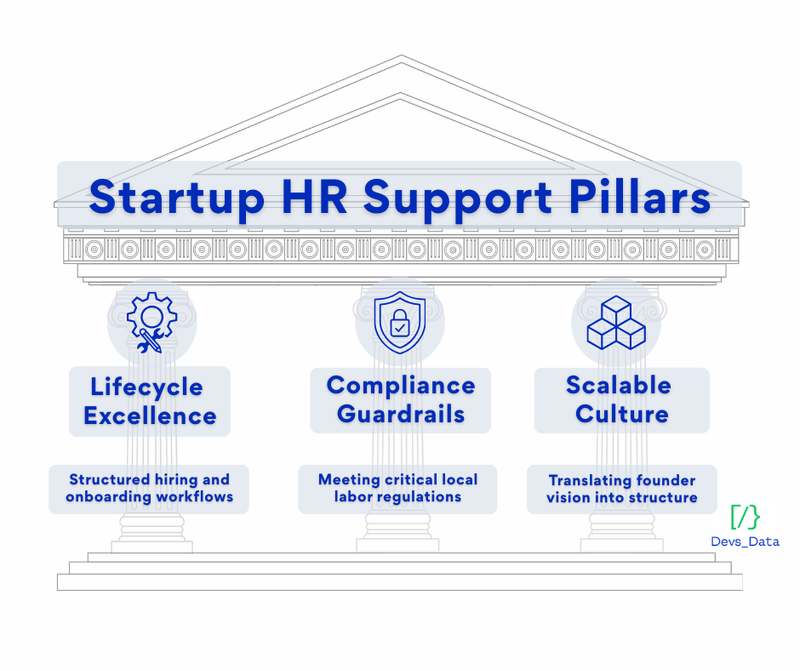
Early-stage companies operate with speed, uncertainty, and limited resources, a combination that makes people-related challenges both unavoidable and high-impact. Without dedicated HR infrastructure, startups face issues that slow down growth, stretch founders thin, and increase the risk of burnout or mis-hiring. Below are the core HR challenges we repeatedly see across early-stage teams, supported by recent independent data and paired with how we address each one as an HR and recruitment service provider at DevsData LLC.
In many startups, founders become the de facto HR, finance, and operations team. A 2023 survey reported that entrepreneurs spend around 36% of their work week on small administrative tasks such as paperwork, data entry, and scheduling, instead of strategic work. For SMEs more broadly, a 2025 study by German development bank KfW found that staff spend about 7% of their working time on administrative processes, averaging 32 hours per month per business. For a five or ten-person startup, that is a material productivity drain.
How we handle it at DevsData LLC
We approach HR as a way to improve how the company operates day-to-day, not merely as a compliance requirement. For early-stage clients, we design lean HR operating models: standardized templates for contracts and policies, streamlined onboarding checklists, and simple HRIS/tooling setups so repetitive tasks are automated or delegated. The goal is to give founders back hours every week while ensuring that people-related decisions are consistent, documented, and legally sound.
Many startups tap remote or international talent from day one, but the regulatory side lags behind. A 2023 global survey summarized by KPMG found that compliance challenges remain a top concern for companies considering cross-border remote work. Respondents pointed to the difficulty of establishing reliable processes, governance frameworks, and systems for tracking days worked abroad. In 2025, the International Chamber of Commerce reported that over 80% of employers receive temporary teleworking requests prompted by family, health, or secondary residence reasons, yet often face tax and regulatory uncertainty when accommodating them. For a resource-constrained startup, missteps here can mean unexpected liabilities or forced policy reversals that damage trust.
How we handle it at DevsData LLC
We help early-stage companies formalize their remote and hybrid model instead of handling requests ad hoc. That includes deciding where they will hire, which employment models fit each location (direct hire, contractor arrangements, EoR, or local partners), and what guardrails should govern temporary cross-border work. We then align HR documentation, contracts, and internal communication with those decisions, so founders are not making one-off promises that later clash with legal or tax realities.
When a team grows from five to fifteen or thirty people, informal culture stops scaling. At the same time, employee engagement is under pressure globally. Gallup’s 2023 State of the Global Workplace report shows that engagement remains low worldwide, with disengagement and stress costing the global economy an estimated trillions of dollars in lost productivity. In startups, where every role is close to the customer or product, even a small pocket of disengagement can slow delivery, damage the user experience, or undermine key launches.
Do you have recruitment needs?
How we handle it at DevsData LLC
In our startup HR work, we approach culture and engagement as practical, structural issues rather than abstract statements. We help founders articulate concrete values and behaviors, then embed them into hiring criteria, onboarding messaging, and feedback structures. We recommend simple engagement check-ins, pulse surveys, and leadership communication routines that give employees clarity on where the company is going and how their work connects to it. This creates a coherent culture early, before unhealthy patterns become hard to unwind.
Early-stage companies face HR challenges that are disproportionately costly: administrative overload, burnout risks, cross-border compliance gaps, and culture drift as teams grow.
As an HR and recruitment service provider, DevsData LLC helps young companies avoid these pitfalls by combining structured processes, skills-based hiring, clear documentation, and proactive people management, building teams that can sustain long-term growth and operational stability.
Even in lean, product-obsessed startups, HR isn’t “back-office admin”, it’s an execution system for hiring, ramping, protecting, and developing the people who actually ship the product. When early teams lack structure, churn, burnout, and ad-hoc decisions compound quickly. Structured HR support gives founders leverage: clearer processes, better data, and repeatable practices that improve retention, performance, and resilience in a market where most startups never reach scale.
Without a proper onboarding framework, new hires leave just as the team expects them to become productive. A 2025 onboarding analysis found that 37.9% of employees leave within their first year, and 20% quit within 45 days, with bad onboarding doubling the likelihood that they’ll start job-hunting; conversely, strong onboarding makes new hires up to 10× more likely to stay. In a team of 5 to 15 people, losing one early hire is a serious setback. Structured onboarding, clear roles, and consistent manager touchpoints shorten ramp time and reduce first-year churn.
The baseline odds are brutal. A 2023 peer-reviewed study analysing 353 CB Insights startup post-mortems notes that three out of four venture-backed startups fail, while Startup Genome’s research puts overall startup failure at around 90%. Beyond product/market fit and funding, many failure factors relate to teams: ineffective leadership, lack of complementary skills, and poor internal processes. Structured HR support reduces people-driven failure modes: misaligned expectations, unclear accountability, and poor hiring. Formalizing roles, feedback loops, and conflict resolution early prevents internal chaos from derailing the path to product-market fit.
The skill requirements around AI, data, and digital operations are shifting faster than traditional education can keep up. An OECD report from 2025, citing World Economic Forum estimates, notes that 59% of the global workforce will require training by 2030 to keep pace with AI-driven changes in skill demand. Organizations are already investing accordingly: the 2023 Training Industry Report found companies spend an average of $954 per learner per year, with 11% of training budgets dedicated to onboarding alone. For startups, structured HR support turns ad-hoc “learn as you go” into a lightweight development plan: identifying mission-critical skills, setting expectations for learning time, curating resources, and tracking who is building which capabilities. That makes the team more adaptable without relying purely on heroic individual effort.
Retention and engagement are not soft metrics when every headcount decision hits the runway. Structured HR support builds managerial and process discipline earlier through clearer expectations, consistent feedback, and basic people analytics. The result is fewer mis-hires, fewer surprise resignations, and more of the payroll contributing to long-term value.
For startups, structured HR support is about building just enough systems to protect what makes the company fast.
Better onboarding reduces first-year churn, wellbeing policies limit burnout-driven productivity loss, deliberate development closes critical skill gaps, and stronger management practices keep key people engaged. Outsourcing these functions to a dedicated HR and recruitment service provider allows early-stage companies to access this level of structure without building an in-house team from scratch. The result is a quieter, more predictable people operation, so founders can focus on product, customers, and runway instead of constant fire-fighting around hiring and retention.
For early-stage teams, choosing an HR partner directly shapes how quickly and smoothly the company can scale, so the decision needs to be made with more care than simply filling an operational gap. The wrong partner adds noise, bureaucracy, and misaligned hires; the right one becomes an extension of the founding team, bringing structure, compliance, and clarity that accelerates growth. Below are the core criteria we advise early-stage companies to examine when evaluating an HR partner.
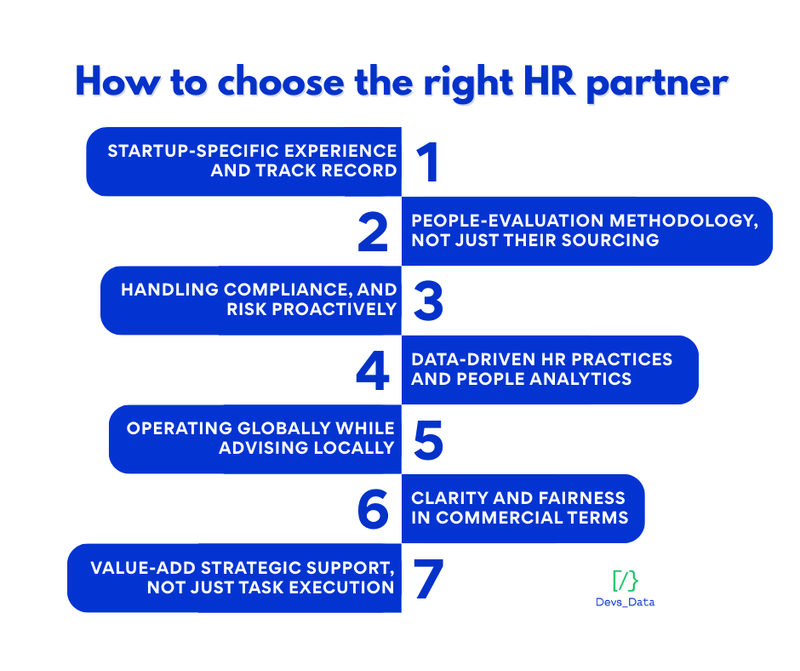
Generic HR experience is not enough. Early-stage environments require fast decision cycles, role ambiguity, and lightweight processes that don’t slow execution. Look for partners who have supported startups at Seed, Series A, and Series B stages and can demonstrate outcomes such as lower early attrition, improved onboarding speed, or successful multi-role hiring. Ask for case studies that reflect challenges similar to yours, rapid hiring sprints, founder-led HR transitions, or cross-border scaling, and don’t hesitate to ask about one engagement that didn’t go as planned and what the partner learned from it.
A strong HR partner should bring structured frameworks for hiring: scorecards, behavioral interview systems, competency models, and clear criteria for cultural alignment. Avoid partners who operate on intuition or unstructured interviews. Ask which frameworks they use (e.g., role scorecards, behavioral anchors, defined pass/fail criteria), how they calibrate interviewers, and how they maintain consistency across roles. Process rigor reduces mis-hires and improves fairness.
Early-stage founders often underestimate employment complexity. Your HR partner should be able to support policy creation, employment contracts, onboarding paperwork, labor-law compliance, and risk mitigation around working hours, leave rules, data privacy, and cross-border employment. Check that they have established templates, legal review processes, and the ability to adapt policies to the jurisdictions you hire in.
Modern HR relies on data, not gut feeling. The partner you choose should be able to track funnel metrics (time-to-hire, offer acceptance rate), retention trends, onboarding ramp time, and engagement signals. They should help you understand what’s working, what’s breaking, and where decisions need to be made. Data transparency shows maturity and helps founders avoid blind spots.
Many startups hire beyond their home country, but global hiring creates compliance, payroll, and cultural challenges. A strong partner understands how to structure international contracts, how to manage time-zone distribution, and how to navigate different labor norms. At the same time, they should offer localized guidance on compensation expectations, market competitiveness, and regional legal considerations. The combination of global reach and local nuance prevents costly mistakes.
Transparent terms build trust. Favor HR partners who offer clear pricing models, defined service scopes, and predictable timelines. If they provide recruitment support, look for success-based fees, guarantee periods, and clarity around candidate ownership. A reputable partner will be explicit about what is included, what is not, and which obligations apply to both sides.
The best HR partners help shape your people strategy, advising on role leveling, organization structure, compensation philosophy, onboarding frameworks, manager training, and long-term HR roadmaps. When a partner flags a poorly defined role, suggests restructuring responsibilities, or helps anticipate scaling challenges, they are enabling healthier growth rather than simply processing tasks.
Selecting the right HR partner goes beyond filling roles or producing documents, it’s about finding an advisor who understands how startups scale and where they break. A strong partner brings structure without slowing speed, helps founders avoid compliance pitfalls, embeds data-driven hiring practices, and provides strategic guidance that strengthens culture and execution. DevsData LLC meets these criteria through a combination of startup-specific experience, competency-based hiring frameworks, compliance-ready documentation, and a success-fee model that aligns incentives with long-term outcomes. For early-stage companies looking for stability, clarity, and momentum at the right time, that combination makes a measurable difference.
Website : www.devsdata.com
Company size: ~60 employees
Founding year: 2016
Headquarters: Brooklyn, NY, and Warsaw, Poland
DevsData LLC has supported startups across the US, Europe, and emerging tech hubs as they shift from informal, founder-led HR to structured people operations. Our scope goes beyond recruitment to cover employer of record (EoR) services, compliance coordination, onboarding design, and ongoing HR consulting tailored to early-stage dynamics. For a Seed-stage company hiring its first employees, that often means building foundational contracts, policies, and payroll structures from scratch. For a Series A team scaling headcount across borders, it means setting up compliant employment models in each target market, whether through direct hire, contractor arrangements, or EoR partnerships. Across both scenarios, the goal stays the same: giving founders a reliable people infrastructure that supports speed without creating operational debt.
Through competency-based interviews, role scorecards, onboarding frameworks, and streamlined documentation, we help founders reduce early attrition, accelerate ramp-up, and build reliable people operations that extend well beyond recruitment into compliance, employee development, and day-to-day HR management. This approach has been especially valuable for distributed and hybrid teams, where unstructured processes can quickly lead to misalignment, uneven workloads, and burnout. Operating under a government-approved recruitment license and a success-fee model with guarantee periods, we ensure accountability and long-term alignment in every engagement.
Do you have recruitment needs?
With 100+ completed projects for 100+ global clients, a vetted network of 95000+ professionals, and consistent 5.0 ratings on Clutch and GoodFirms, we’ve helped startups build stronger cultures, more efficient hiring pipelines, and scalable organizational foundations. From our work with startups, we’ve seen that basic HR structure provides the consistency and alignment young companies need to scale, rather than adding unnecessary complexity.
Talaera, an emerging EdTech company in the United States, needed to scale its engineering capabilities to support rapid product iteration and a growing customer base. The core HR challenge was defining role profiles that captured both coding ability and cross-functional collaboration with Education Specialists. We designed a structured recruitment process with competency-based scorecards, behavioral interviews focused on communication with non-technical teams, and clear evaluation criteria that went beyond technical screening. This gave the hiring team a repeatable framework for assessing candidates consistently.
Key learning: in EdTech startups, recruitment processes should formalize cross-functional collaboration as a core hiring criterion, not treat it as a secondary consideration after technical skills.
Mend.io needed senior algorithmic and Go engineers capable of working on performance-critical components of their security and DevOps pipeline. The main challenge was locating talent with strong experience in distributed systems, dependency graph optimization, and algorithmic reasoning at scale. We structured the recruitment process around competency-based evaluation, defining clear seniority benchmarks and role-specific scorecards before sourcing began. Drawing on our vetted network of 95000+ professionals, we identified candidates with the right mix of systems-level thinking and domain relevance. A multi-step screening process assessed both technical depth and alignment with the team’s working culture. Several senior engineers were successfully placed, reinforcing the company’s capacity to deliver on performance-critical product goals.
Key learning: for specialized engineering roles, a structured HR approach that combines deep candidate sourcing with rigorous competency frameworks produces stronger long-term hires than ad hoc technical screening alone.
PlantingSpace, a Swiss startup building an advanced knowledge representation system, needed Julia Engineers with doctoral-level backgrounds in mathematics and statistics to develop probabilistic reasoning modules and optimize performance-critical code. The main challenge was the extreme scarcity of this profile: professionals combining Julia programming fluency with deep academic credentials in applied mathematics form one of the smallest talent pools in European tech. After months of unsuccessful internal search, PlantingSpace engaged DevsData LLC to redesign the recruitment process from the ground up. We sourced candidates through academic networks, Julia-specific communities, and targeted outreach to research groups across Switzerland and neighboring EU countries. A two-phase evaluation tested both theoretical problem-solving and practical Julia coding under real working conditions, while structured interviews assessed cultural fit with the company’s asynchronous, co-ownership model. From an initial pool of 515 sourced candidates, 42 were shortlisted, 19 interviewed, and three senior hires were placed, all within four weeks, cutting the hiring cycle by more than half compared to earlier attempts.
Key learning: specialized recruitment requires HR processes built around precise role definitions, advanced screening frameworks, and proactive sourcing strategies that go beyond standard job postings to reach candidates in narrow talent pools.
For more information about DevsData LLC, contact us at general@devsdata.com or visit our website at www.devsdata.com.
Not sure if it’s time to bring in structured HR support or partner with an HR expert? Take this quick self-assessment. Answer the questions below and count how many times you say “Yes.”
Mostly “Yes”: your startup will benefit from structured HR support. DevsData LLC helps early-stage teams establish clear hiring processes, compliant documentation, effective onboarding, and scalable people operations, freeing founders to focus on product, customers, and growth.
Mostly “No”: your current HR approach may be adequate for now. As your team grows or expands internationally, consider partnering with an HR expert to avoid compliance risks, strengthen culture, and maintain clarity as responsibilities evolve.
Building a startup is an exercise in speed, focus, and constant adaptation, but none of that is possible without the right people systems in place. HR is not a back-office function for early-stage companies; it is the operational backbone that protects culture, reduces mis-hiring, prevents burnout, and enables teams to scale with clarity and confidence. One poorly defined role, one rushed hire, or one compliance oversight can slow product development, create internal friction, or introduce risks that become increasingly difficult to fix as the company grows.
In today’s environment, shaped by tight labor markets, distributed teams, and rapidly shifting skill requirements, startups cannot rely on ad-hoc processes or founder intuition.
They need structured hiring workflows, clear documentation, thoughtful onboarding, and lightweight people-management routines that support both speed and sustainability. These systems allow founders to stay focused on product, customers, and fundraising rather than getting pulled into repetitive administrative work or firefighting around people issues.
At DevsData LLC, we help founders build those systems from the ground up. Our approach blends structured HR design, data-driven hiring practices, competency-based interviews, and compliance-ready documentation, all tailored to the pace and constraints of early-stage teams. With experience supporting 100+ projects across the US and Europe, a vetted network of 95000+ professionals, and a government-approved recruitment license, we partner with startups to create scalable, resilient HR foundations that make growth smoother, faster, and more predictable.
Learn more at www.devsdata.com or contact general@devsdata.com.
Discover how IT recruitment and staffing can address your talent needs. Explore trending regions
like Poland, Portugal, Mexico, Brazil and more.
 Frequently asked questions (FAQ)
DevsData – your premium technology partner
DevsData is a boutique tech recruitment and software agency. Develop your software project with veteran engineers or scale up an in-house tech team of developers with relevant industry experience.
Free consultation with a software expert
🎧 Schedule a meeting
FEATURED IN
DevsData LLC is truly exceptional – their backend developers are some of the best I’ve ever worked with.”

Nicholas Johnson
Mentor at YC, serial entrepreneur


 Build your project with our veteran developers.
Explore the benefits of technology recruitment and tailor-made software.
Learn how to source skilled and experienced software developers.
Build your project with our veteran developers.
Explore the benefits of technology recruitment and tailor-made software.
Learn how to source skilled and experienced software developers.

Rebecca Botvin

Commercial Director

Tom Potanski
Manager




Categories: Big data, data analytics | Software and technology | IT recruitment blog | IT in Poland | Content hub (blog)













careers@devsdata.com









general@devsdata.com

"I interviewed about a dozen different firms. DevsData LLC is truly exceptional – their backend developers are some of the best I've ever worked with. I've worked with a lot of very well-qualified developers, locally in San Francisco, and remotely, so that is not a compliment I offer lightly. I appreciate their depth of knowledge and their ability to get things done quickly."

Nicholas Johnson
CEO of Orange Charger LLC,
Ex-Tesla Engineer,
Mentor at YCombinator
"DevsData reached out to us, as we've been looking to grow our engineering team in Europe and Poland. Communicating efficiently and professionally, DevsData made a strong impression with their understanding of the recruitment challenges we were facing. They designed a tailored recruitment process for our needs. I was impressed with the technical depth of their approach."

Karim Butt
Co-Founder & CTO at GlossGenius, Inc.
"Out of all the vendors we work with, DevsData clearly stands out. The quality of developers they deliver is beyond what we've received from any other vendor, and they've been able to send profile recommendations very quickly. I'm happy to be their reference for other companies from Israel and talk about their recruitment abilities and what they delivered for us."

Ran Eyal
Senior Manager at
ZIM Integrated
Shipping Services Ltd.
"DevsData demonstrated a strong degree of proactivity, taking time to thoroughly understand the problem and business perspective, and continuously suggesting performance and usability enhancements. Their app exceeded my expectations. I've worked with DevsData on numerous projects over the last 3 years and I'm very happy. Being both responsive and honest in communication."

Jonas Lee
Partner & Executive VP of Verus,
Financial LLC, Investor,
& Serial Entrepreneur
Acknowledgments