Thanks for subscribing.
Your gift is on the way.
 Link copied



Running an eCommerce store today extends well beyond listing products and processing payments. Teams must manage real-time customer inquiries across multiple channels, synchronize inventory and orders across sales platforms, coordinate with fulfillment and logistics partners, and keep pricing, content, and product data continuously up to date. These operational demands compound quickly, creating execution bottlenecks and increasing the risk of delays, errors, and customer dissatisfaction as the business scales. At the same time, workforce dynamics have shifted significantly. Global labor markets remain exceptionally tight: recent research shows that 77% of employers worldwide report difficulty finding workers with the skills they need, the highest level recorded in 17 years. For eCommerce companies, which rely heavily on consistent operational output, this shortage creates pressure to secure reliable support while avoiding lengthy hiring cycles and operational disruptions.
For eCommerce businesses, where customer communication, order accuracy, and operational continuity are crucial, this persistent instability creates real risk. Independent hiring becomes unpredictable, onboarding is frequently interrupted, and mis-hires carry greater operational consequences.
In this environment, virtual assistants have become essential to eCommerce operations, supporting processes such as order tracking, customer inquiry management, product listing updates, and inventory coordination. Their involvement stabilizes daily workflows while allowing internal teams to focus on growth-oriented priorities.
This article will examine the responsibilities of an eCommerce virtual assistant, compare independent hiring with agency-driven recruitment, explain why structured hiring leads to better outcomes, and outline how DevsData LLC helps businesses secure dependable operational talent with reduced risk and faster onboarding.
The operational demands of eCommerce continue to intensify, with stores managing larger product ranges, higher order volumes, and rising expectations for rapid customer support. Together, these factors have made virtual assistants a central component of stable, efficient eCommerce operations.
Global employers continue to struggle with capability-matching: research shows that 20-30% of roles are occupied by employees who lack the required skills, creating bottlenecks in administrative and customer-facing workflows. For eCommerce stores, where accuracy in product updates, inventory tracking, and communication is essential, this mismatch makes independent hiring more time-consuming and uncertain. Recruitment agencies, by contrast, maintain pre-assessed candidate pools and use structured evaluations to ensure that virtual assistants possess the specific competencies needed from day one.
Voluntary turnover remains high across Western labor markets. During the height of the labor-market turmoil, monthly resignations in the US averaged 4.5 million in 2022 and 3.7 million in 2023, and while conditions are stabilizing, resignation levels remain above pre-pandemic norms. Such fluidity poses operational risks for eCommerce businesses, where daily tasks require uninterrupted execution. Agencies reduce these risks by prioritizing candidates with strong retention histories and by providing rapid replacement options when turnover occurs.
Hybrid and remote structures are now deeply embedded in organizational practice: around 90% of companies worldwide have adopted hybrid models, and nearly half of all employees globally work remotely at least part of the time. This shift has significantly expanded the available talent pool for operational roles. For eCommerce businesses, it means that virtual assistants can be integrated seamlessly regardless of geography, but only when communication, responsiveness, and digital fluency are properly assessed. Recruitment agencies specialize in evaluating these remote-work competencies before presenting candidates.
A growing number of organizations report difficulty keeping up with evolving skill requirements. The half-life of technical skills has shortened dramatically, with some becoming half-obsolete in as little as 2.5 years. For eCommerce operations, where tools, platforms, and processes evolve quickly, this creates a need for personnel who can adapt rapidly and maintain accuracy under changing conditions. Agencies address these gaps by administering tool-specific evaluations and practical task tests, ensuring candidates can meet current operational demands.
Workforce well-being continues to deteriorate globally. Studies indicate that around half of workers regularly experience stress or exhaustion, conditions closely linked to inconsistent performance and higher turnover. In eCommerce, where customer experience and daily operational accuracy directly affect revenue, these factors increase the likelihood of errors or sudden disengagement. Recruitment agencies help mitigate this exposure by screening for long-term reliability and placing candidates who demonstrate stable performance histories.
AI-driven automation is reshaping eCommerce support at an accelerating pace, with many routine assistant tasks expected to become fully automated within the coming years. For now, the most immediate operational advantage lies in a Virtual Assistant’s ability to work effectively alongside AI tools, using them to handle repetitive processes while applying human judgment where automation falls short. Recruitment agencies that evaluate candidates on AI-tool fluency position eCommerce businesses to benefit from this transition without sacrificing accuracy during the shift.
In a labor market defined by shifting skills and growing operational demands, virtual assistants have become a structural necessity for eCommerce businesses seeking consistent, day-to-day performance.
A virtual assistant in an eCommerce environment supports the daily operational backbone of an online store. Their work ensures that product information remains accurate, orders move through fulfillment without delays, and customers receive timely assistance. Although specific responsibilities vary depending on the store’s size, tools, and workflows, several core functions are consistent across most eCommerce operations.
Virtual assistants handle routine customer inquiries through email, chat, or platform-integrated messaging systems, often working within omnichannel CX tools such as Zendesk or Gladly. In stores that rely on automated support, they also supervise AI chatbot workflows by reviewing escalations and intervening when human judgment is required. Timely and accurate communication remains essential for maintaining customer satisfaction and preventing negative reviews or escalations.
A core responsibility involves monitoring incoming orders, ensuring they move smoothly through fulfillment, and resolving issues such as stock discrepancies or shipping delays. Virtual assistants may also coordinate with warehouses, dropshipping partners, or suppliers to ensure accuracy throughout the process.
Virtual assistants maintain product catalogs by uploading new products, refining descriptions with SEO and semantic search considerations, adjusting pricing, adding images, and ensuring metadata accuracy. This work improves discoverability within both internal search functions and external search engines while reducing sales loss caused by incorrect information.
By monitoring stock levels and reporting low inventory or inconsistencies, virtual assistants help prevent overselling and fulfillment errors. In stores that rely on predictive analytics, they review demand forecasts and highlight potential shortages before they affect availability. Coordination with internal teams ensures restocking decisions reflect both current data and projected trends.
Virtual assistants streamline internal processes by preparing reports, managing schedules, organizing documentation, and assisting with recurring operational tasks. Their involvement helps reduce workload for internal teams and maintains continuity during high-volume periods.
Virtual assistants often manage day-to-day social media activity, including scheduling posts, monitoring engagement, and preparing product data for paid advertising campaigns. They may also coordinate with CRM systems to align promotional messaging with customer segmentation, maintaining consistency across active channels without requiring a dedicated Marketing Specialist.
On the content side, Virtual Assistants support organic visibility by drafting blog articles, optimizing product descriptions for search, and managing the publishing workflow. Regular content output strengthens search engine rankings over time, and delegating this process to a trained assistant allows internal teams to focus on broader marketing strategy.
Hiring a virtual assistant is not only a matter of identifying day-to-day needs; it is also a strategic decision about how to source operational talent. eCommerce businesses often begin with independent hiring, either through freelance platforms or internal recruitment, but quickly encounter obstacles: lengthy screening processes, limited ability to validate skills, and high turnover risk. These challenges are intensified by broader workforce trends, including elevated employee mobility and persistent skills gaps.
Specialized recruitment agencies take a structured approach that contrasts sharply with the ad-hoc nature of independent hiring. Agencies invest in continuous talent vetting, evaluate candidates through task-based assessments, and maintain updated knowledge of platform-specific requirements relevant to eCommerce operations. As a result, they reduce the uncertainty, inefficiency, and operational exposure associated with sourcing talent independently.
To understand the differences clearly, the table below outlines the key factors that influence the reliability and performance of a virtual assistant hire.
| Category | Independent Hiring | Specialized Recruitment Agencies |
|---|---|---|
| Skill Verification | Relies on CVs, platform ratings, or brief interviews; limited ability to confirm eCommerce-specific capabilities. | Candidates undergo structured skill assessments, task simulations, and communication testing before being shortlisted. |
| Time Investment | Screening, interviewing, and testing fall entirely on the business; hiring often takes weeks. | Agencies handle sourcing and evaluation, delivering a curated shortlist and reducing hiring time dramatically. |
| Candidate Quality Control | Highly variable; dependent on self-reported experience and inconsistent review systems. | Consistent, standardized vetting ensures candidates meet platform, communication, and accuracy requirements. |
| Cost Flexibility | Greater short-term cost control, with no agency fees and the ability to hire selectively based on immediate budget constraints. | Higher initial investment, often including placement fees or retainers tied to agency services. |
| Operational Continuity | Errors or delays are more likely due to mismatches in skills or communication ability. | Candidates are pre-aligned with required workflows, improving accuracy and responsiveness from the start. |
| Scalability | Each new hire requires repeating the full recruitment cycle. | Agencies can scale support quickly through existing vetted talent pools. |
| Compliance and Documentation | Business manages contracts, NDAs, and onboarding alone. | Agencies assist with compliance, documentation, and structured onboarding processes. |
| Direct Management and Autonomy | Full control over hiring decisions, onboarding pace, and day-to-day collaboration without third-party involvement. | Less direct control, as agencies mediate parts of the recruitment and initial candidate management process. |
| Data Privacy and Security | Responsibility for data access controls, confidentiality safeguards, and platform security rests entirely with the business, with limited structured verification of candidate compliance awareness. | Agencies pre-screen candidates for familiarity with confidentiality protocols, NDAs, and secure system handling, reducing exposure to data misuse risks. |
The comparison makes one pattern clear: while independent hiring offers flexibility, it also introduces considerable uncertainty at every stage of the process, from verifying skills to maintaining long-term reliability. Specialized recruitment agencies counter these risks through structured evaluation, predictable candidate quality, and built-in continuity mechanisms. The nature of the Virtual Assistant role itself reinforces this advantage: finding candidates who combine reliability, communication discipline, and platform-specific fluency requires a screening process that general job boards and freelance marketplaces rarely provide. For eCommerce businesses that depend on consistent daily execution, the agency-based approach offers a lower-risk route to placing assistants who meet these combined requirements.
Choosing the right hiring approach helps establish operational stability; structured recruitment delivers the accuracy and continuity that independent sourcing often may not guarantee.
Partnering with a specialized recruitment agency delivers measurable operational and financial advantages for eCommerce businesses. Unlike independent hiring, which often relies on limited screening methods and subjective evaluations, structured recruitment processes generate predictable outcomes that directly influence efficiency, cost management, and business continuity.
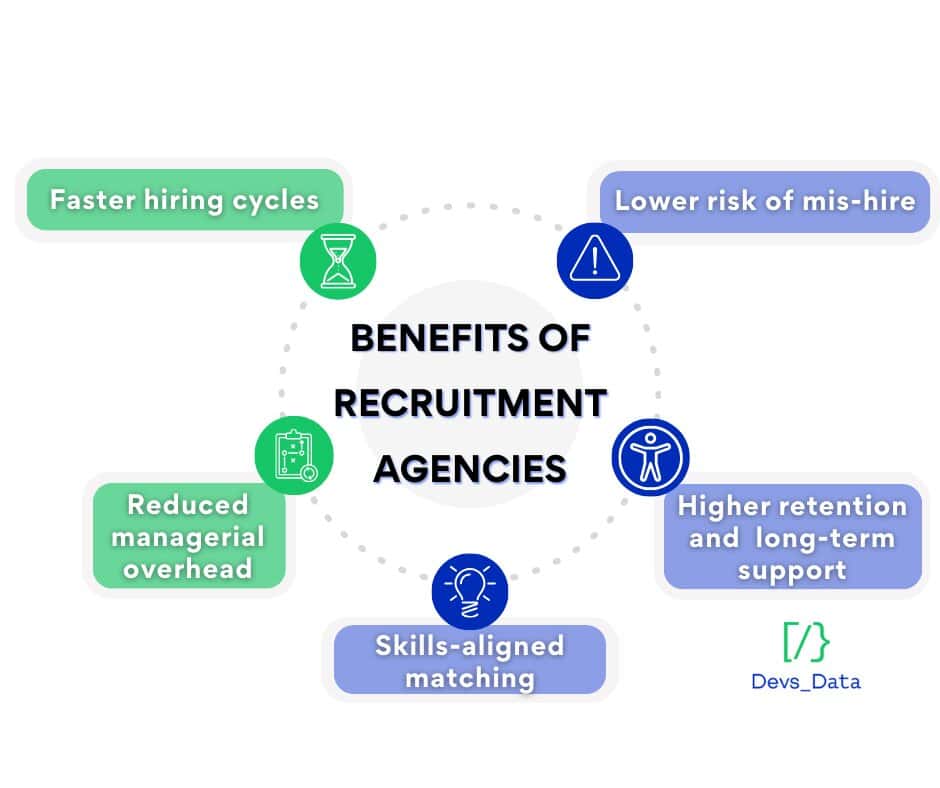
Agencies use predefined assessment frameworks and maintain continuously updated talent pools, enabling businesses to fill virtual assistant roles far more quickly. Studies on structured hiring models show that organizations using systematic evaluation methods reduce time-to-hire by up to 82%. For eCommerce stores, where delays in staffing can result in backlogged customer inquiries or slow order processing, a significantly shorter hiring timeline directly protects revenue and service quality.
Mis-hiring an operational support role is costly: training time is lost, customer satisfaction may decline, and internal teams are forced to compensate for performance gaps. Structured recruitment models have been shown to reduce mis-hire rates by 88%, largely because candidates are tested through real-task simulations and communication assessments before being presented to clients. By minimizing the probability of placing an unsuitable assistant, agencies help businesses avoid avoidable errors, operational disruptions, and the financial burden of restarting the hiring cycle.
Retention is critical in eCommerce, where daily workflows depend on accuracy and continuity. Structured recruitment processes achieve up to 82% improvement in retention, largely due to better role matching and early evaluation of behavioral and communication traits. A more stable virtual assistant presence reduces knowledge loss, eliminates onboarding repetition, and provides consistent customer-facing performance – all of which support long-term operational efficiency.
Agencies assess candidates using task-based evaluations aligned to real eCommerce functions, such as product listing accuracy, order management workflows, and written customer communication. This ensures that new hires begin contributing efficiently from the first week, with fewer errors and less need for corrective oversight. Better alignment between skills and responsibilities translates into measurable gains in order accuracy, response times, and catalog maintenance, improving both customer satisfaction and internal workload distribution.
Independent hiring requires extensive managerial involvement, reviewing applications, conducting interviews, running tests, and supervising early performance. Agencies eliminate most of this workload, freeing internal teams to focus on revenue-generating activities. For lean eCommerce operations, this shift often results in dozens of managerial hours reclaimed per hiring cycle, directly increasing productivity and reducing opportunity cost.
Challenges of collaborating with specialized recruitment agencies for Virtual Assistant hiring
Specialized recruitment agencies provide structural advantages when sourcing eCommerce Virtual Assistants, yet the model carries trade-offs that businesses should weigh against their operational context. Recognizing these limitations ensures that agency partnerships are deployed where they produce the strongest results for daily support roles, rather than applied uniformly to every staffing need.
Placing a Virtual Assistant through an agency typically involves placement fees or success-based compensation that exceed the short-term cost of hiring independently. A total cost of ownership perspective rebalances this comparison. Reduced mis-hire risk, lower turnover disruption, and decreased managerial overhead accumulate over the assistant’s engagement period, often offsetting the initial expenditure. eCommerce businesses evaluating this trade-off should factor in how frequently they expect to replace or retrain assistants under independent hiring conditions.
Independent hiring allows businesses to trial Virtual Assistant candidates quickly, adjust role definitions mid-process, and test short-term support arrangements without contractual commitments. Agency processes favor structured competency evaluation before presenting candidates, which improves placement quality for eCommerce support roles. For stores whose assistant responsibilities are still being defined or where the scope of daily tasks shifts frequently, this thoroughness may limit the speed of initial placement. The trade-off becomes more favorable once the Virtual Assistant role stabilizes and the business requires consistent, long-term performance.
When hiring a Virtual Assistant through an agency, parts of the recruitment workflow are externalized. Screening criteria, assessment design, and shortlisting decisions occur outside the business’s direct oversight. This can reduce visibility into how early-stage candidate filtering aligns with the specific demands of the assistant role. Teams that prefer hands-on involvement in evaluating Virtual Assistant candidates, or that use highly customized screening logic tailored to their eCommerce workflows, may find this delegation restrictive.
Even specialized agencies operate within defined evaluation frameworks. eCommerce stores with proprietary internal tools, unusual communication protocols, or unconventional task structures may require additional calibration before the agency can identify suitable Virtual Assistant candidates. Without precise internal documentation of how the assistant role functions day to day, there is a risk that screening emphasizes general eCommerce competence rather than the specific execution nuances the position demands.
For transactional tasks such as temporary data cleanup or limited seasonal support, the overhead of engaging an agency may outweigh the benefits of structured recruitment. Independent hiring or freelance platforms can provide sufficient Virtual Assistant capability at lower coordination cost when the role is short-lived, operationally simple, and easy to replace if the initial hire underperforms.
Collaborating with a specialized recruitment agency streamlines the process of securing a reliable virtual assistant by combining structured evaluation with deep operational understanding. Instead of navigating fragmented freelance markets or running multi-stage internal hiring cycles, businesses gain access to a workflow designed to reduce uncertainty, improve matching accuracy, and shorten time-to-productivity. The process typically unfolds across several clearly defined stages.
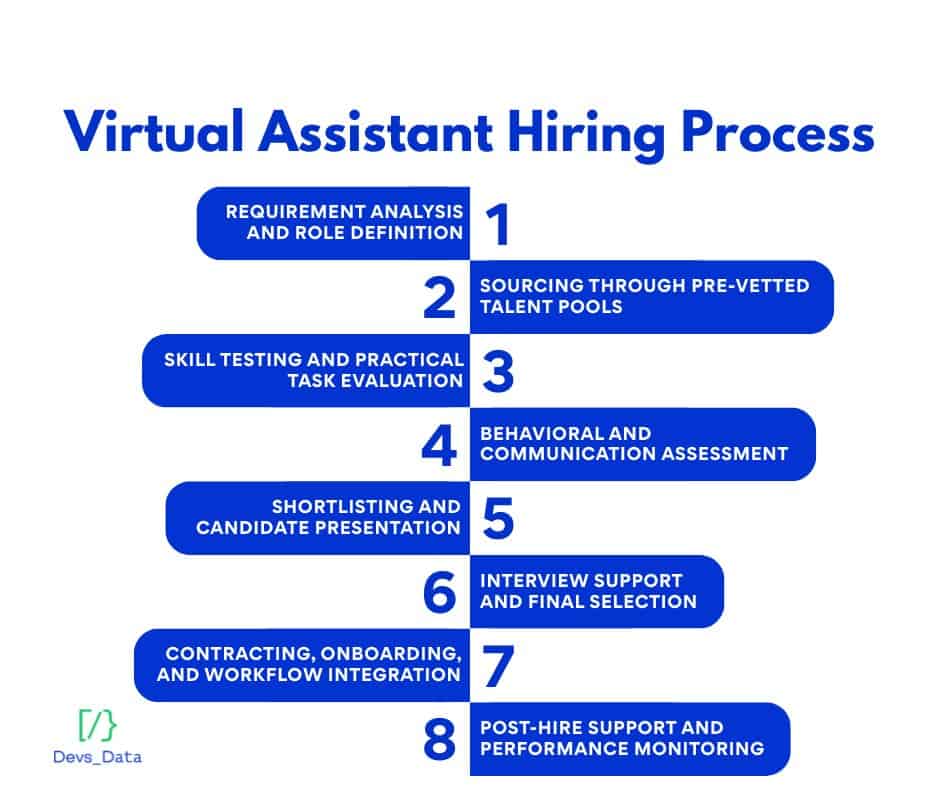
The agency begins by defining what the Virtual Assistant role will involve on a daily basis within the eCommerce operation. This includes quantifying order processing volumes, identifying the channels where customer inquiries arrive, specifying which platforms the assistant must navigate, and determining whether the role requires independent decision-making or follows a supervised workflow. Tech stack compatibility is evaluated to confirm the assistant can operate the store’s existing systems without extended training. Peak-hour coverage expectations and communication cadence requirements round out the assessment.
Translating these operational realities into a structured competency profile for the Virtual Assistant position reduces the mismatches that arise when hiring criteria remain general or assumption-based. The more precisely the assistant’s scope is documented at this stage, the more effectively the agency can screen against it.
Agencies maintain ongoing relationships with a wide network of vetted professionals. Rather than sourcing Virtual Assistant candidates from an open market, they draw from individuals whose skills, communication habits, and reliability have already been observed through previous placements or structured evaluations. For eCommerce roles, this means candidates have already demonstrated competency in areas directly relevant to the assistant’s daily tasks, from order management familiarity to written customer communication quality.
This approach eliminates the screening bottlenecks that slow independent hiring and allows businesses to access Virtual Assistant talent aligned with their workflows rather than starting the search from scratch.
Candidates undergo structured assessments designed around real eCommerce operations that the Virtual Assistant will perform. Written exercises may test product listing accuracy or customer reply quality, while live sandbox testing in staging environments verifies platform-specific competence under controlled conditions. These simulations reflect the actual daily workload the assistant will face, from processing sample orders to navigating CRM and helpdesk interfaces.
Practical tests ensure that Virtual Assistant candidates are selected for demonstrated ability rather than self-reported claims, reducing mis-hire probability and improving the assistant’s operational readiness from day one.
eCommerce Virtual Assistant roles require consistent accuracy, clear written communication, and the ability to follow detailed instructions across distributed workflows. Agencies evaluate communication style, responsiveness under simulated time pressure, adaptability to changing task priorities, and the candidate’s capacity to work autonomously without direct supervision.
This stage identifies Virtual Assistant candidates who can maintain steady performance under daily workload pressures. The assessment carries particular weight for customer-facing tasks in high-volume stores, where communication quality directly affects satisfaction and retention.
Instead of sorting through dozens of applications, the eCommerce business receives a curated shortlist of Virtual Assistant candidates who already match both the technical requirements and the expected communication profile. Each candidate’s assessment results, practical test outcomes, and behavioral evaluation are summarized for the hiring team.
This targeted selection reduces interview fatigue and accelerates decision-making, allowing internal teams to focus on evaluating the best-matched assistants rather than filtering a broad applicant pool.
The business may interview Virtual Assistant candidates directly, or the agency may conduct this step on their behalf. Agencies often assist in structuring interview questions around the assistant’s expected daily tasks, interpreting assessment results within the context of the eCommerce operation, and aligning final recommendations with operational priorities.
This ensures a balanced decision that weighs not only skill but long-term fit between the assistant and the store’s workflow demands.
Once selected, the agency assists with documentation, role clarification, and initial workflow setup for the Virtual Assistant. Expectations regarding communication cadence, tool access sequencing, reporting protocols, and early-stage KPIs are established before the assistant begins active tasks. For businesses sourcing assistants from offshore markets, the agency may also coordinate time zone alignment and cross-cultural communication calibration.
This structured handoff reduces onboarding friction, shortens ramp-up time, and ensures that the Virtual Assistant’s early performance aligns with business objectives.
Agency involvement does not end at placement. Ongoing performance reviews, structured feedback loops, and periodic reassessment of the Virtual Assistant’s output help maintain consistency as the eCommerce operation evolves. Agencies may also incorporate training aligned with new eCommerce tools and platform updates, ensuring the assistant’s skills remain current as operational systems change.
This sustained oversight protects against early-stage disengagement, one of the most common failure points when Virtual Assistants are sourced independently. Continuous monitoring creates a feedback mechanism that strengthens the assistant’s long-term integration into the store’s daily operations.
When planning to hire a virtual assistant, eCommerce businesses should understand how salary expectations vary by location and how partnering with a recruitment agency reshapes the overall cost structure. The salary ranges referenced in this section are based on aggregated data from Glassdoor, providing a consistent benchmark for comparing compensation across markets and outsourcing destinations.
Salary benchmarks
The United States often serves as the default benchmark for full-time virtual assistant compensation in global discussions because of its large remote workforce and transparent reporting:
Using the US market as a reference helps eCommerce businesses quantify the scale of cost differences when considering alternative hiring destinations.
Outsourcing talent to lower-cost countries remains a common strategy, especially for remote eCommerce support roles. Below are typical salary ranges to allow direct comparison with the US benchmark:
These offsets highlight why global outsourcing attracts eCommerce businesses: comparable functional skills at a lower direct salary cost, with trade-offs in time zone management and oversight structures.
Specialized recruitment agencies alter the cost structure in several ways:
Hiring a virtual assistant is not solely a function of base salary rates; businesses must also account for the time and operational overhead required to find, verify, and integrate talent. For example, a US-based assistant’s higher salary might be offset by reduced management complexity if sourced through an agency, whereas outsourcing to lower-cost regions may save on salary but require more internal oversight without structured vetting.
Understanding these trade-offs allows eCommerce companies to match their cost structure to operational priorities, whether that means minimizing upfront spending, reducing uncertainty, or balancing salary costs with quality and continuity expectations.
Before partnering with a recruitment agency, eCommerce businesses benefit from clarifying their operational needs. A well-defined requirement profile allows the agency to match candidates with greater precision, reducing onboarding time and ensuring the assistant integrates seamlessly into existing workflows. The table below outlines the key steps involved in shaping these internal requirements and offers practical guidance for each.
| Step | What to Define | Practical Guidance |
|---|---|---|
| Map daily operational workloads | Identify recurring tasks that require delegation. | Review the past 2-4 weeks of operations to determine which tasks consume the most time and quantify approximate daily or weekly volumes. Where available, process mining tools can be used to extract workflow data directly from operational systems for greater accuracy. |
| Determine required availability | Specify working hours and coverage expectations. | Decide whether the assistant must align with customer time zones, provide peak-hour coverage, or offer partial real-time response capability. Clarify whether you need daily presence, flexible hours, or shift-based availability. |
| Select essential technical skills | Define platform knowledge and tool proficiency. | List the systems your store uses and clarify expected familiarity with access controls, data handling standards, and secure credential management. Distinguish which functions the assistant should operate independently and which remain internally restricted. |
| Establish communication requirements | Specify language proficiency and communication style. | Determine expected response times, tone, and customer-facing standards. Note any additional communication channels (live chat, WhatsApp, social platforms) that require monitoring. |
| Identify internal constraints | Note limitations that may influence matching. | Document internal bottlenecks such as limited onboarding resources, complex workflows, or seasonal fluctuations that require flexible scaling. |
Completing this internal requirements exercise directly strengthens the agency engagement that follows. When a Virtual Assistant’s scope, availability, technical needs, and communication standards are documented before recruitment begins, the agency can source and screen candidates against precise criteria rather than general assumptions. This preparation reduces onboarding friction and improves the likelihood that the assistant integrates smoothly into the store’s daily operations.
Successful collaboration with a Virtual Assistant depends as much on onboarding quality as on hiring precision. The virtual nature of the role removes the informal knowledge transfer that occurs in co-located teams, placing greater weight on written procedures, structured tool access, and defined communication rhythms. eCommerce businesses that source assistants from offshore markets face additional onboarding variables: time zone differences affect real-time collaboration, while cross-cultural communication norms may require explicit alignment during the first weeks. Addressing these dimensions early reduces error rates, accelerates the assistant’s path to independent productivity, and builds the operational consistency that eCommerce workflows demand.
Providing clear instructions for recurring tasks shortens the learning curve for a Virtual Assistant who cannot observe colleagues in a shared office. Product update protocols, refund processing steps, and customer reply templates should be documented in formats the assistant can reference independently. Well-defined SOPs reduce the need for repeated clarifications and ensure task accuracy during peak workloads, a consideration that becomes more important when the assistant operates in a different time zone and cannot request real-time guidance during every shift.
Because Virtual Assistants rely entirely on digital communication, the choice of tools and the expectations around them directly affect service quality. Defined response times, preferred channels, and escalation rules create transparency for both the assistant and the internal team. For offshore assistants, specifying overlap hours when synchronous communication is expected and asynchronous windows when the assistant works independently prevents delays in resolving customer issues. This structure maintains service quality that matches customer expectations for speed and clarity regardless of the assistant’s location.
Access to platforms such as CMS, CRM, helpdesk systems, and fulfillment dashboards should be granted gradually and with clear permission boundaries. Introducing tools step by step allows the Virtual Assistant to understand each system’s context before handling full operational responsibility. The virtual and often offshore nature of the role makes this phased approach particularly valuable: errors made during onboarding are harder to catch remotely and may affect customer-facing processes before they are identified. Structured tool integration reduces these risks and helps ensure compliance with internal data handling standards.
Clear metrics give both the business and the Virtual Assistant a shared understanding of expected performance. Response times, accuracy of product updates, order-processing turnaround, and ticket-resolution speed are common benchmarks for eCommerce assistant roles. Early KPI tracking helps identify areas that require additional clarification or support. For offshore assistants, KPIs also serve as a consistent, objective evaluation framework that compensates for the reduced informal oversight available in remote arrangements.
Short, recurring meetings help identify knowledge gaps before they affect customer experience or daily operations. Regular check-ins also give the Virtual Assistant the opportunity to clarify procedures, raise emerging questions, and align on upcoming tasks. These sessions are especially important during the early weeks of an offshore engagement, where the assistant may need to adapt to the store’s communication style and operational tempo. The patterns established during onboarding carry forward once the assistant transitions to a stable working rhythm.
Once the Virtual Assistant demonstrates reliability in core tasks, additional responsibilities can be introduced incrementally. Supplier coordination, marketing content support, or reporting functions are common areas for expansion in eCommerce operations. A phased approach ensures that quality remains stable as workload grows. For offshore assistants handling an expanding scope, periodic reassessment of time zone coverage and task prioritization prevents bottlenecks that emerge when the role outgrows its original structure.

Website: www.devsdata.com
Company size: ~60 employees
Headquarters: Brooklyn, NY, and Warsaw, Poland
Founded: 2016
DevsData LLC specializes in sourcing virtual assistants and operational support roles for eCommerce businesses, helping companies build reliable workflows through well-matched, pre-vetted talent. With over nine years of experience in the recruitment and consulting market, the company has developed a structured approach to identifying candidates who can support the operational intensity of fast-growing online stores.
The team includes US-based specialists, enabling DevsData LLC to work efficiently across time zones. Over the years, the company has partnered with global corporate clients as well as high-growth startups operating in regions such as the United States, Israel, and Europe. Its track record includes 100+ completed recruitment projects for more than 80 clients.
DevsData LLC maintains a database of 95000 vetted candidates, giving clients access to a wide talent pool without conducting extensive sourcing themselves. The company holds an official, government-approved recruitment license, ensuring compliance with legal and procedural requirements across all hiring stages.
A defining component of DevsData LLC’s methodology is its success-fee model, which allows clients to proceed with recruitment processes without upfront payment. Candidates undergo a rigorous interview process, including a 90-minute problem-solving challenge designed to assess analytical thinking, accuracy, adaptability, and communication clarity. DevsData LLC also provides a guarantee period, offering an added layer of security should replacement ever be needed.

The company holds 5/5 ratings on Clutch and GoodFirms, reflecting strong communication, dependable delivery, and consistent client satisfaction. For eCommerce businesses seeking virtual assistants who can support daily operations with stability and skill, DevsData LLC offers a structured, low-risk, and quality-focused recruitment pathway.
DevsData LLC supported AiDigital LLC, a fast-growing US AdTech company, in hiring two senior marketing leaders to enhance cross-channel campaign efficiency across Europe. AiDigital had previously struggled to identify candidates who could combine strategic decision-making with hands-on execution across complex digital ecosystems. The roles demanded expertise in programmatic advertising, native platforms, media budget allocation, and performance analytics, along with the ability to operate autonomously in a distributed team.

By applying its precision-driven recruitment methodology, DevsData LLC sourced and evaluated senior professionals across Spain, Poland, and Romania. This broad, cross-regional sourcing approach reflects the same international market knowledge DevsData LLC applies when recruiting virtual assistants from global outsourcing destinations, where understanding local talent markets and availability is critical. The search emphasized measurable campaign impact, cross-regional fluency, and strong communication skills.
Through targeted sourcing, ROI-based screening, and close collaboration with AiDigital’s leadership, DevsData LLC delivered candidates who aligned with both the technical requirements and the company’s high-accountability culture. These same screening and collaboration principles underpin DevsData LLC’s approach to virtual assistant recruitment, where reliability, clarity, and adaptability directly affect day-to-day operations.
If you want to reduce hiring risks, improve operational efficiency, and access thoroughly vetted talent, DevsData LLC can support you with a structured, high-precision recruitment process.
Schedule a consultation to discuss your eCommerce staffing needs Reach out at general@devsdata.com or visit our website at www.devsdata.com.
Running an eCommerce store today requires structured, reliable operational support. As daily tasks multiply – from customer communication and product maintenance to order coordination and administrative workflows – many businesses find that internal resources alone are no longer sufficient. Virtual assistants have become an essential extension of modern eCommerce teams: they stabilize operations, maintain accuracy, and ensure that customer-facing processes run without interruption. But the value a VA delivers depends entirely on how they are sourced, evaluated, and integrated into the business. This is where the choice of hiring method becomes critical.
Independent hiring offers flexibility but also exposes businesses to significant risk: inconsistent candidate quality, long screening cycles, limited verification of real skills, and unpredictable turnover. Specialized recruitment agencies, by contrast, operate with structured methods that directly address these challenges. Through skill testing, targeted sourcing, workflow-specific evaluations, and streamlined hiring processes, they reduce operational exposure and improve the reliability of staffing outcomes. The result is not only smoother daily operations but also stronger long-term continuity, better communication standards, and a higher likelihood that the assistant will remain productive over time. For eCommerce stores where precision and responsiveness define customer experience, this difference is substantial.
DevsData LLC exemplifies this structured, high-precision approach. With nearly a decade of experience, a vetted global talent network, and a rigorous, outcome-focused recruitment methodology, the company consistently delivers virtual assistants who integrate seamlessly into eCommerce workflows. Their experience supporting both rapidly scaling startups and established international companies reinforces their ability to adapt to diverse operational needs. For businesses seeking dependable, skilled virtual assistants without the uncertainty of independent hiring, DevsData LLC offers a recruitment partnership grounded in expertise, efficiency, and sustained performance impact.
Any questions or comments? Let me know on Twitter/X.
Discover how IT recruitment and staffing can address your talent needs. Explore trending regions like Poland, Portugal, Mexico, Brazil and more.
DevsData – your premium technology partner
DevsData is a boutique tech recruitment and software agency. Develop your software project with veteran engineers or scale up an in-house tech team of developers with relevant industry experience.
Free consultation with a software expert
🎧 Schedule a meeting
FEATURED IN


DevsData LLC is truly exceptional – their backend developers are some of the best I’ve ever worked with.”

Nicholas Johnson
Mentor at YC, serial entrepreneur


 Build your project with our veteran developers.
Explore the benefits of technology recruitment and tailor-made software.
Learn how to source skilled and experienced software developers.
Build your project with our veteran developers.
Explore the benefits of technology recruitment and tailor-made software.
Learn how to source skilled and experienced software developers.

Rebecca Botvin

Commercial Director

Tom Potanski
Manager




Categories: Big data, data analytics | Software and technology | IT recruitment blog | IT in Poland | Content hub (blog)
Email copied
And many other regional partners across Latin and North America, as well as Central and Eastern Europe. Let's talk.
















careers@devsdata.com









general@devsdata.com

"I interviewed about a dozen different firms. DevsData LLC is truly exceptional – their backend developers are some of the best I've ever worked with. I've worked with a lot of very well-qualified developers, locally in San Francisco, and remotely, so that is not a compliment I offer lightly. I appreciate their depth of knowledge and their ability to get things done quickly."

Nicholas Johnson
CEO of Orange Charger LLC,
Ex-Tesla Engineer,
Mentor at YCombinator
"DevsData reached out to us, as we've been looking to grow our engineering team in Europe and Poland. Communicating efficiently and professionally, DevsData made a strong impression with their understanding of the recruitment challenges we were facing. They designed a tailored recruitment process for our needs. I was impressed with the technical depth of their approach."

Karim Butt
Co-Founder & CTO at GlossGenius, Inc.
"Out of all the vendors we work with, DevsData clearly stands out. The quality of developers they deliver is beyond what we've received from any other vendor, and they've been able to send profile recommendations very quickly. I'm happy to be their reference for other companies from Israel and talk about their recruitment abilities and what they delivered for us."

Ran Eyal
Senior Manager at
ZIM Integrated
Shipping Services Ltd.
"DevsData demonstrated a strong degree of proactivity, taking time to thoroughly understand the problem and business perspective, and continuously suggesting performance and usability enhancements. Their app exceeded my expectations. I've worked with DevsData on numerous projects over the last 3 years and I'm very happy. Being both responsive and honest in communication."

Jonas Lee
Partner & Executive VP of Verus,
Financial LLC, Investor,
& Serial Entrepreneur
Acknowledgments