Thanks for subscribing.
Your gift is on the way.



Who sits on the investment committee shapes which deals get funded, how LPs evaluate the next fundraise, and whether portfolio companies receive the operational support that drives markups. Executive leadership inside venture capital firms carries a direct line to fund-level outcomes that few other industries replicate at such concentration. Unlike earlier boom years when fund performance was buoyed by broad market gains, 2025 sharpened the role of strategic leadership as capital concentrated in a narrow set of high-conviction opportunities. US VC deal value reached $339.4 billion in 2025, close to the 2021 record of $358.2 billion, yet half of that total went into just 0.05% of completed deals, according to Fortune’s reporting on the PitchBook-NVCA 2025 data. Massive rounds drove the figure, including OpenAI’s $40 billion raise. Fewer bets absorbing larger checks raised the bar for every investment committee decision and the leaders making them.
The scale of that concentration is global. The OECD found that AI firms captured 61% of worldwide venture capital in 2025, with AI companies accounting for $258.7 billion of the $427.1 billion total, more than doubling AI’s share since 2022, when it stood at 30%. US-based firms attracted roughly 75%, or $194 billion, of global AI VC deal value, confirming that leadership decisions inside US funds shape outcomes well beyond any single portfolio.
These forces have elevated the role of executive search beyond traditional hiring. Venture capital firms today must secure leaders capable of guiding investment strategy, building differentiated LP confidence, and navigating an increasingly selective funding climate. Executive recruiters operating inside this ecosystem add a layer generalist firms lack: mapping leadership across competing funds, running backchannel references through LP and founder networks, and screening for governance sensitivity before a candidate ever reaches the investment committee.
Venture capital hiring is unlike corporate hiring. It is rarely reactive, almost never public, and frequently tied to long-term fund strategy rather than immediate operational gaps. When a VC firm brings in a new Partner, Investment Director, or Operating Partner, the hire goes beyond filling a seat. That single decision can redirect which sectors the fund pursues, how LPs perceive the next fundraise, and what caliber of founders choose to take the firm’s capital.
Senior VC talent does not sit on job boards. High-performing Partners, Principals, and Operating Leaders are typically embedded within funds, portfolio companies, or institutional networks. Many are not actively looking. The real market at this level is relationship-driven and discreet.
Specialized executive recruiters operate inside this “quiet market.” They maintain trusted relationships across funds, founders, institutional LP circles, and senior operators. Without this network density, outreach at the Partner level often fails before it begins.
Partner-level searches are often confidential for strategic reasons. A firm may be expanding into a new sector, replacing a senior figure, or preparing for a new fundraising round. Premature market signaling can affect LP confidence or competitive positioning.
Executive search firms experienced in venture capital operate with discretion. Outreach is calibrated. Conversations are private. Processes are structured to protect both the hiring fund and potential candidates.
The venture ecosystem is increasingly global. Funds compete across geographies for differentiated deal flow and sector expertise. Recruiting an executive with cross-border investment experience, emerging market insight, or AI-focused portfolio leadership requires access beyond a single region.
Specialized recruiters bring international reach and cross-market intelligence. They understand where investment talent is emerging, which sectors are producing strong operators transitioning into VC, and how compensation expectations shift across regions.
Many venture firms are navigating generational transitions. Founding partners who built funds over decades are preparing for succession. LPs increasingly scrutinize governance structure and long-term continuity when committing capital.
Succession exposes a gap funds struggle to close from inside. The candidates who could inherit a founding partner’s relationships rarely sit within the firm, and the few who do are visible to every competing fund watching for signs of transition. Recruiters reach that layer on a fund’s behalf, mapping next-generation talent across rival partnerships and portfolio companies, running discreet outreach that never signals the firm is preparing for change, and screening for whether a candidate can hold LP and founder relationships and fit partnership culture rather than only point to past returns.
Do you have IT recruitment needs?
Venture capital firms are structured around a small group of senior decision-makers whose influence compounds over time. Unlike large corporations with layered hierarchies, VC partnerships are compact, and each executive plays a direct role in capital allocation, portfolio construction, and long-term fund positioning.
Below is a structured overview of the most critical leadership roles inside venture capital firms and the strategic impact each carries.
| Role | Core responsibility | Strategic impact on the fund |
|---|---|---|
| Managing Partner / General Partner | Sets fund thesis, leads LP fundraising, holds Investment Committee (IC) voting authority, signs term sheets | Drives LP re-up confidence and long-term capital allocation direction |
| Investment Director / Principal | Originates deals, leads due diligence, presents Investment Committee (IC) memos, takes board seats in portfolio companies | Shapes portfolio quality and signals bench depth to LPs |
| Operating Partner | Embeds with portfolio companies on go-to-market (GTM), hiring, and scaling. Reports value creation progress to the Investment Committee (IC) | Compresses time from funding to traction, influences founder preference during term sheet selection |
| Venture Partner / Senior Advisor | Sources sector-specific deal flow, conducts technical diligence for the Investment Committee (IC), opens LP and co-investor introductions | Extends fund reach into verticals the core team does not cover |
| Chief Financial Officer | Manages capital calls, distributions, quarterly LP reporting, schedule K-1 tax form preparation, and Limited Partnership Agreement (LPA) compliance | Ensures institutional-grade governance that large LPs and fund-of-funds require before committing |
Each of these roles carries influence far beyond its formal title. In venture capital, leadership decisions are directly tied to fund performance, reputation, and future fundraising capability. The right Managing Partner can reposition a fund for a decade.
A strong Investment Director can materially improve portfolio outcomes. An experienced Operating Partner can become the reason founders choose one investor over another.
Understanding the distinct function and strategic weight of each leadership position is essential when conducting an executive search in the venture capital ecosystem.
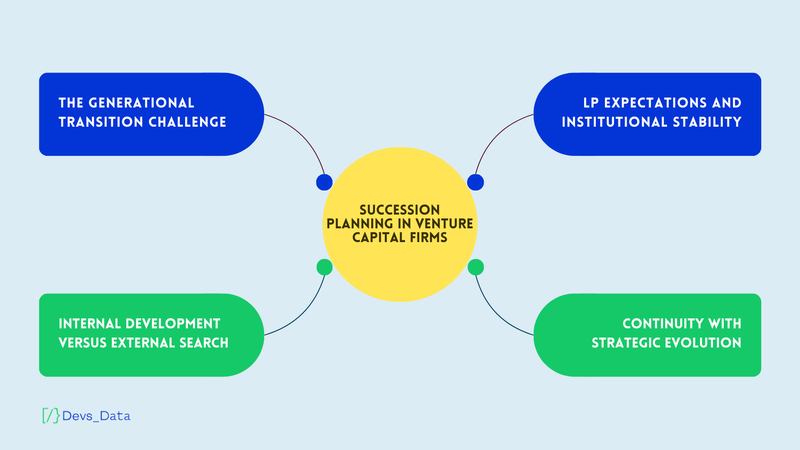
Venture capital firms are often defined by their founding partners. Their networks, investment judgment, and long-standing LP relationships form the backbone of the fund’s reputation. Over time, however, every firm faces the same strategic question: who leads the next chapter? It is a structural decision that directly affects fundraising capacity, investment continuity, and long-term credibility.
Founding partners who launched firms during earlier innovation cycles are reducing involvement or preparing to step back. Unlike corporations with layered leadership hierarchies, venture capital firms typically operate with small, tightly aligned partnerships. Replacing or transitioning a senior partner alters governance dynamics, investment authority, and internal balance.
When leadership transition is not clearly structured, uncertainty can emerge both internally and externally. Investment committees may lose cohesion. Decision timelines may shift. LPs may question long-term stability.
Limited partners increasingly evaluate succession clarity before committing capital. Track record remains important, but institutional resilience has become equally critical. Investors seek confidence in how decision-making authority will evolve and whether the next generation of leadership can sustain or strengthen performance.
Funds with clearly articulated succession frameworks signal maturity and stability. Those without them may face longer fundraising cycles or deeper scrutiny during due diligence.
Many venture firms prepare for transition by gradually expanding the influence of Investment Directors and Principals. Future leaders are introduced to LP conversations, gain greater investment committee responsibility, and assume more visible portfolio oversight.
However, succession is not always purely internal. As markets evolve, funds may require new sector expertise, cross-border investment experience, or access to emerging founder ecosystems. In such cases, external executive search becomes a strategic lever for renewal rather than replacement.
Effective succession balances continuity and adaptation. Preserving core values, partnership culture, and investment philosophy is essential. At the same time, venture markets evolve rapidly. New technologies emerge. Capital flows shift. Geographic priorities change.
Succession sits in this article because a fund’s leadership transition and its hiring needs converge most sharply here. The handover decides fundraising capacity, investment continuity, and the credibility LPs weigh before they re-up, yet the right successor often sits outside the firm.
Executive recruitment supports the fund at that point: a specialized recruiter maps next-generation leaders across rival partnerships, approaches them without signaling a transition is underway, and screens for what a resume cannot show, whether a candidate can carry LP and founder relationships and hold partnership culture through the handover, so the transition strengthens institutional stability rather than introducing the risk LPs scrutinize.
Do you have IT recruitment needs?
VC executive hiring is happening in a market where capital is more selective, LP scrutiny is sharper, and reputational risk travels faster than ever. That combination creates a set of challenges that generalist recruitment approaches rarely handle well. The four challenges below show where standard hiring breaks down and how our process addresses each one.
When deal activity and exits slow, every leadership hire carries more weight. Fewer high-quality opportunities means investment committees become more selective, and the bar for decision-making talent rises. Reuters reported that global VC investment in Q1 2024 fell to $75.9 billion, the lowest since Q2 2019, with 10222 deals, a near four-year low. The same report cites PitchBook data showing the value of exit deals at a six-year low of $234.3 billion.
DevsData LLC solution
DevsData LLC runs executive search built for this environment. Screening covers Partner and Investment Director roles alongside Operating Partner mandates, with candidates measured against the conditions a fund faces now rather than against a resume alone. That means weighing how someone allocated capital through a slower cycle, not only how they performed when exits came easily.
VC firms do not hire executives in isolation. Leadership decisions can affect fundraising narratives, LP confidence, and governance perception. In the 2024 LP Survey on Private Capital (Edelman Smithfield), 46% of LPs cited “good reputation in the market” as more important than returns, and 45% cited “healthy corporate culture” and “positive public perception of the CEO” as more important than returns.
DevsData LLC solution
We assess leadership hires through an LP lens. That means reputation screening, communication profile review, and governance alignment checks, so the final shortlist supports fundraising credibility, not just internal capability.
At senior levels, VC hiring is often a governance signal. LPs interpret leadership changes as indicators of stability or fragility, especially during transitions. The same 2024 LP survey found that 50% of Middle Eastern respondents were most likely not to invest in a fund due to poor evidence of succession planning.
DevsData LLC solution
We run a succession-aware executive search. For Partner and senior roles, we check whether a candidate can take over existing LP and founder relationships rather than start from zero, reference how they handled authority and disagreement inside a previous partnership, and confirm with the hiring fund where the new leader sits in the investment committee and decision rights before an offer goes out. The aim is a hire LPs read as a sign of stability during the transition, not a sign of fragility.
For VC executives, public behavior and digital footprint can influence LP decision-making. The 2024 LP survey reports that 98% of respondents say a private capital firm’s social media content is important when deciding to invest, and 98% say the social media profiles of key personnel are important. It also reports 85% have decided not to allocate to a GP because of content they have seen from personnel on social media.
DevsData LLC solution
We incorporate structured reputational diligence into executive search. That includes narrative alignment, risk scanning, and discreet referencing, so leadership hires strengthen trust with LPs and founders instead of creating avoidable exposure.
Website: www.devsdata.com
Company size: ~60 employees
Founding year: 2016
Headquarters: Brooklyn, NY, and Warsaw, Poland
At DevsData LLC, we support venture capital firms across the US, Europe, and Israel in securing high-impact executive talent at Partner, Investment Director, and Operating Partner levels. Our executive search process is tailored specifically to the venture ecosystem, assessing investment judgment, sector conviction, LP-facing credibility, board-level maturity, and long-term partnership fit. With a proprietary database of 95000+ vetted professionals worldwide and an official, government-approved recruitment license, we operate with full compliance, discretion, and disciplined search standards. Our engagement terms reflect this discipline. We work on a success-fee basis, back every placement with a guarantee period, and maintain a selective 6% candidate acceptance rate that keeps each shortlist tightly aligned with what the fund actually needs.
Our experience shows that senior leadership in venture capital cannot be evaluated through resumes alone. Strong VC executives must demonstrate pattern recognition across cycles, access to differentiated deal flow, institutional fundraising capability, and the ability to operate within a high-trust partnership model. We prioritize strategic alignment, governance awareness, and long-term fund positioning over surface-level track records.
Across 100+ satisfied clients and 100+ senior-level recruitment engagements, we have helped investment firms avoid misaligned Partner hires, succession gaps, and reputational risk. With consistent 5.0 ratings on Clutch and GoodFirms, our focus remains on discreet, high-caliber executive placements that strengthen institutional stability and support sustainable fund performance.
Elsewhen Ltd, a London-based digital consulting firm, partnered with DevsData LLC to strengthen senior engineering and support capabilities across Poland and Eastern Europe. The engagement required discretion, cross-border sourcing precision, and strong stakeholder-facing maturity, similar to executive-level searches.
Our vetting focused on communication competence, leadership readiness, and long-term strategic fit beyond technical skill.
Key learning: high-impact recruitment depends on evaluating long-term alignment and stakeholder maturity, not just functional expertise.
AiDigital LLC, a US-based AdTech agency, engaged DevsData LLC to recruit senior marketing leaders capable of scaling performance-driven operations across European markets. The challenge required candidates who combined measurable results with executive-level strategic thinking.
We assessed data-driven decision-making, scalability mindset, and leadership presence.
Key learning: executive recruitment must validate business judgment and growth capability, not just operational track records.
CVT Services partnered with DevsData LLC to fill senior engineering and administrative leadership roles during a period of expansion. The engagement required balancing technical excellence with operational reliability.
Our evaluation emphasized ownership mentality, governance awareness, and organizational maturity.
Key learning: strong leadership structures rely on both visible executives and disciplined operational foundations, a principle equally relevant in venture capital firms.
Across these engagements, one consistent insight stands out: successful senior recruitment requires assessing judgment, long-term thinking, and institutional credibility rather than relying solely on impressive resumes.
Do you have IT recruitment needs?
Hiring senior leadership in venture capital is not a transactional process. It is a strategic decision that directly influences fund performance, LP confidence, governance stability, and long-term competitive positioning. In a market defined by capital selectivity, slower exits, and heightened scrutiny, executive appointments carry compounded impact. A single Partner or Investment Director can reshape investment thesis, expand or limit deal flow, and influence fundraising outcomes for years.
As venture capital firms navigate generational transitions, global competition, and reputational transparency, disciplined executive search becomes a structural advantage.
Leadership evaluation must extend beyond track record to include judgment across cycles, partnership chemistry, succession compatibility, and public credibility.
At DevsData LLC, we support venture capital firms through structured, discreet, and ecosystem-specific executive search. Our process prioritizes long-term alignment, governance awareness, and investment maturity. With over 100 senior-level recruitment engagements, a proprietary database of 95000+ vetted professionals, and consistent 5.0 ratings on Clutch and GoodFirms, we help funds secure leaders who strengthen institutional stability rather than introduce strategic risk.
Learn more at www.devsdata.com or contact general@devsdata.com.
Discover how IT recruitment and staffing can address your talent needs. Explore trending regions like Poland, Portugal, Mexico, Brazil and more.
 Frequently asked questions (FAQ)
DevsData – your premium technology partner
DevsData is a boutique tech recruitment and software agency. Develop your software project with veteran engineers or scale up an in-house tech team of developers with relevant industry experience.
Free consultation with a software expert
🎧 Schedule a meeting
FEATURED IN

DevsData LLC is truly exceptional – their backend developers are some of the best I’ve ever worked with.”

Nicholas Johnson
Mentor at YC, serial entrepreneur


 Build your project with our veteran developers.
Explore the benefits of technology recruitment and tailor-made software.
Learn how to source skilled and experienced software developers.
Build your project with our veteran developers.
Explore the benefits of technology recruitment and tailor-made software.
Learn how to source skilled and experienced software developers.

Rebecca Botvin

Commercial Director

Tom Potanski
Manager




Categories: Big data, data analytics | Software and technology | IT recruitment blog | IT in Poland | Content hub (blog)















careers@devsdata.com









general@devsdata.com

"I interviewed about a dozen different firms. DevsData LLC is truly exceptional – their backend developers are some of the best I've ever worked with. I've worked with a lot of very well-qualified developers, locally in San Francisco, and remotely, so that is not a compliment I offer lightly. I appreciate their depth of knowledge and their ability to get things done quickly."

Nicholas Johnson
CEO of Orange Charger LLC,
Ex-Tesla Engineer,
Mentor at YCombinator
"DevsData reached out to us, as we've been looking to grow our engineering team in Europe and Poland. Communicating efficiently and professionally, DevsData made a strong impression with their understanding of the recruitment challenges we were facing. They designed a tailored recruitment process for our needs. I was impressed with the technical depth of their approach."

Karim Butt
Co-Founder & CTO at GlossGenius, Inc.
"Out of all the vendors we work with, DevsData clearly stands out. The quality of developers they deliver is beyond what we've received from any other vendor, and they've been able to send profile recommendations very quickly. I'm happy to be their reference for other companies from Israel and talk about their recruitment abilities and what they delivered for us."

Ran Eyal
Senior Manager at
ZIM Integrated
Shipping Services Ltd.
"DevsData demonstrated a strong degree of proactivity, taking time to thoroughly understand the problem and business perspective, and continuously suggesting performance and usability enhancements. Their app exceeded my expectations. I've worked with DevsData on numerous projects over the last 3 years and I'm very happy. Being both responsive and honest in communication."

Jonas Lee
Partner & Executive VP of Verus,
Financial LLC, Investor,
& Serial Entrepreneur
Acknowledgments