Thanks for subscribing.
Your gift is on the way.
 Link copied



The tech industry may have cooled after the 2023-2024 correction, but demand for skilled engineers hasn’t. As companies recalibrate from the pandemic hiring boom, layoffs made headlines – but they’ve masked a deeper challenge: a persistent shortage of qualified talent in cybersecurity, cloud, and AI.
According to the US Bureau of Labor Statistics, employment for software developers, QA analysts, and testers is still projected to grow by 15% between 2024 and 2034, adding over 400000 new roles to a workforce that already exceeds 1.3 million professionals. Despite budget constraints, a 2024 Gartner survey found that 79% of Chief Information Officers plan to expand their IT teams this year. Demand for top specialists outpaces supply, pushing companies to rely on specialized recruiters to find hard-to-reach talent.
Technology drives business growth, but finding and securing the right talent has become one of the biggest operational bottlenecks. Artificial intelligence has intensified this pressure. Organizations rushing to integrate AI capabilities need engineers who understand machine learning pipelines, model deployment, and responsible AI practices – skills that remain scarce even as demand surges. Despite thousands of open tech roles, the pool of specialists with proven, up-to-date expertise is shrinking. According to ManpowerGroup’s 2025 Talent Shortage Report, 74% of employers say they struggle to fill tech positions due to skill gaps and competition from global companies offering remote roles.
A Software & IT Recruitment Agency goes beyond matching CVs to job descriptions. Its role is to identify, vet, and secure technology professionals across permanent, contract, and project-based roles. Unlike generalist firms, specialized agencies understand the nuances of technology, such as the differences between a React developer and an Angular specialist.
“Despite headline layoffs, demand for software and IT professionals has stayed resilient, with hundreds of thousands of openings every year.” – US Bureau of Labor Statistics, Occupational Outlook
Role-specific assessments simulate real-world challenges, while recruiters fluent in technical language can engage engineering leaders as peers.
Beyond candidate evaluation, agencies also act as strategic advisors. They provide data-driven guidance on salary bands, availability trends, and emerging technologies, helping companies refine role definitions and avoid costly mis-hires. In short, the best IT recruitment agencies enable organizations to meet deadlines, scale effectively, and stay competitive in fast-changing markets.
Routine roles such as traditional computer programmers are projected to decline by around six percent over the coming decade, largely because many tasks once performed manually are now automated through low-code platforms, cloud services, and AI-assisted tools. Traditional programmers often focus on translating specifications into code within established systems. Software Developers, by contrast, architect solutions from the ground up, making decisions about system design, technology stack, and scalability. Demand for Software Developers, Cybersecurity Specialists, and AI Engineers is accelerating. These positions require creativity, system design, and domain knowledge that cannot easily be automated.
The pandemic intensified these shifts. Remote work, cloud adoption, and eCommerce created an urgent need for engineers who could build scalable, distributed systems. Even after the 2023-2024 market correction and high-profile layoffs, the core demand did not disappear – it merely shifted toward roles tied to resilience and innovation, such as cloud engineering, security, and applied AI.
In the United States, more than 125000 active job postings in May 2025 mentioned AI skills, reflecting how deeply artificial intelligence is reshaping the market. In Europe, the picture is equally complex. McKinsey notes that the “tech talent gap”, the shortfall between open technology roles and the available qualified professionals, shows no signs of closing. In fact, their 2023 report estimated that Europe could face a shortage of up to 3.9 million technology professionals by 2027 if current trends persist, with shortages most acute in software development, data, and cybersecurity.
Geography further complicates hiring. Labor availability and salary expectations vary widely across regions. In North America and Western Europe, competition for senior engineers drives salaries into six-figure ranges, while in Central and Eastern Europe, equally skilled professionals often earn 30-50% less. In Latin America and parts of Asia, the cost advantage can be even greater, though the availability of senior talent may be uneven. This global imbalance is why companies increasingly turn to nearshore and offshore recruitment models – to combine cost efficiency with access to hard-to-find skills.
The takeaway is clear: permanent roles still form the backbone of engineering teams, but contractors and nearshore units provide the flexibility to meet deadlines and scale projects quickly. Agencies that can operate across these models and geographies are best positioned to deliver the talent and speed companies need.
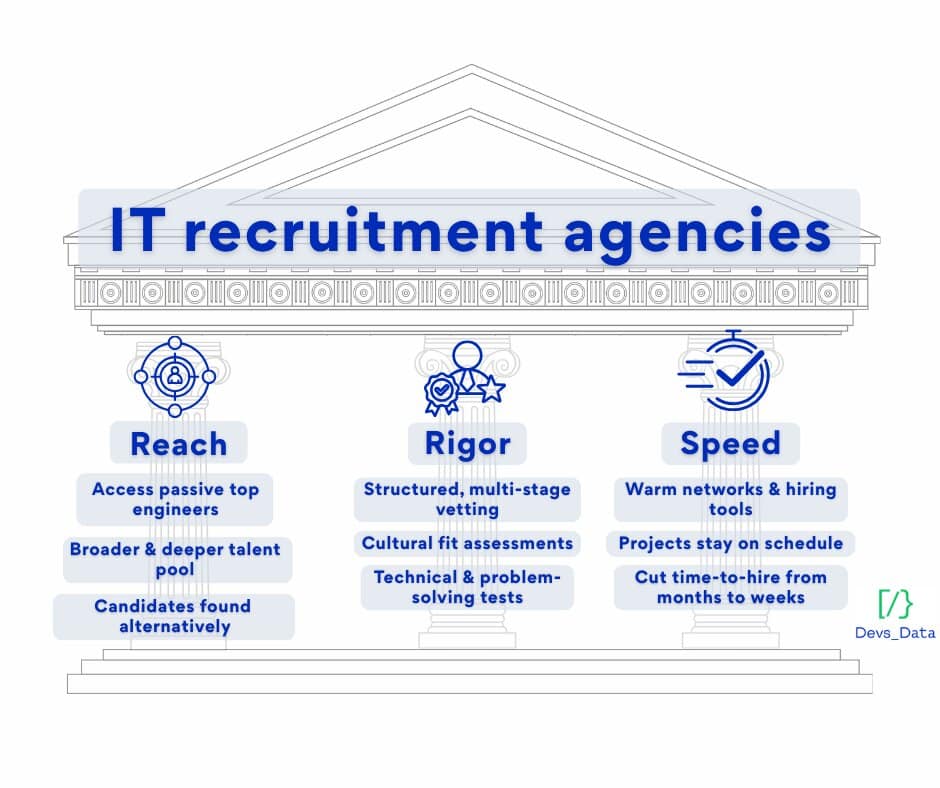
Partnering with a specialized IT recruitment agency is about achieving results that internal teams often cannot replicate under pressure. In-house recruiters may manage routine hiring, but when timelines are tight, technologies are niche, or roles are business-critical, agencies deliver three decisive advantages.
“In competitive markets, the right recruitment partner can cut time-to-hire from months to weeks without sacrificing quality.” – Gartner CIO Talent Planning Survey (2024)
Agencies access a broader and deeper talent pool, including passive candidates – high-performing engineers who are not actively applying but are open to the right opportunity. These professionals rarely surface through standard job ads, yet often make the difference in mission-critical projects. For leadership positions such as VP of Engineering or Chief Technology Officer, agencies tap executive networks that internal teams simply do not have. The same applies to highly specialized roles: finding a Rust expert with blockchain experience or a Machine Learning Engineer who has shipped production models at scale requires connections that extend far beyond LinkedIn searches.
The best IT recruitment agencies apply a structured, multi-stage vetting process. Technical interviews, problem-solving challenges, and cultural fit assessments significantly reduce the risk of costly mis-hires and ensure candidates can deliver in real-world environments. Senior and leadership candidates face additional evaluation layers: strategic thinking exercises, stakeholder management scenarios, and past team-building outcomes. This rigor becomes essential when hiring a Director of Security or a Principal Architect, where a bad hire can derail entire initiatives.
Because agencies maintain warm networks and deploy purpose-built tools, they can compress hiring cycles from months to weeks, sometimes even days, without sacrificing quality. For companies, this means projects continue on schedule while competitors are still in the search process. Speed matters even more for leadership hires, where prolonged vacancies create organizational drift and stalled roadmaps.
These advantages make agencies more than transactional suppliers. For fast-scaling startups, enterprises in transformation, software houses managing multiple client projects, or IT companies entering new markets, the right recruitment partner serves as a strategic ally, ensuring teams are built quickly, effectively, and with long-term success in mind. Software houses, in particular, face dual pressure: they must staff projects rapidly to meet client deadlines while maintaining bench strength for future contracts. Agencies help them scale teams up or down without the overhead of permanent recruiting infrastructure. Once the decision to work with an agency is made, the next step is choosing the right type of partner.
Here, the distinction between boutique and large agencies becomes important. Not all IT recruitment partners operate the same way. Large, multinational agencies often bring scale and broad reach, but they can be slower to adapt processes or tailor searches to a client’s unique context. Boutique agencies, by contrast, specialize deeply in a specific domain rather than covering all industries. A boutique firm focused exclusively on software and IT recruitment builds sector expertise that generalist agencies cannot match. They invest more in understanding each role, run rigorous vetting processes tailored to technical requirements, and provide closer collaboration with hiring managers who speak the same technical language. This often results in higher-quality shortlists and faster feedback loops – critical advantages when building specialized teams or hiring for niche technologies. For many companies, especially startups and mid-sized enterprises, the boutique model translates into more responsive service and stronger alignment with business goals.
Another factor to weigh is pricing structure. Traditional recruitment firms often charge 15-25% of a new hire’s annual salary, which can climb higher for hard-to-fill roles. Some providers, especially boutique agencies, offer alternative models such as flat-fee recruitment or success-based pricing, where clients pay only when a hire is made. These approaches bring more predictability and transparency, and in some cases, significant cost savings compared with percentage-based models. Understanding these options helps organizations choose a partner that not only delivers talent but also aligns with their budget strategy.
Do you have IT recruitment needs?
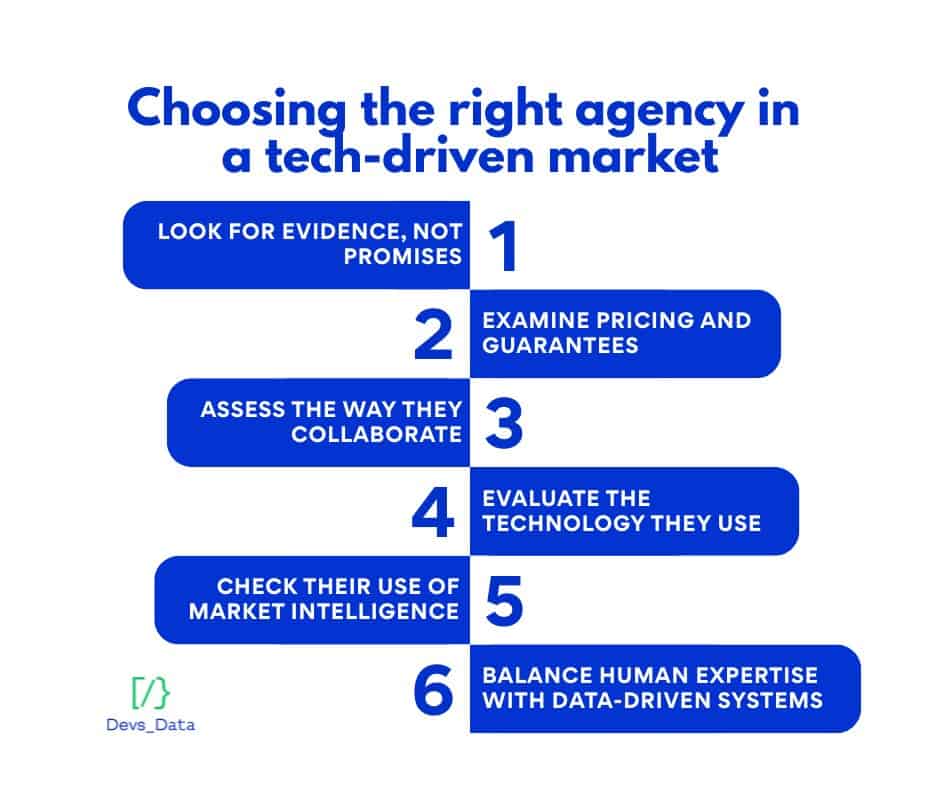
Beyond service style, pricing structures also vary significantly and can influence which partner is the best fit. With dozens of IT recruitment agencies competing for attention, the real challenge is not finding a partner but selecting the right one. A structured approach helps companies separate marketing claims from genuine capability.
The strongest agencies back up their claims with recent wins in your sector and geography. They can demonstrate results under tight deadlines and provide references from clients with similar hiring challenges.
Transparent models, often success-based, ensure you only pay when a hire is secured. A solid guarantee period shows the agency is confident in the quality of its candidates.
At DevsData LLC, only about six percent of candidates pass our multi-stage vetting process. This ensures clients meet rigorously evaluated, top-tier engineers rather than sifting through unqualified resumes.
The best partners don’t behave like transactional vendors. They embed themselves as collaborators with your team: sharing interview notes openly, adapting quickly to your feedback, and advising on overall talent strategy. A strong agency will help you refine role definitions, set realistic salary bands, and design interview loops that measure the skills that matter.
Modern recruitment is powered by sophisticated tools. Applicant Tracking Systems (ATS) keep candidates organized, Candidate Relationship Management (CRM) platforms maintain long-term networks, and assessment software ensures consistent evaluation of coding, architecture, and problem-solving skills.
Leading agencies rely on real-time data from sources such as CompTIA, Lightcast, or the US Bureau of Labor Statistics. This data provides insight into salary bands, availability of talent by geography, and realistic time-to-fill expectations – helping clients avoid surprises and delays.
The best results come from a mix of human judgment and technology. Recruiters bring empathy, cultural understanding, and the storytelling needed to win candidates over. Data systems ensure no profile slips through the cracks, and every decision is grounded in evidence.
Taken together, these steps create a clear roadmap for selecting a recruitment partner that can deliver speed, precision, and resilience in a market where talent dynamics shift quarter by quarter.
Website: www.devsdata.com
Company size: ~60 employees
Founding year: 2016
Headquarters: Brooklyn, NY, and Warsaw, Poland
DevsData LLC is a boutique software development and IT recruitment agency with headquarters in Brooklyn, New York, and Warsaw, Poland. Over the past ten years, we have partnered with Fortune 500 companies, VC-backed startups, and scale-ups across the US, Europe, LATAM, and Israel, helping them build high-performing technology teams under complex, time-sensitive conditions.
What sets us apart is not only who we serve, but how we work. Our team includes specialists based in the United States as well as Europe, giving us a perspective across markets and direct access to top-tier talent pools. We also maintain a proprietary database of more than 95000 vetted candidates, which allows us to activate networks quickly and deliver shortlists faster than traditional sourcing.
Our reputation is built on a rigorous, multi-stage vetting process designed to uncover genuine problem-solving ability and cultural fit. Every candidate undergoes a structured sequence:
On average, only about six percent of applicants pass this process, a benchmark that ensures consistently high quality. This approach means our clients aren’t drowning in resumes – they receive a handful of carefully vetted, high-caliber candidates. Many of these are what we call “Google-level engineers”: alumni of top European universities and professionals with experience at FAANG-level firms, hedge funds, and elite startups.
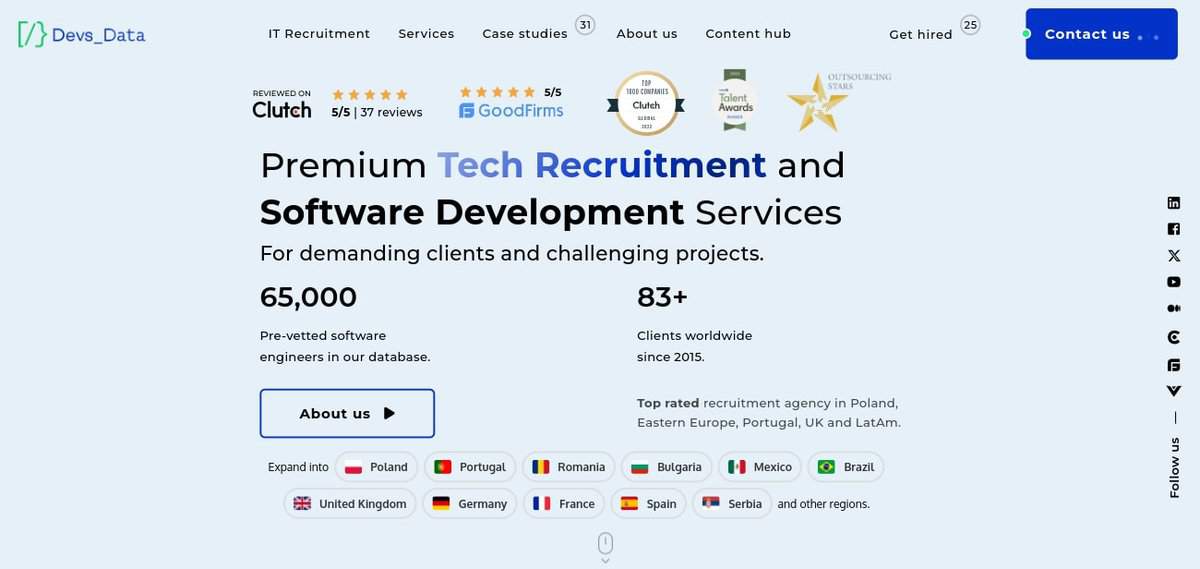
Our standards and outcomes have been recognized externally as well. DevsData LLC holds a 5/5 rating on Clutch and GoodFirms, platforms where clients independently review service providers. These reviews consistently highlight our transparency, our ability to share full interview notes, and our success-based pricing model – where clients pay only when a hire is made and backed by a guarantee period. We also hold an official, government-approved license for recruitment services, underscoring our compliance, accountability, and credibility in international hiring.
Memory AS faced a very specific problem: grant-driven deadlines made hiring delays especially costly, yet their search for Ruby specialists had stalled. DevsData LLC stepped in with international reach, quickly identifying two senior developers, one in Poland and one in Vietnam, whose skills matched the company’s AI-focused roadmap. By cutting time-to-hire by more than half compared to their internal process, we not only helped them secure immediate milestones but also laid the groundwork for future AI and QA-focused hires.
For The Globe and Mail, the challenge was less about speed and more about risk. As a national publisher, its newsroom operations allowed no margin for error – automation had to be integrated seamlessly into legacy workflows without disrupting live publishing. DevsData LLC designed a tailored two-stage assessment that mirrored the newsroom environment, filtering for engineers who could perform under deadline pressure. Within just 14 days, two senior full stack developers were hired, enabling the client to modernize operations while maintaining uninterrupted editorial output.
Rather than relying on inbound channels or public listings, DevsData LLC activated its proprietary networks to reach high-performing engineers who were not actively job-hunting but were open to mission-critical opportunities.
Sea set out to expand its Central European presence but needed more than individual hires – the goal was to establish a fully functioning engineering hub that could take ownership of the product roadmap. The challenge lay in assembling a cross-functional team that combined backend expertise with DevOps, QA, and project management skills, all while ensuring that candidates could adapt to a distributed and international environment. Within four months, DevsData LLC delivered 11 senior professionals whose technical depth and collaborative approach gave Sea a complete hub in Poland. Today, that team not only supports but actively drives the company’s product development and delivery.
In 2025, recruitment in technology has become a core business function rather than a background HR task. The race to integrate AI across products and operations has made talent acquisition even more strategic. Companies that treat hiring as a structured process, informed by market data, reinforced by rigorous assessment, and executed quickly, are the ones that deliver projects on time and scale effectively.
Specialized IT recruitment agencies play a central role in this shift. They help organizations overcome talent shortages, balance costs across regions, and reduce the risks of mis-hiring by applying proven, disciplined methods. As the case studies show, whether it is accelerating deadlines, safeguarding operational continuity, or building an entire engineering hub, outcomes depend on having the right recruitment partner.
At DevsData LLC, we measure success not by the number of resumes shared but by the capability our clients gain. With a vetted network of 95,000 professionals, US and European specialists on the team, and an official license for recruitment services, we focus on delivering results that stand up to scrutiny. Whether you need AI Engineers to build machine learning pipelines or Infrastructure Specialists to support cloud-native architectures, the right partner is the difference between stalled initiatives and sustained progress.
For more information, you can contact us via general@devsdata.com or visit our website www.devsdata.com.
Discover how IT recruitment and staffing can address your talent needs. Explore trending regions like Poland, Portugal, Mexico, Brazil and more.
 Frequently asked questions (FAQ)
DevsData – your premium technology partner
DevsData is a boutique tech recruitment and software agency. Develop your software project with veteran engineers or scale up an in-house tech team of developers with relevant industry experience.
Free consultation with a software expert
🎧 Schedule a meeting
FEATURED IN

DevsData LLC is truly exceptional – their backend developers are some of the best I’ve ever worked with.”

Nicholas Johnson
Mentor at YC, serial entrepreneur


 Build your project with our veteran developers.
Explore the benefits of technology recruitment and tailor-made software.
Learn how to source skilled and experienced software developers.
Build your project with our veteran developers.
Explore the benefits of technology recruitment and tailor-made software.
Learn how to source skilled and experienced software developers.

Rebecca Botvin

Commercial Director

Tom Potanski
Manager




Categories: Big data, data analytics | Software and technology | IT recruitment blog | IT in Poland | Content hub (blog)
Email copied
And many other regional partners across Latin and North America, as well as Central and Eastern Europe. Let's talk.















careers@devsdata.com









general@devsdata.com

"I interviewed about a dozen different firms. DevsData LLC is truly exceptional – their backend developers are some of the best I've ever worked with. I've worked with a lot of very well-qualified developers, locally in San Francisco, and remotely, so that is not a compliment I offer lightly. I appreciate their depth of knowledge and their ability to get things done quickly."

Nicholas Johnson
CEO of Orange Charger LLC,
Ex-Tesla Engineer,
Mentor at YCombinator
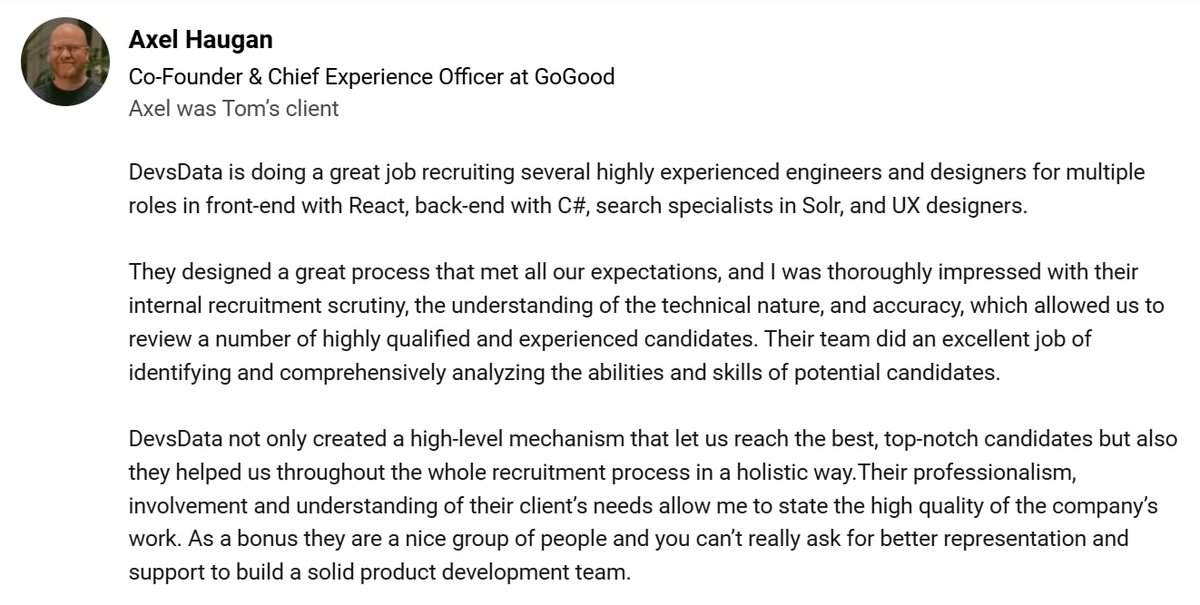
"DevsData reached out to us, as we've been looking to grow our engineering team in Europe and Poland. Communicating efficiently and professionally, DevsData made a strong impression with their understanding of the recruitment challenges we were facing. They designed a tailored recruitment process for our needs. I was impressed with the technical depth of their approach."

Karim Butt
Co-Founder & CTO at GlossGenius, Inc.
"Out of all the vendors we work with, DevsData clearly stands out. The quality of developers they deliver is beyond what we've received from any other vendor, and they've been able to send profile recommendations very quickly. I'm happy to be their reference for other companies from Israel and talk about their recruitment abilities and what they delivered for us."

Ran Eyal
Senior Manager at
ZIM Integrated
Shipping Services Ltd.
"DevsData demonstrated a strong degree of proactivity, taking time to thoroughly understand the problem and business perspective, and continuously suggesting performance and usability enhancements. Their app exceeded my expectations. I've worked with DevsData on numerous projects over the last 3 years and I'm very happy. Being both responsive and honest in communication."

Jonas Lee
Partner & Executive VP of Verus,
Financial LLC, Investor,
& Serial Entrepreneur
Acknowledgments