Thanks for subscribing.
Your gift is on the way.



Global companies increasingly rely on offshore IT services to streamline operations, lower costs, and accelerate innovation.
According to Forbes, offshore IT outsourcing offers tangible benefits, including access to larger talent pools, lower labor costs, and sustained productivity through global time zone coverage.
This model enables organizations to access specialized expertise and advanced technologies, such as machine learning, cybersecurity, and enterprise software, by partnering with teams worldwide. Offshore outsourcing adapts to changing project demands, providing scalable solutions that meet immediate project deadlines and long-term digital transformation goals.
The global IT services outsourcing market was estimated at USD 744,6 billion in 2024, with projections showing a compound annual growth rate of 8.6% from 2025 to 2030. This steady expansion reflects how organizations are shifting more critical IT functions to trusted offshore partners, aiming to gain access to advanced skills while managing costs. As more companies prioritize digital transformation, demand for reliable and flexible IT outsourcing continues to climb.
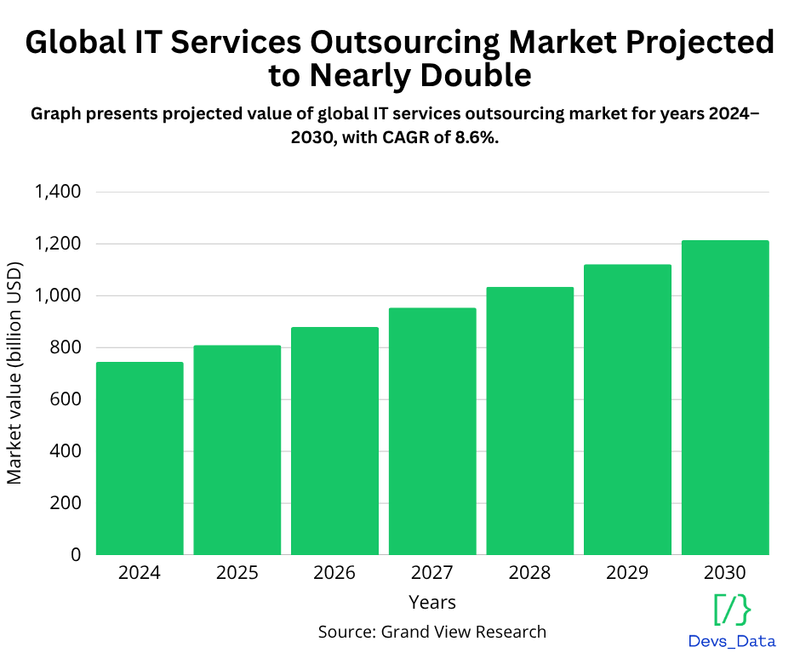
In 2023, offshore providers accounted for over 52% of total outsourcing revenue, illustrating a clear preference among organizations for external, globally distributed solutions. Technical strengths, scalable resources, and cost control are critical factors driving adoption. This article examines the fundamentals of offshore IT outsourcing, compares various service models, highlights the associated benefits and risks, and provides guidance on selecting the ideal partner.
Offshore IT outsourcing refers to the practice of assigning specific information technology responsibilities to external providers located in foreign countries, often where operating expenses are more economical. This method covers a range of activities such as application development, technical assistance, and customer interaction management. By engaging partners abroad, companies can optimize workflows and benefit from a wider pool of specialized professionals.
For example, organizations based in the United States may contract with IT service firms in Southeast Asia to handle support functions. This strategy not only helps reduce expenses but also grants access to highly trained talent from established global markets.
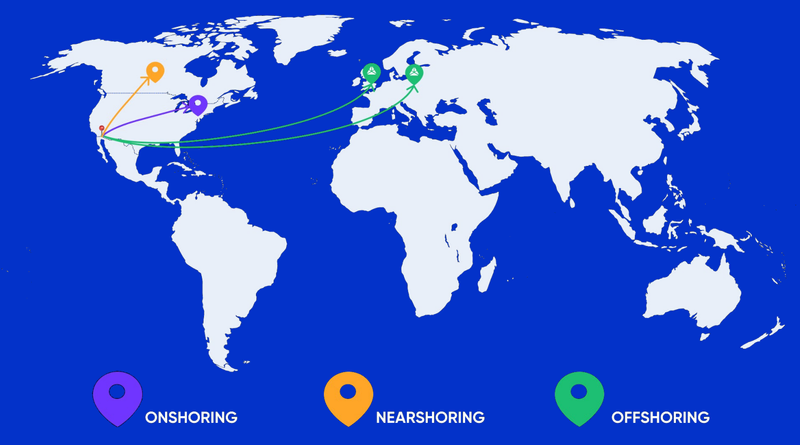
While offshore outsourcing remains a prominent choice for companies aiming to maximize value and reach global talent, it is only one of several models available. Businesses considering external partnerships often evaluate different approaches based on their operational needs, location preferences, and desired level of control over service delivery. Each model offers unique advantages and trade-offs, making it essential to understand how they compare to one another. Below are brief explanations of two other commonly used outsourcing strategies.
Companies evaluate outsourcing approaches based on cost sensitivity, time zone requirements, and risk tolerance. Offshore, nearshore, and onshore models each address these factors differently. The table below compares the three across the dimensions that influence most procurement decisions.
| Model | Relative cost | Time zone overlap with US operations | Primary risk factors |
|---|---|---|---|
| Offshore | Lowest (40 – 70% labor cost reduction) | Minimal (8 – 12 hour difference) | Communication delays, cultural misalignment, data jurisdiction complexity |
| Nearshore | Moderate (20 – 40% labor cost reduction) | High (0 – 3 hour difference) | Smaller talent pool in niche specializations, moderate cost savings |
| Onshore | Highest (local market rates) | Full overlap | Limited cost advantage, potential talent scarcity in competitive metro areas |
Onshore outsourcing
Onshore outsourcing describes the process of hiring external specialists or service providers who operate within the same national borders. Companies select partners from their own country, sometimes even within the same region or metropolitan area, to handle specific business functions.
Nearshore outsourcing
Nearshore outsourcing involves collaborating with vendors based in neighboring countries. This model leverages geographical proximity and cultural similarities, enabling organizations to tap into talent pools located just beyond their home market.
IT outsourcing covers a broad spectrum of services, with organizations increasingly seeking providers for highly specialized tasks. As demand grows for expertise in areas such as artificial intelligence, cybersecurity, and blockchain, companies turn to partners with deep technical knowledge.
“In 2024, 78% of organizations reported using AI in at least one business function, up from 55% the year before.”
This acceleration has increased demand for offshore IT partners who maintain teams with AI and machine learning capabilities, as most companies lack the internal headcount to staff these specializations at the pace of adoption required.
Depending on operational needs, companies can outsource a range of IT services to specialized external teams. Many businesses engage partners for software engineering, application lifecycle management, and DevOps to ensure applications are built, maintained, and delivered efficiently.
Technical support and telecom management are also frequently outsourced, providing organizations with helpdesk services and reliable communication solutions that keep teams connected and productive.
For infrastructure, businesses often rely on partners to handle cloud management, infrastructure oversight, and backup and disaster recovery, protecting operations and supporting stable, scalable environments.
Information security and data analytics are critical outsourcing areas, helping companies protect digital assets and extract valuable insights from their data.
Many organizations also outsource web and eCommerce operations as well as non-core business processes like payroll, HR, and customer support, allowing in-house teams to focus on strategic priorities.
Do you have IT recruitment needs?
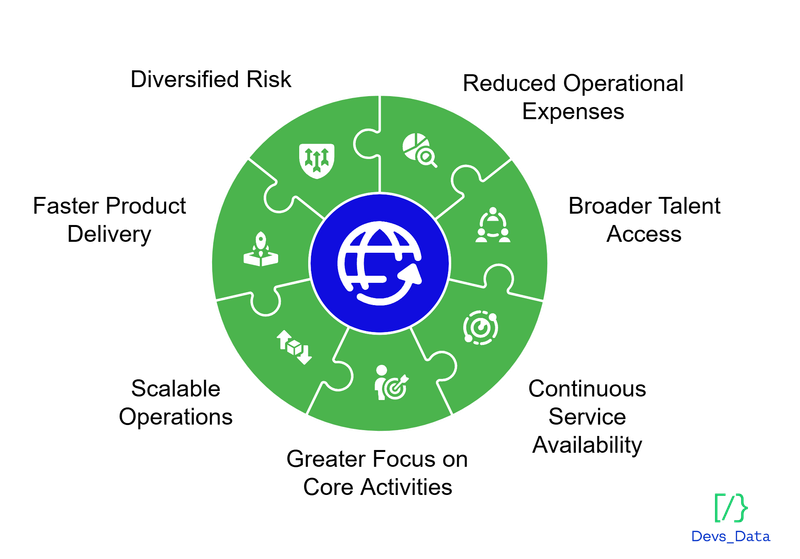
Engaging offshore IT partners delivers a variety of strategic benefits for organizations aiming to streamline budgets, boost performance, and compete in a global setting. Below are several notable advantages:
Outsourcing IT functions to overseas markets, where labor and infrastructure costs are often lower, enables organizations to achieve noteworthy savings.
“A 2024 study by Information Services Group (ISG) found that enterprises save an average of 15% by outsourcing business processes compared to maintaining them in-house”
The figure reflects a cross-industry enterprise average spanning IT and BPO engagements, with savings ranging from single digits for small-scope contracts to 40% or more for large offshore development teams operating in lower-cost markets.
These financial efficiencies free up capital for investment in core projects or expansion, making it easier to forecast and manage budgets over the long term. Businesses can allocate more resources toward innovation or customer experience without increasing overall costs.
By partnering with providers abroad, companies move past the constraints of local hiring markets. Offshore outsourcing connects organizations to a global workforce with specialized skills in software development, cybersecurity, and technical support. The advantage becomes most visible for roles that remain difficult to fill domestically, such as ML Ops Engineers, SAP Integration Specialists, and Embedded Systems Developers. Scaling up for large projects also becomes faster when recruitment draws from multiple countries rather than a single metro area.
Leveraging teams in multiple time zones ensures that operations continue without interruption, even outside regular business hours. Offshore arrangements enable companies to provide 24/7 support, accelerate project timelines, and reduce customer wait times. With tasks moving seamlessly between regions, issues can be resolved overnight, and critical updates can be completed without disrupting daily operations.
This round-the-clock model strengthens customer satisfaction and operational reliability. Organizations that adopt follow-the-sun workflows often report shorter mean time to resolution (MTTR) for support tickets and improved SLA attainment rates, both of which IT leadership tracks as primary performance indicators.
Delegating routine or non-strategic IT responsibilities to offshore partners enables internal teams to focus on activities that drive business growth. Employees can spend more time on strategic initiatives, such as developing new products, refining business models, or expanding market reach. By minimizing distractions from day-to-day support or maintenance, organizations enhance productivity and empower their teams to deliver higher-value work.
Offshore outsourcing offers built-in flexibility to adjust team size and service scope according to current business needs. Whether ramping up quickly for a new product launch or scaling back after a project is complete, organizations can respond with agility, without the long lead times and costs associated with hiring or downsizing permanent staff. This adaptability enables companies to manage fluctuating workloads and seasonal changes while maintaining high service quality.
With access to additional talent and global resources, companies can accelerate their development cycles. Offshore teams often bring established processes and expertise, helping streamline workflows and eliminate bottlenecks. This acceleration reduces time-to-market for new products and services, enabling businesses to seize opportunities more quickly and outpace competitors in fast-moving industries.
Maintaining IT operations across different countries minimizes exposure to regional uncertainties–whether political, economic, or environmental. Offshore outsourcing creates a more resilient operational structure by spreading risk across multiple locations. If challenges arise in one area, work can continue in other areas, ensuring business continuity and minimizing the impact of local disruptions. This diversification is key to building long-term stability and protecting against unforeseen events.
Do you have IT recruitment needs?
While cost reduction is a clear advantage, business leaders also weigh decisions through measurable returns. Offshore outsourcing is best understood not only as a cost-saving measure but as a way to release funds that can be redirected toward growth. By showing how a budget shifts in practice, the financial value becomes more concrete for decision makers.
To illustrate how budget reallocation works in practice, consider a hypothetical scenario. A company with a $1000000 annual IT budget outsources 40% of its development work to a reliable offshore partner. The adjustment reduces direct staffing and overhead expenses, resulting in about $300000 in savings in the first year. Instead of being absorbed back into general operations, those funds strengthen innovation efforts, speed market entry, or support customer-facing improvements. This simplified example shows how outsourcing creates financial room for reinvestment, not just cost reduction.
While offshore IT outsourcing offers substantial benefits, it also poses risks that require careful management. Fortunately, businesses can recognize these challenges in advance and implement measures to address them. The most common risks, along with their corresponding mitigation strategies, are detailed below.
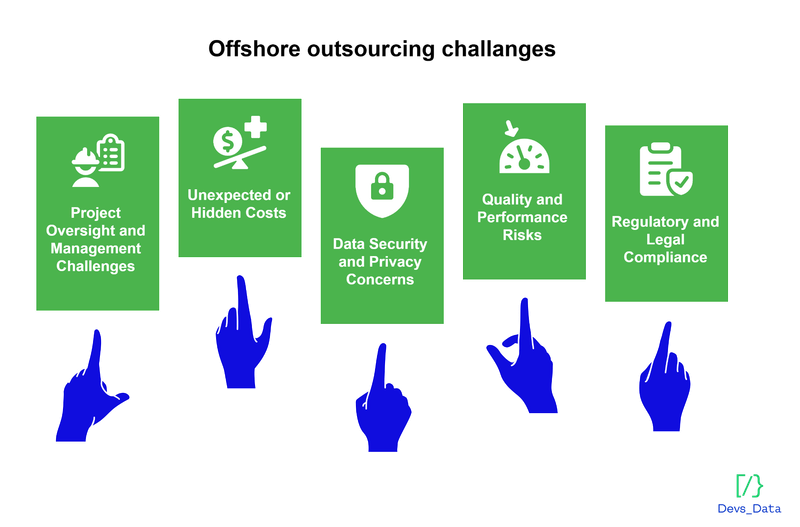
Coordinating teams across borders introduces obstacles in monitoring day-to-day project activities. Physical distance, time zone differences, and limited direct oversight may result in reduced visibility over progress and deliverables. It can be challenging to maintain consistent communication or ensure that every team member follows established procedures.
How to address this risk:
Involve your in-house team during initial planning and maintain open channels throughout the engagement. Clear roles, defined expectations, and regular status meetings help bridge gaps between internal and offshore staff. Frequent updates and documentation foster accountability and transparency.
Appoint a Project Manager on the client side to manage communication, process alignment, and reporting cadence. Require the offshore vendor to designate their own PM with direct access to the delivery team. Splitting responsibility between the two organizations, rather than concentrating it on one side, prevents bottlenecks that compound when issues require cross-border escalation.
While outsourcing is often promoted for its cost-saving potential, unforeseen expenses can still arise in certain situations. Additional charges may appear due to changes in project scope, fluctuating requirements, or contractual ambiguities. Such costs can disrupt budgets and delay delivery.
How to address this risk:
Conduct thorough due diligence on all prospective partners before entering into any agreements. Review their pricing models and seek clarity on all possible fees. Establish a comprehensive contract that specifies payment terms and conditions, and always include a clear statement of work. Opt for payment structures that suit your project type, such as fixed-price agreements for well-defined tasks. Keeping a shortlist of reputable vendors and comparing proposals also helps avoid surprises.
Sharing confidential business data with offshore vendors introduces potential risks to privacy and security. Sensitive information, including customer details or financial records, could be exposed or mishandled if not protected by strong safeguards. Data breaches, leaks, or losses may damage reputation and erode client trust.
How to address this risk:
Define which data categories the offshore vendor is authorized to access, and tie security requirements to established standards. Require ISO 27001 certification as the baseline for information security management. For clients subject to US regulatory oversight, request SOC 2 Type II audit reports. Where EU personal data is processed, build GDPR obligations into the service agreement. Periodic third-party audits against these frameworks replace the ambiguity of generic compliance reviews.
Differences in language, culture, and work practices can sometimes lead to misunderstandings or misalignment on project goals. Quality may also suffer if vendors lack the necessary experience, technical knowledge, or commitment to deadlines. In some cases, the temptation to select the lowest-cost provider results in subpar performance.
How to address this risk:
Evaluate the vendor on practical signals, not credentials alone. Ask for the seniority breakdown of the team assigned to your project: a roster composed entirely of junior Developers without senior oversight signals a quality risk. Request documentation of the vendor’s code review workflow to assess how technical standards are maintained internally.
A paid pilot sprint lasting two to four weeks reveals more about delivery capability than any proposal deck. Combine these assessments with a review of certifications and past client outcomes. Communicate project objectives, timelines, and deliverables in writing before the engagement begins. Schedule performance reviews at regular intervals to catch deviations early.
Every country imposes unique regulations on IT services, data handling, and contractual relationships. Failing to meet these requirements can result in legal issues or penalties. Changes in local laws or international agreements may also affect ongoing projects.
How to address this risk:
An NDA alone does not provide sufficient legal coverage for offshore engagements. Structure the contractual framework around a Master Service Agreement (MSA) that defines scope, liability, and termination rights. Add a Data Processing Agreement (DPA) to govern how the vendor handles personal and confidential data. Include a Service Level Agreement (SLA) with measurable performance thresholds and penalty clauses for non-compliance. Regulatory obligations should be written into the MSA, with clear consequences for violations.
Research the legal environment and compliance standards in each country you consider for outsourcing. Ensure that contracts comply with local and international regulations, and that vendors provide documentation confirming their adherence. Include relevant compliance clauses and penalties in your agreements. Consulting with legal advisors or compliance experts is also recommended, especially when handling sensitive data or operating in highly regulated sectors.
Choosing the right agency for offshore IT services can be a game-changer for organizations that want to scale efficiently and minimize risk. Instead of relying on internal resources for every technical challenge, companies gain direct access to experienced professionals and established processes through an agency partnership. These firms have proven frameworks for managing distributed teams, overcoming recruitment barriers, and delivering tangible results. Working with a reputable agency means greater transparency, reduced operational headaches, and faster progress toward business objectives.
Partnering with an agency helps companies significantly reduce labor and overhead expenses by leveraging lower-cost offshore talent. Agencies also streamline workflows, driving productivity gains and allowing clients to achieve more with fewer resources.
Agencies maintain extensive networks of IT professionals across regions. This global reach means businesses can quickly find the exact technical skills required, even for niche roles or fast-growing technology fields.
As business priorities shift, agencies provide the ability to scale teams up or down without the delays and costs of traditional hiring. This flexibility supports fast-changing project needs and helps companies remain agile.
With established offshore teams, agencies can operate across time zones, ensuring round-the-clock progress. This global delivery model shortens time-to-market for new products and features.
Agencies bring proven recruitment pipelines, rigorous screening, and reliable onboarding. This structured approach ensures only qualified candidates join a project, reducing turnover and improving long-term outcomes.
Distributed offshore teams managed by agencies minimize operational risks from regional disruptions. Their processes ensure business continuity and help clients maintain steady performance, regardless of local issues.
Choosing the right outsourcing partner is essential for a successful IT project. Careful evaluation helps minimize risks and keeps your business goals at the forefront. The following steps highlight key factors for selecting a provider who meets your requirements and supports consistent results.
Begin by pinpointing exactly what you want to achieve through outsourcing. Identify the IT functions or projects you plan to delegate and the specific results you expect. Establish clear benchmarks for success, such as reducing costs, gaining access to specialized expertise, or enhancing operational flexibility. Well-defined goals will guide your search and help you assess whether a potential partner can truly meet your requirements.
Leverage various resources to create a shortlist of qualified partners. Use reputable review sites, such as Clutch or GoodFirms, to review client feedback and ratings. Look for detailed case studies and testimonials that illustrate how each provider has handled similar challenges. Reliable vendors typically have a proven track record of meeting deadlines, staying within budget, and demonstrating technical expertise.
Assess whether each partner has the workforce, infrastructure, and skills to manage your project. Ask about their team size, experience level, and technology stack. Select providers with a proven track record in your sector who can tailor resources to meet your project’s evolving needs. Technical capability and familiarity with current platforms are crucial for long-term success.
When evaluating potential offshore partners, start by reviewing case studies and project summaries to ensure the provider has a proven track record in your industry. Assess whether their teams are proficient in the specific tools, frameworks, and programming languages your project requires. It’s also essential to choose a partner who demonstrates genuine interest and commitment to your success, as this typically results in more innovative solutions and higher-quality outcomes.
Effective communication is key to a smooth collaboration. Make sure your partner can communicate clearly and is proficient in your preferred language. Set up regular meetings and agree on transparent reporting procedures. Confirm that there is enough overlap in working hours for direct coordination. Pay attention to work culture and values–strong alignment reduces misunderstandings and helps build trust.
Discuss the best engagement structure for your needs, whether fixed-price, dedicated teams, or a hybrid approach. Evaluate the strengths and trade-offs of each model with your candidates. Give preference to vendors who understand agile methodologies, as agile practices support flexibility, fast feedback, and continuous improvement throughout the project.
Data protection is essential. Verify that your provider adheres to rigorous security protocols and complies with applicable standards and regulations. Ask for details about their data storage, privacy policies, and access controls. Ensure their approach to safeguarding intellectual property aligns with your expectations and requirements.
Ask your shortlisted partners for comprehensive proposals, including project scope, timelines, deliverables, and pricing. Compare these offers for clarity, thoroughness, and alignment with your objectives. Review all contract details, paying special attention to responsibilities, payment terms, dispute resolution, confidentiality, intellectual property, and termination clauses. When in doubt, consult legal counsel to ensure your interests are fully protected.
Website: www.devsdata.com
Team size: ~60 employees
Founded: 2016
Headquarters: Brooklyn, NY, and Warsaw, Poland
DevsData LLC specializes in offshore IT services, offering comprehensive solutions that help clients navigate every phase of their technology initiatives, including planning, development, quality assurance, and ongoing support. The company’s expertise spans diverse industries, including finance, healthcare, and eCommerce, with a proven track record of delivering high-impact results for global businesses. Whether a client is optimizing existing systems or expanding into new markets, DevsData LLC brings clarity and assurance to every project.
With a global presence, DevsData LLC stands out as a provider of high-quality offshore IT services, recognized for professional delivery and outstanding industry knowledge. The company is known for its flexibility, designing customized offshore IT services and IT recruitment solutions that cater to the needs of clients worldwide, including those in the US and Israel. Over more than 10 years in the industry, DevsData LLC has completed over 100 offshore IT projects for 9+ clients, offering expertise in backend systems, frontend web applications, mobile apps, Big Data and analytics, AI, DevOps, and cloud infrastructure, enterprise solutions, and custom technology consulting.
A distinguishing feature of DevsData LLC is its accomplished team of Google-level engineers, US-based specialists, and globally sourced professionals. The company’s engineers and project managers are graduates of leading universities in Europe and the United States, with experience at major tech firms, hedge funds, and in open source communities. Team credentials include Oxford alumni, Mensa members, former Google employees, and senior tech leads, all of whom bring exceptional technical skills and industry perspective to each client engagement. The group also includes professionals with verifiable certifications, including AWS Certified Solutions Architect, Certified Kubernetes Administrator (CKA), and Offensive Security Certified Professional (OSCP), which demonstrate proven expertise in cloud infrastructure, containerized systems, and advanced security.
DevsData LLC’s commitment to excellence is reflected in its client-focused approach and proven track record of delivering transformative solutions. One example is the creation of an intuitive enterprise resource planning application that streamlined task management, improved productivity, and reduced operational costs for the client. The firm’s agile methodology and efficient project management enable it to offer premium offshore services at competitive rates, benefiting from lower overhead compared to larger competitors. Absolute client satisfaction is a hallmark of DevsData LLC’s service, consistently earning perfect 5/5 scores on Clutch and GoodFirms.
In addition to its technical prowess, DevsData LLC has built a reputation as a trusted IT recruitment partner. The company employs a rigorous, multistage hiring process, which includes a 90-minute interview and a robust problem-solving assessment, to ensure that only candidates with exceptional technical and interpersonal skills are selected to join their team or recommended to clients. This dedication to quality enables the company to fill roles in under 10 days, striking a balance between efficiency and high standards. Their government-approved recruitment license underscores their reliability for managing critical talent needs. By choosing DevsData LLC for offshore IT services, businesses gain a responsive, proactive partner capable of delivering practical results, streamlined collaboration, and lasting value across borders.
DevsData LLC delivered a custom resource management platform for a global enterprise by assembling and managing an offshore team. Recruiting involved sourcing specialists across several countries, then vetting them through a thorough selection process. Key challenges included meeting strict security standards and coordinating across time zones. DevsData LLC addressed these with rigorous screening and regular cross‑location communication. The end result was a platform that replaced Jira across two departments, streamlined project tracking, and became a core operational tool, driving measurable improvements in efficiency and lowering ongoing costs.
For more information, contact DevsData LLC at general@devsdata.com or visit their website at www.devsdata.com.
Do you have IT recruitment needs?
Offshore IT outsourcing success depends on precise planning and defined goals. Businesses that prioritize transparent communication, strong data security, and a tailored approach are better positioned to realize the full benefits of global collaboration. As demand for specialized expertise increases, companies must select partners who demonstrate both technical proficiency and proven results, naturally leading to a closer examination of top providers.
Numerous well-known companies have relied on offshore IT partnerships to support growth and innovation. WhatsApp and Lyft showed how offshore talent allows lean teams to scale rapidly and bring products to market faster. Google has long relied on distributed experts for specialized projects, proving that even the largest enterprises see value in global collaboration. DevsData LLC enables companies of any size to apply the same model by providing vetted senior engineers and reliable processes, minimizing the risk and complexity that smaller organizations often face.
DevsData LLC brings significant advantages to organizations seeking reliable offshore IT services. With more than 10 years of experience, a team of Google-level in-house engineers, and US specialists, the company is equipped to manage complex technology initiatives from start to finish. Their track record includes more than 100 completed software projects for 100 clients worldwide, reflecting an ability to deliver solutions that meet the specific demands of remote collaboration, global integration, and operational scalability.
For businesses navigating the complexities of offshore IT, DevsData LLC provides practical guidance at every stage.
Ready to take your IT operations offshore with confidence? Contact DevsData LLC at general@devsdata.com or visit www.devsdata.com to start building your tailored offshore solution today.
Any questions or comments? Let me know on Twitter/X.
Discover how IT recruitment and staffing can address your talent needs. Explore trending regions like Poland, Portugal, Mexico, Brazil and more.
 Frequently asked questions (FAQ)
DevsData – your premium technology partner
DevsData is a boutique tech recruitment and software agency. Develop your software project with veteran engineers or scale up an in-house tech team of developers with relevant industry experience.
Free consultation with a software expert
🎧 Schedule a meeting
FEATURED IN


DevsData LLC is truly exceptional – their backend developers are some of the best I’ve ever worked with.”

Nicholas Johnson
Mentor at YC, serial entrepreneur


 Build your project with our veteran developers.
Explore the benefits of technology recruitment and tailor-made software.
Learn how to source skilled and experienced software developers.
Build your project with our veteran developers.
Explore the benefits of technology recruitment and tailor-made software.
Learn how to source skilled and experienced software developers.

Rebecca Botvin

Commercial Director

Tom Potanski
Manager




Categories: Big data, data analytics | Software and technology | IT recruitment blog | IT in Poland | Content hub (blog)
















careers@devsdata.com









general@devsdata.com

"I interviewed about a dozen different firms. DevsData LLC is truly exceptional – their backend developers are some of the best I've ever worked with. I've worked with a lot of very well-qualified developers, locally in San Francisco, and remotely, so that is not a compliment I offer lightly. I appreciate their depth of knowledge and their ability to get things done quickly."

Nicholas Johnson
CEO of Orange Charger LLC,
Ex-Tesla Engineer,
Mentor at YCombinator
"DevsData reached out to us, as we've been looking to grow our engineering team in Europe and Poland. Communicating efficiently and professionally, DevsData made a strong impression with their understanding of the recruitment challenges we were facing. They designed a tailored recruitment process for our needs. I was impressed with the technical depth of their approach."

Karim Butt
Co-Founder & CTO at GlossGenius, Inc.
"Out of all the vendors we work with, DevsData clearly stands out. The quality of developers they deliver is beyond what we've received from any other vendor, and they've been able to send profile recommendations very quickly. I'm happy to be their reference for other companies from Israel and talk about their recruitment abilities and what they delivered for us."

Ran Eyal
Senior Manager at
ZIM Integrated
Shipping Services Ltd.
"DevsData demonstrated a strong degree of proactivity, taking time to thoroughly understand the problem and business perspective, and continuously suggesting performance and usability enhancements. Their app exceeded my expectations. I've worked with DevsData on numerous projects over the last 3 years and I'm very happy. Being both responsive and honest in communication."

Jonas Lee
Partner & Executive VP of Verus,
Financial LLC, Investor,
& Serial Entrepreneur
Acknowledgments