Thanks for subscribing.
Your gift is on the way.



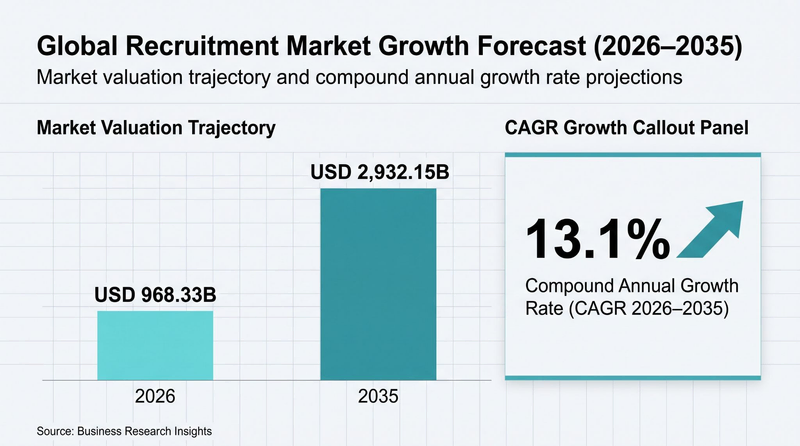
As companies expand across borders, embrace digital transformation, and compete for specialized skills, the Human Resources expertise has become a critical challenge to businesses. The recruitment industry reflects this demand: the global recruitment market is poised for significant growth, starting at USD 968.33 billion in 2026 and expected to reach USD 2932.15 billion by 2035, driven by a CAGR of 13.1%. These numbers demonstrate that organizations worldwide are allocating larger portions of their operational budgets to external staffing solutions, treating talent acquisition as a strategic investment rather than an administrative expense.
At the same time, the reality on the ground paints a more complicated picture. More than two-thirds of organizations ( 69%) are struggling to fill roles in 2026, highlighting the increasing mismatch between supply and demand in the talent market. Skill shortages, shifting workforce expectations, and the need for specialized expertise make traditional, in-house hiring processes less effective on their own. This is where human resources staffing agencies step in to bridge the gap.
HR staffing agencies act as partners in building sustainable teams. By combining access to wide talent networks with market expertise and dedicated screening processes, these agencies help organizations navigate an increasingly competitive hiring landscape. This article explores how HR staffing agencies operate, what the market looks like in 2026, the benefits of collaboration, and the challenges that arise along the way. It also provides guidance on choosing the right partner and outlines why DevsData LLC has proven to be a trusted resource for HR staffing solutions.
Human resources staffing agencies are specialized firms that support organizations in building their teams by sourcing, evaluating, and placing candidates across a wide range of roles. They focus on helping businesses fill positions in any department – from technical and managerial roles to administrative and specialized functions.
These agencies can operate in two primary ways. In the embedded support model, an agency works alongside the internal HR team, expanding the company’s reach to broader talent networks while the client retains decision-making control. Under the full-cycle outsourced model, the agency manages recruitment entirely, taking responsibility for everything from identifying candidates to negotiating offers and onboarding.
The table below outlines how these two models differ across operational dimensions:
| Dimension | Embedded support model | Full-cycle outsourced model |
|---|---|---|
| Scope of responsibility | Supplements the internal HR team with sourcing and candidate pipeline support | Manages the entire recruitment process from job profiling through onboarding |
| Control and decision-making | The client retains direct oversight of hiring decisions and final offers | The agency leads the process, with the client approving at defined checkpoints |
| Resource commitment from the client | Requires an active internal HR function to coordinate with the agency | Minimal internal HR involvement needed beyond intake and final approval |
| Speed of execution | Depends on the internal team’s capacity to act on agency-sourced candidates | Typically faster, as the agency controls all stages without internal handoff delays |
| Best suited for | Organizations with established HR teams that need expanded reach or surge capacity | Companies without dedicated recruitment infrastructure or facing high-volume hiring needs |
The embedded model works best when an organization already has HR infrastructure and needs expanded sourcing reach without relinquishing oversight. The full-cycle model, by contrast, suits companies that lack dedicated recruitment capacity or face high-volume hiring demands. In both cases, the aim is to reduce hiring timelines and ensure candidate quality so that leadership can focus on strategic growth.
Staffing agencies today do more than fill vacancies – they help businesses shape workforce strategies that align with long-term goals.
Do you have recruitment needs?
The HR staffing industry is undergoing a significant transformation, shaped by structural labor shortages, digital innovation, and changing workforce expectations. The following trends illustrate how the market is evolving in 2026.
Companies are increasingly adopting a mix of permanent and project-based workers to remain adaptable. With 63% of employers citing skills gaps as their top barrier, organizations rely on staffing agencies to quickly provide temporary or contract talent. This approach helps reduce risks and ensures continuity while long-term recruitment strategies are refined.
Organizations gain resilience and reduce risk by tapping into agencies’ networks for short-term talent, ensuring continuity even in times of uncertainty.
Organizations that once managed recruitment entirely in-house are shifting portions of that function to external staffing providers. This trend reflects a broader move toward outsourcing operationally intensive HR activities, particularly when internal teams lack the sourcing capacity or specialist knowledge required for high-demand roles. Staffing agencies occupy a distinct position within the outsourcing landscape because they combine candidate pipeline access with screening, compliance, and placement management under a single engagement. As hiring complexity increases, more companies are treating external staffing partnerships not as a temporary fix but as a permanent component of their workforce acquisition strategy.
By outsourcing recruitment to a dedicated staffing agency, companies free internal HR teams to focus on retention, workforce planning, and organizational development while the agency manages the volume and complexity of candidate delivery.
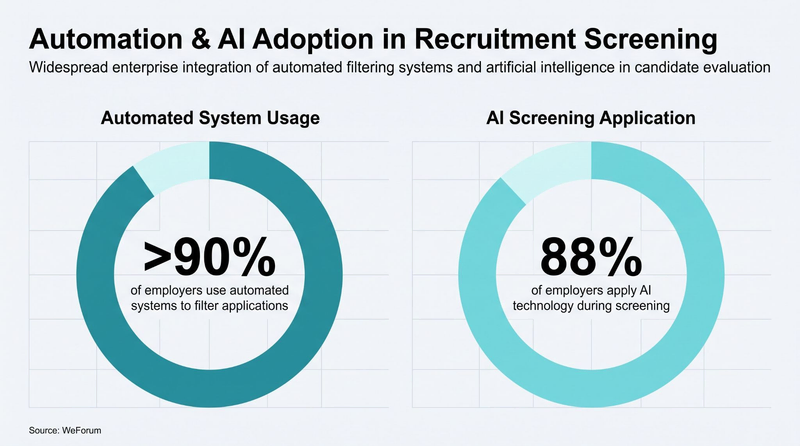
Digital tools have become central to modern hiring. Over 90% of employers now use automated systems to filter applications, and 88% apply AI in screening. For staffing agencies, these tools improve efficiency, cut down hiring timelines, and expand reach, allowing them to deliver better candidate matches in a competitive market.
Partnering with tech-savvy agencies can shorten hiring cycles and deliver better-fit candidates, reducing both turnover and recruitment overhead.
Persistent talent shortages are reshaping recruitment priorities. According to the World Economic Forum, skills gaps are the top obstacle to transformation (63%), while only 29% of businesses expect availability to improve by 2030. Agencies bridge this gap by maintaining talent pipelines and helping clients adjust hiring strategies.
Collaborating with staffing partners helps companies secure scarce expertise faster and stay competitive in industries where qualified talent is in short supply.
Remote work is reshaping access to talent across borders. In OECD countries, telework in job ads continues to rise, with 2-3 remote days per week now standard. Moreover, 27% of employers plan to expand availability through cross-border remote work, giving staffing agencies a broader role in connecting companies with international professionals.
Agencies with global reach allow companies to overcome local shortages, diversify teams, and access specialized skills without geographic limitations.
Partnering with an HR staffing agency goes beyond filling vacancies; it delivers measurable business value. From cutting recruitment costs to improving compliance and reducing administrative workload, agencies help organizations navigate today’s competitive labor market with greater efficiency and confidence. The following benefits highlight the most tangible, quantifiable advantages of collaboration.
Organizations looking to reduce recruitment costs typically consider several outsourcing approaches, from hiring freelance Recruiters to contracting HR consulting firms or building offshore talent acquisition teams. A dedicated HR staffing agency differs from these alternatives by combining sourcing capacity with established candidate pipelines and compliance infrastructure under a single engagement. This consolidation converts fixed HR overhead into variable costs while reducing inefficiencies across recruitment and administration.
Your in-house HR team can stop slogging through mundane tasks and focus on strategy, culture, and talent development. Hiring cycles become faster, and internal bottlenecks shrink.
You mitigate legal and regulatory risk (especially across jurisdictions) and benefit from best-in-class tools and domain knowledge without building them internally.
You don’t over-invest in HR headcount you don’t need. You can quickly respond to business growth, acquisitions, or contractions without internal lag.
A staffing partner that brings strategic HR thinking doesn’t just fill roles; it helps foster a stronger workplace, reducing costly turnover and building morale and performance over time.
By combining flexible workforce models, technology-driven recruitment, and diverse candidate pipelines, HR staffing agencies give organizations an edge in a competitive talent market.
While HR staffing solutions are valuable across sectors, some industries gain particular advantages due to their skill intensity, evolving workforce needs, or strict compliance frameworks. The following sectors illustrate where staffing partnerships deliver the strongest impact.
Agencies help bridge persistent talent shortages by sourcing developers, data scientists, and cloud specialists. With demand outpacing supply, staffing partners ensure faster placements and better technical matches.
Hospitals, clinics, and healthcare networks rely on staffing firms to fill both clinical and administrative roles. Agencies provide certified professionals while maintaining compliance with evolving healthcare regulations.
Project-based workloads make flexible staffing critical. Agencies enable companies to scale teams up or down according to production cycles, minimizing downtime and ensuring consistent delivery.
Staffing agencies streamline recruitment for roles requiring specific certifications, risk management skills, and regulatory knowledge, reducing hiring complexity and ensuring compliance.
Industries facing skill shortages or regulatory pressures gain the most from HR staffing partnerships. Agencies shorten hiring cycles, enhance workforce flexibility, and improve candidate quality while ensuring compliance in demanding environments. At the same time, sectors such as retail, logistics, and hospitality benefit from staffing support during seasonal demand peaks and rapid geographic expansion.
Do you have recruitment needs?
Below are some of the most pressing challenges HR staffing agencies face today, and how we at DevsData LLC strategically address them to deliver real value to our clients.
Even in 2026, recruiting remains tough: 69% of organizations report difficulty filling roles. The shortage of qualified candidates, high competition among employers, and evolving job requirements (especially in tech, data, and AI) make it difficult to match supply and demand. Agencies risk overpromising and underdelivering.
At DevsData LLC, we maintain deep, vertical-specific talent pipelines and proactively develop relationships with passive candidates long before roles open. We invest in continuous skills mapping and reskilling partnerships, so when a client needs a highly specialized hire, we can tap into a pre-screened pool rather than starting from zero. Moreover, we balance local sourcing with access to global talent when necessary, widening the net without compromising cultural fit.
One of the greatest challenges in HR staffing is candidate scarcity, and overcoming it requires proactive pipelines and access to global talent.
Global average time-to-hire is 44 days, and sometimes the recruitment processes may drag on for months, causing lost productivity, increased cost, and candidate dropoff. McKinsey’s HR Monitor shows that offer acceptance rates are low (56%) and hiring success in some regions is just 46%, reflecting inefficient processes.
We design streamlined workflows with integrated automation: AI-assisted screening, structured assessments, and data-driven candidate shortlisting. We define service level agreements for each recruitment stage in collaboration with the client, calibrating speed and quality benchmarks to the specific demands of their project rather than applying a fixed internal template. We also align early with client stakeholders (hiring managers, HR, business leads) to reduce delays from decision gating, and provide weekly updates so there’s visibility and accountability at every step.
Economic uncertainty is pushing organizations to restrain HR spending. In 2024, 37% of HR professionals cited budget constraints as a key concern, and reduced spending power is forcing many to re-evaluate which recruitment activities deliver measurable returns. Client expectations for value and cost justification are high.
We adopt modular, scalable service models so clients pay only for what they need (e.g., candidate sourcing, full-cycle recruitment, HR support). In practice, our pricing is tied to successful outcomes, such as completed hires or defined project deliverables, rather than fixed retainers or long-term overhead commitments. We also continuously optimize our internal operations to reduce waste, leveraging shared tools, templates, and central candidate databases to improve margins without sacrificing service levels.
Applicants disappearing mid-process (“ghosting”) and early resignations are pervasive in competitive hiring markets. Even after placement, cultural mismatch or poor onboarding can cause new hires to churn, hurting client confidence.
We mitigate this risk through rigorous screening: multiple touchpoints, behavioral interviews, reference checks, and transparent expectations setting. We also support onboarding handovers, ensuring the candidate is engaged and aligned from day one. In high-risk hires, we include performance guarantees (e.g., replacement windows) to stand by our placements. Continuous feedback loops allow us to detect misalignment early and act fast.
When hiring across borders or in specialized sectors, agencies must navigate tax rules, labor laws, visas, data privacy, and local employment regulations. These complexities multiply risk and slow execution.
DevsData LLC maintains a compliance operations team with experts in key jurisdictions, supported by legal partners. We pre-audit candidate eligibility, verify documentation, and ensure contracts and placements adhere to local laws. For cross-border projects, we use Employer of Record (EOR) partners or local entities to simplify legal exposure. Our process is designed to remove compliance burden from the client’s hands.
The fee structure of an HR staffing engagement determines when payment is triggered, how risk is distributed between client and agency, and how closely the agency’s financial incentives align with hiring outcomes. Each pricing model carries different implications for budget predictability and engagement depth. Understanding these structures allows organizations to match their hiring needs to the right commercial arrangement before entering negotiations.
Under a contingent model, the client pays only after a candidate accepts an offer and starts the role. Fees are calculated as a percentage of the hired candidate’s first-year salary, typically ranging from 15% to 25%. Entry-level positions fall toward the lower end (10% to 15%), while specialized or senior roles can reach 25% to 30%. Because the agency earns nothing unless the placement succeeds, contingent recruitment transfers most of the financial risk to the provider.
This model suits mid-level hiring and situations where the client engages multiple agencies on the same position simultaneously. Agencies offering contingent recruitment outnumber those specializing in retained search by roughly 10 to 1 across the broader market, making contingent engagement the most widely available option. The tradeoff is that non-exclusive arrangements can reduce the depth of each individual search, as agencies working on a contingent basis prioritize speed over exhaustive market coverage.
Organizations hiring for mid-level roles at moderate volume, where speed of delivery matters more than exhaustive candidate mapping, and where the budget structure favors paying only upon results.
Retained search involves an upfront payment commitment, usually structured in three equal instalments: one-third at engagement start, one-third at candidate shortlist delivery (typically 30 to 60 days in), and one-third upon successful placement. Fees generally fall between 30% and 35% of the candidate’s first-year total cash compensation. For senior executive roles, fees routinely exceed $100000.
The upfront investment reflects a different kind of search. Retained firms dedicate focused resources to a single client’s mandate, conducting in-depth market mapping, targeted outreach to passive candidates, and confidential engagement processes. According to Business Research Insights, retained search holds approximately 50% of the executive search market by revenue, while contingency holds around 35% and hybrid models account for the remaining 15%. Retained assignments also report higher completion rates, commonly cited at 90% or above, compared to 20% to 35% for contingent searches.
Senior leadership positions, C-suite mandates, or highly specialized technical roles where the talent pool is limited, discretion is expected, and the depth of market research justifies an upfront commitment.
Unlike contingent and retained search, which focus on filling individual positions, RPO transfers part or all of the recruitment function to an external provider under a longer-term contractual agreement. The agency operates as an extension of the client’s HR department, managing process design, technology, and reporting alongside candidate delivery. According to REC/CIPD research on resource supply chains, 38% of large employers use RPO, making it the second most widely adopted recruitment model after preferred supplier lists. The same study found that 64% of organizations using RPO also run an additional model alongside it, reflecting the complexity of workforce needs that a single approach may not fully cover. Pricing structures vary: transactional models charge a fixed fee per requisition, FTE-based models assign a monthly rate per dedicated Recruiter, and hybrid arrangements combine both.
The RPO segment is expanding in market value. Grand View Research valued the global RPO market at $8.75 billion in 2023, projecting growth to $24.32 billion by 2030 at a compound annual growth rate of 16.1%. North America accounts for approximately 41% of global RPO revenue, and large enterprises hold over 71% of market share, though on-demand RPO for small and mid-sized businesses is the fastest-growing subsegment.
Organizations with sustained, high-volume hiring needs that benefit from centralized process ownership, dedicated operational support, and the predictability of a managed recruitment function.
Flat fee recruitment charges a predetermined amount per placement, typically between $5000 and $30000 depending on role seniority and industry. Unlike contingent models, which calculate fees as a percentage of the candidate’s salary, flat fee pricing fixes the cost in advance regardless of the final compensation package. Subscription models extend this principle to a recurring monthly fee for ongoing access to recruitment services. Both structures remove salary-based fee variability and simplify financial planning.
Adoption of flat fee models is growing, particularly among companies with predictable annual headcount plans that value cost stability over per-role negotiation. The tradeoff is that fixed pricing does not always reflect the actual difficulty of individual searches, meaning the agency may deprioritize harder-to-fill roles that require disproportionate effort relative to the flat fee.
Companies with stable, forecastable hiring demand and defined annual headcount plans, particularly for mid-level positions where the cost predictability of a fixed fee outweighs the flexibility of a percentage-based model.
The table below compares the four main pricing structures across the dimensions most relevant to the selection decision:
| Dimension | Contingent | Retained | RPO | Flat fee / subscription |
|---|---|---|---|---|
| Fee structure | 15%-25% of first-year salary | 30%-35% of first-year compensation, paid in instalments | Management fee + per-hire cost, or FTE-based monthly rate | $5000-$30000 per hire, or monthly subscription |
| When payment is triggered | Upon successful placement only | Staged: at engagement, shortlist, and placement | Recurring (monthly or per requisition) | Upon placement (flat fee) or monthly (subscription) |
| Risk allocation | Agency bears most risk | Shared between client and agency | Shared, with predictable client commitment | Client bears risk if roles go unfilled under subscription |
| Typical use case | Mid-level roles, non-exclusive multi-agency searches | Executive and senior leadership, confidential searches | High-volume, ongoing recruitment across departments | Predictable hiring volumes, defined annual headcount plans |
| Completion rate | 20%-35% | 90%+ | Varies by contract scope | Varies by provider |
| Budget predictability | Low (salary-dependent, timing uncertain) | Moderate (staged payments, known percentage) | High (recurring, contractually defined) | High (fixed cost per hire or per month) |
The comparison reveals distinct risk profiles across the four models. Contingent recruitment places the financial burden on the agency but offers the least predictability for budgeting purposes. Retained search distributes cost between client and provider, delivering higher completion rates in exchange for upfront commitment. RPO and subscription models offer the strongest budget predictability, though they require a longer-term engagement horizon to deliver returns.
Selecting the right HR staffing partner is a strategic decision that can directly affect hiring outcomes and organizational performance. Unlike general recruitment agencies, HR staffing providers must demonstrate depth in workforce planning, role-specific screening, and the compliance demands that differ across departments and geographies. The most reliable partners combine consistency with the ability to adapt their approach as a client’s staffing requirements evolve. Businesses should evaluate HR staffing agencies across several dimensions:
An effective HR staffing agency brings more than candidate volume. It understands the workforce structures, compliance standards, and role hierarchies specific to your sector. Generalist Recruiters often lack the context needed to assess whether a candidate fits the operational realities of a given department or function.
Transparency in how the agency sources, screens, and evaluates candidates for staffing engagements is critical. The methodology should go beyond resume matching to include structured behavioral assessments, competency mapping aligned to the role’s day-to-day demands, and data-driven evaluation tools that reduce bias while improving long-term placement quality.
A strong HR staffing partner maintains active pipelines segmented by function, seniority, and geography. Databases built over years of specialized staffing work provide faster access to both active candidates and passive professionals who are not visible on public job platforms.
HR staffing arrangements carry compliance obligations that vary by jurisdiction, contract type, and worker classification. The agency must demonstrate fluency in local labor laws, employment data protection, and onboarding requirements. Gaps in this area can expose businesses to regulatory fines and reputational risk.
The strongest HR staffing agencies adapt their service delivery to the client’s operational structure. Some engagements require embedded support alongside an existing HR team. Others call for full-cycle recruitment ownership. The agency should be capable of shifting between these models as hiring volumes and organizational needs change.
Reliable HR staffing partners track performance indicators tied directly to placement outcomes, including time-to-fill, offer acceptance rate, and post-placement retention at the 90-day mark. Guarantee periods for candidate replacements provide an additional layer of accountability and signal confidence in the agency’s screening standards.
| Stage of Evaluation | Questions to Ask | Why It Matters |
|---|---|---|
| Initial Screening | ● What industries and roles do you specialize in? ● How large is your candidate network? |
Confirms relevance to your hiring needs and reach into the market. |
| Process and Methodology | ● How do you source candidates? ● What assessment tools or screening methods do you use? |
Ensures transparency and quality in recruitment practices. |
| Compliance and Risk | ● How do you handle labor law and data protection requirements? ● Do you offer support for international placements? |
Protects your organization from legal or regulatory risks. |
| Performance and Accountability | ● What is your average time-to-hire? ● Do you provide replacement guarantees if a candidate leaves early? |
Measures efficiency and commitment to results. |
| Flexibility and Fit | ● Can you scale services up or down depending on hiring demand? ● Do you work alongside internal HR teams? |
Verifies adaptability to your organization’s needs. |
Selecting a staffing agency is a forward-looking decision. Evaluating the partnership once it is active determines whether that decision continues to deliver results. Organizations that track defined performance indicators gain visibility into whether the engagement meets its intended objectives over time rather than relying on subjective impressions alone.
Time-to-fill measures the number of days between role intake and accepted offer. According to SHRM’s 2025 Recruiting Executives Benchmarking Report, the median time-to-fill for non-executive positions is 44 days, while executive roles average 45 days. Extra-large organizations (5000+ employees) see longer cycles, averaging 61 days for nonexecutive and 60 days for executive hires. Monitoring this figure across multiple placements reveals whether the agency sustains its speed as volume increases or begins to lag behind agreed timelines.
This metric captures the total investment required to fill a single role, including agency fees, internal coordination costs, and administrative overhead. SHRM’s 2025 benchmarking data places the median cost-per-hire at $1200 for nonexecutive roles and $10625 for executive positions. The averages are substantially higher at $5475 and $35879 respectively, reflecting wide variation driven by seniority and search complexity. Tracking cost-per-hire over the life of a partnership helps identify whether the agency is delivering efficiency gains or whether costs are drifting upward without a corresponding improvement in candidate quality.
Quality of hire remains the most revealing yet least measured recruitment metric. Only 20% of organizations measured it in 2025, down from 27% in 2022, according to SHRM. Among those that do, the most common methods are performance appraisal scores (55%) and interviews evaluating on-the-job performance (51%). Gartner identifies quality of hire as the most important yet most frequently overlooked hiring metric in enterprise recruitment. A staffing agency that proactively reports on placed candidates’ performance data signals a deeper commitment to outcomes than one that stops tracking after placement.
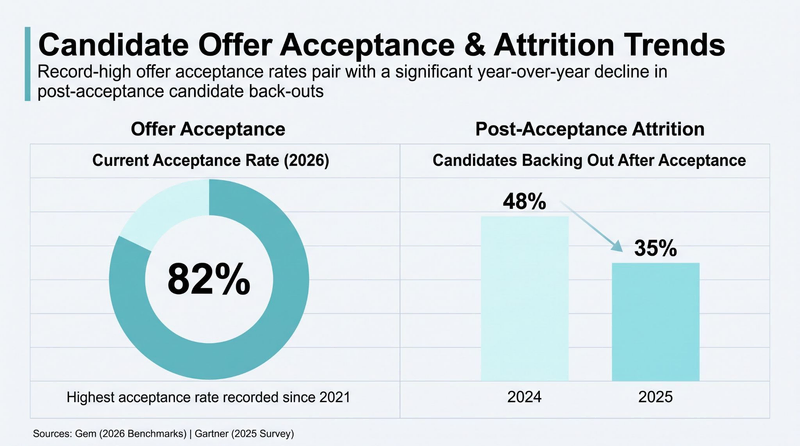
The offer acceptance rate reflects whether the agency is presenting candidates who are genuinely aligned with the role, compensation, and culture. Gem’s 2026 Recruiting Benchmarks Report places the current acceptance rate at 82%, the highest since 2021. Gartner’s survey found that 35% of candidates still backed out after accepting a job offer, down from 48% a year earlier. A staffing partner whose offer acceptance rate consistently falls below the industry benchmark may be misreading role requirements or failing to set accurate expectations with candidates.
Retention of placed candidates at the 90-day and six-month marks indicates whether the agency’s screening process identifies individuals who fit the organization’s operational reality. The CIPD/Omni RMS 2024 report found that 41% of organizations experienced new recruits resigning within the first 12 weeks, while 27% reported selected candidates failing to appear on their first day. Gallup estimates that replacing an individual employee costs 50% to 200% of their annual salary depending on role seniority. High early-attrition rates signal a gap between the agency’s candidate evaluation criteria and the client’s day-to-day work environment.
Beyond quantitative metrics, the quality of ongoing communication separates productive partnerships from stagnant ones. ClearlyRated’s 2024 NPS benchmarks for the staffing industry found that the largest improvements in client satisfaction between 2023 and 2024 came from timeframe of service delivery (+8 points), proactive approach to service (+6 points), and understanding client needs (+5 points). Progress updates should include actionable detail on sourcing channel performance, candidate feedback patterns, and market conditions that could affect search parameters. An agency that shares this level of insight demonstrates active investment in the client’s hiring objectives rather than a passive fulfillment role.
A structured review cadence closes the evaluation loop. For high-volume engagements, a quarterly formal review comparing the agency’s performance data against the benchmarks set at kickoff keeps both sides accountable. Lower-volume partnerships benefit from biannual reviews. In both cases, an initial 90-day review at the start of a new relationship sets expectations early and surfaces calibration issues before they compound. The review should compare actual time-to-fill, cost-per-hire, quality of hire indicators, and retention rates against the targets defined during onboarding, while also revisiting scope to ensure the engagement reflects any shifts in the client’s workforce strategy.
The table below summarizes the metrics and benchmarks discussed in this section:
| Metric | Industry benchmark (2026) | What it reveals |
|---|---|---|
| Time-to-fill (nonexecutive) | Median 44 days | Whether the agency maintains speed as volume increases |
| Time-to-fill (executive) | Median 45 days | Efficiency of senior-level search processes |
| Cost-per-hire (nonexecutive) | Median $1200 / Average $5475 | Agency cost efficiency relative to market norms |
| Cost-per-hire (executive) | Median $10625 / Average $35879 | Whether executive search costs are proportionate to outcomes |
| Offer acceptance rate | 82% | Alignment between candidates presented and role fit |
| Post-offer back-out rate | 35% (Q1 2025) | Candidate commitment and expectation management |
| Early attrition (within 12 weeks) | 41% of employers affected | Post-placement screening effectiveness and cultural fit |
| Cost of replacing an employee | 50%-200% of annual salary | Financial risk of poor placement quality |
Company size: ~60 employees
Founding year: 2016
Website: www.devsdata.com
Headquarters: Brooklyn, NY, and Warsaw, Poland
DevsData LLC specializes in human resources staffing solutions, supporting businesses with end-to-end recruitment across multiple sectors and geographies. With over nine years of experience, the company has established itself as a trusted partner for both global corporations and high-growth startups, including clients from the US, Israel, Europe, and beyond. Its team includes US-based specialists who bring strong market insight and ensure seamless collaboration with international clients.
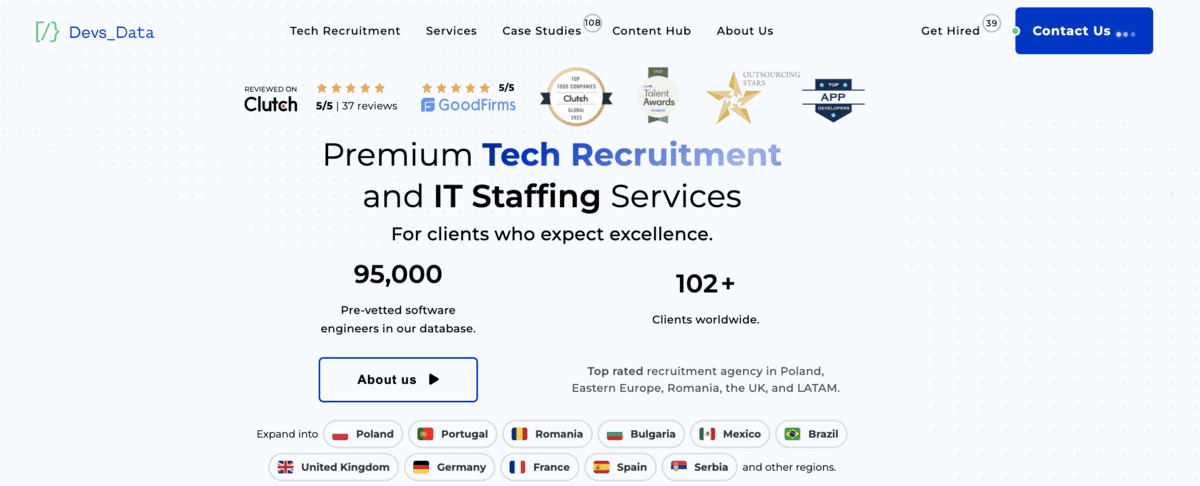
One of DevsData LLC’s key strengths lies in its access to talent. The agency maintains a database of 95000 pre-screened candidates, covering a wide spectrum of roles and seniority levels. Over the years, DevsData LLC has successfully completed 100+ recruitment projects for more than 100 clients, consistently meeting diverse hiring needs. Its expertise is reinforced by an official, government-approved recruitment license, a mark of compliance and professionalism that many competitors lack.
The company’s approach is designed to minimize risk for clients. DevsData LLC operates on a success fee model, ensuring that clients only pay when a candidate is successfully placed. In addition, it offers a guarantee period, replacing candidates at no additional cost if they leave early. This accountability is backed by a rigorous interview process, including a 90-minute problem-solving challenge that evaluates both technical expertise and critical thinking. Candidates are also screened for excellent communication skills, ensuring cultural fit and workplace readiness.
DevsData LLC’s dedication to quality and client satisfaction is reflected in its strong reputation, holding a 5/5 rating on both Clutch and GoodFirms. This track record, combined with a proven methodology and global reach, makes DevsData LLC a reliable choice for companies seeking tailored HR staffing solutions.

Among the many recruitment projects completed by DevsData LLC, a notable example is its collaboration with BNP Paribas, one of Europe’s leading banking institutions. The task was to staff senior Java software engineers for the bank’s IT division under demanding timelines and strict technical requirements.
Project scope:
The outcome was the successful placement of all seven engineers, who quickly integrated into BNP Paribas’ technology teams and contributed to mission-critical initiatives. DevsData LLC’s 95000-candidate database allowed the team to identify qualified professionals who were not actively visible on public job platforms, while specialized outreach across niche engineering communities in Central and Southern Europe surfaced passive candidates that a conventional search would have missed.
Struggling to fill critical roles? Reach out to DevsData LLC and gain access to a pre-vetted network of 95000+ professionals worldwide. Contact DevsData LLC at general@devsdata.com or visit their website at www.devsdata.com.
Do you have recruitment needs?
Human resources staffing agencies have become essential partners for organizations navigating an increasingly competitive talent market. By offering flexible workforce models, leveraging advanced technologies, and addressing critical skill shortages, these agencies enable businesses to focus on growth while ensuring their teams remain strong and adaptable. Beyond filling vacancies, they play a strategic role in aligning talent acquisition with broader organizational goals.
At the same time, choosing the right partner requires careful evaluation. Businesses need agencies that not only provide access to wide candidate networks but also demonstrate transparency in methodology, compliance expertise, and adaptability to changing hiring demands. Asking the right questions at each stage – from sourcing and screening to compliance and performance – helps ensure that collaboration delivers tangible, long-term value.
DevsData LLC stands out as a reliable partner in this landscape. With over nine years of experience, an extensive database of 95000 candidates, and a proven record of 100+ recruitment projects for more than 100 clients, the company combines reach with rigor. Its success fee model, guarantee periods, and uniquely demanding 90-minute problem-solving challenge ensure accountability and quality. Backed by a government-approved recruitment license, a global client base spanning the US and Israel, and top ratings on Clutch and GoodFirms, DevsData LLC consistently demonstrates the expertise and reliability businesses need in a staffing partner.
Looking to strengthen your team with top talent? Connect with DevsData LLC today to explore tailored HR staffing solutions that fit your business needs. Contact DevsData LLC at general@devsdata.com or visit their website at www.devsdata.com.
Any questions or comments? Let me know on
Twitter/X.
Discover how IT recruitment and staffing can address your talent needs. Explore trending regions
like Poland, Portugal, Mexico, Brazil and more.
 Frequently asked questions (FAQ)
DevsData – your premium technology partner
DevsData is a boutique tech recruitment and software agency. Develop your software project with veteran engineers or scale up an in-house tech team of developers with relevant industry experience.
Free consultation with a software expert
🎧 Schedule a meeting
FEATURED IN

DevsData LLC is truly exceptional – their backend developers are some of the best I’ve ever worked with.”

Nicholas Johnson
Mentor at YC, serial entrepreneur


 Build your project with our veteran developers.
Explore the benefits of technology recruitment and tailor-made software.
Learn how to source skilled and experienced software developers.
Build your project with our veteran developers.
Explore the benefits of technology recruitment and tailor-made software.
Learn how to source skilled and experienced software developers.

Rebecca Botvin

Commercial Director

Tom Potanski
Manager




Categories: Big data, data analytics | Software and technology | IT recruitment blog | IT in Poland | Content hub (blog)















careers@devsdata.com









general@devsdata.com

"I interviewed about a dozen different firms. DevsData LLC is truly exceptional – their backend developers are some of the best I've ever worked with. I've worked with a lot of very well-qualified developers, locally in San Francisco, and remotely, so that is not a compliment I offer lightly. I appreciate their depth of knowledge and their ability to get things done quickly."

Nicholas Johnson
CEO of Orange Charger LLC,
Ex-Tesla Engineer,
Mentor at YCombinator
"DevsData reached out to us, as we've been looking to grow our engineering team in Europe and Poland. Communicating efficiently and professionally, DevsData made a strong impression with their understanding of the recruitment challenges we were facing. They designed a tailored recruitment process for our needs. I was impressed with the technical depth of their approach."

Karim Butt
Co-Founder & CTO at GlossGenius, Inc.
"Out of all the vendors we work with, DevsData clearly stands out. The quality of developers they deliver is beyond what we've received from any other vendor, and they've been able to send profile recommendations very quickly. I'm happy to be their reference for other companies from Israel and talk about their recruitment abilities and what they delivered for us."

Ran Eyal
Senior Manager at
ZIM Integrated
Shipping Services Ltd.
"DevsData demonstrated a strong degree of proactivity, taking time to thoroughly understand the problem and business perspective, and continuously suggesting performance and usability enhancements. Their app exceeded my expectations. I've worked with DevsData on numerous projects over the last 3 years and I'm very happy. Being both responsive and honest in communication."

Jonas Lee
Partner & Executive VP of Verus,
Financial LLC, Investor,
& Serial Entrepreneur
Acknowledgments