Thanks for subscribing.
Your gift is on the way.
 Link copied



WebRTC is an open source framework that allows browsers and mobile apps to transmit audio, video, and data directly between users without plug-ins. It has become a common foundation for building real-time communication capabilities in web and mobile platforms. For businesses building user-facing platforms or internal collaboration tools, this translates into faster deployment, broader accessibility, and tighter control over the user experience. In practice, this often enables features such as in-browser video consultations with screen sharing or real-time customer support calls launched directly from a web application, without requiring users to install separate apps.
The scale of adoption highlights WebRTC’s growing commercial relevance. The global WebRTC market exceeded USD 7 billion in 2024 and is forecast to grow at a compound annual growth rate of nearly 40%, reaching the value of USD 94.07 billion by 2032, driven by rising demand for real-time communication capabilities in digital products. This growth reflects a broader shift toward interactive, low-latency services as expectations around immediacy and responsiveness increase across web and mobile environments. As WebRTC moves from a supporting technology to a core architectural component, its implementation quality has a direct impact on product stability, performance, and long-term operating costs.
However, while WebRTC lowers barriers for end users, it raises the technical bar for development teams. Production-grade WebRTC systems require expertise in networking, media handling, browser behavior, security, and scalable infrastructure design. As a result, businesses often find that recruiting WebRTC developers is significantly more complex than hiring general frontend or backend engineers. In Western markets in particular, experienced WebRTC specialists remain scarce, extending hiring timelines and increasing the cost of trial-and-error recruitment.
This article draws on DevsData LLC’s experience in WebRTC recruitment to explore when businesses need WebRTC developers, how the market for this expertise is evolving, and what challenges commonly arise during hiring. It also outlines how to evaluate WebRTC recruitment agencies, what distinguishes reliable partners, and how specialized recruitment can help businesses reduce risk while accelerating delivery.
Businesses typically require WebRTC developers when real-time interaction becomes a core part of the product or service, rather than an auxiliary feature. WebRTC is most valuable in environments where latency, reliability, and security directly influence user outcomes or operational efficiency. While its browser-native model lowers barriers for end users, the complexity of production-grade implementations makes developer expertise a decisive factor in whether WebRTC delivers measurable business value.
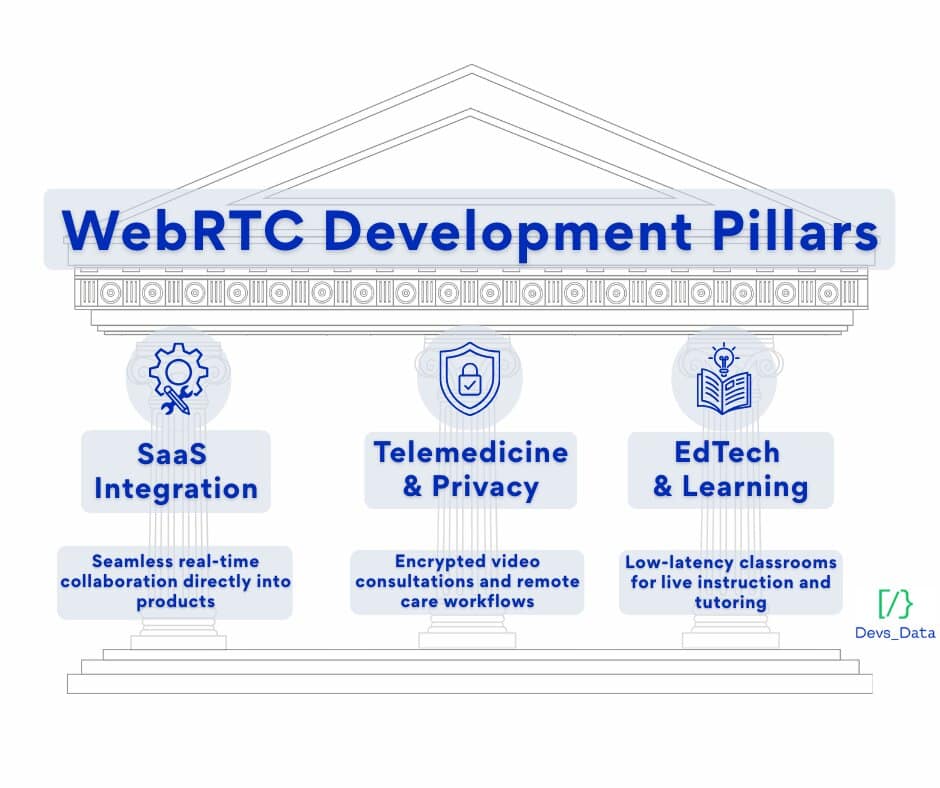
SaaS products increasingly embed real-time features directly into their platforms to avoid reliance on third-party tools. Customer support platforms, for instance, offer in-app video calls from help desks, and collaboration tools route voice conversations through shared workspaces without external conferencing software. WebRTC enables this integration without licensing costs, while its peer-to-peer and selective forwarding models help reduce infrastructure spend as usage scales. For businesses, the benefit is twofold: faster user adoption due to seamless in-app experiences and lower long-term operating costs compared to proprietary real-time communication solutions. These gains depend on developers who understand scaling strategies, browser behavior, and media routing.
Healthcare organizations use WebRTC to support secure video consultations and remote care workflows. Virtual visits now represent approximately 17% of patient interactions, reflecting a sustained shift toward digital care delivery. Providers report operational improvements such as reduced appointment turnaround times and per-visit costs up to 50% lower compared to in-person care. WebRTC’s mandatory encryption supports compliance requirements, but stability and security depend heavily on correct implementation, making experienced WebRTC developers essential to maintaining service reliability.
Online education platforms rely on WebRTC for interactive classrooms, tutoring, and live instruction. With over 30% of internet users in Europe participating in online learning, demand for low-latency, scalable video systems continues to grow. Poorly implemented real-time features can lead to dropped sessions, degraded learning experiences, and user churn. Skilled WebRTC developers help ensure consistent session quality and platform scalability, directly affecting retention and engagement metrics.
Across sectors, the recurring risk is the same: Underqualified teams produce unstable WebRTC systems that create outages, user churn, and costly rebuilds. A specialized recruitment agency addresses this by identifying developers with verified production experience. The result is shorter hiring timelines and fewer failed implementations, both of which reduce the total cost of delivering real-time features.
However, not every product that uses real-time communication requires a dedicated WebRTC Developer. The Communications Platform as a Service (CPaaS) market reached USD 14.05 billion in 2024, and Gartner projects 90% of businesses will use a CPaaS platform by 2028\. Managed platforms from providers such as Agora, Vonage, and Amazon Chime SDK now include no-code visual builders alongside traditional APIs, enabling teams to embed video and voice features without protocol-level engineering.
When real-time communication serves as an auxiliary feature rather than a core product differentiator, and when usage volumes remain within standard pricing tiers, a CPaaS integration handled by a general full stack Developer is often sufficient. Dedicated WebRTC expertise becomes necessary at the point where custom media routing, proprietary encryption, or infrastructure-level optimization directly affects product performance and cost structure.
As WebRTC becomes embedded in business-critical products, its implementation quality directly affects reliability and user trust, not just technical performance.
The WebRTC market has moved from niche adoption to mainstream deployment as real-time communication becomes embedded in digital products. Growth is driven by structural shifts toward interactive services, browser-based delivery, and low-latency user experiences. As WebRTC transitions into core infrastructure for many platforms, the market dynamics increasingly influence how companies hire, evaluate, and retain specialized development talent.
The global WebRTC market exceeded USD 9 billion in 2025 and is projected to reach USD 122.08 billion by 2034, growing with a compound annual growth rate (CAGR) of 32.21%. This pace reflects long-term investment rather than short-term demand spikes, as businesses commit to real-time communication as a core capability. From a recruitment perspective, rapid market expansion intensifies competition for experienced WebRTC developers, particularly those who have worked on production systems at scale.
North America remains the most established WebRTC market, with deployments valued at USD 3.55 billion in 2025 and projected to reach USD 4.81 billion in 2026, driven by demand across healthcare, education, and remote work. Europe follows as another mature region, supported by widespread digitalization, regulatory requirements, and expanding 5G infrastructure. While Asia-Pacific is expected to grow fastest, Western markets are defined by large-scale, production-grade WebRTC systems already in operation. This maturity shifts hiring demand from initial implementation to developers capable of maintaining, optimizing, and evolving complex real-time systems, narrowing the available talent pool and raising technical expectations.
WebRTC is no longer confined to pilot projects or optional features. It now underpins essential workflows such as remote collaboration, customer interaction, and service delivery. As reliability expectations rise, companies seek developers with experience in high-availability setups, failure handling, and performance optimization. Recruitment increasingly focuses on proven production experience rather than theoretical familiarity with the protocol.
Modern WebRTC implementations often involve media servers, load balancing, NAT traversal, and cross-browser compatibility management. This growing complexity reduces the overlap between general frontend/backend developers and true WebRTC specialists. For recruiters, this trend translates into longer hiring cycles unless screening processes are tailored to identify low-level networking and media expertise early.
AI is increasingly being embedded into real-time communication workflows, from noise suppression and background replacement to automated transcription and sentiment analysis during live calls. WebRTC Developers working on modern products are now expected to integrate these AI-powered features alongside their core media pipeline work. This convergence adds another layer to recruitment complexity, since candidates must demonstrate familiarity with machine learning APIs and real-time inference in addition to traditional protocol-level expertise.
WebRTC developer roles command above-average compensation, with US salaries averaging over USD 110000 annually. This reflects a broader talent shortage in specialized engineering roles. Businesses that rely on generalist recruitment approaches often face extended vacancies or mis-hires, reinforcing the value of recruitment partners with domain-specific screening capabilities.
Together, these trends indicate that WebRTC hiring is shaped as much by market maturity and technical depth as by overall growth, making specialized recruitment an operational necessity rather than a convenience.
WebRTC is governed by more than 50 protocol standards from the IETF and a W3C Recommendation that was still receiving updates as recently as March 2025\. That standard footprint is far broader than most web technologies, which is why hiring for WebRTC roles cannot follow a generalist screening approach. A 2024 systematic review of 83 research papers published in evaluated WebRTC systems across six criteria: user experience, network connectivity, security, server infrastructure, interoperability, and real-time performance. Those categories map to the core competency areas outlined below, each of which carries distinct implications for recruitment screening.
The W3C specification deliberately excludes signaling, meaning every WebRTC product must build its own mechanism for initiating and managing sessions. Developers choose from established protocols such as SIP or XMPP, or design custom implementations, while coordinating session descriptions through the JSEP framework (RFC 8829). For businesses, signaling quality directly affects call setup time, reconnection behavior, and system resilience under load. Because third-party SDKs abstract this layer away, candidates who have only used managed platforms may never have built signaling from scratch. This makes signaling design one of the most reliable indicators of production-level experience during recruitment screening.
Establishing peer connections through firewalls and corporate networks requires the ICE framework (RFC 8445), which coordinates address discovery via STUN servers and relay fallback through TURN (RFC 8656). Failures at this layer appear as silent call drops or degraded audio that end users report but internal teams struggle to reproduce. Diagnosing these issues demands protocol-level understanding that general frontend or backend Engineers rarely possess. Recruitment screening should test a candidate’s ability to reason about connection fallback strategies and relay server configuration, since connectivity reliability in diverse network environments is often the difference between a stable product and persistent support escalations.
IETF standards require all WebRTC endpoints to support specific video and audio codecs, including VP8, H.264 Constrained Baseline, Opus, and G.711. In practice, however, the challenge extends well beyond codec compliance. Production systems must manage adaptive bitrate strategies that respond to fluctuating network conditions in real time. A 2025 academic study on adaptive forwarding architectures found that server-side bitrate tuning combined with keyframe caching prevented 73% of decoder stalls and improved video quality by 14%. For hiring managers, this competency area separates Developers who can maintain call quality at scale from those whose implementations degrade under real-world network variability.
WebRTC mandates encryption on every media stream. RFC 8827 requires DTLS-SRTP with forward-secrecy cipher suites, and RFC 8826 defines a threat model covering risks from signaling-layer interception to identity spoofing. For organizations in regulated industries, NIST SP 800-52 Rev. 2 adds compliance requirements around certificate handling and transport-layer configuration. Security failures in real-time communication systems carry operational risk beyond data breaches: they can result in service outages, compliance violations, and loss of user trust. Candidates should demonstrate familiarity with encryption negotiation failures and the ability to audit security configurations in production environments.
Most production WebRTC deployments route media through a Selective Forwarding Unit (SFU) rather than relying on peer-to-peer connections or Multipoint Control Units (MCU). The 2025 adaptive SFU study confirmed that MCU architectures consume roughly ten times more server resources because they decode, mix, and re-encode every stream. This cost differential makes architecture selection a business decision with direct infrastructure budget implications. Four open source frameworks dominate the space: Janus, mediasoup, Pion, and Kurento. Candidates for server-side roles should be able to explain why one framework fits a given use case better than another and how scaling strategies change as concurrent user counts grow.
WebRTC exposes real-time telemetry through the getStats() API, reporting packet loss, round-trip time, jitter, and bitrate per active connection. Even small levels of packet loss can degrade audio quality severely, while round-trip times exceeding 200 milliseconds create perceptible delay for users. A 2025 study on WebRTC quality under constrained network conditions found that platforms vary widely in how they handle limited bandwidth, which underscores the value of Developers who can configure monitoring dashboards, define alert thresholds, and tune adaptive quality responses. For businesses, this competency translates directly into fewer escalated support tickets and more consistent user experience across variable network environments.
Knowing which of these competencies a specific role requires is the starting point for an effective hiring process. A Gartner survey found that 51% of managers demand candidates who possess every desired skill, an approach that drastically shrinks candidate pools in a field where IDC projects a global developer shortage of 4 million. A more practical strategy uses the matrix above as modular: identifying which competencies the project scope demands immediately, which can be developed on the job, and where a specialized recruitment partner can apply domain-specific screening to close the gap efficiently.
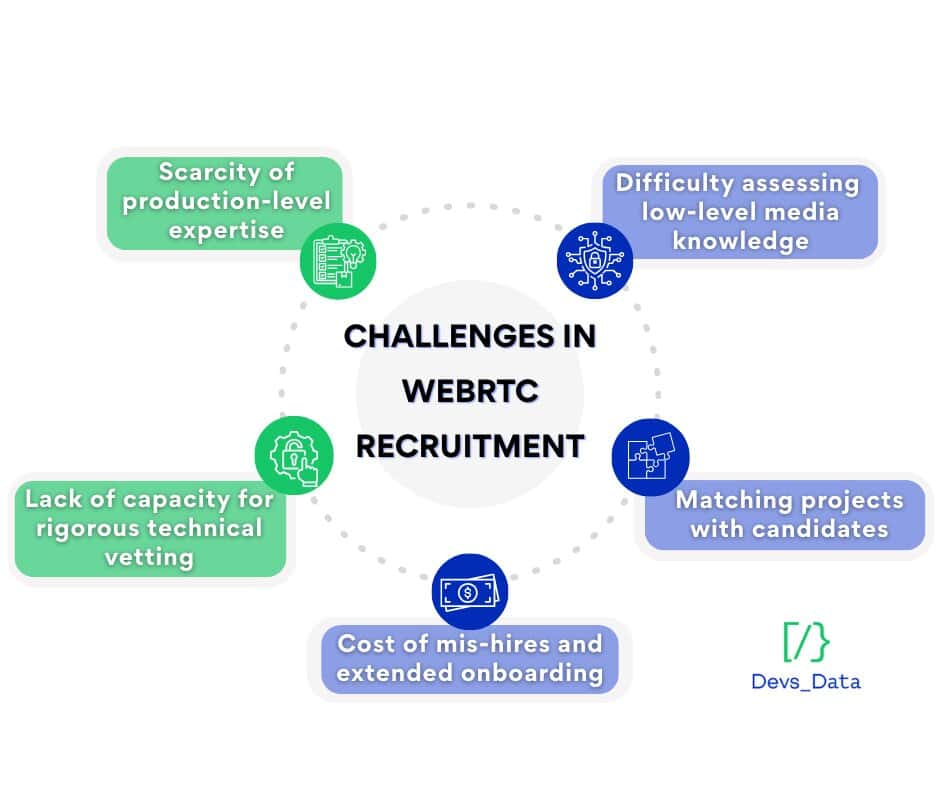
Recruiting WebRTC developers presents a distinct set of challenges that differ from standard frontend or backend hiring. The technical skills matrix above outlines the depth of knowledge required across signaling, connectivity, media processing, security, server architecture, and diagnostics. Translating those technical requirements into effective recruitment criteria is where most hiring processes fall short. WebRTC sits at the intersection of real-time media, networking, and distributed systems, which significantly narrows the pool of production-ready candidates. Below are the most common recruitment challenges in this space and the strategies DevsData LLC applies to address them.
Many developers list WebRTC experience based on SDK usage or limited feature implementation, often through third-party platforms such as Twilio Video, Agora, Vonage (TokBox/OpenTok), Daily, or Amazon Chime SDK, without having worked directly with core WebRTC APIs, signaling design, or media pipeline optimization. As WebRTC increasingly underpins business-critical functionality, this gap leads to a high volume of candidates who appear qualified on paper but lack experience operating real-time systems under load and failure conditions.
The DevsData solution
DevsData LLC focuses on candidates with demonstrated experience in live, user-facing WebRTC systems, prioritizing hands-on exposure to real-world constraints such as scaling, reliability, and performance trade-offs.
WebRTC development requires understanding media pipelines, signaling, NAT traversal, and browser-specific behavior. These competencies are often invisible in resumes and difficult to validate through conventional interviews, increasing the risk of hiring developers who cannot diagnose latency, packet loss, or connectivity issues in production.
The DevsData solution
DevsData LLC applies framework and domain-specific technical screening, evaluating candidates on practical scenarios related to real-time communication rather than abstract algorithmic tasks.
WebRTC roles vary widely depending on whether a company relies on open-source media servers, managed communication platforms, or custom infrastructure. Without careful alignment, candidates may struggle to adapt their prior experience to a different architectural model, slowing delivery and increasing rework.
The DevsData solution
DevsData LLC aligns each role upfront, mapping technical requirements to candidate experience and filtering accordingly to ensure alignment with the client’s stack and delivery model.
WebRTC developers are often expected to contribute quickly to complex systems with limited documentation or prior abstractions. Mis-hires frequently result in prolonged onboarding periods, increased reliance on senior engineers, and delayed product milestones.
The DevsData solution
By emphasizing production readiness and communication skills alongside technical depth, DevsData reduces onboarding risk and improves time-to-productivity.
Many organizations lack internal expertise to properly assess WebRTC-specific skills, particularly in non-core engineering teams or early-stage companies. This limitation forces hiring managers to rely on surface indicators such as past job titles or tool familiarity, which rarely correlate with real-world performance.
The DevsData solution
DevsData LLC operates as an extension of the client’s technical team, conducting WebRTC-specific technical interviews, evaluating production-level media pipeline experience, and assessing candidates’ ability to troubleshoot connectivity and performance issues under real-world conditions. This structured, domain-aware evaluation process allows DevsData LLC to address the structural challenges of WebRTC recruitment, helping businesses secure specialists who can deliver stable, scalable real-time communication systems with lower risk and greater predictability.
Hiring WebRTC developers requires prioritizing production-ready expertise in real-time systems, where architectural mistakes can carry significant operational cost.
WebRTC developers work on latency-sensitive, user-facing systems where mistakes in architecture, security, or scaling can translate into outages, churn, and rework. A reliable agency should therefore demonstrate clear capability in role scoping, domain-specific screening, and predictable delivery. In practice, this means the agency defines the technical requirements for each position, sources candidates with verified WebRTC production experience, conducts protocol-level technical evaluations, coordinates the interview process, and provides post-placement support during onboarding.
Start by clarifying what “WebRTC developer” means for your business: one-to-one calling, group conferencing, live streaming, or embedded support calls. Confirm whether you need browser-only WebRTC, mobile integration, or server-side media routing (e.g., SFU-based architectures), and what “good performance” means (latency, stability, concurrency).
A credible agency should be able to explain how it evaluates real-time expertise, including networking fundamentals, media pipeline understanding, cross-browser behavior, and production troubleshooting. Generic coding tests are not sufficient for WebRTC roles.
WebRTC projects vary significantly depending on whether you use CPaaS tools, open-source media servers, or custom infrastructure. The agency should demonstrate how it matches candidates to your stack and constraints rather than sending broadly “relevant” profiles.
Ask for clarity on timelines, interview coordination, feedback loops, and replacement/guarantee terms. WebRTC hiring often involves scarce talent, so process discipline and expectation-setting are essential.
Because WebRTC work frequently intersects with product, DevOps, and support teams, communication quality matters. Ensure the agency screens for collaboration skills, documentation habits, and ability to work across time zones.
Questions to ask at each step
The table below translates the selection steps above into practical questions that help businesses assess whether a WebRTC recruitment agency has the technical depth and process maturity required for real-time communication roles.
| Step | What you are validating | Questions to ask before moving forward |
|---|---|---|
| Define scope | Role clarity and technical alignment | What details do you need about our use case (1:1, group calls, streaming)? Do we need SFU/MCU experience or CPaaS integration? What performance and reliability targets should we define upfront? |
| Verify vetting | Ability to screen WebRTC-specific competence | How do you test networking/media pipeline knowledge? Do you run scenario-based evaluations for latency, NAT traversal, and browser compatibility? Who conducts the technical screening? |
| Validate matching | Project-fit rather than keyword matching | How do you differentiate candidates with CPaaS-only experience vs infrastructure-level WebRTC work? How do you map candidate experience to our stack? What evidence do you require to confirm that production WebRTC works? |
| Review process | Predictable delivery and accountability | What is your expected time-to-shortlist? How many candidates do you typically screen per final shortlist? What is your replacement/guarantee policy? How do you manage drop-offs and counteroffers? |
| Assess readiness | Communication and delivery reliability | How do you evaluate communication quality and remote collaboration? Can candidates work effectively across time zones? Do you screen for documentation and incident-response readiness? |
Taken together, these questions help shift agency selection from surface-level assurances to evidence-based evaluation. Agencies that can answer them clearly are more likely to operate with domain-aware screening, predictable delivery timelines, and realistic expectations around WebRTC hiring constraints. For businesses, applying this framework reduces the risk of mis-hires, shortens hiring cycles, and improves alignment between technical requirements and recruitment outcomes, particularly in roles where real-time performance and system reliability are business-critical.
With these evaluation criteria in mind, the following companies represent different approaches to WebRTC recruitment and talent delivery. Each offers distinct strengths in terms of specialization, scale, and engagement model, making them suitable for different business needs – from focused, boutique sourcing to larger, execution-oriented partnerships.
Company size: ~60 employees
Founding year: 2016
Website: www.devsdata.com
Headquarters: Brooklyn, NY, and Warsaw, Poland
DevsData LLC specializes in WebRTC developer recruitment, supporting companies that build real-time, latency-sensitive communication systems. With over ten years of experience in the recruitment market, DevsData LLC focuses on sourcing engineers capable of working on production-grade WebRTC implementations rather than experimental or SDK-level integrations. Beyond candidate sourcing, DevsData LLC advises clients on technology stack selection, market-rate benchmarking for WebRTC roles, and role responsibility structuring to align job descriptions with actual project demands. Its team includes US-based specialists, which helps align recruitment processes with market expectations around communication, delivery standards, and hiring rigor. DevsData LLC has worked with both global corporate clients and high-growth startups, delivering WebRTC and real-time engineering talent for companies operating across multiple regions, including the US and Israel.
The company’s recruitment capabilities are underpinned by a database of more than 95000 pre-vetted candidates, enabling targeted searches for highly specialized roles such as WebRTC developers. DevsData LLC has completed 100+ recruitment projects for over 80 clients, reflecting consistent delivery across technically demanding engagements. It operates with an official, government-approved license for recruitment services, an important factor for organizations seeking procedural transparency and compliance. Engagements are structured around a success-fee model, ensuring clients incur costs only upon successful placement, and are supported by a guarantee period to reduce hiring risk.
Recently, DevsData LLC collaborated with TokenMetrics, a rapidly scaling Web3 analytics platform, to support its expansion during a critical phase of product growth. Engagement focused on senior automation and Web3 engineering roles reflects challenges common to real-time, high-reliability systems. Those include complex release cycles, distributed teams, and performance-sensitive features. DevsData LLC delivered three senior specialists through a rigorous, multi-stage recruitment process designed to assess production readiness. The hires integrated quickly and strengthened platform stability while improving delivery predictability. Their production readiness from day one demonstrated how specialized technical recruitment reduces risk and accelerates outcomes in domains where real-time performance is business-critical.
From an execution standpoint, DevsData LLC emphasizes depth of technical evaluation and candidate readiness. Its screening process includes a 90-minute problem-solving interview, designed to assess real-world reasoning, system-level thinking, and practical WebRTC-related decision-making. Equal emphasis is placed on communication skills, reflecting the collaborative nature of real-time product development. This approach has translated into strong client feedback, with DevsData LLC holding a 5/5 rating on Clutch and GoodFirms, based on verified reviews.
Key highlights:
Reach out to DevsData LLC to discuss your WebRTC hiring needs and build a recruitment strategy aligned with your technical and business goals. Contact DevsData LLC at general@devsdata.com or visit their website at www.devsdata.com.
Website: www.nextideatech.com
Company size: ~10
Founding year: 2018
Headquarters: Boston, Massachusetts
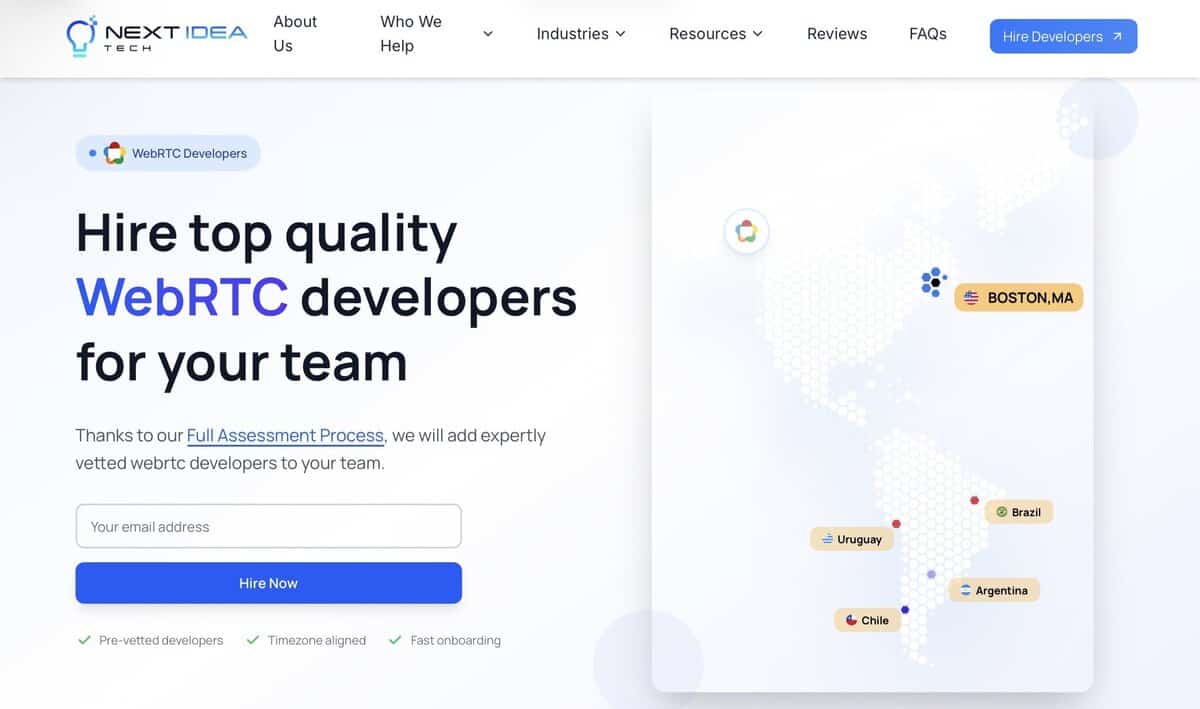
Next Idea Tech is a boutique software development and staffing provider focused on flexible team augmentation, placing external Developers directly into a client’s existing engineering team on a contract basis, with offerings that include WebRTC and real-time communication engineering. Its WebRTC capabilities span custom real-time features such as video calls, conferencing interfaces, and peer-to-peer media integrations, often embedded within broader application development initiatives. Next Idea Tech positions itself as a partner for organizations that need to quickly ramp up real-time functionality without building an internal team from scratch.
The company’s modest size allows it to be agile and responsive, which can be advantageous for startups or smaller teams that require adaptable resourcing and hands-on coordination. At the same time, this scale can limit capacity for large-volume hiring or highly specialized search operations compared with larger recruitment firms. As a result, Next Idea Tech is particularly suited for businesses seeking team augmentation or project-level WebRTC development support rather than extensive, multi-role recruitment pipelines. Their flexibility and focus on integration make them a practical partner for early-stage real-time feature implementation and iterative product work.
Key highlights:

Website: www.cortance.com
Company size: ~10
Founding year: 2022
Headquarters: Tallinn, Estonia
Cortance is a boutique talent provider and software development partner that focuses on delivering on-demand engineering support, including WebRTC and real-time communication specialists. The company caters to startups and scaling teams that need selective expertise quickly without committing to long internal hiring cycles. Cortance’s WebRTC offering is tailored to projects requiring real-time audio, video, and data capabilities embedded into web and mobile applications.
Cortance’s small size allows it to align quickly on role requirements and adapt sourcing to each client’s real-time communication needs. That same scale limits capacity for concurrent hiring compared with larger agencies. The firm is well positioned for companies filling a focused set of WebRTC roles rather than running large-scale recruitment pipelines.
Key highlights:
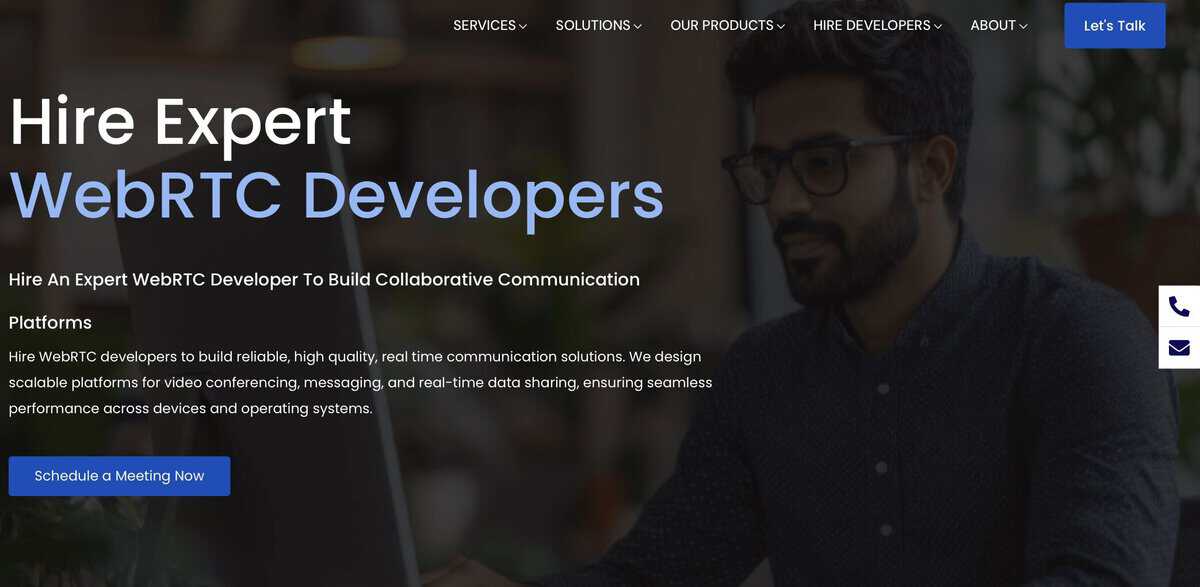
Website: www.inextrix.com
Company size: ~75
Founding year: 2010
Headquarters: Ahmedabad, India
Inextrix is a midsize software development and outsourcing firm with a decade-long track record of delivering WebRTC talent and real-time communication solutions. The company offers a combination of team augmentation and full-cycle development support, helping clients accelerate the buildout of interactive features. Its WebRTC expertise spans both frontend and backend integrations, with engineers capable of working on signaling, media routing, and scalable infrastructure components.
The firm’s size allows for a balance between agility and resourcing capacity. With around 75 professionals in its network, Inextrix can support multi-role hiring or extended engagement needs for mid-sized and growing businesses. At the same time, as an outsourcing-oriented provider, Inextrix focuses on delivering working teams and project output rather than conducting deep individual candidate screening. Companies that require rigorous, role-specific technical vetting for standalone WebRTC positions may find this model less aligned with their evaluation needs.
Key highlights:
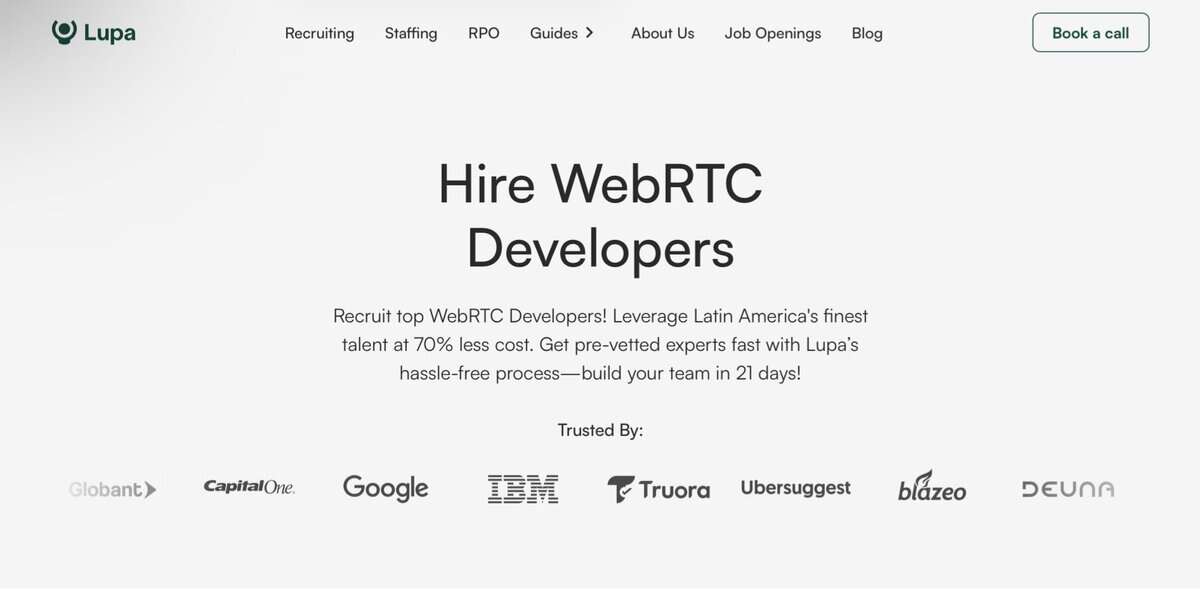
Website: lupahire.com/hire/WebRTC-developers
Company size: ~50
Founding year: 2021
Headquarters: Pittsburgh, Pennsylvania
LupaHire is a recruitment technology platform and talent partner focused on connecting companies with specialized tech professionals, including WebRTC developers and engineers. The company combines curated candidate sourcing with tools designed to surface talent aligned to client technical needs. Its approach emphasizes structured pipelines and candidate engagement workflows, combining platform-based search with hands-on recruitment support. This model helps teams fill roles that require both real-time expertise and broader software development capability.
With a team of around 50 professionals, LupaHire balances personalized service with scalable delivery, making it suitable for small to mid-sized companies that need focused WebRTC hiring without the overhead of large outsourcing providers. Its size enables attentive coordination and client responsiveness. LupaHire is particularly relevant for businesses seeking targeted recruitment support with streamlined candidate pipelines.
Key highlights:
WebRTC has moved from a supporting technology to a core enabler of modern digital products. As real-time communication becomes embedded in SaaS platforms, healthcare services, education tools, and customer-facing applications, the quality of WebRTC implementation increasingly determines performance, reliability, and user trust. While the technology lowers barriers for end users, it raises the technical bar for development teams. Building and maintaining production-grade WebRTC systems requires specialized expertise in networking, media handling, security, and scalable infrastructure – skills that are difficult to source through generalist hiring approaches.
The market dynamics around WebRTC reinforce this challenge. Rapid adoption, growing technical complexity, and persistent talent scarcity have made WebRTC recruitment both time-sensitive and high-risk. Businesses that rely on improvised hiring or surface-level screening often face extended vacancies, misaligned hires, or architectural compromises that slow delivery. By contrast, a structured recruitment approach, the one that emphasizes role clarity, domain-specific vetting, and project-fit alignment, helps reduce uncertainty and accelerates outcomes. Evaluating recruitment agencies through a technical lens, rather than treating them as interchangeable vendors, is a critical step in this process.
DevsData LLC applies this specialized approach to WebRTC recruitment by combining deep technical screening, a large pre-vetted talent pool, and a delivery model designed to minimize hiring risk. With over nine years of market experience, US-based specialists, and a proven track record across global enterprises and high-growth startups, DevsData LLC supports businesses seeking WebRTC developers who can contribute from day one. Its success-fee model, guarantee period, and rigorous interview process, including a 90-minute problem-solving challenge, are structured to prioritize quality, predictability, and long-term fit over speed alone.
Any questions or comments? Let me know on
Twitter/X.
Discover how IT recruitment and staffing can address your talent needs. Explore trending regions
like Poland, Portugal, Mexico, Brazil and more.
 Frequently asked questions (FAQ)
DevsData – your premium technology partner
DevsData is a boutique tech recruitment and software agency. Develop your software project with veteran engineers or scale up an in-house tech team of developers with relevant industry experience.
Free consultation with a software expert
🎧 Schedule a meeting
FEATURED IN


DevsData LLC is truly exceptional – their backend developers are some of the best I’ve ever worked with.”

Nicholas Johnson
Mentor at YC, serial entrepreneur


 Build your project with our veteran developers.
Explore the benefits of technology recruitment and tailor-made software.
Learn how to source skilled and experienced software developers.
Build your project with our veteran developers.
Explore the benefits of technology recruitment and tailor-made software.
Learn how to source skilled and experienced software developers.

Rebecca Botvin

Commercial Director

Tom Potanski
Manager




Categories: Big data, data analytics | Software and technology | IT recruitment blog | IT in Poland | Content hub (blog)
Email copied
And many other regional partners across Latin and North America, as well as Central and Eastern Europe. Let's talk.
















careers@devsdata.com









general@devsdata.com

"I interviewed about a dozen different firms. DevsData LLC is truly exceptional – their backend developers are some of the best I've ever worked with. I've worked with a lot of very well-qualified developers, locally in San Francisco, and remotely, so that is not a compliment I offer lightly. I appreciate their depth of knowledge and their ability to get things done quickly."

Nicholas Johnson
CEO of Orange Charger LLC,
Ex-Tesla Engineer,
Mentor at YCombinator
"DevsData reached out to us, as we've been looking to grow our engineering team in Europe and Poland. Communicating efficiently and professionally, DevsData made a strong impression with their understanding of the recruitment challenges we were facing. They designed a tailored recruitment process for our needs. I was impressed with the technical depth of their approach."

Karim Butt
Co-Founder & CTO at GlossGenius, Inc.
"Out of all the vendors we work with, DevsData clearly stands out. The quality of developers they deliver is beyond what we've received from any other vendor, and they've been able to send profile recommendations very quickly. I'm happy to be their reference for other companies from Israel and talk about their recruitment abilities and what they delivered for us."

Ran Eyal
Senior Manager at
ZIM Integrated
Shipping Services Ltd.
"DevsData demonstrated a strong degree of proactivity, taking time to thoroughly understand the problem and business perspective, and continuously suggesting performance and usability enhancements. Their app exceeded my expectations. I've worked with DevsData on numerous projects over the last 3 years and I'm very happy. Being both responsive and honest in communication."

Jonas Lee
Partner & Executive VP of Verus,
Financial LLC, Investor,
& Serial Entrepreneur
Acknowledgments