Thanks for subscribing.
Your gift is on the way.



Enterprise resource planning systems run the operational core of most large organizations, and SAP holds a dominant position in that market. The company’s software supports financial reporting, supply chain management, human resources, and procurement processes across industries ranging from manufacturing to retail. This concentration of critical operations drives ongoing demand for professionals who can manage SAP environments.
That demand has intensified due to a specific deadline. SAP will end mainstream maintenance for its legacy ECC systems in 2027, requiring approximately 35000 customers worldwide to migrate to S/4HANA. The transition is proceeding slower than anticipated. Gartner research indicates that only 39% of ECC customers had completed the migration by the end of 2024, leaving thousands of organizations competing for qualified SAP Developers, Consultants, and Architects over the next two years.
Cloud adoption compounds this pressure. SAP’s push toward S/4HANA Cloud, the Business Technology Platform, and AI-powered features through SAP Business AI requires skill sets that differ from traditional on-premise expertise. Organizations now require professionals fluent in legacy ABAP codebases alongside SAP’s cloud-native tooling, including BTP integration suites and Fiori application development.
The talent supply has not kept pace. SAP executives have acknowledged a global shortage of project experts, while organizations report hiring timelines stretching beyond 60 days for specialized roles. Compensation has risen accordingly, and competition from major consulting firms intensifies the challenge for mid-market employers.
This article examines the SAP hiring landscape from a practical standpoint. It covers market dynamics shaping demand, regional salary benchmarks, common recruitment obstacles, and sourcing strategies that organizations use to address talent gaps.
The SAP Developer role has shifted from maintaining stable ABAP codebases to managing a broader technology surface. Today’s hires are expected to work across SAP Fiori frontends, BTP integration layers, and legacy backend logic simultaneously. That expansion reflects how S/4HANA migrations and cloud adoption have reshaped what organizations demand from a single role.
SAP Developers create the automation that cuts manual processing time across departments. They build interfaces linking SAP to customer relationship management platforms, warehouse management systems, and payment gateways. When regulations shift, they modify system configurations to meet updated tax laws, audit standards, and industry reporting mandates.
Certain operational situations make hiring SAP Developers unavoidable. The following scenarios represent common triggers:
The global ERP software market reached $92.6 billion in 2025 and continues expanding as organizations digitize core operations. Companies running SAP face a choice: maintain internal development capacity or rely on external partners for system modifications. The decision depends on project volume, system complexity, and how central SAP is to the broader technology architecture.
Do you have IT recruitment needs?
Demand for SAP Developers has followed a trajectory shaped by platform transitions, cloud adoption, and a fixed deadline that concentrates hiring pressure into a narrow window. The market is not experiencing gradual growth. It is responding to structural conditions that have compressed years of expected migration activity into a two-year period ending in 2027.
SAP’s decision to end mainstream maintenance for ECC systems in 2027 created a defined endpoint for legacy operations. The global SAP consulting market reached $18.08 billion in 2025 and is projected to grow to $38.98 billion by 2035 at a 9.8% compound annual growth rate. Much of this expansion reflects migration-related spending rather than net new implementations.
The pace of transitions has not matched expectations. At current migration rates of roughly 6000 customers annually, an estimated 17000 companies will miss the 2027 deadline, with 13000 projected to remain on legacy systems through 2030. Each of those organizations will need ongoing ECC support without the benefit of SAP mainstream maintenance, intensifying competition for a shrinking pool of legacy-qualified professionals.
SAP’s 2027 migration deadline has created a structural talent shortage that existing training pipelines cannot resolve, leaving organizations competing for a limited pool of professionals.
North America accounts for 34.20% of global ERP market spending, with more than 30000 active SAP Consultant positions in the United States alone. The UK holds 16.3% of the European ERP market and leads the continent in growth rate at 8.7% annually. Germany, where SAP originated, shows the fastest regional expansion by compound annual growth rate, driven by Industry 4.0 adoption across manufacturing sectors.
Competition for talent has intensified at the firm level, and it now runs across ERP platforms rather than within SAP alone. The top four SAP S/4HANA service providers captured approximately 50% of total revenue in 2023, concentrating expertise among Accenture, Deloitte, IBM, and Capgemini. The same integrators staff Oracle and Microsoft Dynamics practices, so a Consultant with strong configuration and integration skills can move between ecosystems rather than remaining tied to SAP. Mid-market employers and smaller SAP partners therefore compete not only against larger SAP practices but against every enterprise software vendor drawing on the same skill base.
SAP executives have acknowledged a global deficit of 30000 to 40000 project experts, a gap that existing training pipelines cannot close before the 2027 deadline. The ASUG Pulse of SAP Customer survey found that 37% of organizations cite staff knowledge and turnover as their primary obstacle to technology progress.
The shortage is not uniform across specializations. S/4HANA and cloud skills remain scarcer than legacy ECC expertise because fewer professionals have accumulated production experience with newer platforms. The data shows only 37% of ECC customers had licensed S/4HANA by Q2 2024, meaning most of the existing SAP workforce has limited exposure to the systems that employers now prioritize.
Organizations have adjusted recruitment approaches in response to these structural conditions. Average time to fill SAP specialist roles now reaches 60 to 90 days, extending further for S/4HANA and cloud professionals. The UK contractor market, for example, reflects this pressure, with median SAP Consultant rates at £550 per day and London commanding a 4.55% premium above the national figure.
Staff augmentation has grown as employers seek faster access to qualified professionals. A SAPinsider study found a 42% increase in companies adopting SAP staff augmentation in 2024, with users reporting 30% improvements in delivery timelines compared to traditional hiring. Geographic diversification has expanded as well, with organizations sourcing talent from Eastern Europe, Latin America, and India to supplement domestic capacity.
The market will remain constrained through the 2027 deadline and likely for several years afterward, because migrations continuing at roughly 6000 customers a year leave an estimated 13000 organizations on legacy systems as late as 2030. Every one of those companies needs ECC support at the same time its peers are staffing S/4HANA programs. Organizations that have not started migration planning face compressed timelines and elevated competition for available talent. Those already engaged in transitions must contend with project backlogs at service providers and upward pressure on compensation. The structural shortage has no near-term resolution, which means organizations that delay workforce planning risk stalling their SAP programs entirely.
Hiring SAP professionals presents obstacles that extend beyond standard technical recruitment. The combination of platform complexity, certification ambiguity, and global talent scarcity creates friction at every stage of the hiring process. Organizations that approach SAP recruitment without addressing these structural factors encounter delays, mis-hires, and project disruptions.
SAP certifications confirm theoretical knowledge but do not guarantee hands-on implementation experience. The problem has worsened as SAP certifications now expire after one year, requiring mandatory annual assessments through the Stay-Certified program. Counterfeit credentials have proliferated on professional networking platforms, making verification more difficult. An estimated 40% of candidates fail certification exams on the first attempt, yet fraudulent claims remain common.
The business impact is direct. Organizations that rely on certifications as a primary filter risk hiring candidates who cannot perform in production environments. Failed implementations lead to budget overruns, with 59% of S/4HANA transformations exceeding planned schedules and 49% surpassing original cost estimates.
DevsData LLC addresses this through structured screening that separates credential verification from competency assessment. The process evaluates candidates against specific SAP module expertise, project phase experience, and system landscape familiarity. Each shortlisted candidate comes with documented evidence explaining why their background matches the client’s environment and responsibilities, rather than a generic credential summary.
Certifications confirm theoretical knowledge but cannot guarantee production experience, making structured screening essential for identifying candidates who can deliver in live SAP environments.
Standard SAP recruitment timelines have stretched to 60 to 90 days for specialist roles, extending further for S/4HANA and cloud positions. These delays create project risk, particularly for organizations operating against the 2027 migration deadline.
The cost of extended vacancies compounds over time. Projects stall without required expertise, contractor costs increase to cover gaps, and competing employers secure candidates who might otherwise have accepted offers.
DevsData LLC operates with a clear schedule designed to compress timelines without sacrificing screening quality. The workflow includes regular pipeline updates, structured feedback loops, and transparent milestone tracking. Sourcing extends beyond job boards into SAP-specific channels, including ASUG community networks, SAP Community forums, and referral pipelines built through certified partner ecosystems. This focused outreach reaches professionals who are not actively monitoring open postings.
The top four SAP service providers capture approximately 50% of S/4HANA revenue. Accenture maintains over 15000 SAP-certified staff globally, while Deloitte fields 30000 SAP-focused professionals. These organizations offer career development paths, training budgets, and project variety that mid-market employers cannot easily replicate.
Smaller organizations and SAP partners find themselves competing for a reduced talent pool after large consultancies absorb available candidates. Compensation alone does not resolve the imbalance, as candidates weigh total career opportunity rather than immediate salary.
DevsData LLC helps clients position opportunities effectively against larger competitors. The approach involves understanding what motivates candidates beyond compensation, including project scope, technology exposure, remote work flexibility, and leadership access. Shortlists detail each candidate’s preferred project types, career progression goals, and remote work requirements, enabling clients to tailor their pitch and improve offer acceptance rates.
Global sourcing has become necessary for many organizations. The IT outsourcing market reached $588.38 billion in 2025 and continues growing as companies seek talent beyond domestic markets. Eastern Europe, Latin America, and India offer SAP professionals at lower cost points, but cross-border hiring introduces compliance, communication, and coordination challenges.
Time-zone differences affect collaboration on SAP projects that require real-time troubleshooting during month-end closes or go-live events. Employment regulations vary across jurisdictions, creating legal exposure for organizations unfamiliar with local requirements. Cultural differences in communication styles can lead to misaligned expectations between remote SAP Developers and onshore stakeholders.
DevsData LLC sources globally while screening for factors that determine cross-border success. Assessment covers not only technical qualifications but also language proficiency, time-zone overlap with client operations, and experience working with distributed teams. The process identifies candidates who can integrate into existing workflows rather than requiring significant adaptation from the client organization.
SAP implementations require coordination across finance, operations, IT, and executive leadership. A technically qualified Developer who cannot communicate effectively with functional teams creates friction that slows projects. Research indicates that 78% of Hiring Managers report hiring technically strong candidates who later underperformed due to weak collaboration skills or poor cultural fit.
The business impact extends beyond individual performance. SAP projects involve handoffs between technical and functional workstreams. Communication gaps lead to requirements misunderstandings, rework, and delays that affect broader program timelines.
DevsData LLC incorporates stakeholder skill evaluation into its structured screening process. Assessment examines how candidates have navigated cross-functional collaboration in previous roles, particularly during high-pressure phases such as go-lives, month-end processing, and audit cycles. The resulting shortlists include observations on communication approach alongside technical qualifications, giving Hiring Managers visibility into both dimensions before interviews begin.
Do you have IT recruitment needs?
Selecting a recruitment partner for SAP roles requires evaluation beyond standard hiring metrics. The technical complexity of SAP environments, the scarcity of qualified professionals, and the project-critical nature of these hires demand a structured assessment of agency capabilities. The following criteria provide a framework for comparing potential partners.
General IT recruitment agencies may lack the domain knowledge required to evaluate SAP candidates accurately. The distinction between an ABAP Developer, a Basis Administrator, an S/4HANA Functional Consultant, and an Integration Specialist involves different skill sets, career trajectories, and market dynamics. Agencies without SAP focus often conflate these roles or apply generic screening criteria that miss critical qualifications.
Evaluate whether the agency demonstrates fluency in SAP terminology, module structures, and deployment models. Ask how they differentiate between ECC and S/4HANA experience, or between on-premises and cloud implementations.
The SAP talent shortage means qualified candidates rarely respond to job board postings. Effective agencies maintain networks developed through years of SAP-focused recruitment, enabling access to passive candidates who are not actively seeking new roles. They supplement these networks with targeted outreach based on project history, module expertise, and geographic availability.
Request details on how the agency sources candidates beyond inbound applications. Understand what proportion of their placements come from passive candidate engagement versus active job seekers. Agencies that rely primarily on job board traffic will deliver the same candidate pool available to internal recruiting teams, adding limited value in a constrained market.
Certification screening quality depends on what the agency actually does once a resume arrives. A written summary of past employers tells a client little, whereas a structured evaluation records how a candidate handled a specific implementation phase and which part of the system landscape they owned. Ask which of these steps the agency performs itself and which it leaves the client to repeat.
Ask the agency to describe their screening process in detail. Understand who conducts technical evaluations and what qualifications those evaluators hold. Request sample candidate profiles or redacted shortlist documentation to see how they present evidence supporting each recommendation. Agencies that deliver resumes without context or analysis provide limited differentiation from direct sourcing.
SAP recruitment increasingly involves cross-border sourcing from Eastern Europe, Latin America, and Asia. Agencies operating in these markets should demonstrate understanding of local employment regulations, compensation benchmarks, and cultural factors affecting candidate availability. Organizations hiring contractors or remote employees across jurisdictions face compliance exposure that inexperienced agencies may overlook.
Clarify which regions the agency covers directly versus through subcontracting arrangements. Understand their familiarity with employment structures relevant to your hiring model, whether direct employment, contractor engagement, or employer-of-record arrangements. Agencies with genuine global capabilities will articulate specific experience in target markets rather than claiming broad coverage without substantiation.
Recruitment partnerships fail when communication becomes inconsistent or reactive. Effective agencies provide regular pipeline updates, structured feedback mechanisms, and transparent timelines. They set expectations for response times, candidate availability windows, and process milestones at the outset of engagement.
Define reporting requirements before signing an agreement. Understand how frequently you will receive updates, what metrics the agency tracks, and how they handle situations when searches extend beyond anticipated timelines. Agencies that resist transparency or provide vague commitments on communication often deliver inconsistent service once engagement begins.
Request references from clients who hired for similar SAP roles, ideally within comparable industries or project contexts. Generic testimonials provide less value than specific accounts of how the agency handled challenges such as extended searches, candidate counteroffers, or requirement changes mid-process.
Ask for placement data relevant to SAP specifically, including time-to-fill averages, offer acceptance rates, and retention outcomes. Agencies confident in their performance will share these metrics. Reluctance to provide quantifiable results may indicate inconsistent delivery.
The following table organizes evaluation questions by step, providing a reference for agency conversations:
| Evaluation step | Questions to ask |
|---|---|
| SAP-specific expertise | ● How do you differentiate between ECC and S/4HANA candidate profiles? ● Which SAP modules have you recruited for most frequently in the past 12 months? ● Can you describe a recent placement for a role similar to ours? |
| Sourcing methodology | ● What percentage of your SAP placements come from passive candidate outreach versus job board applicants? ● How do you access candidates who are not actively searching? ● What networks or databases do you rely on for SAP talent? |
| Screening and assessment | ● Who conducts the technical screening for SAP roles, and what is their SAP background? ● How do you evaluate real project experience beyond certifications? ● Can you share an example of how you justify a candidate fit in a shortlist? |
| Geographic coverage and compliance | ● Which regions do you actively recruit SAP talent from? ● How do you handle cross-border hiring, contractor engagement, or employer-of-record setups? ● What experience do you have with local labor regulations in these regions? |
| Communication and transparency | ● How often will we receive pipeline updates? ● What information is included in your reporting? ● How do you handle situations where a search takes longer than expected or requirements change mid-process? |
| Track record and references | ● Can you share SAP-specific placement metrics such as time-to-fill or offer acceptance rates? ● Do you have references from clients who hired for comparable SAP roles or project environments? |
This set of questions shifts the evaluation from high-level claims to observable recruitment practices. By focusing on sourcing reach, screening depth, geographic competence, and process transparency, the framework helps identify agencies capable of handling the practical constraints of SAP hiring. Applied consistently, the framework enables grounded comparisons between vendors and supports selection decisions based on demonstrated capability rather than stated expertise. The five agencies below have been assessed against these same criteria, which gives a starting point for shortlisting before the questions are put to any partner directly.
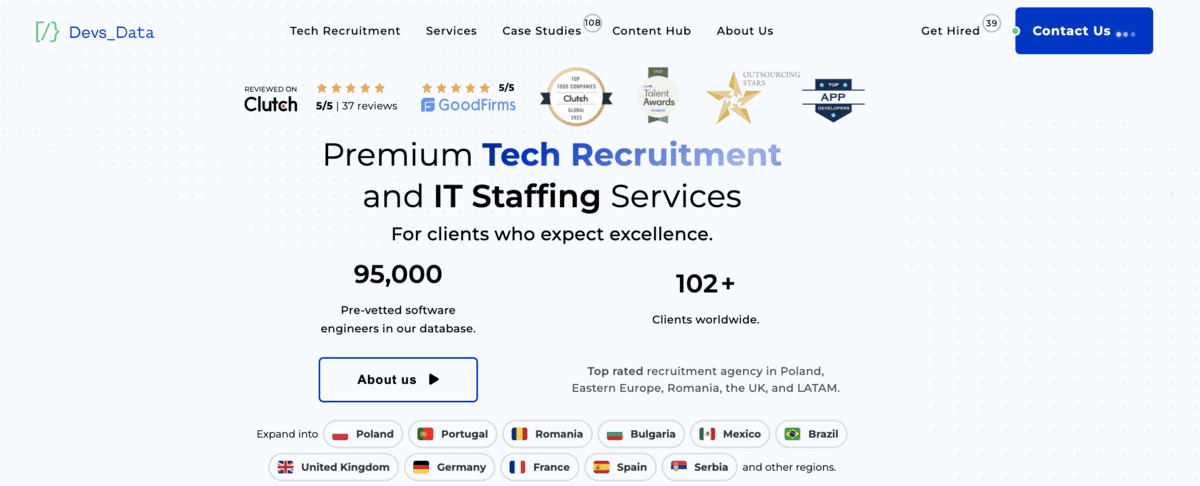
Website: www.devsdata.com
Team size: ~60 employees
Founded in: 2016
Headquarters: Brooklyn, New York, and Warsaw, Poland
DevsData LLC focuses on SAP recruitment, enabling organizations to assemble high-performing teams for complex ERP implementations and migrations. The company brings over ten years of market experience and has completed more than 140 recruitment projects for over 100 clients worldwide. That client base spans global corporations and high-growth startups across the US, Israel, and Europe.
The recruitment team includes US-based specialists who provide localized market insight and facilitate seamless collaboration with international clients. A database of 95000 pre-vetted candidates allows the firm to address niche SAP requirements with speed and accuracy. Each candidate undergoes a rigorous multi-stage evaluation process featuring a 90-minute problem-solving challenge, technical interviews, and communication skills assessments. This approach ensures placements meet both technical specifications and team integration requirements.
DevsData LLC operates on a success-fee model, meaning clients pay only upon successful hire. A guarantee period accompanies each placement, reinforcing confidence in candidate quality. The company holds an official, government-approved license for recruitment services and maintains a 5/5 rating on Clutch and GoodFirms.
The firm’s precision-driven methodology is evident in its engagement with HUGO BOSS, the global premium fashion company. DevsData LLC combined localized network sourcing across closed SAP communities, a multi-stage technical evaluation, and scenario-based interviews to deliver three senior IT specialists across Mexico and Brazil within five weeks, well below the three-month timeline typical of conventional channels in the region. The engagement demonstrated the firm’s ability to identify enterprise SAP and POS talent ready to support live production systems from their first week, a capability directly applicable to SAP recruitment.

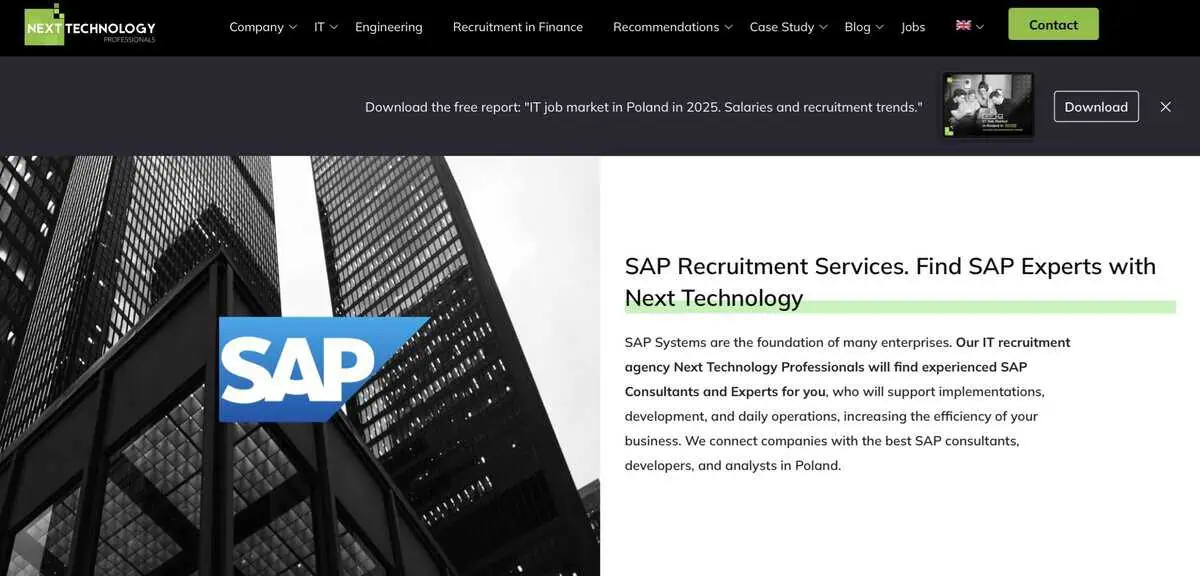
Website: www.nexttechnology.io
Company size: ~20 employees
Headquarters: Warsaw, Poland
Founded: 2015
Next Technology Professionals is a Polish IT recruitment and outsourcing agency that has completed over 1000 recruitment processes since its founding. The company operates from Warsaw with additional coverage in Kraków, offering services including permanent recruitment, IT outsourcing, executive search, and team building. SAP recruitment forms one of several technology verticals alongside Java, .NET, cybersecurity, and business intelligence positions.
The agency emphasizes speed, typically delivering tailored CVs within two to three days of receiving job requirements. Its Central European focus makes it well-suited for organizations seeking SAP talent in Poland or neighboring markets, though its smaller team size may limit capacity for large-scale, multi-geography searches.

Website: www.next-ventures.com
Company size: ~170 employees
Headquarters: London, United Kingdom
Founded: 2001
Next Ventures operates as a specialist technology staffing firm with a dedicated SAP practice established in 2006. The company reports over 138000 registered SAP candidates and contractors operating in 52 countries. Offices in the Netherlands, Germany, Switzerland, and France enable legally compliant staffing across European jurisdictions, supported by Swiss SECO and German AUG licenses.
More than 70% of the firm’s business originates from outside the United Kingdom, reflecting its positioning as an international SAP recruitment partner. The firm’s scale positions it for organizations requiring substantial SAP contractor deployments or multi-country rollouts, though smaller projects may receive less dedicated attention than they would from boutique competitors.
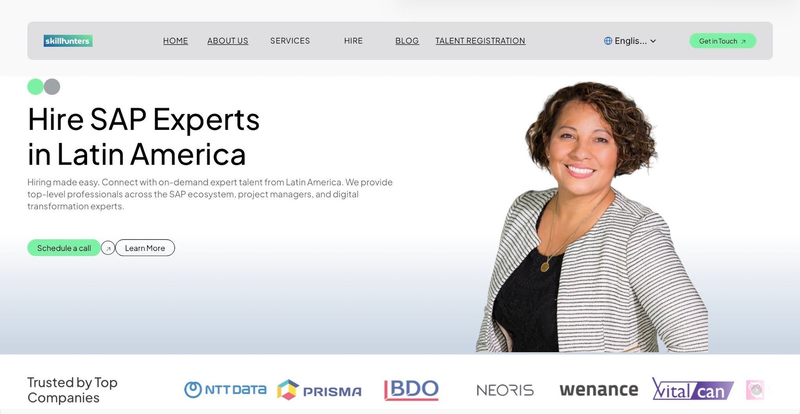
Website: www.skillhunters.net
Company size: ~10 employees
Headquarters: Buenos Aires, Argentina
Founded: 2017
Skill Hunters specializes in connecting organizations with SAP professionals across Latin America, maintaining a database of over 35000 registered candidates. Offices in Buenos Aires and Mexico City provide coverage across major regional markets, with an average candidate matching time under ten days from initial requirements to introduction.
The company offers a Contractor On-Demand model handling sourcing, hiring, and payroll for clients without local entities, alongside traditional recruitment services. Its boutique structure allows close client collaboration but limits capacity for large-volume recruitment drives requiring simultaneous placements across multiple roles.

Website: www.emerging-alliance.net
Company size: ~150 employees
Headquarters: Chennai, India
Founded: 2010
Emerging Alliance operates as an SAP Partner and staffing provider with over 15 years of experience in the SAP ecosystem. The company maintains offices in Chennai, Bangalore, and Sharjah (UAE), with a database covering Consultants, Project Managers, and technical specialists across modules including SAP FICO, MM, SD, ABAP, and SuccessFactors.
Engagement models include contract staffing, contract-to-hire arrangements, and permanent placements. The firm combines staffing services with SAP implementation capabilities, benefiting clients seeking both talent and consulting support from a single provider. Its India and UAE presence positions it for organizations pursuing offshore or hybrid delivery models.
Do you have IT recruitment needs?
The structural conditions shaping this market, from the 2027 migration deadline to the cloud transformation redefining required skill sets, demand a deliberate approach to talent acquisition. Organizations that treat SAP recruitment as a transactional exercise encounter extended timelines, misaligned candidates, and project delays that compound into significant business cost.
Verification matters more than credentials, and context determines fit. SAP certifications indicate familiarity with concepts but do not confirm production experience. Legacy ECC expertise does not translate automatically to S/4HANA readiness. Technical proficiency without stakeholder communication skills creates friction during implementations. Effective hiring processes address each dimension through structured screening rather than relying on resume keywords or interview impressions.
Geographic flexibility has shifted from optional to necessary for most hiring organizations. The talent supply in any single market cannot meet current demand, and compensation alone does not resolve the imbalance. Nearshore and offshore sourcing expand the available pool, but cross-border hiring introduces compliance requirements and collaboration considerations that generic recruitment approaches overlook. Agencies with genuine international capabilities, rather than claimed global reach, provide meaningful advantages in this environment.
The choice of recruitment partner shapes outcomes more directly in SAP hiring than in generalist technology roles. Domain expertise allows accurate candidate evaluation. Established networks access passive professionals who never appear on job boards. Structured processes compress timelines without sacrificing quality. Organizations evaluating agencies should prioritize demonstrated SAP specialization, verifiable placement history, and transparent communication practices over marketing claims.
DevsData LLC addresses these requirements through a methodology built around SAP recruitment realities. The combination of a 95000-candidate database, multi-stage technical and communication assessments, an international team, including US-based team members, and a success-fee model with a guarantee period aligns incentives with client outcomes. For organizations facing SAP hiring challenges, whether migration-driven, expansion-related, or operational, DevsData LLC offers a structured path to qualified talent without the risk of upfront investment in uncertain results.
Any questions or comments? Let me know on
Twitter/X.
Discover how IT recruitment and staffing can address your talent needs. Explore trending regions
like Poland, Portugal, Mexico, Brazil and more.
 Frequently asked questions (FAQ)
DevsData – your premium technology partner
DevsData is a boutique tech recruitment and software agency. Develop your software project with veteran engineers or scale up an in-house tech team of developers with relevant industry experience.
Free consultation with a software expert
🎧 Schedule a meeting
FEATURED IN


DevsData LLC is truly exceptional – their backend developers are some of the best I’ve ever worked with.”

Nicholas Johnson
Mentor at YC, serial entrepreneur


 Build your project with our veteran developers.
Explore the benefits of technology recruitment and tailor-made software.
Learn how to source skilled and experienced software developers.
Build your project with our veteran developers.
Explore the benefits of technology recruitment and tailor-made software.
Learn how to source skilled and experienced software developers.

Rebecca Botvin

Commercial Director

Tom Potanski
Manager




Categories: Big data, data analytics | Software and technology | IT recruitment blog | IT in Poland | Content hub (blog)
















careers@devsdata.com









general@devsdata.com

"I interviewed about a dozen different firms. DevsData LLC is truly exceptional – their backend developers are some of the best I've ever worked with. I've worked with a lot of very well-qualified developers, locally in San Francisco, and remotely, so that is not a compliment I offer lightly. I appreciate their depth of knowledge and their ability to get things done quickly."

Nicholas Johnson
CEO of Orange Charger LLC,
Ex-Tesla Engineer,
Mentor at YCombinator
"DevsData reached out to us, as we've been looking to grow our engineering team in Europe and Poland. Communicating efficiently and professionally, DevsData made a strong impression with their understanding of the recruitment challenges we were facing. They designed a tailored recruitment process for our needs. I was impressed with the technical depth of their approach."

Karim Butt
Co-Founder & CTO at GlossGenius, Inc.
"Out of all the vendors we work with, DevsData clearly stands out. The quality of developers they deliver is beyond what we've received from any other vendor, and they've been able to send profile recommendations very quickly. I'm happy to be their reference for other companies from Israel and talk about their recruitment abilities and what they delivered for us."

Ran Eyal
Senior Manager at
ZIM Integrated
Shipping Services Ltd.
"DevsData demonstrated a strong degree of proactivity, taking time to thoroughly understand the problem and business perspective, and continuously suggesting performance and usability enhancements. Their app exceeded my expectations. I've worked with DevsData on numerous projects over the last 3 years and I'm very happy. Being both responsive and honest in communication."

Jonas Lee
Partner & Executive VP of Verus,
Financial LLC, Investor,
& Serial Entrepreneur
Acknowledgments