Thanks for subscribing.
Your gift is on the way.



Cloud spending reached $723 billion globally in 2025, with Google Cloud Platform capturing roughly 16.5% of the worldwide infrastructure market. Behind those numbers sits a quieter shift in what companies running on GCP expect from their Engineers. The work has moved well past basic deployment into territory where builders architect data pipelines that hold up under production load, secure workloads across multiple regions under tightening compliance rules, and wire machine learning services into customer-facing applications without breaking the cost structure that drew teams to the cloud originally.
Finding those people is the harder problem. At DevsData LLC, we have spent the last several years sourcing Google Cloud Platform Developers for clients across FinTech, healthcare, and retail, and the patterns we see in successful placements rarely match what most hiring guides describe.
The job description varies by company, yet the working reality stays consistent. A GCP Developer designs cloud-native applications, writes the code that runs them, and keeps the infrastructure healthy after deployment. Day-to-day work involves writing Python or Go services, configuring BigQuery datasets for analytics teams, building CI/CD pipelines with Cloud Build, and debugging why a Pub/Sub topic suddenly stopped delivering messages at 2 AM.
Senior Engineers spend more time on architecture decisions. They choose between Cloud Run and GKE for a new microservice, weigh whether Vertex AI fits a use case better than a custom training pipeline, and review IAM policies before they ship to production. Junior Developers handle smaller pieces of that puzzle, often starting with maintenance tickets and feature work inside an existing codebase before moving into design conversations.
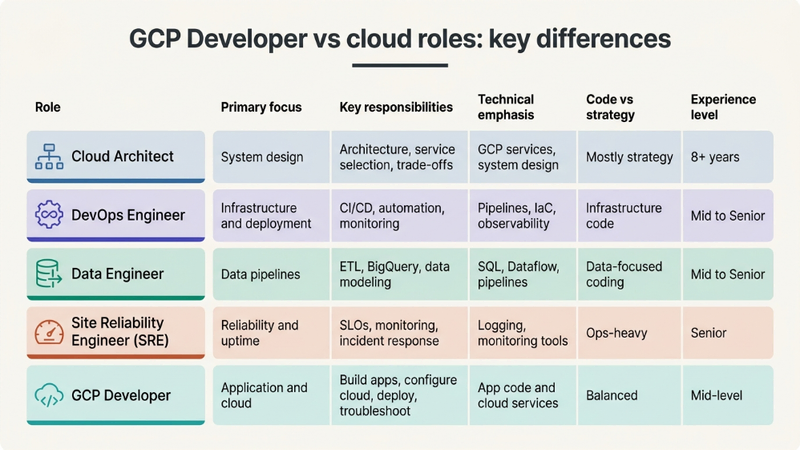
The role overlaps with DevOps engineering and cloud architecture, but it sits closer to software development. A GCP Developer writes more application code than a typical DevOps Engineer and owns less of the broader infrastructure strategy than a Cloud Architect.
Do you have IT recruitment needs?
At DevsData LLC, a recruitment and software development firm with offices in Brooklyn and Warsaw, GCP Developer mandates cluster around a familiar set of project types. Data platform builds dominate the list our consultants source for, and the remaining work tends to fall into a handful of recognizable categories.
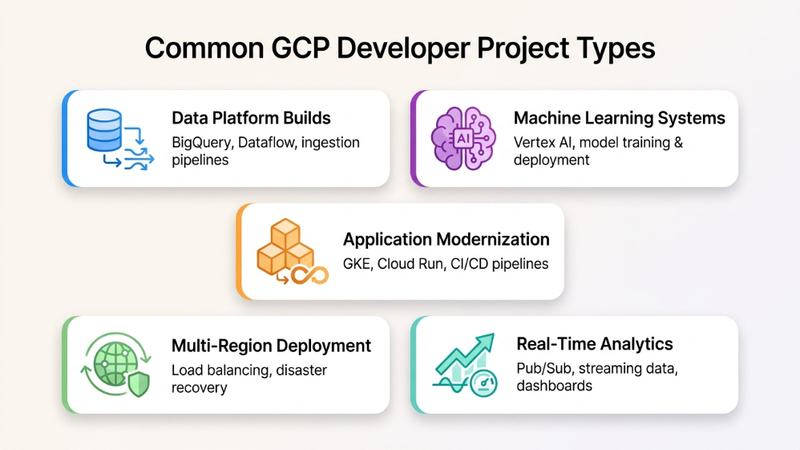
Companies migrating from on-premise warehouses to BigQuery need engineers who understand partitioning strategies, cost-aware query design, and how to wire Dataflow or Pub/Sub into the ingestion layer. These projects often run six to nine months and require strong SQL skills alongside Python or Java for the pipeline code.
Between early 2024 and late 2025, machine learning workloads moved into the top spot among the project types we track. Vertex AI deployments, custom model training infrastructure on GKE, and integration of pre-built ML APIs into product features all require GCP Developers who know the difference between a training pipeline and a serving pipeline. Healthcare, FinTech, and retail clients ask for these skills most often.
Application modernization projects cover the work of moving monolithic applications into containerized microservices on Cloud Run or GKE. The technical scope here pulls in CI/CD pipeline design, service mesh configuration, and gradual traffic migration strategies. These engagements reward engineers who have done it before and can spot the pitfalls early.
Multi-region deployments come up frequently for companies with global user bases. Engineers handle Cloud Spanner configuration, Cloud Load Balancing setup, and the disaster recovery planning that turns a single-region application into something that survives a regional outage.
Real-time analytics platforms round out the common categories. Pub/Sub combined with Dataflow and BigQuery streaming inserts powers most of the dashboards and alerting systems we have seen built on GCP over the past two years.
Confusion between cloud roles costs companies time and money. A job titled GCP Developer that actually describes a Cloud Architect attracts the wrong candidates and leaves the right ones unsure whether to apply. The distinctions matter at hiring time.
A Cloud Architect designs systems at the level of services, regions, and integration patterns. They produce architecture diagrams, evaluate trade-offs across GCP services, and set the standards that Developers follow. They write less code than a GCP Developer and spend more time in meetings with stakeholders. Senior architects often hold the Google Certified Professional Cloud Architect credential and bring eight or more years of cloud experience.
A DevOps Engineer focuses on the platform that supports application teams. Their work centers on CI/CD pipelines, infrastructure automation, monitoring stacks, and incident response. They write code, but the code targets infrastructure rather than business logic. A DevOps Engineer optimizes deployment frequency and platform reliability rather than feature velocity.
A Data Engineer specializes in moving and transforming data at scale. They design BigQuery schemas, build Dataflow pipelines, and own the data quality of what lands in the warehouse. While GCP Developers sometimes touch this work, a dedicated Data Engineer brings deeper SQL expertise and a stronger background in data modeling.
A Reliability Engineer (SRE) sits closest to operations. SLOs, error budgets, and post-incident reviews define the role. SREs at GCP-heavy organizations work with Cloud Monitoring, Cloud Logging, and chaos engineering tools rather than writing application features.
A GCP Developer typically owns one service end to end inside a real team. That ownership covers the application code, the Terraform that provisions its infrastructure, the Cloud Build pipeline that ships it, the dashboards in Cloud Monitoring, and the on-call rotation for the slice the service lives in. Companies hiring for the role want engineers who hold that vertical without needing four separate specialists to back them.
Strong candidates write code the way software engineers do, not the way scripting tutorials suggest. Python and Go appear in nearly every job specification we receive, with Java close behind for clients running enterprise workloads. Bash scripting matters for automation, though it rarely shows up as a primary requirement.
GCP service knowledge varies by industry. Retail and eCommerce clients ask about BigQuery, Cloud Storage, and Pub/Sub for their data platforms. FinTech teams want experience with Cloud KMS, VPC Service Controls, and Cloud DLP for compliance reasons.
Healthcare projects require familiarity with the Healthcare API and HIPAA-aligned configurations. Across industries, GKE proficiency has consistently been a baseline expectation since 2023.
Service combinations matter as much as individual service knowledge. BigQuery rarely appears alone. Engineers who work with BigQuery usually need Dataflow for ETL, Pub/Sub for streaming ingestion, and Cloud Composer for orchestration. GKE knowledge pairs with Cloud Build for CI/CD, Cloud Monitoring for observability, and Cloud IAM for workload identity. Strong candidates explain why these combinations exist and what each piece contributes to a working system.
Infrastructure as Code skills have moved from nice-to-have to mandatory in our experience. Terraform leads, with Cloud Deployment Manager appearing mostly in legacy projects. Engineers who write modular Terraform code save hiring teams weeks of cleanup work later.
Certifications signal effort but do not guarantee skill. The Google Certified Professional Cloud Developer and Cloud Architect credentials carry real weight when the holder also has three or more years of project experience behind them. A certification on its own, without shipping work to back it up, tells us less than a strong GitHub profile or a detailed walkthrough of a past project.
Do you have IT recruitment needs?
Targeted questions during the interview surface the gaps that generic screens miss. After several hundred technical screens at DevsData LLC, a few recurring patterns reliably predict trouble. The most common one is what we call surface familiarity, where a candidate recites a long inventory of GCP services they have touched yet cannot explain why they chose Cloud Run over GKE for a specific workload or what limits they hit with Pub/Sub at scale.
Candidates who learned GCP only from documentation tend to struggle once the questions shift to scenario-based architecture.
Missing IAM understanding shows up as another consistent warning sign. Engineers who have shipped real GCP work know IAM intimately because misconfigured permissions break deployments and create security incidents. Candidates who treat IAM as someone else’s problem rarely thrive in roles where they own infrastructure decisions.
No opinion on cost optimization deserves attention. GCP bills surprise companies regularly, and engineers who have lived through that pain develop strong views on partitioning strategies, query optimization, and idle resource cleanup. A candidate with no cost optimization stories has either worked on small projects or has not been close enough to the financial side of cloud operations.
Resistance to discussing failures signals risk too. Strong engineers describe outages they caused, deployments that went wrong, and lessons they took from those experiences. Candidates who present a flawless track record across multiple years either lack the depth to recognize their mistakes or are filtering their answers in ways that will continue after they join the team.
Certifications without project depth round out the list. A stack of GCP credentials matters less than one detailed walkthrough of a system the candidate built and maintained. Push for the project story. The answer reveals more than any badge.
Companies hiring GCP Developers in 2026 face four practical paths. Each one fits different situations.
Direct hire through internal recruiting fits organizations with mature talent acquisition teams and at least 60 days of runway before the role becomes urgent. The path suits companies building a long-tenure team where the GCP Developer will own systems for several years, since the slow process pays off in retention. Average time-to-fill for cloud roles in the United States sits at 56 days, according to LinkedIn Talent Insights data from late 2025.
Local contract staffing through US-based firms costs between $120 and $180 per hour for senior GCP Developers in major markets, based on rate data we tracked across 2025. The premium suits short, time-boxed projects where same-timezone collaboration and faster onboarding offset the higher rate, such as compliance-driven migrations or pre-launch hardening work on a tight deadline.
More of our clients now choose nearshoring to Latin America over other arrangements. The arrangement fits ongoing product engineering work that benefits from sustained daily overlap with North American teams while keeping budget pressure manageable. Rates run 40 to 55% lower than US contractors for comparable seniority. Mexico, Colombia, and Argentina produce the strongest candidate pools we have screened in this region.
Offshore hiring from Eastern Europe keeps rates low while preserving five to six hours of working overlap with the US East Coast and a near-full overlap with UK teams. South Asia delivers even sharper rate savings but pushes most real-time collaboration into asynchronous handoffs because of the wider time gap. It works well for project-based work with clear specifications and less well for ongoing product development.
The right path depends on three variables: how much real-time collaboration the role requires, how mature the team’s documentation and onboarding processes are, and how rate-sensitive the budget is. Teams that pair frequently and ship daily benefit from same-timezone hires. Teams with strong async culture and clear specs work well with offshore arrangements.
Website: www.devsdata.com
Team size: ~60 employees
Founded in: 2016
Headquarters: Brooklyn, NY, and Warsaw, Poland
DevsData LLC operates at the intersection of two disciplines that most firms keep separate: software development consulting and specialized IT recruitment. That dual capability matters because our consulting Engineers help shape the technical requirements before recruiters open a search, which means a candidate evaluated for a Kubernetes-orchestrated distributed system is measured against the actual workload patterns of the target environment rather than a recycled job description.
Headquartered in Brooklyn and Warsaw, DevsData LLC has over ten years of experience across more than 100 software projects for over 80 clients, ranging from early-stage startups to global enterprises from the US, Israel, and beyond. The firm’s engineering team includes Developers with over ten years of cloud experience alongside Google-level in-house Engineers who apply rigorous standards to every engagement.
On the recruitment side, DevsData LLC maintains a database of over 95000 vetted technology professionals. Fewer than 6% of candidates who apply pass the screening process, which centers on a 90-minute technical interview designed to assess depth of knowledge rather than surface familiarity with a technology. The firm holds an official, government-approved license for recruitment services and operates on a success fee model with a guarantee period, removing upfront financial risk for clients. DevsData LLC holds 5/5 ratings on both Clutch and GoodFirms.
Panzura, an American hybrid cloud storage and data management company headquartered in San Jose, approached DevsData LLC after months of internal recruiting and local agencies in India had failed to produce qualified Senior Developers. The company needed to expand its India engineering hub to support development on CloudFS and Symphony. Candidates needed proven Java expertise alongside hands-on experience with AWS or Google Cloud, Kubernetes, Docker, and test-driven development frameworks, plus the ability to collaborate across time zones under strict data security standards.
We focused sourcing on Bangalore, Hyderabad, and Pune, where senior Java specialists with multinational SaaS exposure cluster most densely. The search moved through our proprietary candidate database, alumni networks, and direct outreach to engineers from companies like Salesforce, Sumo Logic, and Goldman Sachs. Technical assessments led by a Senior Architect with nearly 20 years of experience tested Java, AWS, Google Cloud, and containerized deployments through scenario-based evaluations.
Recruitment closed in 37 days, well below Panzura’s prior benchmarks. All four Senior Developers integrated into the India hub, restored delivery velocity on stalled projects, and remained in their roles long-term.
The Panzura engagement reinforced patterns we apply across every cloud engineering search. Calibrating role descriptions with hiring managers before sourcing begins lifts the interview-to-hire ratio. Taking full ownership of sourcing and scheduling frees the client team to focus only on final-stage evaluation. Screening explicitly for distributed collaboration skills prevents the cultural mismatches that derail prior hiring attempts.
Budget realism deserves the same attention. When rate expectations sit far below the market, no sourcing strategy compensates for it. Pushing that conversation early, walking clients through their existing team’s seniority distribution, and flagging mismatches between role requirements and budget before committing to a search saves weeks of wasted effort later.
Do you have IT recruitment needs?
Hiring Google Cloud Platform Developers in 2026 sits at the intersection of two trends that work against each other. GCP adoption keeps growing, which raises demand for skilled engineers, while supply has not caught up in major hiring markets. Companies that move quickly, define their requirements with precision, and stay open to nearshore or remote talent fill these roles. Companies that insist on local hires at below-market rates often watch their projects stall.
The path that works depends on what you are building. Short engagements with well-defined deliverables fit contractors and offshore teams. Long-term product work benefits from direct hires or contract-to-hire arrangements with strong onboarding. Across both paths, the technical screening process matters more than the sourcing channel. A strong screening process catches problems before they become production incidents.
If your team is starting a GCP project or expanding an existing one, the right hiring partner shortens the search and improves the quality of who lands on your team. Reach out to DevsData LLC for a consultation about your Google Cloud Platform Developer needs on general@devsdata.com or visit their website www.devsdata.com.
Discover how IT recruitment and staffing can address your talent needs. Explore trending regions like Poland, Portugal, Mexico, Brazil and more.
 Frequently asked questions (FAQ)
DevsData – your premium technology partner
DevsData is a boutique tech recruitment and software agency. Develop your software project with veteran engineers or scale up an in-house tech team of developers with relevant industry experience.
Free consultation with a software expert
🎧 Schedule a meeting
FEATURED IN


DevsData LLC is truly exceptional – their backend developers are some of the best I’ve ever worked with.”

Nicholas Johnson
Mentor at YC, serial entrepreneur


 Build your project with our veteran developers.
Explore the benefits of technology recruitment and tailor-made software.
Learn how to source skilled and experienced software developers.
Build your project with our veteran developers.
Explore the benefits of technology recruitment and tailor-made software.
Learn how to source skilled and experienced software developers.

Rebecca Botvin

Commercial Director

Tom Potanski
Manager




Categories: Big data, data analytics | Software and technology | IT recruitment blog | IT in Poland | Content hub (blog)













careers@devsdata.com









general@devsdata.com

"I interviewed about a dozen different firms. DevsData LLC is truly exceptional – their backend developers are some of the best I've ever worked with. I've worked with a lot of very well-qualified developers, locally in San Francisco, and remotely, so that is not a compliment I offer lightly. I appreciate their depth of knowledge and their ability to get things done quickly."

Nicholas Johnson
CEO of Orange Charger LLC,
Ex-Tesla Engineer,
Mentor at YCombinator
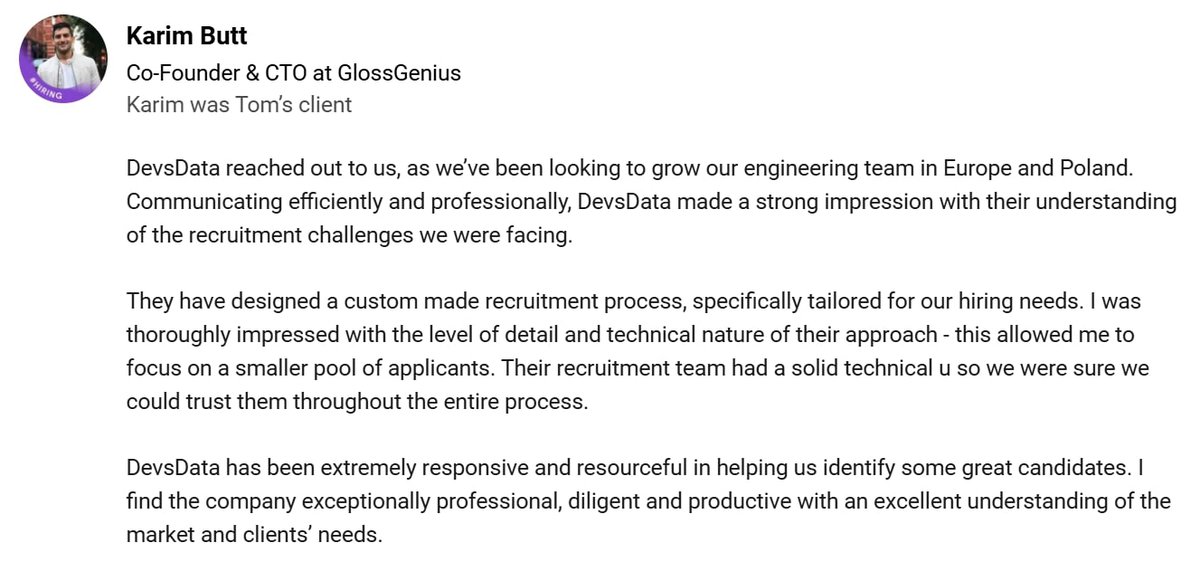
"DevsData reached out to us, as we've been looking to grow our engineering team in Europe and Poland. Communicating efficiently and professionally, DevsData made a strong impression with their understanding of the recruitment challenges we were facing. They designed a tailored recruitment process for our needs. I was impressed with the technical depth of their approach."

Karim Butt
Co-Founder & CTO at GlossGenius, Inc.
"Out of all the vendors we work with, DevsData clearly stands out. The quality of developers they deliver is beyond what we've received from any other vendor, and they've been able to send profile recommendations very quickly. I'm happy to be their reference for other companies from Israel and talk about their recruitment abilities and what they delivered for us."

Ran Eyal
Senior Manager at
ZIM Integrated
Shipping Services Ltd.
"DevsData demonstrated a strong degree of proactivity, taking time to thoroughly understand the problem and business perspective, and continuously suggesting performance and usability enhancements. Their app exceeded my expectations. I've worked with DevsData on numerous projects over the last 3 years and I'm very happy. Being both responsive and honest in communication."

Jonas Lee
Partner & Executive VP of Verus,
Financial LLC, Investor,
& Serial Entrepreneur
Acknowledgments