Thanks for subscribing.
Your gift is on the way.



Ethereum has become one of the most influential Layer 1 blockchain platforms in the world, operating as a base settlement network that secures and finalizes transactions directly on its own chain rather than relying on another protocol underneath. This Layer 1 status sets it apart from Layer 2 networks, which run on top of Ethereum to extend its capacity, and positions it as the foundational infrastructure behind products such as digital asset exchanges, on-chain lending platforms, tokenized investment vehicles, cross-border payment systems, and transparent supply chain tracking tools. Its programmable architecture allows developers to build systems where transactions, ownership, and contractual rules execute automatically without intermediaries, reshaping how businesses manage value transfer, compliance, and trust in digital environments.
The adoption and activity on the Ethereum network have continued to grow significantly in recent years. According to data compiled through 2025, the Ethereum ecosystem added more than 16000 new developers in 2025 alone, retaining the largest active developer base of any blockchain platform, with over 31000 monthly active developers contributing code across the ecosystem.
Additionally, smart contract deployment on Ethereum reached record levels in late 2025, with approximately 8.7 million smart contracts deployed in the last quarter, reflecting intensified development and ecosystem use.
As Ethereum’s use cases expand and smart contract systems grow more complex, demand is rising for developers who not only write Solidity, Ethereum’s primary smart contract programming language, but can design upgrade-safe contract architectures that allow controlled updates to otherwise immutable on-chain code, reason about gas trade-offs that directly affect how much users pay per transaction, and anticipate economic edge cases, such as oracle manipulation or transaction-ordering exploits, before they become live vulnerabilities. Recruiting these developers is challenging due to the specialized skill set required and the competitive global landscape for blockchain talent.
At DevsData LLC, we’ve supported organizations in hiring capable Ethereum Developers who can build secure, efficient, and scalable blockchain solutions aligned with modern product requirements. In this article, we share how we source and vet talent, explore notable companies hiring Ethereum Developers, and provide practical insights from our recruitment experience.
An Ethereum Developer builds, deploys, and maintains applications and protocols that run on the Ethereum blockchain. Their work spans decentralized applications, DeFi platforms, NFT marketplaces, DAO tooling, and enterprise blockchain systems, where contract logic must execute deterministically, handle transaction ordering safely, and operate within clear gas and failure constraints.
At the core of the role is developing smart contracts and Ethereum-based logic using languages such as Solidity (and occasionally Vyper), targeting the Ethereum Virtual Machine (EVM).
Ethereum Developers design contract architectures, define state management and execution flows, and deploy code to Ethereum mainnet, the live production network where real assets are at stake, testnets that simulate mainnet conditions for safe pre-launch validation, or Layer-2 networks such as Arbitrum, Optimism, Base, and zkSync that process transactions off the main chain to reduce costs and increase throughput. Because on-chain code is typically immutable, developers must translate business requirements into clearly defined rules, such as how funds are distributed, who can modify contract parameters, how upgrades are authorized, and what conditions trigger state changes, all implemented in a way that can be independently reviewed before deployment.
Security is a major responsibility. Ethereum Developers work to prevent vulnerabilities such as reentrancy issues, access-control errors, flawed upgrade patterns, and economic exploits that can result in permanent asset loss. This involves extensive testing, code reviews, defensive design patterns, and collaboration with audit processes or formal verification tools before contracts go live.
Beyond contract logic, Ethereum Developers focus on performance and scalability. They optimize gas usage, structure contracts to minimize execution costs, and design systems that balance on-chain and off-chain computation. Many also work with Layer-2 solutions, rollups, and bridging mechanisms to improve throughput and reduce transaction fees while maintaining compatibility with Ethereum’s core ecosystem.
Ethereum Developers rarely work in isolation. They collaborate with frontend engineers, backend teams, infrastructure specialists, and independent security auditors to integrate smart contracts with wallets, indexing services, APIs, oracles, and monitoring systems, while preparing code for external review before mainnet deployment. This subtly reinforces real-world release discipline.
Do you have IT recruitment needs?
Demand for Ethereum Developers has surged as blockchain technologies expand across finance, gaming, digital assets, and enterprise systems. The financial industry in particular is now exploring Ethereum well beyond crypto-native firms, with established banks and asset managers piloting tokenized deposits, on-chain settlement rails, and stablecoin infrastructure on Ethereum and its Layer 2 networks, signaling a shift from experimental interest toward production-grade institutional adoption. Organizations from established tech leaders to innovative startups are investing in Ethereum-based products and actively building teams to support decentralized applications, protocol infrastructure, and smart contract development. Below, we highlight five prominent companies known for hiring Ethereum Developers and contributing to growth in the Ethereum ecosystem.
Here are our top picks to consider:

Website: www.devsdata.com
Company size: ~60 employees
Founding year: 2016
Headquarters: Brooklyn, NY, and Warsaw, Poland
At DevsData LLC, we’ve helped companies across the US, Europe, and Israel build and scale Ethereum-based systems, from early-stage startups launching their first decentralized applications to established organizations developing complex DeFi protocols, NFT platforms, and enterprise solutions on Ethereum. Our recruitment and vetting process is tailored specifically for Ethereum development. Candidates are evaluated on contract architecture design, upgrade and proxy trade-offs, gas-aware structuring decisions, security scenario reasoning (such as reentrancy and access-control risks), and their experience deploying and maintaining contracts in production environments.
We maintain a network of 95000+ vetted IT professionals worldwide, giving us access to experienced Ethereum Developers with hands-on production experience across mainnet, testnets, and Layer 2 environments. Our talent pool also extends into the traditional finance ecosystem, including developers who have delivered for banks, asset managers, payment providers, and regulated fintech firms, which positions us to support engagements where Ethereum systems must integrate with TradFi requirements such as compliance controls, audit trails, custody standards, and institutional reporting workflows. As a company operating with an official, government-approved recruitment license, we follow strict compliance and quality standards throughout every engagement.
Our experience shows that strong Ethereum Developers do far more than write Solidity code. They design resilient contract architectures, optimize on-chain and off-chain interactions, apply secure upgrade patterns, and collaborate closely with frontend, backend, and infrastructure teams to ensure reliable system behavior. Across 80+ satisfied clients and 100+ technical engagements, we’ve helped organizations reduce the risk of deploying upgrade-unsafe contracts, prevent gas-inefficient architectures that inflate user costs, and avoid post-launch security vulnerabilities that can expose funds or require complex migrations. With 5.0 ratings on Clutch and GoodFirms, our focus remains on technical rigor, predictable delivery, and long-term partnerships built on trust.
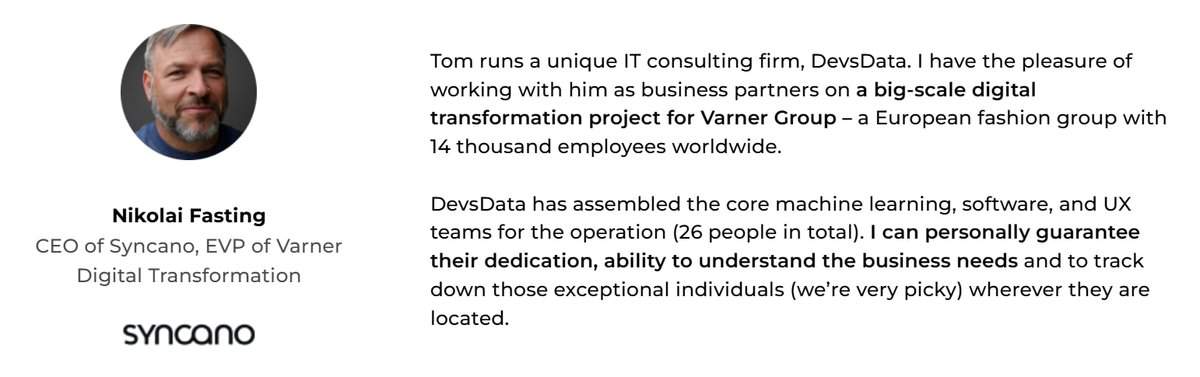
Supporting Ethereum-driven analytics platforms at TokenMetrics
TokenMetrics, a US-based Web3 crypto analytics platform, partnered with DevsData LLC to recruit senior technical talent, including a Web3 developer with hands-on blockchain and decentralized systems experience. The primary challenge was identifying candidates who could operate reliably in a production environment where data accuracy, on-chain interactions, and system integrity directly affect user trust. Our evaluation focused on real-world Ethereum experience, reasoning around smart contract behavior, and the ability to collaborate across product, data, and frontend teams.
Key learning: the biggest gap wasn’t Solidity proficiency, but operational discipline. Developers who had handled live contract data flows and reconciled on-chain state with off-chain analytics systems were far more reliable than those with stronger theoretical blockchain knowledge but limited production accountability.
Executing a precision hire for Cookie3’s Web3 roadmap
Cookie3, a global Web3 analytics company, partnered with DevsData LLC to recruit a Head of AI with combined expertise in artificial intelligence and blockchain technologies. The role required both strategic leadership and a deep understanding of crypto-native product environments, making the search particularly complex due to strict experience criteria and geographic constraints. We delivered a successful hire within two weeks, enabling Cookie3 to accelerate its AI-driven Web3 analytics roadmap.
Key learning: Senior Ethereum and Web3 roles require engineers who can translate blockchain constraints into product decisions, align on-chain logic with data pipelines, and ensure AI or analytics layers reflect accurate contract state.
These engagements reinforce a consistent pattern: while Ethereum development is a specialized discipline, the most effective developers share core traits with top-performing engineers across other domains. Experience with production systems, architectural discipline, security awareness, and cross-functional collaboration consistently outweigh narrow familiarity with specific tools or frameworks alone.
Learn more at www.devsdata.com or contact general@devsdata.com.
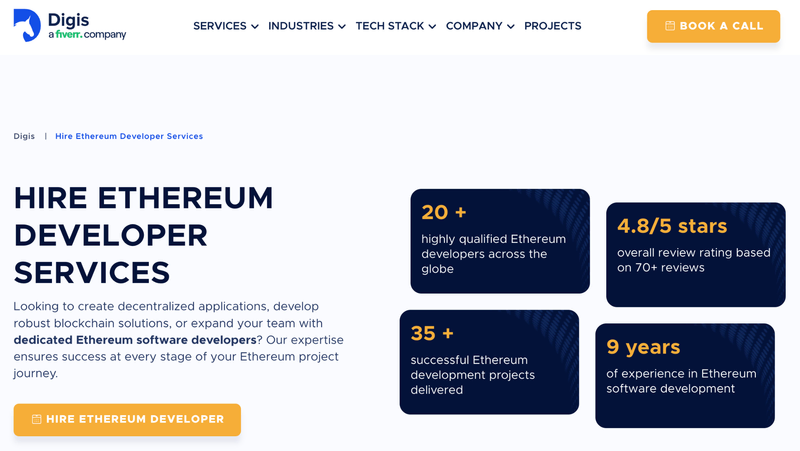
Website: https://digiscorp.com
Company size: ~170 employees
Founding year: 2015
Headquarters: London, United Kingdom
DigisCorp is a software development and technical staffing provider with a focus on emerging technologies, including blockchain and Ethereum-based development. The company offers dedicated Ethereum Developers to support businesses building decentralized applications, smart contracts, and blockchain-enabled platforms, combining development delivery with team augmentation models.
DigisCorp primarily works with companies looking to accelerate Web3 and blockchain initiatives without building in-house teams from scratch. Its approach emphasizes providing developers with practical experience in Solidity, Ethereum tooling, and decentralized system integration, supporting both project-based work and longer-term product development.
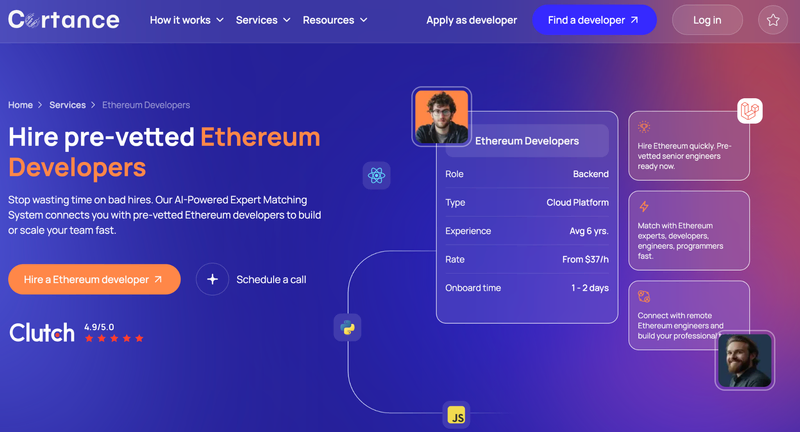
Website: https://cortance.com
Company size: ~10 employees
Founding year: 2022
Headquarters: Tallinn, Estonia
Cortance is a European outstaffing and developer matching platform that connects companies with pre-vetted Ethereum Developers through its internal expert matching system. The service aims to reduce hiring friction by providing tailored candidate proposals and onboarding options, enabling businesses to scale Ethereum and blockchain development quickly without extended search cycles.
Cortance’s approach is centered on vetting developers for real-world experience in Ethereum ecosystem technologies, such as Solidity, EVM internals, Web3 libraries, gas optimization, and Layer-2 deployments, before presenting them to clients. The platform supports both dedicated individual hires and larger Ethereum development teams, with an emphasis on transparency in pricing and rapid onboarding.

Website: https://techamana.com
Company size: ~10 employees
Founding year: 2023
Headquarters: Langhorne, Pennsylvania
Techamana is a selective talent network that admits only the top 5% of applicants, connecting companies with pre-vetted freelance experts across software development, design, and product leadership. Its Ethereum and blockchain talent pool includes developers skilled in Solidity, Ethereum smart contracts, and broader Web3 tooling, all vetted through advanced matching systems focused on quality and real-world experience rather than generic listings.
Techamana’s approach centers on providing elite freelance talent quickly and flexibly. Clients can access Ethereum Developers with experience in smart contract logic, decentralized application stacks, and secure EVM development as part of a broader vetted technology pool. This model suits organizations seeking high-quality contract professionals without the overhead of long-term recruitment cycles.

Website: https://www.onstrider.com/
Company size: ~60 employees
Founding year: 2021
Headquarters: Claymont, Delaware
Strider is a remote hiring platform that helps companies find and hire pre-vetted developers, including Ethereum and Solidity engineers, through a streamlined matching and onboarding process. While the platform sources talent across many technology stacks, its Ethereum Developers go through additional screening for Solidity proficiency, smart contract security awareness, EVM-level reasoning, and prior production deployment experience, helping teams build blockchain solutions on a foundation of verified on-chain expertise rather than general engineering credentials alone.
Strider’s model is geared toward rapid matching, often enabling hires within 1-2 weeks, and supports administrative needs such as onboarding, paperwork, compliance coordination, and remote workforce logistics. Its network includes developers from Latin America who work in US time zones, offering cost-efficient access to Ethereum expertise.
Companies hiring Ethereum Developers are largely focused on building scalable, production-ready systems on Ethereum rather than short-term or experimental implementations. Across this group, demand centers on developers with hands-on mainnet experience, strong security and performance awareness, and the ability to design and maintain Ethereum-based architectures within complex, cross-functional product teams.
Do you have IT recruitment needs?
Hiring an experienced Ethereum Developer delivers far more than basic smart contract implementation. Strong Ethereum engineers improve security, reduce execution and integration risk, optimize costs, and help teams build reliable systems across mainnet and Layer-2 environments. Below are several high-impact benefits, each supported by independent research.
Ethereum’s roadmap is increasingly rollup-centric, and developers who understand L2 mechanics significantly reduce user costs and improve throughput. The Block reported in late 2025 that Layer 2 networks now process under-cent transaction fees while collectively handling more than 1.9 million daily transactions, with Ethereum mainnet average fees stabilizing at $3.78 per transaction across 2025. Experienced Ethereum Developers design contracts and app flows that take advantage of rollups, minimize gas-heavy operations, and implement patterns that keep performance predictable as usage grows.
For teams building DeFi and asset-based products, Ethereum’s liquidity and composability remain a key advantage. The Defiant reported in September 2025 that Ethereum’s TVL grew 50% in a single quarter, climbing from $54 billion in July to $96.5 billion as the broader DeFi ecosystem surpassed $160 billion for the first time since May 2022. Ethereum Developers help organizations tap into this ecosystem by building protocol-compatible contracts, integrating with existing DeFi primitives, and maintaining upgrade paths that support long-lived product roadmaps.
Security is not optional in Ethereum: code errors and operational mistakes translate directly into losses. NBC News reported in December 2025 that crypto thefts globally reached $3.4 billion across the year, citing Chainalysis data, with the single Bybit exchange hack in February accounting for $1.5 billion of that total and North Korea-linked hackers responsible for a record $2.02 billion. Hiring developers with security-first habits (threat modeling, careful access control, safer upgrade design, rigorous testing) reduces the likelihood of vulnerabilities and minimizes the damage if issues occur.
Ethereum is widely used for stablecoin transfers, but “payments” and DeFi-style contract interactions behave very differently, and that affects product design. An Artemis empirical analysis using Ethereum stablecoin transaction data (Aug 2024-Aug 2025) found that the split between EOA-to-EOA payments and smart contract transactions is roughly 50-50 by transaction count, while smart contract transactions accounted for 53.2% of volume.
Ethereum Developers who understand these flows can design safer contract interfaces, reduce integration friction with wallets and off-chain systems, and build monitoring/analytics that reflect how users and institutions actually move stablecoins on Ethereum.
Even when organizations commit to hiring Ethereum Developers, the process often comes with obstacles that slow hiring, inflate costs, or create long-term delivery risk if overlooked. The role blends smart contract security, EVM constraints, production deployment discipline, and cross-functional integration, and that mix makes it easy to mis-hire when evaluation is shallow. Below are several common challenges we see in Ethereum recruitment, each supported by independent data.
Ethereum is high-stakes software. Mistakes can lead to irreversible losses, and many candidates have not operated under those constraints in production. Immunefi’s 2024 report estimates $1467448336 lost to hacks across 192 incidents in 2024, reinforcing how expensive security gaps remain.
Our approach at DevsData LLC
We evaluate security in scenarios: access-control design, reentrancy defense, oracle/manipulation risks, upgrade safety, and test strategy. We prioritize candidates who can explain trade-offs and demonstrate disciplined prevention patterns.
Teams often need developers who can operate across mainnet + L2s + tooling ecosystems, but Ethereum experience isn’t uniform across these environments. Electric Capital’s 2024 Developer Report highlights increasing cross-chain work: 1 in 3 crypto developers work on multiple chains.
Our approach at DevsData LLC
We align screening with the target stack (Ethereum mainnet, specific L2s, bridges, indexing, wallet flows) and validate chain/L2-specific reasoning, deployment practices, and monitoring readiness, not generic Web3 exposure.
Most teams want senior developers who have shipped production contracts, handled real constraints, and can make safe architectural calls. That pool is limited. Electric Capital reports total developers declined 7% in 2024, while established developers (2+ years) grew 27% and produced 70% of all code commits, concentrating delivery capacity in a smaller senior group.
Our approach at DevsData LLC
We focus on senior ownership indicators: shipped contracts, incident learnings, gas/performance trade-offs, and clear testing discipline. Structured interviews help separate “crypto interest” from production-grade Ethereum readiness.
Recruiting Ethereum Developers requires careful role definition and evaluation. Differences in security depth, real production delivery, L2/tooling competence, and architectural judgment often determine whether a hire strengthens a system over time or introduces avoidable risk.
Choosing the right Ethereum development partner plays a critical role in whether Ethereum-based systems remain secure, scalable, and maintainable or accumulate hidden technical debt and post-deployment risk. They understand EVM constraints, security trade-offs, Layer-2 considerations, upgrade patterns, and the operational realities of maintaining systems that interact with live assets and users.
Here is what to look for.
Ethereum development demands disciplined security thinking. A capable partner evaluates developers on threat modeling, access control design, reentrancy prevention, oracle and bridge risks, and safe upgrade strategies, not just Solidity syntax. Their vetting process should reflect real attack vectors and production constraints rather than theoretical coding tasks.
Because Ethereum contracts are costly and risky to change after deployment, partners must plan for evolution from the outset. Strong teams clearly explain how they handle versioning, upgrade mechanisms, backward compatibility, and migration paths while minimizing risk to user funds and protocol integrity. Ask how they structure testing, audits, and deployment pipelines to support safe, long-term operation.
Most Ethereum systems rely on more than mainnet contracts alone. A trustworthy partner understands how to design applications that integrate with Layer-2 networks, wallets, indexing services, APIs, and oracles. They should be able to explain how they manage data flow, error handling, monitoring, and failure modes across on-chain and off-chain boundaries.
Ethereum development sits at the intersection of product, frontend, backend, and infrastructure teams. A strong partner maintains clear documentation, communicates risks and design trade-offs early, and collaborates closely with non-blockchain engineers to avoid misunderstandings that can lead to costly or irreversible issues.
Reputable Ethereum development partners provide clarity around code ownership, audit responsibilities, deployment authority, and post-launch support. They are upfront about limitations and remaining risks instead of presenting Ethereum systems as risk-free or maintenance-free components.
Choosing the right Ethereum development partner means selecting a team that combines Ethereum-specific expertise, security-first engineering, production experience, and clear communication. With the right partner, Ethereum becomes a dependable foundation for scalable decentralized systems rather than a source of ongoing technical or operational risk.
Not sure whether hiring an Ethereum Developer is the right move for your product or team? Use this quick self-assessment to evaluate your situation. Answer each question with yes or no.
Mostly yes: hiring an Ethereum Developer can help reduce security and execution risk, improve contract architecture, and support reliable, production-grade Ethereum systems across mainnet and Layer-2 environments. DevsData LLC helps companies access rigorously vetted Ethereum Developers with proven on-chain experience.
Mostly no: your current setup may be sufficient for now. As Ethereum usage grows, systems become more complex, or security and upgrade requirements increase, revisiting an Ethereum-focused hiring strategy can help prevent costly issues later on.
Do you have IT recruitment needs?
Hiring an Ethereum Developer enables organizations to build secure, scalable, and production-ready systems on one of the world’s most widely used blockchain platforms. As Ethereum underpins decentralized finance, digital assets, governance systems, and increasingly real-world applications, experienced Ethereum specialists help ensure correct execution, strong security posture, and predictable behavior in environments where errors can be costly and difficult to reverse.
Because Ethereum contracts are difficult to change after deployment and security mistakes can be costly, building production systems requires more than experimental development.
Reviewing how the top five companies hiring Ethereum Developers approach talent highlights a consistent pattern: they prioritize senior ownership, deep EVM knowledge, security-first thinking, and long-term maintainability over short-term velocity or surface-level Web3 familiarity.
At DevsData LLC, we help organizations worldwide strengthen their Ethereum capabilities through structured technical assessments, security-focused vetting, and access to a global network of 95000+ vetted IT professionals. With 100+ successful technical engagements, a sub-6% acceptance rate, and experience delivering complex engineering projects across the US, Europe, Israel, and beyond, we bring the rigor and reliability required to build production-grade Ethereum systems.
Learn more at www.devsdata.com or contact general@devsdata.com.
Discover how IT recruitment and staffing can address your talent needs. Explore trending regions
like Poland, Portugal, Mexico, Brazil and more.
 Frequently asked questions (FAQ)
DevsData – your premium technology partner
DevsData is a boutique tech recruitment and software agency. Develop your software project with veteran engineers or scale up an in-house tech team of developers with relevant industry experience.
Free consultation with a software expert
🎧 Schedule a meeting
FEATURED IN

DevsData LLC is truly exceptional – their backend developers are some of the best I’ve ever worked with.”

Nicholas Johnson
Mentor at YC, serial entrepreneur


 Build your project with our veteran developers.
Explore the benefits of technology recruitment and tailor-made software.
Learn how to source skilled and experienced software developers.
Build your project with our veteran developers.
Explore the benefits of technology recruitment and tailor-made software.
Learn how to source skilled and experienced software developers.

Rebecca Botvin

Commercial Director

Tom Potanski
Manager




Categories: Big data, data analytics | Software and technology | IT recruitment blog | IT in Poland | Content hub (blog)
















careers@devsdata.com









general@devsdata.com

"I interviewed about a dozen different firms. DevsData LLC is truly exceptional – their backend developers are some of the best I've ever worked with. I've worked with a lot of very well-qualified developers, locally in San Francisco, and remotely, so that is not a compliment I offer lightly. I appreciate their depth of knowledge and their ability to get things done quickly."

Nicholas Johnson
CEO of Orange Charger LLC,
Ex-Tesla Engineer,
Mentor at YCombinator
"DevsData reached out to us, as we've been looking to grow our engineering team in Europe and Poland. Communicating efficiently and professionally, DevsData made a strong impression with their understanding of the recruitment challenges we were facing. They designed a tailored recruitment process for our needs. I was impressed with the technical depth of their approach."

Karim Butt
Co-Founder & CTO at GlossGenius, Inc.
"Out of all the vendors we work with, DevsData clearly stands out. The quality of developers they deliver is beyond what we've received from any other vendor, and they've been able to send profile recommendations very quickly. I'm happy to be their reference for other companies from Israel and talk about their recruitment abilities and what they delivered for us."

Ran Eyal
Senior Manager at
ZIM Integrated
Shipping Services Ltd.
"DevsData demonstrated a strong degree of proactivity, taking time to thoroughly understand the problem and business perspective, and continuously suggesting performance and usability enhancements. Their app exceeded my expectations. I've worked with DevsData on numerous projects over the last 3 years and I'm very happy. Being both responsive and honest in communication."

Jonas Lee
Partner & Executive VP of Verus,
Financial LLC, Investor,
& Serial Entrepreneur
Acknowledgments