Thanks for subscribing.
Your gift is on the way.



How a company scopes its first data science role shapes the return on every subsequent analytics investment. The timing and infrastructure readiness behind that hire determine whether the function produces measurable business value, the kind that shows up as revenue lifted through dynamic pricing or spend trimmed by predictive maintenance, or stalls at the proof-of-concept stage.
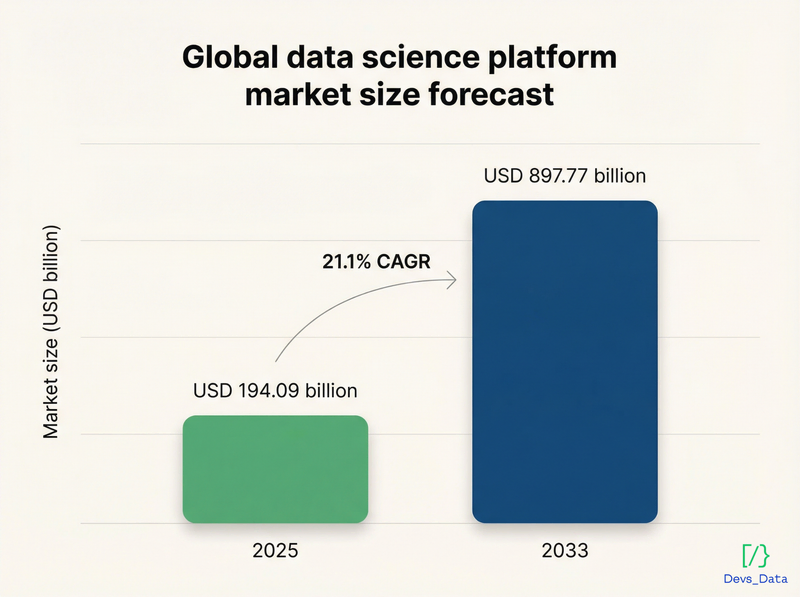
Infrastructure spending already reflects this reality: The global data science platform market reached $ 194.09 billion in 2025 and is projected to grow to $897.77 billion by 2033, as the bar chart below illustrates.
Capital is flowing into the platforms these teams operate on, and the next question for most organizations is who sits behind them. Demand for that talent is accelerating at a comparable pace.
The World Economic Forum’s Future of Jobs Report 2025 projects a net increase of 78 million roles globally by 2030, with Big Data Specialists ranking among the fastest-growing positions.
For Hiring Managers, the challenge is no longer whether to hire for data science but how to scope the role correctly. The Data Scientist title has fractured into distinct specializations, and posting for the wrong one at the wrong company maturity level leads to failed hires that delay programs by full quarters.
This article examines role distinctions that shape job descriptions, evaluation methods designed to prioritize applied reasoning over credential lists, salary benchmarks across the US and Europe, and sourcing channels that shorten time-to-hire. DevsData LLC, an IT recruitment and software consulting agency, developed this guide based on direct placement experience to provide Hiring Managers with a structured path from role definition to the final offer.
Data science shifts business performance when the function moves from periodic reporting into the continuous flow of operational decisions. PwC’s 2025 Global AI Jobs Barometer measured this directly: Since 2022, productivity growth has nearly quadrupled in industries most exposed to AI, from financial services to software publishing.
The gap does not come from better tools alone. The difference reflects organizations that have wired analytical output into pricing and demand planning as a standing function, not a quarterly exercise.
70% of production-stage ML failures trace to organizational factors rather than technical ones, driven primarily by siloed workflows between departments.
That finding frames a frustration many executives recognize: Big Data budgets keep growing without a proportional increase in business value. The platform investment is in place. The talent often is not matched to the actual bottleneck.
When analytical output never reaches the operational decisions that drive the investment, the problem lies between departments rather than within a model. Recognizing where that disconnect lives is the first step toward hiring the right data analytics profile. The comparison below maps five operational areas to the practical impact of a dedicated data science function.
| Area | With a data science capability | Without a data science capability |
|---|---|---|
| Revenue forecasting | Demand models updated weekly from transaction data, with forecast accuracy measured against actuals each cycle | Spreadsheet-based projections built from prior-year figures and adjusted manually by Finance teams |
| Customer behavior analysis | Churn probability scoring tied to retention spend, with segment-level purchase frequency tracking | Broad demographic grouping with limited visibility into what drives customer attrition |
| Operational efficiency | Automated anomaly detection across supply chain data, surfacing cost deviations before they compound | Manual review cycles that catch process breakdowns after the financial impact has materialized |
| Product development | A/B testing with quantified impact estimates feeding feature prioritization directly | Feature roadmaps driven by stakeholder intuition and periodic competitive benchmarking |
| Risk management | Probability-weighted scenario modeling with automated threshold alerts | Static risk registers updated quarterly through manual audit processes |
Each row in that table points to a different analytical skill set. A company focused on revenue forecasting needs a different hire than one building automated anomaly detection across its supply chain. The next section breaks down those role distinctions so Hiring Managers know which profile fits before writing a job description.
Do you have IT recruitment needs?
What a candidate knows tells a Hiring Manager less than what that candidate has shipped with. The tool stack on a resume signals where a person has spent working hours and how close to production their experience runs.
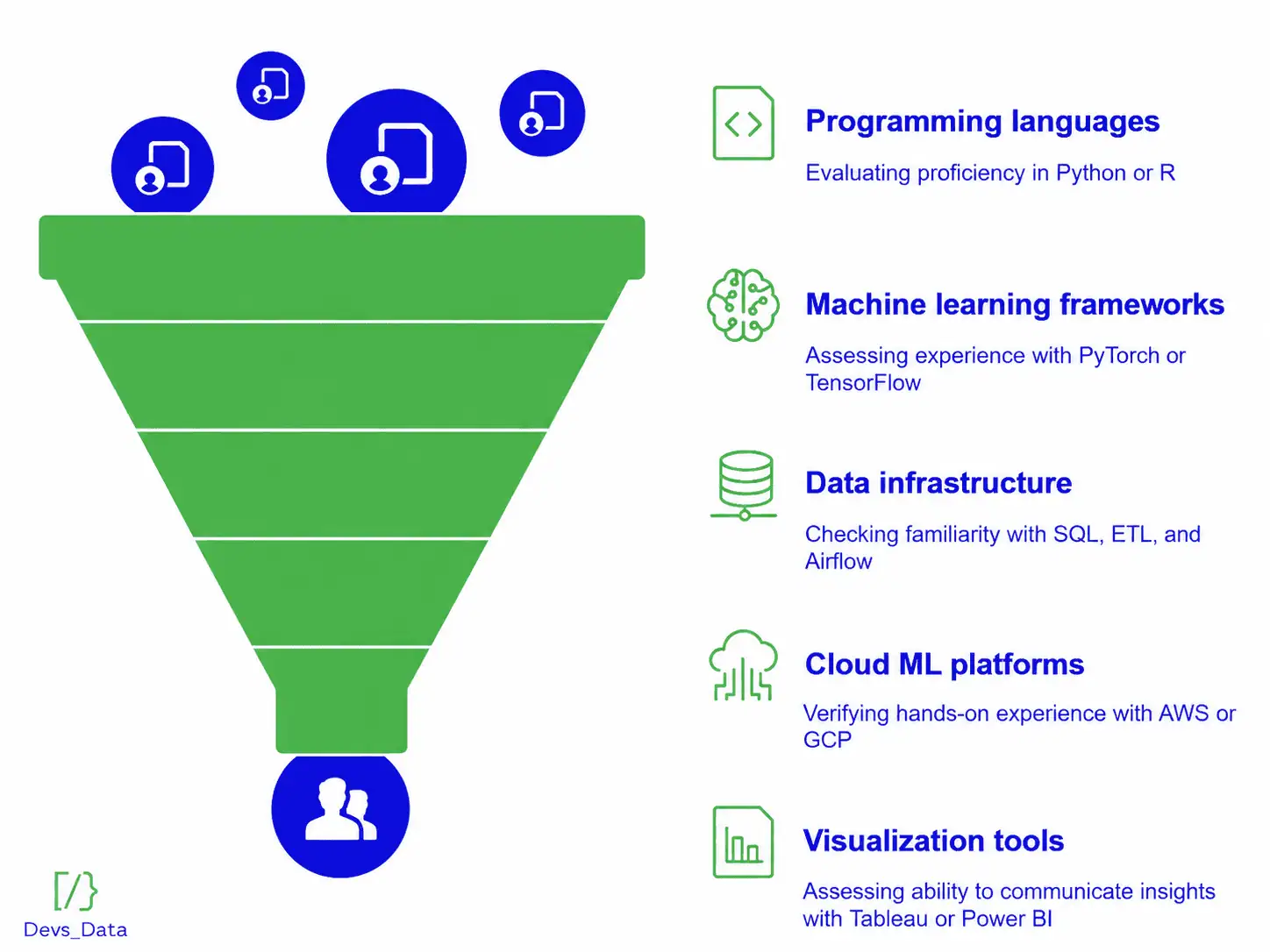
Python leads data science hiring as the default language for both modeling and production work, so its presence on a resume reads as table stakes rather than a differentiator. R appears less often in industry roles yet holds ground in statistics-heavy research, and a portfolio built around it points to an academic background in econometrics or biostatistics that signals whether the candidate leans toward engineering or statistical theory.
PyTorch and TensorFlow divide the framework market along a line that matters during screening. PyTorch has gained ground in production environments and dominates research settings. TensorFlow retains its position in enterprise serving infrastructure, where deployment tooling provides a tested path from model to endpoint. A candidate’s framework preference reveals which end of the ML lifecycle they have spent more time working in.
SQL is the baseline. Companies now expect Data Scientists to work directly with data infrastructure rather than consuming pre-cleaned tables. Airflow handles orchestration. dbt manages transformations inside the warehouse. A candidate listing both alongside Python signals operational readiness beyond notebook-based analysis.
AWS SageMaker and GCP Vertex AI bundle training and deployment into managed environments. Certification shows a candidate invested time in a vendor ecosystem, but hands-on deployment experience matters more. The interview should probe whether the candidate has moved a model from training to a live endpoint, including how monitoring was handled after launch.
Tableau and Power BI sit at the point where analytical output meets decision-makers. A candidate pairing a visualization tool with a strong verbal explanation during interviews signals the ability to translate analysis into organizational impact.
None of these tool categories works as a standalone pass-or-fail filter. The screening value comes from reading combinations together. A candidate listing PyTorch alongside dbt and Airflow describes a profile oriented toward production ML operations.
The same candidate listing PyTorch with Tableau instead points toward a research-to-stakeholder communication role. Recognizing those patterns before the first interview saves screening hours on both sides and narrows the candidate pool toward the actual need.
Resume tool lists indicate what a candidate has touched. They do not reveal how that person reasons through a problem or communicates results to someone outside the data team. The competencies below separate candidates who operate independently from those who need constant direction.
Technical screening for a Data Science Developer goes beyond checking which languages or frameworks appear on a resume. The areas below assess whether a candidate produces work that holds up in production and delivers business value after the interview.
A Data Science Developer who defaults to running models before structuring the experiment produces output no one trusts. Statistical reasoning shows up in how a candidate frames a hypothesis and selects a sample size before training begins. Defining success criteria at that stage, not after the model runs, is what separates rigorous work from exploratory guessing.
The interview should surface whether the person designs A/B tests with measurable outcomes or jumps straight to model building. To read statistical depth, ask the candidate to walk through a past experiment from hypothesis to sample-size choice, then press on how they confirmed a result was real rather than noise. A weak answer leans on tooling, while a strong one explains the reasoning behind each step.
Raw data rarely arrives in a state ready for modeling. The ability to identify which variables contain predictive signals and to construct new features from existing data distinguishes senior candidates from junior ones. Interviewers should ask how a candidate handled missing data in a past project and what trade-offs informed that decision.
57% of employers report that newly hired data talent lacks familiarity with industry best practices. 56% report a lack of up-to-date technical knowledge.
Choosing the right model for a business problem matters more than reaching peak accuracy on a benchmark dataset. A strong candidate explains why a simpler regression outperformed a neural network for a given use case or when a decision tree served the business better than an ensemble method. Evaluation goes beyond accuracy scores. The interview should probe how the candidate measured real-world performance after deployment, not just validation metrics in a notebook.
Skills in AI-exposed occupations are changing 66% faster than in other roles (PwC, 2025), and production deployment is where that shift is most evident. A model running in a Jupyter notebook is not a model in production. Candidates should describe how they moved past work into a serving pipeline and how they monitored for drift after launch.
Whether a retraining cycle was ever triggered and what informed that decision adds a second layer to the question. The absence of any production-deployment story at the senior level is a disqualifying gap.
Git is the minimum. Beyond code versioning, machine learning workflows require experiment tracking and model artifact management. MLflow handles experiment logging and model registry. Weights & Biases adds visualization of training runs. A candidate who has used either of these in a team setting signals familiarity with collaborative, reproducible workflows rather than isolated notebook experiments.
The EU AI Act imposes compliance obligations on companies deploying models in regulated sectors such as finance and healthcare. A Data Science Developer who builds a credit-scoring model without understanding the explainability requirements creates liability rather than value. Interview questions should test whether the candidate documents model decisions and acknowledges limitations in production systems.
Technical ability determines whether a candidate produces correct work. Soft skills determine whether that work reaches the people who act on it and changes how the organization operates.
A model’s prediction has no value until someone acts on it. The candidate should demonstrate past experience turning a probability score or a clustering result into a specific operational recommendation that a non-technical stakeholder implemented.
Ask how the candidate explained a model’s limitations to a Product Manager or a Finance Lead who disagreed with the output. The answer reveals whether the person adjusts language to the audience or defaults to technical terminology that loses the room.
Strong candidates ask business questions before requesting access to data. What decision does this model support? What does a wrong prediction cost? Candidates who start with the dataset rather than the decision tend to build technically sound models that answer the wrong question.
Data science work sits between engineering and product teams, with frequent touchpoints into business operations. A Data Analyst who has never coordinated a deliverable with a Data Engineer or a Product team will struggle in organizations where the data function is embedded across departments rather than centralized. Ask for a specific example where cross-team coordination changed the direction of an analysis.
Business priorities change mid-project. A Data Science Developer who has only worked on stable, well-scoped tasks will struggle when a stakeholder redefines the target variable or the underlying data source disappears. Ask the candidate to describe a project where the original brief changed significantly and how they adjusted the analytical approach without restarting from scratch.
Verbal explanations fade after the meeting ends. A candidate who documents why a specific model was selected, which alternatives were tested, and what limitations remain, provides the organization with a knowledge base that survives team turnover. Ask to see a past write-up or technical summary the candidate produced for a non-technical audience.
Do you have IT recruitment needs?
A balanced skill set carries a price, and geography is among the strongest forces moving that price. The analytical depth that clears the screening above bills at one rate in New York and a fraction of that in São Paulo.
A Hiring Manager planning the spend works two levers at once, the role definition that fixes what to look for and the regional market that sets what landing it costs. The figures that follow come from public salary platforms such as Glassdoor and Levels.fyi, pulled against live 2026 listings and treated as directional rather than locked.
Inside one market, seniority opens the widest gap. Glassdoor puts an entry-level Data Scientist in the US near a $112000 average and a senior one above $230000, a near-doubling that tracks the move from running analyses someone else scoped to owning the modeling strategy outright. Role shape adds a second axis. A Data Scientist tilted toward analysis and reporting prices differently from one who carries models into production, even under the same title and the same years on the resume.
The table lines up junior and senior pay across four markets against the US, every figure converted to annual $, so the rows compare directly.
| Region | Annual cost for Juniors | Annual cost for Seniors |
|---|---|---|
| United States | $90000-$140000 | $170000-$235000 |
| Western Europe | $55000-$80000 | $90000-$125000 |
| Poland and CEE | $20000-$35000 | $45000-$75000 |
| Latin America | $15000-$30000 | $35000-$65000 |
Converted to $, Western Europe runs 45% to 50% under the US at both ends. Poland and the CEE bloc land near a third of the US figure, and Latin America comes in around a quarter. The US pays the highest salaries for the role and draws on the deepest pool of experienced specialists, and equity pushes the top past base, where Levels.fyi shows total compensation at the large platforms clearing $250000.
Western Europe pays less and moves more slowly, with Germany anchoring the range and automotive and FinTech demand lifting senior pay. Poland and the CEE bloc trade on strong university training and fluent English, with a workday that overlaps with Western Europe and B2B contracts as the norm. Latin America sits lower again on costs and aligns cleanly with US time zones, which makes a nearshore data team easy to run day-to-day.
Choosing the engagement model comes before the price. A fixed-fee project fits a one-off build, while embedded support fits a data function that grows with the roadmap. Benchmarking the offer against the real function, rather than a blanket Data Scientist average, keeps it honest, and the evaluation that proves a candidate delivers comes next.
A resume tells a Hiring Manager which tools a candidate has listed. The evaluation process determines whether that person applies those tools to solve the right problems. Assessment design carries its own trade-offs: Take-home challenges that run for four to six hours routinely lose senior candidates who are holding competing offers, and live case walkthroughs risk rewarding presentation polish over analytical depth.
The steps below balance screening rigor with candidate experience.
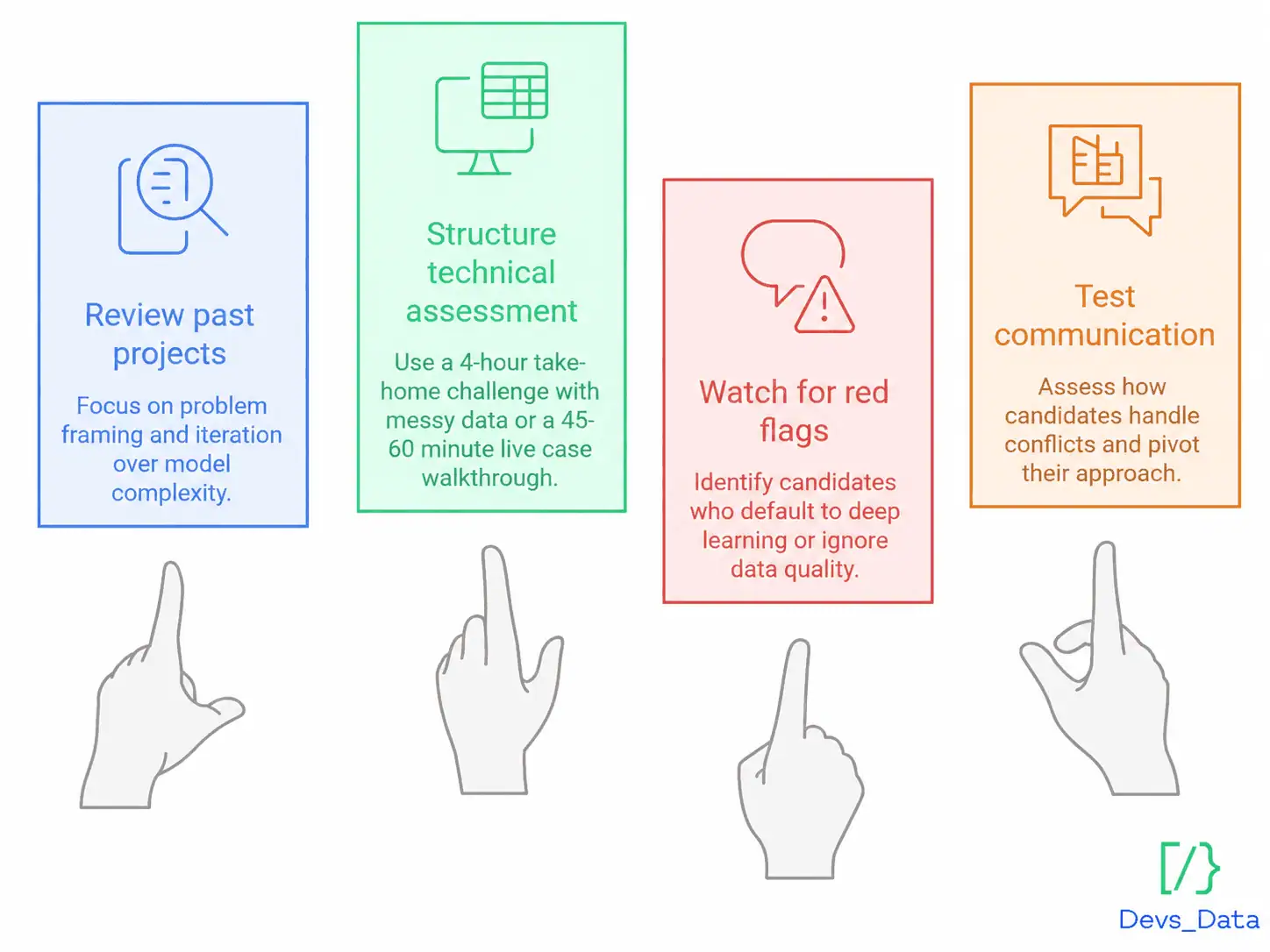
The strongest signal comes from how the candidate approached a past project, not from the model they selected. When reviewing past work, four signals cut through surface-level presentations:
A candidate who walks through those layers unprompted demonstrates structured thinking that transfers across business problems.
A take-home dataset challenge scoped to four hours gives candidates room to show their process. The dataset should be intentionally messy. Missing values and ambiguous column names force judgment calls that clean benchmark data never tests. The alternative is a live case study walkthrough lasting 45 to 60 minutes, where strong performance means asking clarifying questions about the business context before proposing a methodology.
Job postings requiring a data science-specific degree jumped from 47% in 2024 to 70% in 2025. At the same time, employer demand for formal degrees in AI-exposed jobs fell seven percentage points between 2019 and 2024 (PwC, 2025). Those two trends point in opposite directions, and the applied assessment is where Hiring Managers resolve the tension between them.
Defaulting to deep learning for every problem is the most common warning sign. A candidate who reaches for a neural network when a logistic regression answers the business question has not internalized model selection as a discipline. No discussion of data quality is a second flag, signaling someone who has not worked on production problems where data arrives incomplete or inconsistent.
The inverse defines what strong looks like. A candidate who explains why they chose a simpler model demonstrates cost-aware reasoning. One who describes how they audited a dataset before modeling shows production instincts.
Ask the candidate to describe a situation in which a model’s recommendation conflicted with a stakeholder’s intuition. How that conversation unfolded reveals more about working style than any behavioral interview template.
A second question probes what happened when data did not support the starting hypothesis. Candidates who describe pivoting their approach and communicating the revised finding demonstrate intellectual honesty. A Hiring Manager listening for these signals gets a preview of how the candidate will operate in cross-functional settings after the hire.
The sourcing channel a Hiring Manager selects shapes the candidate pool before a single resume arrives. Job boards like LinkedIn and Indeed drive volume, but most applicants will not meet the technical bar for a Data Science Developer role. Freelance marketplaces like Toptal and Upwork are well-suited for modeling projects with defined deliverables. Ongoing ML work in which the Developer serves on the internal team requires an entirely different sourcing model.
Kaggle and data science communities offer a narrower signal. Competition rankings demonstrate applied modeling skills on structured problems, but that signal breaks down when the role requires collaboration or production-deployment experience.
Salary differentials between the US and Eastern Europe reflect differences in employment law and contractor tax treatment that affect how distributed data teams operate. A Hiring Manager comparing a Machine Learning Engineer in Warsaw versus one in New York is making an operational decision, not a cost decision alone. Cross-border compliance adds friction that internal talent acquisition teams rarely have the infrastructure to manage at scale.
57% of Data Scientist postings now seek Versatile Professionals with cross-domain expertise (365 Data Science, 2025). Evaluating whether a candidate qualifies requires technical context that sits outside most Recruiters’ daily operating knowledge. Agencies specializing in data science hiring handle that screening through dataset challenges and case study presentations that filter for applied reasoning rather than keyword matching.
Salary benchmarking data is the second area where an agency adds value. Running multiple concurrent data science searches aggregates salary data across specializations that no single-seat HR team can replicate. The title ambiguity problem raised in the salary section makes this especially relevant: Benchmarking a “Data Scientist” offer without accounting for whether the role functions as an Analyst-level position or an ML Engineering seat produces misaligned offers.
International sourcing rounds out the agency function. Agencies operating across the US and Europe handle cross-border employment structures at a pace that single-company HR departments struggle to match, giving Hiring Managers access to candidate pools that domestic job boards do not reach.
Website: www.devsdata.com
Team size: ~60 employees
Founded: 2016
Headquarters: Brooklyn, NY, and Warsaw, Poland
The evaluation methods covered in the previous section describe what to test for. The question that follows is who runs the process. DevsData LLC places Data Science Developers with organizations where analytical output feeds directly into operational decisions and revenue planning. The firm operates across recruitment and technical consulting divisions, with more than 60 professionals now in the company’s tenth year of operation.
A database of 95000 verified candidates provides hiring teams with fast access to Data Science Developers with documented experience in production ML environments and analytics platforms. Clients across the US and Europe, with additional reach in Israel, rely on DevsData LLC for placements backed by a three-month replacement-or-refund guarantee, reflected in verified 5/5 reviews on Clutch and GoodFirms.
Each recruitment project runs end-to-end. The process begins with candidate sourcing and proceeds through technical evaluation, with structured interviews and onboarding coordination handled sequentially. Clients receive HR advisory support alongside legal guidance to maintain compliance throughout the hiring cycle. For a startup, the work centers on defining a first data hire from scratch, while for an enterprise it shifts toward placing specialists into an analytics team that already runs, and both receive the same rigor.
DevsData LLC refined its evaluation model over years of data-focused placement work. Data Science candidates complete a 90-minute practical challenge that tests their ability to frame a business problem and work through a messy dataset under time constraints. The exercise evaluates how the candidate communicates analytical reasoning alongside structured thinking, rather than model sophistication alone.
Recruiters assess collaboration patterns and communication clarity to confirm that candidates function well within distributed teams. In-house staff lead reference verification during English-language interviews and coordinate final salary negotiations. The agency operates on a success-fee basis, collecting payment only after a candidate starts work.
Key features:
The agency serves established enterprises as well as high-growth startups. Past clients include BCG and venture-backed companies across multiple sectors. Academic partnerships extend sourcing reach alongside connections to data science and engineering communities worldwide.
DevsData LLC recruits Specialists for Data Analyst positions and Machine Learning Engineer roles. Combined Data Science seats, where the Developer owns the full scope from statistical modeling through to production deployment, are equally common. Dedicated Recruiters replace public job boards, adding precision to each search.
Completed engagements show how DevsData LLC addresses data science hiring across different organizational contexts. A full portfolio is available on the case studies page. The assignments below involved data science and the placement of analytical talent for companies building or scaling their data teams.
DevsData LLC provided AI and data science collaboration for a global maritime logistics leader. The project applied data science methods to operational decision-making in one of the world’s largest shipping networks.
DevsData LLC handled IT recruitment for Big Data Professionals and Data Engineering Contractors for a telecommunications operation that runs a large-scale data infrastructure. The search covered senior profiles with production-level experience across distributed data systems.
Beyond recruitment, DevsData LLC delivers consulting for startups and growth-stage companies where data science and software development intersect. Teams assist with ML system builds and analytical platform development for product companies.
Project delivery keeps the recruitment practice technically current, giving Recruiters firsthand exposure to the tools and workflows that candidates describe during evaluations. The engagements below demonstrate hands-on capabilities in data science and development.
DevsData LLC developed a machine learning system for an AdTech company from Los Angeles. The project built a reinforcement learning pipeline that optimized ad placement decisions based on real-time behavioral data.
Do you have IT recruitment needs?
Businesses seeking Data Science Developers who match their technical and organizational requirements can reach DevsData LLC at general@devsdata.com or visit www.devsdata.com to connect with a Recruiter experienced in data science roles.
Hiring the right Data Science Developer determines whether an organization’s analytical investment produces operational returns or remains a reporting cost center. The World Economic Forum identifies skills gaps as the most significant barrier to business transformation, with nearly 40% of skills required in existing jobs expected to change by 2030.
The role spans a wide spectrum, and matching the right profile to the right infrastructure stage carries long-term consequences. Working with a recruitment partner that understands those distinctions shortens the path to a productive hire.
DevsData LLC pairs a government-approved recruitment license with US-based specialists and international reach, positioning it to fill data science seats where analytical rigor and production readiness both matter.
That combination of technical screening depth and international reach positions the agency to fill Data Science Developer seats where both analytical rigor and production readiness are non-negotiable.
Reach DevsData LLC at general@devsdata.com or visit www.devsdata.com for further details.
Any questions or comments? Let me know on Twitter/X.
Discover how IT recruitment and staffing can address your talent needs. Explore trending regions like Poland, Portugal, Mexico, Brazil and more.
 Frequently asked questions (FAQ)
DevsData – your premium technology partner
DevsData is a boutique tech recruitment and software agency. Develop your software project with veteran engineers or scale up an in-house tech team of developers with relevant industry experience.
Free consultation with a software expert
🎧 Schedule a meeting
FEATURED IN


DevsData LLC is truly exceptional – their backend developers are some of the best I’ve ever worked with.”

Nicholas Johnson
Mentor at YC, serial entrepreneur


 Build your project with our veteran developers.
Explore the benefits of technology recruitment and tailor-made software.
Learn how to source skilled and experienced software developers.
Build your project with our veteran developers.
Explore the benefits of technology recruitment and tailor-made software.
Learn how to source skilled and experienced software developers.

Rebecca Botvin

Commercial Director

Tom Potanski
Manager




Categories: Big data, data analytics | Software and technology | IT recruitment blog | IT in Poland | Content hub (blog)














careers@devsdata.com









general@devsdata.com

"I interviewed about a dozen different firms. DevsData LLC is truly exceptional – their backend developers are some of the best I've ever worked with. I've worked with a lot of very well-qualified developers, locally in San Francisco, and remotely, so that is not a compliment I offer lightly. I appreciate their depth of knowledge and their ability to get things done quickly."

Nicholas Johnson
CEO of Orange Charger LLC,
Ex-Tesla Engineer,
Mentor at YCombinator
"DevsData reached out to us, as we've been looking to grow our engineering team in Europe and Poland. Communicating efficiently and professionally, DevsData made a strong impression with their understanding of the recruitment challenges we were facing. They designed a tailored recruitment process for our needs. I was impressed with the technical depth of their approach."

Karim Butt
Co-Founder & CTO at GlossGenius, Inc.
"Out of all the vendors we work with, DevsData clearly stands out. The quality of developers they deliver is beyond what we've received from any other vendor, and they've been able to send profile recommendations very quickly. I'm happy to be their reference for other companies from Israel and talk about their recruitment abilities and what they delivered for us."

Ran Eyal
Senior Manager at
ZIM Integrated
Shipping Services Ltd.
"DevsData demonstrated a strong degree of proactivity, taking time to thoroughly understand the problem and business perspective, and continuously suggesting performance and usability enhancements. Their app exceeded my expectations. I've worked with DevsData on numerous projects over the last 3 years and I'm very happy. Being both responsive and honest in communication."

Jonas Lee
Partner & Executive VP of Verus,
Financial LLC, Investor,
& Serial Entrepreneur
Acknowledgments