Thanks for subscribing.
Your gift is on the way.



In crypto, the cost of a coding mistake can run to nine figures, and it is often final within minutes of mainnet deployment. That single fact separates blockchain hiring from traditional software recruitment, where a coding error stays bounded by the next release cycle. The technology has moved into the mainstream at the same time. Banks now tokenize money market funds, and payment networks settle in stablecoins. Consumer applications increasingly route through smart contracts that no human can modify once they go live.
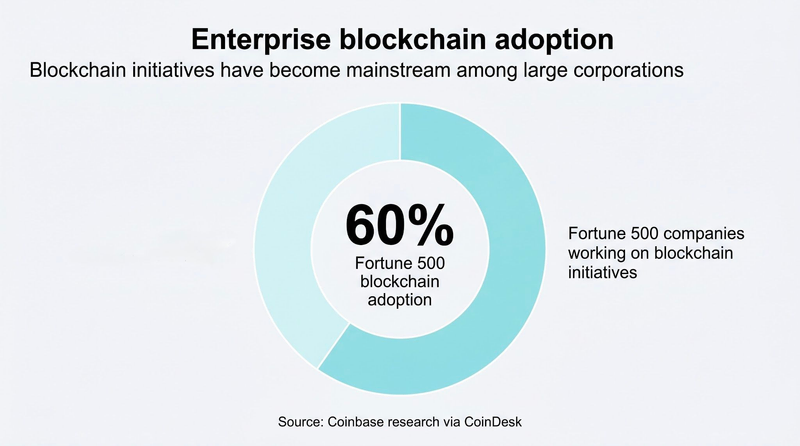
The market data behind this shift is unambiguous. Total cryptocurrency market capitalization reached an all-time high of $4.28 trillion in October 2025 before settling closer to $3 trillion at year-end, a level that places digital assets firmly inside the discussion of traditional enterprises. Adoption follows the capital. According to CoinDesk reporting on Coinbase research, roughly 60% of Fortune 500 companies were working on blockchain initiatives by mid-2025, a share that would have looked aspirational two years earlier.
This combination of capital concentration and enterprise activity has produced a specific hiring problem. Demand has shifted from crypto-native startups alone to a broader buyer base, with asset managers like BlackRock, payment processors like Stripe, supply chain operators, and government agencies now sourcing the same talent. Each of these buyers needs engineers who understand consensus protocols, gas economics, signature schemes, and the operational discipline required to manage private keys at scale. The pool of engineers with that skill set is small, geographically dispersed, and competitive. Companies that approach blockchain recruitment with a generalist software template tend to spend months filling roles that ultimately underperform once code reaches production.
The stakes are higher because blockchain code is, in practical terms, a permanent legal artifact. A buggy web application can be patched in the evening. A buggy smart contract that custodies user funds becomes the headline of a security incident, a regulatory inquiry, and often the closing chapter of a company. Hiring decisions in this space are therefore not just about velocity and cost. They are decisions about exposure to operational, financial, and reputational risk that compound across every contract a team ships.
This is a practical guide for hiring leaders, built from institutional research and from the blockchain and Web3 recruitment DevsData LLC, a technology recruitment and software development firm, has handled directly. The sections ahead move from the work crypto engineers do to the market they sit in and the framework for selecting a partner.
The label “Crypto Developer” covers at least five distinct engineering specialties, and conflating them is the most common reason crypto hiring processes fail. Each specialty has its own toolchain, security failure modes, evaluation method, and salary band. Treating them as interchangeable produces job descriptions that attract a broad and shallow candidate pool, and the cost surfaces months later when the wrong hire ships the wrong category of work.
Smart contract engineers write the code that custodies user funds, governs token transfers, and enforces the rules of decentralized applications. The work is dominated by Solidity on Ethereum and EVM-compatible chains, with Rust used for Solana and a smaller share for chains such as Aptos and Sui. The defining characteristic of this role is the irreversibility of deployment. Once a contract is live, the code is the agreement, and a logic flaw cannot be fixed by pushing a hotfix. Senior Smart Contract Engineers, therefore think more like Security Researchers than Feature Developers, spending significant time on invariants, formal verification, fuzzing, and audit preparation. Business outcomes from this role are measured less in features shipped and more in the absence of incidents over the lifetime of deployed contracts.
Backend engineers in crypto operate the infrastructure that surrounds the contract layer. This includes node operations, indexing services such as The Graph, RPC gateways, off-chain databases that mirror on-chain state, message queues that handle transaction submission, and the integrations with custody providers, oracle networks, and key management systems. The work resembles traditional backend engineering in shape but differs in failure modes. A misconfigured node, a stale indexer, or a poorly handled chain reorganization produces user-visible inconsistencies that erode trust quickly. Companies that try to repurpose their existing backend team to cover this work without dedicated blockchain experience typically find that the operational burden grows faster than expected, and incident response becomes a recurring drain on senior engineering time.
Decentralized application engineers, often described as Web3 Fullstack Developers, sit at the intersection of frontend engineering and protocol interaction. They build the wallet connection flows, transaction signing experiences, gas estimation logic, and state synchronization between user interfaces and on-chain contracts using libraries such as ethers.js, viem, and wagmi. The business outcome here is conversion. A clumsy wallet flow, an unclear transaction prompt, or a slow state update is the difference between a user who completes an action and a user who abandons. Quality engineers in this category understand that crypto user experience is fundamentally different from Web2 because every meaningful action incurs a real cost and a real delay, and the interface has to communicate both clearly without overwhelming the user.
Protocol engineers work below the application layer, on the consensus, networking, cryptography, and economic mechanism design that defines how a blockchain itself behaves. The work includes contributing to client implementations, designing rollup architectures, engineering bridge protocols, and integrating zero-knowledge proof systems. This is the smallest and most technically demanding category, drawing from a candidate pool that often overlaps with distributed systems research, applied cryptography, and game theory. Companies that need this work usually need only a few of these engineers, and the hiring timeline tends to be measured in quarters rather than weeks. The business outcome is the protocol itself, and the cost of getting it wrong is paid by every application built on top.
Security engineers in crypto handle a remit that does not exist in equivalent form in traditional software. They run threat models against contract logic, design key management procedures, evaluate signing infrastructure, plan incident response for both code-level and operational compromises, and maintain ongoing relationships with audit firms. The category overlaps with smart contract development at the senior level, since the most experienced contract engineers are typically also the most experienced security thinkers. The business outcome is risk reduction across the full lifecycle of a deployed system, from pre-deployment audits through post-deployment monitoring and the eventual upgrade or migration of contracts. Companies that treat security as a checkbox at audit time, rather than an integrated engineering function, tend to learn the cost of that decision in public.
Across these five specialties, the common thread is that crypto engineering is defined by what cannot be undone. Each category carries its own toolchain and salary band, yet all five share a discipline that traditional software rarely demands, where a single deployment can be permanent, and a single key can hold custody of real value. The practical implication for hiring is that the first decision is not who to hire but which specialty the work actually requires, because a strong smart contract engineer and a strong protocol engineer are not substitutes, and mismatching the two is the error that surfaces at the first audit.
Hiring Crypto Developers is not a hedge against a future trend. It is an operational decision that should follow a concrete product or infrastructure requirement. Companies that hire speculatively, hoping the team will discover its own roadmap, generally produce expensive proofs of concept that never reach production, while companies that hire against a defined business need produce systems that compound in value. The buyers driving this demand now span several industries, from asset managers and payment processors to supply chain operators and government agencies, each arriving with a different product requirement rather than a shared interest in the technology. The table below outlines the most common situations where bringing crypto engineering capacity in-house, or sourcing it through a specialist partner, is justified by a specific business outcome rather than by general curiosity about the technology.
| Use case | When it applies |
|---|---|
| Launching a blockchain product | A company is shipping a token, an on-chain registry, or a decentralized application as a primary product line, and treats the smart contract code as core intellectual property rather than an experiment. |
| Building DeFi applications | The product offers lending, trading, derivatives, asset management, or yield strategies that compose with established protocols like Uniswap and Aave, which demands deep familiarity with composability, oracle design, and liquidation mechanics. |
| Integrating digital assets | An existing business needs to accept, custody, or settle in cryptocurrency or stablecoins, and requires reliable wallet integration, on-ramp logic, and treasury infrastructure that handles custody risk correctly. |
| Developing custom smart contracts | The use case cannot be served by existing protocol primitives, and requires bespoke contract logic that will be audited, deployed, and operated under the company’s own governance and upgrade processes. |
| Scaling Web3 infrastructure | A growing application is hitting throughput, gas cost, or operational limits on its current chain and needs to migrate to a Layer-2 network, deploy on multiple chains, or operate its own validator and indexing infrastructure. |
| Improving blockchain security | An organization with deployed contracts or signing infrastructure needs to harden against known attack patterns, formalize incident response, and integrate continuous monitoring rather than relying on audit reports alone. |
| Tokenizing real-world assets | A financial institution or asset originator is bringing securities, real estate exposure, or other off-chain assets onto a blockchain and needs engineers who understand both the technical and regulatory mechanics of the bridge. |
The shared characteristic across these use cases is that crypto engineering is on the critical path to a defined business outcome. The work cannot be outsourced to a generalist agency or covered by an existing backend team without acquiring the specialized knowledge that only experienced crypto engineers bring. Companies that recognize this early, and structure their hiring around the actual category of work needed, avoid the expensive middle phase of hiring the wrong profile, discovering the gap during the first audit, and then paying twice to replace the role. The reverse is also worth stating clearly. If a business is exploring whether blockchain is relevant to a future product line, that exploration is best handled by a small, time-boxed engagement with a specialist partner rather than by a permanent hire who lacks a clear roadmap to support.
Do you have IT recruitment needs?
The market for crypto engineering talent in 2026 is shaped by four converging forces: capital flowing into onchain financial products, a developer base whose casual contributors thinned during the downturn while its experienced core kept growing, a hiring base that has expanded beyond crypto-native firms, and a security loss profile that has made talent quality a board-level concern.
Onchain financial activity has expanded across multiple categories simultaneously. The real-world asset tokenization market reached $24 billion in size in mid-2025, having grown roughly fivefold in three years, with treasury products, private credit, and tokenized funds leading the inflows. Stablecoin market capitalization crossed $300 billion for the first time in late 2025, growing close to 47% from the start of the year as the regulatory framework for issuance clarified in the United States. Decentralized finance moved with the same trend, with DeFi total value locked reaching a three-year high of $153 billion by late July 2025 according to DefiLlama data. Each of these segments requires its own engineering specialization. Tokenization platforms need engineers who understand both securities mechanics and contract design. Stablecoin operators need treasury, redemption, and reserve management infrastructure. DeFi protocols need composability, risk modeling, and oracle integration. The breadth of demand is what makes the talent picture tighter than the headline numbers alone would suggest.
The supply side of the equation looks different from the demand side. According to Electric Capital, roughly 23613 monthly active open-source Crypto Developers were contributing in late 2024, a figure that declined approximately 7% year over year as the long tail of casual contributors thinned out during the bear market. The picture changes meaningfully when the data is filtered to experienced developers. Established contributors with two or more years of tenure grew 27% year over year and accounted for around 70% of all code commits, the highest concentration on record. The pool of engineers who can credibly own a smart contract or protocol role is smaller than the aggregate developer count suggests, and that pool grew faster than the headline number because the work is concentrating in fewer, more capable hands.
New developer inflow tells a parallel story about the geography of the market. The 2024 Electric Capital Developer Report tracked roughly 39148 new developers entering crypto over the year, with India contributing about 17% of those new entrants and overtaking the United States as the largest single source of new developer activity. Within Ethereum specifically, 56% of developers were working on Layer-2 networks rather than mainnet, a sharp inversion from the pre-rollup era. EigenLayer was the fastest-growing single ecosystem of the year, with monthly active developers expanding 167% as restaking-based architectures attracted new builders. For buyers, this matters because skill stacks are diverging. A Senior Engineer who lived in Hardhat on Ethereum mainnet in 2022 is not automatically fluent in a Foundry-based workflow on a modern Layer-2 stack, and a hiring rubric written three years ago will quietly screen out exactly the engineers who are most active today.
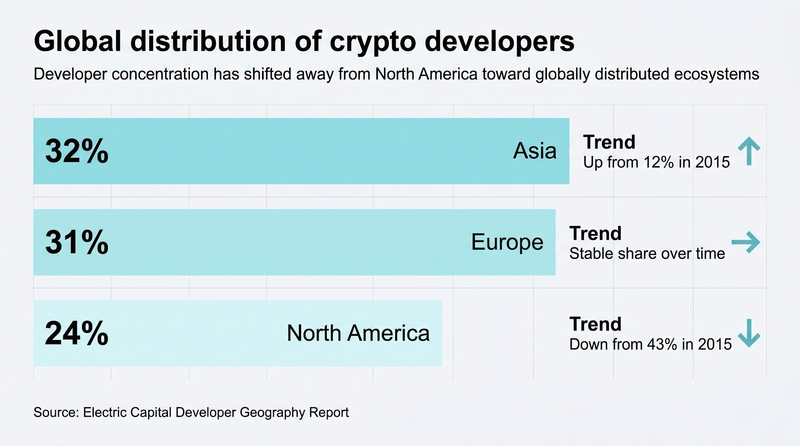
Geographic distribution of Crypto Developers has shifted decisively over the last decade. Per the Electric Capital Developer Geography Report, Asia became the top region for Crypto Developers in 2024 at roughly 32% of global share, up from 12% in 2015. North America held about 24%, down from 43% over the same period, while Europe held steady around 31%. The country-level picture is consistent with the regional one. The United States remains the largest single country at 19%, India is second at 12%, and the United Kingdom, China, Canada, and Germany fill the next four slots. The practical consequence for buyers headquartered in North America or Western Europe is that local-only hiring searches now address a minority of the available talent. A hiring strategy that does not actively source across Asia, Eastern Europe, and Latin America will systematically miss the candidates who are entering the market in the largest numbers.
The risk profile of the work has not improved alongside the maturity of the market. According to The Block reporting on Chainalysis data, total cryptocurrency theft reached approximately $3.4 billion through the first eleven months of 2025, with attacks shifting toward individual wallets and away from purely smart contract logic. The composition of those losses is what should drive hiring decisions. According to Halborn, off-chain incidents accounted for 56.5% of attacks and 80.5% of total funds lost in 2024, and only 19% of hacked protocols had used multi-signature wallets while just 2.4% used cold storage. These are not failures of contract code in the abstract. They are failures of operational discipline, key management, and signing infrastructure. Hiring criteria that treat security as a smart-contract-only concern systematically miss the categories of risk that are actually producing the largest losses.
That standard sets up the harder problem, which is execution. Knowing that discipline matters more than framework count does not by itself make the right engineer easier to find or to verify. The market conditions described above translate, at the level of an individual search, into a specific set of hiring obstacles that recur across almost every engagement. The next section works through the four that surface most often, along with the operational adjustment that resolves each.
Crypto engineering is the rare hiring category where the cost of a wrong hire is not measured in lost productivity but in lost custody, and where the right hire is identifiable not by the breadth of frameworks they list but by the discipline they bring to irreversible decisions.
Hiring Crypto Developers fails in predictable ways. The same four obstacles surface across nearly every engagement, regardless of company stage or location. Companies that anticipate them in advance, and build their process to address each one, fill roles in weeks. Companies that discover them in sequence during the search, often by losing finalist candidates or shipping incidents, take quarters. The four challenges below are drawn from recurring patterns DevsData LLC has observed in blockchain recruitment, and each is paired with the operational adjustment that resolves it. The pattern is consistent enough that treating these as standard process design rather than as edge cases is the single highest-leverage change a hiring team can make.
Generalist technical interviews do not surface the specific competence that crypto roles require. A candidate who passes a standard backend or fullstack loop with strong scores can still be unprepared to reason about reentrancy, signature replay, oracle manipulation, or the interaction between gas mechanics and contract logic. The reverse is also true. A candidate who has shipped notable contracts but interviews quietly may underperform on a generic algorithmic round and be filtered out before reaching anyone who can evaluate the actual work.
The standard signals also drift quickly. A GitHub history that looked impressive in 2022 may reflect ecosystems that no longer match the current toolchain. Tenure at a recognizable crypto company is a useful filter but is not predictive on its own, since the role distribution at large protocols varies widely. Reference checks help but are limited by the small size of the senior community, where everyone knows everyone and most references are positive by default. The result is an evaluation problem that does not map cleanly onto the templates most engineering organizations already use, and that will not be solved by adding more interview rounds of the same kind.
DevsData LLC operates a structured technical evaluation built around a 90-minute problem-solving challenge calibrated to crypto-specific failure modes, paired with a portfolio review of deployed contracts and verified on-chain code provenance. The process replaces the generic algorithmic round with scenarios that surface security thinking, gas reasoning, and protocol literacy directly. Communication screening runs inside the same workflow rather than as a separate stage, and reference checks ask about specific work the candidate shipped, such as a named contract they deployed, rather than general impressions.
The security stakes in crypto hiring sit at a different order of magnitude from those in traditional software. According to Decrypt reporting on full-year 2025 figures, DPRK-linked actors stole roughly $2 billion across the year, much of it through compromise of operational and signing infrastructure rather than smart contract logic alone.
The cost of the wrong hire in a privileged role is therefore not bounded by salary or onboarding time. It is bounded by the largest signing authority that a hire will hold, and by the procedural discipline they bring to handling that authority. Hiring teams that treat security as a downstream concern, addressed by audits after engineering decisions are made, end up structurally exposed to the dominant attack surface. The candidates who reduce this exposure tend to be quiet about it during interviews, because they have learned that the most important security work is the work that prevents incidents rather than the work that responds to them.
DevsData LLC screens for operational security discipline as a first-class evaluation criterion, not as an afterthought. Candidates for privileged roles are assessed on their handling of key management, signing flows, multi-signature design, and incident response history, with verification against publicly visible artifacts where available. The screening is calibrated against current attack patterns rather than against generic security checklists, and the framework is updated as new incident classes emerge in the field.
The crypto stack changes faster than the hiring market can adapt. Tooling that was standard in 2022 has been replaced, frameworks that dominated have lost share to faster alternatives, and execution environments have multiplied to include several major Layer-2 networks plus alternative virtual machines. According to Cointelegraph reporting on Chainalysis data, 43.8% of stolen value in 2024 stemmed from compromised private keys, and the dominant attack vectors continue to evolve as defensive tooling improves. A candidate whose practice was current two years ago may have stopped tracking the changes, particularly if they have been working at a single firm with an internal stack.
The reverse holds for evaluators. A hiring manager who has not deployed contracts recently may underweight signals that matter and overweight signals that no longer do. The challenge is not finding candidates who know the current stack. It is finding evaluators and processes that recognize current expertise when they see it, and that distinguish between engineers who have stayed current and engineers whose résumés look current but whose practice has drifted.
DevsData LLC maintains an internal calibration on the current state of crypto tooling, refreshed against ecosystem reports and active deployment data, so that screening filters reflect what is in production rather than what was prominent two cycles ago. The technical evaluation is updated continuously rather than annually, and the framework distinguishes between engineers actively working with current tooling and those whose recent activity does not match their stated expertise.
The senior end of the crypto engineering market is structurally small and competitive. Companies hiring in this segment are not just competing with other crypto-native firms. They are competing with traditional financial institutions building tokenization desks, with custody and infrastructure providers building enterprise products, and with non-crypto companies adding digital asset capabilities to existing product lines.
The result is a market where senior candidates often have multiple offers in flight, where compensation expectations include cash, equity, and token components, and where the time-to-close on a senior role is measured in weeks of negotiation rather than days. Sourcing through LinkedIn posts and public job boards reaches the smallest part of this pool, since the most Senior Engineers rarely search actively and respond only to introductions that show specific knowledge of their work. Companies that approach senior crypto hiring through standard inbound funnels typically reach a small fraction of the actual candidate set, and convert a smaller fraction of those they reach.
DevsData LLC reaches Senior Crypto Engineers through a sourcing model that pairs a curated candidate database with active ecosystem relationships, then adds outreach calibrated to each specific role rather than to generic templates. Because crypto work is remote by default, that search runs across regions rather than within a single local market, which is where most of the current senior talent actually sits. Senior candidates respond to introductions that reflect understanding of their published work and deployed contracts, along with their wider protocol contributions, and the process is structured to produce that kind of introduction rather than mass outreach.
None of these challenges are theoretical. Each one corresponds to a specific point in the hiring pipeline where companies lose either time or candidates, and each one compounds when ignored. The teams that move fastest in this market are not the ones with the largest budgets. They are the ones who have internalized that crypto recruitment is a different process from general software recruitment, and who have either built the operational discipline themselves or partnered with a specialist who has. The compounding effect runs in both directions. Companies that get the process right ship faster, hire better, and avoid the incidents that derail their roadmaps. Companies that treat crypto hiring as a variant of standard recruitment generally pay for that decision in delay, in turnover, and occasionally in losses that show up on a public block explorer.
The shortest path to a successful crypto hire runs through a process that has already learned which signals matter, which signals mislead, and which questions surface the discipline that distinguishes engineers who ship safely from engineers who ship quickly.
Do you have IT recruitment needs?
Selecting a recruitment partner for crypto engineering roles is itself a technical decision. The wrong partner produces volume without precision and consumes hiring manager time on candidates who will not pass a serious technical loop. The right partner reduces the search to a smaller, more targeted set of candidates whose backgrounds map directly to the specific role, the specific stack, and the specific stage of the company. The five criteria below are the ones that distinguish the two outcomes, and applying them in sequence produces a faster and more reliable shortlist than starting an engagement and adjusting in flight.
A recruitment firm that has placed candidates at crypto companies is not the same as a firm that understands the work those candidates do. The distinction surfaces quickly in the first conversation. A partner with real domain depth can describe the difference between protocol and application engineering, name the current toolchain on the major networks, and explain why a particular candidate fits a smart contract role rather than a backend role. A partner with surface exposure tends to use the vocabulary correctly but cannot reason about the underlying tradeoffs, and the gap shows up in the candidates they shortlist. The verification is conversational, not contractual. The right questions early reveal the depth without requiring a paid engagement to discover it.
Ask the partner to describe their screening process step by step. The answer should include a technical evaluation that goes beyond résumé review and reference checks, ideally a structured assessment that surfaces security thinking, gas reasoning, and current ecosystem familiarity. It should include explicit communication screening, since crypto engineering work is increasingly distributed and asynchronous. It should include verification of claimed work, since portfolio quality varies widely and some candidates overstate their contributions to deployed protocols. A partner who cannot describe these steps in concrete detail is unlikely to apply them consistently across an engagement.
Given that the geographic center of crypto development has shifted toward Asia and Eastern Europe, a recruitment partner whose candidate base is concentrated in a single region structurally addresses a minority of the market. The right partner sources globally and can demonstrate active relationships across the regions where current developer activity is strongest. Ask for the rough geographic distribution of the candidate base. If the answer is heavily skewed toward one region, the engagement will likely produce candidates from that region regardless of where the strongest match for the role actually sits.
Commercial structure shapes incentives. A success fee model aligns the partner with the outcome the company is paying for, since the fee is paid only when a hire is made and remains. A guarantee period covering the first months of employment further aligns incentives, since the partner is exposed to the cost of a candidate who does not work out. Retainer-only models with no performance component or guarantee tend to produce higher candidate volume and lower precision, since the firm is paid regardless of outcome. The commercial model is therefore not just a pricing question. It is a signal of how the partner thinks about quality.
Independent platforms that aggregate verified client reviews provide a useful counterweight to a recruitment firm’s own marketing claims. Strong, consistent ratings across multiple platforms, paired with reviews that name specific projects or roles rather than general impressions, indicate a firm that has performed at the standard it advertises. A handful of generic five-star reviews is less informative than a smaller number of detailed reviews that describe the actual work. The check takes less than ten minutes and meaningfully reduces the risk of selecting a partner whose marketing claims are stronger than their delivery record.
The questions below operationalize each step into a short, direct script that can be used during initial conversations with prospective recruitment partners.
| Evaluation step | Questions to ask the agency |
|---|---|
| Verify domain depth | Can you walk me through the difference between a protocol engineer and a smart contract engineer, and describe the current toolchain on Ethereum Layer-2 networks and Solana? |
| Confirm screening methodology | What does your technical evaluation look like for a senior smart contract role, and how do you verify that a candidate’s claimed deployments and contributions are real? |
| Evaluate sourcing reach | What is the rough geographic distribution of your candidate base, and how do you source across Asia, Eastern Europe, and Latin America for senior roles? |
| Examine commercial model | Do you operate on a success fee model, and what guarantee period do you provide if the candidate leaves or underperforms in the first months? |
| Check reputation signals | Can you point me to verified client reviews on independent platforms, and to two recent placements I can ask about specifically? |
Taken together, these five checks describe a single kind of partner, one that can reason about the work, verify it independently, source it globally, and stand behind the placement commercially. Few firms clear all five. The section that follows explains how DevsData LLC maps against them, not as a claim but as a record a buyer can check.

Company size: ~60 employees
Founding year: 2016
Website: www.devsdata.com
Headquarters: Brooklyn, NY, and Warsaw, Poland
DevsData LLC has built its blockchain recruitment practice on top of nearly a decade of broader IT recruitment experience, with a candidate base, screening methodology, and commercial model designed for the specific failure modes of senior technical hiring. The firm operates from offices in Brooklyn and Warsaw, with US-based specialists who handle client communication for North American engagements and a wider sourcing team that reaches across Europe and Asia. Clients are concentrated in the United States and Israel, two markets where the demand for senior crypto engineering capacity has grown fastest as institutional adoption has accelerated.
The operational backbone of the practice is a candidate database of more than 95000 verified profiles, refreshed continuously and segmented by stack, seniority, and ecosystem familiarity. The firm holds a government-approved recruitment license and has completed more than 100 projects for over 80 clients across IT recruitment and software development engagements. Commercial terms run on a success fee model with a guarantee period, which aligns the firm’s incentives with the client’s hiring outcome rather than with engagement volume. Each candidate is screened through a 90-minute problem-solving challenge calibrated to the role, paired with structured communication screening designed to surface the asynchronous, distributed working patterns that crypto teams require.
Independent reputation signals are consistent with the operational record. The firm holds a 5/5 rating on Clutch and a 5/5 rating on GoodFirms, with verified client reviews that describe specific projects rather than general impressions. The combination of long operating history, structured screening, global sourcing reach, aligned commercial terms, and verified reputation produces a partner profile that maps directly onto the five criteria a serious buyer should apply when selecting a recruitment partner for crypto engineering roles.
LayerZero is a cross-chain interoperability protocol that enables messaging and asset transfer across more than thirty blockchain networks. As the protocol scaled adoption across both crypto-native applications and emerging institutional use cases, the engineering team needed to expand capacity in roles where the technical bar sits among the highest in the industry.

Cross-chain messaging engineering combines protocol-level reasoning, cryptographic primitives, and the operational discipline required to move assets safely between different blockchains. The candidate set capable of contributing at this level is small globally, distributed across regions, and rarely active on standard recruitment channels. Generic sourcing produces volume without precision, and the cost of a mismatched hire in this category is paid in slowed roadmap and elevated operational risk rather than in onboarding time alone.
DevsData LLC ran the search across multiple geographies, drawing on the segmented candidate database and on direct outreach into communities where active cross-chain protocol contributors are concentrated. The sourcing brief was calibrated against the specific stack and security profile that LayerZero’s engineering organization required, rather than against a generic blockchain engineer template, so that the shortlist reflected actual fit rather than surface keyword matches.
Each candidate moved through a structured technical evaluation focused on protocol-level reasoning, security thinking, and verified portfolio review, paired with communication screening calibrated to a distributed engineering culture. The 90-minute problem-solving challenge surfaced the specific competencies that cross-chain work demands, and reference checks were anchored to concrete deliverables rather than general impressions, which compressed the noise typically introduced by the small-community dynamics of senior crypto recruitment.
The engagement produced a shortlist of candidates whose backgrounds mapped directly to the protocol-engineering profile required, and the placement closed within a timeline materially shorter than the firm’s prior experience with generalist recruitment channels. The candidate’s performance after onboarding has been consistent with the screening signal, which is the strongest validation any recruitment process can produce.
The hire freed senior engineering leadership at LayerZero from sourcing and screening overhead during a phase of rapid scaling, and the engagement established a sourcing pattern that has carried into subsequent searches. The case illustrates how a structured recruitment process applied to one of the harder corners of crypto engineering produces measurably different outcomes than generic technical recruitment, and how the value of a specialist partner compounds across multiple roles within the same engineering organization.
Do you have IT recruitment needs?
If your engineering roadmap includes blockchain, smart contract, or Web3 roles in 2026, DevsData LLC can structure the search around the specific category of work you need filled. Reach out to start a conversation calibrated to your stack, your seniority bar, and your timeline by emailing at general@devsdata.com or visiting www.devsdata.com.
The buyers who close senior crypto roles fastest in 2026 will be the ones who hire smart contract, backend, protocol, and security work as separate disciplines with separate rubrics, while the rest keep paying for a single blockchain engineer template that screens for the wrong signals. The market data points in one direction. Onchain financial activity has expanded across tokenization, stablecoins, and decentralized finance simultaneously, the experienced developer cohort has consolidated rather than expanded, the geographic center of the talent base has moved decisively toward Asia, and the operational risk profile of the work has continued to surface losses at a scale that no other category of software engineering routinely produces. Each of these forces shapes what a successful hiring process looks like, and each of them rewards specialization in the recruitment function.
The strategic implication for hiring leaders is that the categories of crypto engineering work, smart contract, backend, decentralized application, protocol, and security, should be hired as distinct roles with distinct evaluation rubrics rather than under a single blockchain engineer banner. The operational implication is that screening must surface security discipline, current ecosystem familiarity, and verified portfolio quality, rather than relying on generic technical interview templates that were designed for a different category of work. The commercial implication is that the partners who reduce time-to-hire and elevate hire quality in this market are those whose model aligns with the outcome the buyer is paying for, with success fees, guarantee periods, and structured screening rather than retainer volume.
Looking forward, the trends that have defined the last two years are unlikely to reverse. Enterprise adoption will continue to broaden the buyer base for crypto engineering capacity, the senior end of the talent market will remain structurally tight, and the geographic distribution of new developers will continue to favor regions outside North America. Companies that build their hiring infrastructure around these realities, either internally or through specialist partners, will compound advantages over peers who continue to treat crypto recruitment as adjacent to general software recruitment. The market is rewarding operational discipline in this category more visibly than in most others, and the gap between teams that have internalized this and teams that have not will widen over the coming cycles.
DevsData LLC approaches Crypto Developer recruitment as a specialized practice within a broader IT recruitment foundation, with the screening discipline, geographic reach, and commercial alignment that this category specifically requires. For organizations building blockchain, smart contract, or Web3 capacity in the year ahead, a structured recruitment partnership is the shortest path between a defined business need and the engineers who can deliver it without producing the kinds of incidents that crypto specifically punishes.
Any questions or comments? Let me know on
Twitter/X.
Discover how IT recruitment and staffing can address your talent needs. Explore trending regions
like Poland, Portugal, Mexico, Brazil and more.
 Frequently asked questions (FAQ)
DevsData – your premium technology partner
DevsData is a boutique tech recruitment and software agency. Develop your software project with veteran engineers or scale up an in-house tech team of developers with relevant industry experience.
Free consultation with a software expert
🎧 Schedule a meeting
FEATURED IN


DevsData LLC is truly exceptional – their backend developers are some of the best I’ve ever worked with.”

Nicholas Johnson
Mentor at YC, serial entrepreneur


 Build your project with our veteran developers.
Explore the benefits of technology recruitment and tailor-made software.
Learn how to source skilled and experienced software developers.
Build your project with our veteran developers.
Explore the benefits of technology recruitment and tailor-made software.
Learn how to source skilled and experienced software developers.

Rebecca Botvin

Commercial Director

Tom Potanski
Manager




Categories: Big data, data analytics | Software and technology | IT recruitment blog | IT in Poland | Content hub (blog)















careers@devsdata.com









general@devsdata.com

"I interviewed about a dozen different firms. DevsData LLC is truly exceptional – their backend developers are some of the best I've ever worked with. I've worked with a lot of very well-qualified developers, locally in San Francisco, and remotely, so that is not a compliment I offer lightly. I appreciate their depth of knowledge and their ability to get things done quickly."

Nicholas Johnson
CEO of Orange Charger LLC,
Ex-Tesla Engineer,
Mentor at YCombinator
"DevsData reached out to us, as we've been looking to grow our engineering team in Europe and Poland. Communicating efficiently and professionally, DevsData made a strong impression with their understanding of the recruitment challenges we were facing. They designed a tailored recruitment process for our needs. I was impressed with the technical depth of their approach."

Karim Butt
Co-Founder & CTO at GlossGenius, Inc.
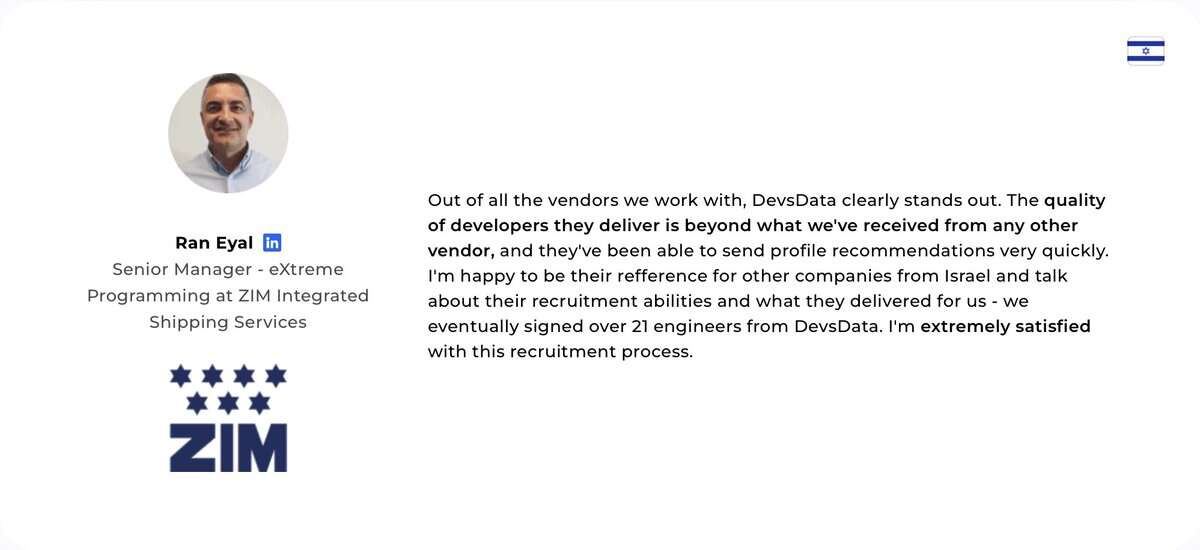
"Out of all the vendors we work with, DevsData clearly stands out. The quality of developers they deliver is beyond what we've received from any other vendor, and they've been able to send profile recommendations very quickly. I'm happy to be their reference for other companies from Israel and talk about their recruitment abilities and what they delivered for us."

Ran Eyal
Senior Manager at
ZIM Integrated
Shipping Services Ltd.
"DevsData demonstrated a strong degree of proactivity, taking time to thoroughly understand the problem and business perspective, and continuously suggesting performance and usability enhancements. Their app exceeded my expectations. I've worked with DevsData on numerous projects over the last 3 years and I'm very happy. Being both responsive and honest in communication."

Jonas Lee
Partner & Executive VP of Verus,
Financial LLC, Investor,
& Serial Entrepreneur
Acknowledgments