Thanks for subscribing.
Your gift is on the way.
 Link copied



A strong digital presence now underpins how companies run their operations and reach their audiences, and Content Management Systems (CMS) are central to that shift. These platforms enable businesses to publish, update, and manage content rapidly (often without direct engineering involvement), making them fundamental to modern digital operations. Their ubiquity is reflected in platform-level dominance: according to recent industry analysis, WordPress alone powers approximately 43.4% of all websites online and holds over 60% of the total CMS market share. This level of reliance on CMS technology directly translates into growing demand for developers who can build, customize, secure, and evolve these systems at scale.
At the same time, the broader technology landscape faces an unprecedented labor shortage. According to IDC, by 2026 more than 90% of organizations will be affected by IT skills shortages, with projected global economic losses reaching $5.5 trillion due to stalled digital initiatives and unfilled technical roles. AI is accelerating this shift further, as automation reshapes how content is produced and managed, pushing CMS Developers toward higher-value tasks that require architectural judgment and platform-level decision-making. CMS Developers sit at the center of these pressures: they require both platform-specific expertise and broader software engineering skills that generative tools cannot yet replace. The scarcity of such profiles makes CMS recruitment essential for businesses seeking stable and scalable digital infrastructure.
Because of these pressures, companies increasingly turn to specialized recruitment partners. Agencies with CMS-specific expertise maintain wider talent networks, understand platform intricacies, and run screening processes tailored to evaluate real CMS proficiency rather than generic development experience. This accelerates time-to-hire and significantly reduces the risks associated with mis-hiring – an important factor when CMS performance directly feeds into lead generation, eCommerce revenue, and brand credibility.
In this article, we explore how CMS recruitment works, the current market context, the challenges companies face when hiring CMS Developers, and why partnering with a specialized agency creates a competitive advantage in today’s saturated digital ecosystem.
CMS recruitment refers to the process of hiring specialists who work with Content Management Systems – platforms such as WordPress, Drupal, Joomla, Magento, Shopify, Sitecore, and Adobe Experience Manager. CMS development focuses on building and maintaining websites, digital platforms, and content-heavy applications using the tools, frameworks, plugins, and customization layers these systems provide. Unlike general software developers, CMS professionals combine programming skills with an understanding of content workflows, templates, modules, and user-facing functionality, making them critical for businesses that rely on frequent content updates or operate dynamic digital experiences.
The roles covered by CMS recruitment typically include:
As the CMS ecosystem has matured, hiring for these roles has become more nuanced than evaluating general web development experience. Each platform has its own architecture, extension models, performance considerations, and security expectations, which means candidate suitability depends heavily on specific technical background rather than broad familiarity with web technologies. The end-user industries driving this demand reinforce the point. Banking, financial services, and insurance companies require CMS talent that can handle secure, compliance-driven portals. Healthcare and life sciences organizations need developers who can maintain content systems operating under strict regulatory oversight. Retail and eCommerce businesses rely on CMS-powered storefronts for revenue, while IT and telecom providers operate large-scale service platforms with constant content turnover.
This is where specialized CMS recruitment partners add meaningful value. They understand the distinctions between platforms, keep talent pools segmented by expertise, and apply screening processes tailored to real CMS tasks. With this level of precision, companies gain quicker access to developers who can support stable, scalable, and well-structured CMS-driven solutions, without the trial-and-error often seen in generalist hiring.
The global market for content-management software continues to expand as organizations invest in scalable digital infrastructure. Recent industry analysis estimates the CMS market at USD 31.71 billion in 2024, with projections reaching USD 57.29 billion by 2030, reflecting a steady 10.4% compound annual growth rate (CAGR).
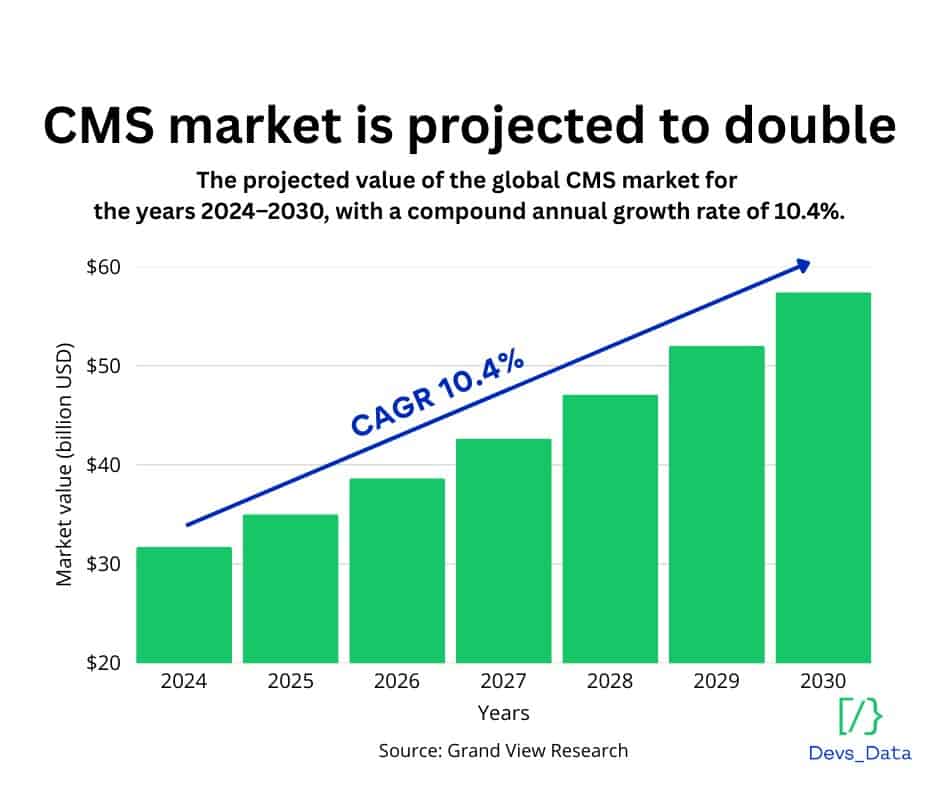
This growth indicates that CMS platforms are not only widely adopted but increasingly relied upon for enterprise-level content operations, omnichannel delivery, and digital experience management. As a result, companies face a rising need for CMS Developers capable of maintaining and extending these systems.
One of the most significant shifts in the CMS landscape is the move toward headless and decoupled architectures. By separating content management from frontend presentation, these systems enable content delivery across websites, mobile apps, and other digital channels. Platforms like Contentful, Strapi, Sanity, and Storyblok are widely adopted due to their API-first design and cloud-native scalability.
From a hiring perspective, this trend expands required skill sets. Companies increasingly seek CMS Developers with strong API expertise, JavaScript framework experience, and the ability to collaborate across frontend and backend environments, rather than focusing solely on themes or templates.
Cloud-based CMS deployments have become the default choice for many organizations, offering scalability, simplified maintenance, and lower upfront costs than on-premises systems. Adoption is accompanied by growing demand for integration, migration, and managed support services.
This directly affects hiring needs. CMS Developers with experience in cloud infrastructure, DevOps practices, continuous deployment, and platform security are increasingly in demand, as companies expect CMS talent to manage cloud-native workflows alongside content management tasks.
CMS platforms are now deeply embedded in industries such as eCommerce, retail, healthcare, and enterprise services. Managing large catalogs, multilingual content, compliance requirements, and omnichannel experiences has increased reliance on CMS-driven solutions.
As a result, recruitment extends beyond general CMS development. Employers look for specialists who understand both CMS platforms and industry-specific requirements, such as payment integrations, accessibility standards, or regulated content workflows, further tightening the talent market.
Organizations increasingly view CMS implementations as long-term digital infrastructure rather than one-off projects. Ongoing updates, security management, performance optimization, and system integrations require continuous development effort.
This shifts hiring priorities toward developers capable of long-term support. Many companies favor full-time CMS engineers or stable long-term contractors over short-term freelancers, particularly when scalability and security are critical.
The growing adoption of AI-powered content tools and low-code or no-code CMS platforms is reshaping the development landscape. These tools enable non-technical users to build pages and manage content independently, which shifts the CMS Developer role toward integration oversight, performance tuning, and platform governance.
Companies now need specialists who can bridge automated workflows with custom development, ensuring that AI-generated content and drag-and-drop configurations operate reliably within broader technical architectures.
The CMS ecosystem now includes headless, hybrid, SaaS-based, and enterprise digital experience platforms, often combining content, commerce, and digital asset management within a single system.
This architectural diversity increases demand for versatile developers who can navigate multiple platforms, manage complex integrations, and adapt to evolving CMS models. Agencies with CMS-specific expertise are better equipped to identify and place such cross-functional talent.
Modern digital operations depend on CMS ecosystems that support websites, eCommerce, content hubs, and corporate portals. As platforms diversify and expectations rise, companies increasingly rely on developers who can configure, extend, and maintain these systems without compromising performance or security. Industry analysis shows a highly diversified CMS market, where widely used platforms like WordPress coexist with enterprise and specialized solutions for more complex environments.
As a result, businesses need CMS Developers who can adapt to evolving architectures, integrate new capabilities, and support content operations with minimal disruption.
As CMS ecosystems expand, companies face increasing pressure to deliver fast, stable, and user-friendly digital experiences. CMS Developers strengthen performance by optimizing templates, reducing page-load friction, improving mobile responsiveness, and ensuring that content workflows remain efficient. When these developers come through specialized agencies, companies benefit from candidates pre-screened for platform-specific best practices, significantly reducing the risk of performance bottlenecks and user-experience issues.
CMS Developers support eCommerce performance by ensuring stable checkout integrations, smooth product-catalog management, and properly optimized content structures. Specialized recruiters help businesses secure developers who understand both the CMS architecture and eCommerce workflows, minimizing costly downtime, abandoned-cart issues, and integration errors that can directly impact sales.
As CMS platforms grow more advanced, with multiple deployment models, cloud-based environments, and complex integration points, companies are increasingly dependent on developers who can maintain long-term operational stability. CMS landscape is characterized by rapid diversification across platforms, each requiring different development approaches. Specialized agencies help companies hire developers who already understand these nuances, reducing onboarding time and lowering long-term maintenance costs. This results in fewer rebuilds, less technical debt, and more efficient content operations overall.
The shift toward headless, decoupled, and hybrid CMS implementations, highlighted in the research as a notable direction in CMS evolution, means businesses cannot rely solely on generalist developers. Companies increasingly need CMS specialists who understand structured content models, API-driven delivery, and multi-platform distribution. Recruiting through specialized agencies ensures businesses gain access to developers equipped for these modern architectures, allowing websites, eCommerce stores, and content systems to scale without performance degradation.
CMS Developers are essential as every layer of a company’s digital presence, from content delivery to eCommerce stability, depends on specialists who can configure, extend, and maintain these platforms under real operational conditions.
CMS Developer compensation reflects both the technical scope of modern content platforms and the competitive nature of the global hiring market. According to Glassdoor data, salaries vary significantly based on seniority, platform specialization, and the complexity of CMS environments developers are expected to manage. Roles involving enterprise CMS platforms, eCommerce integrations, or headless architectures tend to command higher pay than traditional theme- or template-focused positions.
| Role / specialization | Average annual salary | Typical salary range |
|---|---|---|
| CMS Developer (general) | ~$122700 | $96000 – $158000 |
| WordPress Developer | ~$87000 | $68000 – $115000 |
| Drupal Developer | ~$114000 | $92000 – $145000 |
| Senior CMS Developer | ~$163000 | $130000 – $208000 |
These figures illustrate how CMS roles increasingly align with broader software engineering compensation rather than traditional web development rates. Employers seeking developers with experience in performance optimization, security, cloud deployments, or headless CMS setups should expect salaries toward the upper end of these ranges, particularly in competitive markets or for senior-level positions.
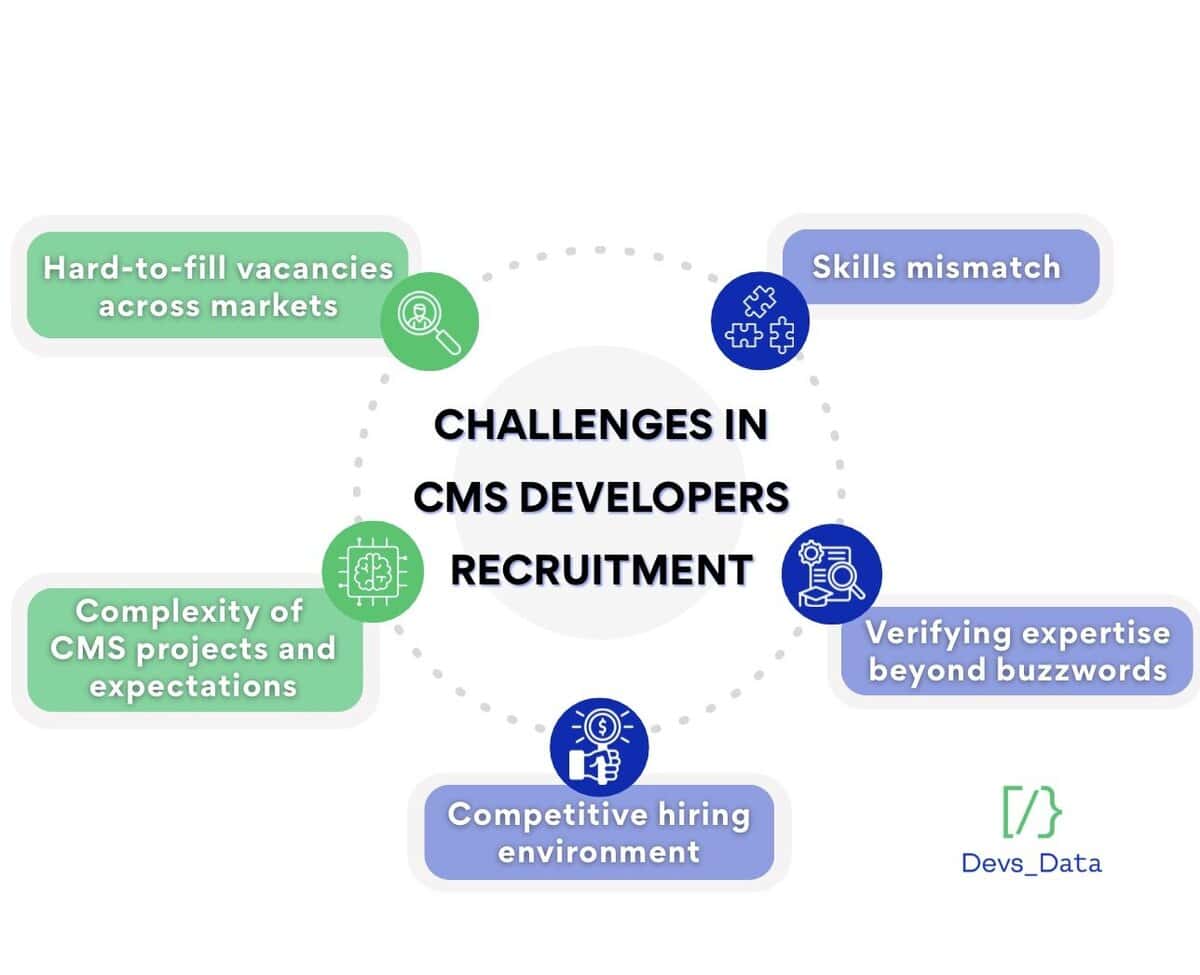
Recruiting CMS specialists has become increasingly complex as digital platforms grow more sophisticated and business expectations rise. Companies rely on CMS Developers to support content operations, eCommerce capabilities, and scalable digital experiences, but the hiring process itself is shaped by structural labor-market constraints, rapidly evolving skill requirements, and the growing technical depth of modern CMS ecosystems. The following points outline the most relevant challenges in CMS recruitment today and how DevsData LLC addresses each through targeted, platform-aware strategies.
Hiring CMS specialists sits inside the broader challenge of recruiting ICT experts. Across the EU, 57.5% of enterprises were unable to recruit ICT specialists in 2025, with the figure rising above 70% for some areas. The most common reasons were lack of applications, lack of relevant qualifications and experience, and high salary expectations. CMS Developers (WordPress, Shopify, Drupal, etc.) fall into these categories: the roles are visible, but truly qualified candidates are limited, and many markets experience intense competition for them.
Our approach
We address hard-to-fill CMS roles through global sourcing and platform-specific talent pools. By recruiting across multiple regions and maintaining segmented pools (e.g., Shopify, Drupal, headless CMS specialists), we reduce reliance on single markets and consistently deliver qualified candidates for niche roles.
The skills required in digital roles are evolving quickly. The World Economic Forum’s Future of Jobs Report estimates that 44% of workers’ skills will be disrupted in the next five years, and that six in ten workers will require training by 2027\. Employers themselves identify skills gaps and inability to attract talent as key barriers to industry transformation. For CMS roles, this translates into candidates who may know a platform superficially but lack depth in areas like performance optimization, security, API integration, or headless architectures. Job descriptions often assume a “unicorn” mix of skills, while candidate profiles are uneven.
Our approach
We reduce skills mismatch by clarifying role requirements and applying CMS-focused technical screening. This includes distinguishing core competencies from secondary skills and assessing candidates through live discussions, portfolio reviews, and practical CMS-related tasks aligned with the actual tech stack.
On paper, many developers list popular CMS platforms – WordPress, Drupal, Magento, Shopify – on their CVs. However, the range of possible experience is enormous: from clicking through a simple website builder to architecting a complex, multi-site deployment with custom modules and integrations. For in-house HR or generalist recruiters, it is difficult to distinguish between “surface-level familiarity” and “production-grade expertise,” especially when they are not deeply familiar with CMS internals or terminology. This risk is amplified in modern setups involving headless CMS, microservices, or deep eCommerce integrations.
Our approach
We verify real CMS expertise through technical vetting led by experienced engineers. Each candidate completes a 90-minute technical interview designed to evaluate practical CMS implementation skills under real-world conditions. Code reviews, architecture-level questions, and problem-solving scenarios allow us to distinguish surface-level familiarity from hands-on experience with complex, production-grade CMS environments.
Across multiple labour-market reports, employers consistently describe hiring as difficult. In the EU, nearly 63% of enterprises recruiting ICT specialists report difficulties filling vacancies. A separate employer survey from Australia found that 61% of recruiting employers experienced difficulty when hiring. Other global snapshots suggest that most HR professionals expect hiring to be at least as hard as the previous year, with candidates increasingly selective and offer-acceptance rates dropping. For CMS Developers, who often receive multiple offers or can easily freelance, this means companies lose candidates to faster, more attractive opportunities.
Our approach
We improve hiring outcomes by optimizing speed, transparency, and role positioning. This includes pre-screening candidates, accelerating interview-to-offer timelines, clearly communicating role expectations, and advising clients on market-aligned compensation and flexible engagement models.
By managing the process tightly and presenting roles in a transparent, compelling way, we reduce drop-offs and help clients compete more effectively for in-demand CMS specialists.
CMS projects today sit at the intersection of content, eCommerce, analytics, and broader digital transformation. The Future of Jobs Report notes that digital platforms and apps are expected to be adopted by 86% of companies, and eCommerce and digital trade by 75%, over 2023-2027. This implies that many organizations are building or expanding CMS-driven experiences tightly integrated with commerce, marketing automation, and data systems. The challenge is that CMS Developers are now expected not only to code, but to understand UX implications, content workflows, SEO, tracking, and stakeholder communication. Finding people who combine technical depth with cross-functional awareness is difficult.
Our approach
We focus on cross-functional fit alongside technical capability. Screening covers collaboration with marketing, design, and product teams, as well as experience with SEO, analytics, and eCommerce workflows. We also help clients tailor role profiles to match their operational needs.
The right agency can shorten time-to-hire, improve candidate quality, and reduce the risk of misaligned placements. Geography has become an important variable in this process. With remote work now established across the CMS development market, businesses increasingly consider offshore and nearshore talent as part of their hiring strategy, particularly when local markets are saturated or cost-prohibitive. The process is easier to navigate when broken down into clear steps.
Before evaluating agencies, a business should define what exactly it needs: technologies (WordPress, Drupal, Shopify, headless CMS), seniority level, engagement model (full-time, contract, team extensions), preferred sourcing regions, and expected timelines. The clearer the scope, the easier it is to assess whether an agency is equipped to deliver.
Not every tech recruiter is equally strong in CMS roles. Businesses should look for agencies that can demonstrate experience with CMS-specific positions, understand platform nuances, and can speak confidently about typical responsibilities, architecture patterns, and pitfalls of CMS projects.
An effective CMS recruitment agency maintains ongoing access to talent, not just ad-hoc job-board sourcing. It should be able to explain where candidates come from (communities, referrals, previous placements, international markets) and whether it can reach both active and passive CMS specialists.
Since many developers list CMS platforms on their CVs without deep expertise, a key differentiator is how the agency evaluates skills. Businesses should ask how the agency verifies real CMS experience, what tests or interviews are used, and whether technical experts are involved in the process.
The collaboration model matters: who will be the main point of contact, how often updates are shared, how feedback loops are handled, and how issues are escalated. Clear, predictable communication reduces friction and speeds up hiring decisions.
Finally, businesses should consider pricing, replacement guarantees, expected time-to-hire, and how the agency measures success. It is also useful to check references or case studies to understand whether the agency has delivered similar CMS roles before and how they performed over time.
Questions to ask at each step
To make the evaluation process more practical, it helps to use a structured set of guiding questions when speaking with potential recruitment partners. The table below outlines key questions to ask at each stage of selecting a CMS recruitment agency. These prompts help businesses identify whether an agency is equipped with the right technical expertise, sourcing capabilities, and operational approach to support CMS-focused hiring.
| Step | Questions to ask the agency |
|---|---|
| Clarify needs and scope | Have you filled roles similar to ours (same CMS, seniority, engagement model)? Based on our description, would you adjust or narrow the profile in any way? What information do you still need from us to clearly define the role? |
| Assess CMS and technical specialization | Which CMS platforms do you recruit for most often (e.g., WordPress, Drupal, Shopify, headless CMS)? Can you share examples of CMS roles you’ve successfully filled recently? How familiar are your recruiters with CMS-specific responsibilities and terminology? |
| Evaluate sourcing strategy and talent pool | Where do most of your CMS candidates come from (communities, referrals, previous projects, specific regions)? Do you maintain an existing pool of pre-vetted CMS Developers, or do you start each search from scratch? Are you able to source candidates in multiple geographies or only in one country? |
| Review screening and technical evaluation | How do you verify that a candidate truly has hands-on CMS experience and not just surface-level exposure? Do you use technical assignments, portfolio reviews, or interviews conducted by engineers? How do you assess soft skills relevant for CMS work (collaboration with content/marketing, communication, ownership)? |
| Examine communication and process | Who will be our main point of contact, and how often will we receive progress updates? What does your typical recruitment process look like from intake to offer acceptance? How do you handle feedback, rejected candidates, and adjustments to the role profile during the search? |
| Compare commercial terms and long-term fit | What are your fees, payment terms, and replacement or guarantee conditions? What is your average time-to-hire for similar CMS roles? Can you provide client references or case studies for comparable CMS recruitment projects? How do you measure success in a long-term collaboration with a client? |
Using these questions as a framework gives businesses a clearer benchmark for comparing agencies and understanding how well each aligns with their technical needs, hiring pace, and long-term goals. This structured approach not only reduces the risk of misalignment but also makes it easier to identify partners capable of delivering consistently strong CMS talent.
Specialized CMS recruitment is no longer a convenience. It is the most effective way for businesses to secure the talent needed to support fast-changing content operations, evolving user expectations, and long-term digital growth.
Website: www.devsdata.com
Company size: ~60 employees
Headquarters: Brooklyn, NY, and Warsaw, Poland
Founded: 2016
DevsData LLC combines deep technical specialization with a proven recruitment methodology, making it a strong partner for companies seeking skilled CMS Developers. With over ten years of experience in the market and a dedicated focus on CMS-related engineering and digital talent, the company has built a reputation for delivering high-quality candidates across a wide spectrum of platforms, including WordPress, Drupal, Shopify, Magento, and modern headless CMS solutions.
The company’s capability is strengthened by a team that includes US-based specialists, allowing DevsData LLC to communicate effectively with global clients. Over the years, the company has supported both large corporate organizations and fast-scaling startups from multiple regions, including the United States, Israel, and Europe. With 100+ completed recruitment projects for over 80 clients, DevsData LLC brings a track record of successfully delivering talent for specialized roles.
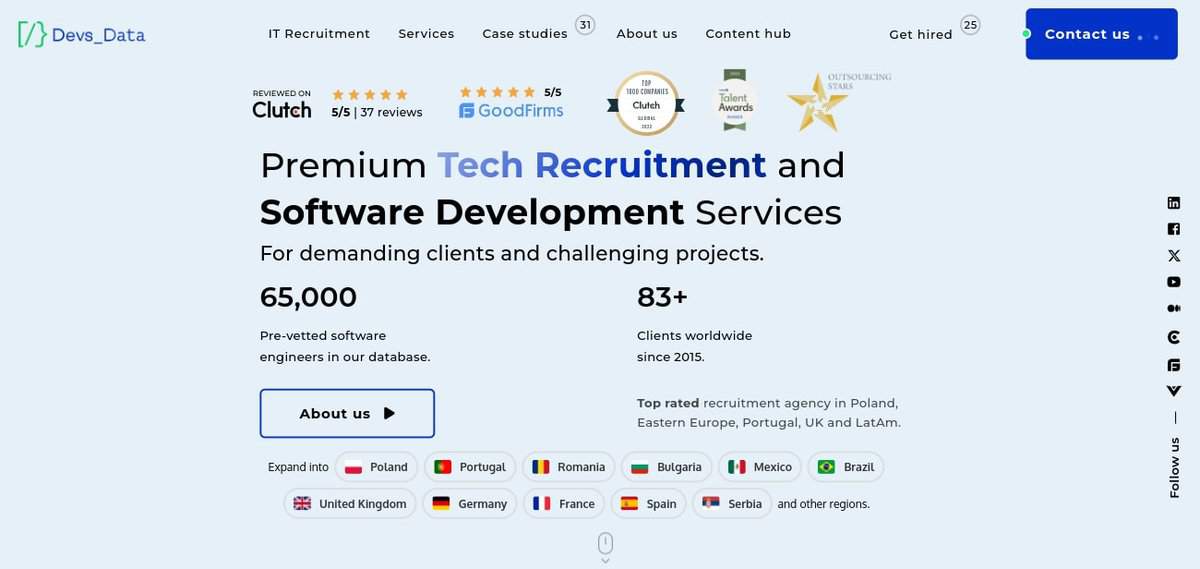
DevsData LLC maintains a sizable internal database of 65000 vetted candidates, giving clients immediate access to niche CMS talent rather than relying solely on live-market sourcing. The company holds an official, government-approved recruitment license, reinforcing compliance and operational legitimacy, an important factor for businesses engaging external partners for technical hiring.
Its success-fee model offers cost transparency and ensures that clients pay only upon successful hiring. A structured guarantee period further protects clients by allowing replacements if a hire does not meet expectations.
Quality control is a core part of DevsData LLC’s value. Candidates undergo a rigorous, multi-stage interview, including a 90-minute problem-solving challenge designed to evaluate analytical ability, technical depth, and compatibility with real-world CMS tasks. The agency places strong emphasis on communication skills, ensuring that selected developers collaborate effectively with marketing teams, product owners, designers, and non-technical stakeholders.
Client satisfaction reflects this approach: DevsData LLC holds a 5/5 rating on Clutch and GoodFirms, demonstrating consistent positive feedback, transparency, and long-term reliability.
The SyrenCloud engagement illustrates how DevsData LLC approaches technically specialized hiring projects and reflects the recruitment dynamics discussed throughout this article.
SyrenCloud Inc., a US-based provider of cloud and data solutions, needed to expand its backend engineering team with senior developers experienced in Azure cloud services, ETL pipeline development, and custom API architecture. These responsibilities closely intersect with GraphQL-oriented backend environments, particularly in API-layer design and distributed systems integration. Initial recruitment efforts in the domestic market did not produce suitable candidates within the required timezone coverage, prompting SyrenCloud to engage DevsData LLC to conduct a targeted search across Latin America.
The recruitment process followed a structured multi-stage pipeline:
Each selected developer brought more than seven years of experience in backend engineering, cloud infrastructure, and data systems. All had previously worked in distributed remote teams, which allowed them to integrate quickly into ongoing development cycles. After joining, the engineers contributed to high-volume data ingestion workflows, custom API development, and improvements in ETL pipeline stability across Azure-based infrastructure.
The SyrenCloud project reflects a pattern commonly seen in specialized backend recruitment: a highly specific technical profile, a constrained domestic talent pool, and the need to expand sourcing geographically while maintaining rigorous evaluation standards. By applying a structured recruitment pipeline and focusing on experienced engineers with proven cloud and backend expertise, the engagement resulted in three senior hires within six weeks and a stable expansion of the client’s engineering capacity.
The CMS landscape continues to evolve rapidly, shaped by new architectures, expanding eCommerce ecosystems, and growing expectations for seamless digital experiences. For businesses, this creates both opportunity and urgency. Modern CMS platforms have become the core of digital operations, enabling marketing teams, product owners, and content creators to work flexibly while maintaining a strong online presence. Yet the sophistication of these systems means that success increasingly relies on developers with platform-specific expertise, the ability to integrate complex workflows, and a clear understanding of performance, scalability, and long-term maintainability. In practice, the quality of a CMS talent now has a direct impact on the speed, stability, and competitiveness of the entire digital ecosystem.
This growing complexity amplifies the importance of strategic recruitment. Finding CMS specialists requires identifying developers who understand the nuances of different platforms, evolving architectural models, and business-specific requirements. Specialized recruitment agencies play a crucial role in this process by offering structured vetting, focused technical evaluation, and access to high-quality talent pools across geographies. With the right developer in place, companies can deliver better digital experiences, streamline operational efficiency, and scale confidently as their digital infrastructure expands.
DevsData LLC supports businesses in navigating this landscape through a combination of technical specialization and a refined recruitment process. With more than nine years of experience, a global candidate network, a government-approved license, and proven delivery across corporate and startup environments, the company provides a reliable pathway to securing CMS Developers who fit both the technical and collaborative needs of modern digital teams. Its rigorous evaluation practices, success-fee model, and guarantee period further help businesses reduce hiring risk and achieve stable, long-term results.
If you are ready to strengthen your digital operations with skilled CMS Developers, reach out to DevsData LLC and start building the team that will support your growth. Contact DevsData LLC at general@devsdata.com or visit www.devsdata.com.
Any questions or comments? Let me know on
Twitter/X.
Discover how IT recruitment and staffing can address your talent needs. Explore trending regions
like Poland, Portugal, Mexico, Brazil and more.
 Frequently asked questions (FAQ)
DevsData – your premium technology partner
DevsData is a boutique tech recruitment and software agency. Develop your software project with veteran engineers or scale up an in-house tech team of developers with relevant industry experience.
Free consultation with a software expert
🎧 Schedule a meeting
FEATURED IN

DevsData LLC is truly exceptional – their backend developers are some of the best I’ve ever worked with.”

Nicholas Johnson
Mentor at YC, serial entrepreneur


 Build your project with our veteran developers.
Explore the benefits of technology recruitment and tailor-made software.
Learn how to source skilled and experienced software developers.
Build your project with our veteran developers.
Explore the benefits of technology recruitment and tailor-made software.
Learn how to source skilled and experienced software developers.

Rebecca Botvin

Commercial Director

Tom Potanski
Manager




Categories: Big data, data analytics | Software and technology | IT recruitment blog | IT in Poland | Content hub (blog)
Email copied
And many other regional partners across Latin and North America, as well as Central and Eastern Europe. Let's talk.















careers@devsdata.com









general@devsdata.com

"I interviewed about a dozen different firms. DevsData LLC is truly exceptional – their backend developers are some of the best I've ever worked with. I've worked with a lot of very well-qualified developers, locally in San Francisco, and remotely, so that is not a compliment I offer lightly. I appreciate their depth of knowledge and their ability to get things done quickly."

Nicholas Johnson
CEO of Orange Charger LLC,
Ex-Tesla Engineer,
Mentor at YCombinator
"DevsData reached out to us, as we've been looking to grow our engineering team in Europe and Poland. Communicating efficiently and professionally, DevsData made a strong impression with their understanding of the recruitment challenges we were facing. They designed a tailored recruitment process for our needs. I was impressed with the technical depth of their approach."

Karim Butt
Co-Founder & CTO at GlossGenius, Inc.
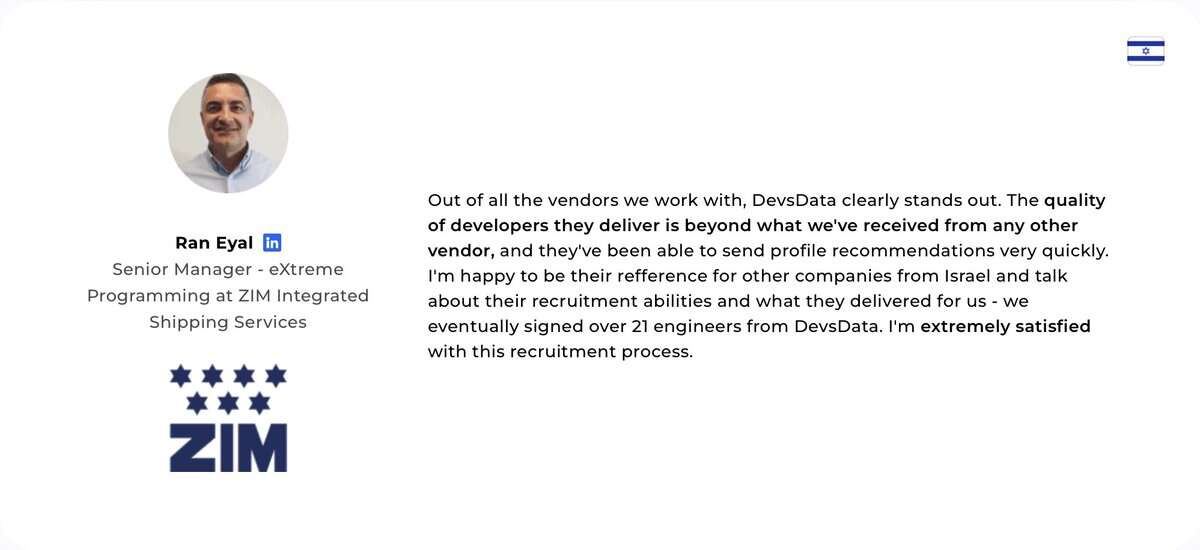
"Out of all the vendors we work with, DevsData clearly stands out. The quality of developers they deliver is beyond what we've received from any other vendor, and they've been able to send profile recommendations very quickly. I'm happy to be their reference for other companies from Israel and talk about their recruitment abilities and what they delivered for us."

Ran Eyal
Senior Manager at
ZIM Integrated
Shipping Services Ltd.
"DevsData demonstrated a strong degree of proactivity, taking time to thoroughly understand the problem and business perspective, and continuously suggesting performance and usability enhancements. Their app exceeded my expectations. I've worked with DevsData on numerous projects over the last 3 years and I'm very happy. Being both responsive and honest in communication."

Jonas Lee
Partner & Executive VP of Verus,
Financial LLC, Investor,
& Serial Entrepreneur
Acknowledgments