Thanks for subscribing.
Your gift is on the way.



Big Data Architects decide how an organization’s data is structured and how it moves, and the quality of those decisions sets the upper limit on what every team downstream can achieve. The effect surfaces at inconvenient moments. A model-training program stalls once its team discovers that the data layer underneath was built to feed dashboards rather than algorithms, a mismatch that traces back to design choices made years earlier.
The pressure on this layer is visible in budget data. Gartner forecasts that worldwide IT spending will reach $6.08 trillion in 2026, growing 9.8% year on year, with the largest share flowing into the data center systems that underpin AI workloads. That spending does not deploy itself. It requires architects capable of translating capital allocation into systems that scale predictably and remain governable.
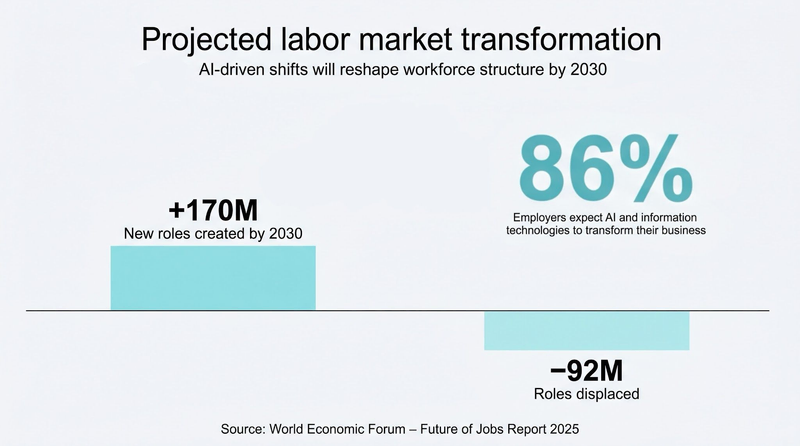
Demand for the role is reinforced by labor market signals. The Future of Jobs Report 2025, based on data from over a thousand employers covering 14 million workers across 22 industry clusters and 55 economies, places Big Data Specialists among the three fastest-growing job categories worldwide through 2030, alongside FinTech Engineers and AI/Machine Learning specialists. The same study projects 170 million new roles created and 92 million displaced by the end of the decade, with 86% of surveyed employers expecting AI and information processing technologies to transform their business.
There is a parallel story on the system side. Cloud platforms, lakehouse formats, real-time streaming, vector stores, and regulatory pipelines now coexist inside the same enterprise environment. Each of those layers carries its own operational logic, and each one fails differently. A data engineer can build any of them in isolation. A data architect is the person who decides which combination is defensible for the business over a 5-year horizon, and who owns the consequences when those decisions hit production.
This article is written for the people making those calls: CTOs, heads of data and analytics, founders building data-heavy products, and talent acquisition leaders responsible for closing senior technical hires. It walks through what Big Data Architects actually do, the business situations that justify hiring one, the market conditions shaping availability and compensation, the recurring failure modes in architect-level recruitment, and the way DevsData LLC structures its process to address them.
The function of a Big Data Architect is often summarized as system design, but that description undersells the role. According to the US Bureau of Labor Statistics, database architects design and build new databases for systems and applications, research the technical requirements of an organization during the design phase, create models for building the database, and code the new data architecture, integrating existing databases or infrastructure. The same official taxonomy keeps this role explicitly separate from administration, which is operational and reactive.
Translated into business terms, the architect is the person who answers four questions before code is written:
Every artifact the architect produces, from reference architectures to technology selections to data contracts, is a defensible answer to one of those four questions.
The first deliverable is the architecture itself: the conceptual, logical, and physical models that describe how data is structured and how it travels. This is not just diagramming. It is the explicit decision about which data is authoritative, which is derived, and which is disposable. Done well, it removes ambiguity from every team that touches data downstream. Done poorly, it produces the recurring complaint that two dashboards, both technically correct, disagree on the same number.
The second deliverable is scale. A platform that performs at 10 terabytes and collapses at 100 terabytes is not a scaled platform; it is a platform that has not yet failed. Architects make the partitioning, replication, indexing, and storage-tier decisions that determine how cost and latency behave when volume changes by an order of magnitude. The work is unglamorous, and its quality is rarely visible until a marketing campaign, a product launch, or a regulatory query stresses the system in a way no one anticipated.
Governance is third area of ownership, and it is the one most often underestimated at hiring time. An architect defines who can see what, under which conditions, with what audit trail, and how those rules are enforced inside the platform rather than at the application layer. In regulated environments, this work is not optional. The European Data Protection Board reported over 1.2 billion euros in GDPR fines levied across the EU in 2024, alongside 982 one-stop-shop procedures and 350 cross-border cases. Those penalties are issued against architectures, not against individual developers.
The fourth deliverable, and the one that separates senior architects from skilled engineers, is alignment with the business. An architect must be able to sit in front of a CFO and explain why a particular storage choice protects margin, in front of a CMO and explain how customer data flows into segmentation, and in front of a board and explain why a 6-month platform investment is cheaper than the operational debt it replaces. The technical work is necessary. The translation work is what makes it strategic.
Hiring an architect is not a default move. It is a response to specific business conditions where the cost of getting the data layer wrong has become higher than the cost of recruiting senior expertise to design it correctly. Most organizations recognize the need too late, after a migration has stalled, an audit has surfaced gaps, or a flagship analytics product has missed its launch window. The signals below are the patterns that consistently precede those outcomes.
What follows is a set of business situations in which the case for a dedicated architect becomes defensible. Each one describes a state the organization is already in, not a hypothetical future. If two or more of these apply, the conversation has shifted from whether to hire an architect to how quickly one can be sourced.
| Business situation | What is happening | Why an architect becomes necessary |
|---|---|---|
| Scaling data infrastructure | Systems that performed reliably at lower volumes begin to degrade as data grows unevenly, stepwise increases. | Redesigning partitioning, replication, and query strategies requires coordinated architectural decisions rather than incremental tuning. |
| Migrating to cloud data platforms | Migration efforts focus on tooling or vendors, while core design decisions around data models and workloads remain unresolved. | An architect defines the target architecture, migration path, and operating model to avoid replicating legacy inefficiencies in a more expensive environment. |
| Building analytics ecosystems | Multiple teams generate inconsistent outputs due to fragmented transformations and definitions across tools and datasets. | Designing semantic layers, transformation pipelines, and data contracts ensures consistent, shared interpretations across departments. |
| Improving data governance | Compliance gaps begin to appear in audits, contracts, or reporting, exposing a lack of enforceable data policies. | Governance needs to be embedded into the system design, shifting enforcement from manual oversight to platform-level controls. |
| Integrating multiple data sources | Disparate systems (CRM, ERP, analytics, finance) operate with incompatible schemas, refresh cycles, and ownership structures. | An architect defines integration patterns – batch vs. streaming, materialized vs. virtual – to create a unified, usable data layer. |
| Implementing AI and ML pipelines | AI initiatives reveal inconsistencies in data quality, lineage, and environment parity that earlier reporting workloads tolerated. | Supporting feature stores, retraining cycles, and consistent labeling requires a structured data foundation designed at the architectural level. |
These six conditions rarely appear in isolation. A scaling problem usually arrives with an integration problem, a governance gap usually surfaces during a migration, and an AI initiative tends to expose all three at once. The reason organizations hire dedicated architects is not that any single condition is unmanageable. It is that handling them concurrently, with the same set of design decisions, requires a level of seniority that engineering teams cannot reliably backfill from internal promotion. Once two of these patterns run in parallel, the cost of delay stops being an unfilled salary line. It becomes the rework created by design decisions that engineering teams make in the architect’s absence, and that rework is what turns a planning item into an active sourcing engagement.
Do you have IT recruitment needs?
The market for Big Data Architects sits at the intersection of two forces that pull in opposite directions. Demand is rising because data volumes, AI workloads, and regulatory expectations are all expanding simultaneously. Supply is constrained because the role takes years to develop, requires cross-domain experience, and competes with adjacent senior tech functions for the same candidates. Reading the numbers on each side of that imbalance is what makes hiring decisions defensible at the budget meeting.
The clearest signal of demand is data volume itself. The trajectory from 149 zettabytes to 394 zettabytes between 2024 and 2028 is not a marketing figure. It corresponds to a measurable shift in how organizations capture telemetry, customer interactions, and machine-generated events. As the underlying volume grows, the design choices that govern it stop being routine and start being load-bearing.
On the buy side, Gartner observes that data and analytics have moved from the domain of the few to ubiquity, with agentic analytics, AI agents, and synthetic data emerging as the categories where data and analytics leaders are now expected to do much more with much more. The implication for hiring is direct. Organizations are no longer staffing data and analytics as a service function. They are staffing it as a platform function, and platform functions need architects.
Reliance shows up in adoption rates rather than survey opinions. The shift in generative AI usage from one third to nearly two thirds of organizations in 12 months is one of the steepest enterprise adoption curves recorded in the McKinsey global series. What it tells hiring leaders is that AI use cases are no longer waiting for permission. They are arriving in the data team’s queue, and the architecture either supports them or limits them.
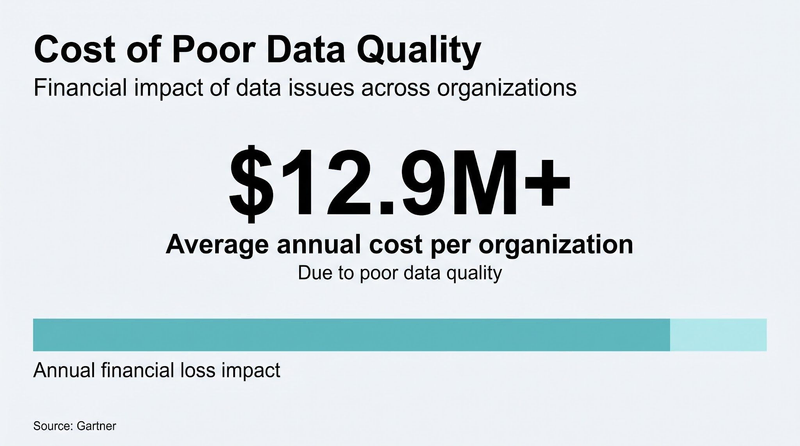
The financial consequences of that reliance are not abstract. Gartner estimates that poor data quality costs organizations, on average, at least $12.9 million per year, manifesting as inefficiencies, ecosystem complexity, and downstream poor decisions. Most of those costs are architectural in origin: duplicated entities, ungoverned joins, inconsistent definitions, and absent lineage. They are also, structurally, the easiest costs to compound and the hardest to attribute, which is why they tend to grow until an architect-level redesign forces them into the open.
Complexity in modern data platforms is no longer a function of how many tools are deployed. It is a function of how many of those tools have to interoperate consistently. A typical enterprise environment now combines a cloud warehouse, a lakehouse layer, streaming infrastructure, an orchestration framework, observability tooling, identity and access management, and increasingly a vector or feature store for AI. Each component is individually well documented. The integration between them is rarely documented at all, and that integration is what an architect owns.
Sustaining the build-out of those systems is what drives the IT spending forecast cited earlier, with the largest growth concentrated in data center systems that support AI infrastructure. From the inside, that spending is felt as relentless pressure on platform teams to prevent fragmentation. Without an architect, the same six tools end up integrated three different ways across three different business units, and the cost of unification later usually exceeds the cost of designing it correctly the first time.
The supply side is structurally tight. Korn Ferry projects a global human talent shortage exceeding 85 million people by 2030, equivalent to roughly $8.5 trillion in unrealized annual revenues, with the technology, media, and telecommunications sector alone potentially losing $162 billion in annual revenues in the United States in the absence of additional high-tech workers. India is the only economy in the 20-country study expected to maintain a high-skilled tech talent surplus through the end of the decade.
The picture from the demand side is consistent. McKinsey reports that only 16% of executives feel comfortable with the volume of technology talent available to drive digital transformation, that 60% cite scarcity of tech talent and skills as a key inhibitor of digital transformation, and that demand for tech talent is projected to be 2 to 4 times greater than supply in the coming years. Those numbers describe the entire technology workforce, but the imbalance is sharpest at the architect tier, where deep cross-system experience compounds the problem.
The scarcity described above sets the price, and that price moves more with geography than with any other single factor. In the United States, the role sits at the top of the global market. The US Bureau of Labor Statistics records a median wage of $135980 for database architects, while Robert Half places the mid-market starting point higher at $166750. Glassdoor, which folds in bonuses and senior contributors, reports an average closer to $179000. The same role costs materially less across Europe and less again across Central and Eastern Europe, which is the gap that turns nearshore sourcing into a budget decision rather than only a talent one.
The regional spread is clearest when the figures sit side by side.
| Region | Median (in national currency) | Median (in USD) |
|---|---|---|
| United States | $135980 | $135980 |
| United Kingdom | ~£74000 | ~$99709 |
| Germany | ~€90000 | ~$104854 |
| Poland and wider CEE | ~320000 PLN | ~$88040 |
The gradient across those markets is what makes sourcing a commercial decision rather than only a technical one. The same design responsibility carries a materially different price depending on where the architect sits, and the distance between the United States figure and the Central European one is wide enough to change what else a platform budget can cover.
The data layer determines whether AI investments compound into measurable business outcomes or fragment into isolated projects, and it is the first place where the quality of senior hiring becomes visible to the rest of the organization.
AI tooling has already entered the architect’s daily work, not only the systems the architect designs. The 2025 Stack Overflow Developer Survey records that 84% of developers use or plan to use AI tools, and McKinsey finds more than 90% of software teams now applying AI to engineering work, saving an average of six hours each week. The effect is uneven across the role. It compresses the drafting work an architect once did by hand while leaving the design decisions untouched.
The division between automated drafting and retained judgment is sharp enough to set out directly.
| What AI now handles | What stays with the architect |
|---|---|
| Schema generation, drafted in seconds | Deciding which data is authoritative across the business |
| Pipeline scaffolding and the SQL beneath it | Choosing how data moves between systems and which trade-offs hold |
| Routine coding, 55.8% faster on a contained task | Complex design work, where the saving falls to under 10% |
| A first draft of almost any artifact | Validation and final accountability for it |
The labor market is already pricing this division. Stack Overflow added Architect as a role in 2025, and it entered as the fourth most common answer at 6.1%, a sign that the work in the right-hand column is consolidating into a named seniority. Trust points the same way, with more developers distrusting the accuracy of AI output at 46% than trusting it at 33%. For the hiring organization, automation raises the floor on routine output and raises the premium on the architect who decides what that output should have been.
Hiring a senior architect is procedurally similar to hiring any senior engineer, but the failure modes are different. A weak software engineer ships slow features. A weak architect ships a platform that the organization is forced to live with for years, often without realizing the costs are architectural in origin. DevsData LLC is a technology recruitment firm that sources and screens senior engineering talent for enterprise clients across the United States and Israel, working from offices in New York and Warsaw. The challenges below are the recurring patterns the firm has met across senior data engagements, paired with the way it structures its process to address them.
Each challenge below is described first as a market condition, then as a hiring failure mode that follows from it.
The structural shortage described in the previous section translates into a specific recruiting problem. Job postings for senior data architects routinely receive a high volume of applications, but only a small fraction of those applicants have actually owned an enterprise platform end to end. The rest are Senior Data Engineers, lead developers, or analytics managers who have worked adjacent to architecture without holding accountability for it. A CV review rarely separates the two groups, since a Senior Engineer and a true Architect will both list data modeling and platform work, and the wording alone never shows which one owned the design decisions rather than executing them.
The result, when filtering is shallow, is predictable. Organizations interview promising candidates, hire one, and discover three months in that the candidate is highly capable inside a defined system but has never had to design a platform from a blank sheet under business constraints. The replacement cycle that follows is expensive on its own and corrosive to the engineering team that watched it happen. The cost is rarely captured in the official cost-of-hire number, but it is real, and it accumulates.
DevsData LLC works from a vetted candidate database of more than 95000 technology professionals, with senior data and architecture talent flagged by prior platform ownership rather than by self-declared title. Sourcing for an architect role is scoped at the start to candidates with documented end-to-end design experience, and shortlisting decisions are reviewed by US-based specialists familiar with enterprise data environments. The objective is to ensure that every candidate reaching the client interview has already cleared the architect-versus-senior-engineer distinction internally.
Coding skills can be tested in 60 minutes with reasonable confidence. Architectural skills cannot. A candidate’s ability to choose between a star schema and a wide table, or between a streaming and a micro-batch ingestion pattern, depends on the business constraints in play, and those constraints are usually not written down. Standard interview formats, take-home projects, and whiteboard exercises tend to reward candidates who explain frameworks rather than candidates who make sound trade-offs under uncertainty.
The hiring failure mode here is also predictable. Selection processes drift toward measurable proxies such as a Snowflake certification or recorded years on Databricks, which are easy to verify yet weak predictors of design judgment. Those proxies correlate weakly with architectural judgment, which is why two candidates with identical resumes can produce platforms that differ by an order of magnitude in long-term cost. The cost of getting this evaluation wrong scales with the size of the platform the new hire is about to design, which is the worst possible scaling property for a hiring decision.
DevsData LLC pairs CV screening with a structured 90-minute problem-solving challenge designed to surface architectural reasoning rather than tool recall. Candidates are asked to walk through real design trade-offs, describe how they would respond to constraint changes mid-project, and defend their choices against alternatives. The exercise is calibrated by practicing architects and is the same regardless of which client it is run for, which keeps the bar consistent across engagements.
A modern Big Data Architect is rarely valuable for one technology in isolation. The same person is expected to navigate distributed processing, cloud warehouses, streaming, governance, and increasingly machine learning infrastructure, and to do so while remaining fluent in the underlying database fundamentals. The role requires expertise in database methodology, modeling, network management, distributed databases, application architecture, and performance management, typically across more than one operating system family. Few candidates accumulate that breadth before 8 to 10 years into their career.
The hiring failure mode is over-specialization. Organizations interview candidates who are world-class in one layer of the stack and assume the rest will be acquired on the job. In practice, the gaps surface during the first major design decision, often when no obvious teacher is available to fill them. The team then either lives with the resulting compromises, or escalates to external consulting at a cost that exceeds the original recruiting budget several times over. Either outcome undermines the original business case for the hire.
DevsData LLC structures sourcing briefs around the actual breadth required by the client’s environment, not around the dominant technology in the job description. Candidates are screened on their ability to operate across multiple data layers, with verifiable production experience in each, and references are checked specifically against cross-domain delivery rather than against tenure. The shortlist that reaches the client is filtered on coverage, not only on depth.
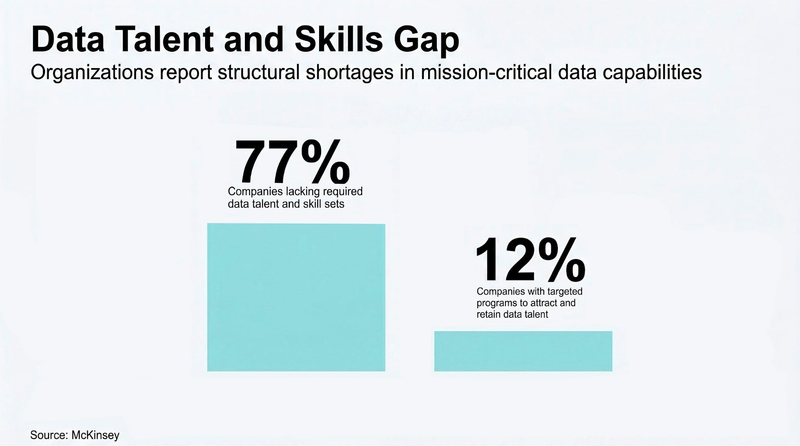
An architect who cannot translate technical decisions into commercial outcomes will be steadily reassigned to operational work, regardless of seniority on paper. McKinsey reports that 77% of companies say they lack the necessary data talent and skill sets to perform required tasks in mission-critical areas, and that only 12% have established targeted programs to attract and retain key data talent, even as the role demands a blend of coding, statistics, data manipulation, machine learning, and business understanding. The combination is rare; the structured pipelines to develop it are rarer.
The hiring failure mode is the inverse of the cross-domain problem. Organizations sometimes hire candidates who present extremely well to non-technical stakeholders but lack the depth to make load-bearing technical calls. Those hires perform well in early steering committees and then begin to defer the decisions that matter to engineers reporting to them, which produces an architecture defined by whoever shouts loudest. The platform built that way is rarely the platform the business actually needs.
DevsData LLC includes a dedicated communication and stakeholder-context screen alongside the technical evaluation, run in English by US-based specialists. Candidates are assessed on whether they can articulate trade-offs to a non-technical audience without losing technical precision, and on whether they can defend a decision in front of constraints they did not choose. Both directions of the alignment problem are tested before any candidate reaches the client.
The four challenges above are not independent. Scarcity inflates the importance of evaluation, evaluation flaws produce cross-domain gaps, and cross-domain gaps reveal the alignment problem only after the architect is in the seat. A structured external process tends to produce shortlists that survive the client interview, because one team applies a single calibrated bar to every candidate instead of rebuilding the standard for each search. The difference shows up as fewer interview cycles per hire and fewer placements that fail inside the guarantee window. Treating them in isolation, which is the default when an internal team handles architect-level hiring once every few years, is what produces the cost overruns most organizations attribute to bad luck.
A structured recruitment process is the difference between hiring an architect who reduces future cost and hiring one whose first decisions become the next platform’s technical debt.
Do you have IT recruitment needs?
Choosing a recruitment partner for a Big Data Architect is itself an architecture decision. The wrong partner optimizes for time-to-shortlist and forwards candidates whose CVs carry the right platform names, which at this level almost always means Senior Data Engineers arriving under an architect label. The right partner absorbs the cost of catching that substitution before the client does. An architect search also fails differently from an engineering search, because a weak hire clears the interview comfortably and only reveals the gap at the first design decision that cannot be deferred. The five steps below describe how to test whether a partner is equipped for that.
The first filter is whether the agency has placed people who owned platform design rather than platform execution. Generic IT recruitment experience does not transfer to this tier. Ask how many Big Data Architect placements were made in the past 24 months, then ask what those architects actually designed, because a partner that can describe the warehouse, streaming layer, or governance model a candidate built has read the role properly. Ask separately what seniority the hiring company confirmed once the person was in the seat, since architect titles are awarded inconsistently across employers. Vague answers here predict vague candidates later.
Architects are the least likely senior technology group to be visible on job boards, because the people who have designed enterprise platforms end to end are usually mid-project on the next one. A serious partner sources from a proprietary, vetted database rather than waiting on inbound applications, and can state how that database is segmented by platform ownership rather than by job title. Robert Walters analysis of more than 100000 UK technology roles documents high hiring demand against a contracting talent pool, with average tenure around two years. At the architect tier that combination makes reactive sourcing uncompetitive, since the candidates worth reaching are not applying anywhere.
Ask exactly who runs the technical evaluation and what it tests beyond CV review. A generic coding test screens for the wrong role, because the question at architect level is not whether someone can write the transformation but whether they can defend choosing a star schema over a wide table, or a streaming ingestion pattern over micro-batch, when the business constraints behind that choice were never written down. A structured architectural exercise run by reviewers who have worked in senior data environments reaches that judgment. Ask how the exercise is calibrated across candidates, since a bar that moves between searches tells you nothing about the person in front of you.
The commercial structure shows how the partner allocates risk, and architect placements test it harder than most. A poor architecture hire is often still performing well at month three and visibly wrong at month nine, by which point the design decisions have propagated into the platform. A success-fee model with a guarantee period long enough to cover that lag aligns the partner’s economics with the durability of the placement. Retainer-only models, or guarantees that expire before the first major design milestone, push the risk back onto the client. Read the guarantee closely, ask how replacements are handled, and ask how often they have been triggered in the past year.
Independent review platforms exist for a reason. A partner holding consistent 5/5 ratings on Clutch and GoodFirms across multiple years has been assessed by clients with nothing to gain from the recommendation. Named enterprise case studies add a second layer, particularly where the placed candidate carried design responsibility rather than delivery responsibility. Ask to speak with one of those clients directly, and confirm that the architect placed is still holding the seat, since retention at this level is the only real evidence that the original evaluation was accurate.
The questions below summarize the same five evaluation steps in a form that can be put directly to any agency under consideration.
| Evaluation step | Questions to ask the agency |
|---|---|
| Domain credibility | How many Big Data Architects have you placed in the past 24 months, and what types of platforms did they design? |
| Sourcing reach | Do you operate a proprietary candidate database, and how many vetted senior data architects can you access for our region and time zone? |
| Technical screening | Who runs your architecture-level evaluation, and what does the screening process look like beyond a CV review? |
| Commercial model | Is your fee structure success-based, what is included in the guarantee period, and how do you handle replacements? |
| References and proof | Can you share recent enterprise case studies and verifiable client reviews on independent platforms such as Clutch and GoodFirms? |
Company size: ~60 employees
Founding year: 2016
Website: www.devsdata.com
Headquarters: Brooklyn, NY, and Warsaw, Poland
DevsData LLC is a technology recruitment firm with offices in New York and Warsaw, supporting enterprise clients across the United States and Israel. The firm has been operating for more than 10 years, screens candidates through US-based specialists, and concentrates its sourcing on senior technical roles where misplacement carries disproportionate cost.
The firm maintains a vetted candidate database of more than 95000 technology professionals, including Senior Data Engineers, architects, and platform leads, and operates under a government-approved recruitment license. To date, DevsData LLC has delivered more than 140 projects for over 100 clients, ranging from venture-backed startups to global enterprises with regulated data environments. The composition of that client base is the reason the firm’s screening defaults are calibrated against demanding standards rather than relaxed ones.
Engagements operate on a success-fee model, paired with a guarantee period that ensures replacements are handled at no additional cost if a placement does not work out within the agreed window. Every candidate is screened through a structured 90-minute problem-solving challenge that surfaces architectural reasoning rather than tool recall, alongside a dedicated communication assessment in English to confirm that the candidate can interact with non-technical stakeholders without losing technical precision. The two screens run in parallel and feed into a single calibrated decision rather than into separate scorecards.
Independent verification of that process exists. DevsData LLC holds 5/5 ratings on Clutch and GoodFirms, the two most-cited independent platforms for B2B service review, sustained across multiple engagements and reviewed by clients with no commercial relationship to the firm. The combination of license, database, screening rigor, success-fee economics, guarantee, and verified third-party reviews is what allows the firm to commit to senior data hires without offloading the risk of a wrong placement onto the client.
Astromind Inc., a Boston-based artificial intelligence company, engaged DevsData LLC for the recruitment of senior data science professionals to support the build-out of its core AI capabilities. The client operated in a competitive US AI hiring market and required talent capable of contributing to production-grade machine learning workflows from the first month, not after a long ramp-up.

The role required a rare combination of applied data science depth, communication fluency with US stakeholders, and prior exposure to AI product environments. The client had attempted to source through standard channels and inbound applications, but candidates who looked qualified on paper were not clearing the technical screen. The cost of each unsuccessful interview cycle was compounding, and the launch timeline for the platform the new hires were meant to support was beginning to slip.
DevsData LLC scoped the search across its proprietary candidate database and reactivated relationships with senior data scientists who had previously been screened for comparable enterprise AI environments. The brief was narrowed against verifiable production experience rather than against title or vendor familiarity, and the geographic scope was set to maximize time zone overlap with the client’s Boston-based engineering team.
Each shortlisted candidate completed the standard 90-minute problem-solving challenge, calibrated against the technical complexity of the client’s product, and was assessed in English by US-based specialists for stakeholder communication. The two evaluations were merged into a single hire-or-pass recommendation rather than presented as separate scores, which kept the client interview focused on fit rather than on retesting fundamentals already cleared.
The successful candidates joined Astromind Inc. and ramped into production responsibilities on the timeline the client had originally projected before the slip began. The placements held through the guarantee period without triggering a replacement, and the engagement is publicly documented as a delivered case study, available for verification rather than only described in marketing material.
The platform work the new hires unblocked moved back onto its original timeline, the cost of further failed interview cycles was eliminated, and the client retained internal capacity to focus on product decisions rather than on continuous re-sourcing. For Astromind Inc., the engagement returned the platform build-out to its original schedule and removed the recurring cost of failed interview cycles, with the placed hires holding through the guarantee period.
Do you have IT recruitment needs?
The case for hiring Big Data Architects is no longer a question of category prestige. It is a function of the cost of getting the data layer wrong at a moment when AI workloads, data volumes, and regulatory exposure are all expanding at the same time. The architect is the role that absorbs that complexity into a coherent design, and the absence of one tends to be felt as a cost rather than as a missing job description.
Organizations that treat architect recruitment as one more requisition will continue to under-budget, over-extend their interview cycles, and absorb the cost of failed placements as overhead. Organizations that treat it as a structured engagement, with calibrated sourcing, structured technical evaluation, and explicit alignment screening, will close senior hires faster and retain them longer. SHRM benchmarking data shows that senior hires cost far more to make than junior ones, with executive-level roles averaging about 7 times the cost of non-executive hires ($35879 versus $5475 per hire), and that only 20% of organizations measure quality of hire at all. An architect search sits between those poles in cost but inherits the executive-tier consequence, because a wrong design decision compounds long after the hiring fee is spent.
The forward outlook is consistent across the data sources used in this article. Demand will continue to outpace supply through 2030, the role will continue to absorb adjacent responsibilities (governance, AI infrastructure, cross-system integration) rather than shed them, and the gap between organizations with architect-level capability and organizations without it will widen. For CTOs, heads of data, founders, and talent acquisition leaders, the practical question is no longer whether to invest in this layer of the team. It is whether the recruitment process being used is structured enough to source it reliably at the speed the business needs.
A first conversation does not commit to a search. Write to general@devsdata.com or visit www.devsdata.com to scope an engagement, and bring the questions from the selection framework above so the answers can be checked directly.
Any questions or comments? Let me know on
Twitter/X.
Discover how IT recruitment and staffing can address your talent needs. Explore trending regions
like Poland, Portugal, Mexico, Brazil and more.

 Frequently asked questions (FAQ)
DevsData – your premium technology partner
DevsData is a boutique tech recruitment and software agency. Develop your software project with veteran engineers or scale up an in-house tech team of developers with relevant industry experience.
Free consultation with a software expert
🎧 Schedule a meeting
FEATURED IN


DevsData LLC is truly exceptional – their backend developers are some of the best I’ve ever worked with.”

Nicholas Johnson
Mentor at YC, serial entrepreneur


 Build your project with our veteran developers.
Explore the benefits of technology recruitment and tailor-made software.
Learn how to source skilled and experienced software developers.

Rebecca Botvin

Commercial Director

Tom Potanski
Manager




Categories: Big data, data analytics | Software and technology | IT recruitment blog | IT in Poland | Content hub (blog)
















careers@devsdata.com







general@devsdata.com

"I interviewed about a dozen different firms. DevsData LLC is truly exceptional – their backend developers are some of the best I've ever worked with. I've worked with a lot of very well-qualified developers, locally in San Francisco, and remotely, so that is not a compliment I offer lightly. I appreciate their depth of knowledge and their ability to get things done quickly."

Nicholas Johnson
CEO of Orange Charger LLC,
Ex-Tesla Engineer,
Mentor at YCombinator
"DevsData reached out to us, as we've been looking to grow our engineering team in Europe and Poland. Communicating efficiently and professionally, DevsData made a strong impression with their understanding of the recruitment challenges we were facing. They designed a tailored recruitment process for our needs. I was impressed with the technical depth of their approach."

Karim Butt
Co-Founder & CTO at GlossGenius, Inc.
"Out of all the vendors we work with, DevsData clearly stands out. The quality of developers they deliver is beyond what we've received from any other vendor, and they've been able to send profile recommendations very quickly. I'm happy to be their reference for other companies from Israel and talk about their recruitment abilities and what they delivered for us."

Ran Eyal
Senior Manager at
ZIM Integrated
Shipping Services Ltd.
"DevsData demonstrated a strong degree of proactivity, taking time to thoroughly understand the problem and business perspective, and continuously suggesting performance and usability enhancements. Their app exceeded my expectations. I've worked with DevsData on numerous projects over the last 3 years and I'm very happy. Being both responsive and honest in communication."

Jonas Lee
Partner & Executive VP of Verus,
Financial LLC, Investor,
& Serial Entrepreneur
Acknowledgments