Thanks for subscribing.
Your gift is on the way.



Before 2024, “AI Agent Developer” was not a recognized job title. Recruiters now hunt for production experience in a pool where even senior builders have at most a 2-year track record. That leaves hiring pipelines without a benchmark for vetting the role.
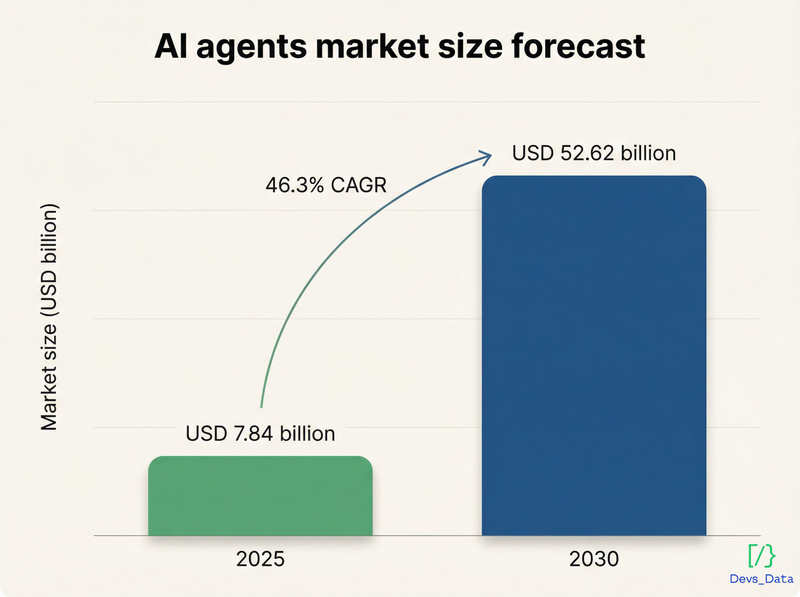
The market behind that demand continues to expand. The AI agents market reached $7.84 billion in 2025 and is projected to reach $52.62 billion by 2030, at a 46.3% CAGR. The bar chart below maps the projected growth.
Broader generative AI adoption puts additional pressure on an already constrained talent pool. 88% of organizations now use AI, the majority of it generative, in at least one business function, up from 78% a year earlier. Yet nearly two-thirds of those organizations have not moved beyond the pilot stage.
A recurring pattern appears at the hiring level: companies post generic AI Engineer descriptions that attract ML Researchers and Data Scientists whose experience does not cover agent deployment in production environments. Filling this role requires a different evaluation process, one calibrated to a candidate pool in which relevant experience spans months rather than years.
This article examines the AI Agent Developer from a hiring perspective, explaining what separates qualified candidates from adjacent profiles and where compensation sits in a market without established salary benchmarks. DevsData LLC, an IT recruitment agency with direct experience in AI professional placement, built this guide so Hiring Managers walk away with a screening methodology matched to a discipline that formed within the last 24 months.
Companies attach the word “agent” to chatbots and RPA bots that execute a fixed sequence of steps with zero deviation. That same label now describes an entirely different category of software. The distinction between these categories shapes every hiring decision in this space, from writing the position description to evaluating a candidate’s production track record.
Traditional automation follows a script. If condition X occurs, the system performs action Y. RPA bots click through interfaces by replaying recorded sequences, and chatbots match user input against predefined response trees before returning the corresponding answer.
The output stays predictable within expected parameters. When input falls outside those boundaries, the system either fails or routes the request to a human operator. No learning takes place between sessions, and no adaptation occurs within a session.
The next layer adds machine learning to a specific task. A recommendation engine suggests products based on purchase history. A classification model routes support tickets by category.
These systems improve over time as their training data grows, and their accuracy compounds with each feedback cycle. The boundary, in every case, remains at the task level. A recommendation engine does not decide to query an external database or restructure the output format on its own. Each tool excels at one function and stops there.
An AI Agent receives a goal, not a script. Given a task such as “research these five companies and produce a competitive analysis,” the agent determines which information sources to query and how to structure the output.
When incomplete data is encountered, the agent decides whether to request clarification from the user or query another source. This planning and tool-selection loop runs continuously until the goal is reached or the system flags an obstacle that requires human input. The separation from every prior category sits in that loop: the agent plans and adjusts.
Most deployed agents in 2025 operate with more human oversight than the marketing language around them implies. The majority run short execution chains before requiring human review, with chatbot-style interfaces dominating production deployments. The shape this takes in practice is what the field calls a human-in-the-loop setup, where the agent reaches a defined checkpoint, and a person validates output before the chain advances further.
The full autonomous vision of multi-step reasoning exists at the advanced end of the spectrum, where agents recover from errors and select fallback strategies without prompting.
The median production agent, by contrast, sits closer to a supervised assistant than an independent system. This gap between definition and operational reality matters for hiring. A candidate who built a supervised five-step agent brings a different experience from one who deployed a fully autonomous system with error recovery and backend fault tolerance.
The following table maps the operational differences across all three categories, organized by the capabilities that matter most during candidate evaluation.
| Capability | Rule-based automation | AI-assisted tools | AI Agents |
|---|---|---|---|
| Decision-making | Follows predetermined if/then rules | Applies a trained model to a single task | Reasons toward a goal across multiple steps |
| Task scope | One fixed workflow per configuration | One task per model, such as classification or recommendation | Multiple tasks within a single session, selected by the agent |
| Adaptation | None without manual reprogramming | Improves with new training data over time | Adjusts approach based on intermediate results in real time |
| Failure behavior | Stops or escalates when input falls outside defined rules | Degrades in accuracy on out-of-distribution inputs | Selects fallback tools or requests clarification from the user |
| Human involvement | Designs the script and intervenes on exceptions | Labels training data and monitors accuracy metrics | Sets the goal and reviews output at defined checkpoints |
The skill set behind a system that follows rules bears no resemblance to the skill set behind a system that reasons toward a goal. Hiring Managers who treat these categories as interchangeable pull the wrong tech talent into the pipeline.
Do you have IT recruitment needs?
When a candidate lists “AI Agent development,” the Hiring Manager needs to determine whether the work involves multi-step tool selection or a chatbot with function calling relabeled as an “agent.” Defining what “agent” means within the organization’s context comes before any search begins.
AI Agents produce measurable financial returns when a task involves repetitive multi-step reasoning that would otherwise require a human to coordinate across tools and information sources. 52% of executives report that their organizations now run AI Agents in production, with 39% operating more than 10, though definitions of production vary and many deployments sit closer to advanced chatbots than to true autonomous systems.
Those figures come from a 2025 survey of 3466 enterprise leaders across 24 countries. Adoption claims from broader surveys deserve a closer read because definitions of “deployed” vary widely, and the subset running autonomous multi-step systems remains smaller than the headline numbers suggest.
“ 74% of executives report achieving ROI from generative AI within the first year. Among “agentic AI early adopters” dedicating at least 50% of their AI budget to agents, that figure reaches 88%.”
Agents handling multi-turn conversations access account data mid-conversation and process refunds without escalation to a human. The cost structure shifts from per-agent headcount to per-resolution compute cost, and customer service operations report faster resolution times with fewer human touches per ticket.
Coding agents reached mainstream enterprise adoption in 2025, building on earlier Copilot and assistant tooling embedded in developer workflows for several years. Software Engineers using agent-assisted workflows complete feature cycles faster. Organizations treating the agent as a draft generator with mandatory human review ship features on tighter timelines, with revision rounds dropping at a steady rate of defects.
“Among executives reporting improvements, 39% have seen output at least double since deploying AI across their operations.”
Agents parsing large document sets deliver structured comparison reports in minutes rather than the hours a human Analyst would spend on the same material. A FinTech firm running an agent on regulatory filings sees throughput gains that compound as document volume increases.
Agents conducting multi-turn outreach qualify prospects through conversation before handing warm leads to human Sales Representatives with full context. AI-enabled sales pipelines compress the gap between first contact and qualified opportunity. They run outside business hours in ways human-only teams do not.
IT helpdesk agents resolve password resets and access provisioning without routing to a human. Approval-chain agents move procurement requests between Managers who previously passed documents through email. These use cases replace human coordination roles rather than decision-making roles, which is why they reach production faster.
Before investing in a custom agent, organizations should evaluate whether a vendor product covers the use case. Customer service has off-the-shelf agent platforms layered into the major CRM and contact-center suites, while IT helpdesk environments are served by vendor-supplied service-desk agents that ship pre-integrated with ticketing and identity systems. Custom development makes sense when the process is proprietary or when deep integration with internal systems is required.
A company buying a vendor solution needs an Integration Specialist, not a full AI Agent Developer. This is the first decision a Hiring Manager should make before writing a position description. The following table maps the advantages and limitations of deploying AI Agents across enterprise operations.
| Advantages of AI Agents | Limitations of AI Agents |
|---|---|
| Cost shifts from fixed headcount to variable per-task compute, dropping unit cost on cached or constrained workloads | Initial deployment demands significant investment in infrastructure and integration engineering |
| Agents operate outside business hours and across time zones without staffing constraints | Production agents need continuous monitoring and human review checkpoints |
| Multi-step coordination across systems happens in seconds rather than hours | Agent output is non-deterministic, producing slightly different results across runs on identical input |
| Document processing scales linearly with volume, while human throughput stays flat | Agents working with incomplete data produce errors that propagate across the full reasoning chain |
| Productivity gains compound as agents improve through updated prompts and expanded tool access | No standardized evaluation framework exists, making the accuracy measurement inconsistent |
No standard job description exists for the AI Agent Developer because the discipline is forming in real time. Candidates arrive from ML Engineering, Backend Development, and, in some cases, DevOps backgrounds. Each entry point produces a different strength profile, and the Hiring Manager’s primary task is identifying which competency cluster matters most for the organization’s use case.
The AI Agent Developer decides whether the product runs as a single agent with tool access or a multi-agent system with specialized sub-agents. A separate option introduces human-in-the-loop configurations where the agent proposes actions that a person approves before execution.
The architecture choice affects cost per query, response latency, and failure behavior. Candidates who have made this decision on a real project bring a perspective that demo-only environments cannot provide.
Writing system prompts and behavioral guardrails that govern agent reasoning functions as programming the agent’s decision logic in natural language. A poorly constructed prompt produces an agent that misinterprets goals or selects the wrong tools. The AI Agent Developer at this level writes instructions that control behavior across hundreds of edge cases while keeping the prompt within the model’s context limits.
The Developer selects the framework managing the agent’s reasoning loop. LangGraph, CrewAI, and Microsoft’s Agent Framework survived a consolidation that eliminated dozens of smaller projects over 18 months. Candidates who articulate why they chose one framework over another for a given problem signal deeper reasoning than those defaulting to the most popular option.
Connecting the agent to databases, web search endpoints, and internal company APIs adds capability and introduces failure points. A database timeout or a rate-limited API response requires graceful handling that prevents the agent from stalling. The Developer builds retry logic and fallback paths for every connection.
Short-term memory governs what the agent retains within a single session. Long-term memory, stored through vector databases, allows recall across sessions. The Developer chooses embedding models and data chunking strategies that determine how accurately the agent surfaces relevant context. Poor memory design produces agents that repeat questions or lose track of conversation threads.
Traditional software testing does not cover agent behavior because output is non-deterministic. The Developer builds evaluation pipelines that combine automated scoring with human review, track task completion rates, and flag regressions after prompt changes.
For regulated industries, this extends to governance: designing audit trails for agent decisions and handling data in accordance with sector-specific compliance requirements. Candidates raising governance questions unprompted signal familiarity with production environments.
The technical clusters above run on a foundation built earlier in the project: a clear, tested understanding of what the business actually wants the agent to do. The AI Agent Developer bears direct responsibility for that foundation, working with a Product Manager or non-technical stakeholder to convert the request into a technical specification that both parties recognize.
The work involves requirement-gathering interviews on workflow specifics, paired with scope boundary checks against operational constraints. A written translation step then turns stakeholder language into agent specifications that the rest of the team can build on. Candidates without this skill produce technically clean systems that solve the wrong problem, since the brief they received was never tested against operational reality before architectural decisions were locked in.
An ML Engineer understands model selection but may lack experience with production infrastructure. A Backend Developer builds reliable systems but may not fully grasp how prompt engineering shapes an agent’s reasoning. If the organization’s bottleneck is connecting agents to internal systems, prioritize tool integration experience.
If output quality is the issue, weight evaluation and testing should be higher. Writing a description that demands mastery across all six areas yields a search with zero qualified candidates.
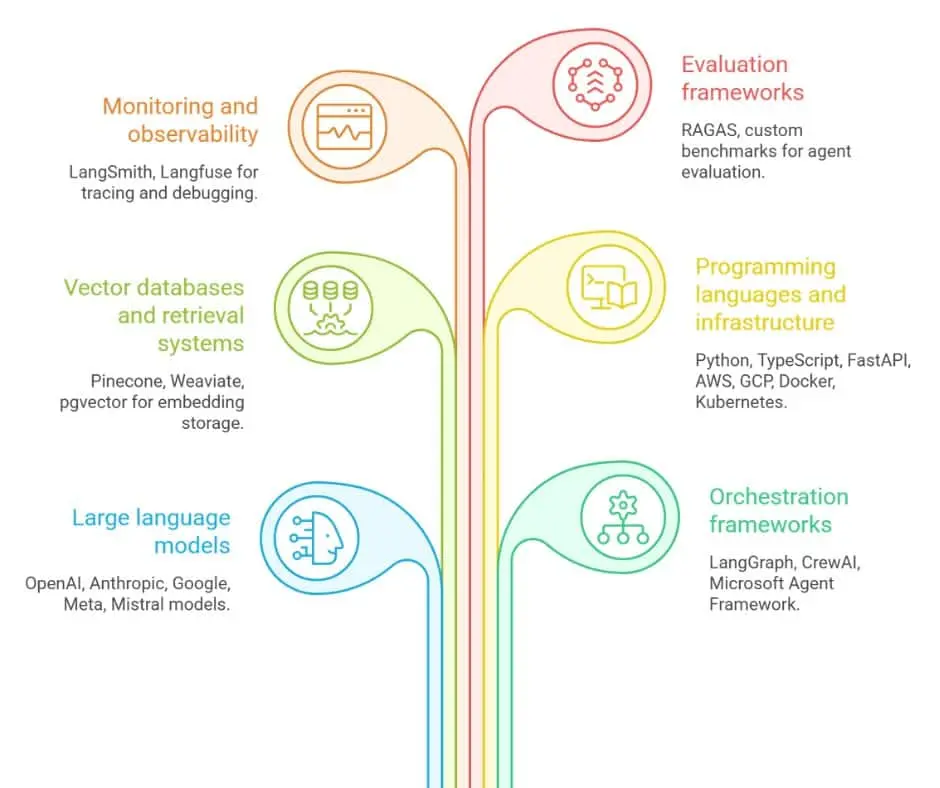
The tooling landscape for AI agent development shifts on a quarterly cycle. Frameworks that dominated six months ago have been absorbed into larger projects or abandoned entirely. This section maps the capability layers a Hiring Manager should understand, using current tools as reference points rather than permanent recommendations.
OpenAI’s GPT series and Anthropic’s Claude represent the proprietary end of the spectrum. Google’s Gemini competes at a similar tier. Open source alternatives from Meta and Mistral offer deployment flexibility at a lower per-token cost.
A candidate who selects models based on task fit signals production maturity in consumer contexts, while enterprise selection places additional weight on data residency requirements, vendor SLAs, contractual indemnification, and the option to self-host within the company’s own cloud account. Defaulting to the most expensive option for every use case yields the opposite result.
This layer manages how the agent plans and how it handles failures. LangGraph is now the recommended production framework within the LangChain ecosystem. CrewAI handles multi-agent role-based workflows. As of early 2026, Microsoft has merged AutoGen and Semantic Kernel into a unified Agent Framework, now generally available.
Multi-agent systems accounted for 53.3% of the agentic AI market in 2025, expanding at a 43.5% CAGR.
That figure confirms multi-agent orchestration as the dominant production pattern.
These store embeddings that agents query during retrieval-augmented generation. Pinecone and Weaviate lead the purpose-built category. PostgreSQL’s pgvector extension offers a lighter path for teams already running Postgres. The candidate’s grasp of chunking strategies and evaluation of retrieval quality matters more than which database they name.
Python dominates. TypeScript holds a secondary position for web-facing applications. The infrastructure layer covers API routing through FastAPI alongside cloud deployment on AWS or GCP. Containerization with Docker or Kubernetes forms the foundation for deployment. Candidates describing their full pipeline during interviews stand apart from those who have only run agents locally.
Agent systems without observability produce outputs no one audits. LangSmith and Langfuse trace multi-step reasoning chains, allowing teams to inspect individual decisions and pinpoint the origins of failures. Candidates who mention an observability setup unprompted demonstrate a production awareness that demo builders lack.
No standardized testing framework for agents exists yet. Teams combine RAGAS for retrieval-quality scoring with custom benchmarks for task-completion accuracy. Candidates who have developed their own evaluation methodology signal greater experience than those who rely on manual spot checks.
The following table maps each capability layer to what it reveals during a technical conversation.
| Tool category | What it signals in a candidate |
|---|---|
| Large language models | Selects models by task fit rather than defaulting to the highest-priced option |
| Orchestration frameworks | Understands how planning loops and retry logic shape reliability at scale |
| Vector databases and retrieval | Evaluates chunking strategies rather than treating RAG as plug-and-play |
| Programming languages and infrastructure | Describes a pipeline from local development through containerized production |
| Monitoring and observability | Traces reasoning steps and pinpoints failure origins across agent chains |
| Evaluation frameworks | Measures output systematically rather than relying on anecdotal checks |
“AI Agent Developer” does not exist as a standalone salary category on Glassdoor, Levels.fyi, or any major compensation database. The role is too new. Compensation data for this position requires proxy titles: AI Engineer, ML Engineer, or LLM Engineer serve as the closest benchmarks.
Candidates with verified production agent-deployment experience sit at the upper end of each proxy range and, in some cases, exceed it because the scarcity premium for agent-specific skills has not yet surfaced in published salary databases.
The wage dynamics around AI skills support that premium positioning. Workers with AI skills command a 56% wage premium over comparable roles without AI skills, more than double the 25% recorded one year earlier. Job postings requiring AI skills rose 7.5% year over year while total postings fell 11.3%. AI Agent Developers operate at the specialized end of that premium band.
AI Engineer and ML Engineer salaries form the baseline. Junior candidates with one to two years of agent-adjacent experience fall into the lower range. Mid-level professionals who have deployed at least one agent system in production move into the middle band. Senior candidates with experience in multi-agent architectures and production observability track records reach the upper band.
The following table reflects proxy-based ranges drawn from AI Engineer and ML Engineer compensation data across US markets.
| Experience | Annual salary range (USD) |
|---|---|
| 0-1 years | $120000-$160000 |
| 1-3 years | $160000-$220000 |
| 4-6 years | $220000-$350000 |
Prompt engineering is not a single discipline, and the rate spread inside it reflects that. A Prompt Engineer working on chatbot instruction design and behavioral guardrails commands a different rate from one running structured prompting research, and prompt-versioning systems for production LLM workloads.
Both still sit below an Agent Developer who designs multi-agent systems with tool integration and production monitoring, with work extending from prompt logic to orchestration, error recovery, and runtime infrastructure.
“The skills sought by employers are changing 66% faster in AI-exposed occupations, up from 25% the prior year.”
That acceleration widens the compensation gap between adjacent roles. A Prompt Engineer’s ceiling often becomes an Agent Developer’s floor. This distinction mirrors the pay gap between a WordPress Developer and a full stack framework Engineer, or between a UI-only Designer and a full stack Product Designer who owns the end-to-end experience.
General job boards generate applications, but “AI Agent Developer” is too new for most platforms to index as a searchable category. Posts with this title attract ML Engineers and Data Scientists whose backgrounds do not include agent deployment.
Freelance platforms carry a limited supply. Most experienced Agent Developers hold full-time positions at AI-first companies. AI skills jumped from the sixth most scarce technology skill to number one in 18 months. That scarcity hits hardest in agent-specific work.
AI-specific communities on Hugging Face and the LangChain Discord contain the highest-quality passive candidates. Reaching them requires direct outreach that most internal Recruiters lack the technical credibility to execute.
The screen demands hands-on technical evaluation of agent architectures, a depth of review that most hiring pipelines are not yet set up to run in-house. A Recruiter unfamiliar with agent systems cannot distinguish between a candidate who fine-tuned a chatbot prompt and one who built a multi-agent production system. Many vendors practice “agent washing”, rebranding chatbots as agentic products.
Candidates from those environments list “agent experience” without meeting the definition established earlier in this article. Agencies with AI hiring experience surface this difference before the candidate reaches the client stage.
Agency screening for this role includes architectural exercises in which the candidate maps an agent system to a business problem. Code review sessions examine orchestration logic and error recovery. Evaluation methodology checks confirm whether the candidate systematically measures output quality. These filters require evaluators who understand the material, a gap most internal recruiting teams face.
Agencies also track where offers land across concurrent searches, helping employers avoid underbidding against AI-first companies or overpaying for prompt engineering experience that does not extend to full system design.
The strongest candidates contribute to open source frameworks and build internal tools at companies that do not appear in a standard LinkedIn search. Before launching a search, the agency should confirm whether the client has the API infrastructure and cross-functional support to make an Agent Developer productive from week one.
Market-rate advisory belongs in the same conversation, since published salary data is based on proxy titles rather than Agent Developer figures, and an agency tracking concurrent searches reads where live offers actually land before that signal reaches any compensation database.
AI Agent talent concentrates in a handful of global markets. The US West Coast and London anchor the primary clusters. Tel Aviv and select Western European cities form a secondary tier. Cross-border hiring introduces compliance complexity that agencies absorb through Employer of Record services.
“ Over 40% of agentic AI projects face cancellation by the end of 2027 due to escalating costs and unclear value. A wrong hire multiplies that risk.”
An Agent Developer’s architectural decisions are embedded in the system’s reasoning structure. Poorly designed prompts become invisible technical debt that degrades output over months. These failure modes hit the decision-making layer, making remediation far more expensive than a standard engineering correction.
Do you have IT recruitment needs?
Website : www.devsdata.com
Team size: ~60 employees
Founded: 2016
Headquarters: Brooklyn, NY, and Warsaw, Poland
The screening pipeline described above requires evaluators who carry agent-specific technical knowledge. That requirement is where DevsData LLC operates. The firm runs both IT recruitment and technical consulting divisions, employs more than 60 professionals, and is now in its tenth year of operation. A database of 95000 verified candidates provides hiring teams with access to AI and ML professionals with documented production experience. Clients across the US and Europe, with additional reach into Israel, rely on DevsData LLC for placement outcomes backed by 5/5 reviews on Clutch and GoodFirms.
Each AI Agent Developer search runs end-to-end. The process begins with candidate sourcing and proceeds through technical evaluation, with structured interviews and onboarding coordination handled sequentially. Clients receive HR advisory support alongside legal guidance to maintain compliance at every phase. These systems serve startups building their first agent capability and enterprise operations scaling existing AI teams at equal depth.
The technical evaluation is where the AI Agent Developer screening diverges from a standard hiring pipeline. Candidates complete a 90-minute practical challenge that tests their ability to work through an agent architecture problem under time constraints. The exercise evaluates how the candidate approaches orchestration decisions and handles failure-mode reasoning. A written component accompanies the technical output.
That written portion carries extra weight for distributed placements because the working relationship relies on asynchronous documentation rather than verbal explanations. Recruiters assess communication patterns alongside technical results to confirm that candidates function within teams spanning multiple time zones.
In-house staff lead reference verification during English-language interviews and coordinate final salary negotiations. The agency operates on a success-fee basis, collecting payment only after a candidate starts work.
Completed engagements show how DevsData LLC addresses AI hiring across different organizational contexts. A full portfolio is available on the case studies page. The assignments below involved AI and AI-adjacent talent placement for companies building or scaling their development teams.
DevsData LLC recruited two AI Engineers for a leading German digital ordering platform. The search targeted candidates with production-level experience in ML model deployment suited to a high-volume commercial environment.
DevsData LLC placed the Head of Artificial Intelligence for a global Web3 crypto company. The engagement required identifying a senior candidate who combined depth in AI research with executive-level leadership in a fast-moving sector.
DevsData LLC recruited AI NLP Developers and Product Managers for an intelligent document processing company. The positions demanded candidates with natural language processing experience applied to structured data extraction.
Beyond recruitment, DevsData LLC delivers software consulting at the intersection of AI development and broader product engineering. Technical project delivery keeps the recruitment practice current, giving Recruiters firsthand exposure to the tools and workflows that candidates describe during evaluations.
DevsData LLC built AI computer vision software for a leading American drone technology company. The project required production-grade image recognition systems operating under real-world field conditions.
DevsData LLC developed a machine learning system for an AdTech company from Los Angeles. The engagement applied reinforcement learning to optimize ad placement decisions at scale.
DevsData LLC built an AI and NLP system that identified investment opportunities by automatically analyzing unstructured financial data. The project combined natural language processing with pattern recognition across large document sets.
Businesses seeking AI Agent Developers who match their technical and organizational requirements can reach DevsData LLC at general@devsdata.com or visit www.devsdata.com to connect with a Recruiter experienced in AI talent placement.
Hiring an AI Agent Developer for work that has taken its current shape within the last 24 months requires evaluation methods that most internal teams have not developed. The senior end of the salary table earlier in this article reflects that timeline, since the 4-6-year bracket is read as time spent in adjacent disciplines such as ML Engineering, and applied LLM work, with the agent-specific portion of the candidate’s career sitting nearer the front of that range.
94% of C-suite leaders face AI-critical skill shortages, with one in three reporting gaps of 40% or more. A wrong placement embeds architectural decisions that are costly to reverse, making the choice of recruitment partner the first decision that matters.
DevsData LLC brings ten years of recruitment operations experience to this search, with a government-approved license for placement services and a verified database of 95000 candidates. The firm staffs US Specialists alongside international Recruiters who carry deep technical screening fluency in AI-adjacent disciplines.
For details on DevsData LLC’s AI placement services, contact them at general@devsdata.com or visit www.devsdata.com.
Any questions or comments? Let me know on
Twitter/X.
Discover how IT recruitment and staffing can address your talent needs. Explore trending regions
like Poland, Portugal, Mexico, Brazil and more.
 Frequently asked questions (FAQ)
DevsData – your premium technology partner
DevsData is a boutique tech recruitment and software agency. Develop your software project with veteran engineers or scale up an in-house tech team of developers with relevant industry experience.
Free consultation with a software expert
🎧 Schedule a meeting
FEATURED IN


DevsData LLC is truly exceptional – their backend developers are some of the best I’ve ever worked with.”

Nicholas Johnson
Mentor at YC, serial entrepreneur


 Build your project with our veteran developers.
Explore the benefits of technology recruitment and tailor-made software.
Learn how to source skilled and experienced software developers.
Build your project with our veteran developers.
Explore the benefits of technology recruitment and tailor-made software.
Learn how to source skilled and experienced software developers.

Rebecca Botvin

Commercial Director

Tom Potanski
Manager




Categories: Big data, data analytics | Software and technology | IT recruitment blog | IT in Poland | Content hub (blog)















careers@devsdata.com









general@devsdata.com

"I interviewed about a dozen different firms. DevsData LLC is truly exceptional – their backend developers are some of the best I've ever worked with. I've worked with a lot of very well-qualified developers, locally in San Francisco, and remotely, so that is not a compliment I offer lightly. I appreciate their depth of knowledge and their ability to get things done quickly."

Nicholas Johnson
CEO of Orange Charger LLC,
Ex-Tesla Engineer,
Mentor at YCombinator
"DevsData reached out to us, as we've been looking to grow our engineering team in Europe and Poland. Communicating efficiently and professionally, DevsData made a strong impression with their understanding of the recruitment challenges we were facing. They designed a tailored recruitment process for our needs. I was impressed with the technical depth of their approach."

Karim Butt
Co-Founder & CTO at GlossGenius, Inc.
"Out of all the vendors we work with, DevsData clearly stands out. The quality of developers they deliver is beyond what we've received from any other vendor, and they've been able to send profile recommendations very quickly. I'm happy to be their reference for other companies from Israel and talk about their recruitment abilities and what they delivered for us."

Ran Eyal
Senior Manager at
ZIM Integrated
Shipping Services Ltd.
"DevsData demonstrated a strong degree of proactivity, taking time to thoroughly understand the problem and business perspective, and continuously suggesting performance and usability enhancements. Their app exceeded my expectations. I've worked with DevsData on numerous projects over the last 3 years and I'm very happy. Being both responsive and honest in communication."

Jonas Lee
Partner & Executive VP of Verus,
Financial LLC, Investor,
& Serial Entrepreneur
Acknowledgments