Thanks for subscribing.
Your gift is on the way.



Every company runs on records that someone entered by hand, and in most organizations, that someone holds a job title with no mention of data. A Sales Rep updates a CRM between client calls. A Finance Coordinator copies invoice totals into a spreadsheet at month-end. Neither was hired for data entry, and the mistakes that follow add up: duplicate records creep into the CRM, and mismatched figures surface only when a quarterly report raises questions no one anticipated.
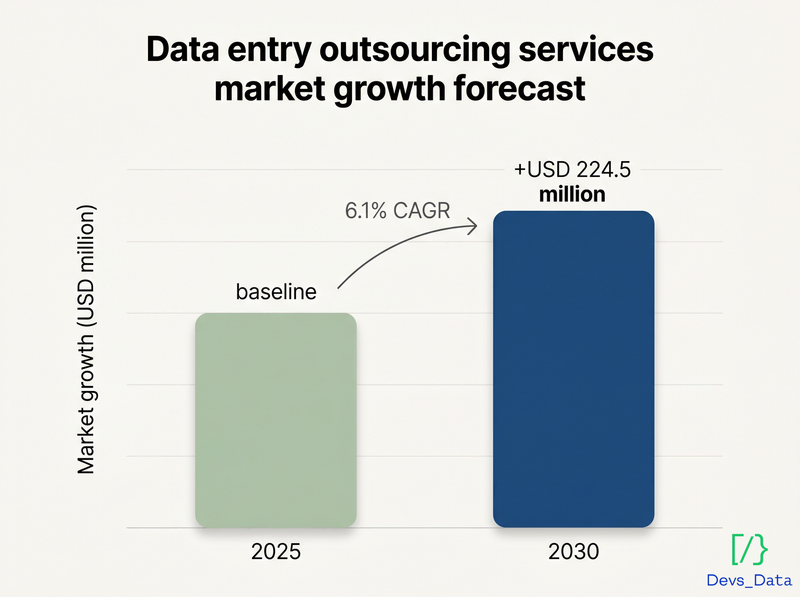
The data entry outsourcing market has grown in step with that problem. Technavio projects the data entry outsourcing segment to expand by USD 224.5 million between 2026 and 2030 at a 6.1% CAGR. More organizations are routing this work to dedicated professionals rather than absorbing it across internal teams already stretched thin. The bar chart below compares the size of the data entry outsourcing services market in 2025, used as the baseline, with Technavio’s projection for 2030, measured in millions of US dollars.
Those numbers capture the market side of the shift. Inside organizations, the consequences of poor data entry have reached the executives responsible for operational performance. A COO reviewing quarterly results depends on figures that passed through manual entry somewhere in the pipeline, and when those figures carry errors, the decisions built on them carry the same distortion. That dependency moved data quality into executive operational planning.
A 2025 IBM Institute for Business Value report found that 43% of Chief Operations Officers rank data quality issues as their most significant data priority.
That finding has pushed data handling out of the back-office category and into the COO’s operational planning. A growing number of organizations respond by bringing on a remote Data Entry Virtual Assistant who owns record accuracy as a core responsibility, not as one more task squeezed between meetings.
This article provides business owners with compensation benchmarks across four geographic markets and screening criteria for evaluating Data Entry Virtual Assistant candidates with verified operational backgrounds.
DevsData LLC, an IT recruitment agency placing professionals across the US and Europe, compiled the guidance from a decade of recruitment work in data management and operational support roles, with the depth to separate candidates who manage full data workflows from those limited to basic keystroke input.

The distinction between full workflow management and basic keystroke input shows up in how organizations define the role itself. Most job descriptions for Data Entry Virtual Assistant positions list typing speed and spreadsheet proficiency as core requirements.
Those descriptors apply to nearly every administrative function and tell the person reviewing applications almost nothing about whether a candidate has managed records at the operational level this role demands. The role has changed over the past decade, and the responsibilities a Data Entry Virtual Assistant carries in a modern remote operation differ from the clerical data entry work most people picture when they hear the title.
A Data Entry Virtual Assistant enters and maintains records across the business systems where operational data lives. CRM platforms like Salesforce and HubSpot handle customer and sales records, while ERP systems such as Oracle NetSuite and Microsoft Dynamics 365 hold purchase orders and inventory data. Spreadsheet tools like Google Sheets and Microsoft Excel cover ad hoc financial tracking alongside them.
The VA processes records across whichever combination of platforms the business uses, and consistency depends on how well that person carries data from one system into the next, such as matching a HubSpot customer record against the same entity in the ERP before a sales order is released.
Daily tasks are split into two categories. The first is direct entry: a VA handling sales leads updates contact records after each interaction and logs the touchpoint in the sales team’s pipeline. A VA processing financial documents enters invoice line items into QuickBooks or the ERP’s accounts payable module and reconciles the entries against source documents.
The second is verification. The Data Entry Virtual Assistant cross-references incoming records with existing data to catch duplicates and formatting inconsistencies before they propagate across platforms that other departments rely on.
A marketing team pulling a segmented customer list for a campaign depends on the accuracy of those CRM records. A Finance Director running a quarterly close depends on invoice figures matching their source documents. Both outputs trace back to the same entry function, and that link tends to become visible only once downstream reports flag a mismatch.
At the senior end of the range, the work extends past input into light process design. Virtual Assistants at this level set up validation rules inside CRM and ERP fields and build spreadsheet templates with built-in error detection.
Some configure automated import workflows using tools like Zapier or built-in platform integrations.
Annual global CRM spending is projected to reach $98.84 billion in 2025, yet 70% of revenue leaders report a lack of confidence in their CRM data.
Automation has taken over the data-entry tasks involving structured, repetitive input from standardized documents. OCR engines and form-parsing software extract line items from invoices, and AI-based document processing now goes further, reading semi-structured files such as receipts and emails and proposing field values without a fixed template. That shift has not eliminated the Data Entry Virtual Assistant role. What the position requires has changed.
The accuracy gap between automated and human entry quantifies the reason. DocuClipper reports that automated data entry achieves 99.959% to 99.99% accuracy, producing between one and 4.1 errors per 10000 entries.
Human data entry achieves 96% to 99% accuracy and produces between 100 and 400 errors at the same volume. That gap has driven organizations to automate the structured portion of the work. AI models push automation into messier inputs, yet they can misread a field or return a confident but wrong value, so their output still needs a person who checks it against the source.
Unstructured data widens that responsibility. Handwritten notes and inconsistent formatting across vendor records require a human operator who understands the data model well enough to place each piece in the correct field.
Non-standard file types that OCR and AI tools do not recognize require manual processing before the data reaches the target system. A Data Entry Virtual Assistant in this environment spends less time on keystroke input and more time auditing automated data-processing output and managing the exceptions that those systems flag but do not resolve.
That hybrid function has replaced the older model, in which one person typed records into a single database for a full shift. The Data Entry Virtual Assistant now operates as both an operator and a quality controller, sitting between the automation tooling and the business logic that those tools do not interpret. The accuracy of the records reaching executive dashboards and financial reports depends on the person in that seat. Getting the hire right frees the core team to do the work they were brought on to do.
Do you have IT recruitment needs?
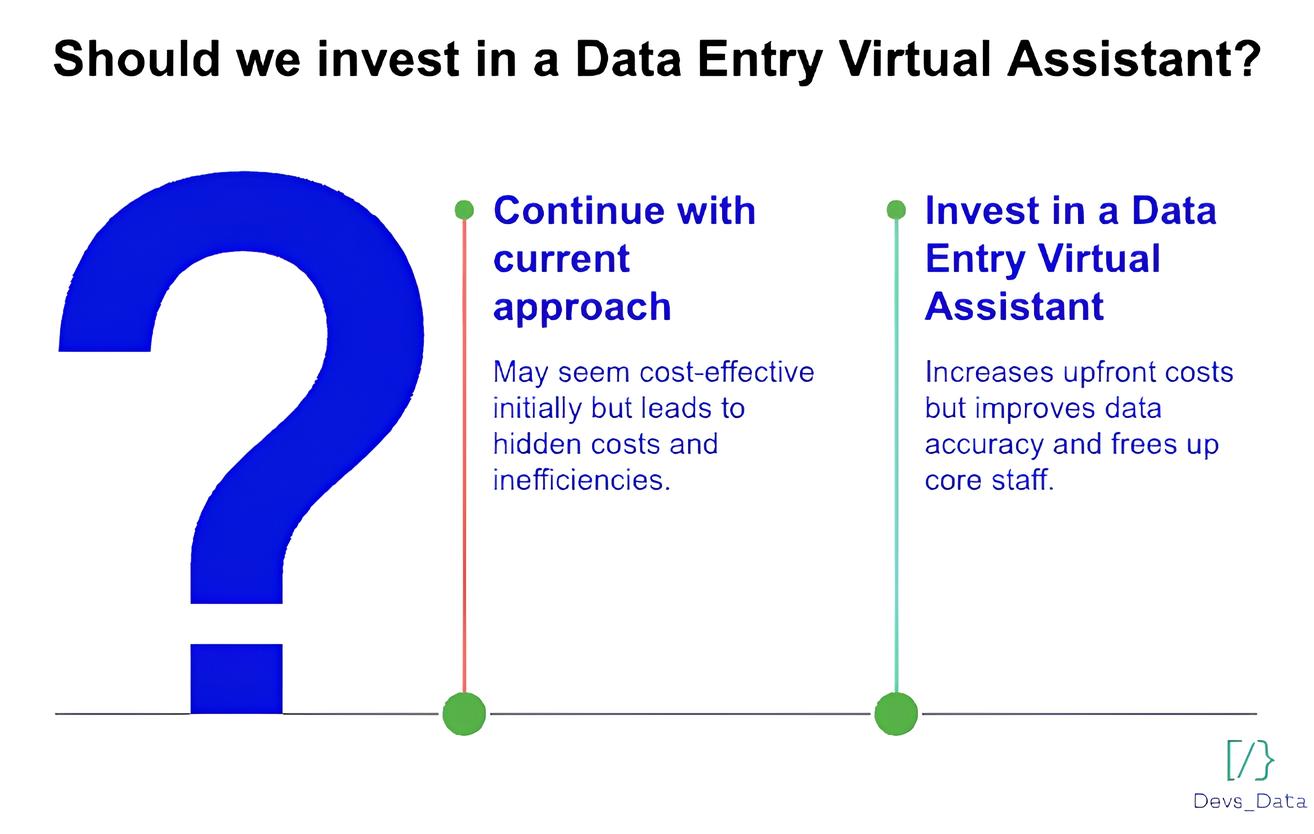
That capacity question sits at the center of the business case for a dedicated Data Entry Virtual Assistant. The cost of distributing data work among employees hired for other functions does not appear as a separate line item in the operating budget.
Those costs surface later: the hours the team spends on tasks outside their primary function and the correction cycles that follow when records are entered into the system inaccurately. A business owner reviewing the monthly financials sees the output of that arrangement without the input cost, and that disconnect keeps the hire feeling optional until the operational drag becomes too visible to ignore.
The direct cost carries a number that most organizations do not track. A 2025 survey by Parseur and QuestionPro found that manual data entry tasks cost American companies an average of $28500 per employee annually. That figure covers the labor hours spent on entry work. The downstream cost of errors and the opportunity cost of displaced productive time sit outside that calculation.
The displaced time is where the larger loss accumulates. A Product Manager spending 45 minutes per day updating project tracking spreadsheets loses more than three hours per week to a task that has nothing to do with product development.
A Customer Success Lead entering support ticket data into the CRM between client calls splits attention, degrading both data quality and client interactions. The pattern scales with headcount: the more employees absorbing data work as a secondary task, the more hours the organization loses from the functions those employees were hired to perform.
Miro’s research quantified that imbalance at a broader level. For every one hour of momentum work, knowledge workers spend three hours on maintenance tasks, including email and administrative duties. Data entry sits squarely in the maintenance category. A dedicated Data Entry Virtual Assistant takes that load off team members whose time carries a higher per-hour cost to the organization, and the hours reclaimed are reinvested in product and sales work that generates revenue. The cost-of-time argument is the one most business owners grasp first. The data quality argument runs deeper.
Inaccurate records do not stay confined to the field where the error originated. An incorrectly entered product price in an inventory system carries over into the sales quotes the team generates from that system. A customer address entered with an incorrect postal code affects shipping cost calculations and delivery routing for every subsequent order. Each error starts small and compounds in proportion to the number of processes that reference the original record.
For organizations operating in regulated industries, the stakes extend beyond operational inefficiency. A healthcare provider submitting patient billing data with entry errors faces claim rejections and compliance exposure.
A FinTech platform processing transaction records with mismatched figures triggers audit flags that the compliance team then resolves manually. The cost of those corrections exceeds that of the original entry work by a factor that increases with the sector’s regulatory complexity.
A dedicated Data Entry Virtual Assistant does not eliminate errors. No human operator does. What the role reduces is the structural condition that produces the highest error rates: employees entering data as a secondary task without the process discipline that a dedicated professional builds into the daily routine.
The model carries its own risks. Concentrating record ownership in one remote person creates a single point of dependency, so an unplanned absence or resignation can stall entry work until someone else learns the data structure. Granting an external hire access to customer and financial systems also widens the security surface, which calls for role-based permissions and documented handover procedures from the first week.
Weighed against those risks, the return sits on the other side of the expense. It shows up in the accuracy of every report and operational decision that depends on the records that person manages.
The screening criteria for identifying that level of capability require more specificity than most standard hiring processes apply to administrative roles.
Do you have IT recruitment needs?
Standard screening processes flag typing speed and software names on a resume. They do not flag whether the candidate behind those keywords maintained a ten-record personal spreadsheet or processed 500 invoices per day across connected CRM and accounting platforms.
Both profiles pass the same keyword filter, and Tech Recruiters using generalist workflows lack the tools to distinguish between them before the interview stage. By that point, the organization has already spent screening hours on candidates whose experience falls short of the role’s operational demands.
One decision belongs at the front of the recruitment process: whether the role calls for a fixed-term contract or a permanent hire. A well-defined project with a clear endpoint, such as migrating records between CRM platforms or cleaning a database before a system switch, is well-suited to a fixed-term engagement.
Ongoing data management across live business systems requires someone who builds context on the data architecture over months and adapts to seasonal volume shifts. Mixing those two profiles in the same candidate pipeline wastes screening time on both sides.
The technical bar gets set at the job posting stage. Separating baseline requirements from preferred qualifications provides the screening process with a structure that aligns with the role’s demands. The table below organizes those categories for Data Entry Virtual Assistant positions.
| Required skills | Preferred skills |
|---|---|
| Proficiency in at least one CRM platform (Salesforce or HubSpot) with record creation and maintenance experience | AI and automation literacy, including identifying tasks ready for automation |
| Spreadsheet competency in Google Sheets or Excel, including formulas and data validation rules | Accounting software experience (QuickBooks or Xero) for invoice and financial data entry |
| Documented typing speed above 60 WPM with a verified accuracy rate at or above 98% | Data import and export experience across platforms using CSV files or API connectors |
| Data verification and deduplication workflow experience in a production environment | Industry-specific data handling in healthcare records or FinTech transaction processing |
| English proficiency for asynchronous written communication in a remote team setting | Process documentation and SOP creation for repeatable data entry workflows |
| Familiarity with cloud-based file management (Google Drive or SharePoint) | Prior remote work history with documented async communication and self-reporting habits |
The team running the interview loop should test operational accuracy through practical assessments in which the candidate processes a sample dataset under conditions that mirror the role’s daily workload.
A candidate who enters records without verifying against the source document reveals the same habits that will surface in production. One who flags formatting inconsistencies and asks clarifying questions about ambiguous fields demonstrates the verification instinct that the role depends on. That behavioral signal matters more than typing speed, and standard resume screening does not surface behavioral patterns.
46% of new hires fail within 18 months, and 89% of those failures stem from attitudinal factors rather than lack of technical skills.
Preferred qualifications carry different weights depending on the organization’s data environment. Regulated sectors place a premium on accuracy standards and compliance awareness, since mishandling a patient record creates regulatory exposure and operational disruption.
eCommerce businesses running high-volume order processing need a VA who maintains speed without sacrificing accuracy during seasonal demand spikes around promotional events and holiday periods. A candidate who performs well on a 50-record test sample but has no documented experience at production volume leaves the operation exposed when throughput scales up.
Compensation data turns those screening criteria into a budget conversation, and the regional spread of business owners from whom business owners source determines how far the budget stretches.
Geography and depth of capability set the price for this role. A business owner comparing candidates across markets needs the full compensation picture, not a single figure pulled from a job board in a single region. The spread between a junior and a senior Data Entry Virtual Assistant reflects a gap in their operational output. Regional labor markets add a second variable that shifts every range in the table below.
The cost gap between tiers runs wider than most administrative role comparisons suggest. A junior hire operates within spreadsheet templates and CRM configurations designed by someone else.
The work follows defined processes: entering records according to validation checklists and flagging entries that fall outside pre-set rules. A senior Data Entry Virtual Assistant designs the workflows that structure those processes and configures the automation tooling that the junior hire operates. That capability difference drives the spread within each range more than years on a resume do.
Regional labor markets shape the second axis. The table below shows annual compensation ranges for Data Entry Virtual Assistant roles compiled from Glassdoor, levels.fyi, and cross-market hiring data as of early 2026.
| Region | Annual cost for Juniors | Annual cost for Seniors |
|---|---|---|
| United States | $28000-$42000 | $45000-$65000 |
| Western Europe | $22000-$36000 | $36000-$55000 |
| Poland and CEE | $10000-$18000 | $18000-$32000 |
| Latin America | $8000-$16000 | $16000-$28000 |
The US market sets the ceiling, and every other region prices relative to that reference point. Western European ranges run about 20% below US figures at both tiers. Poland and Central and Eastern Europe sit at roughly half the US senior range, a compression driven by the lower cost of living alongside a growing pool of trained remote data professionals.
Latin America tracks closely with CEE at the junior level and is slightly lower for senior hires. For the person building the sourcing strategy, those percentage differentials shape the total cost more than any single candidate’s positioning within the band.
Specialization differs by market as well as price. US-based candidates work under the same federal privacy rules as their employers, including HIPAA for patient records, which simplifies healthcare data work. Western European candidates handle records under GDPR every day, a background that transfers directly to EU customer data. In Poland, the business services sector delivers finance and accounting work for international companies alongside HR and logistics processes, so candidates from that environment tend to arrive with audited, structured workflows behind them. Latin American candidates share working hours with North American teams and can process records in Spanish or Portuguese natively.
Cost-of-living differences account for part of the spread, but the maturity of remote-work infrastructure and the density of candidates with production-level data-management backgrounds also shift pricing within each region. Remote-first engagement models at many technology companies have narrowed some of those differentials without closing them.
Industry-specific experience in healthcare or financial services commands a measurable premium due to the compliance requirements associated with data handling in those sectors.
Documented CRM platform proficiency beyond basic record entry adds a second dimension, commanding higher rates across all four markets. An agency with compensation benchmarking data from concurrent searches helps the person approving the offer position the number competitively without overrunning the budget.
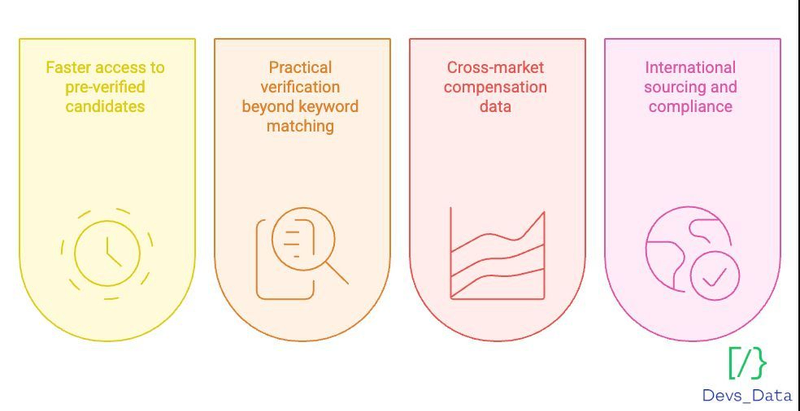
Filling one position gives the business owner one data point. The salary the candidate accepted and the sourcing channel that produced the shortlist both reflect a single cycle, with no baseline for comparison for the next hire. Agencies running concurrent Data Entry Virtual Assistant searches across regions build that baseline in real time. The accumulated depth reduces risk at the points in the cycle when a solo search is most exposed.
Speed matters when a data migration deadline or a platform transition has a fixed delivery date. Agencies maintaining active databases of remote data management professionals have verified candidates’ backgrounds through accuracy testing and production-volume work histories. Sourcing from this pre-screened pool compresses the window between role approval and a signed offer, and the person managing the project timeline avoids the weeks of open-market sourcing that a generalist search adds to a specialized data role.
That head start carries more weight for Data Entry Virtual Assistant positions than for most administrative hires. The supply of candidates who list “data entry” on their resumes far exceeds the supply of those who have operated at production volume across CRM and accounting platforms with documented accuracy rates. Open-market postings pull from the full pool without filtering for the production-level subset, shifting the screening burden onto the organization’s internal team.
A resume listing “data entry” and “Excel” does not confirm that the candidate has maintained records at production volume or managed data quality workflows in a live business environment. Agencies with recruitment depth in data operations test those distinctions through practical exercises: sample dataset processing tasks where the candidate enters records under time pressure and identifies errors planted in the source material.
The behavioral gap between candidates who verify against the source document and those who skip that step is where most internal screening processes break down. Tech Recruiters without Data Entry Virtual Assistant-specific assessment workflows pass candidates whose experience ends with basic record entry.
The data quality problems those hires introduce do not surface during onboarding. They surface in the second month, when the records entered start producing downstream mismatches at a volume the organization did not anticipate.
The average cost to replace an employee ranges from one-half to two times the employee’s annual salary, according to a study by the Society for Human Resource Management.
Salary ranges for Data Entry Virtual Assistant roles vary by the depth of the data workflow and the industry vertical in which the organization operates. Agencies track those variables across searches running in parallel, producing compensation data with a level of granularity that no single company can generate on its own.
Pricing the offer within the right band requires data from placements happening at similar seniority levels in the same quarter. An agency tracking 15 active Data Entry Virtual Assistant searches across two regions knows where the market moved last month. The person inside the organization filling a role does not have that comparison set, and the gap between those two perspectives determines whether the offer closes or the candidate walks away.
Data Entry Virtual Assistant talent is found in markets where remote-work infrastructure has matured, and English proficiency is high enough to support asynchronous team communication. LinkedIn’s 2025 Workforce Report, as cited by CareerAhead, reports a 44% year-over-year increase in international remote job postings.
That acceleration has expanded the sourcing pool for business owners open to cross-border placements, but each jurisdiction carries its own payroll registration requirements and tax obligations that absorb administrative hours the internal team would otherwise spend evaluating candidates.
Agencies absorb this compliance load through Employer of Record arrangements that handle payroll and local labor law obligations on behalf of the client. The business owner hires a Data Entry Virtual Assistant under a compliant contract without managing jurisdiction-specific legal work.
A compliant contract does not confirm the candidate’s tooling, however. Tech stack verification has become a separate step for data roles, because a CRM or ERP listed on a resume says little about the modules or configuration the person actually used. Accounting and ERP choices also differ between countries, so a short hands-on task in the client’s own stack confirms proficiency before the offer stage.
For organizations sourcing from Poland or other CEE markets, where qualified remote data professionals operate at roughly half the US rate, the EoR model removes the administrative barrier that otherwise delays those hires.
DevsData LLC spans both talent placement and hands-on consulting delivery, keeping the sourcing process aligned with the platforms and workflows Data Entry Virtual Assistants operate in daily. The next section covers how the firm structures each engagement.
Team size: ~60 employees
Founded: 2016
Headquarters: Brooklyn, NY, and Warsaw, Poland
Screening a Data Entry Virtual Assistant for production readiness requires evaluators who work with the same platforms the candidate will operate in daily. A recruitment team that has never configured a CRM validation rule or built a data import workflow lacks the frame of reference to judge whether a stated credential holds up under operational conditions.
DevsData LLC has operated across both recruitment and hands-on software development for a decade, placing data management professionals in organizations where record quality directly affects operational output. Their rigorous recruitment process includes a 90-minute problem-solving challenge with a 6% acceptance rate.
DevsData LLC has successfully completed over 100 projects for over 100 businesses. A team of more than 60 spans both divisions. The consulting side runs backend data projects and platform integrations that keep the recruitment practice up to date with the tools Data Entry Virtual Assistants use every day.
The firm’s verified candidate database holds 95000 profiles, and Data Entry Virtual Assistants and data management specialists within that pool carry documented histories in CRM record management and production-volume data processing across business platforms.
Placement outcomes for clients across the US and European markets hold verified 5/5 ratings on Clutch and GoodFirms.
Each engagement runs as a single thread from sourcing through signed offer. Screening feeds into structured interviews, and HR advisory support runs in parallel with contract and compliance preparation. The process depth stays consistent whether the client is a five-person startup or an enterprise operation with distributed teams.
Practical assessment sits at the center of how DevsData LLC distinguishes Data Entry Virtual Assistants ready for live operations from candidates still building their data management experience. The exercise places the candidate in simulated operational conditions: they process a sample dataset with planted errors across CRM and spreadsheet formats and verify records against source documents under time constraints.
A follow-up scenario introduces a data quality incident in which the candidate receives a batch of vendor records with inconsistent formatting and must determine the correct field mapping without a prebuilt template to reference.
A second evaluation tests how the candidate responds to ambiguous inputs. The exercise provides a record batch without complete field specifications, and the candidate’s response reveals whether they ask clarifying questions before proceeding or make assumptions that produce records requiring correction once the data reaches downstream systems.
That behavioral pattern predicts how a hire will perform on a remote team, where async communication gaps compound when left unaddressed. In-house staff verify references during English-language interviews and manage compensation discussions through to the final offer. Payment follows a success-fee structure: the agency collects nothing until a candidate starts work.
BCG and venture-backed companies across multiple sectors count among past clients. Academic partnerships and connections to professional communities extend the sourcing network beyond public job boards.
A full portfolio of completed engagements is available on the case studies page. The recruitment assignments below placed operational and data management talent in environments where record accuracy and processing reliability formed part of the placement criteria.
Project delivery work runs alongside the recruitment practice, keeping Recruiters up to date on data platforms and operational workflows. The consulting engagements below reflect that capability.
Business owners seeking Data Entry Virtual Assistants who match their operational requirements reach DevsData LLC at general@devsdata.com or visit www.devsdata.com to connect with a Recruiter experienced in data management and administrative support roles.
Do you have IT recruitment needs?
Data entry no longer describes a clerical function performed by a single person typing records into a database for a full shift. The role has shifted to a hybrid position in which the Data Entry Virtual Assistant operates between the automation tooling and the business logic that those tools do not reach. The cost of a wrong hire in this position does not appear as a single line item on the operating budget. That cost compounds across every record that moves through the system unchecked and every downstream report built on the inaccurate data those records produce.
The screening challenge at the center of this article runs from the first to the last section. A resume listing “data entry” reads the same whether the candidate behind it maintained a ten-record personal spreadsheet or managed 500 daily records across connected CRM and accounting platforms. The gap between keyword presence and verified operational capability is where every hiring decision for this role succeeds or fails.
Organizations filling these positions operate in a market where the candidate pool listing “data entry” dwarfs the subset with production-level CRM management experience and documented data verification workflows. That imbalance puts pressure on every stage of the process, from sourcing through final offer, and business owners who delay the hire absorb the compounding cost of the data problems a qualified professional would have prevented.
DevsData LLC operates under an official, government-approved license for recruitment services and maintains a database of 95000 verified candidates, including Data Entry Virtual Assistants and data management specialists with documented production-volume processing histories. Practical assessments evaluate operational accuracy and behavioral readiness before candidates reach client interviews.
To discuss Data Entry Virtual Assistant recruitment needs, reach DevsData LLC at general@devsdata.com or visit www.devsdata.com.
Any questions or comments? Let me know on
Twitter/X.
Discover how IT recruitment and staffing can address your talent needs. Explore trending regions
like Poland, Portugal, Mexico, Brazil and more.

 Frequently asked questions (FAQ)
DevsData – your premium technology partner
DevsData is a boutique tech recruitment and software agency. Develop your software project with veteran engineers or scale up an in-house tech team of developers with relevant industry experience.
Free consultation with a software expert
🎧 Schedule a meeting
FEATURED IN


DevsData LLC is truly exceptional – their backend developers are some of the best I’ve ever worked with.”

Nicholas Johnson
Mentor at YC, serial entrepreneur


 Build your project with our veteran developers.
Explore the benefits of technology recruitment and tailor-made software.
Learn how to source skilled and experienced software developers.

Rebecca Botvin

Commercial Director

Tom Potanski
Manager




Categories: Big data, data analytics | Software and technology | IT recruitment blog | IT in Poland | Content hub (blog)















careers@devsdata.com







general@devsdata.com

"I interviewed about a dozen different firms. DevsData LLC is truly exceptional – their backend developers are some of the best I've ever worked with. I've worked with a lot of very well-qualified developers, locally in San Francisco, and remotely, so that is not a compliment I offer lightly. I appreciate their depth of knowledge and their ability to get things done quickly."

Nicholas Johnson
CEO of Orange Charger LLC,
Ex-Tesla Engineer,
Mentor at YCombinator
"DevsData reached out to us, as we've been looking to grow our engineering team in Europe and Poland. Communicating efficiently and professionally, DevsData made a strong impression with their understanding of the recruitment challenges we were facing. They designed a tailored recruitment process for our needs. I was impressed with the technical depth of their approach."

Karim Butt
Co-Founder & CTO at GlossGenius, Inc.
"Out of all the vendors we work with, DevsData clearly stands out. The quality of developers they deliver is beyond what we've received from any other vendor, and they've been able to send profile recommendations very quickly. I'm happy to be their reference for other companies from Israel and talk about their recruitment abilities and what they delivered for us."

Ran Eyal
Senior Manager at
ZIM Integrated
Shipping Services Ltd.
"DevsData demonstrated a strong degree of proactivity, taking time to thoroughly understand the problem and business perspective, and continuously suggesting performance and usability enhancements. Their app exceeded my expectations. I've worked with DevsData on numerous projects over the last 3 years and I'm very happy. Being both responsive and honest in communication."

Jonas Lee
Partner & Executive VP of Verus,
Financial LLC, Investor,
& Serial Entrepreneur
Acknowledgments