Thanks for subscribing.
Your gift is on the way.



Product demand in global markets shifts within weeks, while filling the engineering roles behind those products still takes months. Companies operating in financial technology feel that gap most sharply, where a single engineering role sits under regulatory scrutiny from its first commit, and a slow hire turns into a missed product window rather than a missed deadline. Staff augmentation addresses that pressure by placing external specialists directly within an existing team, scaling capacity up or down with project demand without the fixed weight of permanent headcount.
Worldwide outsourcing was set to pass $1.02 trillion in 2026, and within that total, roughly $81.87 billion went to staff augmentation as a standalone category. Deloitte’s Global Outsourcing Survey adds the motive behind the spend, reporting that 57% of executives name cost reduction as the primary driver of traditional outsourcing, usually delivered through staff augmentation for transactional business and IT activities.
FinTech raises the stakes on every one of those hires. The global FinTech market reached $394.88 billion in 2025 and points toward $460.76 billion in 2026, on a longer trajectory past $1.1 trillion by 2032 at a growth rate of above 16% a year. Capital on that scale flows into payment systems and the customer platforms that depend on engineers fluent in both code and finance. Funding those platforms has proven easier than staffing them. More than half of EU companies that tried to recruit ICT specialists in 2023 reported trouble filling the roles, according to Eurostat, while the global cybersecurity workforce gap reached a record 4.8 million unfilled positions, with 65% of organizations holding open security roles they could not staff, per ISACA’s 2025 State of Cybersecurity report.
At DevsData LLC, we have recruited and embedded technical talent for FinTech companies across Europe and the US, with additional work for clients in Israel. This article draws on that experience, setting out what FinTech staff augmentation involves, where it fits against other hiring routes, the obstacles that surface most often, and the practices that keep augmented teams productive once they join.
Staff augmentation integrates external professionals into an existing team to close skill gaps or absorb a rising workload, typically over a longer engagement rather than a one-off task. The augmented specialist works inside your tools, attends your standups, and aligns with your workflows, acting as a direct extension of in-house staff rather than a detached vendor handling a project at arm’s length.
In FinTech, the model carries an extra layer that general IT staffing does not. The work begins with translating a business requirement into a precise technical profile, since a company building a payments platform needs a different engineer than one developing a lending engine or a digital banking core. That profiling maps the role against the actual systems a candidate will touch, from the languages and frameworks in play to the cloud environment and data pipelines behind them.
An engineer working on fraud detection or customer data falls under frameworks such as PSD2, GDPR, and the regulatory regime of whichever country the product operates in, so sourcing accounts for both technical fit and a candidate’s familiarity with the rules that govern financial software.
A capable FinTech staffing partner differs from a generic recruiter in what it screens for. It reads a technical brief the way an engineer would, then tests whether a candidate grasps the regulatory obligations attached to financial software before writing a line of it. A weak hire in this setting surfaces as a security incident or an audit failure, which is why companies now treat the model as a standing source of skilled people at the exact points where speed and specialization matter most.
Do you have IT recruitment needs?
The shape of the workforce has already moved toward flexibility. About 40% of the global workforce now consists of contract or contingent workers, and the broader contingent pool of freelancers, independent contractors, and temporary staff accounts for 30 to 40% of the US labor market, a share projected to approach 50% by 2050. Traditional hiring cycles have proven too slow and rigid for conditions that change every quarter.
FinTech amplifies that pattern. Recruitment cycles for specialized engineers stretch for months in competitive markets, and ISACA’s research found that 38% of organizations take three to six months to fill even entry-level roles. Building and holding an in-house team that keeps pace with the technology is expensive and slow, and once the right people are in place, internal teams still struggle to scale quickly against a sudden product launch or a market shift. Staff augmentation removes that bottleneck by opening access to specialized talent at the moment a project needs it, whether the goal is to accelerate a release, modernize infrastructure, or cover a short resource gap. For the business, that speed turns into a faster path to launch, like standing up a KYC process in weeks rather than waiting out a full hiring cycle.
Companies hiring FinTech engineers usually weigh four routes, each carrying a different balance of control, cost, and speed.
| Route | Cost | Control | Speed | Best for |
|---|---|---|---|---|
| In-house hiring | $150000 to $200000 a year in the US | Direct oversight, tight cultural fit | Slow, long time to hire | Long-term core roles with steady demand |
| Freelance Developers | $20000 to $80000 a year by location | Limited, varies by contractor | Fast for short tasks | Temporary workload spikes |
| Outsourcing and dedicated teams | $8000 to $60000 a year by destination | Sits with the vendor | Quick access to a ready group | Mid to large projects with end-to-end delivery |
| Staff augmentation | Set by region, without permanent headcount overhead | Stays in-house over technical decisions | On-demand scaling | Daily collaboration without permanent headcount |
In-house hiring offers direct oversight and tight cultural integration, which suits long-term roles with ongoing needs and a larger budget. The trade-off shows up in high recruitment and overhead costs along with a longer time to hire, made harder by a competitive market for skilled FinTech professionals.
Freelance Developers bring flexibility and lower cost, useful for short tasks or temporary workload spikes. Reliability, commitment, and consistent availability become the open questions, so thorough vetting and clear contracts carry more weight.
Outsourcing and dedicated teams give quick access to a coordinated group of Developers, Designers, and Project Managers, with end-to-end delivery that fits mid to large projects. The dependency moves to an external vendor, and coordination across time zones demands strong project management.
Staff augmentation sits closest to in-house work while keeping the flexibility of contract hiring. The augmented engineer plugs into your existing team and processes rather than operating as a separate unit, which preserves control over technical decisions and institutional knowledge while still letting you scale on demand. The model fits companies that want daily, real-time collaboration without the fixed cost and long ramp of permanent hiring.
On cost, the gap between routes is wide. A full-time in-house FinTech Developer in the US runs roughly $150000 to $200000 a year once benefits and overhead are counted. Outsourced engagements land between $8000 and $60000 a year, a spread that tracks the prevailing salary levels of the country supplying the engineer rather than any difference in the work delivered. Freelance contractors fall between $20000 and $80000 a year on the same regional logic.
A US Developer earns $114000 to $159000, against $48000 to $58000 in Eastern Europe, $30000 to $40000 in Latin America, and $8000 to $12000 in India. That puts a mid-level US hire at roughly three times the cost of a comparable European one and up to 15 times an Indian one, which is why companies open to distributed teams often source from Eastern Europe or Latin America for the balance of lower cost and working-hour overlap with US operations.
A general recruiter fills a seat. A specialized FinTech staffing partner fills it with someone who understands that the code in question moves money, holds personal financial data, and ships under regulatory scrutiny from day one. That difference produces concrete advantages.
The first is reduced regulatory exposure. European data protection authorities issued roughly €1.2 billion in GDPR fines during 2025, and cumulative penalties since the regulation took effect in 2018 now exceed €7.1 billion, according to the DLA Piper GDPR Fines and Data Breach Survey.
An engineer who misconfigures data residency or builds a logging system that captures more than it should exposes the business to penalties reaching up to 4% of global annual revenue. A partner that vets for regulatory awareness screens out that risk before a candidate touches the codebase.
The second is access to scarce, pre-vetted talent. FinTech competes for a narrow band of engineers who combine financial domain knowledge with production-grade software skill, and most of them are not reading job boards. A specialized partner maintains relationships with passive candidates across markets, reaching them through direct networks rather than waiting for applications. That access matters most at the senior level, where the engineer capable of architecting a settlement system rarely appears in an inbound applicant pool.
The third is faster time-to-productivity paired with stronger retention. A FinTech engineer needs to grasp the regulatory frame, the existing architecture, and the risk attached to every change before contributing safely, which extends the ramp-up well beyond a typical software role. Pre-screening for both technical depth and domain familiarity shortens that ramp. Retention follows from the same precision, since a candidate matched on technical fit, compensation expectations, and the regulatory reality of the role stays longer than one placed on keyword overlap alone, and in FinTech the departure of someone who held context on a live financial system costs far more than the original placement fee.
A company that recruits through structured, domain-aware vetting lowers its regulatory risk, reaches the passive engineers in Poland and Bulgaria that competitors rarely surface, and builds teams that reach productive output sooner.
DevsData LLC runs IT recruitment and software development outsourcing for FinTech companies across Europe and the US, which places us on both sides of the hiring problem, sourcing the engineers and later supporting them inside client teams. That position exposes obstacles reaching well past salary negotiation and interview logistics. Three surface most often in our work.
The engineers FinTech companies need most are the ones the wider market fights over. With a 4.8 million-role cybersecurity gap and 65% of organizations unable to fill open security positions, the search stretches, and the temptation to settle for a candidate who looks adequate on paper grows. We screen for security reasoning as a core requirement rather than a bonus, testing how candidates handle authentication, data exposure, and threat modeling inside financial systems. We build candidate networks before a role opens, which shortens the search rather than starting it from zero when a client cannot wait three to six months for a hire.
The rules governing financial software have multiplied faster than the talent pool’s familiarity with them. The European Banking Authority found in its November 2025 report that most AI use cases at supervised institutions, including credit scoring and fraud detection, fall into the high-risk category under the EU AI Act, which carries strict obligations around risk management, human oversight, and auditability. An engineer who builds a credit-scoring model but cannot account for the documentation and explainability the regulation demands ships a system that fails its first audit. We assess regulatory fluency directly, asking candidates to reason through how a design decision interacts with frameworks such as the AI Act, DORA, PSD2, and GDPR. Someone who treats compliance as another team’s problem raises an immediate flag.
In FinTech, a hiring mistake surfaces as a breach rather than a missed sprint. AI now shapes the work itself, not only the threat model. Coding assistants handle boilerplate and test scaffolding, which moves the value of a FinTech engineer toward judgment that a model cannot supply, such as deciding how a payment flow handles failure or how a logging routine stays within data-protection limits. Demand has not fallen for these roles. The skill that matters has shifted toward reviewing machine-generated code for security and compliance gaps that an automated tool will miss. An engineer who writes a logging routine that leaks card data or a settlement function with a race condition exposes the business to losses that dwarf the cost of the role. We use practical, scenario-based assessments rather than theoretical interviews. One exercise asks a candidate to design a payment data pipeline that meets PCI DSS handling rules while holding transaction integrity under load.
Do you have IT recruitment needs?
DevsData LLC operates across two service lines, IT recruitment and software development outsourcing, and staff augmentation sits at the intersection of both. Our process moves through four stages.
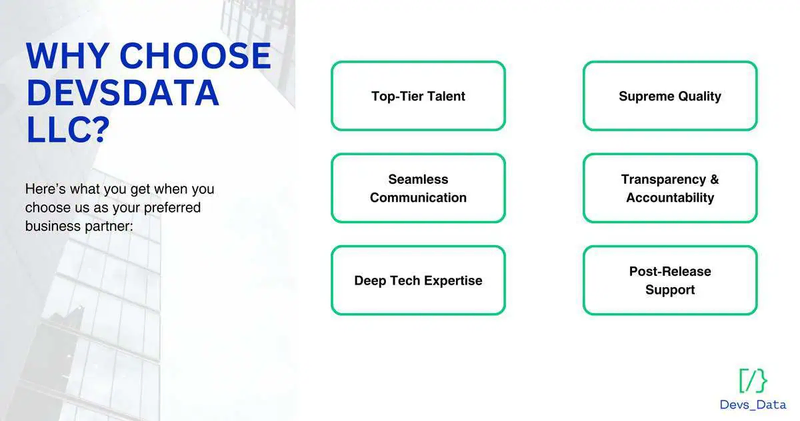
Every engagement opens with a structured consultation that maps your project goals and technical stack against the regulatory frame the role will operate inside, since a payments platform under PSD2 calls for a different profile than a lending engine built around credit-decision auditability. Stakeholder interviews and role-profiling workshops establish where the position sits relative to your compliance obligations, while a skills gap analysis pairs that picture with live salary benchmarks and talent-availability data for your target regions. This turns the discovery phase into a planning step rather than a hiring brief.
Within a few business days, you receive a curated shortlist of candidates screened for technical fit and for the working language your team operates in. Each professional has already passed our multi-step vetting, which pushes past framework familiarity into how a candidate handles transaction integrity and the exposure of customer financial data. Our sourcing goes beyond job boards, drawing on a proprietary database of vetted professionals alongside targeted outreach to engineers already shipping regulated financial products. From there, you interview and evaluate candidates as if you were hiring in-house.
Once you select your candidates, we handle contracting and legal compliance, writing confidentiality and data-handling terms that match the standards your financial records already sit under. A structured kickoff follows, opening with access provisioning for the systems that carry payment data. Workflow alignment and an introduction to your internal team complete it, so the new team member feels part of your company from day one.
Our involvement continues past onboarding. A dedicated Account Manager checks in regularly to assess satisfaction and resolves issues before they escalate, supporting long-term scaling as your product scope widens into new markets or licence requirements. Optional performance tracking covers technical and collaboration metrics, from code-review quality to bug-resolution rate, giving you the data to make informed scaling and retention decisions.
FinTech Developers pair strong technical foundations with focused domain knowledge. On the backend, Python and Java carry most financial processing for their mature ecosystems and reliability, with Python doubling as the go-to language for AI-driven work like fraud detection through libraries such as TensorFlow and scikit-learn. JavaScript and TypeScript power frontend interfaces, while C++ and Go handle latency-sensitive systems such as high-frequency trading, and Solidity and Rust cover blockchain projects on Ethereum and Solana.
Framework choices follow the same logic. Spring Boot and Node.js support secure API and microservice architectures. React dominates FinTech frontend work, holding a 39.5% usage share across websites and powering real-time interfaces at platforms like Coinbase and Robinhood through efficient rendering and WebSocket updates. Docker, Kubernetes, and cloud platforms such as AWS or GCP underpin delivery resilience, with CI/CD pipelines keeping deployments compliant.
On data, skilled Developers work fluently across PostgreSQL, MongoDB, and Redis, understanding ACID compliance, replication, and secure encryption.
Domain and compliance knowledge separates a strong FinTech hire from a strong generalist. The best Developers understand payments, FX, and trading logic alongside the standards that constrain them, designing with PCI DSS, GDPR, and KYC or AML obligations in mind from the first design decision rather than as later rework. Soft skills round out the profile, since these engineers sit in close contact with compliance, legal, and operations teams who do not share their vocabulary. A Developer who can explain a risk or a limitation in plain terms speeds up decisions, and one who stays calm and communicative during a payment incident helps restore service faster.
After working with companies across industries and regions, we have gathered a set of practices that separate high-performing augmented teams from struggling ones.
Technical onboarding covers only part of the work. Differences in decision-making hierarchy and in attitudes toward direct feedback still show up, and product-context sessions that explain who your users are and which regulator watches the product build alignment lasting beyond the first sprint.
Bundling feedback into weekly reviews lets small misunderstandings compound into blockers. In a codebase that moves money, shorter two-way cycles surface a flawed assumption about transaction handling within hours rather than at sprint review.
Define which systems hold financial data and the limits on moving it, then write those controls into the contract so an external engineer operates under the same rules as your own team.
Ambiguity slows teams down, and in regulated work it blurs who signs off on a change touching customer records. Clear scopes and ownership boundaries let augmented engineers plug into your workflows with less rework.
Involving an external Engineer or Data Analyst in standups and sprint planning signals that they are collaborators rather than contractors on the periphery, which matters when compliance context travels through conversation rather than tickets.
Reserve shared working hours for live review of payment and authentication logic, leaving async channels for lower-priority updates.
A single reliable source of truth in Confluence or a GitHub wiki reduces friction and protects against knowledge loss when team members rotate, and in FinTech that record doubles as evidence during an audit.
Give your augmented Developers room to work, then back it with clear KPIs and transparent performance tracking that keeps progress visible without loosening controls over production financial systems.
Virtual coffees and informal chats during demos go a long way toward loyalty and a positive team culture, even across distance.
Founding year: 2016
Website: www.devsdata.com
Headquarters: Brooklyn, NY, and Warsaw, Poland
At DevsData LLC, FinTech staff augmentation means building scalable teams that align with a client’s business objectives rather than simply filling roles. We combine over ten years of market experience in IT recruitment and outsourcing with performance-driven hiring strategies, so every professional we place contributes to measurable, long-term results. Since 2016, we have grown into a cross-continental team supporting global corporate clients and fast-growing startups from countries including the US and Israel.
Our process rests on a proprietary database of 95000+ vetted professionals, AI-supported sourcing, a 90-minute technical problem-solving interview, and a rigorous soft-skill assessment, which together produce an acceptance rate under 6%. A government-approved recruitment license, a success-fee model, and a guarantee period give clients confidence and flexibility, since payment follows a successful hire, and a placement that does not work out gets replaced. That track record carries through to over 140 technical engagements for 100+ satisfied clients, backed by 5.0 ratings on both Clutch and GoodFirms. Our vetting is tuned specifically for FinTech, evaluating system design under transactional load, secure data handling, and regulatory awareness spanning PSD2, GDPR, and DORA, alongside the ability to reason through audit and oversight requirements.
Do you have IT recruitment needs?

Papaya Gaming, an Israeli company behind mobile titles like Bubble Cash and 21 Cash, partnered with DevsData LLC to build a full engineering hub in Warsaw. The roles spanned backend, QA, Unity, design, and data engineering inside a regulated environment where payment-processing accuracy carried real financial weight. We targeted passive candidates across Poland and applied role-specific screening that weighed domain expertise and architectural thinking together. The work made one thing plain: recruiting for platforms that move real money calls for a different vetting lens than standard application hiring. We added a payment-reliability check to the screen, asking candidates to reason through transaction reconciliation and the PCI DSS handling of card data, and the strongest ones paired performance-tuning skill with that grasp of payment-system reliability.

Paysera, a Lithuanian digital financial services provider, partnered with us to scale hiring across regulated FinTech roles. The engagement opened with senior backend and frontend Engineers, then widened into mobile, QA, DevOps, AI specialists, and PHP as the scope grew. We focused sourcing on Poland and Bulgaria, reaching into Ukraine and Georgia for the harder roles, and built compliance checks aligned to GDPR and PCI DSS directly into the coding evaluation rather than bolting them on as a separate step. Over three years, hiring quality rose, time-to-fill dropped, and product delivery accelerated as Paysera entered new markets while holding high retention. The pattern that held across the engagement was simple enough to carry into later work: sustained FinTech staffing depends on matching each technical assessment to the specific regulatory frame the candidate will actually work under.
Across these engagements, one pattern holds. Effective FinTech recruitment validates production ownership, regulatory awareness, and security judgment together, rather than leaning on years-of-experience counts or framework keyword matching.
Demand for engineers who build on regulated financial products keeps climbing, while the pool that pairs technical depth with genuine regulatory awareness stays narrow, producing a market where precision matters more than volume. Staff augmentation answers that mismatch by giving companies fast, controlled access to specialized talent that integrates as a true extension of the in-house team.
Unstructured hiring tends to reveal its costs late, when an under-vetted hire touches a live financial system, and the result shows up as a security incident, a failed audit, or lost context after an early departure. A structured, domain-aware approach changes those outcomes, lowering regulatory exposure while shortening time-to-productivity and improving retention. Partnering with a specialized agency amplifies the benefit further through access to pre-vetted talent, refined recruitment infrastructure, and deep market insight that tightens the match across technical and regulatory dimensions.
At DevsData LLC, we combine IT recruitment expertise, advanced sourcing, and regional networks to deliver FinTech staffing that aligns with each client’s goals. To discuss your staff augmentation needs, visit www.devsdata.com or reach us at general@devsdata.com.
Discover how IT recruitment and staffing can address your talent needs. Explore trending regions
like Poland, Portugal, Mexico, Brazil and more.

 Frequently asked questions (FAQ)
DevsData – your premium technology partner
DevsData is a boutique tech recruitment and software agency. Develop your software project with veteran engineers or scale up an in-house tech team of developers with relevant industry experience.
Free consultation with a software expert
🎧 Schedule a meeting
FEATURED IN


DevsData LLC is truly exceptional – their backend developers are some of the best I’ve ever worked with.”

Nicholas Johnson
Mentor at YC, serial entrepreneur


 Build your project with our veteran developers.
Explore the benefits of technology recruitment and tailor-made software.
Learn how to source skilled and experienced software developers.

Rebecca Botvin

Commercial Director

Tom Potanski
Manager




Categories: Big data, data analytics | Software and technology | IT recruitment blog | IT in Poland | Content hub (blog)
















careers@devsdata.com







general@devsdata.com

"I interviewed about a dozen different firms. DevsData LLC is truly exceptional – their backend developers are some of the best I've ever worked with. I've worked with a lot of very well-qualified developers, locally in San Francisco, and remotely, so that is not a compliment I offer lightly. I appreciate their depth of knowledge and their ability to get things done quickly."

Nicholas Johnson
CEO of Orange Charger LLC,
Ex-Tesla Engineer,
Mentor at YCombinator
"DevsData reached out to us, as we've been looking to grow our engineering team in Europe and Poland. Communicating efficiently and professionally, DevsData made a strong impression with their understanding of the recruitment challenges we were facing. They designed a tailored recruitment process for our needs. I was impressed with the technical depth of their approach."

Karim Butt
Co-Founder & CTO at GlossGenius, Inc.
"Out of all the vendors we work with, DevsData clearly stands out. The quality of developers they deliver is beyond what we've received from any other vendor, and they've been able to send profile recommendations very quickly. I'm happy to be their reference for other companies from Israel and talk about their recruitment abilities and what they delivered for us."

Ran Eyal
Senior Manager at
ZIM Integrated
Shipping Services Ltd.
"DevsData demonstrated a strong degree of proactivity, taking time to thoroughly understand the problem and business perspective, and continuously suggesting performance and usability enhancements. Their app exceeded my expectations. I've worked with DevsData on numerous projects over the last 3 years and I'm very happy. Being both responsive and honest in communication."

Jonas Lee
Partner & Executive VP of Verus,
Financial LLC, Investor,
& Serial Entrepreneur
Acknowledgments