Thanks for subscribing.
Your gift is on the way.
 Link copied



When a product recall reaches the press before internal teams have aligned on a response, the gap between corporate communications and PR becomes visible. Companies that staff both functions with experienced professionals control the narrative from the first hour. Those that lack this coordination spend weeks correcting mixed signals across media channels and investor calls.
“The global public relations market, valued at USD 106.63 billion in 2025, is expected to reach USD 153.18 billion by 2030, growing at 7.51 %.”
The difficulty lies in finding professionals who perform well across both strategic planning and live media situations. Communication roles demand a combination of writing proficiency, stakeholder awareness, and crisis readiness that narrows the candidate pool considerably. Recruitment partners with experience evaluating these overlapping competencies shorten searches that internal HR teams often struggle to close.
Corporate communications, long treated as a support role, now sits at the table for decisions on crisis response, investor positioning, and executive messaging. A 2025 Korn Ferry survey found that more than half of Fortune 500 Chief Communications Officers now sit on their company’s executive committee, with a 17% increase in the number of comms chiefs reporting directly to the CEO since 2023. That repositioning reflects a market in which the function is evaluated on business outcomes, not just on messaging output.
For companies that rely on coordinated communications and PR functions, finding the right professionals determines whether messaging stays consistent as the organization scales. Based on DevsData LLC’s experience placing communications and PR professionals, this article covers the recruitment process for these roles and explains why agency partnerships reduce time-to-hire without compromising candidate quality.
Corporate communications and public relations serve different functions within the same organizational goal. Examining each one separately clarifies where their responsibilities overlap.

PR manages the external information environment around a business, translating company positioning into media coverage that reaches audiences through internal channels. The operational output includes press releases and media briefings that generate earned placements in publications and industry forums. Third-party coverage carries commercial weight because it signals market credibility to investors and partners in a way that owned content does not replicate.
Strategic PR focuses on shaping an organization’s image through consistent messaging that reaches the right audiences at the right time. Its purpose is to influence how people outside the company understand its values and actions. Skilled PR specialists maintain ongoing contact with journalists, editors, and broadcasters to ensure balanced coverage. They also act quickly in crises to protect credibility and sustain public confidence when incidents threaten a company’s reputation.
Corporate communications, often called strategic communication, governs how information moves within and beyond the organization. It includes staff announcements, investor updates, stakeholder correspondence, and executive statements. This function manages company-wide communication on matters such as mergers, litigation, and client interaction.
“The U.S. corporate communication market reached USD 2.2 billion in 2024. At a projected 14.0% CAGR, it is forecast to hit USD 4.8 billion by 2030, a growth rate that confirms the function has crossed from operational overhead into a recognized driver of business value.”
The day-to-day work here is about making sure everyone says the same thing. Internal newsletters, executive briefings, all-hands talking points, and written guidelines for how departments describe the same event: all of that falls on this role. When two teams send contradictory messages to the outside world, someone has to catch it and sort out which version is accurate. That someone coordinates with Legal and HR before sensitive announcements go out, too. One version of events across the whole organization, not five floating around unchecked.
Both disciplines support an organization’s reputation, yet their focus and approach differ. Public relations looks outward, and corporate communications operate across internal and external channels. The table below captures these contrasts simply.
| Aspect | Public relations (PR) | Corporate communications |
|---|---|---|
| Definition | Manages information shared with the public to influence perception and reputation. | Coordinates internal and external messaging to maintain consistency across all channels. |
| Primary objective | Builds and sustains a favorable public image that supports business goals. | Ensures message alignment and reinforces the overall credibility of the organization. |
| Key strategies | Media outreach, press releases, event coordination, and social campaigns. | Internal communication management, investor relations, and brand oversight. |
| Target audience | General public, journalists, clients, and community groups. | Employees, investors, partners, and governing institutions. |
| Tools and channels | News media, social platforms, newsletters, and public events. | Company intranet, reports, email communication, and the corporate website. |
The structural differences above explain why these functions are frequently staffed and managed separately. The strategic insight is that this separation creates vulnerability when the organization needs to respond quickly to multiple audiences simultaneously. Internal messaging and public communications that diverge during a crisis, a market entry announcement, or a leadership transition generate reputational damage that neither function can repair independently. Coordination between the two is not a structural ideal but a business continuity requirement.
Despite working in separate areas, corporate communications and public relations depend on one another to maintain consistent messaging. Each supports different stages of audience engagement, yet contributes to how an organization builds and protects its credibility.
“According to the Axios HQ Annual Report on Internal Communications, 27% of leaders believe their staff is fully aligned with organizational goals, while only 9% of employees agree.”
That gap is precisely where uncoordinated communications and PR functions do their damage. When internal messaging and external narrative are managed separately, the disconnect extends beyond the organization’s workforce to the markets, investor relationships, and media coverage that PR is responsible for shaping. Closing it requires the two functions to operate on a shared factual record, which makes their collaboration a structural requirement rather than an operational preference.
Corporate PR ties communication planning to business results. Communications keeps everyone inside the company aligned; PR takes that message out to the public. Both cross into marketing territory wherever reputation touches revenue.
Some industries don’t get to treat this coordination as optional. A FinTech firm’s public statements land on a regulator’s desk the same morning. What the CEO said in a press interview becomes a compliance question by lunch. Pharma operates under a different version of the same pressure: public trust affects how quickly a drug gets approved, and a mishandled safety announcement can stall a timeline by months. Energy companies know this math too, except that their version plays out before legislative committees and protest campaigns.
In all of these sectors, a gap between what employees hear and what the public reads doesn’t stay a communications problem. It becomes a regulatory one, a revenue one, or both, and faster than most leadership teams expect.
Corporate PR blends communication oversight with direct relationship management among stakeholders who influence performance and governance. Its methods focus on reputation and transparency at the corporate level. Key elements include:
Corporate PR differs from consumer-facing outreach because it targets professional audiences whose opinions affect long-term stability and compliance. By integrating these efforts with communications and marketing, organizations maintain stronger control over both internal alignment and external perception.
The PR and communications market continues to face ongoing challenges, including the unpredictability of assignments and a limited supply of adaptable professionals.
“According to the U.S. Bureau of Labor Statistics, hiring for public relations specialists is projected to grow by 6% between 2023 and 2033, outpacing the average for most professions.”
The 6% projected growth in PR specialist roles outpaces the average across professions, driven by current market conditions. Trust in business leaders dropped to historic lows in 2025, with the Edelman Trust Barometer reporting that 68% of those surveyed distrust business leaders, up 12 points from the prior year. Organizations responding to that environment need professionals who manage reputation continuously, not only during crises.
The simultaneous expansion of digital media channels has multiplied the surfaces on which reputational risk accumulates, and the scale of AI-driven disinformation has introduced a new threat that the World Economic Forum estimates costs corporations USD 78 billion annually. Each of these conditions increases the demand for skilled communicators who combine strategic judgment with speed of response, a profile narrow enough that the existing talent pipeline consistently falls short of employer requirements.
The talent shortage cuts deepest at the senior end of the market, where the required profile is narrow and the candidate pool rarely moves. A Head of Corporate Communications or VP of PR needs documented experience managing multi-stakeholder crises, a track record of advising C-suite leaders under time pressure, and the credibility to represent the organization at the board level.
Those qualifications take years to accumulate, and professionals who have them are rarely on the open market. Recruiters filling senior communications roles routinely find that candidates who pass initial screening lack either the strategic depth or the media relationship network the role demands, not both at the same time. This mismatch between title-level expectations and the actual depth of candidates makes senior PR and communications hiring one of the most frequently extended recruitment processes within the function.
The second challenge at this level is retention rather than sourcing. According to the PRWeek Salary Survey 2025, 33% of the PR workforce is currently job-seeking, up from 31% the prior year, with the mobility rate highest among mid-to-senior professionals who have accumulated the market value to negotiate. Organizations that secure a strong Head of Communications often face the prospect of replacement hiring within 18 to 24 months if compensation structures or reporting lines do not reflect the role’s strategic weight in practice.
Corporate communications and PR recruitment firms specialize in finding skilled professionals for communication-focused roles across industries. They identify candidates for positions such as internal communication managers, media relations experts, and executive communication leads. These firms reach beyond job boards to engage passive candidates who already hold relevant experience but are not actively seeking new positions. This approach enables companies to identify professionals who can effectively manage brand image, public messaging, and stakeholder engagement.
Working with a PR-focused recruitment partner offers several operational advantages that strengthen the hiring process and improve overall outcomes. The following points outline key benefits.
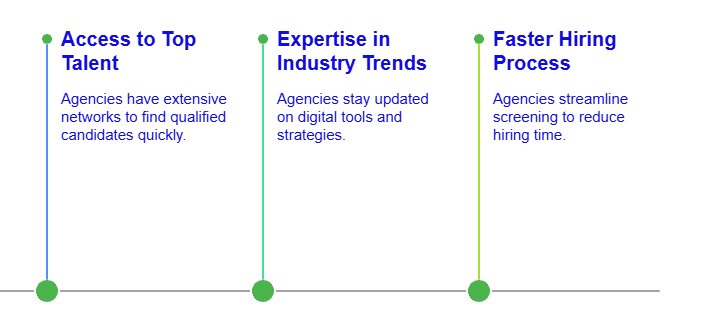
Access to top PR talent
Recruiters in this niche maintain extensive databases of qualified communication specialists. They identify both active job seekers and experienced professionals open to selective opportunities. Access to these networks allows employers to compete for high-demand talent in markets where strong candidates are often already employed. Through precise targeting, agencies can fill senior and strategic roles with greater efficiency.
Expertise in PR industry trends
Communication requirements evolve quickly as digital tools, media channels, and content formats shift. Specialized recruiters track these developments and connect clients with candidates who possess updated technical and strategic skills, such as analytics use or audience segmentation.
Faster hiring process
Recruitment firms streamline candidate screening, allowing businesses to shorten hiring timelines without compromising quality. They rely on structured evaluations, data tools, and role-matching techniques to identify suitable applicants quickly. This approach minimizes time spent on manual sourcing and accelerates placement for critical roles.
The three conditions are distinct enough to deserve their own visual weight. A short lead sentence followed by a bulleted breakdown makes each one land cleanly without the paragraph feeling like one long run-on argument:
Specialist PR and communications recruitment agencies consistently outperform internal processes in three situations:
Organizations managing a crisis, a leadership departure, or a product launch that requires communications capacity within weeks rather than months
Roles at Director level and above, where the right candidates are not searching on public job boards and require proactive outreach into the passive talent market
Companies in regulated industries like healthcare, financial services, or energy, where the communications function carries compliance implications alongside reputational ones and a generalist recruiter lacks the sector knowledge to evaluate candidates
accurately
In each of these situations, the cost of a slow or misaligned hire outweighs the agency fee by a significant margin.
Website: www.devsdata.com
Team size: ~60 employees
Founded: 2016
Headquarters: Brooklyn, NY, and Warsaw, Poland
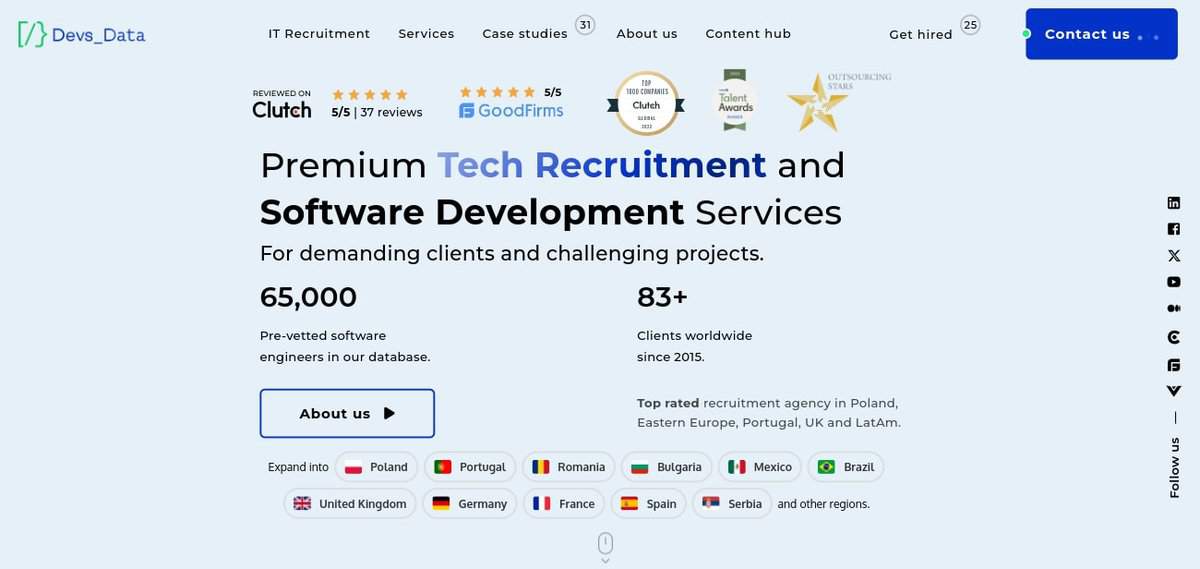
DevsData LLC has delivered customized recruitment solutions for over 80 organizations, completing more than 100 projects in the communications and brand strategy fields. The firm consistently receives 5/5 client ratings on Clutch and GoodFirms, supported by a record of transparent collaboration. Clients gain full access to progress updates and interview insights throughout every stage of the recruitment cycle. This structured communication helps them make precise hiring decisions based on clear data rather than assumptions.
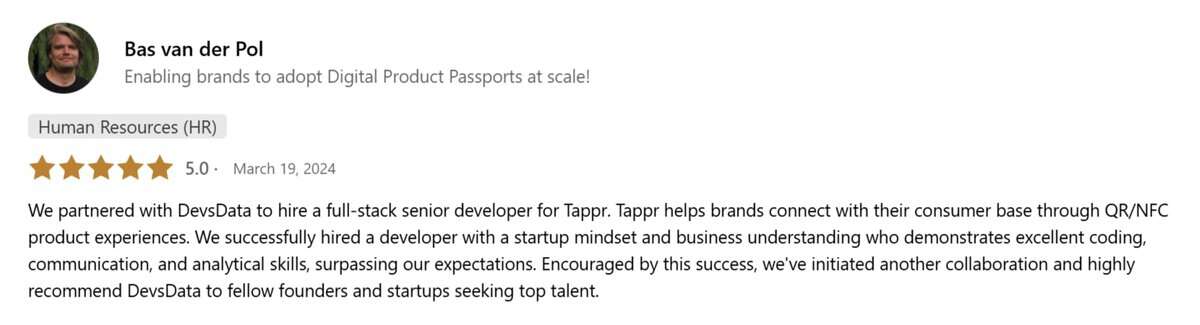
What distinguishes DevsData LLC in PR and corporate communications staffing is its structured, multi-layered assessment process. The evaluation process focuses on analytical performance and clarity of communication under pressure. The process includes a practical review that measures how applicants handle stakeholder communication and crisis response. Each stage confirms a balance of technical skill and professional judgment, ensuring that only proven specialists advance.
DevsData LLC provides companies with access to a wide network of verified communication professionals. Its recruiters map industry talent through continuous market research and direct outreach, identifying both active job seekers and experienced professionals open to new roles. The firm applies data-based search and screening to fill communication roles faster while maintaining cultural consistency.
The firm supports organizations ranging from global corporations to scaling startups. Its success fee model means clients only pay once a hire is completed, reducing financial risk. A guarantee period adds further protection, giving employers confidence in the long-term fit of every placement.
Key highlights:
Organizations seeking qualified professionals in corporate communications or PR can contact DevsData LLC at general@devsdata.com or visit www.devsdata.com to explore recruitment options designed for measurable hiring success.
Do you have IT outsourcing needs?
DevsData LLC’s recruitment results show consistent success in placing professionals across PR and corporate communications. The firm has staffed positions such as communications directors and media relations managers for clients operating under tight timelines. Each project prioritized specialists skilled in strategic communication and reputation oversight. These results reflect DevsData LLC’s ability to align candidate expertise with complex business needs while maintaining both speed and accuracy in delivery.

A fast-growing European startup in the digital compliance sector partnered with DevsData LLC to hire a Senior Marketing Specialist. The company needed an experienced professional to manage Google Ads, Meta campaigns, and SEO initiatives that would strengthen its go-to-market execution across Europe. The challenge was to find a specialist who could operate autonomously in a hybrid team while driving measurable growth in a regulated, high-stakes industry.
DevsData LLC implemented a full-cycle recruitment process focused on quality and speed. More than 100 profiles were screened, and five finalists were interviewed after a multi-stage evaluation covering campaign results, analytical depth, and platform expertise. The position was filled in six weeks with a candidate skilled in both SEO strategy and paid acquisition. The new hire improved visibility, optimized reporting dashboards, and launched targeted demand generation campaigns within the first month.
To present the engagement and its outcomes clearly, the case details are summarized below.
| Category | Detail |
|---|---|
| Client | Confidential European B2B startup in the compliance tech sector |
| Role hired | Senior Marketing Specialist |
| Recruitment timeline | 6 weeks |
| Key criteria | SEO expertise, Google Ads and Meta Ads proficiency, strategic thinking, and startup readiness |
| Result | Time-to-hire reduced by 25%, faster campaign execution, improved reporting, and performance tracking |

Edisen AS (acquired by ORB Group), a creative marketing agency operating in more than 15 countries, partnered with DevsData LLC to expand its Portugal team. The agency needed senior professionals to strengthen its proprietary marketing automation platform, which serves global brands including Amazon Prime and H&M. Recruitment focused on candidates with cross-functional experience who could meet the agency’s delivery standards and work within international client workflows.
DevsData LLC followed a structured sourcing approach to meet the client’s expectations. The recruitment process included multiple evaluation stages that tested technical accuracy, architectural reasoning, and adaptability within cross-regional teams. Over 180 candidates were reviewed, leading to four successful hires within four months. The engagement strengthened Edisen’s engineering capabilities and reduced overall time-to-hire by 30%.
The table below summarizes the key outcomes and criteria of this collaboration.
| Category | Detail |
|---|---|
| Client | Edisen AS (acquired by ORB Group), a global marketing and technology company |
| Role hired | Senior Backend Engineer, Cloud Engineer, Media Processing Engineer, Full Stack Engineer |
| Recruitment timeline | 4 months |
| Key criteria | AWS expertise, Python development, scalability, workflow optimization |
| Result | Four hires completed ahead of schedule, reduced recruitment cycle by 30 %, improved system reliability |
Public perception and internal alignment shape how companies sustain their reputations. Corporate communications manages internal clarity, whereas public relations controls external narrative and response. In an environment where credibility directly affects growth, strategic hiring in these areas becomes central to maintaining trust. The right professionals not only guide messaging but also anticipate challenges and manage responses that protect an organization’s image. The link between operational consistency and public communication forms the foundation of lasting corporate credibility. Together, these disciplines form a communication framework that supports stability and reinforces identity in competitive markets.
DevsData LLC stands out as a trusted partner in this field. With more than nine years of experience and a global team that includes US-based specialists, the company delivers targeted recruitment for communication and PR roles worldwide, including regions such as the US and Israel. Operating under a government license, DevsData LLC uses its success fee model and candidate pool of 65000 to deliver proven recruitment outcomes.
For further details on DevsData LLC’s services, contact them at general@devsdata.com or visit www.devsdata.com.
Any questions or comments? Let me know on
Twitter/X.
Discover how IT recruitment and staffing can address your talent needs. Explore trending regions
like Poland, Portugal, Mexico, Brazil and more.
 Frequently asked questions (FAQ)
DevsData – your premium technology partner
DevsData is a boutique tech recruitment and software agency. Develop your software project with veteran engineers or scale up an in-house tech team of developers with relevant industry experience.
Free consultation with a software expert
🎧 Schedule a meeting
FEATURED IN


DevsData LLC is truly exceptional – their backend developers are some of the best I’ve ever worked with.”

Nicholas Johnson
Mentor at YC, serial entrepreneur


 Build your project with our veteran developers.
Explore the benefits of technology recruitment and tailor-made software.
Learn how to source skilled and experienced software developers.
Build your project with our veteran developers.
Explore the benefits of technology recruitment and tailor-made software.
Learn how to source skilled and experienced software developers.

Rebecca Botvin

Commercial Director

Tom Potanski
Manager




Categories: Big data, data analytics | Software and technology | IT recruitment blog | IT in Poland | Content hub (blog)
Email copied
And many other regional partners across Latin and North America, as well as Central and Eastern Europe. Let's talk.
















careers@devsdata.com









general@devsdata.com

"I interviewed about a dozen different firms. DevsData LLC is truly exceptional – their backend developers are some of the best I've ever worked with. I've worked with a lot of very well-qualified developers, locally in San Francisco, and remotely, so that is not a compliment I offer lightly. I appreciate their depth of knowledge and their ability to get things done quickly."

Nicholas Johnson
CEO of Orange Charger LLC,
Ex-Tesla Engineer,
Mentor at YCombinator
"DevsData reached out to us, as we've been looking to grow our engineering team in Europe and Poland. Communicating efficiently and professionally, DevsData made a strong impression with their understanding of the recruitment challenges we were facing. They designed a tailored recruitment process for our needs. I was impressed with the technical depth of their approach."

Karim Butt
Co-Founder & CTO at GlossGenius, Inc.
"Out of all the vendors we work with, DevsData clearly stands out. The quality of developers they deliver is beyond what we've received from any other vendor, and they've been able to send profile recommendations very quickly. I'm happy to be their reference for other companies from Israel and talk about their recruitment abilities and what they delivered for us."

Ran Eyal
Senior Manager at
ZIM Integrated
Shipping Services Ltd.
"DevsData demonstrated a strong degree of proactivity, taking time to thoroughly understand the problem and business perspective, and continuously suggesting performance and usability enhancements. Their app exceeded my expectations. I've worked with DevsData on numerous projects over the last 3 years and I'm very happy. Being both responsive and honest in communication."

Jonas Lee
Partner & Executive VP of Verus,
Financial LLC, Investor,
& Serial Entrepreneur
Acknowledgments