Thanks for subscribing.
Your gift is on the way.



Enterprise work has moved, almost entirely, onto structured collaboration systems. Documents, approvals, project plans, and compliance records that used to live in scattered folders and inboxes now flow through governed platforms that combine storage, permissions, and automation in one place. For a large share of organizations, SharePoint is the platform underneath that shift. The people who build, configure, and extend it decide whether the system becomes a backbone or a bottleneck.
The scale of that dependency shows up clearly in vendor data. Microsoft reported more than 430 million Microsoft 365 Commercial paid seats, with the underlying commercial cloud revenue growing 15% on the year. SharePoint is not a peripheral product inside that estate. It is the content layer that Teams, Outlook, Power Automate, and Copilot reach into when they need a document, a list, or a site. When this layer is poorly built, the cost surfaces in every downstream workflow.
At the same time, the talent base to support these platforms is under strain. ManpowerGroup reports that 74% of employers across all industries cannot find the skilled talent they need, roughly double the 36% reported in 2014, with Information Technology employers only marginally higher at 76%. SharePoint runs inside hospitals, manufacturers, law firms, banks, and public agencies as readily as inside software companies, so the organizations bidding for these engineers are drawn from the whole economy rather than from one industry.
This article takes a structured look at what it takes to hire SharePoint developers in 2026. It covers what these engineers actually do inside enterprises, when a business genuinely needs dedicated SharePoint expertise rather than generic .NET capacity, how the wider market for collaboration platforms is moving, and why the hiring process itself is harder than the job description suggests. It also lays out how DevsData LLC approaches this category of recruitment and what clients should expect from a credible partner.
The job title tends to get flattened in job ads, which treat SharePoint developers as a narrow configuration role. The reality is closer to a hybrid engineering function. A capable SharePoint developer works across the full Microsoft 365 surface area, writes production code against public APIs, and has to reason about security, governance, and operational risk in a way that a standard application developer often does not.
The table below summarizes the five core areas of responsibility that define the role and the operational stakes attached to each one.
| Area of responsibility | What the developer actually does | Operational impact on the business |
|---|---|---|
| Intranet platforms and digital workplaces | Designs site architectures in SharePoint Online, builds custom web parts and extensions with the SharePoint Framework, and shapes navigation, search, and permissions across organizations with thousands of sites and tens of thousands of users. | Determines whether employees find what they need or lose hours daily to search failures and duplicated content. Internal portals, policy hubs, and onboarding experiences all depend on this foundation. |
| Document management at enterprise scale | Configures content types, metadata schemas, retention policies, and version control across document libraries that hold millions of files, often in regulated industries with strict audit requirements. | Feeds directly into audit and compliance obligations. Decisions about access, retention, and lifecycle logging carry legal consequences, not just usability ones. |
| Workflow automation and process engineering | Translates business processes such as invoice approvals, contract reviews, HR onboarding, and expense handling into Power Automate flows running against SharePoint lists and libraries, increasingly alongside Copilot agents. | Removes days of manual routing from processes when done well. When done badly, it creates shadow inboxes and silent failures that slow the business down without generating visible errors. |
| Integration across the Microsoft 365 stack | Connects SharePoint to Teams, the Microsoft Graph API, Azure Active Directory, Power BI, and Copilot grounding, so that content, identity, and reporting flow consistently across the estate. | Turns a collection of disconnected tools into a coherent digital workplace. Also determines whether Copilot and other AI features return reliable answers grounded in real enterprise content. |
| Copilot enablement and agent development | Prepares the content estate for Microsoft 365 Copilot by remediating oversharing and applying sensitivity labels, then builds agents in Copilot Studio scoped to a single site or library rather than to the whole tenant. | Decides whether Copilot cites the authoritative document or a superseded draft. Weak preparation surfaces material employees were never meant to reach, which turns an AI rollout into a governance incident. |
Taken together, these responsibilities explain why hiring is harder than it appears on paper. A strong SharePoint developer is, simultaneously, a platform engineer, a document governance specialist, a workflow designer, and an integration architect. They write C# and TypeScript, manage Azure identities, model business processes, and often sit in conversations with compliance and security teams. That composite profile is difficult to screen for with a generic technical interview, and it is even harder to find at scale. The rest of this article works through the consequences of that reality.
Not every organization that uses SharePoint needs dedicated SharePoint developers. For a small team using out-of-the-box sites and default libraries, a solid Microsoft 365 administrator is often enough. The need for engineering capacity appears at a specific inflection point, usually when the platform stops being a tool and starts being infrastructure. Once SharePoint underpins how the company works rather than simply where it stores files, the cost of doing it badly becomes too high to leave to part-time attention. The use cases below describe the moments where that shift tends to happen and where generalist .NET capacity is no longer a fit.
Large organizations still sitting on SharePoint Server 2016 or 2019 face a migration window that is both technical and political. Decades of custom solutions, workflows, and permissions have to be inventoried, triaged, rebuilt, or retired. The business impact of a botched migration is significant: broken links, lost metadata, and frustrated users who quietly revert to email attachments. Dedicated SharePoint developers are required here because the decisions are not about whether a tool works but about how to preserve institutional knowledge as the ground shifts underneath it.
Many enterprise intranets began as static document repositories and have aged into cluttered, search-unfriendly archives. A rebuild is not a design exercise; it is an engineering project that touches site architecture, governance, branding, analytics, and personalization for different employee populations. SharePoint-specific expertise is essential because the platform has its own information architecture logic, its own modern and classic experiences, and its own patterns for extensibility. A generic web developer will produce something that looks correct and behaves badly in production.
In financial services, healthcare, pharmaceuticals, and the public sector, document workflows are audited. Contract review, clinical documentation, and regulatory submissions have to follow defined paths with defined approvers, version control, and tamper-evident logs. SharePoint can support these requirements, but only when configured by someone who understands how to combine content types, retention, Purview-level policies, and Power Automate flows. This is a compliance-sensitive engineering role, not a configuration task, and the business risk of getting it wrong is direct.
Organizations investing in Power Apps and Power Automate quickly discover that the quality of those applications depends on the quality of the SharePoint data underneath them. A list with inconsistent columns will break a flow that ran correctly last quarter, and a library with no usable metadata forces every app built on it into hard-coded assumptions that fail the moment someone reorganizes a site. SharePoint Developers are the engineers who structure that data layer so the business applications sitting on top behave predictably. This is increasingly where the return on the Microsoft 365 investment is actually realized.
The most common Copilot rollout failure has nothing to do with the model. An organization licenses seats, enables the service, and discovers within days that salary files, board papers, and unsigned contracts are reachable by employees who never had a practical route to them before. The permissions were always wrong. Search simply never made them easy to exploit. Fixing that is SharePoint work, and it is the phase where Copilot programs either stall or succeed. Developers audit site access at scale, retire abandoned sites, apply sensitivity labels so restricted content is excluded from responses, and restructure metadata so that answers cite the authoritative version of a document. Organizations that skip this stage tend to pause the rollout rather than tune it, which converts an AI budget into a governance backlog.
Many mid-sized and large companies run internal applications, from project trackers to vendor management systems, on top of SharePoint. These look like lightweight tools and behave like production software, with real users, real data, and real downtime costs. Developing and maintaining them well requires knowledge of SPFx, PnP libraries, permission models, and deployment pipelines. A .NET generalist can produce a working first version; keeping it reliable, secure, and performant over the years is a different discipline.
Multinational groups and portfolio companies under private equity ownership often need a shared knowledge base that respects legal entity boundaries, language differences, and local data residency. SharePoint supports these patterns primarily through cross-tenant configurations that respect identity boundaries between legal entities while still allowing controlled search across them. Getting this right requires experience with enterprise-scale SharePoint rather than with individual sites, and it is the kind of scenario where hiring the wrong profile shows up as regulatory exposure, not just frustration.
A quieter but costly problem inside large SharePoint estates is search. When employees cannot find documents, they recreate them, which multiplies versioning problems and regulatory risk. Tuning Microsoft Search, configuring managed properties, training SharePoint Premium features, and integrating with Copilot grounding all fall to developers who understand both the platform and the information retrieval concepts underneath it. This is a specialized subfield within SharePoint engineering, and it is the kind of problem that rewards deep experience rather than general IT fluency.
The common thread across these scenarios is dependency. When a business process, compliance obligation, or customer-facing capability relies on SharePoint behaving correctly, the platform needs engineers who understand its specific mechanics, not contractors who will treat it as a generic content system. The cost of a mismatch is rarely visible on day one. It appears later, in audit findings, in stalled migrations, and in Copilot responses that cite the wrong document. Recognizing which category a project falls into is the first step in deciding whether to hire internally, contract, or work with a specialist recruitment partner.
Do you have IT recruitment needs?
The demand for SharePoint developers does not exist in isolation. It is shaped by three overlapping markets: enterprise collaboration software, the broader Microsoft 365 ecosystem, and the general developer labor market. Looking at each of these tells a consistent story. Spending is growing, platforms are consolidating around a small number of vendors, and the pool of engineers capable of delivering the work is not keeping pace. For hiring leaders, this is the context that explains why experienced SharePoint candidates are harder to find and more expensive to secure than the role description might suggest.
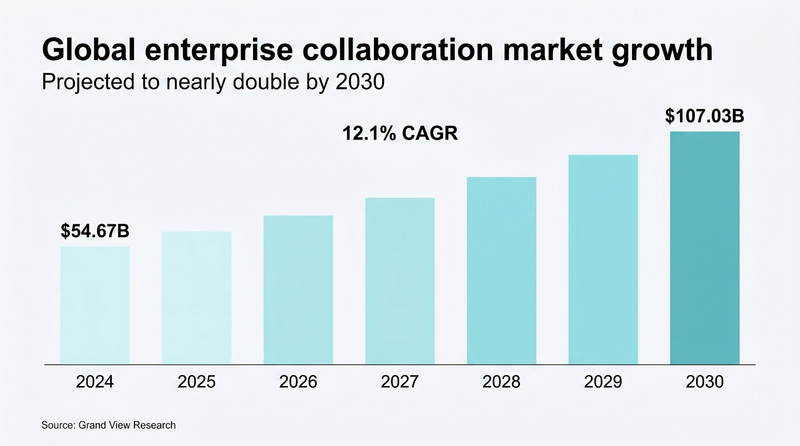
According to Grand View Research, the global enterprise collaboration market was valued at $54.67 billion in 2024 and is projected to reach $107.03 billion by 2030, growing at a 12.1% compound annual rate. The growth is not coming from net-new users; it is coming from enterprises consolidating fragmented tools into governed platforms and adding automation and AI features on top. For hiring, this translates into sustained demand for engineers who can build and integrate these environments rather than simply operate them.
Adjacent to collaboration software is the collaborative applications market tracked by IDC, which is expected to more than double to $83 billion by 2029. The growth is tied to AI-enhanced workspaces, multimodal collaboration, and AI teammates embedded inside team platforms. Contrary to the expectation that automation would reduce engineering headcount, these features create new work. Someone has to expose the right content, configure the right permissions, and build the scaffolding that lets AI agents act safely inside enterprise data. SharePoint developers are a natural home for that scope.
Two of SharePoint’s core functions are also expanding as standalone markets. The global document management systems market is projected to grow from $10.48 billion in 2025 to $21.39 billion by 2031, a 12.61% compound annual growth rate driven by enterprises retiring legacy repositories. In parallel, the workflow automation market reached $23.77 billion in 2025, with cloud deployment accounting for 62.15% of revenue. These two curves explain why SharePoint developers increasingly operate as hybrid document and process engineers. The separate disciplines are being bought as one capability.
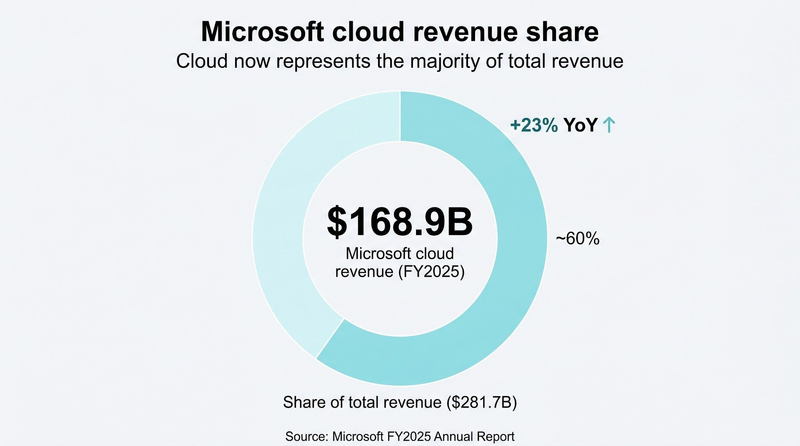
The commercial gravity inside enterprise IT continues to pull toward Microsoft. Microsoft’s FY2025 Annual Report shows cloud revenue of $168.9 billion, up 23% year on year, inside a total company revenue of $281.7 billion. The Productivity and Business Processes segment, which houses Microsoft 365, including SharePoint and Teams, reported 17% growth in Microsoft 365 Commercial cloud revenue in Q1 FY2026, with commercial remaining performance obligations rising 51% to $392 billion. That backlog figure is the important one for hiring planners. It represents multi-year customer commitments that have to be delivered, which in turn requires engineers who can deliver them.
Aggregate IT spending is expected to grow strongly. Gartner projects worldwide IT spending to reach $6.15 trillion in 2026, up 10.8% from 2025, with enterprise software specifically growing 14.7%. The labor supply underneath that spend is moving at a different pace. The US Bureau of Labor Statistics projects software developer employment to grow 15% between 2024 and 2034, roughly five times the average for all occupations, with around 129200 annual openings. Compensation reflects the tension: the BLS reports a median annual wage of $133080 for software developers as of May 2024. Enterprise platform specialists typically price above that median.
Read together, these data points describe a market in which the demand signal for SharePoint developers is strong across every relevant dimension: the collaboration software they work on is growing, the Microsoft platform that anchors their work is consolidating, and the underlying spend is accelerating faster than the labor pool can expand. None of this makes hiring impossible, though it does change which channels work. Job boards reach developers who are actively looking, and in a market where enterprise platform specialists are held onto by employers running long-lived Microsoft estates, the experienced ones usually are not. Referrals fail for a related reason, since most engineering teams do not contain a SharePoint specialist who knows others. What is left is targeted outreach to a population that has to be identified before it can be approached, which is the work specialist partners are structured to do.
Enterprise collaboration platforms are no longer a productivity layer. They are the operating system of the business, and the engineers who build on them decide whether that system is reliable or fragile.
The difficulty of hiring SharePoint developers is not a single problem. It is the compounded effect of a narrow talent pool, a hybrid skill requirement, an evaluation gap in the recruiting market, and the operational weight of the projects themselves. A standard hiring process, built around job boards and generic technical interviews, tends to underperform across all five. The sections below break down where the friction actually sits and how DevsData LLC addresses each one inside its recruitment model.
The raw supply of SharePoint-capable developers is small before any filtering. According to the Stack Overflow 2025 Developer Survey, C# is used by 27.8% of professional developers, while only 4.3% of respondents identify as desktop or enterprise application developers. SharePoint engineers are drawn from the intersection of these two already-narrow populations, then filtered again by the need for platform-specific experience. Korn Ferry projects a global tech talent shortfall of 4.3 million workers by 2030, tied to $8.5 trillion in unrealized revenue. Inside enterprise software, the shortage is acute. Organizations trying to hire on their own often compete for the same small set of public candidates against employers with larger brands and higher ceilings.
DevsData LLC maintains a segmented candidate database of more than 95000 technology professionals, with specific tagging for Microsoft ecosystem specialists across SharePoint, SPFx, Power Platform, and Microsoft Graph. This segmentation lets the firm reach candidates who are not actively visible on public channels and surface profiles whose experience matches the specific subcategory of SharePoint work required. The effect is a shorter time to a qualified shortlist and far less of the generalist noise that dominates open sourcing.
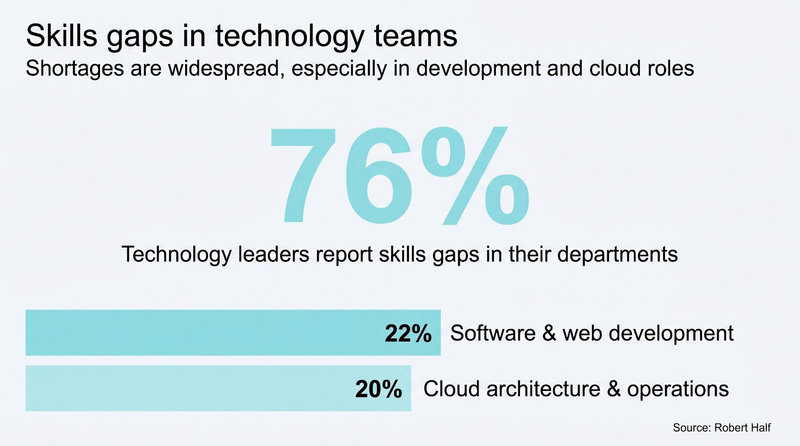
A serious SharePoint role rarely ends at SharePoint. Most enterprise projects require a combination of .NET, SharePoint Framework, Power Platform, Azure identity concepts, and increasingly Copilot extensibility. Robert Half reports that 76% of technology leaders identify skills gaps in their departments, with software and web applications development flagged at 22% and cloud architecture and operations at 20%. The skills gap is not only about the scarcity of any single skill; it is about the rarity of the combination. Eurostat recorded more than 10 million ICT specialists employed in the EU in 2024, yet 61% of large EU enterprises still report difficulty hiring them. Breadth, not headcount, is the binding constraint.
DevsData LLC screens against the actual combination of skills the client needs rather than any one line on the resume. The process pairs a structured technical interview with a 90-minute problem-solving challenge designed by senior engineers on the firm’s US team, which tests how candidates reason across SharePoint, Microsoft Graph, and Power Platform scenarios at once. The result is a shortlist of candidates validated on the hybrid profile rather than on a single keyword.
SharePoint resumes are easy to inflate. The platform has been around long enough that many candidates have touched it at some point, and the tooling has changed often enough that listed experience does not always translate to current capability. Robert Half’s hiring research found that 93% of US hiring managers say the hiring process takes longer now than it did two years ago, and 92% say finding skilled talent is challenging. The consequence inside SharePoint hiring is that internal teams either draw out the process chasing certainty or accept bad hires under time pressure.
DevsData LLC is staffed with US-based technical recruiters and senior engineers who conduct the substantive parts of candidate evaluation themselves. Technical assessments are designed around real SharePoint problems rather than off-the-shelf coding tasks, and references are checked specifically for the subcategory of work the client needs. The model is success-fee based with a replacement guarantee, which aligns incentives with the client’s definition of a successful hire.
SharePoint projects rarely fail quietly. When they go wrong at enterprise scale, migrations stall, compliance reports go missing, and entire departments lose faith in the platform. The World Economic Forum’s Future of Jobs Report 2025 finds that 63% of employers cite the skills gap as the most significant barrier to business transformation, with nearly 40% of job skills set to change by 2030. Viewed through the lens of SharePoint hiring, that statistic describes the lived risk: the developer hired today has to remain effective as the platform, the AI layer on top of it, and the compliance environment around it all continue to shift.
DevsData LLC takes a consultative approach at the top of the funnel, starting with a scoping conversation about the actual project rather than a generic job brief. That lets the firm surface candidates whose experience fits the shape of the project, including migration work, governance design, or Copilot integration. The operating license is government-approved, which matters for enterprise procurement and compliance teams that have to clear external recruitment vendors.
SharePoint belongs to no single sector, which changes who a hiring organization is bidding against. The same developer profile is wanted by a hospital group modernizing clinical documentation, a bank rebuilding contract workflows, a manufacturer standardizing plant records, and a public agency preparing a migration. ManpowerGroup put the cross-sector shortage at 74% of employers, barely below the 76% recorded among Information Technology employers, which is the statistical signature of exactly this problem. Geography compounds it. Platform work is delivered remotely as a matter of routine, so a developer in Warsaw or Lisbon fields approaches from any time zone willing to accept the overlap. An employer benchmarking its offer against local software salaries is often benchmarking against the wrong market entirely.
DevsData LLC sources across the United States and Europe rather than inside a single hiring market, and calibrates offers against what comparable Microsoft ecosystem roles pay in the candidate’s region rather than in the client’s. Approaches are made with the specifics of the project rather than a generic brief, which is what moves an engineer who is not looking and already has alternatives on the table.
These five challenges do not act independently. They compound. A scarce talent pool becomes harder to reach without targeted sourcing; a hybrid skill profile becomes harder to screen without structured technical assessment; an evaluation gap becomes harder to close without senior technical involvement; and project complexity becomes riskier without a consultative intake. A recruitment partner that addresses only one of these dimensions will produce uneven results. The value of working with a specialist comes from handling all four inside a single, repeatable process.
Structured hiring is the difference between filling a role and solving a problem. For enterprise platforms, informal sourcing is the most expensive option, because the cost of a wrong hire is paid over years, not weeks.
Do you have IT recruitment needs?
Choosing a recruitment partner for SharePoint work is not the same as choosing one for general software engineering hires. The category is narrower, the stakes around compliance and institutional knowledge are higher, and the proportion of candidates whose resumes will overstate their real capability is larger. A rigorous selection process compresses to five questions, each of which tells the buyer something about how the agency will behave during the engagement rather than how well it markets itself.
Every IT recruitment firm claims to cover the Microsoft stack. The practical test is whether the firm has closed SharePoint-specific roles recently and at volume. Ask for the count of Microsoft ecosystem placements in the last two years, the industries they were made in, and the split between SharePoint Online migrations, SPFx development, and Power Platform integrations. Agencies that answer this question precisely tend to have actual specialization; agencies that pivot to general capability statements do not.
A headline database number is meaningless without segmentation. A reliable partner will explain how its database is tagged and how it distinguishes SPFx-capable developers from general .NET engineers from Microsoft 365 administrators. Ask how they maintain the database, how often profiles are refreshed, and how they handle candidates who have left the SharePoint space for adjacent work. The quality of this answer predicts how fast a realistic shortlist will arrive.
The most critical step in SharePoint hiring is the technical assessment. Ask who designs it, who administers it, and how it discriminates between candidates with surface familiarity and candidates with production experience. Look for assessments that include real-world scenarios, such as debugging a broken migration, structuring a governance plan, or integrating SharePoint with Power Automate. Generic coding tasks are a red flag for this category of role.
The structure of the fee tells the buyer how the risk is distributed. A success-fee model, in which the agency is paid only on a successful placement, aligns incentives with the client. A replacement guarantee covering a defined window after the start date adds a second layer of protection. Ask explicitly what the guarantee covers, what events trigger replacement, and how quickly a replacement candidate is produced. Ambiguity at this stage tends to surface as friction later.
Self-reported case studies are less informative than independent ratings and direct client references. Ask to speak with one or two clients who have hired SharePoint or Microsoft stack developers through the partner, ideally in the same industry as the buyer. Check public review platforms such as Clutch and GoodFirms, where ratings are tied to verified engagements. A partner with a consistent five-star record on independent platforms and a willingness to share references is measurably safer than one without either.
The checklist below consolidates these steps into a concrete set of questions any hiring leader can put to a shortlisted agency before signing an agreement.
| Evaluation step | Questions to ask the agency |
|---|---|
| Microsoft ecosystem specialization | How many SharePoint, Microsoft 365, and Power Platform placements have you completed in the last 24 months, and across which industries? |
| Candidate pool depth | How is your database segmented for SharePoint developers, and how do you distinguish SPFx specialists from general .NET engineers? |
| Technical screening methodology | Who designs your technical assessments, and how do you verify hands-on experience with SharePoint Online, on-premises, and hybrid migrations? |
| Commercial model and risk sharing | Do you operate on a success-fee basis, what does the replacement guarantee cover, and what happens if a placement leaves inside that window? |
| Client references and track record | Can you provide references from enterprise clients who hired SharePoint or Microsoft stack developers, and what ratings do you hold on independent review platforms? |
| Communication and delivery model | Who is the single point of contact during the engagement, how often do you report progress, and do your consultants communicate at a business-native English level? |
Read as a set, these questions test something narrower than credentials. They test whether the agency has an opinion about SharePoint hiring, formed by having done it. A firm that has run these searches answers with specifics before being pressed and will say plainly where its coverage is thinner, because it has seen enough of these engagements to know which ones go wrong. A firm that has not will keep returning to general capability language and to the size of its database. The distinction is usually visible within the first conversation, and it predicts the quality of the shortlist more reliably than anything in the proposal document. The section that follows sets out how DevsData LLC answers each of these questions.
Website: www.devsdata.com
Company size: ~60 employees
Founding year: 2016
Headquarters: Brooklyn, NY, and Warsaw, Poland
DevsData LLC operates as a specialist IT recruitment firm focused on the technology roles that general agencies tend to handle poorly. The enterprise Microsoft ecosystem sits squarely inside that focus. The firm’s operating model is shaped around the hiring conditions described earlier in this article: narrow talent pools, hybrid skill requirements, evaluation gaps, and project complexity that rewards consultative engagement over volume placement.
The firm has been operating for more than ten years, with a core team of US-based specialists supporting clients across the United States and Israel. Over that period, it has completed more than 140 projects for 100+ clients, building a candidate database of over 95000 technology professionals segmented by skill cluster, seniority, and platform specialization. SharePoint and the broader Microsoft 365 stack are among the tagged categories, which allows the firm to respond quickly when clients bring in role briefs that would take weeks to source on the open market.
The evaluation process is designed to close the evaluation gap that wastes most internal hiring cycles. Every candidate progresses through a structured technical interview, followed by a 90-minute problem-solving challenge built by senior engineers on the firm’s US team. The challenge is designed around real enterprise scenarios rather than abstract puzzles, which is particularly important for SharePoint roles where production experience is harder to read from a resume than it is for application development work. Candidates who pass this stage arrive at the client interview already validated on the technical dimension, letting the client focus on fit, communication, and domain alignment.
DevsData LLC operates on a success-fee model with a guarantee period, so clients pay only on a completed placement and are covered if a candidate leaves early in the engagement. The firm holds a government-approved recruitment license, which matters for enterprise procurement functions that need to clear third-party vendors through formal due diligence. Communication is handled in fluent English by consultants who operate on US business hours, and reviews on independent platforms such as Clutch and GoodFirms sit at 5/5, which reflects the consistency of the delivery model rather than marketing effort.
The result is a recruitment partner that behaves more like an embedded talent function than a traditional agency. Clients hiring SharePoint developers through DevsData LLC receive shortlists that are shorter, more precisely matched to the actual project, and less prone to the mismatch between claimed and real experience that slows down most enterprise hiring processes.
A useful way to see the DevsData LLC model in action is through a representative engagement with AstroMind Inc., an artificial intelligence company based in Boston.
AstroMind Inc. is an AI company operating in a competitive segment where product delivery depends on a small number of highly specialized hires. The company had an existing technical team in place and needed to extend it with a profile that the open market was not producing.
The client needed Data Science professionals with a rare combination of production machine learning experience and communication skills strong enough to work directly with enterprise customers. The role profile was narrow, the timeline was tight, and the client had already exhausted standard sourcing channels without finding candidates who cleared their internal bar.
DevsData LLC began with a scoping conversation that reframed the brief around the specific combination of skills the client needed rather than a generic job title. Sourcing drew on the segmented candidate database, with additional targeted outreach into adjacent specializations that rarely surface through job board searches.
Screening combined a structured technical interview with the firm’s 90-minute problem-solving challenge, calibrated by senior engineers to test real-world reasoning rather than memorized algorithms. Only candidates who passed both stages were forwarded to the client, which kept the shortlist short and high-signal.
The engagement produced a successful placement within the client’s timeline, with a candidate who met both the technical and communication requirements.
The client accelerated a delivery roadmap that had been blocked by the open role, and the hire became a stable part of the team rather than a short-tenure fill. The transferable logic applies directly to SharePoint hiring: a narrow brief, a segmented candidate pool, a rigorous technical screen, and a success-fee engagement produce repeatable outcomes across technology recruitment categories.
For hiring leaders evaluating partners for SharePoint or broader Microsoft ecosystem recruitment, the most useful next step is a scoping conversation about the actual project. DevsData LLC offers this at no charge and without commitment, so that both sides can assess fit before any engagement begins.
Contact DevsData LLC by emailing general@devsdata.com or visit our website www.devsdata.com.
Do you have IT recruitment needs?
Hiring SharePoint developers in 2026 is a specialist exercise, not a routine recruitment task. The role has evolved into a hybrid engineering function that spans platform development, document governance, workflow automation, and integration across the wider Microsoft 365 stack. Enterprises that still treat it as a configuration job pay the cost downstream in stalled migrations, underperforming Copilot deployments, and compliance findings that trace back to poorly designed document libraries.
The market context reinforces this direction. Enterprise collaboration software, document management, and workflow automation are all expanding at double-digit rates, and the Microsoft ecosystem is consolidating its share through cloud revenue, commercial seat growth, and a multi-year backlog of committed work. Against that backdrop, the pool of engineers capable of doing serious SharePoint work is not growing fast enough, and the bar for what counts as production-grade experience will continue to rise as Copilot extensibility and AI agent orchestration mature.
DevsData LLC is structured to support buyers who take this category seriously. The firm combines more than ten years of operating experience, a US-based team, and a candidate database of 95000+ professionals with a structured evaluation model that includes a 90-minute technical challenge and a success-fee commercial structure backed by a replacement guarantee. Its government-approved license clears enterprise procurement requirements, and its 5/5 ratings on Clutch and GoodFirms reflect consistent delivery. For organizations that need to hire SharePoint developers without absorbing the risk of an unstructured process, DevsData LLC offers a route that treats the role with the specialization it now requires.
Any questions or comments? Let me know on
Twitter/X.
Discover how IT recruitment and staffing can address your talent needs. Explore trending regions
like Poland, Portugal, Mexico, Brazil and more.

 Frequently asked questions (FAQ)
DevsData – your premium technology partner
DevsData is a boutique tech recruitment and software agency. Develop your software project with veteran engineers or scale up an in-house tech team of developers with relevant industry experience.
Free consultation with a software expert
🎧 Schedule a meeting
FEATURED IN


DevsData LLC is truly exceptional – their backend developers are some of the best I’ve ever worked with.”

Nicholas Johnson
Mentor at YC, serial entrepreneur


 Build your project with our veteran developers.
Explore the benefits of technology recruitment and tailor-made software.
Learn how to source skilled and experienced software developers.

Rebecca Botvin

Commercial Director

Tom Potanski
Manager




Categories: Big data, data analytics | Software and technology | IT recruitment blog | IT in Poland | Content hub (blog)













careers@devsdata.com







general@devsdata.com

"I interviewed about a dozen different firms. DevsData LLC is truly exceptional – their backend developers are some of the best I've ever worked with. I've worked with a lot of very well-qualified developers, locally in San Francisco, and remotely, so that is not a compliment I offer lightly. I appreciate their depth of knowledge and their ability to get things done quickly."

Nicholas Johnson
CEO of Orange Charger LLC,
Ex-Tesla Engineer,
Mentor at YCombinator
"DevsData reached out to us, as we've been looking to grow our engineering team in Europe and Poland. Communicating efficiently and professionally, DevsData made a strong impression with their understanding of the recruitment challenges we were facing. They designed a tailored recruitment process for our needs. I was impressed with the technical depth of their approach."

Karim Butt
Co-Founder & CTO at GlossGenius, Inc.
"Out of all the vendors we work with, DevsData clearly stands out. The quality of developers they deliver is beyond what we've received from any other vendor, and they've been able to send profile recommendations very quickly. I'm happy to be their reference for other companies from Israel and talk about their recruitment abilities and what they delivered for us."

Ran Eyal
Senior Manager at
ZIM Integrated
Shipping Services Ltd.
"DevsData demonstrated a strong degree of proactivity, taking time to thoroughly understand the problem and business perspective, and continuously suggesting performance and usability enhancements. Their app exceeded my expectations. I've worked with DevsData on numerous projects over the last 3 years and I'm very happy. Being both responsive and honest in communication."

Jonas Lee
Partner & Executive VP of Verus,
Financial LLC, Investor,
& Serial Entrepreneur
Acknowledgments