Thanks for subscribing.
Your gift is on the way.



Backend systems have grown more complex faster than companies have been able to staff them. A product that ran on one application server and one database five years ago now spans managed cloud services, event streams, container orchestration, and an identity layer, and each of those pieces needs an engineer who has operated it in production. Hiring that engineer inside the buyer’s home market is where the plan usually stalls. The US Bureau of Labor Statistics projects software developer employment to grow 15% from 2024 to 2034, with roughly 129200 openings each year on average, against a 3% average across all occupations. Demand at that level, concentrated in the same handful of markets, is what pushes companies toward engineering capacity outside them.
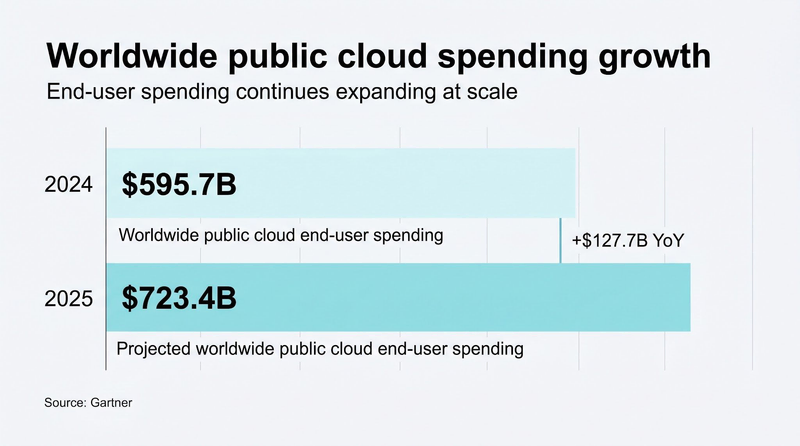
That number describes net demand inside a single country whose ecosystem already absorbs most of the available senior backend supply, and it sits against a global cloud spend trajectory that intensifies the same demand from another direction. Gartner forecasts worldwide end-user spending on public cloud services to reach $723.4 billion in 2025, up from $595.7 billion in 2024. Each dollar of incremental cloud spend translates into backend work: service decomposition, infrastructure-as-code, observability, identity, and data plane engineering. The supply curve has not moved with the demand curve.
Backend infrastructure has also become structurally more complex. A modern revenue-generating system rarely consists of a single application server and a relational database; it spans event streams, container orchestration, multiple managed services, hybrid cloud boundaries, and increasingly LLM-integration layers. The operational discipline required to build and run that stack has outpaced what most product engineering teams can hire for in their home market within a reasonable timeframe.
Nearshore backend development is the response that has scaled most quickly because it solves three constraints at once: it expands the available talent pool by an order of magnitude, it preserves real-time collaboration through overlapping working hours, and it does so at a cost structure that growth-stage companies can actually carry. This article covers the key factors behind the model’s adoption and how to structure an engagement so it works operationally.
Nearshore backend development is the delivery of server-side software systems by an engineering team based in a country geographically and time zone adjacent to the buyer. For a US client, that typically means Mexico, Brazil, Colombia, Argentina, or Costa Rica; for a Western European client, it usually means Poland, Romania, or Ukraine. Synchronous overlap defines the model. Engineers share enough of the buyer’s working day to join architecture decisions while they are being made and to answer a production page during business hours. Lower compensation comes with the geography and makes the model affordable, though it does not describe what the model is.
The work itself centers on the systems that hold business state and execute business logic: domain services, transactional databases, event-driven pipelines, authentication and authorization layers, billing engines, and the integration surface that connects internal systems to third parties. These are the components where failure modes are expensive, regressions are visible to customers, and architectural decisions compound over years rather than sprints. A nearshore backend engagement that delivers value does not produce isolated features; it produces durable subsystems with documented contracts, tested boundaries, and operational runbooks.
APIs are now the primary unit of software composition. Internal services expose them to each other, partner systems consume them, and AI applications generate load against them at volumes that conventional capacity planning did not anticipate. Backend Engineering in this context is API engineering: schema design, versioning discipline, rate limiting, idempotency, and observability across the call graph. A nearshore team that owns this layer becomes responsible for the contracts that the rest of the product organization depends on, which is why the engagement model must support sustained ownership rather than ticket-by-ticket execution.
The economic shape of the cloud has set the technical agenda for backend work. Synergy Research Group reports that enterprise spending on cloud infrastructure services reached $107 billion worldwide, with AWS at 30% share, Microsoft Azure at 21%, and Google Cloud at 12%, the three providers together holding 63% of the market. That concentration matters operationally: a nearshore backend team building on AWS, Azure, or GCP works inside a stack whose primitives, managed services, and pricing levers are converging rather than fragmenting. The skill mix required, infrastructure-as-code, managed databases, container orchestration, identity federation, cost governance, is now broadly transferable across providers, which makes senior cloud-native engineers in nearshore regions immediately productive against the platforms most US companies actually run.
Backend work is collaborative by structure. A change to an authentication service touches every dependent system; a database migration is rehearsed across multiple environments; an incident at 2 PM Eastern requires the engineer who built the affected service to be reachable, not asleep. Nearshore engagements support this rhythm because the working day overlaps with the buyer’s working day. Stand-ups happen in real time, design reviews happen on the same calendar, and the production on-call rotation can include nearshore engineers without forcing them into night shifts that erode retention. The collaboration model is what separates nearshore from offshore in operational practice, and it is the reason backend systems specifically tend to benefit from the model more than feature-front-end work does.
Backend systems are evaluated over years, not quarters. The architectural choices that look efficient at one user volume often become the bottleneck at the next, and the cost of replacement is high. Microservices adoption is now mainstream, with a Gartner Peer Community survey of 300 engineering leaders showing 74% of organizations currently using microservices architecture and 23% planning to adopt it, implying near-universal penetration. That architectural shift transfers complexity from individual services to the boundaries between them, which is where nearshore teams add disproportionate value: the work of maintaining service contracts, evolving event schemas, and operating shared platforms requires sustained, named ownership rather than rotating contract execution.
DevOps maturity has followed a parallel curve. The Gartner Magic Quadrant for DevOps Platforms notes that by 2027, 80% of organizations will incorporate a DevOps platform into their tooling to reduce complexity, up from just 25% in 2023. For a nearshore engagement, standardized pipelines remove the negotiation that used to consume the first months of any distributed arrangement. The buyer’s platform becomes the working contract, the nearshore engineers ship through it from the first sprint, and the effort goes into the systems rather than into agreeing how systems get deployed.
The decision to move Backend Engineering to a nearshore model rarely begins with cost. It begins with a capacity problem that hiring inside the buyer’s home market cannot solve on the required timeline, and it becomes a nearshore decision specifically because the work involved cannot tolerate a fifteen-hour communication gap. The buying organizations vary, growth-stage SaaS, enterprise digital transformation programs, FinTech and healthtech platforms with strict reliability requirements, but the underlying logic is consistent: backend systems are revenue-critical, and the engineering capacity required to build and operate them has to be reachable during the working day. Deloitte’s Global Outsourcing Survey of more than 500 executives globally concluded that skilled talent and agility now join cost reduction as the key drivers for outsourcing, which describes the shift clearly: cost matters, but it is no longer the variable that decides where the work goes.
The use cases below describe the operational reasons that the model has scaled. Each one ties back to a constraint that nearshore answers better than either domestic-only hiring or far-shore outsourcing.
| Use case | What nearshore backend development delivers |
|---|---|
| Accelerating product development | Synchronous working hours let Backend Engineers attend the same product reviews, design sessions, and prioritization meetings as the rest of the team, compressing the cycle from decision to merged code. |
| Scaling engineering capacity | Access to a deeper senior-engineer pool in nearshore regions removes the structural ceiling on how fast the engineering organization can grow, particularly for platform and infrastructure roles. |
| Improving timezone collaboration | Overlap of four to eight working hours per day with North American and European clients enables real-time code review, design feedback, and incident response without after-hours rotations. |
| Reducing operational bottlenecks | Nearshore engineers participating in on-call rotations and release management distribute load across the team rather than concentrating it on the engineers closest to the buyer. |
| Supporting cloud migration | Sustained nearshore capacity makes multi-quarter migration programs viable, since the team carrying the migration is the same team that will operate the target state. |
| Handling infrastructure growth | Platform and SRE work scales as the product scales; a nearshore team owning the infrastructure layer absorbs that growth without forcing the buyer to compete for senior SRE talent in the home market. |
| Balancing cost and quality | Nearshore compensation is materially lower than home-market rates while remaining high enough to attract senior engineers, which separates the model from pure cost-arbitrage offshore engagements. |
The pattern across these use cases is that nearshore is selected when the work demands sustained ownership and real-time collaboration, not when the work can be specified in advance and shipped over the wall. Feature factories rarely choose nearshore; platform teams, payments teams, identity teams, data infrastructure teams, and revenue systems teams almost always do. The cost of a communication failure on a backend system is paid in production incidents and architectural debt, and those costs compound because each unresolved ambiguity becomes a fixed assumption in code. An engineer blocked on a question about idempotency behavior does not stop working. They pick an interpretation, ship it, and by the time the buyer sees the behavior three services already depend on it. Eliminating the delay removes the incentive to guess, which is the actual mechanism behind the model rather than any general claim about better communication.
Cost matters as a secondary factor, and it is real, but it functions as an enabler of the talent decision rather than the decision itself. A Senior Backend Engineer in a nearshore market costs meaningfully less than the same engineer in the buyer’s home market, which means the buyer can hire the seniority the system actually requires rather than the seniority the budget would otherwise allow. The economic logic is therefore not arbitrage; it is quality-for-quality at a lower price point, which in turn enables a more senior team than the buyer could otherwise field. That is the version of the model that produces durable backend systems. The cheaper version, where junior offshore capacity is substituted for senior nearshore capacity, produces rework, incident load, and architectural debt, a lesson most buyers only need to learn once.
One number separates nearshore from offshore, and it is the count of hours the two teams are working at the same time. Offshore engagements typically span a ten-to-fifteen-hour time-zone gap, which means there is at most one or two hours of overlap with the buyer’s working day, and often none. Nearshore engagements operate inside a one-to-four-hour gap, which produces four to eight hours of overlap. That single variable, the size of the overlap window, shapes how the engagement actually runs day to day.
| Factor | Nearshore | Offshore |
|---|---|---|
| Timezone alignment | Four to eight hours of daily overlap with the buyer’s working day, enabling real-time participation in standups, design reviews, and incident response. | Zero to two hours of overlap, requiring asynchronous handoffs, scheduled meeting windows outside one side’s normal hours, and slower decision loops. |
| Communication efficiency | Decisions are made in synchronous conversation. Ambiguity is resolved in minutes, not in next-day email threads. | Decisions cycle across days as questions and answers cross time zones. Ambiguity tends to be resolved by assumption rather than dialogue. |
| Project management | Single working rhythm. Sprint ceremonies, release gates, and on-call schedules operate on the buyer’s calendar without modification. | Dual working rhythms. Project managers spend significant effort bridging the two calendars, and the schedule absorbs the cost of that bridging. |
| Operational flexibility | Roadmap shifts, hotfixes, and architectural pivots can be absorbed inside a single working day. | Mid-cycle changes require explicit re-planning across the gap, which makes the engagement model better suited to stable, well-specified work. |
| Development velocity | Sustained sprint throughput because feedback loops close inside the working day. Production incidents are diagnosed by the team that built the affected service. | Sprint throughput depends on how cleanly work can be batched and handed off. Production incidents during the buyer’s day are often handled by the on-call closest to the buyer, not the engineer who knows the system. |
| Cost structure | Lower than home-market rates while attracting senior engineers, which raises the average seniority of the delivered team rather than lowering it. | Lowest gross hourly rate available, but the savings are partially absorbed by management overhead, longer cycles, and rework caused by communication latency. |
| Cultural alignment | Familiarity with US business norms and agile delivery practices reduces friction in design reviews and any client-facing work the team takes on. | Greater cultural distance can require explicit investment in cross-cultural management practices to maintain alignment. |
The operational implications follow from the table. Backend systems that change frequently, such as customer-facing APIs, billing engines, identity layers, and any service whose contract is renegotiated as the product evolves, benefit from nearshore because the cost of communication latency is paid every week. Backend systems that are stable and well-specified, such as a long-running data migration with a fixed target schema, can sometimes tolerate offshore execution because the specification absorbs the gap. The buying decision is therefore not nearshore-versus-offshore in the abstract; it is a match between the volatility of the work and the latency the engagement model imposes.
A second implication is that the two models scale differently. A nearshore team grows by adding senior engineers who immediately take ownership of subsystems; the marginal hire adds capacity without requiring a corresponding increase in management overhead. An offshore engagement that grows tends to require additional bridging roles, technical project managers, dedicated liaisons, written process to compensate for missing real-time dialogue, and the cost of those roles partially offsets the rate advantage. For backend work specifically, where the architectural complexity is concentrated at the boundaries between services rather than inside any single service, the bridging overhead grows non-linearly with team size, which is why most companies that started with offshore backend execution have moved at least the platform-critical portion of the work to nearshore as they have scaled.
Neither model is universally correct, and a substantial share of buyers operate both, with nearshore for systems that need real-time engineering ownership and offshore for execution-heavy work that can be scoped cleanly. The decision becomes a portfolio question rather than a binary one. The risk to avoid is using offshore for a system that turns out to need nearshore engineering attention, because the cost of that mismatch is paid in production over years rather than in budget over a quarter.
Do you have IT recruitment needs?
The market context that has produced the current intensity of nearshore backend hiring is not a single trend; it is the intersection of several, each of which independently raises the marginal value of an external Senior Backend Engineer. Cloud spend is compounding, the architectural complexity of backend systems is increasing, the talent pool inside developed-market boundaries is constrained, and the consumption of backend capacity by AI workloads is now a measurable input rather than a forecast. Reading the data points individually understates the pressure; reading them together explains why nearshore has moved from a sourcing option to a strategic default for a meaningful share of growth-stage and enterprise software organizations.
Deloitte’s Global Outsourcing Survey reports that 70% of executives have selectively insourced scope previously held by a third-party over the last five years, and 78% of organizations leverage Global In-house Centers today. The two figures describe the same shift from a different angle: the dominant operating model is no longer arms-length vendor contracting, it is captive or hybrid engineering capacity placed in talent-rich regions and managed as part of the buyer’s organization. For backend work that requires sustained ownership, the captive model resolves the principal-agent issues that pure vendor engagements struggle with, and the nearshore regions that support it are the ones with sufficient senior-engineer depth.
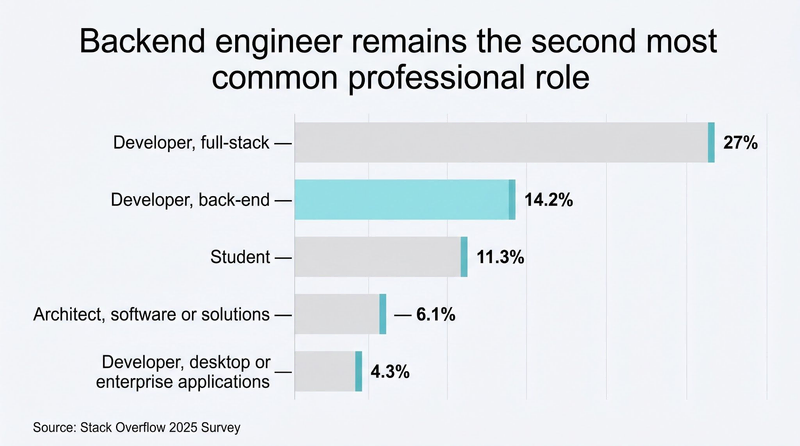
The hiring demand for backend skills is visible in both occupational data and developer-community data. Stack Overflow’s 2025 Developer Survey finds that Backend Engineer remains the second most common professional role at 14% of respondents, behind full stack at 27%, and has held that position for seven consecutive years. The role count is one signal; the demand against that pool is the larger signal. McKinsey states that demand for technology talent has increased as companies invest in the technological backbone needed to deploy AI, and that there is currently no evidence that generative AI is leading to a reduction in demand for tech talent. The combination of a constrained pool and rising consumption is the structural condition that has made nearshore sourcing economically necessary, not merely attractive.
Cloud is the layer where most modern backend code runs, and its expansion sets the pace for backend hiring. Gartner’s August 2026 forecast puts worldwide IaaS spending at USD 287.347 billion for 2026, a 29.3% increase, with AI-optimized IaaS growing 96.4% to USD 42.276 billion within that total. Cloud spend is a leading indicator of Backend Engineering workload, because every increment in managed-service consumption produces engineering work in designing, securing, and operating those services. That work is what nearshore backend teams are typically built to absorb.
The structural shift toward distributed engineering is reinforced by the data on regional capacity. Deloitte’s analysis of Latin American nearshore capacity finds that Brazil and Mexico together host more than 2.2 million software engineering professionals and graduate more than 350000 new engineering students every year, which is the supply-side condition that makes the model scale at all. Without that depth, nearshore would be a tactical sourcing channel rather than a structural one. With it, nearshore regions function as extensions of the buyer’s engineering organization rather than as substitutes for it. Deloitte’s Global Business Services Survey further reports that 50% of global business services organizations are planning to increase their footprint, driven by new functions and market needs. The growth of these centers is the growth of nearshore capacity, and the engineering-heavy functions within them are growing fastest.
Remote-first collaboration is the operating mode that makes nearshore backend engagements viable at scale, and the developer-community data shows the maturation of the tooling that supports it. The GitHub Octoverse 2024 reports a 59% surge in contributions to generative AI projects on GitHub in 2024 and a 98% increase in the number of generative AI projects overall, with Python overtaking JavaScript as the most-used language on the platform. The substantive point for backend hiring is not the GenAI growth on its own; it is that the platforms Backend Engineers use to collaborate, GitHub, the cloud consoles, the observability stacks, and the issue trackers, are now indistinguishable in functionality whether the engineer is sitting in São Paulo, Warsaw, or San Francisco. Remote collaboration is no longer the variable that limits how distributed the team can be.
The final input to current market conditions is the AI-driven modernization wave inside enterprise IT. Gartner’s analysts describe organizations shifting “from model development to production-scale deployment,” with domain-specific models integrated into operational systems that require continuous execution rather than periodic training. The spending pattern confirms it, since inference now accounts for USD 23.3 billion of AI-optimized IaaS spending in 2026 against USD 19 billion for training. Production AI is backend work by definition, which is why enterprise modernization programs generate demand for the same engineers this article describes.
Taken together, the market picture is straightforward: cloud spend is rising at over 20% annually, AI adoption is driving net new backend integration load, the developer pool inside the buyer’s home market is constrained, and the established nearshore regions in Latin America and Central and Eastern Europe have the senior-engineer depth to absorb the work. The strategic question for technology leaders is no longer whether to operate a distributed Backend Engineering function; it is where that capacity is placed and how it is governed.
US companies have not converged on a single nearshore region for Backend Engineering because the relevant tradeoffs differ by use case. A SaaS team building a payments service biases toward Mexico, Costa Rica, or Colombia for cloud-native fluency in US business hours. A platform needing senior infrastructure engineers may accept Argentina’s currency volatility in exchange for the depth of its senior pool. An enterprise with European and US footprints often uses Poland as an extended-nearshore extension. The decision is which region matches the buyer’s combination of timezone, talent depth, communication standard, and budget.
Backend work is interdependent, which is why synchronous collaboration matters more for it than for most other software work. A schema change touches every dependent service; a production incident requires the engineer who wrote the affected code, not whoever happens to be online. The regions that have built the largest Backend Engineering communities, Mexico, Brazil, Argentina, Colombia, Costa Rica, and Poland on the European-extended side, are the ones with both the timezone overlap and the senior-engineer density to sustain that synchronous ownership. The cost differential is the second-order benefit; the synchronous ownership is the first.
Compensation figures are drawn from country-specific Glassdoor salary data for Backend Developer roles in each region’s primary tech hub, with timezone overlap calculated against the US Eastern. The talent, English, timezone, and ecosystem assessments draw on our direct experience building and operating backend teams across these regions.
| Country | Salary range | English proficiency | Timezone overlap with US | Key strengths | Main limitations |
|---|---|---|---|---|---|
| Mexico | Glassdoor reports a Mexico City Backend Developer range of MX$20385–45204 per month | Strong working proficiency in tech roles | Same-day overlap with Central, Eastern, Mountain, and Pacific US | Largest North American nearshore market, deep cloud-native talent, geographic adjacency | Senior engineer competition is rising as US companies expand local presence |
| Brazil | Glassdoor reports a São Paulo Backend Developer range of R$5213–11500 per month | Variable; strong in tier-one tech hubs | One to two hours ahead of US Eastern; full afternoon overlap with US East Coast | Largest engineering ecosystem in the region, mature FinTech and SaaS sectors | Portuguese as primary business language can require explicit screening for client-facing roles |
| Colombia | Glassdoor reports a Bogotá Backend Developer total pay range of COP 4.9M to COP 11.0M per month, with a median of COP 7.0M across 50 reported salaries | Strong in tech roles in major hubs | Same time as US Eastern during US Standard Time | Close cultural and timezone alignment with US East Coast clients | Smaller absolute pool than Mexico or Brazil |
| Argentina | Glassdoor reports a Buenos Aires Backend Developer median of ARS 255667 per month, with high FX volatility | Generally strong in tech roles, particularly in Buenos Aires | One to two hours ahead of US Eastern | Mature engineering culture, senior talent depth | Macroeconomic volatility affects compensation benchmarking and retention |
| Costa Rica | Glassdoor reports a San José Backend Developer base pay range of CRC 253K to CRC 1.4M per month, averaging CRC 1.1M across 50 reported salaries | Strong, with established US enterprise presence reinforcing fluency | Same time as US Central | Political and economic stability, established nearshore infrastructure | Smaller engineering pool than Mexico, Brazil, or Argentina |
| Poland | Glassdoor reports a Poland Backend Developer range with median around PLN 15667 per month | Strong in tech roles; widely used as primary business language | Five to six hours ahead of US Eastern; morning overlap with US East Coast | Largest CEE developer pool, mature engineering ecosystem, EU and GDPR alignment | Limited daily overlap for US West Coast clients |
Before reading the comparison, it is worth stating what each column is based on. Ecosystem maturity reflects the presence of major cloud provider regions and certification density in the country. Enterprise project exposure reflects the documented presence of global enterprise delivery centers. Scalability expertise reflects the local track record of high-volume consumer or financial platforms built and operated in that market. DevOps maturity reflects the prevalence of standardized delivery platforms inside the country’s larger engineering organizations. Each rating is a qualitative read of those indicators drawn from our own placement experience alongside published market data, and none of them is a measured index.
Reading the rows against each other, Brazil and Mexico are the strongest destinations for enterprise backend work because pool depth lets buyers hire senior platform engineers, SREs, and security engineers without competing for named individuals. Argentina and Poland have the most accessible senior layer, with engineering cultures that produce architects and platform leads who have shipped at scale. Cost efficiency is deepest in Mexico and Brazil. Regulatory positioning splits the field, with Poland’s EU and GDPR alignment structural for European data while Latin American regions are simpler for primarily US-resident data.
| Country | Cloud/backend ecosystem maturity | Enterprise project exposure | Scalability expertise | DevOps maturity | Best fit |
|---|---|---|---|---|---|
| Mexico | High; strong AWS, Azure, and GCP communities; significant Big Three certification density | High; established presence of US enterprise nearshore centers | Strong, particularly in commerce and SaaS scaling | High; DevOps platform adoption aligns with US enterprise standards | SaaS scaling, US enterprise nearshore extensions |
| Brazil | Very high; largest cloud-native community in Latin America | Very high; mature FinTech and enterprise SaaS sectors | Strong, with proven track record in high-volume consumer platforms | High; mature CI/CD and observability practices in tier-one engineering organizations | FinTech backend systems, high-volume SaaS |
| Argentina | High; long-established engineering culture supports cloud-native and infrastructure work | Moderate to high; strong presence in product-led companies | Strong; senior architects and SREs available | High; strong DevOps and platform engineering practice | Enterprise modernization, platform engineering |
| Colombia | Growing; significant investment in DevOps and cloud skills over the last five years | Moderate; expanding nearshore presence | Growing | High; rapidly maturing | Fast product iteration, US East Coast-aligned SaaS |
| Poland | Very high; mature enterprise IT ecosystem with deep cloud and SRE talent | Very high; significant work for global enterprise clients | Strong; particularly in regulated and large-scale enterprise systems | Very high; DevOps platform standardization is mainstream | Enterprise modernization, regulated industries, cost-sensitive enterprise projects |
No single destination fits every backend project, and buyers that treat country selection as the strategic decision tend to optimize the wrong variable. The strategic decision is the operating model: how the nearshore team is integrated, how ownership is allocated, how seniority is maintained as the team grows. Engineering maturity, operational efficiency, communication alignment, and scalability push different parts of the engineering portfolio toward different regions, and the buyers that get the most out of nearshore typically operate in two or three regions concurrently. The right perspective is portfolio composition, not country ranking.
Backend systems do not scale because the codebase is well written; they scale because the engineering team that owns them remains responsible for the system long enough to adapt it as usage patterns change. Distributed delivery succeeds when ownership is durable, not when activity is high.
The hardest problems in nearshore backend engagements are not technical; they are organizational. A capable team in a capable region can still fail to deliver if the operating model around the team is poorly built, and the failure modes tend to look the same regardless of which country the engineers sit in. Deloitte’s tech talent strategy study, surveying 1179 global leaders supplemented by more than 100 qualitative executive interviews, flagged talent shortages alongside transformation pressure as the binding constraints on technology delivery. The challenges below are the operational manifestations of those constraints, and each one is solvable if the engagement is structured to address it from the start rather than to discover it in production.
Most of what an engineer needs to know about a backend system is never written down. Documentation captures how a service works today. It rarely captures why a retry limit was set at three, which downstream team breaks when a field is renamed, or which outage produced the defensive code nobody wants to remove. A new engineer acquires that knowledge by asking people who were there, and the speed of acquisition depends entirely on how quickly those people answer. Across a fifteen-hour gap, each question costs a day. Across a two-hour gap, it costs an afternoon.
Deloitte’s Managing the new digital workplace research finds that practices that drive productivity in physical offices do not necessarily translate to distributed environments and may even be counterproductive, which is a polite way of saying that the default management instinct, to write more processes and require more documentation, often makes the alignment problem worse rather than better. The actual solution is to design the engagement around real-time communication rather than to layer asynchronous compensation on top of it.
DevsData LLC structures nearshore backend engagements around synchronous communication as the default and written documentation as the audit trail rather than the primary channel. Engineers are placed inside the client’s existing standups, design reviews, and incident channels rather than reporting through a separate management layer, which eliminates the most common source of communication latency. The engagement is sized so that overlap windows produce four to six hours of effective synchronous time per day, and the work is partitioned so that asynchronous handoffs occur at natural boundaries rather than mid-task.
As nearshore teams grow, the risk of architectural drift grows with them. Each new engineer brings a set of patterns from previous work; each new service is an opportunity to introduce a new framework, a new database engine, a new observability tool. Without active architectural governance, the system that the nearshore team operates ends up looking like the union of every individual engineer’s prior experience rather than a coherent platform, and the long-term cost of that drift is paid in incident response time, onboarding cost, and the eventual need to consolidate divergent stacks.
The challenge is particularly acute in backend work because the choices made early, the data model, the messaging substrate, the service boundaries, are the choices that compound over years. Deloitte’s Global Outsourcing Survey describes the broader version of this problem as the governance challenge of the extended workforce, the combined population of vendors, captive centers, and increasingly AI workers, which requires a multidimensional sourcing model that most companies have not yet built.
DevsData LLC engagements operate with a named architectural lead who participates in the client’s architectural review cadence and carries the responsibility for keeping the nearshore team’s work consistent with the broader platform. Pattern decisions, technology selections, and service boundaries are documented as living architectural decision records rather than negotiated case by case, and the team’s seniority profile is calibrated so that the engineers making implementation choices have the context to make them in alignment with the platform’s direction.
Backend systems do not scale linearly with team size, and neither does the engineering effort to maintain them. The conventional model, where additional capacity is added by hiring additional engineers, breaks down at the point where the coordination overhead between engineers exceeds the marginal productivity of each new hire. For nearshore teams specifically, the coordination overhead is sensitive to the boundaries between services: if a team owns a coherent set of services with clear contracts, the team can grow productively; if the team’s responsibilities span the boundaries between many services owned by other teams, the coordination cost grows faster than the team’s output.
McKinsey’s return-to-office research, surveying 8426 employees and 3531 executives across 15 industries, found burnout running at roughly one in three workers regardless of where they worked. The detail that matters for distributed backend teams is that location was not the driver. Always-on communication norms were, and those norms directly erode the uninterrupted focus that architectural and platform work depends on.
DevsData LLC sizes engagements to align with natural service boundaries rather than abstract headcount targets, so the team that grows is the team that owns a coherent piece of the platform rather than a generic capacity pool. The working pattern is structured around protected focus blocks during overlap windows and asynchronous deep work outside them, which preserves the conditions for the architectural and operational work that backend scaling requires.
The most common reason a technically capable nearshore engagement underperforms is that the team operates as an island inside the buyer’s organization. They are on the standup calendar but not in the design reviews; they ship code but not on-call; they own a service but not the customer outcomes that depend on it. The integration problem is solved by treating the nearshore team as a peer engineering unit rather than as a delivery resource, with full access to the same systems and the same metrics, the same incident channels as the buyer’s internal teams. Anything less produces a permanent two-tier dynamic that erodes both retention and ownership.
DevsData LLC integrates engineers into the client’s tooling, on-call rotations, and review cadences from the first sprint rather than after a transition period. Access to production telemetry, incident management systems, and code-ownership boundaries is established at engagement start so the team operates with the same context as any internal hire would, and the engagement reviews assess the team against the same delivery and operational metrics the client applies to internal engineering.
Across these four challenges, the underlying pattern is that the technical work is the easier half. Senior Backend Engineers in any of the nearshore regions discussed earlier can build a service, design a schema, debug a production incident, and operate a cloud-native platform; the question is whether the engagement structure lets them do it. DevsData LLC operates as a software development and delivery partner rather than a recruitment broker, because the value in a nearshore backend engagement comes from durable engineering ownership rather than from matching resumes to job descriptions. Clients who keep the same team on a system see that durability compound, in steadily falling incident rates and in architecture that absorbs new load instead of buckling under it.
Distributed delivery is not a sourcing problem; it is an engineering ownership problem. The teams that succeed are the ones where the buyer has stopped thinking of the nearshore engineers as external and started thinking of them as the people who own a specific piece of the platform.
Do you have IT recruitment needs?
The selection process for a nearshore backend partner is not a sourcing exercise; it is an architectural decision dressed up as a procurement decision. The team that wins the engagement will hold meaningful responsibility for systems whose failure modes are expensive and whose evolution path is multi-year. The evaluation has to surface what the partner actually does rather than what the partner claims, and the most useful evaluation criteria are the ones the partner has the hardest time staging for a demo. Five areas matter most.
The signal to look for is whether the partner has a documented and lived engineering practice for the work they will be doing, not a generic agile deck. Ask how they handle code review when the reviewer is on a different team, how they structure pull-request gates, how they decide when a service is ready for production, and how they handle the moment when a deadline conflicts with a code quality concern. Mature partners answer these questions from experience with specific examples; less mature ones answer them from process documentation. The difference predicts how the engagement will run when the easy work is done, and the hard trade-offs begin.
The communication question is not what tools the partner uses; everyone uses the same tools. The question is how decisions get made, who can make which decision unilaterally, how disagreements between the nearshore team and the buyer’s team are resolved, and how status is communicated when something is going wrong rather than when everything is on track. Ask for an example of a recent engagement where a deliverable slipped and how the partner handled the conversation. The shape of that answer tells you whether the partner will be a source of clarity when the engagement encounters trouble or a source of additional ambiguity.
Architecture expertise is the area where most evaluations stop at the wrong level of depth. Confirming that the partner has engineers who know microservices, Kubernetes, and the major cloud providers tells you very little; every credible partner can produce that list. The deeper signal is how the partner reasons about architectural tradeoffs, whether they push back when the buyer’s proposed design has known failure modes, and whether they have shipped systems at scale rather than only built them in greenfield. Ask for the architectural decisions the partner is most proud of from prior engagements and the ones they would now make differently. Engineers who can speak to both are operating at the level backend systems require.
DevOps capability separates partners who can ship code from partners who can operate systems. The relevant questions are about the production reality: how the partner approaches observability, what their incident response cadence looks like, how they handle the boundary between development and operations responsibility, and what their on-call practices are. A partner whose engineers ship code but hand operations to someone else is a partner whose backend work will not stay reliable after the initial release. The mature alternative is a partner whose engineers carry both the build and the run, with the same standards applied to both.
Scalability is the test of whether the partner has shipped real backend systems or has primarily worked on demonstration-scale code. Ask about systems they have operated through significant load increases, what broke, what they redesigned, and what they would build differently with the benefit of hindsight. The specific numbers matter less than the texture of the answer: partners who have operated systems at scale describe specific load patterns, specific bottlenecks, specific architectural responses, and specific tradeoffs they accepted. Partners who have not tend to describe scalability in abstract terms. Backend work that needs to grow with the business needs the first kind of partner.
| Evaluation area | Questions to ask the development partner |
|---|---|
| Engineering process maturity | ● How is code review handled across teams? ● What is the gating practice for production readiness? ● Describe a recent situation where a deadline conflicted with a code quality concern and how it was resolved. |
| Communication workflows | ● Walk through a recent engagement where a deliverable slipped: how was the conversation handled? ● Which decisions can the nearshore team make unilaterally? ● How are disagreements with the buyer’s team escalated? |
| Architecture expertise | ● What architectural decisions from prior engagements are you most proud of? ● Which would you now make differently? ● How do you push back when a proposed design has known failure modes? |
| DevOps capabilities | ● What does your observability practice look like for backend services in production? ● What are your on-call practices? ● Do your engineers operate the systems they build, and if not, where does the boundary sit? |
| Scalability management | Describe a system you operated through a significant load increase: ● What broke first? ● What did you redesign? ● What tradeoffs did you accept rather than resolve? |
Across all five areas, the answers that matter share one quality: specificity about work that has already happened. A partner describing a real incident, a real disagreement, or a real redesign is describing systems they operated. A partner answering in principle is usually describing systems they read about. Weight the evaluation accordingly, and give the most weight to the DevOps and scalability answers, since those are where a partner’s production experience becomes hardest to fake. Where a partner scores well on process and poorly on operations, the engagement will ship code reliably and struggle to keep it running.
Company size: ~60 employees
Founding year: 2016
Website: www.devsdata.com
Headquarters: Brooklyn, NY, and Warsaw, Poland
DevsData LLC is a software engineering and delivery company headquartered in New York, NY, and Warsaw, Poland. The company specializes in nearshore backend development, building and operating server-side systems for clients whose backend work needs sustained engineering ownership rather than burst capacity. The dual-headquarters structure places engineering management close to clients on both sides of the Atlantic, with US-based specialists embedded in client engagements alongside the Warsaw engineering core. That structure produces a working day that overlaps both US and European business hours without compromising either.
The company has 10 years of experience in the market, accumulated through engagements with global corporate clients and high-growth startups across multiple geographies, including the US and Israel. That client mix matters because it has produced an engineering practice calibrated for two very different operating realities: the multi-stakeholder, compliance-aware delivery model that enterprise clients require, and the rapid-iteration, product-led model that growth-stage companies operate. The same engineering team supports both, and the discipline transfers in both directions: enterprise clients benefit from the iteration speed the startup work has built, and startup clients benefit from the operational rigor the enterprise work has built.
The engineering team carries the seniority backend work requires. DevsData LLC employs Google-level in-house engineers and includes developers with over 10 years of experience in nearshore backend development. The seniority profile is the variable that most directly determines delivery quality on backend systems; engineers with a decade of production experience have already seen the failure modes that less experienced engineers are about to encounter for the first time, and the cost of avoiding those failures by design is much lower than the cost of recovering from them in production. The team has completed 140+ software projects for over 100 clients, and the company holds a 5/5 rating on Clutch and GoodFirms, which reflects sustained delivery quality across the engagement portfolio rather than performance on individual projects.
Specialization extends beyond conventional backend work into Big Data and Machine Learning engineering, which has become structurally important as backend systems increasingly carry the data and ML integration load that AI-driven applications require. The combination is operationally relevant because ML models now run on the streaming data pipelines and serving infrastructure that the backend team already owns. When the same engineers control the data plane and the services that call the model, the integration stops being a hand-off between specialties and becomes one team’s coherent responsibility. Clients building backend systems that will eventually integrate ML workloads benefit from working with engineers who can reason across the boundary, for instance designing a data schema today so that a future model can be trained and served from it without a re-platforming project. Handing that to a separate vendor tends to surface the mismatch only after the model is ready to ship.
The engagement with Signal Capital Ltd. covered a backend platform supporting the discovery and surfacing of investment opportunities, a system whose primary load characteristics are data-intensive ingestion, complex matching logic, and a user-facing layer where latency and ranking quality are both directly visible to end users. The client required a backend foundation that could scale with data volume, support evolving matching criteria as the product learned, and present results through a responsive, low-latency interface.

The matching and surfacing logic at the center of the product is the part of the system whose correctness and performance most directly affect the user outcome. The challenge was to build a backend that could ingest, normalize, and continuously update opportunity data from diverse upstream sources while serving a search and matching surface fast enough to feel interactive, with ranking quality that improved as the dataset and the matching rules evolved.
The work covered the full backend stack: ingestion pipelines for upstream data, the data model and storage layer that supports matching queries, the service layer that exposes the matching and discovery API to the frontend, the search and ranking implementation, and the operational tooling required to monitor pipeline health and matching quality in production.
The backend was structured around clear service boundaries between ingestion, matching, and serving, which allowed each layer to evolve at its own cadence without forcing redeployment of the others. Data was modeled to support both the current matching logic and the anticipated evolution of ranking criteria, and the API layer was designed for stable contracts that the frontend could depend on as the underlying logic continued to improve.
The system shipped as a production-ready platform capable of supporting active user discovery against a continuously updated dataset, with observability and matching-quality monitoring in place from the initial release rather than retrofitted later.
The platform now functions as the production backend underpinning the discovery experience, and the architectural separation between ingestion, matching, and serving means that future improvements to ranking quality, additions of new data sources, or changes to the user-facing surface can be implemented independently rather than as coupled changes.
Do you have IT recruitment needs?
Nearshore backend development has moved from a sourcing alternative to a structural component of how growth-stage and enterprise software organizations operate. The shift is not driven by cost, although cost remains a real input; it is driven by the combination of a senior-engineer shortage in the buyer’s home market, an architectural complexity curve that has outpaced internal hiring, and a backend workload trajectory shaped by cloud spend and AI integration that compounds faster than conventional capacity planning anticipated. The strategic recap is that the model exists because the alternatives have stopped working at the scale the business requires.
The operational implication is a clear order of priority. The engagement model outweighs the choice of country, and the choice of country in turn outweighs the rate negotiated. Buyers who optimize the rate first tend to discover that they have hired junior offshore capacity for senior nearshore work, and the cost of that discovery is paid in production over the years. Buyers who optimize the engagement model first, sustained ownership, integrated tooling, real-time communication, named architectural responsibility, tend to find that the country selection and the rate negotiation resolve themselves naturally because the model defines what the engagement actually needs.
Scalability considerations follow the same logic. Backend systems scale through architectural decisions made by engineers who stay in the role long enough to see those decisions compound, not through additional capacity added at moments of pressure. The nearshore model supports the durability requirement when it is structured for it, and it does not when it is structured as headcount augmentation. The future outlook for distributed backend development is, accordingly, less about geographic shifts and more about engagement maturity: the buyers and partners who get the model right will find that distributed Backend Engineering is not a workaround for a domestic constraint but a more capable operating model than the one it replaced.
DevsData LLC operates inside that frame. The company’s positioning as a software development and delivery partner with dual headquarters in Brooklyn and Warsaw, a senior-heavy engineering team, and an engagement model built around sustained ownership reflects what backend work actually requires. For technology decision-makers evaluating how to build distributed backend capacity that compounds in value, the engagement structure DevsData LLC operates is the version of the model that is designed to deliver against the strategic conditions described throughout this article.
For teams deciding how to build durable distributed backend capacity, DevsData LLC operates the version of the model designed for it. The next step is a scoping conversation. Reach DevsData LLC at general@devsdata.com or www.devsdata.com to map an engagement to your systems.
Any questions or comments? Let me know on
Twitter/X.
Discover how IT recruitment and staffing can address your talent needs. Explore trending regions
like Poland, Portugal, Mexico, Brazil and more.

 Frequently asked questions (FAQ)
DevsData – your premium technology partner
DevsData is a boutique tech recruitment and software agency. Develop your software project with veteran engineers or scale up an in-house tech team of developers with relevant industry experience.
Free consultation with a software expert
🎧 Schedule a meeting
FEATURED IN


DevsData LLC is truly exceptional – their backend developers are some of the best I’ve ever worked with.”

Nicholas Johnson
Mentor at YC, serial entrepreneur


 Build your project with our veteran developers.
Explore the benefits of technology recruitment and tailor-made software.
Learn how to source skilled and experienced software developers.

Rebecca Botvin

Commercial Director

Tom Potanski
Manager




Categories: Big data, data analytics | Software and technology | IT recruitment blog | IT in Poland | Content hub (blog)
















careers@devsdata.com





general@devsdata.com

"I interviewed about a dozen different firms. DevsData LLC is truly exceptional – their backend developers are some of the best I've ever worked with. I've worked with a lot of very well-qualified developers, locally in San Francisco, and remotely, so that is not a compliment I offer lightly. I appreciate their depth of knowledge and their ability to get things done quickly."

Nicholas Johnson
CEO of Orange Charger LLC,
Ex-Tesla Engineer,
Mentor at YCombinator
"DevsData reached out to us, as we've been looking to grow our engineering team in Europe and Poland. Communicating efficiently and professionally, DevsData made a strong impression with their understanding of the recruitment challenges we were facing. They designed a tailored recruitment process for our needs. I was impressed with the technical depth of their approach."

Karim Butt
Co-Founder & CTO at GlossGenius, Inc.
"Out of all the vendors we work with, DevsData clearly stands out. The quality of developers they deliver is beyond what we've received from any other vendor, and they've been able to send profile recommendations very quickly. I'm happy to be their reference for other companies from Israel and talk about their recruitment abilities and what they delivered for us."

Ran Eyal
Senior Manager at
ZIM Integrated
Shipping Services Ltd.
"DevsData demonstrated a strong degree of proactivity, taking time to thoroughly understand the problem and business perspective, and continuously suggesting performance and usability enhancements. Their app exceeded my expectations. I've worked with DevsData on numerous projects over the last 3 years and I'm very happy. Being both responsive and honest in communication."

Jonas Lee
Partner & Executive VP of Verus,
Financial LLC, Investor,
& Serial Entrepreneur
Acknowledgments