Thanks for subscribing.
Your gift is on the way.



The market for Unity Developers has changed structurally over the past two years. A combination of mass layoffs across the gaming sector, growing demand from non-gaming industries for real-time 3D skills, and a measurable shift in engine preference among AAA studios has reshaped the talent landscape in ways that complicate traditional hiring approaches. Companies seeking Unity expertise now operate in a market where raw candidate supply appears high, yet the availability of senior, production-tested developers remains critically low.
The GDC 2026 State of the Game Industry Survey found that 28% of surveyed game developers had been laid off in the past two years, with that figure rising to 33% in the United States. Those cuts corrected a hiring boom rather than a collapse in demand. Studios expanded aggressively when mobile revenue climbed 32.8% to USD 99.9 billion in 2020, then met falling mobile spend in 2022 and 2023 with payrolls sized for continued growth. Development budgets had risen at the same time, with several AAA titles passing USD 200 million, and higher interest rates made the capital behind those budgets more expensive. Consolidation added the final push, since 16 of the 22 largest gaming acquisitions on record closed between 2020 and 2024 and the restructuring that followed removed duplicated roles. The wave eliminated approximately 16766 gaming jobs in 2024 alone and created a visible surplus of applicants at the junior level.
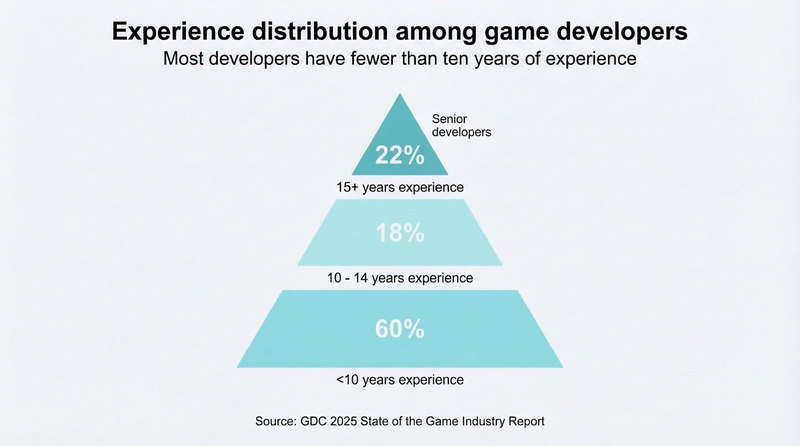
At the same time, Unity remains the dominant engine for mobile and immersive platforms. Unity Technologies reports that more than 70% of top mobile games by monthly active users run on Unity, while the engine also powers over 70% of the best-selling VR titles on the Meta Quest Store. The ecosystem comprises approximately 5 million developers globally, with 1.3 million monthly active users of the Unity Editor. This scale might suggest abundant supply, but experience-level distribution tells a different story: according to the GDC 2025 report, 60% of game developers have fewer than ten years of experience, and only 22% have 15 or more years.
This article examines the market dynamics shaping Unity developer recruitment in 2026. It covers industry growth data, engine adoption trends, talent availability, and the operational challenges businesses face when hiring Unity specialists. It also outlines how DevsData LLC approaches Unity developer recruitment and what companies should evaluate when selecting a hiring partner.
Not every Unity hiring need requires external support. Companies with established game development teams, dedicated technical recruiters, and an existing pipeline of industry contacts can often manage standard hiring internally. The calculus changes when the role demands are specialized, the timeline is compressed, or the talent pool is geographically dispersed. In those situations, general recruitment processes tend to produce mismatches, extended vacancies, or compromises on technical quality. A specialized agency adds value precisely where internal teams lack the domain expertise to evaluate candidates on criteria such as GPU profiling fluency, render pipeline configuration for target hardware, and whether they have shipped on the platform the product actually targets.
The following scenarios represent common business situations where specialized agency support becomes operationally justified.
Companies entering the game development market for the first time, or launching a new studio division, face a compounding challenge. They need to hire multiple Unity Developers simultaneously while lacking the internal expertise to evaluate candidates. A single poor hire at the foundational stage can permanently bottleneck the product’s architecture, locking the team into rendering approaches or asset pipelines that become costly to reverse during production. Specialized agencies maintain pre-vetted candidate pools with verified project records, including store links to shipped titles, GitHub repositories, and reference checks from prior production leads. This reduces the risk of hiring developers whose portfolios do not reflect the depth of their claimed experience. The evaluation of Unity-specific competencies, from shader programming to physics optimization, requires assessors who understand engine internals.
Game development follows a cyclical production model. Studios regularly need to scale from a small prototyping team to a full production crew within weeks, then reduce headcount after launch. This pattern drives heavy reliance on contract and project-based hiring. Internal HR teams rarely have the specialized networks needed to locate multiple qualified Unity Developers on a compressed timeline. Specialized agencies, with their existing candidate databases and industry networks, can deploy pre-screened developers faster than general recruitment channels, where the average time-to-hire for senior developers has extended to 11 weeks.
Unity supports deployment to 25 or more platforms, including mobile operating systems, current-generation consoles, VR headsets, and Apple Vision Pro. Each platform introduces distinct performance constraints, input paradigms, and certification requirements. A developer experienced in mobile Unity development may lack the optimization knowledge needed for console submission, and vice versa. Agencies specializing in Unity recruitment can match candidates to specific platform requirements, drawing from pools of developers who have shipped titles on the target platform rather than relying on generalized game development experience.
Unity’s expansion into automotive visualization, digital twins, architectural rendering, and defense simulation has created a new category of hiring need. Companies in these sectors often do not know how to evaluate Unity Developers because their HR teams have no game industry background. The technical requirements differ from traditional game development: real-time data integration, CAD model handling, and simulation accuracy matter more than gameplay mechanics. A specialized agency bridges this knowledge gap, identifying developers whose skills transfer effectively from gaming to enterprise real-time 3D contexts.
The supply of senior Unity Developers remains structurally limited. Only 22% of game developers have 15 or more years of experience. Studios, tech companies, and increasingly enterprise firms compete for the same senior candidates. Internal recruiters without game industry connections struggle to reach passive candidates through standard channels. Specialized agencies source through game industry communities, Unity forums, and direct referrals from past placements rather than relying on LinkedIn alone. Specialized agencies maintain long-term relationships with experienced developers and can access talent that does not appear on standard job boards or LinkedIn searches.
Hiring Unity Developers from international markets introduces legal, tax, and employment compliance considerations that vary by jurisdiction. Eastern European markets offer strong Unity talent at significantly lower compensation than US or Western European rates. Agencies with cross-border recruitment infrastructure handle employment law complexities, payroll compliance, and candidate verification in markets where internal HR teams have no operational presence. This capability becomes critical given that cross-border employment arrangements introduce work-authorization requirements, remote payroll compliance obligations, and contractor-classification rules that vary by jurisdiction.
Losing a lead Unity Developer during active production creates an immediate technical and project management risk. The replacement must understand the existing codebase architecture, Unity version-specific constraints, and the team’s workflow conventions. General recruiting cannot reliably deliver this level of specificity under time pressure. A specialized agency can prioritize candidates with experience onboarding into mid-cycle projects and can accelerate screening by focusing on the precise technical stack in use rather than running a broad evaluation process.
Each of these scenarios shares a common thread: the hiring requirement exceeds what general recruitment infrastructure can deliver because Unity development is a specialized technical discipline. The cost of a poor hire, measured in project delays, rework, and team disruption, typically exceeds the cost of engaging a specialized recruitment partner. Companies that recognize this early in their hiring process avoid the cycle of extended vacancies and compromise hires that often result from treating Unity recruitment as a general software hiring exercise.
Do you have IT recruitment needs?
The Unity developer hiring market in 2026 is shaped by forces that extend well beyond the gaming industry. Revenue growth across the global gaming sector, rapid adoption of real-time 3D technology in enterprise settings, and shifting engine preferences among developers are all converging to create a talent environment that demands careful analysis. Understanding these dynamics is essential for any company planning to hire Unity Developers, because the market conditions directly affect candidate availability, compensation expectations, and time-to-hire.
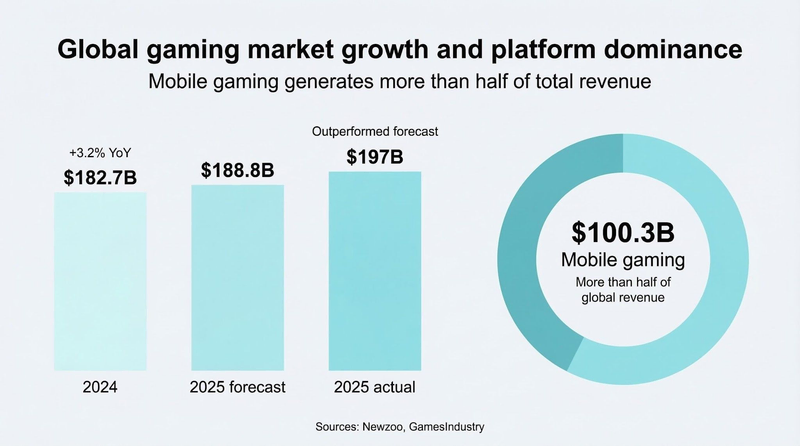
The global gaming market generated $182.7 billion in revenue in 2024, representing a 3.2% year-over-year increase. Mobile gaming led at $100.3 billion, accounting for more than half of total revenue. Newzoo reported the market reaching $188.8 billion in 2025, while a year-end composite by GamesIndustry estimated actual performance at $197 billion, suggesting the market outperformed initial forecasts. This growth sustains demand for Game Developers across all engines. Because Unity powers over 70% of top mobile games by monthly active users, studios expanding their mobile portfolios frequently require Unity-proficient developers, though hiring volume depends on the scope and platform mix of each studio’s roadmap. Studios expanding their mobile portfolios are hiring Unity specialists at rates proportional to this revenue trajectory.
Non-gaming industries now contribute 22% of total game engine revenue, with Unity’s automotive and film toolkits growing 34% year-over-year in 2024. The digital twin market, a core application of real-time 3D, is valued at $21-36 billion in 2025 and projected to reach $150 billion by 2030. Companies like Toyota, BMW, Rivian, and Walmart use Unity for visualization, simulation, and training applications. Capgemini acquired Unity’s Digital Twin Professional Services arm in February 2024, signaling enterprise-scale demand for Unity-trained talent. This expansion means companies hiring Unity Developers now compete with automotive manufacturers, defense contractors, and enterprise technology firms, not just other game studios.
Unity holds an unmatched position in mobile and VR development. The Sensor Tower Big Game Engine Report of 2025 confirmed that 51% of all games released on Steam in 2024 were built with Unity. Yet Unity titles accounted for 26% of units sold on Steam, while Unreal Engine captured 31% of sales from 28% of releases. In the GDC 2026 survey, Unity’s share as primary engine dropped to 30%, down from 33% in 2024, while Unreal climbed to 42%. This divergence suggests Unity hiring demand will concentrate in mobile, indie, VR, and enterprise segments rather than AAA console development, where studios increasingly standardize on Unreal Engine for its cinematic rendering pipeline.
The global game engine market was valued at $3.45 billion in 2024, projected to reach $12.84 billion by 2033 at a compound annual growth rate of 17.85%. This expansion creates a multiplying demand for developers skilled in Unity’s real-time rendering, physics simulation, and cross-platform deployment capabilities. Bain & Company reported that gaming job postings grew approximately 40% over the three years ending 2023, reflecting persistent demand even before the layoff wave introduced temporary supply fluctuations. AI-focused gaming startups attracted $602 million in 2024 alone, the highest single year in five. New studio formation funded by this investment generates additional hiring demand for Unity-proficient developers.
Investment in AI-focused startups tells only half the story, since the more relevant change for hiring is how existing teams work. GDC’s 2026 survey found that 30% of respondents at game studios use AI tools, against 58% at publishing companies and support teams. Where those tools appear, they support research or brainstorming for 81% of users and code assistance for 47%. Sentiment runs in the opposite direction, with 52% of industry professionals describing generative AI as a negative influence on the industry, up from 30% the previous year. For a hiring manager, that split has a practical consequence. A candidate’s position on AI tooling now affects team fit as much as their technical stack does, and it is worth raising in an interview rather than discovering after a hire.
Total gaming deal value in 2024 reached $23.2 billion, including $5 billion in private investments across 466 deals. Major transactions included Keywords Studios ($2.8 billion) and Disney’s $1.5 billion investment in Epic Games. The volume of private investment, up roughly 30% in deal count year-over-year, indicates that new studios and expansions will require developer hiring in the near term. For Unity specialists, this investment activity translates to sustained demand, particularly in mobile and casual gaming segments where Unity’s market share is strongest. Companies planning to hire Unity Developers should anticipate that this investment-driven demand will keep the market competitive for qualified candidates through 2026.
The market data paints a clear picture. Gaming revenues continue to grow, real-time 3D applications are expanding into enterprise sectors, and investment activity is generating new hiring demand. At the same time, Unity’s position is bifurcating: dominant in mobile and VR, but losing ground in AAA segments to Unreal Engine. Companies hiring Unity Developers must account for this segmentation. The candidates best suited for mobile free-to-play development differ substantially from those needed for enterprise digital twin applications or VR experiences. Effective recruitment requires understanding not just the Unity engine but the specific market context where the developer will work.
The Unity talent pool spans five million developers, but senior specialists with production experience still command over $170000 at the 75th percentile in the US.
Choosing between Unity and Unreal is no longer a matter of personal preference, because the decision now carries consequences a team cannot reverse cheaply. Rendering architecture is the first of them, since Unreal’s pipeline was built for cinematic fidelity on console hardware while Unity’s was built for performance on constrained mobile devices, and a mismatch between engine and target platform surfaces as a rewrite rather than a tuning exercise. Licensing is the second, with Unreal charging a royalty on revenue above a threshold and Unity returning to seat-based subscriptions after cancelling its Runtime Fee in 2024, which means the same product costs different amounts under each model depending on how it monetizes. Hiring is the third and the most binding for the purposes of this article. Each engine now has its own talent pool, so a studio that picks against the prevailing engine in its segment competes for a smaller group of candidates at a higher price. The data below compares their platform presence, developer adoption, and segment concentration as of the most recent industry surveys.
A direct comparison between the two engines reveals where each concentrates hiring demand:
| Factor | Unity | Unreal Engine |
|---|---|---|
| Steam game releases (2024) | 51% | 28% |
| Steam unit sales (2024) | 26% | 31% |
| GDC 2026 developer preference | 30% | 42% |
| Dominant segments | Mobile, VR, indie, enterprise | AAA console, film, cinematic |
| Non-gaming traction | Automotive, digital twins, defense simulation | Virtual production, architecture |
Despite accounting for the majority of Steam releases, Unity titles generate a smaller share of unit sales. This gap reflects the engine’s concentration in indie games and lower-priced titles rather than premium console-quality releases. Unreal captures fewer releases but higher revenue per title, driven by AAA console development. For hiring purposes, this means Unity recruitment demand will concentrate on mobile, VR, and enterprise segments. Companies must calibrate their recruiting strategy to the specific market segment where their product competes.
Hiring Unity Developers involves challenges that are distinct from general software recruitment. The technical evaluation is more complex, the candidate pool is more stratified by experience level, and the competitive dynamics cross industry boundaries in ways that standard hiring processes do not anticipate. Understanding these challenges is the prerequisite for building an effective recruitment strategy. The following sections outline the primary obstacles companies encounter, along with the specific approaches DevsData LLC applies to address each one.
The most persistent challenge in Unity recruitment is the scarcity of senior-level talent. The GDC 2025 State of the Game Industry report found that only 22% of game developers have 15 or more years of experience. This limited pool is further depleted by attrition to non-gaming industries. Glassdoor data shows that game developers in the IT sector earn a median of $114254, compared to $90156 in arts, entertainment, and recreation, a 27% premium that draws experienced developers away from traditional studios. The game industry also has a 33% higher attrition rate than the broader technology sector, meaning that even studios that successfully hire senior Unity Developers face above-average retention risk. This combination of limited supply, cross-industry competition, and high attrition creates a structural shortage that cannot be resolved by increasing recruiting volume alone.
DevsData LLC maintains a database of 95000 pre-screened candidates, including Unity specialists with documented production experience across mobile, console, and VR platforms. The firm’s sourcing methodology targets passive candidates through industry networks rather than relying on job board applicants. Each candidate undergoes a 90-minute technical problem-solving challenge designed to evaluate applied Unity expertise, not just theoretical knowledge. This process identifies senior-caliber developers before they enter the open market.
Unity development encompasses a technical range that standard coding assessments do not cover. A Unity Developer working on a mobile free-to-play game needs proficiency in draw call optimization, texture atlasing, and memory management for constrained hardware. A developer building a VR experience must understand spatial audio, frame-rate-sensitive rendering, and motion-sickness mitigation techniques. A developer creating a digital twin for an automotive client requires competency in CAD data pipelines, real-time physics accuracy, and enterprise integration protocols. Generic coding interviews test algorithmic reasoning but miss these domain-specific competencies entirely. The result is that companies hire developers who pass standard technical screens but underperform in production because their Unity-specific skills were never evaluated.
DevsData LLC structures its technical screening to match the specific Unity use case. The evaluation covers engine-specific problem solving, platform optimization knowledge, and the ability to articulate architectural decisions under production constraints. Screening panels include assessors with direct Unity development experience, ensuring that evaluation criteria reflect actual production requirements rather than generic software engineering benchmarks.
The Unity developer talent pool is geographically concentrated. IGDA survey data shows that 39% of game developers are based in the United States, 12% in Canada, 8% in Finland, and 6% in Sweden. Asia-Pacific, which generates 47% of global gaming revenue ($88.1 billion in 2024), has significant developer populations that are underrepresented in Western surveys. Eastern European markets offer Unity talent at annual compensation ranges of $35000-$50000, compared to $80000-$130000 or more in the US. Accessing these markets requires cross-border recruitment infrastructure, including legal compliance, payroll management, and cultural alignment processes. The GDC 2026 survey noted that nearly one-third of non-US game developers cancelled US travel plans due to policy concerns, indicating that geopolitical factors now directly affect international talent flows.
DevsData LLC operates with a government-approved recruitment license and maintains sourcing capabilities across multiple geographies. The firm supports cross-border hiring with a compliance infrastructure for international placements. Its US-based specialists work with clients in the United States and Israel, ensuring alignment with local employment standards while accessing talent in cost-effective markets. The firm has completed over 140 recruitment projects for more than 100 clients, including placements requiring international coordination.
Game development follows a production cycle that creates distinct hiring patterns. Studios expand rapidly during full production, then reduce headcount after launch or during content gaps. Robert Half reported that 67% of managers expected to hire contract workers as part of their staffing strategy, reflecting the industry’s reliance on flexible workforce models. The average time-to-hire for senior developers has reached 11 weeks, a 57% increase since 2021. Layoff cycles compound this problem: approximately 45000 gaming jobs were eliminated from 2022 through mid-2025, yet roughly a third of laid-off workers left the industry entirely. The remaining candidate pool, while large in absolute numbers, includes many professionals who are re-evaluating whether to stay in game development, introducing uncertainty into offer acceptance rates.
Platform scope is the second variable that determines whether a hire holds across the cycle. A title that launches on mobile frequently follows with a PC build, a console submission, or a headset version, and each step introduces constraints the original developer may never have worked under. A specialist hired purely for iOS optimization can struggle with the fragmented GPU drivers on Android hardware and will have no exposure to the certification requirements that PlayStation and Xbox submissions impose. Hiring for a single platform therefore limits a team at exactly the moment a successful product expands, which is why screening should test how a candidate reasons about an unfamiliar target rather than only how well they know the current one.
DevsData LLC operates on a success-fee model with a guarantee period, aligning incentives with long-term placement quality rather than volume. The firm’s screening process evaluates candidates for project fit, career stability indicators, and alignment with the client’s production timeline. This approach reduces the risk of early-stage departures that disrupt active development cycles.
Each of these challenges reflects a structural feature of the Unity developer market, not a temporary fluctuation. The shortage of senior talent, the difficulty of technical evaluation, the complexity of cross-border hiring, and the instability of project-based employment patterns are persistent conditions. Companies that address these challenges with general-purpose recruitment tools consistently underperform compared to those that engage partners with Unity-specific expertise. The hiring methodology must match the complexity of the technical domain.
The evaluation process, not the candidate pipeline, determines whether a Unity placement succeeds under production conditions.
Do you have IT recruitment needs?
Selecting a recruitment partner for Unity developer hiring requires evaluation criteria that go beyond standard agency metrics. The partner must demonstrate domain competency in game development and real-time 3D technology, maintain access to a relevant candidate pool, and operate with a commercial model that incentivizes placement quality over volume. The following steps provide a structured framework for this evaluation.
The agency must demonstrate familiarity with Unity’s technical ecosystem, including engine versions, platform-specific optimization, and the distinction between mobile, console, VR, and enterprise development contexts. Ask for examples of past Unity placements and the technical evaluation methods used. An agency that cannot articulate the difference between a draw call budget for mobile and a frame-time budget for VR lacks the knowledge to evaluate Unity candidates effectively.
A relevant database is not measured by total size alone. Evaluate what percentage of the agency’s candidates have documented Unity experience, how recently candidate profiles were updated, and whether the database includes developers from international markets. Pre-screened candidates with verified project histories reduce time-to-hire and lower the risk of misrepresentation. Ask how the agency distinguishes between developers who list Unity on their resume and those with verified shipping experience.
The screening process must include Unity-specific technical evaluation, not just generic coding tests. Effective screening covers engine-specific problem solving, platform optimization knowledge, and portfolio review with an assessor who has direct Unity development experience. Ask to see the structure of a typical technical evaluation. Agencies that rely solely on algorithmic coding interviews or third-party testing platforms cannot reliably assess real-time 3D competencies.
Recruitment agencies operate under different fee structures: retained search, contingency (success fee), and hourly. For Unity developer recruitment, a success-fee model with a guarantee period aligns the agency’s incentives with placement quality. The guarantee period provides protection against early departures, which are a documented risk in project-based game development. Clarify the length of the guarantee period, what triggers a replacement search, and how the agency handles situations where the initial placement does not meet expectations.
Given the geographic concentration of Unity talent and the compensation differentials between markets, cross-border hiring capability is a practical consideration. Verify whether the agency holds relevant recruitment licenses, has operational experience in the target geography, and can manage compliance requirements for international placements. Ask for examples of successful international Unity placements and the specific compliance processes used.
AI tools now sit on both sides of a recruitment process, which makes the agency’s policy on them a legitimate question. On the candidate side, a take-home task completed with generative assistance tells you little about the developer, so ask how the screening is structured to produce evidence of a candidate’s own reasoning. On the role side, adoption varies widely, with 30% of game studio respondents using AI tools against 58% at publishers, so an agency should be able to match candidates to your tooling expectations rather than assume them. Ask also how the agency uses AI in its own sourcing, since a shortlist assembled by keyword matching reproduces exactly the resume-screening problem a specialist partner is meant to solve.
Recruitment for game studios moves sensitive material, from unreleased project details in a briefing document to candidate identity records crossing borders. The sector attracts attention, and gaming was the most targeted industry for HTTP DDoS attacks in 2024 with Layer 7 incidents rising 94% year over year. Confirm how candidate data is stored, how long it is retained, and what contractual protection covers information shared during a search. Where the role itself touches live services or player accounts, ask whether the agency can screen for secure coding practice rather than treating it as an adjacent concern.
The following table summarizes the key evaluation criteria and corresponding questions for each step.
| Evaluation step | Questions to ask the agency |
|---|---|
| Domain expertise | ● Can you describe your experience placing Unity Developers across mobile, console, and VR platforms? ● What technical evaluation criteria do you use for Unity-specific skills? |
| Database quality | ● How many candidates in your database have verified Unity shipping experience? ● How frequently are candidate profiles updated? |
| Technical screening | ● What does your Unity-specific technical screening process include? ● Do your assessors have direct Unity development experience? |
| Commercial model | ● Do you operate on a success-fee model? ● What guarantee period do you provide, and what are the terms for replacement searches? |
| Cross-border capability | ● Do you hold government-approved recruitment licenses? ● In which geographies have you completed Unity developer placements? |
| Communication standards | ● How frequently do you provide progress updates during an active search? ● What is your process for candidate feedback and iteration? |
| AI in the process | ● How does your screening establish that the work is the candidate’s own, and how do you use AI in sourcing? |
| Security and data handling | ● Where is candidate data held, how long is it retained, and what protects the project details we share with you? |
Website: www.devsdata.com
Team size: ~60 employees
Founded: 2016
Headquarters: Brooklyn, NY, and Warsaw, Poland
DevsData LLC is a technology recruitment firm with over ten years of experience placing software developers, including Unity specialists, for clients in the United States and Israel. The firm operates with a government-approved recruitment license and has completed more than 140 recruitment projects for over 100 clients across multiple technology domains.
The firm’s candidate database contains 95000 pre-screened professionals. For Unity developer recruitment, DevsData LLC draws on this database alongside targeted sourcing through industry networks to identify candidates with verified production experience. Each candidate undergoes a rigorous screening process that includes a 90-minute problem-solving challenge focused on applied Unity competencies. This evaluation is not a generic coding test. It is structured to assess how developers handle real-time 3D constraints, optimize for specific target platforms, and make architectural decisions relevant to the client’s project requirements.
DevsData LLC employs US-based specialists who manage the recruitment process from sourcing through placement. The firm maintains strong communication standards throughout every engagement, providing structured progress updates and iterating on candidate profiles based on client feedback. This approach reflects the firm’s operational philosophy: recruitment quality depends on continuous alignment between the hiring team and the recruitment partner.
The commercial model is success-fee-based with a guarantee period, meaning the client pays only upon successful placement and receives protection against early departures. This structure removes upfront financial risk while ensuring the agency’s incentives align with placement quality and retention.
Independent validation supports these claims. DevsData LLC holds 5/5 ratings on Clutch and GoodFirms, based on verified client reviews. These ratings reflect consistent performance across technology recruitment engagements, including placements in specialized domains such as game development.
A practical example illustrates how DevsData LLC applies its methodology. In a recruitment project for a gaming industry client in Poland, the firm was tasked with placing a specialized developer to support an active game production team. The client required a candidate with specific technical competencies aligned to their existing Unity-based production pipeline, and the geographic scope was constrained to the Polish market due to the client’s operational requirements.
The engagement followed a structured pipeline approach. The recruitment process involved the following stages.
This case study reflects the operational reality of Unity developer recruitment: the value of a placement is determined by its impact on the client’s production timeline, not by the volume of candidates processed. DevsData LLC’s structured methodology, from initial sourcing through technical evaluation to placement, is designed to optimize for this production-level outcome.
Do you have IT recruitment needs?
The Unity developer hiring market in 2026 is defined by a divergence between headline supply and qualified supply. Approximately 5 million developers operate within the ecosystem, yet senior specialists with shipped-title production records remain difficult to source. Time-to-hire for these candidates has reached 11 weeks, and salaries at the 75th US percentile exceed $170000.
Standard recruitment approaches do not address this gap because Unity development requires domain-specific evaluation. Algorithmic coding tests cannot measure shader optimization, platform-specific rendering constraints, or real-time physics accuracy. The evaluation methodology, rather than the volume of candidates screened, determines whether a placement holds under production conditions.
DevsData LLC addresses these requirements through a combination of its 95000-candidate database, 90-minute Unity-specific technical screening, and success-fee model with a guarantee period. The firm has completed over 140 recruitment projects for more than 100 clients, holds a government-approved recruitment license, and maintains 5/5 ratings on Clutch and GoodFirms. For companies seeking to hire Unity Developers, DevsData LLC offers a structured, data-informed approach calibrated to the specific demands of this specialized technical market.
Any questions or comments? Let me know on
Twitter/X.
Discover how IT recruitment and staffing can address your talent needs. Explore trending regions
like Poland, Portugal, Mexico, Brazil and more.
 Frequently asked questions (FAQ)
DevsData – your premium technology partner
DevsData is a boutique tech recruitment and software agency. Develop your software project with veteran engineers or scale up an in-house tech team of developers with relevant industry experience.
Free consultation with a software expert
🎧 Schedule a meeting
FEATURED IN


DevsData LLC is truly exceptional – their backend developers are some of the best I’ve ever worked with.”

Nicholas Johnson
Mentor at YC, serial entrepreneur


 Build your project with our veteran developers.
Explore the benefits of technology recruitment and tailor-made software.
Learn how to source skilled and experienced software developers.

Rebecca Botvin

Commercial Director

Tom Potanski
Manager




Categories: Big data, data analytics | Software and technology | IT recruitment blog | IT in Poland | Content hub (blog)
















careers@devsdata.com





general@devsdata.com

"I interviewed about a dozen different firms. DevsData LLC is truly exceptional – their backend developers are some of the best I've ever worked with. I've worked with a lot of very well-qualified developers, locally in San Francisco, and remotely, so that is not a compliment I offer lightly. I appreciate their depth of knowledge and their ability to get things done quickly."

Nicholas Johnson
CEO of Orange Charger LLC,
Ex-Tesla Engineer,
Mentor at YCombinator
"DevsData reached out to us, as we've been looking to grow our engineering team in Europe and Poland. Communicating efficiently and professionally, DevsData made a strong impression with their understanding of the recruitment challenges we were facing. They designed a tailored recruitment process for our needs. I was impressed with the technical depth of their approach."

Karim Butt
Co-Founder & CTO at GlossGenius, Inc.
"Out of all the vendors we work with, DevsData clearly stands out. The quality of developers they deliver is beyond what we've received from any other vendor, and they've been able to send profile recommendations very quickly. I'm happy to be their reference for other companies from Israel and talk about their recruitment abilities and what they delivered for us."

Ran Eyal
Senior Manager at
ZIM Integrated
Shipping Services Ltd.
"DevsData demonstrated a strong degree of proactivity, taking time to thoroughly understand the problem and business perspective, and continuously suggesting performance and usability enhancements. Their app exceeded my expectations. I've worked with DevsData on numerous projects over the last 3 years and I'm very happy. Being both responsive and honest in communication."

Jonas Lee
Partner & Executive VP of Verus,
Financial LLC, Investor,
& Serial Entrepreneur
Acknowledgments