
Thanks for subscribing.
Your gift is on the way.



Poland has turned into a prime destination for businesses building dedicated remote development teams. The country’s IT industry has grown quickly, backed by strong infrastructure and a business climate that keeps foreign employers returning to the market.
Bureau of Labor Statistics data points to a software developer shortage in the US reaching 1.2 million by 2026. Eastern European countries face no comparable gap in the near term, and Poland sits at the center of that contrast with over 607000 IT specialists, close to 25% of all developers in the CEE region. Seven major IT hubs employ more than 85% of the nation’s professionals. Since 2022, Poland has taken in 35.2% of Ukrainian software developers who relocated across Europe, widening an already deep talent pool.
Polish developers work across multiple programming languages and frameworks, taking on builds as demanding as enterprise FinTech platforms. The workforce aligns culturally with Western businesses, speaks fluent English, and carries a reputation for reliability and sharp problem-solving. That cultural fit, paired with competitive labor costs, explains why our clients keep returning to Poland for high-quality development at a favorable rate.
Across ten years of placements, our work has centered on one question clients raise again and again: how do you hire remote developers in Poland without losing control, quality, or speed? This article shares what we have learned.

Poland’s software sector has matured into a strong and diverse market. The Polish ICT market reached $31.59 billion in 2025 and is projected to climb toward $34.75 billion in 2026. Global tech giants such as Google, IBM, and Apple run engineering operations across Polish cities, a signal of confidence that smaller businesses read closely before committing.
Do you have IT recruitment needs?
Several traits set Polish developers apart for remote collaboration, and our placement record reflects each one.
English proficiency comes first. Poland ranks 13th in Europe and second in Eastern Europe on the EF English Proficiency Index, which removes much of the friction that derails distributed teams.
Cultural alignment follows. Polish professionals share Western expectations around reliability, deadlines, and direct communication, so onboarding into an existing team rarely stalls.
Technical range rounds out the picture. Polish developers are fluent in Java, .NET, C++, Python, and JavaScript, with strength across frontend, backend, and full stack work. Many specialize further in cloud architecture on AWS, Azure, and Google Cloud, while a growing group focuses on machine learning and big data. Polish engineers placed third on HackerRank’s Best Developers list, a result that matches what our technical screeners see in interviews.
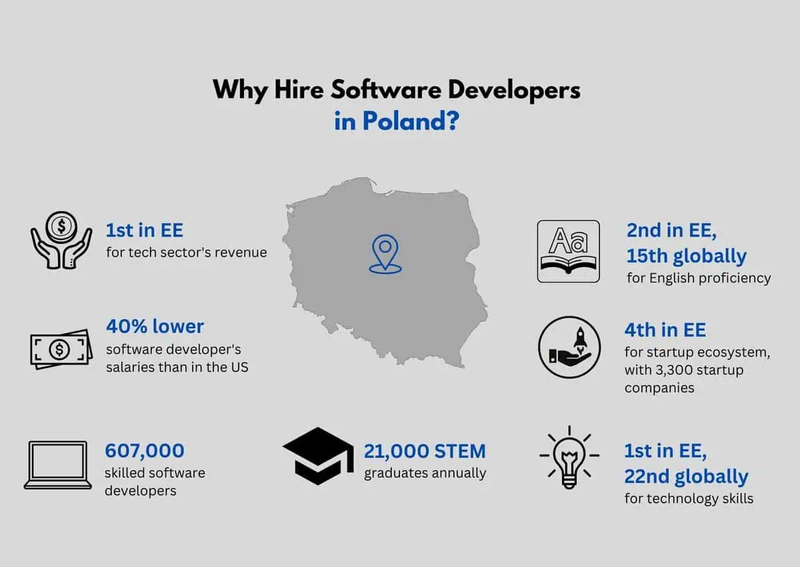
Knowing who you are hiring matters as much as knowing where. The Polish IT workforce skews young and senior at the same time, with most professionals sitting in the 25-34 bracket and a clear majority already past junior titles. Education runs deep too, since a bachelor’s or master’s degree in a STEM field remains the standard route into the market.
The single figure that matters most for this topic is remote readiness. As many as 91% of Polish developers prefer remote or hybrid arrangements, which makes the country a natural match for distributed teams rather than a compromise. The perks they value reflect that mindset: a four-day workweek, workplace flexibility, extra days off, access to professional courses, and comprehensive medical insurance.
Poland’s talent pipeline rests on a technical education system with Cold War roots, when neighboring states built rigorous math and engineering programs to compete with the West. That legacy now produces around 20000 new IT graduates a year from a base of roughly 75000 students enrolled in IT and ICT degrees.
According to the QS World University Rankings 2024, three institutions lead the field. The University of Warsaw, first in Poland and 262nd globally, serves more than 34000 students and stands as the country’s leading AI hub, with graduates contributing to OpenAI’s ChatGPT, including its Chief Scientist, Jakub Pachocki. Jagiellonian University in Krakow, second nationally and 304th globally, also teaches over 34000 students and runs niche tracks such as Bioinformatics. Warsaw University of Technology, third in Poland and 571st globally, educates more than 23000 students with an engineering-driven curriculum spanning machine learning and cybersecurity.
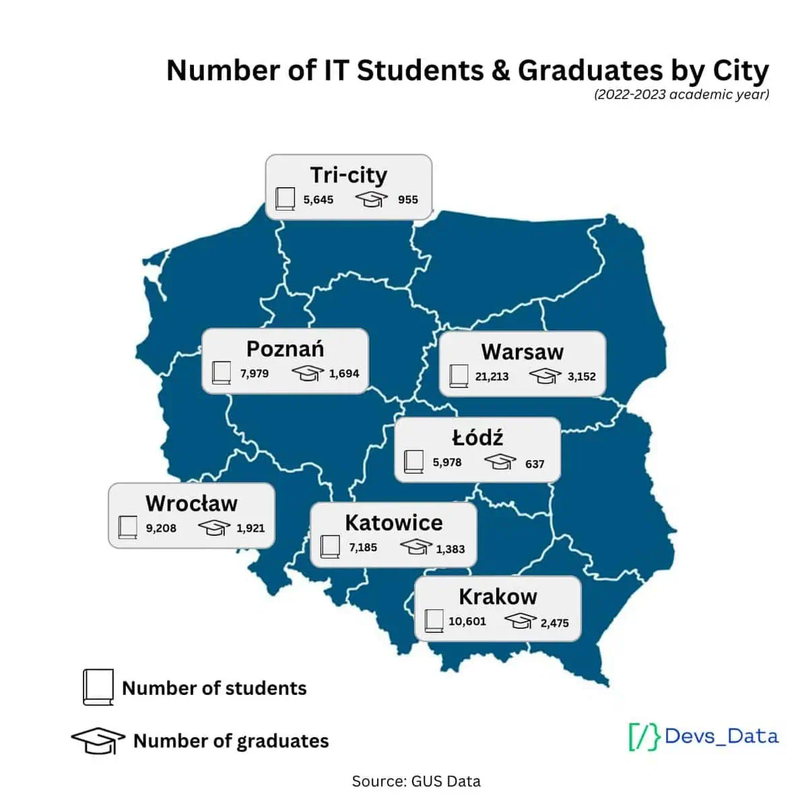
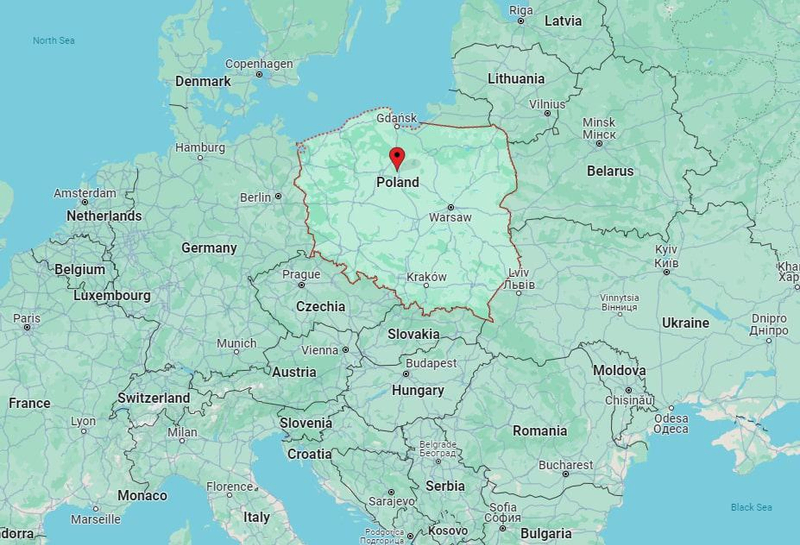
Even for fully remote teams, knowing where talent concentrates shapes a hiring plan. Four cities anchor the market.
Warsaw, the capital, hosts over 163000 IT specialists and roughly 330 software company offices, with Microsoft and Google operating development centers there. Krakow ranks as the second-largest hub, holding more than 500 development offices and a steady draw for startups. Wroclaw leans toward AI, big data, and IoT, with over 100 IT and R&D centers tied to local universities. The Tri-City area of Gdansk and Gdynia, with Sopot alongside them, has grown to 73500 developers at a 12.6% annual employment rate. Nordic firms nearshore there for reasons of geography, since the Baltic coast puts Stockholm and Copenhagen within a short flight and keeps Polish teams on the same clock as their Scandinavian counterparts.
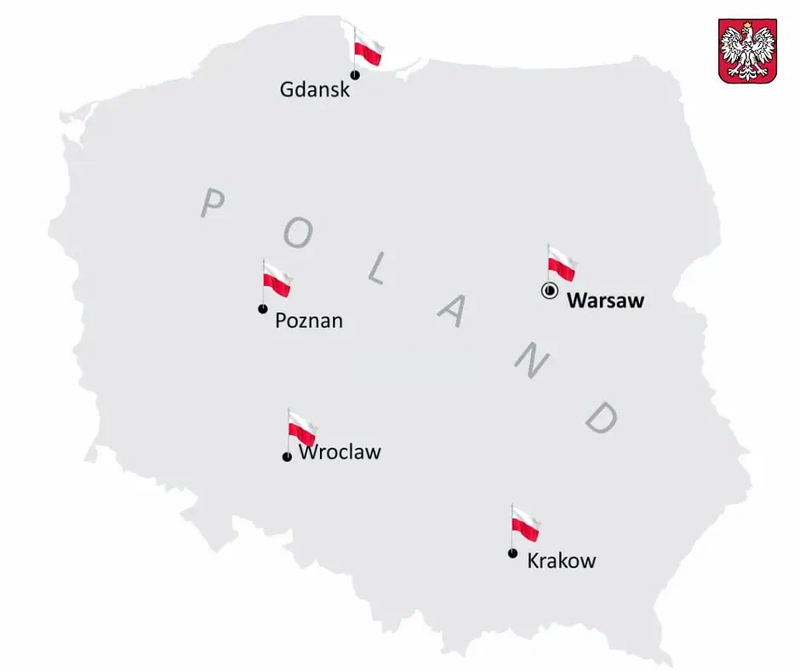
Distance between these cities rarely slows collaboration. The table below lists approximate train times across the main routes.
Train travel times between major IT hubs in Poland
| Route | Travel time (Approx.) | Train type |
|---|---|---|
| Warsaw → Krakow | 2.5 – 3 hours | High-speed (Pendolino) |
| Warsaw → Gdańsk | 3 – 3.5 hours | High-speed (Pendolino) |
| Warsaw → Wrocław | 3.5 – 4 hours | Express InterCity (EIC) |
| Krakow → Wrocław | 3 – 3.5 hours | Express InterCity (EIC) |
| Krakow → Gdańsk | 5.5 – 6 hours | Express InterCity (EIC) |
Short transit times let a remote team gather in person for a kickoff or quarterly review without major logistics, a small detail that pays off over a long engagement.
Poland remains an attractive hub for IT professionals, offering competitive salaries while being cost-effective for global businesses. The latest JustJoinIT 2025 Report provides key insights into salary trends for junior, mid, and senior developers, highlighting differences between UoP (employment contract) and B2B (freelance) agreements.
| Seniority level | UoP salary (PLN) | UoP salary (USD) | B2B salary (PLN) | B2B salary (USD) | Expected salary (PLN) | Expected salary (USD) |
|---|---|---|---|---|---|---|
| Junior | 7800 | $1895 | 9125 | $2218 | 10000 | $2430 |
| Mid | 14750 | $3584 | 18000 | $4374 | 15000 | $3645 |
| Senior | 20400 | $4957 | 24360 | $5920 | 25000 | $6075 |
Note: USD amounts are approximate. Exchange rates may vary over time.
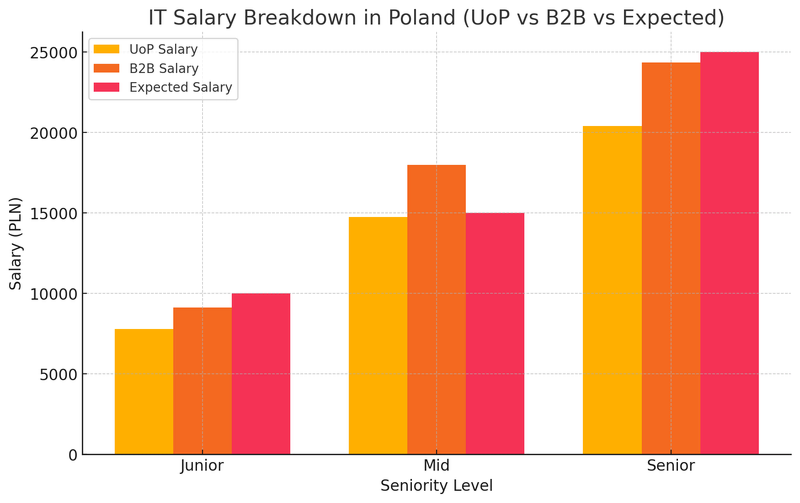
The IT Salary Breakdown table above provides insights from the JustJoinIT 2025 Report, reflecting median salaries for Polish developers at different experience levels. These figures are based on actual job offers and contracts, accounting for standard employment terms in Poland and covering various tech roles.
Despite lower salary levels, compensation for Polish developers has steadily increased, reflecting rising demand for skilled IT professionals. This trend highlights Poland’s rapidly expanding tech sector, where competitive wages and growing career opportunities continue to attract top talent.
In major IT hubs such as Warsaw, Krakow, and Wroclaw, salaries tend to be higher due to local cost-of-living variations and stronger demand for expertise.
Across Europe, significant salary disparities exist between Western and Eastern regions. Western European developers typically earn over $40000 annually, while those in Eastern Europe average around $20000 or more. In Southern Europe, developers in Spain, Italy, Portugal, and Greece earn between $21300 and $36300 per year.
Poland’s cost-efficiency and its growing prominence in the tech industry position it as a prime destination for companies looking to establish or expand their software development teams. The breakdown below sets out salaries for a range of Polish tech roles, showing a market that stays cost-effective without trading away quality. The same data lines up senior pay in Poland against the United States, with the chart bringing those differences into view across the main roles.
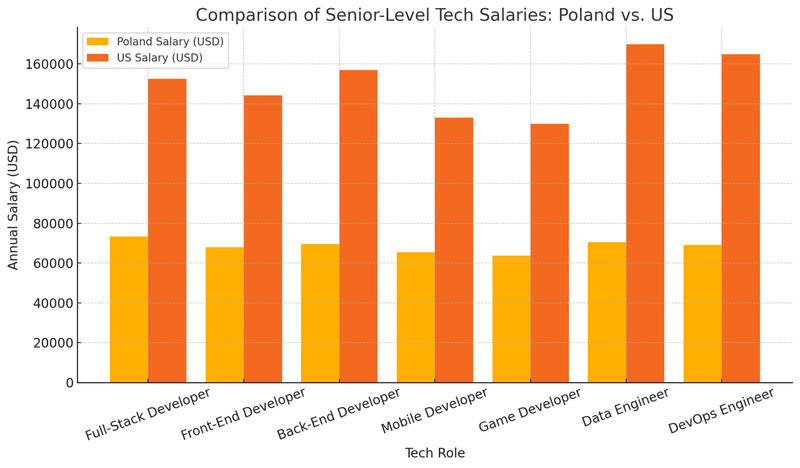
For detailed insights, consider exploring resources like Plane or Levels.fyi.
Beyond salaries, Poland offers financial mechanisms that lower the cost of building a presence. The R&D Tax Relief allows for up to a 100% deduction on eligible R&D costs, stimulating innovation. The standard corporate tax rate is 19%. However, startups and small enterprises pay a lower 9% rate.
The IP Box provides a preferential 5% tax rate on income from intellectual property rights, while the Polish Investment Zone offers CIT exemptions for up to 15 years on new investments. These financial benefits make Poland an appealing location for outsourcing and building R&D centers.
Beyond these national initiatives, Poland is currently experiencing a wave of European Union grants to boost technology ventures, particularly in AI and software development. These grants provide non-dilutive funding, allowing startups and tech companies to scale operations, invest in R&D, and accelerate growth.
Several EU-backed programs support projects in:
Do you have IT recruitment needs?
Working with Polish remote developers brings obstacles that businesses should weigh in advance. DevsData LLC covers most of them end-to-end, from sourcing and technical screening through Employer of Record setup, payroll compliance, employment law advisory, and business process outsourcing for the back office. Each obstacle below appears alongside the way we resolve it.
Poland ranks 4th in Europe for business complexity, according to the 2023 Global Business Complexity Index. Companies face challenges such as:
To work through payroll registration and the reporting rules flagged above, bringing in a local tax advisor or an Employer of Record provider keeps operations compliant from the start.
Hiring software developers in Poland requires navigating different types of employment contracts, each with its own implications:
51% of IT professionals in Poland work under UoP contracts, while 37% prefer B2B agreements, reflecting the growing dominance of the B2B model due to its flexibility and cost efficiency.
Poland operates on Central European Time (CET), 6-9 hours ahead of the continental United States. This time difference might create issues such as:
However, many companies have turned this challenge into an advantage by implementing a “round-the-clock” work strategy. Polish developers can complete tasks during their workday, allowing United States-based teams to review and continue the work as their day begins, thereby accelerating product development.
| Location | Time zone difference |
|---|---|
| Berlin | Warsaw is in the same time zone as Berlin. |
| London | Warsaw is 1 hour ahead of London. |
| Austin | Warsaw is 7 hours ahead of Austin. |
| Chicago | Warsaw is 7 hours ahead of Chicago. |
| San Francisco | Warsaw is 9 hours ahead of San Francisco. |
| New York | Warsaw is 6 hours ahead of New York. |
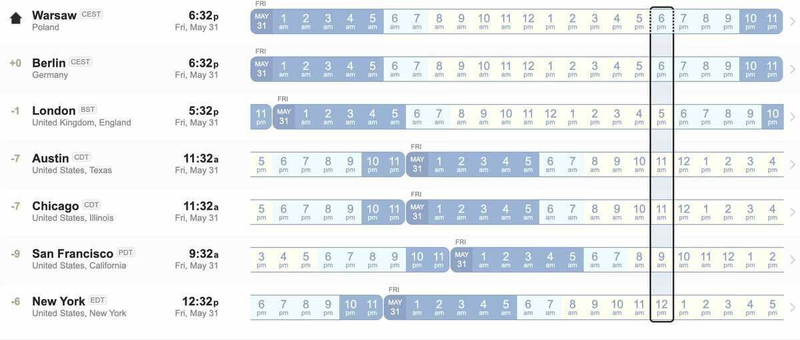
To map the overlap in more detail, head to the World Time Buddy tool.
Our process has held steady across hundreds of placements, and it treats the team rather than the single hire as the unit of work.
Reading the local market for each role comes first, where salary expectations get weighed against the depth of the relevant talent pool. Competing employers in the same city shape that reading too. Requirements follow, defined with the client in precise terms, since a vague brief produces vague candidates. A .NET role, for instance, calls for proven command of C# and the .NET Framework alongside SQL Server before anyone reaches an interview. Structured interviews then put technical depth under realistic conditions, with problem-solving judged in the same session. Composition decides the rest. A calibration session at kickoff fixes the seniority mix and the reporting lines, after which the first senior hire anchors the group and later placements fill in around that core, so the team arrives as a working unit rather than as a set of separate contractors.
Clients usually weigh three engagement models against this process. A freelancer suits a short, contained task. An outsourcing firm offers a ready team at lower rates, though it trims client control and carries intellectual property risk without firm legal cover. A recruitment partner gives clients a handpicked dedicated team while preserving full control over spend, IP, and management, which is the route we most often recommend for long-term builds.
Website: www.devsdata.com
Team size: ~60 employees
Founded in: 2016
Headquarters: Warsaw, Poland and Brooklyn, NY
DevsData LLC is a leading IT recruitment and software development company in Poland, where it has built a strong reputation among businesses setting up dedicated remote teams. With more than ten years in the industry and over 100 clients served worldwide, the company has built a steady reputation across the tech sector. Our dedicated teams take on demanding projects spanning web development, mobile apps, and AI technologies.
Key features that shape our work:
DevsData LLC stands apart through tailored solutions and a focus on quality at every stage. A global network of offices and access to over 95000 vetted professionals lets the company match requirements with precision, while competitive pricing keeps value high without trimming standards. The model runs on a success fee with a guarantee period, which removes financial risk from the client side.
Local presence supports the remote relationship rather than replacing it. DevsData LLC keeps offices in Warsaw, Krakow, Katowice, Gdansk, Poznan, and Wroclaw, so the team meets clients in person where useful. Legal and tax advisory services cover employment law and HR questions tied to local recruitment or company setup, and Employer of Record (EoR) services together with business process outsourcing round out the offering.
Do you have IT recruitment needs?
Two recent engagements show what a structured remote hiring process delivers in practice.
Sea is an independent vendor of commercial software for the maritime industry, with more than 12000 users across the world. Its platform has supported over 750 million tonnes of traded cargo, with more than 51000 contracts documented each year. As new product features moved onto the roadmap, Sea needed a cross-functional product engineering team in Poland rather than a handful of generalists. The roles broke down as follows.
| Role | Purpose |
|---|---|
| Senior Node.js Developers | Lead backend APIs and microservices architecture |
| Senior PHP Developers | Support and modernize the legacy codebase |
| Senior DevOps Engineers | Raise reliability through automation and CI/CD |
| QA Engineers (manual and automation) | Build scalable testing processes |
| Senior Project Managers | Coordinate delivery across distributed teams |
Working from early sessions with Sea’s technical leaders, we sourced through our internal talent pool alongside targeted outreach to passive candidates. Each applicant moved through a role-specific evaluation: live programming for backend engineers, architecture reviews for infrastructure candidates, test design problems for QA, and case exercises for project managers. The result was 11 senior professionals who now form the core of Sea’s engineering team in Poland, delivered in under four months from brief to onboarding. Backend and DevOps roles closed in an average of three weeks, all on a success-fee basis that carried no cost to Sea until each hire was confirmed.
H2B Group builds software for clients in FinTech, MedTech, GreenTech, and FMCG from its base in Poland, with a team of about 50 Engineers. With internal resources stretched across active projects, the company needed Senior Python Developers who could contribute from day one on backend-heavy systems. The bar was high. Candidates needed fluency in Python, Django, Flask, Docker, Kubernetes, Postgres, and Redis, and the niche slimmed the pool further, since developers with FinTech experience sit at an estimated 12% of the market and those with MedTech experience at 6%.
| Role | Purpose |
|---|---|
| Senior Python Developer (hire 1) | Take ownership of financial data processing components |
| Senior Python Developer (hire 2) | Handle platform integrations across client-facing systems |
| Senior Python Developer (hire 3) | Drive service-layer optimization |
We assigned a compact recruitment team and ran a role calibration session on day one, then searched across Central and Eastern Europe, the Baltics, and Portugal alongside direct outreach on GitHub and LinkedIn. Screening ran in three phases: asynchronous review, behavioral alignment, and live technical validation. Out of more than 95 sourced candidates, 71 reached initial screening, 27 advanced to technical validation, and 13 met H2B’s technical lead. The first hire signed within three weeks, with two more Senior Python Developers joining over the following month and a half. Time-to-hire averaged under two weeks per role, candidate dropout stayed below 5%, and offer acceptance hit 100%. The engagement has since grown into an ongoing staffing partnership.
Poland offers a range of benefits that enhance the professional environment, promoting a healthy balance between work and personal life. These benefits play a crucial role in attracting and retaining top talent.
Renowned healthcare providers such as Luxmed, Enelmed, and Medicover offer extensive medical coverage, ensuring employees can access comprehensive healthcare services.
Polish labor law provides employees with at least 20 paid vacation days per year. For those with more than 10 years of combined work and study experience, this entitlement often increases to 26 days annually or more, depending on the employer’s policies.
Many companies in Poland emphasize employee well-being by offering gym memberships and wellness initiatives. The popular MultiSport card grants access to fitness facilities across various locations, encouraging a healthy and active lifestyle among employees.
Paying contractors in Poland requires careful navigation of local regulations to ensure compliance and efficiency. Here’s how to manage it effectively:
Using Employer of Record (EoR) services can simplify the process significantly. Companies like DevsData LLC, Deel, Remote, Plane, and Oyster HR specialize in managing Polish employment laws, ensuring smooth and compliant payment workflows.
DevsData LLC, our top choice, has a significant presence in Poland with offices in Warsaw, Krakow, Katowice, Gdansk, Poznań, and Wroclaw. They offer extensive experience in EoR services, handling employment law issues, and providing HR advisory services for businesses looking to hire locally or set up operations in Poland. Their expertise extends to business process outsourcing (BPO) services, which can significantly improve operational efficiency and optimize corporate activities.
Platforms like Wise (formerly TransferWise) and Payoneer are excellent options for international fund transfers. They provide secure transactions, competitive exchange rates, and low fees, making them reliable solutions for global payments.
Poland combines a 607000-strong talent pool, deep technical range, and costs roughly 2.5 times below US levels, which keeps it at the front of the remote hiring market. With most of its developers favoring remote or hybrid work, the country fits distributed teams by default rather than by exception.
DevsData LLC brings ten years of focus on exactly this work, a database of 95000 vetted professionals, and a 90-minute technical screen that surfaces the top 6%. The results speak through engagements like Sea and H2B Group, where senior teams came together in weeks rather than quarters. For organizations weighing a remote development team in Poland, reach the team at general@devsdata.com or visit www.devsdata.com.
Discover how IT recruitment and staffing can address your talent needs. Explore trending regions
like Poland, Portugal, Mexico, Brazil and more.

 Frequently asked questions (FAQ)
DevsData – your premium technology partner
DevsData is a boutique tech recruitment and software agency. Develop your software project with veteran engineers or scale up an in-house tech team of developers with relevant industry experience.
Free consultation with a software expert
🎧 Schedule a meeting
FEATURED IN


DevsData LLC is truly exceptional – their backend developers are some of the best I’ve ever worked with.”

Nicholas Johnson
Mentor at YC, serial entrepreneur


 Build your project with our veteran developers.
Explore the benefits of technology recruitment and tailor-made software.
Learn how to source skilled and experienced software developers.

Rebecca Botvin

Commercial Director

Tom Potanski
Manager




Categories: Big data, data analytics | Software and technology | IT recruitment blog | IT in Poland | Content hub (blog)
















careers@devsdata.com





general@devsdata.com

"I interviewed about a dozen different firms. DevsData LLC is truly exceptional – their backend developers are some of the best I've ever worked with. I've worked with a lot of very well-qualified developers, locally in San Francisco, and remotely, so that is not a compliment I offer lightly. I appreciate their depth of knowledge and their ability to get things done quickly."

Nicholas Johnson
CEO of Orange Charger LLC,
Ex-Tesla Engineer,
Mentor at YCombinator
"DevsData reached out to us, as we've been looking to grow our engineering team in Europe and Poland. Communicating efficiently and professionally, DevsData made a strong impression with their understanding of the recruitment challenges we were facing. They designed a tailored recruitment process for our needs. I was impressed with the technical depth of their approach."

Karim Butt
Co-Founder & CTO at GlossGenius, Inc.
"Out of all the vendors we work with, DevsData clearly stands out. The quality of developers they deliver is beyond what we've received from any other vendor, and they've been able to send profile recommendations very quickly. I'm happy to be their reference for other companies from Israel and talk about their recruitment abilities and what they delivered for us."

Ran Eyal
Senior Manager at
ZIM Integrated
Shipping Services Ltd.
"DevsData demonstrated a strong degree of proactivity, taking time to thoroughly understand the problem and business perspective, and continuously suggesting performance and usability enhancements. Their app exceeded my expectations. I've worked with DevsData on numerous projects over the last 3 years and I'm very happy. Being both responsive and honest in communication."

Jonas Lee
Partner & Executive VP of Verus,
Financial LLC, Investor,
& Serial Entrepreneur
Acknowledgments


