Thanks for subscribing.
Your gift is on the way.



Any business owner who has tried to fill a security opening in the past year knows the pattern. A posting stays open for a quarter while the few qualified candidates who respond quote figures the budget never anticipated. Security vacancies behave differently from standard engineering roles. An empty backend seat delays a release, while an empty security seat leaves live systems with nobody watching them, and every unfilled month carries a price the finance team calculates. Fortinet reports that 86% of organizations experienced at least one breach in the past year, with 28% recording five or more incidents.
Cross-border sourcing became the standard answer for engineering teams years ago, and security hiring now follows the same offshore logic with greater urgency. The supply curve sets the two apart. Software talent shortages ease as universities catch up with demand. The security gap holds firm, since the work depends on judgment formed through years of real incidents, which no training pipeline can shortcut.
Poland sits at the center of that story for employers across the US and Western Europe. The country pairs top-tier engineering depth with salaries well below US levels, and its cybersecurity sector has grown fast enough to build a deep specialist pool. The sections below cover what cybersecurity recruitment services involve, where the Poland market stands today, how the economics of hiring shape the decision, and what our placements have taught us about building security teams that hold under pressure.

Cybersecurity recruitment services cover the path from role definition through to a signed offer, working with professionals who defend live systems and contain active attacks inside strict compliance regimes. A specialist partner maps the opening against an organization’s real exposure and compliance duties before sourcing anyone, then screens for technical depth alongside trust with privileged access. A posting that says “security” without further definition attracts the wrong applicants and repels the right ones, which puts that scoping step ahead of every other stage. The discipline spans distinct specializations, each solving a different operational problem, and the person approving the hire buys one rather than all of them at once. A firm holding EU health records faces a different exposure than one running a live payment platform, and matching the specialization to that real exposure becomes the first decision in the process, ahead of geography and ahead of budget.
The output is measurable. Intrusions end in containment instead of downtime, and a compliance record survives an audit. Risk language rarely moves a hiring decision forward. Outcomes do.
Do you have IT recruitment needs?
Threat detection and incident response form the operational core. Security Analysts watch infrastructure for signs of compromise and shut down attacks as they unfold, a discipline that grows more demanding as extortion-based intrusions spread. Verizon’s 2025 Data Breach Investigations Report found ransomware present in 44% of confirmed breaches, a 37% rise over the prior year. Containment speed decides how much of that risk turns into a company’s own losses.
Penetration Testers attack an organization’s own systems under contract, surfacing weaknesses before a hostile actor finds them. Security architecture works one layer earlier, shaping infrastructure so that compromise stays expensive for the attacker. A Security Engineer typically owns that layer, segmenting networks so a breach in one zone stays contained and enforcing multi-factor authentication on the accounts an attacker targets first. Identity and access management governs who reaches which system under what conditions, the control that fails most visibly when credentials leak. Above the hands-on layer sits leadership. A CISO or Head of Cybersecurity sets the risk an organization agrees to carry and answers to the board for that decision, while smaller structures assign the same brief to a Cybersecurity Officer reporting into the executive team.
Artificial intelligence has started to reshape what these roles defend against, from AI-driven phishing that mimics a colleague’s writing to automated vulnerability discovery that scans for weak points at machine speed. The World Economic Forum found 66% of organizations expect AI to carry the largest impact on cybersecurity, while only 37% run any process to check the security of an AI tool before deployment. Seen together, these functions show the security role an organization actually buys, and they explain why finance teams stopped filing security under overhead.
Moving security out of overhead changes how the spending gets judged. An expense line is measured against its alternatives, and the alternative to a security hire is the cost of operating exposed. That cost arrives in four forms: halted revenue, regulatory fines, lost contracts, and stolen intellectual property. Each loss converts into a figure a CFO can weigh against salary.
Ransomware proves the point fastest. An encrypted production environment stops invoicing the moment it stops running, and recovery stretches across days even for prepared teams. Organizations with a dedicated incident response function, often led by a Cybersecurity Manager, contain intrusions earlier and absorb smaller losses. The unprepared pay twice, first in downtime and again in forensic and rebuild labor. IBM put the global average cost of a data breach at $4.4 million in 2025, down 9% on the prior year, a decline the report attributes to faster identification and containment of incidents.
Regulation supplies the second reason to hire. The GDPR defines how organizations touching EU personal data must handle it, and the CCPA sets parallel duties in the US. The NIS2 directive widened incident-reporting obligations across EU member states, and DORA layered operational-resilience requirements onto financial entities. Noncompliance carries fines, and in some jurisdictions, personal liability for executives. Cybersecurity professionals, often working alongside a Data Protection Officer, build and maintain the controls those laws require. Regulation is not the only outside force lifting security budgets. The war on Europe’s eastern border raised the level of state-linked intrusion activity across the region, and public institutions absorbed much of the response, with local government among the bodies receiving funding to build defenses that had stayed thin for years.
Procurement turned security posture into a contract condition. Enterprise buyers request ISO 27001 certificates and SOC 2 reports inside vendor questionnaires, and a thin answer removes the bidder before pricing ever comes up. A breach reverses years of accumulated credibility in a single news cycle, and marketing spend repairs it slowly if at all. For companies whose advantage sits in proprietary algorithms or research data, security stands between those assets and a competitor’s copy. Trade-secret value lasts exactly as long as the secrecy does.
Poland’s security sector has expanded fast enough to matter to employers far beyond its borders. PMR Market Experts report that spending on cybersecurity products and services in Poland rose roughly 25% in 2025 to reach about $1 billion, up from more than $0.7 billion a year earlier, and the same analysis finds that spending has nearly tripled over the past decade. Around two-thirds of Polish firms treated cybersecurity as a priority across 2024 and 2025, while 43% named it their single largest IT spending area.
Regulation has become a second driver of security budgets, layered on top of a threat level that keeps climbing on its own. The wider move toward cloud and service-based IT then reshapes where that money goes.
Poland transposed the NIS2 directive into national law through amendments to the National Cybersecurity System Act, widening the set of entities that must run risk-management systems and incident-reporting procedures. Those duties now reach critical sectors that range from energy and transport to finance, healthcare, and digital services.
Demand has outrun supply. The Polish Chamber of Information Technology and Telecommunications (PIIT) estimates the country is short roughly 50000 IT specialists, of which cybersecurity makes up close to a fifth, a shortfall of between 10000 and 15000 security professionals that holds even with hundreds of candidates active on LinkedIn.
The cost gap is what turns Poland from a talent option into a budget strategy. The figures below set out 2025 annual salary ranges by role, drawn from Glassdoor estimates, comparing the US with Poland.
| Role | US | Poland |
|---|---|---|
| SOC Analyst (mid-level) | $90000-$120000 | $40000-$60000 |
| Penetration Tester | $100000-$140000 | $50000-$80000 |
| Cloud Security Engineer | $130000-$170000 | $60000-$100000 |
| DevSecOps or Security Architect | $120000-$180000 | $60000-$110000 |
| CISO or Head of Cybersecurity | $180000-$300000 | $90000-$160000 |
Ranges shift with experience, certifications, engagement type, and risk level.
Do you have IT recruitment needs?
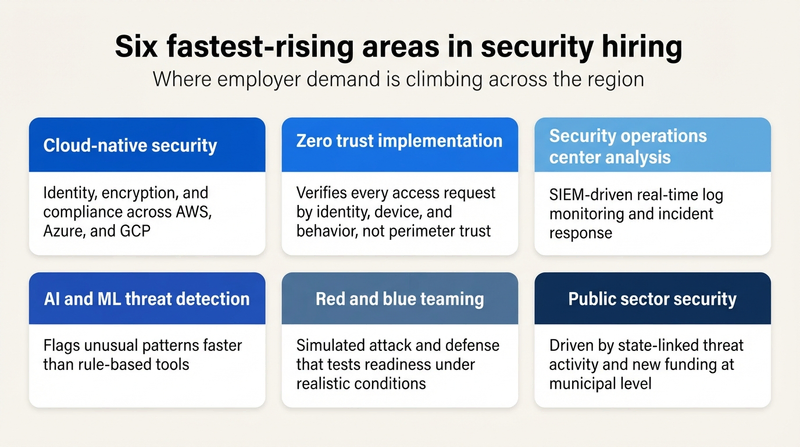
Several shifts are reshaping how organizations staff security, and each one changes what a hiring partner has to deliver. At smaller and mid-size organizations, the generalist still carries the load, covering detection, response, and compliance from a single seat. That role has only grown harder as the attack surface widened. Larger organizations move the other way, splitting the work into deeper specializations where the sharpest demand now sits. Employer type has shifted alongside role type, since public institutions across the region, municipal offices included, now hire against state-linked threat activity that the war turned into a standing condition rather than an episode.
The fastest-rising areas of demand include:
Artificial intelligence has moved into the hiring process as well. Tools now handle candidate-to-role matching and resume screening against role requirements, along with interview scheduling, which compresses the early stages of a search. What those tools cannot read is whether a person can be trusted with access to a company’s most sensitive systems. A wrong security hire does not slow a project down; it opens a door from the inside. Human judgment at the final stage is what closes that gap.
Holding onto security talent has become part of the hiring strategy rather than a separate issue. In-demand professionals weigh more than salary when they choose an employer. Funded access to threat-intelligence tools and lab environments, paid attendance at conferences such as Black Hat or DEF CON, protected time for research and certifications, and a visible path into roles like CISO or Security Architect all shift the decision. In security-critical teams, where turnover carries operational risk, that package often decides who accepts and who stays. Security staffing now rewards employers who treat it as a continuous, specialized function rather than a reaction to the last incident.
A generalist recruiter reads a security CV the way they read any other, scanning for keywords and years served. A specialist reads it for what the keywords hide. The difference shows up across every stage of the search.
On technical screening, a generalist leans on resume keywords and surface experience, while a specialist runs scenario-based tasks and tests attack-response reasoning. On regulatory awareness, the generalist carries limited familiarity with compliance regimes, whereas the specialist turns GDPR, NIS2, ISO 27001, and SOC 2 into hiring criteria, flagging early that any role handling EU personal data needs a candidate with documented GDPR training. Trust evaluation marks the sharpest split: a generic soft-skills check on one side, discretion and integrity profiling for sensitive access on the other. Role alignment follows the same line, since a generalist misses an organization’s risk posture while a specialist matches candidates to threat level and security maturity. The outcome separates them most plainly. A generalist search raises the odds of a mis-hire and stretches onboarding, while a specialist search puts someone in the seat who holds up during the first real incident and stays past it. Specialized recruitment outperforms general hiring on that single point, since the screen tests the behavior a security role turns on rather than the vocabulary printed on a CV.
Certifications such as CISSP, OSCP, or CEH signal credibility without proving it. True competence shows when a candidate reasons through a live scenario and matches the right control to the threat in front of them, weighing business risk along the way. Trust carries equal weight, since a security hire holds privileged access to the systems an attacker most wants, and a recruiter who has run those interviews before knows which answers reveal discretion under pressure.
Company size: ~60 employees
Founding year: 2016
Website: www.devsdata.com
Headquarters: Brooklyn, NY, and Warsaw, Poland
Founded in 2016, DevsData LLC works as a tech-focused recruitment firm with offices in Brooklyn and Warsaw and a team of about 60 across the US and Europe. Our Warsaw base gives clients direct access to the Polish talent pool, backed by a government-approved Polish recruitment license that lets us place candidates in the country under full local compliance. Our proprietary database holds more than 95000 vetted professionals, and a technical screen that runs about 90 minutes keeps our acceptance rate below 6%. We work on a success-fee model, so a client pays only when a hire lands, and every placement carries a guarantee period. Ratings of 5.0 on Clutch and GoodFirms, across 80+ clients and more than 100 completed projects, reflect how that approach holds up over time.
Every engagement starts by mapping the role to a client’s real exposure and compliance duties before a single candidate is contacted. The work then runs through a sequence built for the realities of security hiring:
We pair that human screen with AI-assisted sourcing and internal matching tools, so every recommendation aligns on both technical fit and culture.
Do you have IT recruitment needs?
The approach reads cleanly on paper. What it produces shows up in the engagements below, drawn from our Poland and wider regional work in security and security-adjacent hiring.
Building a security product needs engineers who understand how vulnerabilities work and how detection systems hold up, a narrower brief than standard technical hiring. Mend.io, an Israeli leader in open source security and software composition analysis, needed two senior hires to strengthen its vulnerability detection engine and scale performance-sensitive backend systems. The roles, a Senior Algorithmic Engineer and a Senior Go Developer, called for depth in graph theory, static analysis, distributed systems, and Go concurrency, a combination that thins the candidate pool further inside the security space.
DevsData LLC sourced across Eastern Europe, Israel, and selected EU markets, running scenario-based evaluations tied to the product’s demands. The engagement closed with an average eight-day time-to-offer, a 100% offer acceptance rate, and most candidates drawn from passive pools that standard channels never reach. Both engineers took ownership of core components quickly and lifted algorithmic performance and backend throughput.

Caladan, a Singapore-headquartered proprietary investment fund active in crypto trading and market making, set out to build a senior engineering hub in Poland to support a platform that processes more than $50 billion in annual transactions across 65+ exchanges. Internal hiring had stalled for months because leadership experience paired with crypto-native depth was rare, and cross-border reviews slowed every decision.
We concentrated the search in Poland, drawn by the country’s standing among the global top five for coding proficiency and its deep pool of distributed-systems engineers, then added select EU clusters where prior placements had produced strong low-latency backend talent. The stack centered on Go and Python, with Rust reserved for performance-sensitive modules. Screening mirrored the real workload, from concurrency-heavy coding tasks to API-stability tests under load, with practical Terraform and Vault exercises for the DevOps and security tracks. Asynchronous review loops between Singapore and Poland, run through shared boards and fixed checkpoints, cut decision time by close to 40%.
The funnel ran from 540 sourced candidates to 210 screened, 116 shortlisted, 78 interviewed, and 17 final hires. Across the two-year partnership, DevsData LLC placed those 17 senior hires spanning leadership, backend, DevOps, and security. Shortlists arrived in under a week; nearly four in five finalists accepted their offers.
Not every agency that lists security among its services can vet for it. A short set of questions separates a specialist from a generalist with a security tag.
Security hiring sits among the highest-stakes decisions a growing company makes, since the cost of a wrong hire shows up as exposure rather than inefficiency. Poland answers a large part of that problem. The country pairs top-tier engineering depth with salaries far below US levels, a security market that has nearly tripled in a decade, and a regulatory regime sharp enough to produce compliance-fluent specialists. The gap between demand and supply stays wide, which means the search itself decides the outcome. A partner that screens for judgment as closely as for technical skill turns that gap from a liability into an advantage, especially when it reaches candidates who never apply and moves at the speed an exposed system demands.
That is the work we do, and our placements across Poland and the wider region are where the approach proves out. If you are building a security team or filling a single mission-critical role, our recruiters can scope the search and deliver a first shortlist within days. Reach us at general@devsdata.com to start the conversation or visit www.devsdata.com, and we will map the role to your exposure before any candidate is contacted.
Discover how IT recruitment and staffing can address your talent needs. Explore trending regions
like Poland, Portugal, Mexico, Brazil and more.
 Frequently asked questions (FAQ)
DevsData – your premium technology partner
DevsData is a boutique tech recruitment and software agency. Develop your software project with veteran engineers or scale up an in-house tech team of developers with relevant industry experience.
Free consultation with a software expert
🎧 Schedule a meeting
FEATURED IN


DevsData LLC is truly exceptional – their backend developers are some of the best I’ve ever worked with.”

Nicholas Johnson
Mentor at YC, serial entrepreneur


 Build your project with our veteran developers.
Explore the benefits of technology recruitment and tailor-made software.
Learn how to source skilled and experienced software developers.
Build your project with our veteran developers.
Explore the benefits of technology recruitment and tailor-made software.
Learn how to source skilled and experienced software developers.

Rebecca Botvin

Commercial Director

Tom Potanski
Manager




Categories: Big data, data analytics | Software and technology | IT recruitment blog | IT in Poland | Content hub (blog)
















careers@devsdata.com









general@devsdata.com

"I interviewed about a dozen different firms. DevsData LLC is truly exceptional – their backend developers are some of the best I've ever worked with. I've worked with a lot of very well-qualified developers, locally in San Francisco, and remotely, so that is not a compliment I offer lightly. I appreciate their depth of knowledge and their ability to get things done quickly."

Nicholas Johnson
CEO of Orange Charger LLC,
Ex-Tesla Engineer,
Mentor at YCombinator
"DevsData reached out to us, as we've been looking to grow our engineering team in Europe and Poland. Communicating efficiently and professionally, DevsData made a strong impression with their understanding of the recruitment challenges we were facing. They designed a tailored recruitment process for our needs. I was impressed with the technical depth of their approach."

Karim Butt
Co-Founder & CTO at GlossGenius, Inc.
"Out of all the vendors we work with, DevsData clearly stands out. The quality of developers they deliver is beyond what we've received from any other vendor, and they've been able to send profile recommendations very quickly. I'm happy to be their reference for other companies from Israel and talk about their recruitment abilities and what they delivered for us."

Ran Eyal
Senior Manager at
ZIM Integrated
Shipping Services Ltd.
"DevsData demonstrated a strong degree of proactivity, taking time to thoroughly understand the problem and business perspective, and continuously suggesting performance and usability enhancements. Their app exceeded my expectations. I've worked with DevsData on numerous projects over the last 3 years and I'm very happy. Being both responsive and honest in communication."

Jonas Lee
Partner & Executive VP of Verus,
Financial LLC, Investor,
& Serial Entrepreneur
Acknowledgments