Thanks for subscribing.
Your gift is on the way.



For many startups, content marketing drives growth by helping them reach new customers and nurture lasting relationships. Companies like Duolingo and Canva show how guides, videos, and community resources turn content into a driver of recognition and long-term growth. A targeted content strategy helps startups grow their audience, increase visibility, and build trust with potential customers. The content marketing market reached $524.73 billion in 2025 and is projected to grow at a 13.53% CAGR, reaching $989.84 billion by 2030. As competition intensifies, more organizations are turning to content to achieve their business objectives and connect with their target audience.
In 2024, 45% of marketers reported plans to raise business-to-business content marketing budgets, reflecting this broader shift.
For example, HubSpot grew its software business by publishing inbound marketing guides that educated potential clients and generated qualified leads. The rise of AI-powered content tools has accelerated this trend, allowing startups to produce and distribute content at a fraction of the traditional cost. Whether aimed at businesses or consumers, content marketing serves as a proven way to inform audiences and build credibility. This article explains strategies for getting started, common mistakes to avoid, affordable content formats, and the process for selecting a marketing agency.
For startups, content marketing means sharing content that informs, entertains, or educates a specific audience without relying on direct promotion. This approach helps young companies build credibility, stand out from established competitors, and show their unique value. While often associated with consumer brands, the same methods are widely used in B2B to explain complex offerings and nurture long-term client relationships. The main goal is to attract attention, keep potential customers engaged, and guide them toward specific actions like booking a consultation, downloading a resource, or starting a free trial by offering helpful resources that address real needs.
73% of B2B marketers and 70% of B2C marketers include content marketing as part of their overall marketing strategy.
Consistently delivering valuable content helps startups earn trust and strengthen relationships with their audience. Building this trust is especially important for early-stage companies trying to establish authority and encourage repeat business. Over time, a focus on valuable content can move startups beyond single transactions and lay the groundwork for customer loyalty and higher lifetime value.
A few brands offer practical examples of content marketing in action:

Each year, Spotify compiles a personalized summary for users, showing which songs and artists they played the most. Bright visuals and sharing options have turned these annual playlists into a social media trend, raising awareness for Spotify and deepening user engagement.

Duolingo has drawn millions of followers by sharing humorous and memorable videos featuring its green owl mascot. Many clips don’t mention language learning directly, but this steady stream of creative content keeps the brand top-of-mind and makes it more approachable.

Canva’s online learning hub teaches users how to design graphics, offering step-by-step guides and tips. These resources help people get started with design and showcase Canva’s capabilities without relying on hard selling.
Each of these examples demonstrates how relevant and well-timed content connects brands with audiences, supporting growth and building recognition. This approach extends to B2B markets as well. Notion attracted business users through template galleries and workflow guides that demonstrated the product’s flexibility, thereby growing its user base without relying solely on paid advertising.
Do you have recruitment needs?
Establishing a foothold in a competitive market can be demanding for startups.
In 2023, 69% of global marketing teams increased or maintained their content spend, highlighting content’s resilience and value in uncertain times.
Content marketing helps new companies overcome early hurdles by making it easier to get noticed, build credibility, and earn trust without large advertising budgets. It allows startups to reach potential customers organically, explain new products or ideas, and create lasting connections that support long-term growth. Below are several important reasons why startups often choose this strategy:
Build trust and credibility
A startup that publishes original research based on its own user data gives readers a reason to return. Sharing detailed results from internal testing or documenting a product development process in public shows transparency that generic ad copy cannot replicate. Audiences begin associating the brand with reliability long before a sales conversation starts.
Raise brand visibility
Blog posts optimized for specific search terms attract visitors who are actively seeking answers. A how-to article ranking on the first page of search results introduces the brand to readers who have no prior awareness. Short video breakdowns posted on professional platforms reach a different audience segment, expanding the brand’s footprint across channels.
Attract and engage users
An interactive calculator embedded on a landing page pulls in visitors with a specific problem to solve. The visitor receives immediate value, and the startup captures a qualified lead in the same interaction.common-content-marketing-mistakes Targeted landing pages built around high-intent search queries deepen this effect by meeting users at the exact moment of need.
Educate the market
Product walkthrough guides reduce the learning curve for potential buyers evaluating an unfamiliar solution. A well-structured FAQ page addressing common objections serves double duty: it informs visitors and equips Sales Teams with a resource they share during outreach. Technical glossaries or explainer series break down complex topics into language that the target audience can understand without specialized knowledge.
Strengthen sales activities
A downloadable guide tied to a specific pain point generates leads that move directly into the sales pipeline. Recorded panel discussions repurposed as on-demand resources extend the value of a single production session well beyond its original audience. Embedding a cost-comparison tool on a pricing page gives prospects a personalized reference point that supports their decision.
Maximize cost efficiency
Evergreen articles continue generating organic traffic months after publication, turning a single piece into a long-term asset. Repurposing a single recorded session into blog excerpts and short social clips multiplies output without increasing production costs. Paid campaigns stop delivering once the budget runs out, while owned content builds value over time.
Startups that align content formats with real audience needs turn each published piece into a building block for sustained growth.
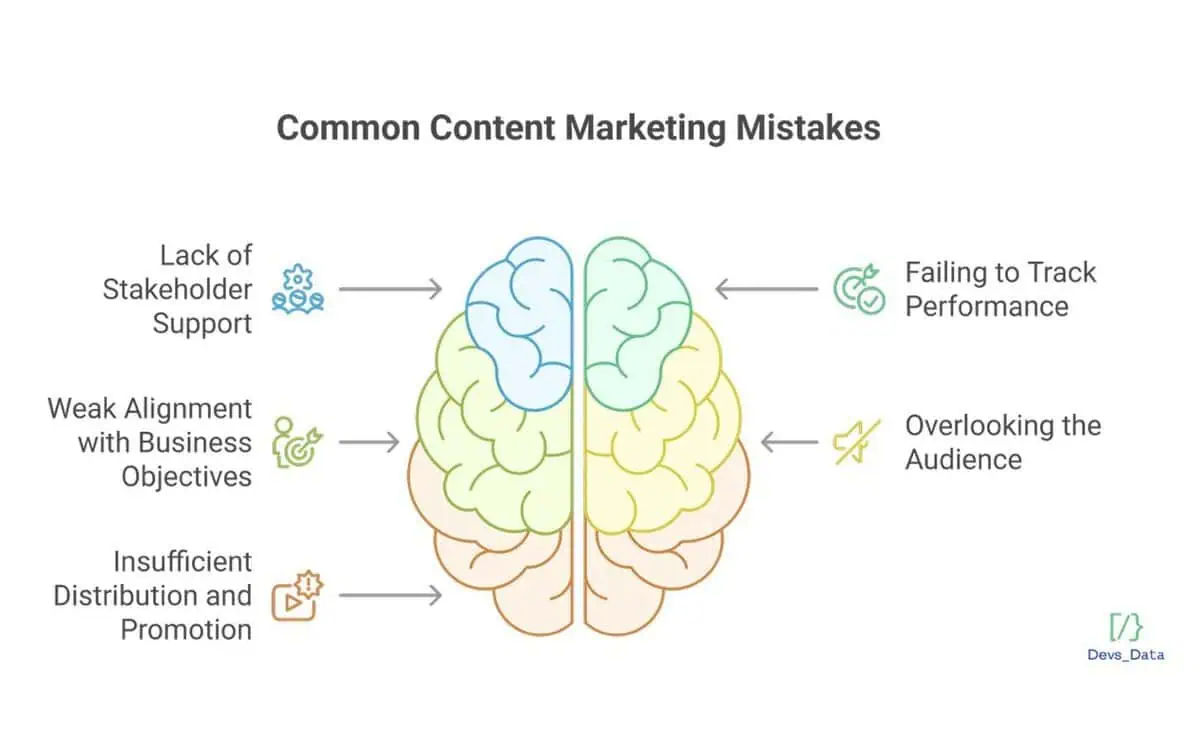
Startups often find content marketing to be a complex field, especially when operating with limited resources. Avoiding common mistakes can make a significant difference in achieving better results from content efforts.
1. Lack of stakeholder support and feedback
Content marketing projects often depend on support from key stakeholders, such as founders, company leadership, or investors. The most common challenge is not a lack of general endorsement but a shortage of direct input: reviewing drafts, supplying data for case studies, participating in interviews for thought leadership pieces, and providing feedback loops that keep content aligned with the company’s direction. Consistent updates and communication with stakeholders keep projects focused and help overcome early obstacles.
2. Failing to track performance
Creating content alone is not enough. Monitoring key performance indicators, such as organic traffic, engagement, and conversion rates, helps teams understand what is working. Reporting these numbers at least monthly allows for better decision-making and keeps all team members informed.
3. Weak alignment with business objectives
If content does not tie back to measurable business goals like increasing qualified leads, reducing customer acquisition costs, or improving conversion rates, valuable time and effort go to waste. Integration with the overall marketing plan is essential.
4. Overlooking the audience
Effective content is tailored to the target market’s interests and needs. Ignoring feedback or preferences often leads to lower engagement. Regular surveys and analysis of social media interactions can help ensure the content remains relevant.
5. Insufficient distribution and promotion
Publishing high-quality material is only part of the process. Without active promotion on suitable channels, valuable content may go unnoticed. Developing a thorough distribution plan increases visibility and helps achieve better outcomes from each campaign.
Do you have recruitment needs?
Jumping into content creation without a documented strategy is a major misstep. Businesses that lack a clear plan often find their content efforts scattered, with little connection to business objectives or measurable results. Before choosing content formats, startups should identify their audience, set specific goals, and outline a process for creating and promoting material that supports long-term growth.
96% of B2B marketers use LinkedIn for organic content marketing, while 80% use it for paid campaigns.
This widespread adoption demonstrates how social platforms play a critical role in distributing content and reaching decision-makers. A variety of cost-effective content types can help startups reach business goals and strengthen relationships. The following table summarizes key options and the distinct value each provides:
| Content type | Main business benefit | Example use case |
|---|---|---|
| Blogs and articles | Establish expertise, boost search visibility | Product guides, industry insights |
| Email newsletters and templates | Maintain engagement, provide practical value | Updates, exclusive offers, toolkits |
| Infographics and videos | Simplify complex topics, increase engagement | Visual data, explainer videos |
| Webinars and podcasts | Enable in-depth discussion, interact with audiences | Expert panels, interviews |
| eBooks and case studies | Build credibility, generate leads | Success stories, detailed guides |
| Product demos | Show real product value, address buyer questions | Feature walkthroughs, FAQs |
Selecting a thoughtful mix of these content types helps startups communicate more effectively, manage marketing costs, and support ongoing growth.
Many startups face a choice between building an in-house content team and partnering with an external agency. Hiring internally offers closer alignment with the brand but requires significant time and budget for recruitment, onboarding, and tooling. Outsourcing to an agency gives startups access to a full range of specialists from day one, often at a lower initial commitment. Selecting the right agency partner becomes a high-priority step once your startup’s content plan is in place and you are ready to scale production.
With more than 6000 digital marketing agencies operating in the US, finding a provider that truly matches your needs requires careful evaluation.
The following factors can help guide your search:
1. Ensure a full-service offering
A reliable agency handles every part of a campaign, including media planning, creative work, analytics, and integration with your internal tools. When an agency manages these details from beginning to end, it frees your team to focus on product development or customer success.
2. Look for industry expertise
The best results often come from agencies familiar with your sector, whether that is FinTech, prop-tech, health tech, or another field. Evaluate their website for references to specific industries. Review their case studies, certifications, and client lists to verify experience. If possible, ask for direct feedback from companies similar to yours.
3. Seek credible recommendations
References from respected marketing publications or professional networks can reveal a great deal about an agency’s reputation and the outcomes they deliver. Consider how peers and clients across the industry view the agency.
4. Check presence at investment and industry events
Agencies active at VC conferences or startup-focused events tend to be well-connected and understand the funding and growth cycles that affect early-stage companies. Meeting potential partners at these gatherings also gives you a sense of their approach and priorities.
5. Prioritize creativity and tailored strategies
Avoid agencies that rely on the same solutions for every client. True creativity means designing campaigns that reflect your company’s brand, audience needs, and goals. Review the agency’s proposals, pitch materials, and past work to ensure they deliver unique, thoughtful strategies. A diverse portfolio of creative solutions to a range of challenges is often a strong indicator of a flexible and innovative partner.
Choosing an agency that aligns with your business stage, industry, and growth ambitions increases the chance of success. The range of agency services varies widely, from content strategy and SEO copywriting to graphic design, social media management, and performance analytics. Some startups need end-to-end support across all these areas, while others seek a partner to handle a specific function, such as distribution or video production. Matching the agency’s strengths to your gaps makes the partnership more productive from the start.

Website: www.devsdata.com
Team size: ~60 employees
Founded: 2016
Headquarters: Brooklyn, NY, and Warsaw, Poland
DevsData LLC draws on over ten years of market experience, combining strong business acumen with expertise in Big Data and machine learning to inform data-driven content strategies. Startups gain direct access to a Google-level in-house team, including specialists with more than ten years of experience in content-focused technologies, as well as US-based experts familiar with audience expectations. This unique blend of advanced analytical skills and marketing know-how supports practical, high-impact solutions.
DevsData LLC’s client list spans the globe, including high-growth startups and global enterprises. Our reach covers a range of industries and business models worldwide, with specific experience supporting firms in the US and Israel. Notably, DevsData LLC has increased the visibility of VC-backed companies such as dotData and GlossGenius and has collaborated with premium consulting firms and demanding clients across competitive sectors.
What sets DevsData LLC apart as a startup partner is its hands-on experience across more than 100 diverse projects for over 80 organizations. Beyond execution, the company advises startups on content strategy and builds the technical platforms needed to distribute that content at scale. The company has helped agile teams and fast-growing businesses scale efficiently and adapt to changing needs. Our project portfolio includes solutions for:
DevsData LLC built a dynamic microsite to help a leading incubator present its startup curriculum. The project delivered a modern, user-friendly resource for founders and early-stage teams.
The team developed and optimized the software infrastructure for this electric vehicle charging company. Orange Charger was able to scale quickly with reliable technical support.
DevsData LLC managed end-to-end branding and website launch for a commercial space venture. Our approach enhanced the client’s visual identity and online reputation.
The company supported Wellbee from MVP through acquisition, providing continuous product development and technical direction. This enabled Wellbee to expand its online mental health services.
An all-in-one platform was built for delivering courses, managing users, and tracking progress. DevsData LLC’s work streamlined operations for education-focused organizations.
The team designed a scalable web application for tracking carbon capture projects. This solution supported the client’s mission of reducing environmental impact through advanced analytics.
Transparency is a core value at DevsData LLC, visible in every client relationship. The company’s ultra-transparent approach means startups always have clear insight into workflows and project status. Extensive guarantees, a strong business and marketing focus, and consistent 5/5 client satisfaction ratings on platforms like Clutch and GoodFirms further underline DevsData LLC’s ability to help startups maximize their investment and accelerate growth in a competitive market.

Explore how DevsData LLC can accelerate your startup’s growth with tailored content marketing and technology solutions. Visit www.devsdata.com or reach out at general@devsdata.com to get started.
Do you have recruitment needs?
Startup founders often face the question of how much to budget for a partnership with a marketing agency. Costs can vary widely depending on the required services, the agency’s expertise, and the project’s complexity. Understanding the main pricing models can help in planning and decision-making.
Agencies typically charge a flat monthly fee or set up a retainer for ongoing search optimization and content creation. Pricing reflects the volume of content, expected outcomes, and the agency’s track record.
Some firms charge a percentage of your advertising spend, while others use a fixed monthly rate. It’s important to clarify how fees are calculated and what specific results the agency aims to deliver.
A monthly retainer typically covers regular newsletters, while campaigns such as drip sequences or automations may be billed as one-time projects. Costs depend on campaign complexity and the agency’s level of involvement.
Designing sales materials such as brochures or presentations may involve a retainer or be priced per project. These fees reflect the time, creative work, and resources required for each asset.
Visual content, from videos to graphics, is most often billed separately for each project. This category includes everything from social media graphics to branded videos and other creative deliverables.
Pricing structures vary across agencies, so it’s important to request a detailed cost breakdown before making a commitment. This helps ensure the investment aligns with your startup’s goals and resources.
As a general benchmark, startups working with mid-tier agencies typically spend between $3000 and $10000 per month on agency fees for content marketing services. Paid media budgets add another $1000 to $15000 per month, depending on the channels and campaign objectives. Larger, full-service engagements with established agencies can exceed $20000 per month when combining strategy, content production, and distribution. Requesting a detailed cost breakdown before committing helps confirm that the investment aligns with your startup’s goals and resources.
Content marketing gives startups an affordable way to build their brand and reach potential customers, even with limited resources. For many early-stage companies, sharing practical articles, guides, or videos helps explain new products, demonstrate value, and earn credibility in a crowded field. Startups benefit from content that adapts quickly as their businesses evolve or pivot. Working with a partner who understands the fast-changing needs of startups ensures each campaign stays relevant and supports real growth. When done well, content marketing can help startups stand out, win loyal customers, and grow in competitive markets.
DevsData LLC delivers specialized support to startups through content strategy consulting, copywriting, design, and custom platform development, powered by a team that features Google-level in-house Engineers and US-based Specialists. Drawing on more than ten years of experience, the company has successfully completed over 100 software projects for 80+ clients worldwide. This proven track record, combined with advanced technical and marketing skills, positions DevsData LLC as a trustworthy partner for startups seeking effective content marketing solutions that drive measurable results.
For further details on DevsData LLC’s services, contact us at general@devsdata.com or explore our website at www.devsdata.com.
Any questions or comments? Let me know on
Twitter/X.
Discover how IT recruitment and staffing can address your talent needs. Explore trending regions
like Poland, Portugal, Mexico, Brazil and more.
 Frequently asked questions (FAQ)
DevsData – your premium technology partner
DevsData is a boutique tech recruitment and software agency. Develop your software project with veteran engineers or scale up an in-house tech team of developers with relevant industry experience.
Free consultation with a software expert
🎧 Schedule a meeting
FEATURED IN


DevsData LLC is truly exceptional – their backend developers are some of the best I’ve ever worked with.”

Nicholas Johnson
Mentor at YC, serial entrepreneur


 Build your project with our veteran developers.
Explore the benefits of technology recruitment and tailor-made software.
Learn how to source skilled and experienced software developers.
Build your project with our veteran developers.
Explore the benefits of technology recruitment and tailor-made software.
Learn how to source skilled and experienced software developers.

Rebecca Botvin

Commercial Director

Tom Potanski
Manager




Categories: Big data, data analytics | Software and technology | IT recruitment blog | IT in Poland | Content hub (blog)
















careers@devsdata.com









general@devsdata.com

"I interviewed about a dozen different firms. DevsData LLC is truly exceptional – their backend developers are some of the best I've ever worked with. I've worked with a lot of very well-qualified developers, locally in San Francisco, and remotely, so that is not a compliment I offer lightly. I appreciate their depth of knowledge and their ability to get things done quickly."

Nicholas Johnson
CEO of Orange Charger LLC,
Ex-Tesla Engineer,
Mentor at YCombinator
"DevsData reached out to us, as we've been looking to grow our engineering team in Europe and Poland. Communicating efficiently and professionally, DevsData made a strong impression with their understanding of the recruitment challenges we were facing. They designed a tailored recruitment process for our needs. I was impressed with the technical depth of their approach."

Karim Butt
Co-Founder & CTO at GlossGenius, Inc.
"Out of all the vendors we work with, DevsData clearly stands out. The quality of developers they deliver is beyond what we've received from any other vendor, and they've been able to send profile recommendations very quickly. I'm happy to be their reference for other companies from Israel and talk about their recruitment abilities and what they delivered for us."

Ran Eyal
Senior Manager at
ZIM Integrated
Shipping Services Ltd.
"DevsData demonstrated a strong degree of proactivity, taking time to thoroughly understand the problem and business perspective, and continuously suggesting performance and usability enhancements. Their app exceeded my expectations. I've worked with DevsData on numerous projects over the last 3 years and I'm very happy. Being both responsive and honest in communication."

Jonas Lee
Partner & Executive VP of Verus,
Financial LLC, Investor,
& Serial Entrepreneur
Acknowledgments