Thanks for subscribing.
Your gift is on the way.



In 2026, teams rarely struggle to find developers. They struggle because the work is ambiguous: AI features that touch data privacy, legacy systems that can’t be paused, cloud costs that keep rising, and Stakeholders who need a clear decision, not another technical debate. In these moments, the real bottleneck is choosing the right direction quickly and building it safely in production.
The economic picture reinforces that distinction. According to Dice’s 2025 Tech Salary Report, the average US technology professional now earns USD 112521, marking a 1.2 percent year-over-year increase even amid cost pressures.
Meanwhile, findings from The Pragmatic Engineer’s 2024 “Senior-and-Above Compensation” survey confirm that Senior Engineers and Technical Leaders continue to command a significant premium, evidence that deep, production-level expertise remains one of the most valued assets in technology organizations.
Yet technical execution is only one side of the equation. The consulting market, despite broader economic uncertainty, continues to expand. Bloomberg Tax 2025 reports that the US consulting sector is expected to grow by about 6% this year, fueled by rising corporate demand for advisory services in AI adoption and digital transformation. Likewise, Management Consulted 2025 notes that consulting recruiting remains one of the most competitive cycles in recent memory, with firms continuing to invest heavily in strategic roles even as other industries reduce headcount.
Within that expanding market, Software Consultants occupy a distinct position. They sit closer to the product than a management Consultant and closer to the business than a Senior Engineer, translating organizational pressure around AI, cloud migration, and system modernization into concrete technical plans. That hybrid positioning explains much of the demand growth the data reflects.
Together, these data points illustrate a clear trend: while organizations still reward Senior Engineers for the precision and depth that keep products stable and scalable, they increasingly depend on Software Consultants to interpret technological change and guide long-term decisions. The two paths are not rivals but complements, one focused on building the solution, the other on defining why and how it should be built. In the following sections, we’ll explore the practical differences between the two roles, the skills that set them apart, and how both shape the evolving structure of modern software teams in 2026.
A Software Consultant is an IT professional who advises on and often leads the implementation of software initiatives that address business challenges, spanning strategy, system design, and large-scale deployment programs such as ERP rollouts and digital transformations.
They often carry out these tasks in collaboration with Software Developers. These professionals are usually Senior Developers with years of experience and know-how in the industry. As the name implies, the main role of these professionals is consultancy, i.e. offering their expert advice. They provide an independent and unbiased health check of your organization’s current business and technology plans, identifying strategic misalignment, architectural risk, delivery bottlenecks, and cost inefficiencies before they turn into execution failures. They zero in on the tech-related weak spots and areas of improvement within business operations and then propose solutions.
| Category | Key elements |
|---|---|
| Core responsibilities | – Analyze business and technical environments to align software solutions with strategic goals. – Define and document software requirements and technical specifications. – Lead or oversee implementation programs, from ERP deployments and platform migrations to full-scale digital transformations. – Test and validate solutions for reliability, performance, and scalability. – Advise and train clients to ensure effective adoption and long-term success. |
| Essential skills | – Strong command of programming, architecture, and modern software frameworks. – An analytical mindset to translate complex business problems into actionable solutions. – Clear communication with both technical teams and non-technical Stakeholders. – Business acumen to align technology choices with ROI and company strategy. – Ability to lead and manage IT teams, including client-side engineering groups and cross-functional delivery teams. – Adaptability and curiosity for emerging fields like AI, cloud computing, and cybersecurity. |
| Areas of specialization | – Cloud computing and DevOps: designing scalable, automated infrastructures. – Data analytics and AI: turning data into insights and predictive tools. – Cybersecurity: protecting systems and ensuring compliance. – ERP and CRM systems: integrating enterprise processes and customer management tools. |
Typical engagements reflect this range of expertise. Software Consultants frequently lead digital transformation programs, oversee ERP and enterprise systems implementations, and manage large-scale eCommerce platform builds or mobile application rollouts. These projects often span multiple departments and require coordinating technical delivery with business process change across the organization.
Compensation for Software Consultants varies significantly depending on seniority, specialization, and whether the Consultant works independently or within a larger organization. However, recent market data provides a clear picture of how competitive these roles have become.
According to Glassdoor 2025, the total pay range for a Software Consultant in the United States is USD 134000–233000 per year, with a median total compensation of around USD 176000.
Base pay typically falls between USD 97000 and 164000, while additional pay, including bonuses, profit-sharing, and stock, averages USD 37000 to 69000 annually.
These figures reflect the strong market demand for professionals who can bridge business strategy with technical execution. Consultants with expertise in cloud infrastructure, data analytics, or AI systems tend to earn at the higher end of this range, while early-career or domain-generalist roles align closer to the lower bands.
Compared to the broader US technology sector, where the average professional earns roughly USD 112000 annually, Software Consultants command a noticeable premium. This difference underscores the value organizations place on advisory capabilities and the ability to translate complex technical initiatives into measurable business outcomes.
Do you have software development needs?
Building a career as a Software Consultant requires a mix of technical skills, business understanding, and continuous professional growth. The following steps outline a practical path toward establishing yourself in this field:
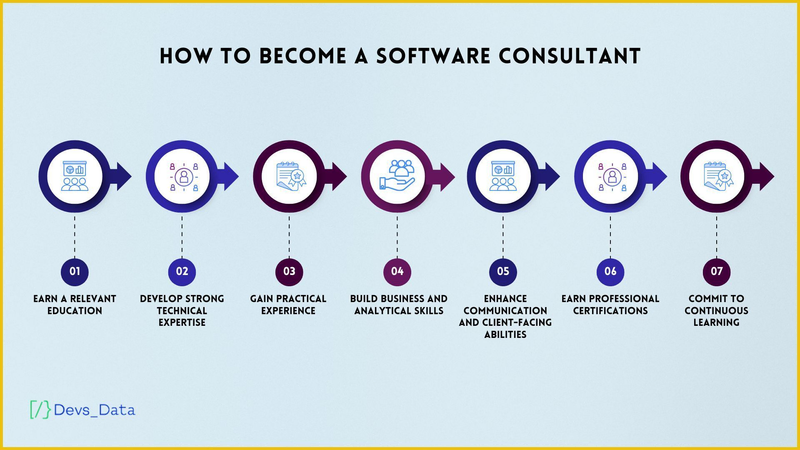
Start with a bachelor’s degree in computer science, information technology, or a related area. A postgraduate specialization or MBA can provide an additional advantage for roles that blend technology and business.
Gain proficiency in programming languages such as Java, Python, or C++, as well as enterprise platforms like SAP, Oracle, or Microsoft Dynamics. Learn the principles of software development, Agile and DevOps practices, and cloud platforms like AWS or Azure. ERP implementation and configuration is a common career path, making platform-specific knowledge as valuable as general programming ability.
Work on real projects through internships, entry-level developer roles, or freelance work. Exposure to different technologies, industries, and team structures builds versatility and credibility.
Understand how technology creates business value. Strengthen your skills in project management, process analysis, and strategy to connect technical solutions with measurable outcomes.
Develop clear communication, presentation, and negotiation skills. Being able to explain technical concepts in a business-friendly way is what separates Consultants from Developers.
Obtain certifications such as AWS Certified Solutions Architect, Microsoft Certified: Azure Solutions Architect Expert, ITIL for IT service management, or PMP from the Project Management Institute to validate your technical and management knowledge.
Stay current with new tools and trends in AI, data analytics, cybersecurity, and cloud computing. A habit of learning ensures long-term growth and adaptability.
A great Software Consultant is more than a skilled technologist. They combine technical expertise with strategic thinking, helping organizations build effective systems and make smarter decisions that drive lasting business success.
As digital transformation becomes a baseline expectation for organizations, Consultants will shift from merely delivering software to architecting ecosystems powered by AI, machine learning, and advanced analytics. The imperative won’t just be “build this app”, it will be “design a system that learns, adapts, and scales over time.”
Cloud, DevOps, and agile practices will continue to dominate. Consultants will be judged not simply on solution design, but on how well they can embed continuous integration, delivery, observability, and resilience into client systems. The ability to oversee infrastructure, manage software pipelines, and ensure operational stability will become integral to consulting engagements.
AI will reshape consulting engagements at every level. Consultants will increasingly be expected to evaluate AI readiness across client organizations, define adoption strategies, and oversee the integration of large language models, computer vision, and predictive systems into existing workflows. As AI agents become capable of handling routine development and analysis tasks, the Consultant’s role will shift toward governance, model selection, risk assessment, and ensuring that AI deployments align with regulatory and ethical standards. Proficiency in AI will move from a specialization to a baseline expectation for Software Consultants within the next few years.
At the same time, the growth of IoT (Internet of Things), edge computing, and cross-device architectures will widen the scope of software consulting. Deploying intelligent agents across devices, securing data at the edge, and delivering seamless user experiences across platforms will demand more breadth in technical expertise.
The consulting market itself is expanding rapidly. According to Grand View Research, the global software consulting market is projected to grow at a compound annual growth rate (CAGR) of 12.58% from 2025 through 2034, reaching over USD 1143 billion by then.
As these trends unfold, Software Consultants will evolve into strategic partners, not just executors of code, but trusted guides helping organizations chart paths through technological uncertainty. Their influence will extend into governance, ethics, and ecosystem design, especially as human-centric skills (empathy, collaboration, ethical judgment) become crucial for aligning technology to business values.
Looking ahead, the future of software consulting is not only about more intelligent tools, but it’s also about deep integration with business strategy and responsible stewardship of evolving digital systems. Consultants who master both the human and technical dimensions will lead in this next phase of transformation.
Do you have software development needs?
A Senior Engineer’s job, on the other hand, focuses more on the actual building of software. These professionals design, build, test, and maintain software systems that support a company’s operations. They’re usually part of a development team, supporting others in designing, building, testing, and maintaining IT systems.
Senior Software Engineers have numerous years of programming experience, hence their senior status. They usually have advanced knowledge of at least one major programming language and a strong understanding of additional languages as well.
They possess project management know-how and understand coding and frameworks, information analysis, and software design, architecture, documentation, testing, and maintenance. While Software Consultants are typically responsible for clarifying direction and reducing uncertainty at the strategic level, Senior Engineers frequently contribute to strategy through architecture decisions, feasibility assessments, and long-term system design, in addition to building and maintaining the software itself.
| Category | Key elements |
|---|---|
| Core responsibilities | – Design, develop, and maintain complex software systems that meet business and technical requirements. – Lead architecture decisions and establish coding standards to ensure maintainability and scalability. – Collaborate with Product Managers, Designers, and QA teams to translate specifications into production-ready solutions. – Review code, mentor Junior Engineers, and promote best engineering practices across teams. |
| Essential skills | – Advanced proficiency in at least one major programming language (such as Java, Python, or C++). – Deep understanding of software architecture, design patterns, and data structures. – Strong knowledge of version control, CI/CD pipelines, and automated testing. – Ability to manage technical debt, balance trade-offs, and ensure long-term code quality. – Proficiency with AI-assisted development tools such as Cursor, GitHub Copilot, and Claude Code to accelerate coding, debugging, and code review workflows. – Leadership and mentoring skills to guide teams toward efficient and high-quality delivery. |
| Areas of specialization | – Backend engineering: building and maintaining scalable APIs, microservices, and distributed systems. – Frontend development: creating user-centric interfaces with frameworks like React, Angular, or Vue.js. – DevOps and cloud infrastructure: managing CI/CD, containerization, and deployments using platforms such as AWS, Azure, or GCP. – Data engineering: designing pipelines for processing, storing, and analyzing large-scale datasets. – Mobile development: developing native and cross-platform applications for iOS and Android. – AI and automation: integrating machine learning models and automation into existing systems to improve performance and intelligence. |
Salaries for Senior Engineers remain among the highest in the technology sector, reflecting the combination of deep technical expertise, architectural ownership, and leadership responsibility that the role demands. Compensation varies based on experience, specialization, and company size, yet the overall trend continues to show strong upward pressure in 2026.
According to Glassdoor 2025, a Senior Software Engineer in the United States earns an average salary of around USD 189845 per year, with most professionals earning between USD 156512 and 245852 annually (25th to 75th percentile).
The upper end of this range typically reflects engineers with expertise in cloud architecture, distributed systems, and AI-driven solutions, as well as those working within large-scale enterprise or high-growth product environments. In contrast, salaries closer to the lower quartile are more common among generalist engineers or those in smaller organizations.
Geographic and organizational factors play a substantial role as well. Senior Engineers in major US tech hubs such as San Francisco, Seattle, or Boston often receive total compensation packages that exceed these averages once bonuses, stock options, and equity are included. Remote-first companies, on the other hand, tend to offer competitive pay adjusted to regional cost-of-living indexes while maintaining performance-based incentives.
These figures highlight how the Senior Engineer’s role has evolved beyond coding into one of technical leadership and long-term system stewardship, a key driver of value in modern technology organizations.
Becoming a Senior Engineer takes years of focused learning, hands-on experience, and a dedication to mastering both technical depth and engineering leadership. The following steps outline a practical roadmap for reaching this level:
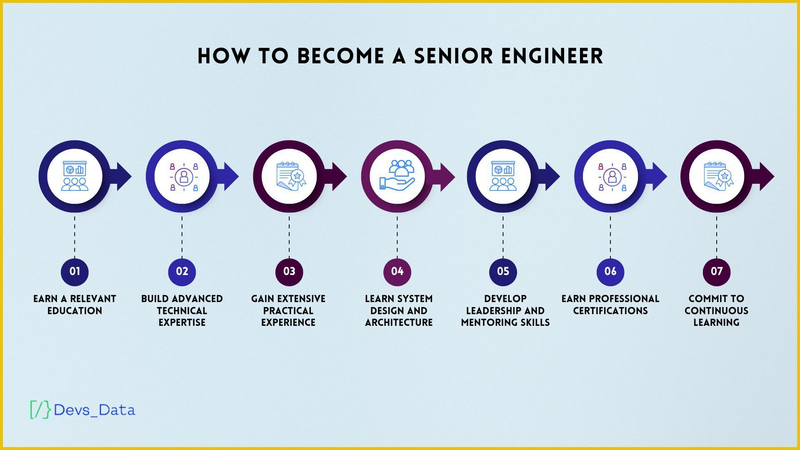
Begin with a bachelor’s degree in computer science, software engineering, or a related technical field. A postgraduate degree or specialization in systems architecture, AI, or data engineering can further strengthen your foundation.
Develop strong proficiency in programming languages such as Java, Python, or C++. Gain experience with modern frameworks, design patterns, and software architecture principles. Understanding DevOps, cloud platforms, and CI/CD pipelines is equally essential.
Work on diverse projects that expose you to full product lifecycles, from design to deployment and maintenance. Focus on solving complex engineering challenges and contributing to scalable, high-quality codebases.
Move beyond coding tasks to designing distributed systems, managing scalability, and making architectural decisions. Familiarize yourself with trade-offs in performance, cost, and reliability.
Senior Engineers often guide others. Take initiative in code reviews, technical planning, and team discussions. Learn to delegate, mentor Junior Developers, and communicate technical ideas effectively.
Validate your expertise with certifications such as AWS Certified DevOps Engineer, Google Cloud Professional Engineer, or Certified Kubernetes Administrator (CKA). These credentials demonstrate practical mastery and commitment to best practices.
Stay current with evolving technologies in AI, cloud computing, and cybersecurity. Attend conferences, read engineering blogs, and explore open-source projects to remain adaptable and innovative.
At the senior level, the role extends beyond writing code to include system design, long-term maintainability, and technical leadership within the team. Senior Engineers are also increasingly expected to evaluate and integrate AI tools into development workflows, from code generation and automated testing to architecture-level decisions about where AI adds genuine value. They combine deep technical insight with sound judgment, ensuring that every engineering decision strengthens both the product and the team behind it.
Although Software Consultants and Senior Engineers often work on the same projects, their impact and focus differ. Consultants serve as strategic advisors, turning business needs into technical direction, while Senior Engineers convert those strategies into scalable, reliable systems. Understanding how the roles complement each other is key to building teams that balance strategic insight with technical execution. The following subsections highlight their core differences and contributions to organizational success.
The main distinction between a Software Consultant and a Senior Engineer lies in where they create value. Consultants operate at the strategic level, identifying business challenges, shaping technology roadmaps, and ensuring initiatives support organizational goals. Their strength is linking business strategy with technical feasibility. Senior Engineers work at the implementation level, turning those strategic plans into functional, scalable systems. While Consultants decide what to build and why, Senior Engineers determine how to build it, ensuring precision, performance, and long-term maintainability.
Software Consultants and Senior Engineers both make critical decisions, but their scopes differ. Consultants operate at a higher organizational level, advising on technology investments, architecture, and long-term strategy. They shape the overall direction and how technology supports business goals, and frequently take on management responsibility for entire software teams or departments during engagements. Senior Engineers focus on execution, choosing frameworks, tools, and implementation approaches to ensure stability and scalability. While Consultants guide direction, Senior Engineers ensure each technical decision brings that vision to life.
The daily focus of Software Consultants and Senior Engineers differs depending on who they serve. Consultants are client-oriented, working across industries to understand business models, identify pain points, and shape technology strategies. Senior Engineers are product-oriented and embedded within a single company or team to ensure the reliability, performance, and scalability of long-term software systems. While Software Consultants adapt to varied business contexts, Senior Engineers go deep into a single codebase to maintain technical excellence.
| Aspect | Software Consultant | Senior Engineer |
|---|---|---|
| Core skills | Business analysis, communication, systems thinking, and advisory insight | Programming expertise, software architecture, debugging, and optimization |
| Technical depth | Broad understanding across multiple domains to guide strategic decisions | Deep specialization in specific technologies, frameworks, and tools |
| Analytical focus | Evaluates business challenges and proposes technology-driven solutions | Analyzes system performance, scalability, and technical constraints |
| Deliverables | Reports, strategy documents, technical roadmaps, and recommendations | Production-ready software, system components, and architecture designs |
| Collaboration | Engages with executives, clients, and cross-functional teams | Works with Developers, Designers, and Product Managers to deliver features |
| Goal | Enable informed decision-making and long-term technology planning | Build efficient, reliable, and maintainable software systems |
The two roles rarely overlap in deliverables, yet each role’s output depends on the other’s quality. A Consultant’s roadmap is only as strong as the team’s ability to execute it, and an Engineer’s code delivers full value only when it serves a well-defined strategic objective. Organizations that staff both roles early in a project tend to avoid costly misalignment later.
Software Consultants and Senior Engineers operate in different spheres, but their success is tightly linked. Consultants set strategic direction, ensuring software initiatives align with business goals and deliver value. Senior Engineers turn that strategy into reality by designing, building, and maintaining the systems behind it. Without Consultants, teams risk building misaligned solutions; without strong Engineers, strategy remains theoretical. When both roles collaborate well, organizations gain a clear vision and precise execution.
Modern organizations thrive when strategic insight and technical execution work together. Software Consultants align technology with business priorities, guiding decisions around digital transformation, scalability, and innovation. Senior Engineers turn those visions into reality, upholding technical standards and performance at scale. Both roles are essential: Consultants provide clarity and direction, while Engineers ensure reliability and precision. Together, they create sustainable software success and long-term value.
The choice of a Software Consultant affects how well a company navigates complexity, aligns Stakeholders, and executes large-scale technology initiatives. The Consultant you choose should not only be technically skilled but also capable of translating business goals into actionable, efficient, and scalable solutions. The following factors are essential when evaluating potential partners.
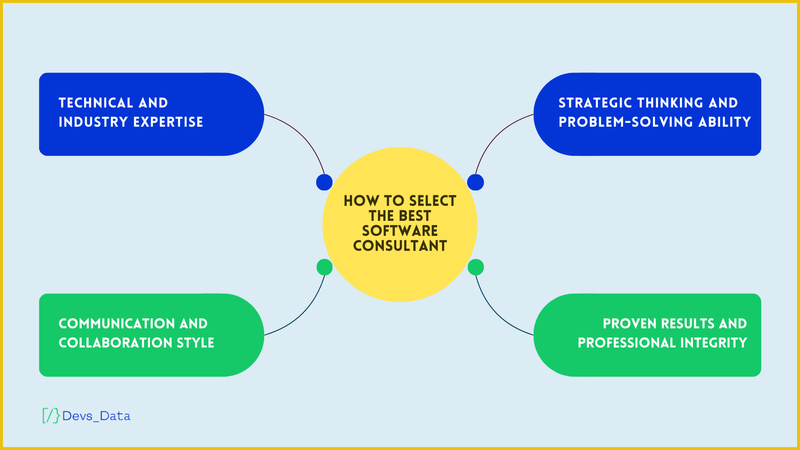
A strong Software Consultant brings both depth and context. Beyond technical proficiency in programming, architecture, and cloud systems, they should understand the specific challenges of your industry. A Consultant experienced in finance, healthcare, or eCommerce can better anticipate compliance requirements, customer behavior, and integration complexities. Review case studies, certifications, and past project outcomes to ensure their expertise aligns with your business domain and technology stack.
The best Consultants do not simply execute tasks; they think strategically. Look for individuals or firms that begin by understanding your business model, goals, and long-term vision. They should be able to analyze bottlenecks, propose scalable system architectures, and quantify the expected business impact of their recommendations. During interviews or proposal reviews, ask open-ended questions about how they would handle trade-offs between cost, scalability, and time to market. Their answers reveal whether they think beyond code and focus on sustainable value creation.
Effective communication is what distinguishes a great Consultant from a merely competent one. The ideal Consultant should be able to explain complex technical concepts in an accessible language and maintain transparency throughout the project. They should integrate smoothly with internal teams, listen actively to stakeholder feedback, and encourage shared ownership of project outcomes. A collaborative approach reduces friction, aligns priorities, and ensures the final product reflects both strategic and operational needs.
A Consultant’s credibility is best measured by their track record. Ask for verifiable references, performance metrics, or examples of how their work contributed to measurable business growth. Reputable Consultants prioritize long-term relationships over short-term gains, are transparent about risks, and set realistic expectations. Ethical integrity and accountability are just as important as technical ability, since they directly influence trust, efficiency, and the overall success of the engagement.
Choosing the right Consultant means choosing a partner who combines technical depth, business intelligence, and integrity. When those qualities align, the Consultant becomes more than an external expert; they become an extension of your organization, driving innovation and sustainable success.
Sourcing qualified Software Consultants and Senior Engineers through general job boards or internal HR alone often leads to lengthy hiring cycles and mismatched candidates. Specialized technology recruitment agencies and consulting firms offer a more targeted approach, providing pre-vetted talent pools, industry-specific screening, and faster placement timelines. For complex projects that require both strategic and technical expertise, working with a partner that combines consulting advisory with recruitment capabilities reduces the risk of assembling a team where one side outweighs the other.
Digital initiatives rarely succeed with only strategy or only execution. A Consultant can define the right solution, but without strong engineering leadership, that strategy never becomes a reliable product. A Senior Engineer can write exceptional code, but without strategic guidance, the product may solve the wrong problem, miss market needs, or introduce unnecessary complexity. That’s why understanding the distinction is essential for business owners: choosing the wrong role delays projects, increases costs, and reduces the likelihood of long-term success.
This leads into DevsData LLC as the partner capable of providing both sides. Our experience supporting technology-driven companies worldwide demonstrates what an effective partnership looks like in practice.
Website: www.devsdata.com
Company size: ~60 employees
Founding year: 2016
Headquarters: Brooklyn, NY, and Warsaw, Poland
DevsData LLC is a trusted partner for organizations seeking to strengthen their technical leadership and software delivery capabilities. We combine deep expertise in software consulting, engineering advisory, and global recruitment to help businesses build high-performing teams and achieve measurable results. Our role extends beyond traditional hiring; we deliver both the strategic insight of Consultants and the technical excellence of Senior Engineers, ensuring our clients gain lasting value from every engagement.
With a proprietary network of over 95000 vetted professionals and a 60+ person international team based across the United States and Europe, DevsData LLC supports companies at every stage of growth. We specialize in matching organizations with Senior Software Consultants, System Architects, and Technical Leaders who can drive modernization, scalability, and innovation. Our in-house experts also provide advisory support, from defining architecture roadmaps to optimizing product development workflows.
We operate under an official government-approved recruitment license and on a success-fee model, meaning clients pay only after a successful hire. Each candidate undergoes a rigorous, data-backed selection process, including structured behavioral interviews, role-specific simulations, and remote-readiness assessments. With an acceptance rate below 6%, every placement meets the highest standards of technical proficiency, integrity, and cultural fit.
DevsData LLC serves global enterprises and high-growth startups across the United States, Israel, and Europe, delivering results in industries such as FinTech, Healthcare, eCommerce, and EdTech. Our clients value our ability to combine strategic advisory with operational delivery, helping them design software solutions, assemble distributed teams, and scale digital operations efficiently.
Having completed over 100 projects for more than 100 global clients, and holding 5.0 ratings on platforms such as Clutch and GoodFirms, DevsData LLC is recognized for precision, transparency, and performance. Whether advising on a large-scale software initiative or building a remote engineering team from the ground up, we ensure every engagement translates technical excellence into measurable business impact. A strong example of DevsData LLC’s combined consulting and recruitment expertise is the collaboration with Memory AS, a Norwegian SaaS company developing AI-powered productivity and time-tracking solutions. Facing rapid growth and a government-backed innovation grant, Memory AS needed to expand its engineering capacity quickly with Senior Ruby Developers skilled in distributed systems and AI integration. Instead of relying solely on local hiring channels, the company partnered with DevsData LLC, which provided both strategic advisory on team composition and end-to-end recruitment support.
Within just six weeks, DevsData LLC identified and placed two Senior Ruby Engineers from Europe and Asia, cutting the client’s time-to-hire by more than half. The partnership enabled Memory AS to accelerate feature development, strengthen its AI capabilities, and meet project milestones without compromising quality or scalability. This case highlights how DevsData LLC’s hybrid model, combining software consulting insight with targeted technical recruitment, helps technology companies scale efficiently while maintaining precision and performance.
If you’re planning a major software initiative or need senior technical leadership, our team can guide you from strategy to execution.
Do you have software development needs?
Learn more about DevsData LLC at www.devsdata.com or reach the team directly at general@devsdata.com.
As technology becomes more deeply embedded in every aspect of business, understanding the distinction between Software Consultants and Senior Engineers has never been more critical. Consultants provide the strategic perspective that aligns software initiatives with business goals, while Senior Engineers deliver the technical excellence that turns those strategies into scalable, reliable systems. Together, they form the foundation of effective digital transformation.
In 2026 and beyond, organizations that integrate both functions, strategic consulting and high-level engineering, will be best positioned to innovate quickly, manage complexity, and sustain long-term growth. The combination of business insight and technical precision drives measurable value, ensuring that each technological investment contributes to real outcomes rather than isolated innovation.
DevsData LLC stands at this intersection of consulting and engineering. With expertise in both strategic advisory and recruitment, the company helps global businesses design technology strategies, assemble expert teams, and execute projects with confidence. Whether building distributed engineering functions or advising on digital transformation, DevsData LLC delivers the people and processes that enable lasting software success.
Discover how IT recruitment and staffing can address your talent needs. Explore trending regions like Poland, Portugal, Mexico, Brazil and more.
 Frequently asked questions (FAQ)
DevsData – your premium technology partner
DevsData is a boutique tech recruitment and software agency. Develop your software project with veteran engineers or scale up an in-house tech team of developers with relevant industry experience.
Free consultation with a software expert
🎧 Schedule a meeting
FEATURED IN

DevsData LLC is truly exceptional – their backend developers are some of the best I’ve ever worked with.”

Nicholas Johnson
Mentor at YC, serial entrepreneur


 Build your project with our veteran developers.
Explore the benefits of technology recruitment and tailor-made software.
Learn how to source skilled and experienced software developers.
Build your project with our veteran developers.
Explore the benefits of technology recruitment and tailor-made software.
Learn how to source skilled and experienced software developers.

Rebecca Botvin

Commercial Director

Tom Potanski
Manager




Categories: Big data, data analytics | Software and technology | IT recruitment blog | IT in Poland | Content hub (blog)











careers@devsdata.com









general@devsdata.com

"I interviewed about a dozen different firms. DevsData LLC is truly exceptional – their backend developers are some of the best I've ever worked with. I've worked with a lot of very well-qualified developers, locally in San Francisco, and remotely, so that is not a compliment I offer lightly. I appreciate their depth of knowledge and their ability to get things done quickly."

Nicholas Johnson
CEO of Orange Charger LLC,
Ex-Tesla Engineer,
Mentor at YCombinator
"DevsData reached out to us, as we've been looking to grow our engineering team in Europe and Poland. Communicating efficiently and professionally, DevsData made a strong impression with their understanding of the recruitment challenges we were facing. They designed a tailored recruitment process for our needs. I was impressed with the technical depth of their approach."

Karim Butt
Co-Founder & CTO at GlossGenius, Inc.
"Out of all the vendors we work with, DevsData clearly stands out. The quality of developers they deliver is beyond what we've received from any other vendor, and they've been able to send profile recommendations very quickly. I'm happy to be their reference for other companies from Israel and talk about their recruitment abilities and what they delivered for us."

Ran Eyal
Senior Manager at
ZIM Integrated
Shipping Services Ltd.
"DevsData demonstrated a strong degree of proactivity, taking time to thoroughly understand the problem and business perspective, and continuously suggesting performance and usability enhancements. Their app exceeded my expectations. I've worked with DevsData on numerous projects over the last 3 years and I'm very happy. Being both responsive and honest in communication."

Jonas Lee
Partner & Executive VP of Verus,
Financial LLC, Investor,
& Serial Entrepreneur
Acknowledgments