Thanks for subscribing.
Your gift is on the way.



As digital transformation accelerates across industries, Western companies are facing mounting pressure to scale engineering capacity at speeds their domestic hiring channels struggle to match, pushing them toward offshore regions where specialist supply is more accessible. According to Gartner, global IT spending is projected to reach $5.74 trillion by the end of 2025, reflecting a 9.3% year-over-year increase and underscoring how deeply technology is embedded in modern business strategy. As demand for digital capabilities rises, so does the need for qualified technical talent capable of delivering and maintaining these systems at scale.
However, this demand collides with a persistent and widening talent shortage across Western markets. Many companies struggle to hire experienced engineers, product specialists, and technical managers locally within reasonable timelines or budgets. A ManpowerGroup survey shows that 74% of employers globally report difficulty finding the skilled talent they need, marking one of the most severe talent shortages in decades. For technology-driven businesses, this gap directly translates into delayed product launches, overstretched internal teams, and rising labor costs – factors that increasingly undermine competitiveness.
Against this backdrop, offshore staffing has evolved from a cost-driven tactic into a strategic workforce model. By accessing global talent pools, companies can scale teams faster, diversify skill sets, and maintain operational flexibility without compromising delivery standards. Yet successful offshoring is rarely achieved through ad-hoc hiring or transactional outsourcing alone. Collaborating with a specialized offshore staffing agency allows businesses to mitigate risks related to quality, communication, compliance, and long-term team stability, turning offshore recruitment into a controlled, scalable extension of internal operations.
In this article, we share our experience with offshore staffing by examining current market dynamics, outlining tangible business benefits, comparing common offshoring models, and reviewing leading offshore destinations. We also address key recruitment challenges, explain how to evaluate offshore staffing agencies, and detail why DevsData LLC operates as a reliable partner in this space.
The offshore staffing market is shaped less by geography today and more by structural shifts in how companies build and operate technology teams. As digital systems become central to revenue generation, compliance, and customer experience, businesses are reassessing where and how engineering capacity is sourced. Offshore staffing has moved beyond a purely cost-oriented function and is increasingly positioned as a response to scale, speed, and capability gaps in domestic labor markets. This evolution is driven by several converging trends that continue to redefine global tech hiring.
Sustained investment in digital transformation is one of the strongest forces expanding the offshore staffing market. According to IDC, global spending on digital transformation is expected to reach almost $4 trillion by 2027, more than doubling compared to 2020 levels. This growth reflects how deeply software development, cloud migration, and data platforms are embedded in business strategy, particularly among Western companies.
As organizations modernize core systems and launch new digital products, internal hiring alone often fails to keep pace. Offshore staffing offers a way to extend delivery capacity without slowing transformation timelines.
Artificial intelligence has shifted from experimental to operational, further intensifying demand for highly specialized engineers. A global survey reported that 88% of companies now use AI in at least one business function, indicating widespread adoption across industries.
This rapid uptake creates pressure on hiring pipelines, as AI systems moving into production environments require more than standalone data science skills. Deploying and maintaining AI solutions involves integrating models into existing software architectures, managing data pipelines, and ensuring reliable infrastructure performance. As a result, demand has shifted toward roles that combine software engineering, data, and infrastructure expertise. Offshore staffing enables companies to access these hybrid skill sets globally, where supply is often deeper and more immediately available.
While technology investment continues to grow, execution remains a challenge. McKinsey reports that around 70% of large-scale digital transformation initiatives fail to meet their objectives, often due to operational complexity rather than technology limitations.
This failure rate has made companies more cautious about unstructured outsourcing. As a result, demand is shifting toward offshore staffing models supported by specialized agencies that provide governance, technical vetting, and delivery oversight, reducing execution risk while preserving the benefits of global talent access.
Do you have recruitment needs?
Offshoring delivers business value when it directly improves how technology initiatives are executed, scaled, and protected. In practice, this value materializes when offshore teams are embedded into delivery workflows through a specialized staffing agency that handles technical vetting, onboarding, and day-to-day delivery support, rather than leaving engineers to operate as isolated external resources.
Organizations are investing heavily in advanced technologies, particularly AI-driven systems, but returns depend on execution quality. Deloitte reports that 84% of companies investing in AI are already seeing positive ROI, demonstrating that financial returns are achievable when initiatives move beyond experimentation and into production.
Offshore staffing contributes to this ROI by lowering delivery costs while maintaining output capacity. When agencies supply engineers with proven production experience, companies can allocate more budget toward product development and iteration rather than fixed local hiring overhead, improving the return profile of technology investments without reducing scope.
Execution gaps remain a major constraint. An MIT study shows that only 5% of generative AI pilot projects generate rapid, material revenue impact, largely because teams lack the delivery maturity required to operationalize them. Offshore hubs have built deep benches of engineers who have already shipped production AI for Western clients, making offshoring a direct answer to this gap at cost levels domestic hiring cannot match.
Specialized offshore staffing agencies operating in these regions pre-vet practitioners experienced in deployment pipelines, system integration, monitoring, and post-launch maintenance on behalf of US and EU customers, giving buyers access to production-tested delivery capacity stabilized for the stage beyond pilots.
As development becomes more distributed, operational exposure increases. Organizations now face an average of 1984 cyberattacks per week, a 30% year-over-year rise, highlighting the growing cost of weak security practices. . Offshoring inherently widens the third-party footprint because engineers in other jurisdictions gain access to systems and data.
Specialized offshore staffing agencies counteract this by embedding compliance checks and role-specific vetting directly into recruitment in each delivery country. Security awareness protocols layered into onboarding reduce the likelihood that cross-border teams introduce vulnerabilities, making the additional exposure tied to distributed hiring manageable.
While 93% of US companies plan to increase AI investments, only 49% of HR leaders prioritize training employees in AI and data skills, creating a structural mismatch between investment intent and internal readiness.
Offshore staffing offers a way to scale execution without overcommitting internal resources or delaying delivery. By engaging experienced specialists through an agency, companies can advance AI initiatives without diverting core teams into lengthy reskilling programs. This approach helps control opportunity cost, limit long-term headcount risk, and keep internal teams focused on strategic priorities rather than short-term capability gaps.
Offshore staffing delivers value not through geography or cost alone, but through how effectively global teams are integrated into core delivery workflows.
Offshoring can be structured in different ways depending on how much control, flexibility, and long-term commitment a business requires. Choosing the right model is less about cost alone and more about aligning delivery structure with product maturity, internal capabilities, and execution risk. Below are the three most common offshoring models used by tech-driven companies, along with guidance on when each is appropriate.
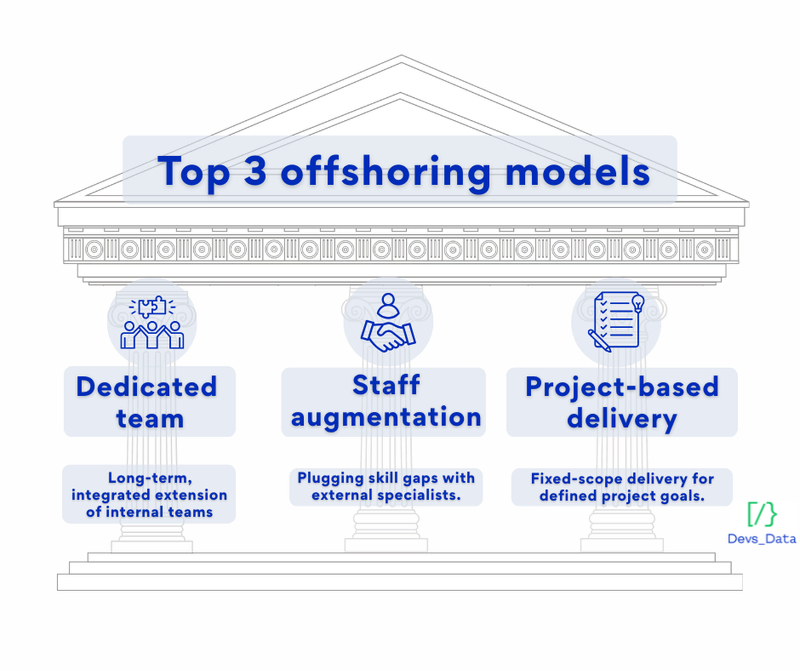
A dedicated offshore team operates as a long-term extension of the client’s in-house function from a chosen delivery country. Engineers in that location are assigned exclusively to the client’s roadmap and adopt its processes, tooling, and communication norms.
This structure suits companies running continuous development cycles for SaaS platforms or AI-driven systems, where domain knowledge compounds over time. Offshore hubs in Eastern Europe and Latin America specialize in sustaining these long-running mandates, assembling teams whose tenure with a single client often exceeds local market averages. Against the high failure rate of large digital initiatives reported by McKinsey, an offshore dedicated team reduces execution risk by preserving knowledge continuity across releases at a cost profile unavailable in domestic labor markets.
A specialized offshore staffing agency handles team assembly, technical vetting, and retention inside the chosen delivery region, providing the stability that one-off offshore hires rarely achieve.
Offshore staff augmentation supplements an existing in-house team with engineers sourced from a different country to cover specific roles or skill gaps. Engineers remain managed by the client but are sourced, hired, and administratively supported by the offshore staffing agency.
This model works particularly well when internal teams face immediate capability gaps in areas such as AI, data engineering, or security while local upskilling lags behind investment plans, and when the required specialists are scarce or expensive in the client’s home market. Forbes Research data shows that only 49% of US companies prioritize AI and data training, making access to offshore expertise a practical necessity rather than a stopgap.
Offshore augmentation lets companies maintain delivery velocity at lower cost without restructuring teams or delaying roadmaps.
In a project-based model, an offshore team is engaged for a defined scope, timeline, and set of deliverables. This approach is commonly used for MVPs, system migrations, or proof-of-concept builds.
While this model offers predictability, it also carries higher execution risk if teams lack production experience. The MIT finding that only 5% of generative AI pilots generate rapid revenue impact highlights how easily projects can stall without delivery maturity.
Specialized agencies mitigate this risk by assigning teams with prior production and handover experience, ensuring that projects are designed with scalability and post-launch continuity in mind.
While each offshoring model serves a different delivery need, the practical differences become clearer when viewed through decision-oriented criteria such as control, risk, and long-term alignment. The table below summarizes the three models from a comparative perspective to help evaluate which structure best fits a company’s delivery goals and operational constraints.
| Offshoring model | Level of control | Best suited for | Primary advantage | Main risk to manage | When it makes sense |
|---|---|---|---|---|---|
| Dedicated offshore team | High | Ongoing product development, long-term roadmaps | Knowledge retention and delivery continuity | Team stability and long-term governance | When the product requires sustained development and deep domain understanding |
| Staff augmentation | Medium-High | Teams with immediate skill or capacity gaps | Fast access to specialized expertise | Integration friction with internal teams | When delivery speed matters but core ownership stays in-house |
| Project-based delivery | Low-Medium | Defined scopes, MVPs, migrations | Predictable scope and timeline | Limited post-delivery continuity | When outcomes are clearly bounded and long-term ownership is secondary |
Rather than prescribing a single approach, the comparison highlights how offshoring models trade flexibility, ownership, and continuity against speed and predictability. Selecting the right model depends on product maturity, internal leadership capacity, and tolerance for execution risk, making structural fit more important than cost considerations alone.
When evaluating offshore destinations, cost remains an important factor, but only when viewed in context with delivery maturity, scalability, and engagement structure. Salary benchmarks help frame expectations, but they do not operate in isolation. Below, we compare three widely used offshore regions using Glassdoor-reported gross annual salary benchmarks for software developers, followed by practical interpretation for decision-makers.
Salary benchmarks by region (software developers, gross monthly pay, USD):
| Region / Country | Junior developer | Mid-level developer | Senior developer |
|---|---|---|---|
| USA | ~$6500-$8000 | ~$9000-$11000 | ~$12000-$15000 |
| Eastern Europe / Poland | ~$1200-$1400 | ~$1500-$1800 | ~$1900-$2200 |
| South Asia / India | ~$400-$600 | ~$900-$1200 | ~$1200-$1500 |
| Latin America / Brazil | ~$500-$800 | ~$700-$1000 | ~$1000-$1200 |
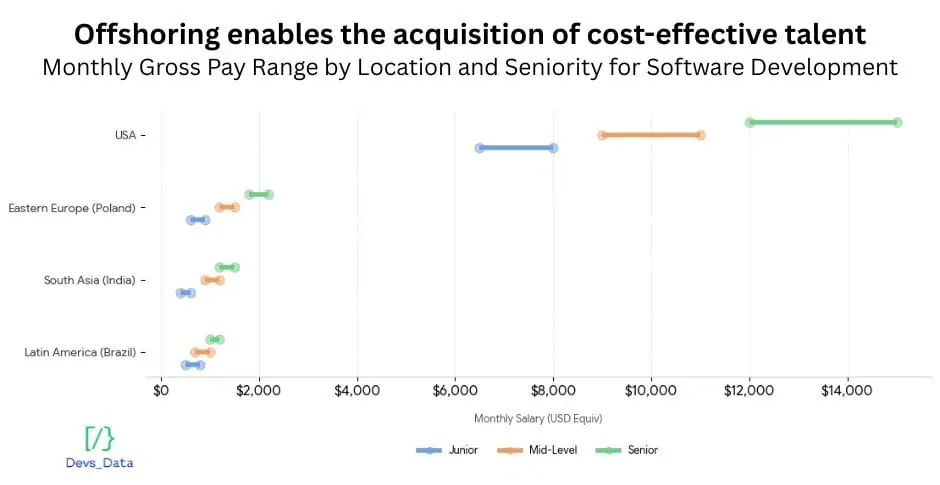
Note: Glassdoor-reported figures for some markets, particularly Poland and Brazil, appear unusually low and may reflect reporting inconsistencies (e.g., partial-year, net, or monthly entries). In practice, market salaries are often higher. Nonetheless, the Glassdoor benchmarks indicate that offshore developers in these regions command significantly lower gross annual salaries than Western averages, which can inform cost evaluations for staffing.
Eastern Europe is commonly selected for offshore teams working on core product development, platform engineering, and complex backend systems. While Glassdoor benchmarks suggest comparatively low gross salaries, real-world compensation in the region is typically higher, but still meaningfully below Western Europe and the US.
The region’s appeal lies less in minimum cost and more in the overall value it delivers: strong engineering education, experience with Western business practices, and suitability for long-term dedicated teams. As a result, Eastern Europe is frequently used for sustained development rather than short-term cost arbitrage.
India remains one of the most established offshore destinations globally, particularly for large-scale engineering operations. Glassdoor data shows higher average salaries compared to other offshore regions, reflecting both the size of the market and intense competition for experienced engineers.
This makes India well-suited for enterprises that require volume, scalability, and role diversity across multiple projects. The cost advantage persists at scale, especially when teams are structured through agencies that provide governance, quality control, and retention support.
Latin America is often chosen by North American companies prioritizing time-zone alignment and synchronous collaboration. Glassdoor benchmarks show lower reported salaries than South Asia, which, combined with real-time communication, makes the region attractive for staff augmentation and hybrid team models.
Brazil, in particular, is frequently used for frontend, product-oriented, and iterative development work where close coordination with US-based teams is critical. As with Eastern Europe, agency involvement is key to standardizing hiring quality and compensating for market variability.
Agency involvement becomes the mechanism for standardizing hiring quality and absorbing market variability. DevsData LLC guides clients in choosing between different markets, consults on prevailing rates, and manages the full lifecycle from sourcing through hiring and day-to-day administration so setup and ongoing operations stay consolidated under one provider.
Do you have recruitment needs?
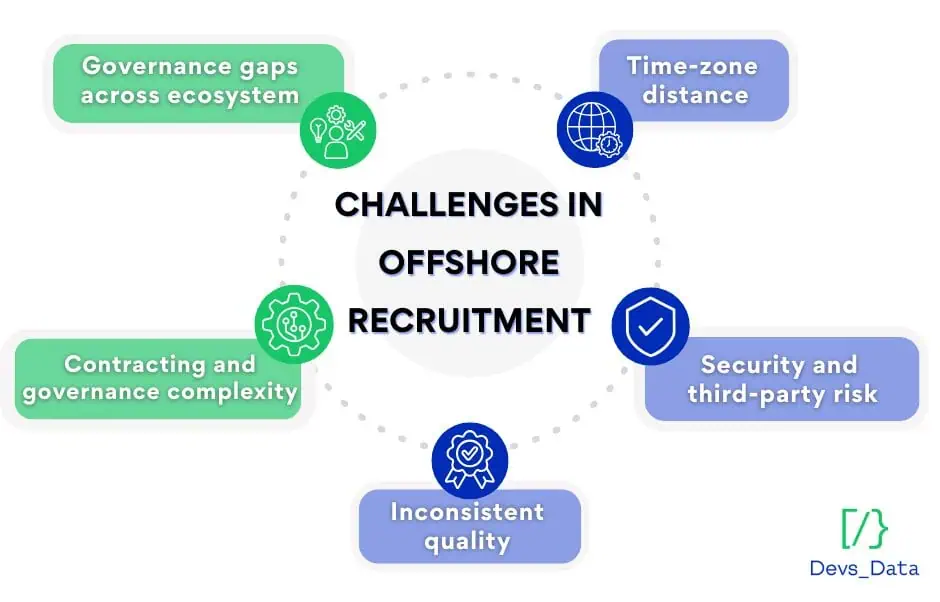
Offshore recruitment introduces a different set of risks than local hiring; not because talent quality is inherently lower, but because distance, scale, and external dependencies increase operational complexity. Without the right structures in place, offshoring can amplify issues around coordination, accountability, security, and delivery consistency. This section outlines the most common challenges companies face when building offshore teams and explains how a structured, agency-led approach turns these risks into manageable, predictable processes.
Offshore staffing often fails not because of talent availability, but because companies underestimate governance complexity. In Deloitte’s Global Outsourcing Survey 2024, 70% of executives report their Vendor Management Office (VMO) is not fully mature, which creates blind spots in ownership, escalation paths, and performance control across external teams.
DevsData LLC runs offshore hiring and delivery with an explicit governance layer: clear role ownership (client vs. team lead vs. account owner), documented operating cadence, and measurable SLAs. The goal is to make the offshore teams we hire behave like an extension of the internal org under the client’s own management, with predictable reporting and auditable decisions, while the client retains full control over operations, roadmap, and delivery.
Distributed teams lose synchronous bandwidth as time-zone separation grows. Research highlighted by Harvard Business School Working Knowledge reports that synchronous communication declines by ~11% for each additional hour of time delay between workers.
DevsData LLC selects offshore candidates whose working hours give the client meaningful overlap with their home team (even if limited) and coaches them on async-first habits: written specs, decision logs, and documented handoffs. The engineers then execute this approach within the client’s own workflow, which cuts down on overnight waiting cycles without shifting operational control to us.
Offshoring expands the number of people and systems touching your product, data, and infrastructure, raising third-party exposure. ENISA’s implementation guidance explicitly maps security measures to ISO/IEC 27001:2022-aligned controls, reinforcing that supplier and access governance must be treated as a formal risk domain, not a checklist.
DevsData LLC treats offshore staffing as a controlled security surface: role-based access, least-privilege onboarding, and process-level controls around how environments and credentials are handled. This is paired with candidate vetting that prioritizes security hygiene for teams working on sensitive systems.
“Offshore” can mean wildly different skill levels in practice. Deloitte notes that only 25% of executives report reductions in vendor service costs or improvements in service quality, suggesting that many engagements fail to produce clear performance gains.
DevsData LLC reduces variance through technical screening that mirrors real work: practical tasks, structured technical interviews, and evaluation against the client’s stack and delivery expectations. The objective is to minimize false positives and build teams that can contribute reliably without heavy supervision.
As outsourcing becomes more AI-enabled, governance becomes harder, not easier. Deloitte reports 83% of surveyed executives are leveraging AI as part of outsourced services, but benefits such as productivity or cost reductions remain limited due to governance and contracting challenges around AI requirements.
For AI-related mandates, DevsData LLC adjusts the recruitment filter: candidates are assessed for experience with clearly scoped AI work, documented model and tool usage, and accountable quality validation before being placed. This focuses hiring on engineers who already operate to the governance standards the client expects, rather than staffing a separate AI service unit.
Selecting an offshore staffing agency is less about comparing price lists and more about evaluating whether the agency can reliably integrate into your delivery model. A structured, step-by-step approach helps businesses reduce risk, avoid misalignment, and ensure offshore teams deliver measurable value rather than operational friction.
Below is a practical framework companies can use when evaluating offshore staffing partners.
Before evaluating agencies, businesses should clearly define what they intend to offshore and why. This includes scope (roles vs. outcomes), duration (short-term vs. long-term), and criticality (core product vs. auxiliary work). Agencies perform best when expectations are explicit and measurable.
A mismatch at this stage often leads to delivery issues later, regardless of talent quality.
The agency’s screening process determines the quality ceiling of your offshore team, and that ceiling matters more across borders where hands-on validation before contract signing is harder. Buyers should look past CV reviews and confirm that offshore candidates are assessed through practical tasks and stack-specific interviews modeled on the client’s actual tech environment. Shallow screening increases execution risk and shifts technical validation back onto the client, which is particularly costly when the engineer sits in another country and correction cycles take longer.
Offshore staffing is about operating distributed teams across geographies, not just hiring. Strong agencies provide governance suited to cross-border delivery, covering ownership definitions, escalation paths across time zones, reporting cadence that compensates for asynchronous work, and performance tracking independent of physical presence. Without this layer, offshore contributors often become detached rather than integrated into the client’s delivery unit.
Offshoring multiplies jurisdictional exposure, so agencies should demonstrate how they manage access control, data handling, and third-party risk across the regions where engineers are based. This becomes non-negotiable for products with sensitive data or regulated environments that cross national boundaries. Security should be embedded into offshore hiring and onboarding from day one rather than handled as a post-contract formality.
Buyers should assess how the agency scales offshore teams up or down, replaces members within the same region without losing context, and maintains continuity as local labor markets shift. Offshore staffing only delivers long-term value when teams remain stable inside their delivery geography and accumulated knowledge survives turnover.
| Evaluation focus | Questions to ask the agency |
|---|---|
| Scope alignment | ● What roles or outcomes are you best suited to offshore? ● How do you align team structure with business goals? |
| Technical screening | ● How are candidates assessed beyond CVs? ● Are interviews and tasks aligned with our tech stack? |
| Delivery governance | ● Who owns delivery, performance tracking, and escalation? ● How is progress reported? |
| Security and compliance | ● How do you manage access control, data exposure, and third-party risk for offshore teams? |
| Scalability and continuity | ● How do you handle team scaling, replacements, and long-term knowledge retention? |
The right partner combines rigorous technical vetting, structured governance, and operational discipline, allowing offshore teams to function as a predictable, scalable extension of your internal organization.
The success of offshoring depends less on where talent is located and more on the structures that govern execution, accountability, and communication.
Website: www.devsdata.com
Company size: ~60 employees
Founding year: 2016
Headquarters: Brooklyn, NY, and Warsaw, Poland
DevsData LLC specializes in offshore staffing and recruitment for technology teams, supporting companies that need to scale engineering capacity beyond local markets without sacrificing delivery quality or operational control. With over nine years of experience, the company has built offshore teams for both global corporate clients and high-growth startups, working with organizations across multiple geographies, including the United States and Israel.
A key differentiator is DevsData LLC’s ability to operate at the intersection of global sourcing and Western business expectations. US-based specialists on the team align recruitment standards, communication practices, and delivery expectations with those familiar to North American and Western European companies, while recruiters based in Poland and other offshore markets contribute close knowledge of local talent pools, prevailing rates, and engineering communities across Central Europe and beyond. This combination reduces friction typically associated with offshore hiring and supports smoother integration with in-house teams.
From an operational standpoint, DevsData LLC maintains a database of over 95000 pre-vetted specialists, enabling faster access to qualified engineers across multiple technology stacks. To date, the company has completed 100+ recruitment projects for more than 80 clients, demonstrating repeatable delivery rather than one-off placements. DevsData LLC also holds an official, government-approved recruitment license, reinforcing compliance and legal reliability in cross-border hiring.
The recruitment process itself is designed to minimize execution risk. Candidates undergo a rigorous interview process, including a 90-minute problem-solving challenge, which evaluates real-world technical thinking rather than surface-level knowledge. Strong emphasis is placed on communication skills, ensuring offshore hires can collaborate effectively within distributed teams.
Commercially, DevsData LLC operates on a success fee model, meaning clients pay only after a successful hire. This is paired with a guarantee period, aligning incentives around long-term placement quality rather than short-term volume. The company’s approach is reflected in its 5/5 ratings on Clutch and GoodFirms, based on verified client feedback.
Together, these factors position DevsData LLC as a structured, outcome-oriented partner for companies building offshore technology teams.

The case below represents a multi-year engagement and demonstrates how DevsData LLC executes offshore recruitment in technically demanding, security-sensitive environments.
When Caladan, a Singapore-headquartered proprietary crypto trading and market-making firm processing over $50 billion in annual transactions across 65+ exchanges, set out to scale its engineering hub in Poland, the objective was to secure senior technical leadership capable of reinforcing low-latency trading systems, distributed architectures, and compliance-sensitive infrastructure. Internal hiring efforts had stalled due to the scarcity of crypto-native engineering leaders and cross-border coordination delays.
DevsData LLC was engaged to design and implement a focused offshore recruitment strategy centered on Poland and select EU clusters. By combining calibrated technical screening, asynchronous international coordination, and workload-mirrored assessments, the team reduced decision cycles by approximately 40% and delivered role-ready shortlists in under one week.
This engagement reinforces the article’s core themes: offshore recruitment as an execution discipline, structured vetting calibrated to real technical environments, and regional specialization enabling predictable hiring outcomes in high-complexity domains.
Do you have recruitment needs?
Build your offshore team with execution in mind. If you’re evaluating offshore staffing to scale engineering capacity, close skill gaps, or accelerate delivery without increasing operational risk, DevsData LLC can help. Contact us at general@devsdata.com or visit our website at www.devsdata.com.
Offshore staffing has evolved into both a strategic response to the structural pressures shaping modern technology organizations and a meaningful cost lever for companies managing rising engineering budgets. Persistent challenges in hiring and scalability sit alongside pressure on margins in saturated Western labor markets, and offshoring addresses them together by opening access to global talent at rate structures domestic markets rarely match. Approached deliberately, the model lets businesses adjust capacity to shifting demand while preserving delivery momentum at a substantially lower cost base than equivalent in-house expansion. Outcomes depend not on geography alone, as the article has shown, but on how offshore teams are sourced, structured, and governed.
Throughout this article, we examined the offshore staffing landscape from a practical, execution-oriented perspective. We explored how different offshoring models align with business needs, how regional talent markets differ in cost and collaboration dynamics, and why unstructured outsourcing often leads to delivery and governance risks. The recurring theme is clear: offshore staffing delivers value when it is treated as an extension of internal operations, supported by rigorous technical screening, clear accountability, and communication-first processes. Without these elements, cost advantages quickly erode under the weight of coordination issues, quality inconsistencies, and execution delays.
DevsData LLC operates within this execution-focused framework. By combining global talent access with structured recruitment processes, deep technical vetting, and commercially aligned engagement models, DevsData LLC helps companies build offshore teams that are reliable, scalable, and fit for high-responsibility environments. With nearly a decade of experience supporting both enterprises and fast-growing startups, DevsData LLC positions offshore staffing not as a shortcut, but as a disciplined way to strengthen delivery capacity and support long-term business objectives.
Any questions or comments? Let me know on
Twitter/X.
Discover how IT recruitment and staffing can address your talent needs. Explore trending regions
like Poland, Portugal, Mexico, Brazil and more.
 Frequently asked questions (FAQ)
DevsData – your premium technology partner
DevsData is a boutique tech recruitment and software agency. Develop your software project with veteran engineers or scale up an in-house tech team of developers with relevant industry experience.
Free consultation with a software expert
🎧 Schedule a meeting
FEATURED IN


DevsData LLC is truly exceptional – their backend developers are some of the best I’ve ever worked with.”

Nicholas Johnson
Mentor at YC, serial entrepreneur


 Build your project with our veteran developers.
Explore the benefits of technology recruitment and tailor-made software.
Learn how to source skilled and experienced software developers.
Build your project with our veteran developers.
Explore the benefits of technology recruitment and tailor-made software.
Learn how to source skilled and experienced software developers.

Rebecca Botvin

Commercial Director

Tom Potanski
Manager




Categories: Big data, data analytics | Software and technology | IT recruitment blog | IT in Poland | Content hub (blog)
















careers@devsdata.com









general@devsdata.com

"I interviewed about a dozen different firms. DevsData LLC is truly exceptional – their backend developers are some of the best I've ever worked with. I've worked with a lot of very well-qualified developers, locally in San Francisco, and remotely, so that is not a compliment I offer lightly. I appreciate their depth of knowledge and their ability to get things done quickly."

Nicholas Johnson
CEO of Orange Charger LLC,
Ex-Tesla Engineer,
Mentor at YCombinator
"DevsData reached out to us, as we've been looking to grow our engineering team in Europe and Poland. Communicating efficiently and professionally, DevsData made a strong impression with their understanding of the recruitment challenges we were facing. They designed a tailored recruitment process for our needs. I was impressed with the technical depth of their approach."

Karim Butt
Co-Founder & CTO at GlossGenius, Inc.
"Out of all the vendors we work with, DevsData clearly stands out. The quality of developers they deliver is beyond what we've received from any other vendor, and they've been able to send profile recommendations very quickly. I'm happy to be their reference for other companies from Israel and talk about their recruitment abilities and what they delivered for us."

Ran Eyal
Senior Manager at
ZIM Integrated
Shipping Services Ltd.
"DevsData demonstrated a strong degree of proactivity, taking time to thoroughly understand the problem and business perspective, and continuously suggesting performance and usability enhancements. Their app exceeded my expectations. I've worked with DevsData on numerous projects over the last 3 years and I'm very happy. Being both responsive and honest in communication."

Jonas Lee
Partner & Executive VP of Verus,
Financial LLC, Investor,
& Serial Entrepreneur
Acknowledgments