Thanks for subscribing.
Your gift is on the way.



Over the past five years, the proportion of consumer purchases completed online has climbed past the 20% threshold of total worldwide retail, and the underlying technology stacks have grown far more complex than a simple storefront template. Businesses now operate across multiple platforms, integrate with dozens of payment gateways, manage real-time inventory across warehouses, and personalize experiences at the session level. The Developers who build and maintain these systems need platform-specific fluency, not just generic web development skills.
This shift is reflected in formal labor market data. The US Bureau of Labor Statistics projects Web Developer employment to grow 7% through 2034 and explicitly ties that growth to eCommerce expansion. Meanwhile, the eCommerce platform market itself is valued at $11.55 billion in 2025 and projected to reach $61.83 billion by 2034, growing at a 20.49% compound annual rate. As these platforms grow, they need more specialized Developers who can work within and extend specific commerce ecosystems.
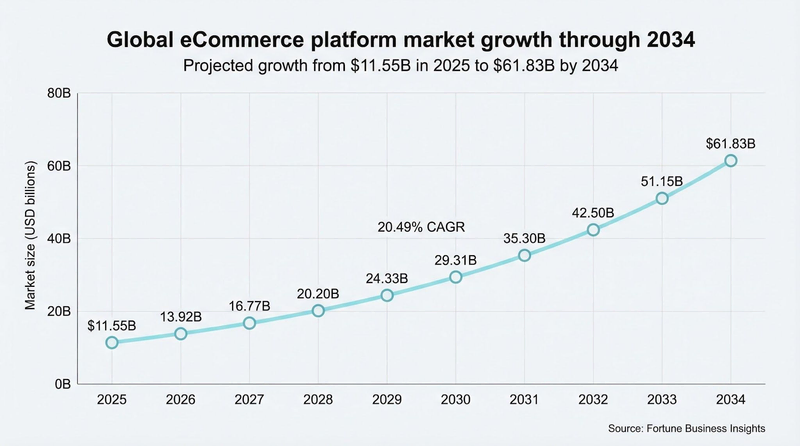
Yet the supply side is tightening. The global Developer population reached 47.2 million in Q1 2025, but its growth rate has decelerated from 21% to just 10% year-over-year.
The sections that follow examine when businesses actually need dedicated eCommerce Developers working across stacks like Shopify Liquid, Magento 2, WooCommerce, and increasingly headless architectures built with React or Next.js. The analysis covers the market forces shaping this talent category, the specific hiring challenges that make these roles difficult to fill, and how a structured recruitment methodology addresses them, drawing on government labor data, institutional research, and compensation benchmarks from established salary platforms.
Not every business needs a dedicated eCommerce Developer on staff. A company running a single Shopify storefront with standard themes and minimal customization can often manage with freelance support or an agency retainer. A dedicated Developer becomes necessary when the storefront outgrows standard templates and performance problems begin showing up in revenue numbers. At that point, the gap between a generalist Web Developer and a commerce-platform specialist becomes operationally visible, often in the form of slow feature delivery, integration failures, or revenue-impacting bugs during peak traffic periods.
The following scenarios represent the most common inflection points where dedicated eCommerce expertise becomes necessary.
A platform migration moves a store from one provider to another while keeping the broad commercial model intact, for example shifting from Magento Open Source to Magento Commerce Cloud to gain managed hosting. Replatforming is the deeper shift, where the underlying architecture changes as well, such as leaving a monolithic Magento setup for a headless Shopify Plus build with a separate frontend layer. Either move involves far more than porting templates. It requires deep knowledge of both the source and target platforms, data migration strategy for products, customers, and order histories, and careful handling of SEO equity. A dedicated Developer who understands both ecosystems can anticipate compatibility issues that a generalist will only discover in production, for example partial data loss during customer record migration or broken URL redirects that quietly destroy organic search traffic after go-live.
When a business sells through its own storefront, Amazon, a B2B portal, and potentially a mobile app, the backend synchronization across inventory, pricing, and fulfillment becomes technically demanding. Dedicated eCommerce Developers build and maintain the middleware and API connections that keep these channels consistent, preventing overselling and pricing mismatches.
Standard payment integrations work until they don’t. Businesses operating across currencies, tax jurisdictions, or regulated product categories need customized checkout flows. A dedicated Developer can implement region-specific payment gateways, configure tax calculation engines, and handle PCI-DSS compliance requirements that off-the-shelf plugins rarely cover completely.
Shopify merchants generated a record-breaking $14.6 billion in BFCM 2025 sales. Sustained traffic spikes on that scale require performance optimization at the CDN, database, and application layers. Dedicated Developers conduct load testing, implement caching strategies, and architect failover systems well before peak periods arrive.
B2B eCommerce introduces complexities absent from B2C: custom pricing per account, approval workflows, bulk ordering interfaces, and ERP integration. The US International Trade Administration projects global B2B eCommerce at $36 trillion by 2026. Companies entering this segment need Developers who understand procurement logic, not just product catalogs.
Commerce teams are now embedding machine learning models into product recommendations, search ranking, and dynamic pricing. The scope of this work has widened quickly with the spread of large language models in production, which now underpin conversational search, automated product description generation, and customer service agents that handle routine inquiries directly inside the storefront.
Vector databases sit beneath much of this functionality, indexing product catalogs and content so that semantic search can return results based on user intent rather than exact keyword matches. Building these systems sits at the intersection of platform APIs and data engineering, calling for Developers who can move confidently between commerce platform internals, model integration through services such as OpenAI or open source alternatives, and the data pipelines that feed both.
Commerce platforms release frequent updates, breaking changes, and new capabilities. Shopify alone maintains an App Store with thousands of extensions and regularly updates its APIs. A dedicated Developer tracks these changes, evaluates their business impact, and implements upgrades without disrupting revenue-generating operations.
What connects these scenarios is a practical business cost: every week that passes without dedicated expertise translates into slower feature releases and missed revenue windows. Freelancers and agencies deliver well on bounded projects, but long-running commerce operations with evolving requirements benefit from Developers who accumulate deep context over time. A dedicated hiring model ensures continuity of knowledge, which translates directly into faster delivery cycles and fewer production incidents.
Do you have IT recruitment needs?
The demand for eCommerce Developers does not exist in isolation. It is a function of how fast the underlying market is growing, how fragmented the platform ecosystem has become, and how much technical complexity each additional channel or integration adds. This section examines the structural forces shaping hiring demand for dedicated eCommerce development talent in 2025 and beyond.
Global retail eCommerce sales crossed $6 trillion in 2024 and were forecasted to reach approximately $6.86 trillion in 2025, with eCommerce representing 20.5% of total global retail. Statista projects continued expansion at a 9.5% retail CAGR through 2029. The US market alone reached $1.192 trillion in 2024, according to the US Census Bureau, with eCommerce capturing 16.1% of total retail sales. Each percentage point of retail migration to digital channels translates directly into engineering workload: new storefronts, payment integrations, mobile optimization, and backend infrastructure.
The eCommerce platform landscape is bifurcating. Shopify reported FY 2025 revenue of $11.6 billion with $378 billion in gross merchandise volume, claiming 14% of US eCommerce. WooCommerce powers 8.5% of all websites globally. BigCommerce reported $342.3 million in FY 2025 revenue with 6648 enterprise accounts. Each platform requires distinct technical skills: Shopify uses Liquid and Hydrogen, Magento runs on PHP with a different architecture, and WooCommerce integrates into the WordPress ecosystem. This fragmentation is the primary driver of specialization premiums in Developer compensation.
Cross-border eCommerce logistics is a $119.3 billion market (2024), projected to reach $463.7 billion by 2030 at a 25.4% CAGR. Asia-Pacific dominates with over 42% share. For Developers, cross-border commerce means multi-currency support, international tax compliance, localized checkout flows, and integration with region-specific payment providers. These are not features that ship with default platform installations. They require dedicated development effort, often involving custom middleware that connects platform APIs with local payment and logistics infrastructure.
Modern eCommerce stacks extend well beyond a storefront. The Stack Overflow 2025 Developer Survey shows Docker adoption among Developers jumped 17 percentage points year-over-year, the largest increase of any technology measured. TypeScript surpassed JavaScript as the most-used language on GitHub by monthly contributor count. For eCommerce, this means headless architectures built with React and Next.js, containerized deployments, GraphQL APIs connecting frontend and backend, and AI-powered personalization engines. The Developer who could manage an eCommerce site in 2019 using only PHP and a CMS dashboard is increasingly insufficient for the systems being built today.
The same Stack Overflow 2025 Developer Survey reports that 84% of Developers now use or plan to use AI tools in their development workflow, the highest figure on record. For eCommerce, AI is no longer a peripheral feature. It powers personalization engines, generative product content, semantic search, and AI assistants embedded in checkout flows, and it relies on its own toolchain of model APIs, vector databases, and prompt orchestration layers. Building this layer well has become a distinct competency that hiring managers increasingly screen for alongside platform expertise.
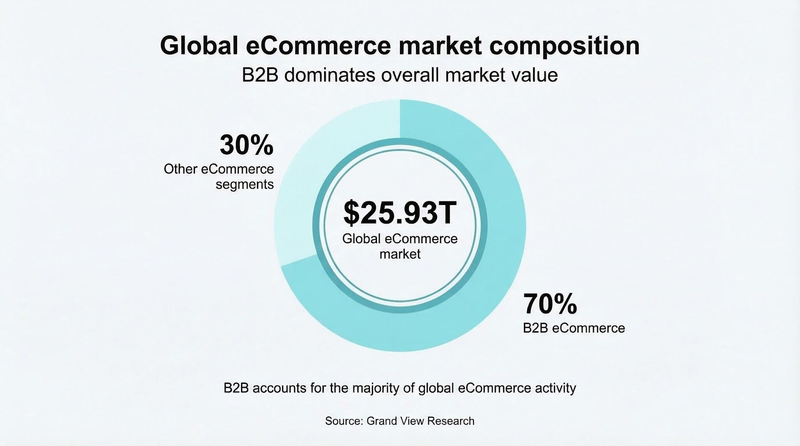
B2B eCommerce dwarfs B2C in absolute size. Grand View Research estimates the total global eCommerce market at $25.93 trillion, with B2B accounting for roughly 70% of that figure. Mordor Intelligence projects B2C alone reaching $16.83 trillion by 2030. B2B development work involves custom pricing tiers, approval workflows, procurement portals, and ERP synchronization, all of which require dedicated engineering capacity and deep domain knowledge that general-purpose web Developers rarely possess.
Taken together, these forces create a hiring environment where demand for platform-specific eCommerce Developers is growing at a rate that significantly outpaces the general Developer labor market. The platform market’s 20.49% CAGR far exceeds the 10% annual growth in the global Developer population, and the increasing technical complexity of modern commerce stacks narrows the pool of Developers with the right combination of skills.
The eCommerce platform market is growing at twice the rate of the global Developer population. This structural imbalance means competition for dedicated eCommerce development talent will intensify for years to come.
Do you have IT recruitment needs?
Hiring dedicated eCommerce Developers is measurably harder than filling general software engineering positions. The talent pool is constrained by platform specialization requirements, complicated by cross-system integration demands, and made more competitive by a global skills shortage that shows no signs of abating. The ManpowerGroup 2025 Talent Shortage Survey found that 74% of employers globally report difficulty filling roles, with IT employers at 76%. In the eCommerce development niche, the challenge is compounded by the need for combined technical depth and business domain knowledge. The following sections examine the most significant obstacles and how DevsData LLC addresses each one.
The global Developer population stands at 47.2 million, with over 23 million working in web development. However, the subset of Developers with deep experience in a specific commerce platform, such as Shopify Liquid, Magento 2, or Adobe Commerce Cloud, is far smaller. Korn Ferry projects a worldwide shortage of 85.2 million workers by 2030, resulting in approximately $8.5 trillion in unrealized annual revenues. In the technology sector specifically, the US faces a potential $162 billion annual revenue loss. Platform-specific eCommerce Developers sit at the sharp end of this shortage: they combine software engineering skills with commerce-domain fluency, payment system expertise, and an understanding of retail operations that most Developers never acquire.
DevsData LLC maintains a database of over 95000 pre-vetted candidates with verified platform-specific expertise. Their sourcing methodology targets Developers with documented project histories on specific eCommerce platforms, allowing rapid identification of candidates whose experience matches the client’s technology stack. This focused pipeline reduces time-to-shortlist significantly compared to generalist recruitment channels.
Standard technical interviews often fail to distinguish between a Developer who can write clean code and one who understands the nuances of a particular commerce platform. A Magento Developer, for example, needs to navigate Adobe’s module architecture, understand EAV data models, and configure complex product attribute sets. A Shopify Hydrogen Developer needs fluency in React Server Components and Shopify’s Storefront API. These skills are difficult to assess through generic coding challenges. Robert Half reports that 76% of technology leaders identify active skills gaps within their departments, and 69% say the impact of those gaps has worsened year-over-year. The evaluation problem is a significant contributor: companies hire based on general technical signals and then discover the candidate lacks the platform-specific depth the role requires.
DevsData LLC uses a proprietary 90-minute problem-solving challenge calibrated to each platform’s specific technical requirements. Rather than testing abstract algorithmic ability, the assessment replicates real-world commerce development scenarios: building a custom Shopify section, configuring a Magento module, or integrating a payment gateway. This approach separates genuine platform specialists from Developers with surface-level exposure.
Modern eCommerce operations rarely exist as standalone systems. They connect to ERP platforms, CRM tools, marketing automation suites, warehouse management systems, and third-party logistics providers. The Fortune Business Insights eCommerce platform market report identifies implementation complexity and platform customization as key market restraints, and that complexity translates directly into a hiring problem: candidates who can confidently work across all of these surfaces are far rarer than those skilled in any single platform. Hiring managers consistently report that resumes signaling Shopify or Magento experience are abundant, while those evidencing deep work on API design patterns, webhook architectures, and data transformation across distributed systems remain scarce.
DevsData LLC evaluates candidates not only on platform knowledge but on integration competency. Their assessment process includes scenarios involving API connectivity, data mapping between systems, and error handling under real-world conditions. Candidates are also assessed on communication skills, ensuring they can coordinate effectively with product, operations, and engineering teams across the client organization.
Accessing global talent pools introduces compliance, communication, and quality control challenges. McKinsey documents that demand for tech talent runs 2 to 4 times greater than supply, and that only 16% of executives feel comfortable with available technology talent. Cross-border hiring can ease the supply constraint but requires navigating different employment regulations, time zone management, and cultural alignment. Without a structured process, companies risk prolonged hiring timelines and misaligned expectations. The Deloitte 2024 study found that nearly 90% of technology industry leaders still classify recruiting and retaining tech talent as a moderate or major challenge, even when sourcing internationally.
DevsData LLC operates with US-based specialists and holds a government-approved recruitment license, enabling compliant cross-border placements. Their client base spans the US and Israel, and their structured vetting process ensures cultural and communicative alignment regardless of candidate geography. A success-fee model with a guarantee period protects clients from the financial risk typically associated with international hiring.
The cumulative effect of these challenges is that eCommerce Developer hiring requires a more specialized methodology than general tech recruitment. Generic job boards and unstructured interview processes produce poor outcomes because they fail to account for the platform-specific, integration-heavy, commercially grounded nature of these roles. Organizations that adopt a structured, partner-driven approach consistently achieve faster placements and lower turnover.
Standard technical interviews fail to distinguish general coding ability from the platform-specific fluency that eCommerce roles demand. Structured, scenario-based assessment is the only reliable way to identify genuine commerce development expertise.
Do you have IT recruitment needs?
Selecting a recruitment partner for eCommerce development roles requires different evaluation criteria than choosing a generalist staffing agency. The partner must demonstrate both technical literacy in commerce platforms and a recruitment methodology that can reliably identify candidates with the right combination of engineering depth and domain knowledge. The following five steps provide a structured framework.
Ask for case studies or client references specifically within eCommerce development recruitment. A partner who has successfully placed Shopify, Magento, or WooCommerce Developers can demonstrate familiarity with the technical stacks, candidate expectations, and compensation norms unique to this niche. General software recruitment experience is insufficient because commerce platforms introduce domain-specific evaluation criteria that generalist recruiters typically miss.
The hiring partner’s technical assessment process should go beyond standard coding tests. Effective eCommerce Developer screening includes platform-specific problem-solving scenarios, integration architecture discussions, and evaluation of candidates’ understanding of commerce business logic. Ask how the partner differentiates between a Developer with surface-level platform exposure and one with deep, production-level experience.
Understand the size and composition of the partner’s candidate pipeline. A strong eCommerce recruitment partner maintains a pre-vetted database of platform-specific talent, supplemented by active sourcing, which in practice means direct outreach to contributors in Developer communities, engagement with open source maintainers, and a presence at platform partner events where senior specialists gather. The depth of this pipeline directly determines how quickly shortlists can be generated for specialized roles.
Recruitment fees should be structured to align incentives. A success-fee model, where payment is contingent on a successful placement, signals confidence in the partner’s ability to deliver. A guarantee period provides additional protection. Avoid partners who require large upfront retainers without clear deliverables tied to candidate presentation and placement milestones.
Hiring eCommerce Developers often involves coordinating across time zones and technical teams. The recruitment partner should provide regular pipeline updates, structured candidate profiles with technical assessments included, and clear communication on timelines. Strong communication skills should be a stated evaluation criterion for candidates as well, not an afterthought.
The following table summarizes questions to ask when evaluating a potential hiring partner.
| Evaluation step | Questions to ask the agency |
|---|---|
| Domain-specific track record | Can you share eCommerce-specific placement case studies? |
| Technical screening methodology | How do you assess platform-specific skills beyond general coding? |
| Sourcing depth and reach | What is your candidate database size and platform specialization coverage? |
| Commercial model | Do you operate on a success-fee basis with a guarantee period? |
| Communication standards | How frequently do you report on pipeline progress, and in what format? |
| Cross-border capability | Do you hold recruitment licenses for international placements? |
The criteria above describe what a reliable eCommerce recruitment partner should look like in the abstract. The natural next question is what that profile looks like in practice, applied to a specific firm with a documented track record in commerce hiring. DevsData LLC is one such partner, and the section that follows examines the firm against the same evaluation lens.

Company size: ~60 employees
Founding year: 2016
Website: www.devsdata.com
Headquarters: Brooklyn, NY, and Warsaw, Poland
DevsData LLC brings over ten years of experience in IT recruitment, with a specific focus on technical roles across eCommerce, software engineering, and data science. The firm operates with US-based specialists who serve clients primarily in the US and Israel, with more than 100 recruitment projects completed for over 100 clients.
The company maintains a curated database of 95000 candidates, sourced and pre-screened against platform-specific criteria. This database spans eCommerce platform specialists (Shopify, Magento, WooCommerce, BigCommerce), full stack Commerce Engineers, and related technical roles. DevsData LLC holds a government-approved recruitment license, ensuring compliance across jurisdictions.
What distinguishes the firm operationally is its assessment process. Every candidate undergoes a proprietary 90-minute problem-solving challenge designed to replicate real-world eCommerce development tasks. This goes beyond algorithmic testing to evaluate how candidates approach commerce-specific engineering challenges: payment integration, platform customization, and multi-system coordination. Candidates are also evaluated on strong communication skills, which are treated as a core competency rather than a secondary trait.
The commercial model is built around a success-fee structure with a guarantee period, meaning clients pay only upon successful placement and receive protection against early attrition. Under this arrangement, clients carry no fee exposure until a placement is confirmed, and the guarantee period provides additional coverage if the hire does not complete the probationary window.
DevsData LLC maintains 5/5 ratings on both Clutch and GoodFirms, reflecting consistent client satisfaction across project scopes and technical domains. For eCommerce businesses navigating a tight talent market, the combination of domain-specific expertise, structured assessment, and risk-aligned pricing makes the firm a practical choice.
A representative example of DevsData LLC’s eCommerce recruitment methodology is the engagement with Easyship, a global eCommerce logistics platform. The project illustrates how structured sourcing and assessment translate into successful placements for technically demanding commerce roles.

The engagement followed a structured pipeline.
Do you have IT recruitment needs?
The market for dedicated eCommerce Developers is shaped by structural forces that are unlikely to reverse in the near term. Global retail eCommerce has crossed the $6 trillion mark, the US market alone exceeds $1.19 trillion, and projections from Mordor Intelligence place US eCommerce at $2.28 trillion by 2031. Behind every dollar of digital commerce revenue is an engineering team responsible for platform customization, payment processing, logistics integration, and frontend performance. The demand for Developers who can do this work competently and continuously is growing faster than the available supply.
Platform fragmentation intensifies the challenge. Shopify commands 14% of US eCommerce with $378 billion in GMV; WooCommerce powers 8.5% of all websites; BigCommerce serves 6648 enterprise customers. Each platform’s technical stack, from Shopify’s Liquid and Hydrogen to Magento’s PHP architecture to WooCommerce’s WordPress integration, requires distinct Developer competencies. Hiring a generalist Web Developer and expecting them to perform at the level of a platform specialist produces predictable gaps in delivery quality and timeline.
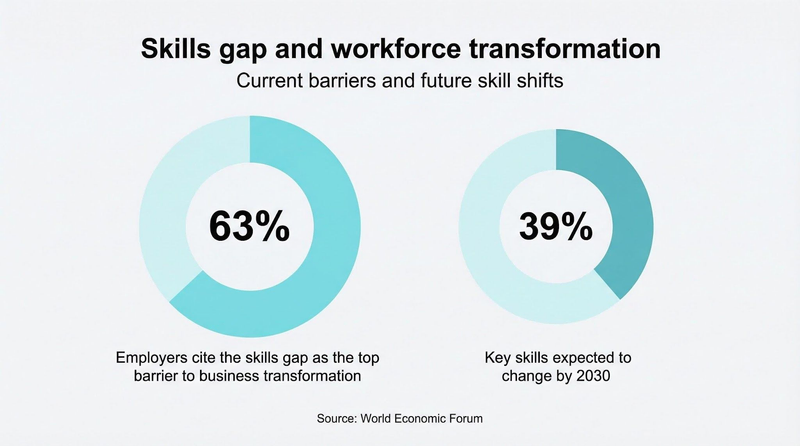
The talent shortage compounds this problem. Gartner identifies talent scarcity as the adoption barrier for 64% of emerging technologies. The World Economic Forum reports that 63% of employers cite the skills gap as their top barrier to business transformation, with 39% of key skills expected to change by 2030. Deloitte finds that nearly seven in ten technology leaders plan to increase headcount for generative AI, adding further competitive pressure on the Developer labor market.
Compensation data confirms the specialization premium. Robert Half’s 2026 Salary Guide places eCommerce Developers at a $141000 midpoint, 9% above general Web Developers. Magento Developers average $123499 on ZipRecruiter, a 36% premium over the BLS web Developer median. Shopify Developers average $109905. These premiums reflect genuine scarcity, and companies that underestimate them lose candidates to competitors who do not.
In this environment, a structured recruitment methodology is not optional. DevsData LLC provides that structure through a 95000-candidate database, platform-specific assessment processes, and a commercial model that aligns incentives through success fees and guarantee periods. For CTOs, Heads of Engineering, and Talent Acquisition Leaders navigating this market, the question is not whether to invest in dedicated eCommerce development capacity. It is how to secure it before the supply-demand gap widens further.
Any questions or comments? Let me know on
Twitter/X.
Discover how IT recruitment and staffing can address your talent needs. Explore trending regions
like Poland, Portugal, Mexico, Brazil and more.
 Frequently asked questions (FAQ)
DevsData – your premium technology partner
DevsData is a boutique tech recruitment and software agency. Develop your software project with veteran engineers or scale up an in-house tech team of developers with relevant industry experience.
Free consultation with a software expert
🎧 Schedule a meeting
FEATURED IN


DevsData LLC is truly exceptional – their backend developers are some of the best I’ve ever worked with.”

Nicholas Johnson
Mentor at YC, serial entrepreneur


 Build your project with our veteran developers.
Explore the benefits of technology recruitment and tailor-made software.
Learn how to source skilled and experienced software developers.
Build your project with our veteran developers.
Explore the benefits of technology recruitment and tailor-made software.
Learn how to source skilled and experienced software developers.

Rebecca Botvin

Commercial Director

Tom Potanski
Manager




Categories: Big data, data analytics | Software and technology | IT recruitment blog | IT in Poland | Content hub (blog)
















careers@devsdata.com









general@devsdata.com

"I interviewed about a dozen different firms. DevsData LLC is truly exceptional – their backend developers are some of the best I've ever worked with. I've worked with a lot of very well-qualified developers, locally in San Francisco, and remotely, so that is not a compliment I offer lightly. I appreciate their depth of knowledge and their ability to get things done quickly."

Nicholas Johnson
CEO of Orange Charger LLC,
Ex-Tesla Engineer,
Mentor at YCombinator
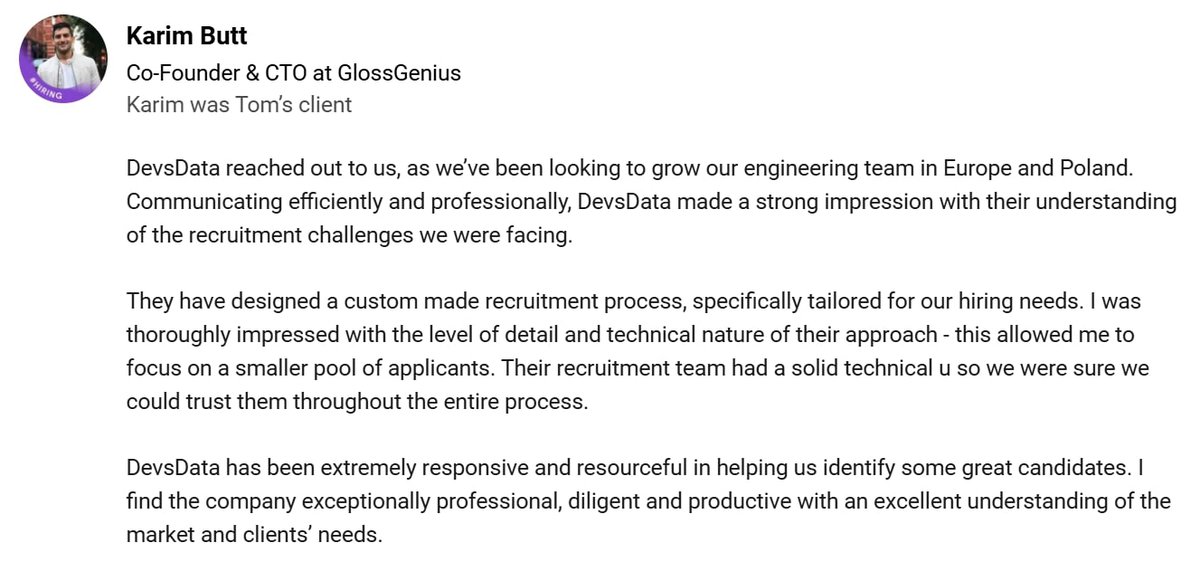
"DevsData reached out to us, as we've been looking to grow our engineering team in Europe and Poland. Communicating efficiently and professionally, DevsData made a strong impression with their understanding of the recruitment challenges we were facing. They designed a tailored recruitment process for our needs. I was impressed with the technical depth of their approach."

Karim Butt
Co-Founder & CTO at GlossGenius, Inc.
"Out of all the vendors we work with, DevsData clearly stands out. The quality of developers they deliver is beyond what we've received from any other vendor, and they've been able to send profile recommendations very quickly. I'm happy to be their reference for other companies from Israel and talk about their recruitment abilities and what they delivered for us."

Ran Eyal
Senior Manager at
ZIM Integrated
Shipping Services Ltd.
"DevsData demonstrated a strong degree of proactivity, taking time to thoroughly understand the problem and business perspective, and continuously suggesting performance and usability enhancements. Their app exceeded my expectations. I've worked with DevsData on numerous projects over the last 3 years and I'm very happy. Being both responsive and honest in communication."

Jonas Lee
Partner & Executive VP of Verus,
Financial LLC, Investor,
& Serial Entrepreneur
Acknowledgments