Thanks for subscribing.
Your gift is on the way.



Recruitment has become one of the most critical functions for businesses worldwide, as companies face growing competition for talent in an increasingly dynamic market. The global recruiting market alone is estimated to generate USD 690.3 billion by the end of 2026 and is projected to reach USD 989.32 billion by 2031, growing at a steady 7.47% CAGR. This growth reflects not only the demand for skilled professionals but also the complexity of managing hiring at scale.
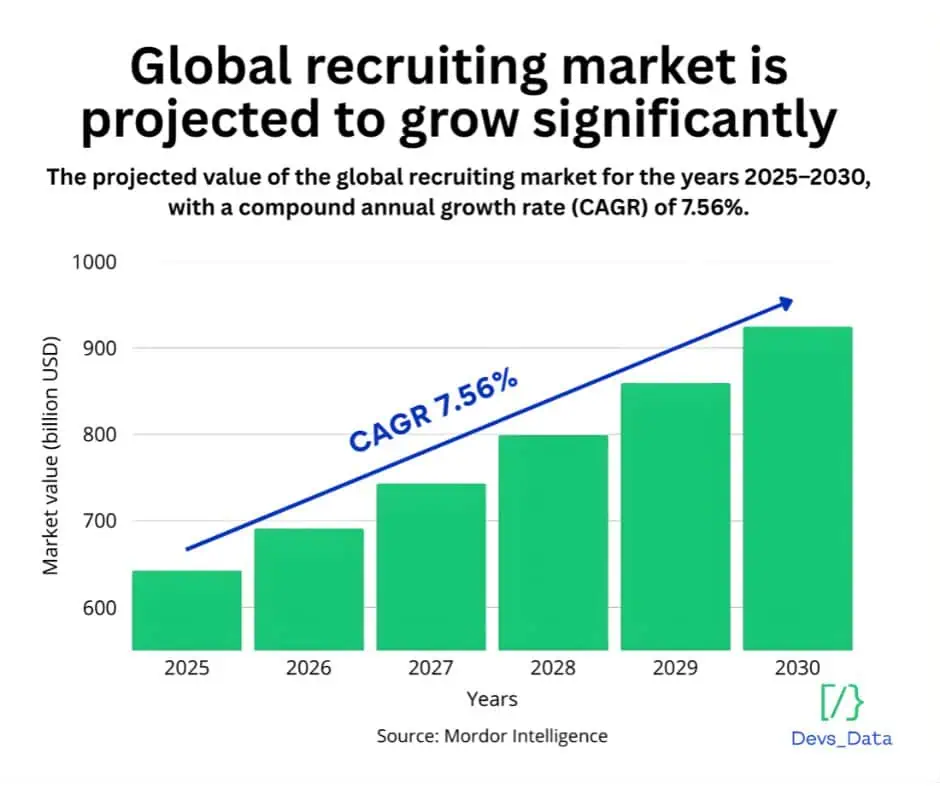
When organizations experience rapid growth or seasonal spikes, the pressure on internal HR teams intensifies. Such scenarios often emerge from concrete business drivers: market expansion into new regions, the launch of large-scale customer operations, new product rollouts requiring immediate workforce ramp-up, mergers and acquisitions, or cyclical demand in industries like retail, logistics, healthcare, and customer support. Managing dozens or even hundreds of hires simultaneously requires a level of efficiency and consistency that standard recruiting models often cannot sustain. The financial implications are significant: the cost per hire can range from approximately $480 for seasonal retail roles to as much as $7000 for technical positions. For businesses scaling their workforce, these figures compound quickly, resulting in substantial budget allocations and operational strain.
High-volume recruitment requires a balance of speed, quality, and candidate experience to scale teams effectively without compromising organizational goals.
Volume recruitment – hiring a large number of employees within a short timeframe – addresses this challenge, but executing it effectively requires specialized processes, advanced sourcing strategies, and technology-driven solutions. Many companies underestimate the operational complexity, assuming their existing HR systems can simply be scaled. In practice, the pace and coordination needed often exceed expectations: hundreds of candidates must be screened in days, interviews aligned across time zones, and compliance checks processed without error. In business-critical hiring cycles, even minor inefficiencies can cascade into large-scale disruptions, as hidden bottlenecks such as application drop-offs, scheduling conflicts, and onboarding administration quickly surface, turning what seemed like a straightforward expansion into a demanding logistical exercise that strains both time and resources.
This is where specialized agencies come into play. By delegating volume hiring to experts, businesses gain access to established pipelines, automation tools, and experienced recruiters who understand how to streamline high-volume hiring without compromising quality. In the following sections, we’ll explore what volume recruitment entails, current market dynamics, common challenges organizations face, and why partnering with a reliable agency can be a strategic advantage.
Volume recruitment, also known as high-volume, mass, or bulk hiring, is a strategic process of hiring a large number of candidates within a relatively brief timeframe. It isn’t limited to seasonal or hourly roles; rather, it spans diverse sectors that face sudden scaling demands. High-volume recruitment can involve filling hundreds of positions in a short period or receiving the number of applications per role, encompassing industries like aerospace, finance, technology, and healthcare.
Volume recruitment is often used for roles where demand spikes quickly, business continuity depends on headcount, or operations scale rapidly. These campaigns frequently target:
By comparison, traditional (or corporate) recruitment typically targets filling one or a few specific roles, often at mid-to-senior levels. This process tends to be more bespoke, with deeper candidate evaluation, focused sourcing, and relationship-driven hiring.
Here’s how they differ from a business standpoint:
| Dimension | Volume recruitment | Traditional recruitment |
|---|---|---|
| Scale | Hiring dozens simultaneously | One or a few hires, often at higher levels |
| Speed and urgency | Extremely time-sensitive, event-focused | Generally more moderate timelines |
| Processes | Highly standardized, automated, and scalable | Manual, tailored, and relationship-based |
| Technology use | Heavy reliance on automation, applicant tracking systems (ATS), business intelligence (BI) | Less dependency on automation |
| Goal Focus | Efficiency, throughput, cost-effectiveness | Quality of hire, fit, and strategic match |
This comparison highlights the fundamental trade-off between volume and traditional recruitment models. While volume recruitment prioritizes speed, consistency, and operational efficiency to meet immediate workforce demands, traditional recruitment allows for deeper evaluation and relationship-driven selection. Understanding these differences helps organizations align their hiring approach with business urgency, role criticality, and long-term workforce strategy rather than applying a one-size-fits-all model.
Do you have IT recruitment needs?
Understanding the state of the recruitment market is essential to designing effective high-volume hiring strategies. Volume recruitment does not happen in a vacuum; it is shaped by talent availability, regulatory shifts, candidate expectations, and the tools available to manage large-scale pipelines. Presenting a market overview helps contextualize the challenges companies face when hiring hundreds or thousands of employees at once and highlights the external factors that can make or break a campaign’s success.
While the recruitment market continues to grow, the volume recruitment segment, too, is undergoing significant transformation. Several key trends define the current landscape:
Employers continue to struggle with finding qualified candidates at scale. Recent research indicates 74% of employers worldwide report difficulties in filling positions, a challenge that has persisted since 2021. This shortage creates additional pressure for organizations with large-scale hiring needs, increasing competition for talent and elongating hiring cycles.
Recruitment is moving away from credential-focused evaluations toward skills-based models. LinkedIn’s Future of Recruiting 2024 and Deloitte’s Human Capital Trends show a growing emphasis on assessing capabilities rather than academic or employment history. For volume recruitment, this requires scalable assessment tools and job architecture adjustments, enabling faster, more inclusive hiring. However, in high-volume contexts, this shift is often applied selectively. To meet tight hiring timelines, organizations frequently simplify evaluation frameworks, prioritizing role-critical skills and baseline competency thresholds over deep, multidimensional assessments. As a result, volume hiring strategies tend to favor speed and consistency at scale, accepting a narrower evaluation scope to sustain throughput without stalling operational demand.
High-volume hiring demands automation to handle thousands of candidates efficiently. Aptitude Research reports that over 40% of applicants drop off at the application stage, often due to long or non-mobile processes. Implementing automated scheduling, programmatic job advertising, and streamlined application flows with tools like Greenhouse or SmartRecruiters is becoming essential to reduce drop-offs and improve time-to-fill.
Beyond workflow automation, AI-driven capabilities are increasingly influencing volume recruitment, particularly in resume screening, candidate ranking, and automated candidate communication. While adoption is still uneven, these technologies are expected to further compress hiring timelines and reduce manual coordination. As AI becomes more embedded within applicant tracking and sourcing platforms, automation is likely to shift from a supporting role to a central component of large-scale hiring operations.
Regulatory changes are shaping recruitment strategies. The EU Pay Transparency Directive requires employers to disclose salary ranges and address pay gaps, with compliance deadlines set for June 2026. Similarly, US states are introducing their own pay transparency laws. These measures influence job posting strategies, offer management, and candidate communications in high-volume environments.
Labor demand continues to fluctuate. iCIMS data shows job openings increased 10% and applications 11% in March 2025, with further fluctuations in subsequent months. This creates a situation where application volumes surge but conversion rates lag, amplifying the need for efficient triage and automation in volume hiring.
These trends collectively indicate that volume recruitment today is about implementing automation, ensuring compliance, adopting skills-based assessments, and maintaining speed without sacrificing quality. For many organizations, putting these pieces in place internally can be resource-intensive and complex, especially without dedicated expertise or infrastructure. Specialized recruitment agencies such as DevsData LLC address this gap by providing structured volume hiring processes, access to hiring technology, and teams experienced in coordinating large-scale recruitment efforts, enabling companies to meet hiring targets efficiently while maintaining consistency and candidate experience.
High-volume hiring requires a coordinated infrastructure encompassing candidate sourcing pipelines, screening workflows, scheduling capacity, compliance management, and recruitment technology that most in-house teams cannot maintain at scale. Partnering with an agency built for volume recruitment provides:
Specialized agencies have access to programmatic advertising tools, curated talent pools, and automated outreach systems that go beyond generic job boards, ensuring applicant volumes in the thousands can be managed efficiently.
With time-to-hire being critical, agencies leverage systems designed for high-volume recruitment. Research highlights that traditional applicant tracking systems often fall short, as they are not optimized for mobile applications, lack automated scheduling, and create drop-offs with lengthy, complex apply processes. This is why agencies deploy platforms with mobile optimization, automated scheduling, and streamlined candidate communication to keep pipelines moving fast.
In volume recruitment, candidate experience is shaped primarily by speed, clarity, and process consistency. Up to 43% of applicants drop off during the initial apply phase due to slow or cumbersome workflows – an issue amplified when thousands of candidates move through the funnel simultaneously. Specialized agencies design standardized, automation-supported application and scheduling processes that reduce friction at scale, improving completion rates and helping organizations secure candidates before competing offers or delays intervene.
Volume hiring places constant pressure on throughput, yet 61% of companies still cite “quality of hire” as their most critical metric. In high-volume environments, maintaining this balance requires clearly defined evaluation criteria, role-specific screening thresholds, and data-driven decision rules. A specialized recruitment partner applies these controls consistently across large candidate pools, enabling organizations to meet aggressive hiring targets without allowing quality to erode under time constraints.
For organizations planning large-scale hiring campaigns, monitoring the right performance indicators is essential. Metrics such as time-to-fill, cost-per-hire, and drop-off rates reveal how efficiently the recruitment process is operating, while quality of hire and retention show whether new employees are contributing to long-term success.
The table below outlines the most relevant KPIs for high-volume recruitment, provides typical benchmarks for comparison, and explains why each metric is significant from a business perspective. These indicators help companies evaluate the effectiveness of their hiring strategy, identify process inefficiencies, and ensure that growth objectives can be met without compromising quality or candidate experience.
| KPI | What it measures | Benchmark / typical range | Why it matters |
|---|---|---|---|
| Time to fill | Number of calendar days from job approval to accepted offer | About 42 to 54 days in many US/corporate environments. | Long time to fill means slower progress, more cost, lost opportunity in competitive hiring. |
| Cost-per-hire | Total cost (ads, recruiter salaries/tools/assessments/agency fees/etc.) ÷ number of hires | Approximately $4700 per hire on average in US markets; specialized roles (senior, executive) often far higher. | Helps with budgeting; shows where inefficiencies or hidden costs may be leaking. |
| Drop-off rates by stage | Percent of candidates who drop out at application, screening, interview, assessment, offer stages | Apply stage ~92% drop-off; interview stage ~25% drop-off. | Reveals friction points in process; big opportunities for improving candidate experience and conversion. |
| Quality of hire | A composite measure – new-hire performance, hiring-manager satisfaction, early or first-year retention | Most companies with high-volume roles still rank this as their most critical metric (over 60%). | If hires are fast but low quality, you’ll pay later in turnover, errors, performance issues. |
| Retention after six to twelve months | The share of the hired cohort still employed after half a year / a full year | Industry norms vary | This shows whether hiring + onboarding + culture are working in practice, not just in theory. |
Managing hundreds or thousands of candidates simultaneously requires a right technology infrastructure. Modern volume recruitment relies on a combination of systems that streamline sourcing, automate repetitive tasks, and provide real-time visibility into funnel health. When implemented correctly, these tools reduce time-to-fill, improve candidate experience, and allow internal teams to focus on strategic decisions rather than manual coordination. The subsections below outline the core technologies that enable efficient and high-quality volume hiring.
An ATS forms the backbone of volume recruitment, managing requisitions, candidate flow, and workflow automation. For large-scale hiring, it should support mobile-friendly applications, templated workflows, and automated status updates while integrating with sourcing channels. Strong systems also track time spent in each stage and flag bottlenecks, helping recruiters act quickly to prevent candidate drop-off. Commonly used ATS platforms for volume hiring include Greenhouse, SmartRecruiters, and Lever, which are designed to handle high application volumes with standardized workflows.
CRM platforms maintain warm talent pools, allowing companies to re-engage past applicants and passive candidates when demand spikes. Segmenting candidates by skills, region, or role and sending relevant updates keeps them engaged, reducing the need to start sourcing from scratch with every campaign. Tools such as Beamery and Avature are often used to support high-volume talent pooling and campaign-based outreach.
AI-based tools accelerate shortlisting by matching candidates to job requirements and personalizing outreach at scale. Calibrating models with real hiring success data, monitoring for bias, and reviewing final shortlists manually ensure both speed and fairness, while tailored messaging boosts response rates. Platforms like HireVue and Pymetrics are increasingly applied in volume contexts to manage large applicant pools efficiently.
Automated scheduling tools remove one of the biggest bottlenecks in high-volume hiring by letting candidates self-schedule interviews, managing time zones, and sending reminders. This minimizes delays between stages, reducing candidate drop-off and helping teams meet aggressive hiring timelines. Solutions such as GoodTime and Calendly are commonly integrated into volume recruitment workflows to support scale and consistency.
Do you have IT recruitment needs?
Assessment platforms deliver job-relevant tasks, such as coding challenges, design exercises, or logic tests, allowing recruiters to evaluate skills at scale. Clear rubrics, reasonable time limits, and transparent communication improve candidate experience and lower early-stage attrition, while automated scoring speeds up decision-making. Widely used platforms in volume hiring include HackerRank, Codility, and TestGorilla.
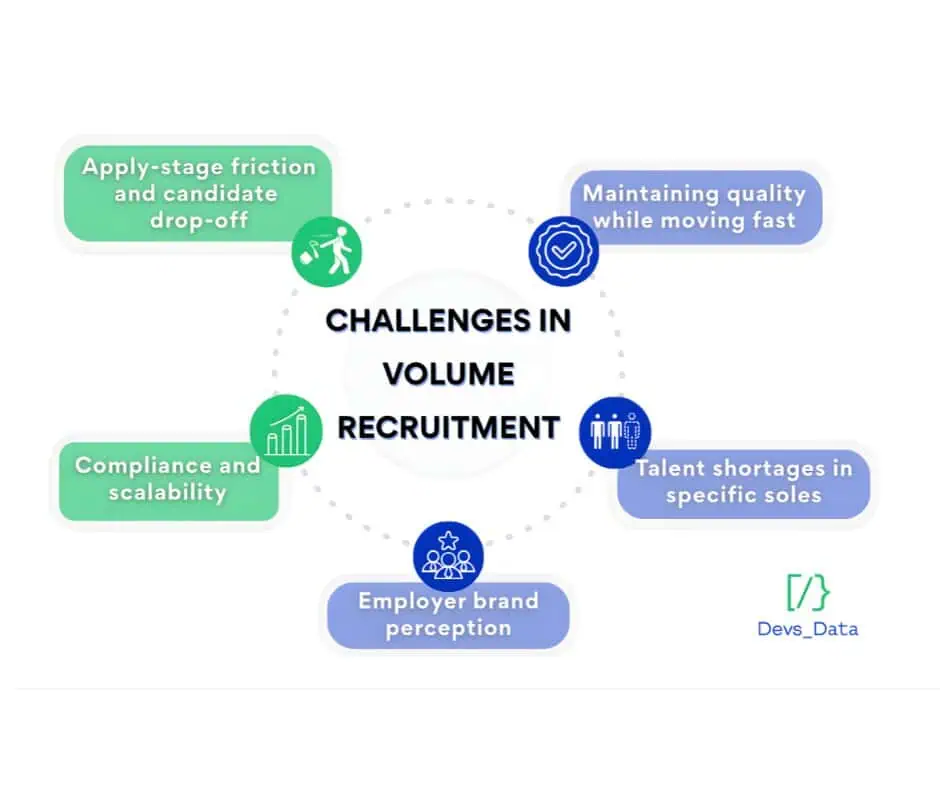
Below are the most common, research-validated obstacles in high-volume hiring today, along with the strategies we use to address them at scale.
In high-volume recruitment, a significant number of candidates leave the process before completion. Lengthy applications, slow feedback, and poor communication contribute to disengagement. High drop-off rates increase time-to-fill and overall hiring costs, making it difficult to meet large-scale staffing goals efficiently.
Our approach
We streamline workflows using automation and structured processes, ensuring timely feedback and seamless progression. Mobile-friendly applications, short screening forms, and automated scheduling reduce friction. Personalized updates and proactive communication keep candidates engaged, resulting in higher completion rates and a more reliable pipeline for mass recruitment campaigns.
Filling hundreds of positions quickly can lead to shortcuts in screening and assessment. Compromising on quality increases the risk of mismatched hires, higher turnover, and lower productivity. Organizations struggle to maintain standards while meeting aggressive deadlines and volume requirements.
Our approach
We implement a hybrid approach combining automated skills assessments with human evaluation. Structured interviews, task-based tests, and clear role criteria ensure candidates meet both technical and cultural requirements. This approach allows us to process large volumes without sacrificing hire quality, maintaining consistency across every requisition.
Many high-volume campaigns include specialized roles where qualified talent is scarce. Competition for these candidates slows the process and can create bottlenecks, risking delays across the entire recruitment pipeline. This is particularly critical in technical roles such as software developers, QA engineers, DevOps specialists, and data analysts; operational positions including logistics coordinators, warehouse supervisors, and field technicians; and niche industry roles like clinical research associates, compliance analysts, or multilingual customer support agents, where supply is limited and demand fluctuates sharply.
Our approach
We expand sourcing strategies beyond conventional channels, tapping into global talent pools, passive candidates, and targeted communities. Data-driven outreach and skills-based screening ensure that even hard-to-fill positions are quickly matched with capable candidates, helping companies maintain momentum in large-scale recruitment initiatives.
Managing a high-volume hiring campaign poorly can damage employer branding. Inconsistent communication, unclear job postings, or delayed feedback creates negative candidate experiences, potentially harming future recruitment and reducing interest in the company.
Our approach
We maintain consistent, transparent communication at every touchpoint. Clear job descriptions, realistic expectations, and structured feedback reflect the company’s values and reinforce credibility. By prioritizing candidate experience, we enhance brand perception while running large-scale hiring campaigns efficiently.
Scaling recruitment across regions introduces complex compliance requirements, including labor laws, pay transparency, and reporting obligations. Failure to adhere can lead to legal risks, financial penalties, and reputational damage, making compliance a critical concern during volume hiring.
Our approach
We embed compliance protocols into every recruitment stage and use scalable systems that adapt to multiple jurisdictions. Standardized templates, audit trails, and automated checks ensure legal requirements are met, allowing clients to scale hiring efficiently without compromising regulatory obligations.
Structured processes, parallel pipelines, and rigorous assessment methods are essential to overcome the unique challenges of recruiting multiple specialized roles simultaneously.
Choosing the right volume recruitment agency is critical for organizations that need to hire a large number of employees quickly while maintaining quality. Unlike traditional recruitment, volume hiring demands specialized processes, technology, and operational expertise. Selecting an agency with the right capabilities can significantly reduce time-to-hire, minimize costs, and improve the overall candidate experience. Below are the key qualities and considerations that define an efficient and reliable volume recruitment partner.
An effective volume recruitment agency should demonstrate a track record of managing campaigns involving hundreds, or even thousands, of hires simultaneously. Look for agencies that can provide case studies, references, or metrics showing how they successfully delivered similar scale projects, including reduced cycle times, low drop-off rates, and high-quality hires. Experience ensures the agency understands the operational complexities of large-scale hiring.
Automation is essential for efficiency in volume recruitment. A reliable agency should utilize Applicant Tracking Systems (ATS), candidate relationship management tools, automated screening, and scheduling systems to handle large applicant volumes without compromising candidate experience. Integration of AI-based matching, bulk communication tools, and analytics dashboards allows for faster decision-making and more accurate pipeline management.
High-volume hiring should not compromise quality. Agencies must offer standardized yet flexible assessment methods to evaluate candidates effectively at scale. Skills-based testing, role-specific assessments, and structured interviews help ensure that each hire meets both technical and cultural requirements. Agencies that can balance efficiency with rigorous evaluation protect clients from early attrition and poor fit.
Candidate experience is a key differentiator. Even in mass hiring, applicants expect timely updates, clear communication, and transparency regarding roles and compensation. A reliable agency implements processes that minimize delays, provides consistent feedback, and ensures a positive interaction at every touchpoint. A strong candidate experience not only improves engagement but also enhances the employer’s brand.
Recruitment demand can fluctuate due to seasonal needs, expansions, or unforeseen growth. Agencies should demonstrate the ability to scale quickly, adjust resources, and manage fluctuating volumes without losing quality. Flexibility also involves adapting workflows, integrating with client systems, and supporting multiple locations or regions simultaneously.
Volume recruitment often spans multiple jurisdictions with varying labor laws and regulations. Agencies must ensure adherence to employment standards, pay transparency, equal opportunity policies, and data privacy requirements. A reliable agency integrates compliance into every stage of recruitment, reducing legal risk and safeguarding the client’s reputation.
Before signing a contract, it’s important to dig deeper into each agency’s approach, processes, and track record. The questions below can help you evaluate whether a partner can truly deliver on high-volume hiring needs:
| Criteria | Questions to ask the agency |
|---|---|
| Proven experience with high-volume campaigns |
|
| Automation and technology integration |
|
| Structured screening and assessment processes |
|
| Candidate experience management |
|
| Scalability and flexibility |
|
| Compliance and risk management |
|
Partnering with a dedicated recruitment agency ensures access to large talent pools, structured evaluations, and scalable workflows that accelerate hiring without sacrificing quality.
Company size: ~60 employees
Founding year: 2016
Website: www.devsdata.com
Headquarters: Brooklyn, NY, and Warsaw, Poland
DevsData LLC specializes in volume recruitment, helping organizations efficiently hire large numbers of employees without compromising on quality. With over nine years of experience in the recruitment market, the company has developed the expertise, processes, and technology needed to manage complex, high-volume hiring campaigns across multiple industries and regions. Its approach combines programmatic job advertising, automated scheduling, and bulk candidate outreach, supported by analytics dashboards to monitor progress and optimize pipelines in real time.
The agency’s team includes US-based specialists, providing local market insights and ensuring that recruitment strategies are tailored to meet specific business needs. DevsData LLC has successfully worked with global corporate clients as well as high-growth startups from various countries, including the US and Israel, demonstrating the ability to operate across diverse markets and organizational structures.
A key strength of DevsData LLC is its extensive talent database of 95000 candidates, which allows the team to quickly source and match qualified professionals with client requirements. This is supported by a structured multi-stage screening process designed to handle high applicant volumes without sacrificing quality, filtering candidates efficiently through automated pre-screening and role-specific assessments. Each candidate undergoes an interview process, including a 90-minute problem-solving challenge, ensuring technical competence and strong communication skills. This approach guarantees a high standard of candidate quality and readiness for the workplace.
DevsData LLC has completed over 100 recruitment projects for more than 80 clients, establishing a proven track record in delivering scalable hiring solutions. The company operates on a success fee model and offers a guarantee period, aligning its incentives with client success and providing additional reassurance.
Holding an official, government-approved license for recruitment services, DevsData LLC combines compliance with professionalism. Clients also benefit from a strong reputation, reflected in a 5/5 rating on Clutch and GoodFirms, which highlights consistent satisfaction and trust.
Through a combination of deep expertise, access to a large candidate pool, rigorous evaluation, and client-focused service, DevsData LLC ensures that organizations can manage high-volume hiring efficiently, mitigate risks, and achieve their growth objectives without sacrificing quality.

DevsData LLC supported UK-based company Imagine Anything Ltd. in building a complete cross-functional technical team within just five weeks. The project involved recruiting seven specialized roles, including a CTO, frontend and backend developers, QA automation engineer, UI/UX designer, prompt engineer, and a unique “vibe-coder” role, all UK-based.
The main challenge was running multiple pipelines in parallel while sourcing top local talent across engineering, design, and creative technology under tight deadlines. Our ten-person recruitment team executed targeted outreach across LinkedIn, GitHub, Dribbble, and local communities, using structured interviews and a 90-minute problem-solving challenge to ensure both technical competence and cultural fit.
The engagement resulted in seven hires who immediately aligned on architecture, established workflows, and began product development. Read the full case study here for detailed metrics and our step-by-step approach.
Scale your team without compromise. Partner with DevsData LLC to streamline high-volume hiring and secure top-tier talent quickly. Contact us today at general@devsdata.com or visit our website at www.devsdata.com. to build your next high-performing workforce.
Do you have IT recruitment needs?
Volume recruitment is a critical strategy for organizations aiming to scale quickly while maintaining workforce quality. Unlike traditional recruitment methods, it requires a combination of speed, efficiency, and precision to manage large candidate pipelines without compromising on technical skills, cultural fit, or overall candidate experience. Businesses face challenges such as high drop-off rates, maintaining quality at scale, sourcing specialized talent, and ensuring compliance – all of which can significantly impact time-to-hire and operational performance if not addressed strategically.
The volume recruitment market continues to evolve, driven by trends such as advanced automation, global talent sourcing, and a growing emphasis on employer branding. Companies that leverage these trends effectively can achieve faster hiring cycles, access a broader talent pool, and reduce operational costs. However, successful volume recruitment depends on choosing the right agency partner, the one that combines technology, structured processes, and industry expertise to handle large-scale hiring while delivering high-quality candidates. A reliable agency provides scalable solutions, transparent communication, and data-driven insights that allow businesses to stay agile and competitive in a rapidly changing market.
DevsData LLC exemplifies what it means to be a trusted partner in volume recruitment. With over nine years of experience, a team of US-based specialists, and a candidate database of 95000 professionals, the company has completed more than 100 recruitment projects for over 80 clients worldwide. DevsData LLC combines rigorous candidate evaluation, including problem-solving challenges and cultural alignment assessments, with structured, high-volume sourcing strategies. Operating on a success fee model with a guarantee period, the agency ensures both accountability and quality. Rated 5/5 on Clutch and GoodFirms, DevsData LLC has helped startups and global corporates alike assemble cross-functional, high-performing teams efficiently. For organizations seeking to scale their workforce with speed, precision, and confidence, DevsData LLC offers a reliable, results-driven solution.
Any questions or comments? Let me know on
Twitter/X.
Discover how IT recruitment and staffing can address your talent needs. Explore trending regions
like Poland, Portugal, Mexico, Brazil and more.
 Frequently asked questions (FAQ)
DevsData – your premium technology partner
DevsData is a boutique tech recruitment and software agency. Develop your software project with veteran engineers or scale up an in-house tech team of developers with relevant industry experience.
Free consultation with a software expert
🎧 Schedule a meeting
FEATURED IN

DevsData LLC is truly exceptional – their backend developers are some of the best I’ve ever worked with.”

Nicholas Johnson
Mentor at YC, serial entrepreneur


 Build your project with our veteran developers.
Explore the benefits of technology recruitment and tailor-made software.
Learn how to source skilled and experienced software developers.
Build your project with our veteran developers.
Explore the benefits of technology recruitment and tailor-made software.
Learn how to source skilled and experienced software developers.

Rebecca Botvin

Commercial Director

Tom Potanski
Manager




Categories: Big data, data analytics | Software and technology | IT recruitment blog | IT in Poland | Content hub (blog)














careers@devsdata.com









general@devsdata.com

"I interviewed about a dozen different firms. DevsData LLC is truly exceptional – their backend developers are some of the best I've ever worked with. I've worked with a lot of very well-qualified developers, locally in San Francisco, and remotely, so that is not a compliment I offer lightly. I appreciate their depth of knowledge and their ability to get things done quickly."

Nicholas Johnson
CEO of Orange Charger LLC,
Ex-Tesla Engineer,
Mentor at YCombinator
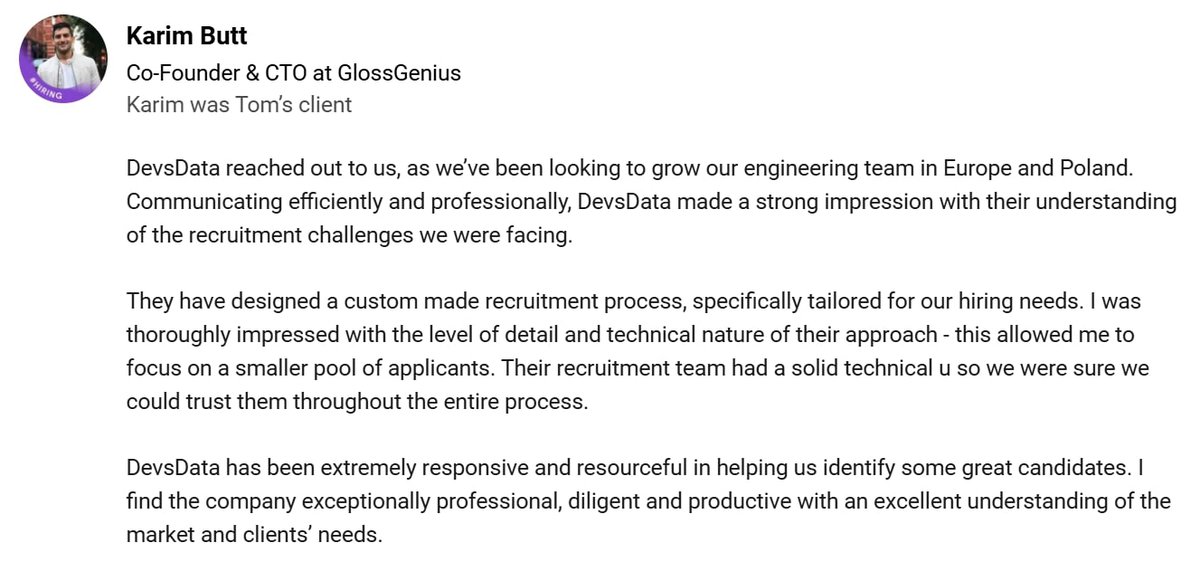
"DevsData reached out to us, as we've been looking to grow our engineering team in Europe and Poland. Communicating efficiently and professionally, DevsData made a strong impression with their understanding of the recruitment challenges we were facing. They designed a tailored recruitment process for our needs. I was impressed with the technical depth of their approach."

Karim Butt
Co-Founder & CTO at GlossGenius, Inc.
"Out of all the vendors we work with, DevsData clearly stands out. The quality of developers they deliver is beyond what we've received from any other vendor, and they've been able to send profile recommendations very quickly. I'm happy to be their reference for other companies from Israel and talk about their recruitment abilities and what they delivered for us."

Ran Eyal
Senior Manager at
ZIM Integrated
Shipping Services Ltd.
"DevsData demonstrated a strong degree of proactivity, taking time to thoroughly understand the problem and business perspective, and continuously suggesting performance and usability enhancements. Their app exceeded my expectations. I've worked with DevsData on numerous projects over the last 3 years and I'm very happy. Being both responsive and honest in communication."

Jonas Lee
Partner & Executive VP of Verus,
Financial LLC, Investor,
& Serial Entrepreneur
Acknowledgments