Thanks for subscribing.
Your gift is on the way.



Global markets are changing faster than ever. Companies face growing pressure to cut costs, respond quickly to shifting customer demands, and integrate new technologies ahead of competitors. In this environment, relying only on permanent teams often leaves organizations struggling to adapt. Flexibility, speed, and access to specialized skills have become central to staying competitive.
This shift is evident across the workforce. According to a report by Procurious, about 40% of the global workforce now comprises contract or contingent workers. The reason is straightforward. Traditional hiring cycles can be too slow and rigid for today’s rapidly changing market conditions.
Meanwhile, the broader contingent workforce, which includes freelancers, independent contractors, and temps, accounts for 30-40% of the US labor market, and could reach 50% by 2050.
Nowhere are these challenges felt more strongly than in technology. Rapid innovation cycles, shifting project scopes, and the high cost of hiring full-time engineers make long recruitment processes both impractical and risky. IT projects cannot always wait months for the right candidate. This is why IT contract staffing has developed into a long-term approach rather than a short-term fix. It gives companies access to highly skilled professionals at critical points, whether to accelerate a product launch, modernize infrastructure, or cover a short-term resource gap.
Along with its advantages, this type of recruitment introduces new challenges, such as managing distributed teams and maintaining continuity, that specialized outsourcing agencies are well-positioned to handle. For businesses, this means agility and reduced risk. For contractors, it means opportunities to work on projects that vary in scope and complexity.
In the sections that follow, we explore how IT contract staffing works in practice, its benefits, the challenges that companies often face, how it compares to other hiring options, and the situations where it proves most valuable. Along the way, we outline practical steps and insights drawn from DevsData LLC’s experience supporting clients across various industries.
IT contract staffing means bringing in skilled professionals on a temporary basis to handle specific projects or business needs. Unlike permanent employees, contractors are usually hired for specialized roles, such as supporting a product launch, managing a system migration, or covering a temporary resource gap. They are engaged through agreements that define their scope, duration, and responsibilities.
In most cases, the staffing agency acts as the formal employer, handling recruitment, screening, contracts, and payroll, while the client company gains immediate access to qualified talent. This structure allows businesses to scale quickly without administrative complexity. From a financial perspective, it also enables companies to treat contract labor as a variable operating expense rather than a long-term capital commitment. For CFOs, this provides greater budget flexibility, supports cost control, and can improve tax efficiency by aligning workforce spending with active projects.
The appeal of this model lies in its adaptability. Companies can adjust staffing levels to match project needs without the long-term obligations of traditional employment. For projects with clear start and end points, or for roles requiring specialized knowledge that is not needed on a full-time basis, contract staffing provides a cost-efficient and practical alternative.
In technology specifically, contract professionals are often brought in for cloud migrations, system integrations, compliance-driven updates, or to accelerate development cycles.
Do you have IT recruitment needs?
By contributing advanced skills from day one, they reduce ramp-up time. A contract cloud engineer, for instance, can begin optimizing infrastructure in the first week, helping the team stay on track.
Contract staffing can take several forms, depending on the project scope, required skills, and timeline. Some organizations hire a single specialist to solve a well-defined problem, while others bring in full teams to deliver complex initiatives. Engagements may last only a few weeks or extend over many months. Understanding these different types helps companies choose the right model for their needs.
A single specialist is engaged to fulfill a focused requirement, such as a cybersecurity analyst to run penetration testing or a DevOps engineer to implement containerization. This model works well when a project needs highly targeted expertise.
Entire groups of professionals are contracted together, often including complementary roles like Frontend Developers, Backend Developers, and QA Engineers. This approach accelerates delivery and ensures cohesive collaboration from the start.
Assignments lasting from a few weeks to several months are typically used to cover urgent deadlines, seasonal demand, or an employee’s leave. Short-term contracts provide businesses with maximum flexibility at minimal cost exposure.
Engagements that extend over many months or even years, often tied to multi-phase projects such as platform modernization, ERP implementation, or large-scale infrastructure programs. More extended contracts maintain stability while still giving clients the freedom to reduce the workforce when projects end.
Taken together, these types can be viewed along two main dimensions: the length of the engagement and the number of professionals involved. This structure helps companies select the right setup for each project, whether it is a short, targeted assignment or a longer collaboration that requires an entire team. Understanding these distinctions also shows why contract staffing has become a practical way to build flexible and effective teams, a topic discussed in the next section.
IT contract staffing offers companies a practical way to adapt their workforce to changing project needs without the long timelines or commitments of permanent hiring. It combines access to specialized talent with flexibility in cost and duration.
Many IT projects require knowledge that is not available within existing teams. Contract staffing provides direct access to experts in fields such as cloud engineering, cybersecurity, data science, and emerging technologies. Companies can engage these professionals only for the period their expertise is needed.
Traditional recruitment for senior or niche IT roles often takes eight to 16 weeks, covering sourcing, interviews, notice periods, and onboarding. Through established talent networks and pre-screened candidates, contract staffing can reduce this timeline to two to four weeks in many cases. This allows organizations to fill critical positions faster and keep projects on schedule.
Contract staffing helps organizations match labor costs precisely to project duration and scope. Since contractors are engaged for defined periods, there are no long-term salary obligations, benefits, or severance expenses. This reduces the fully burdened labor rate, which includes payroll taxes, insurance, benefits, training, and administrative overhead. As a result, companies gain clearer cost visibility and can align workforce spending more closely with active project requirements.
IT projects often go through phases of higher and lower activity. Contract staffing enables companies to expand or reduce team size in line with these cycles, maintaining efficiency and avoiding unnecessary overhead.
Staffing agencies handle contracts, payroll, and compliance, allowing internal teams to focus on project delivery rather than administrative management.

Although contract staffing provides significant benefits, it also presents challenges that businesses must anticipate. From our experience at DevsData LLC, these issues can be effectively managed with the right structures in place. Below, we discuss some of the main challenges and how they can be addressed in practice.
Contractors often join projects already underway, which can make it difficult for them to adjust to workflows and culture. To address this, we prepare both clients and contractors with structured onboarding materials, clear documentation, and early alignment on goals. In many engagements, a designated internal “buddy” or point of contact is also assigned to guide the contractor through tools, processes, and informal team practices during the first weeks. This shortens the adaptation period and allows professionals to become productive quickly.
Top contractors are frequently approached with competing opportunities, which increases the risk of early exits. We manage this risk by maintaining close communication with candidates throughout the contract, setting transparent expectations, and keeping engagement high. These steps help contractors remain committed to the client’s project.
When contracts conclude, important know-how may be lost. To prevent this, we emphasize structured handover sessions, thorough documentation, and proactive planning well before the end of the engagement. This ensures continuity and minimizes disruption for the client.
Different regions impose varying labor, tax, and compliance requirements, including regulations related to contractor classification and co-employment risk. Handling these independently can be complex and time-consuming. With our international expertise, we manage contracts, payroll, and legal obligations on behalf of clients, helping reduce exposure to misclassification issues and unintended employment liabilities. This keeps businesses compliant across jurisdictions while reducing administrative burden.
Choosing the right staffing approach depends on project goals, budget, and timelines. Contract staffing sits between permanent hiring and full outsourcing, offering flexibility and control. Understanding how it compares to other models helps companies decide when it is the best option.
Employing staff on a full-time basis provides stability and long-term retention. However, recruitment is often lengthy and costly, making it less suitable when immediate skills are needed or when the workload is temporary.
Freelancers are effective for small, narrowly defined tasks but can be unreliable for larger, collaborative projects. They often work independently and may not fully integrate into client teams, limiting their usefulness in complex environments.
Outsourcing full projects to an external vendor allows companies to offload responsibility, but it reduces direct control over day-to-day execution. Contract staffing, by contrast, lets businesses manage professionals directly within their own teams while still avoiding permanent commitments.
This model is similar to contract staffing but typically involves longer-term placements in which contractors are embedded in client teams for extended periods. While effective for ongoing needs, it can be less cost-efficient for shorter initiatives or projects with uncertain futures.
To make these differences clearer, the table below provides a side-by-side view of each hiring model, highlighting its main advantages, limitations, and the situations where it works best.
| Hiring model | Advantages | Limitations | IP risk/ownership | Best use cases |
|---|---|---|---|---|
| Permanent hiring | Stability and long-term retention | High recruitment cost, slower process, limited flexibility | Low risk, IP usually owned by the employer | Core teams and ongoing roles |
| Freelancers | Cost-efficient for small tasks, flexible | Limited integration, variable reliability | Higher risk unless contracts are strict | Short, individual assignments |
| Outsourcing projects | Clear deliverables, full vendor responsibility | Less control, vendor dependency | Medium risk, IP depends on vendor terms | Non-core projects with defined scope |
| Staff augmentation | Longer-term integration, scalable support | Higher costs over time, not ideal for short projects | Low to medium risk, governed by contracts | Multi-phase or ongoing projects |
| Contract staffing | Quick access to skills, scalable, adaptable | Requires integration and handover planning | Low risk when managed through the agency | Urgent, short-term to mid-term projects |
Companies often ask how contractor salaries compare with those of permanent employees. To provide a clearer point of reference, the table below presents annual compensation figures based on widely reported industry averages from major recruitment and workforce data sources. These figures reflect general market trends and should be viewed as indicative ranges. For the most accurate and up-to-date benchmarks, we encourage you to consult platforms such as Glassdoor and Levels.fyi.
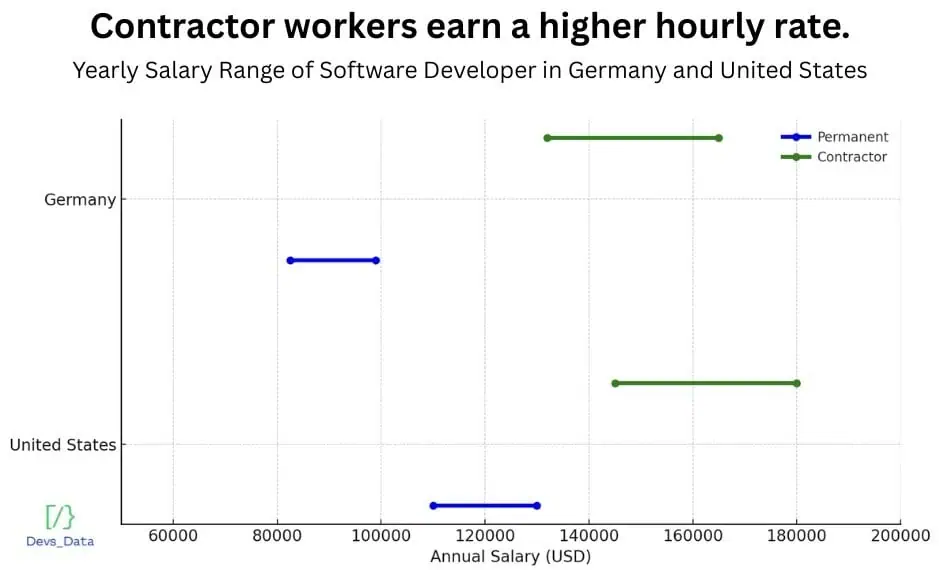
Overall, the data shows that contractors often receive higher annual compensation when their hourly or daily rates are projected across a full working year. This difference reflects their specialized expertise and the fact that companies do not provide benefits such as paid leave, health insurance, or retirement programs.
For professionals, contract roles can be appealing due to higher immediate earnings and exposure to varied projects. For companies, the flexibility and absence of long-term employment commitments often balance the higher rates, making contract staffing a practical option for dynamic or project-driven environments.
While salary considerations are important, the decision to use contract staffing is often driven by when and where it delivers the greatest impact. Below are the scenarios where it proves most effective.
When projects receive sudden funding or demand spikes unexpectedly, contract staffing enables companies to add skilled professionals within days. This speed prevents delays and keeps critical initiatives moving forward.
Not all projects justify permanent hires. For tasks like system migrations, compliance-driven updates, or product launches, contractors provide the necessary expertise without long-term commitments.
Some roles, such as Blockchain Developers, AI Engineers, or Cybersecurity Experts, are essential during specific phases but unnecessary on a permanent basis. In many technology fields, core skills evolve rapidly, with an average skill half-life of around two to three years. This means expertise can become outdated quickly. Contract staffing allows businesses to access up-to-date specialists exactly when they are needed, without carrying long-term roles that may lose relevance as technologies change.
Permanent recruitment processes often take months. Contractors can fill key roles temporarily, ensuring projects continue without disruption while the search for long-term hires is underway.
Organizations operating with tight budgets, hiring freezes, or strict labor regulations often benefit from contract staffing. When full-time headcount is restricted by internal HR policies or budget approvals, contract roles can provide a compliant alternative that allows project managers to secure critical skills and keep delivery on track. Costs remain predictable and tied to the contract length, while compliance responsibilities can be managed more effectively.
When expanding into new markets, businesses may need professionals on the ground to navigate local regulations and practices. Contract staffing provides this local presence without the complexity of establishing a permanent legal entity abroad. In many cases, it also functions as a lightweight alternative to full Employer of Record (EoR) setups, allowing companies to test new regions, validate demand, and build early operational capacity before committing to long-term expansion.
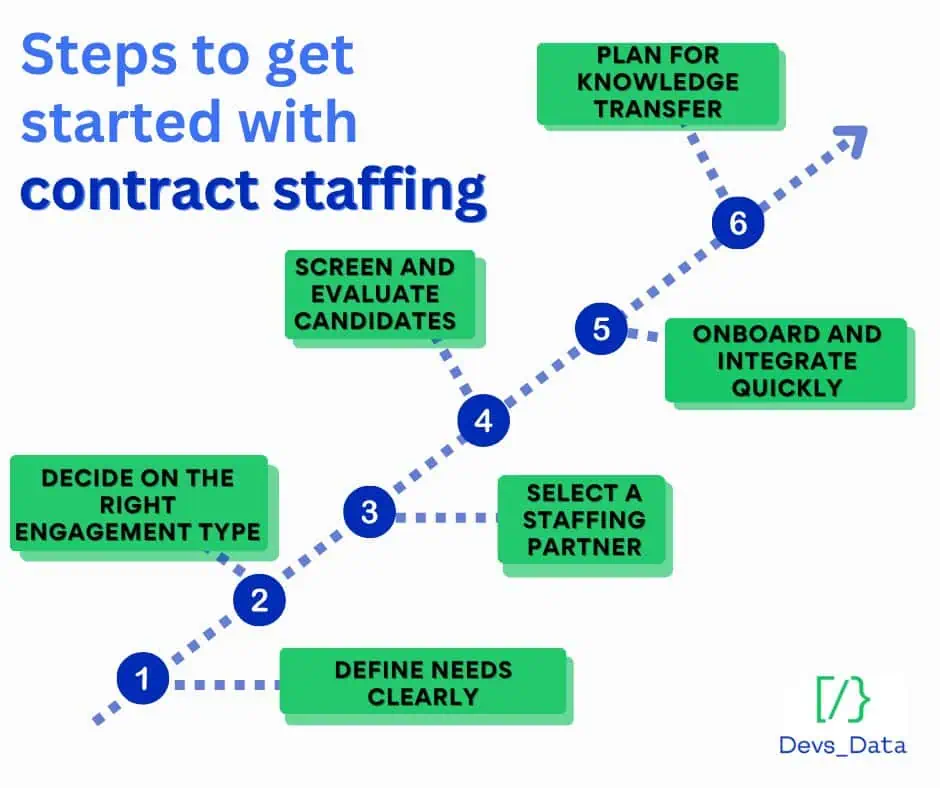
Recognizing when contract staffing is the right choice is only the first step. Moving from interest to implementation requires a structured approach. By following clear steps, companies can avoid common pitfalls and maximize the value of contract staffing.
Start by reviewing your existing systems and conducting a basic tech stack audit to understand current architectures, tools, and dependencies. This helps identify the exact skills required before outlining the project scope and expected timeline. A well-defined role description, grounded in real technical requirements, reduces mismatches and accelerates the search process.
Determine whether the project requires an individual specialist, a full team, or support for a short versus long duration. Choosing the right type early prevents unnecessary adjustments later.
Working with an experienced staffing agency, like DevsData LLC, provides access to broader talent pools, market insights, and compliance expertise. This reduces risks and speeds up recruitment.
Go beyond technical proficiency. Assess adaptability, communication, and cultural alignment, as these qualities are essential for contractors who must integrate quickly into existing teams.
Provide contractors with clear documentation, defined goals, and the necessary system access from day one. Fast onboarding minimizes downtime and allows them to contribute immediately.
Before the contract ends, arrange structured handover sessions and thorough documentation. This ensures critical knowledge remains within the company and operations continue seamlessly.
Website: www.devsdata.com
Team size: ~60 employees
Founded: 2016
Headquarters: Brooklyn, NY, and Warsaw, Poland
DevsData LLC supports organizations with urgent and complex technical needs by providing tailored IT contract staffing services. With more than nine years of experience and a presence in Europe, North America, and Latin America, the company has built a reputation for delivering skilled professionals who strengthen teams and accelerate project delivery. From short-term assignments to longer-term contracts, DevsData LLC provides flexible solutions that align with the pace and technical demands of today’s business environment.
What sets DevsData LLC apart is its ability to respond quickly without compromising quality. The company operates under a government-approved recruitment license, which reinforces trust and credibility in every engagement.
DevsData LLC maintains a proprietary network of over 95000 vetted IT professionals and a team of 40 senior recruiters across the US and Europe. This structure allows for rapid sourcing combined with rigorous evaluation. Every candidate undergoes a 90-minute interview to demonstrate their technical expertise, problem-solving ability, and communication skills, ensuring both capability and cultural alignment.
On average, qualified candidates are presented within 10 to 14 days. By comparison, traditional IT recruitment processes often take 8 to 16 weeks due to extended sourcing, multiple interview stages, and notice periods. This shorter timeline enables clients to secure critical talent and maintain project momentum.
The company operates on a success-based fee model, where clients only pay once a placement is confirmed. Each engagement includes a replacement guarantee at no extra cost, reflecting a commitment to long-term partnerships built on trust and measurable results.
In addition to individual specialists, DevsData LLC regularly provides full contract teams for projects requiring diverse roles, such as Backend and Frontend Developers, Cloud Engineers, DevOps Specialists, QA Testers, and Project Managers. Assignments have ranged from large-scale cloud migrations and ERP rollouts to blockchain development, AI-driven data platforms, and cybersecurity audits. Depending on the project scope, the company can supply a single expert or assemble contract teams of more than ten engineers within weeks.
One example of this approach in action is DevsData LLC’s collaboration with Roche, a global pharmaceutical leader undergoing digital transformation. Roche faced urgent timelines for several data-driven projects and needed contract engineers who could integrate quickly into ongoing work while meeting strict compliance standards. Within days of project initiation, DevsData LLC presented the first qualified candidates.
The full team, including two Java Engineers, one React Developer, and one Python Data Engineer, was assembled and onboarded within two months. This timeline was significantly faster than the typical three to six months required for traditional enterprise hiring.
The quick completion reflected key strengths of contract staffing, including access to a vetted talent pool and the ability to onboard specialists quickly for critical project phases. All professionals joined smoothly and began contributing to backend systems, dashboards, and data pipelines almost immediately.
The success of this engagement highlights how IT contract staffing can fill critical skill gaps without slowing down enterprise innovation. By providing professionals with both strong technical expertise and the ability to adapt to regulated environments, DevsData LLC helped Roche maintain momentum on essential projects. The outcome demonstrated that well-executed contract staffing is not just about speed but also about precision and reliability in meeting industry-specific requirements.
Do you have IT recruitment needs?
DevsData LLC has also delivered numerous complex IT contract staffing projects for global clients, such as:
Through IT contract staffing, DevsData LLC recruited 18 engineers and specialists in backend development, data, system integration, and cloud infrastructure. The contract team was assembled within weeks to support ZIM’s urgent scaling needs and digital transformation roadmap.
Using a contract staffing model, DevsData LLC delivered 14 Software, DevOps, and Product Professionals for a crypto-native digital bank. This approach allowed Xapo to strengthen innovation and security while accelerating its roadmap within a tight timeframe.
DevsData LLC provided contract teams comprising 26 experts in machine learning, engineering, UX/UI, and strategy. Their work produced advanced tools for pricing intelligence and smart logistics, driving major workflow improvements within the first year.
In addition, DevsData LLC has successfully delivered IT contract staffing solutions for companies such as Paysera, Kyoto AS, and Txodds. These organizations have relied on the firm’s ability to provide highly qualified professionals within tight timelines, helping them meet critical milestones and maintain smooth operations.
IT contract staffing is no longer just a short-term solution. It allows companies to scale engineering capacity quickly, access specialized expertise, and keep projects moving without the delays of permanent recruitment. When managed effectively, it becomes a form of agile workforce orchestration, enabling organizations to deploy the right skills at the right time across multiple initiatives. Success depends on choosing the right partner, one that can source talent efficiently, support cultural and technical fit, and manage compliance across multiple regions.
DevsData LLC has built its reputation on these strengths. With more than nine years of experience, a global network of 95000 vetted professionals, and a structured recruitment process, the company helps clients secure reliable contract engineers who integrate easily with internal teams and deliver results from day one.
In addition to IT contract staffing, DevsData LLC provides Employer of Record (EoR) services to help clients manage remote teams while staying compliant with local labor laws. Its Business Process Outsourcing (BPO) solutions further support companies by taking on operational functions such as administration or customer support, enabling internal teams to focus on strategic priorities.
Whether the goal is to accelerate development, strengthen digital transformation initiatives, or expand into new markets, DevsData LLC combines speed, reach, and expertise to deliver the right IT professionals and operational support.
To learn more, visit www.devsdata.com or contact the team at general@devsdata.com.
Any questions or comments? Let me know on Twitter/X.
Discover how IT recruitment and staffing can address your talent needs. Explore trending regions like Poland, Portugal, Mexico, Brazil and more.
 Frequently asked questions (FAQ)
DevsData – your premium technology partner
DevsData is a boutique tech recruitment and software agency. Develop your software project with veteran engineers or scale up an in-house tech team of developers with relevant industry experience.
Free consultation with a software expert
🎧 Schedule a meeting
FEATURED IN

DevsData LLC is truly exceptional – their backend developers are some of the best I’ve ever worked with.”

Nicholas Johnson
Mentor at YC, serial entrepreneur


 Build your project with our veteran developers.
Explore the benefits of technology recruitment and tailor-made software.
Learn how to source skilled and experienced software developers.
Build your project with our veteran developers.
Explore the benefits of technology recruitment and tailor-made software.
Learn how to source skilled and experienced software developers.

Rebecca Botvin

Commercial Director

Tom Potanski
Manager




Categories: Big data, data analytics | Software and technology | IT recruitment blog | IT in Poland | Content hub (blog)















careers@devsdata.com









general@devsdata.com

"I interviewed about a dozen different firms. DevsData LLC is truly exceptional – their backend developers are some of the best I've ever worked with. I've worked with a lot of very well-qualified developers, locally in San Francisco, and remotely, so that is not a compliment I offer lightly. I appreciate their depth of knowledge and their ability to get things done quickly."

Nicholas Johnson
CEO of Orange Charger LLC,
Ex-Tesla Engineer,
Mentor at YCombinator
"DevsData reached out to us, as we've been looking to grow our engineering team in Europe and Poland. Communicating efficiently and professionally, DevsData made a strong impression with their understanding of the recruitment challenges we were facing. They designed a tailored recruitment process for our needs. I was impressed with the technical depth of their approach."

Karim Butt
Co-Founder & CTO at GlossGenius, Inc.
"Out of all the vendors we work with, DevsData clearly stands out. The quality of developers they deliver is beyond what we've received from any other vendor, and they've been able to send profile recommendations very quickly. I'm happy to be their reference for other companies from Israel and talk about their recruitment abilities and what they delivered for us."

Ran Eyal
Senior Manager at
ZIM Integrated
Shipping Services Ltd.
"DevsData demonstrated a strong degree of proactivity, taking time to thoroughly understand the problem and business perspective, and continuously suggesting performance and usability enhancements. Their app exceeded my expectations. I've worked with DevsData on numerous projects over the last 3 years and I'm very happy. Being both responsive and honest in communication."

Jonas Lee
Partner & Executive VP of Verus,
Financial LLC, Investor,
& Serial Entrepreneur
Acknowledgments