Thanks for subscribing.
Your gift is on the way.



Building an application no longer has to be a slow and highly technical effort. Low-code development has changed how software is created by reducing the amount of manual coding required and allowing more people inside a company to take part in shaping solutions.
Low-code platforms make it possible to model logic, data, and interfaces visually instead of writing everything by hand. This approach shortens delivery time, improves collaboration between technical and business roles, and helps teams iterate without delaying releases.
In practice, this shift favors development models that reduce manual coding through visual modeling and reusable components. These approaches align closely with low-code principles and allow teams to move from planning to delivery with fewer technical barriers.
Forrester estimates that the combined low-code and digital process automation market reached $13.2 billion by the end of 2023, with projections of around $30 billion by 2028 and up to $50 billion in stronger growth scenarios.
The demand is increasing because organizations want faster ways to build products, decrease dependency on scarce senior engineering capacity, and modernize internal tools without rebuilding entire systems from scratch.
Among the platforms contributing to this growth, Mendix has become one of the most widely recognized. It makes software creation accessible to both developers and business professionals through visual modeling and reusable components. Teams can move from an idea to a working solution around 30-50% faster on average for typical business applications, while still retaining technical control and reliability.
This article explains what Mendix is, the problems it addresses, the benefits it offers, and where it delivers the most value. It also looks at common use cases, costs, and considerations to help determine whether Mendix is the right fit for a particular business need.
Below is a short introductory video overview of Mendix for additional context. The video summarizes Mendix as a low-code platform that enables fast application delivery, process automation, and legacy system modernization through visual development, flexible deployment, and a broad ecosystem of reusable components.
Mendix is a low-code application development platform that allows organizations to design, build, and deploy software with less manual programming. It uses a visual interface that lets users model logic, data, and workflows using simple drag-and-drop components rather than writing complex code.
The platform was built to help professional developers and business specialists collaborate within the same environment. This shared space makes it easier to move from an idea to a working solution while keeping development structured and reliable.
Mendix supports both web and mobile application development and is used across many industries, including finance, healthcare, manufacturing, logistics, and the public sector.
Its marketplace provides ready-to-use modules and templates that shorten development time, while built-in tools support cloud deployment, version control, testing, and performance tracking.
Mendix also connects easily with existing systems such as SAP, Salesforce, and Microsoft Dynamics, allowing organizations to improve or extend legacy software without replacing it entirely.
Overall, Mendix simplifies application creation while preserving the flexibility needed for professional development, giving teams a practical and efficient way to deliver high-quality business software.
Do you have IT recruitment needs?
Many organizations struggle to keep up with the growing demand for new software. Traditional development often takes months or even years, requires large engineering teams, and depends on hard-to-find technical skills. As a result, business ideas are delayed, and resources are tied up in long release cycles.
Mendix helps solve these issues by making application development faster and more accessible. It allows companies to create digital tools and internal systems without relying solely on advanced programming skills. This reduces the pressure on IT departments and lets business professionals participate directly in the development process.
The platform also addresses the problem of disconnected systems. Many organizations rely on a mix of legacy applications and newer tools that were built at different times and cannot easily share data or workflows. Mendix helps bridge this gap by providing built-in connectors and APIs that allow teams to integrate existing systems, expose data to new applications, and gradually modernize processes without replacing core systems.
In essence, Mendix removes the barriers that often slow down digital projects. It shortens development cycles, lowers costs, and creates a more collaborative environment where ideas can turn into working solutions much faster than before.

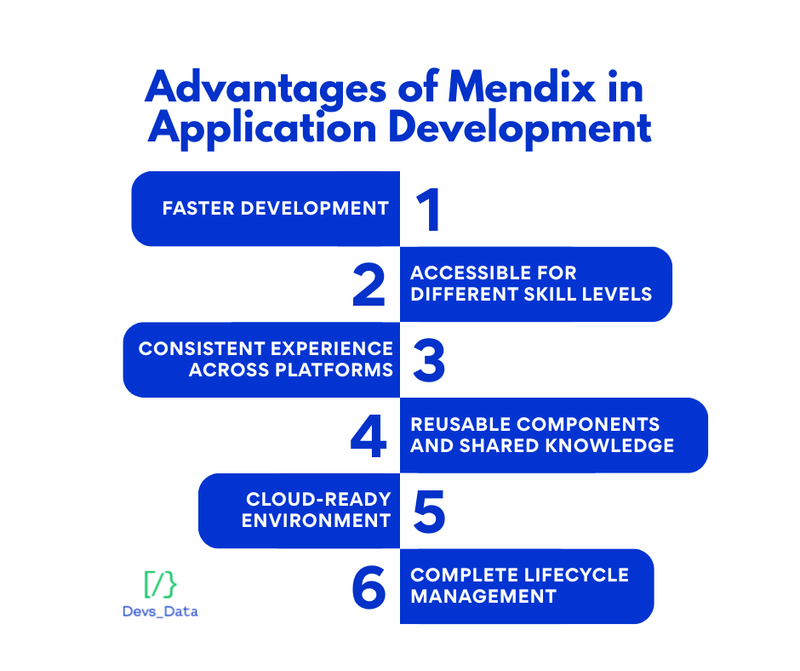
Mendix offers several practical benefits that enable organizations to deliver applications faster and manage them more effectively throughout their lifecycle. Let’s review how these capabilities translate into real advantages for teams using the platform.
Applications can be built and adjusted quickly through visual modeling instead of manual coding. This shortens the time from an idea to a functional product and makes it easier to update or expand existing applications when business needs change.
The platform is designed for both technical and non-technical users. Business analysts, designers, and developers can work in the same environment, reducing the communication gaps that often slow down traditional projects.
Mendix applications work smoothly on web and mobile devices without requiring separate development for each platform. This consistency improves usability and helps organizations reach users on any device.
The built-in marketplace includes ready modules, templates, and connectors. Teams can use these elements instead of creating everything from the ground up, which saves time and promotes collaboration between projects.
Mendix supports deployment on public and private clouds with tools for monitoring, scaling, and managing applications after launch. This flexibility allows organizations to maintain reliable performance and adapt their infrastructure as projects grow.
The platform provides tools for development, testing, deployment, and maintenance in one place. This unified approach gives teams a clear view of each stage of the process and helps maintain quality from start to finish.
Taken together, these advantages make Mendix an effective choice for organizations that want to create modern software efficiently without sacrificing control or reliability.
Mendix is built around the idea that software creation should be collaborative. It provides tools for both developers and business professionals, giving each group an environment suited to their level of technical knowledge.
The platform offers two main workspaces. Mendix Studio is a web-based environment designed for users with little or no coding experience. It allows them to build and adjust applications through a visual interface that shows processes, data models, and user interactions in an understandable way.
Mendix Studio Pro is the desktop version created for professional developers. It gives them more control over logic, integrations, and security settings. Developers can extend applications with custom code when needed, while still benefiting from the shared structure that low code provides.
This setup helps teams work together effectively. Business users can model requirements and review results directly, while developers refine and expand the application for production. As a result, the gap between business needs and technical implementation becomes much smaller.
Mendix combines visual modeling with the ability to customize deeper layers when necessary, offering a balanced approach that supports both simplicity and precision in software development.
Do you have IT recruitment needs?
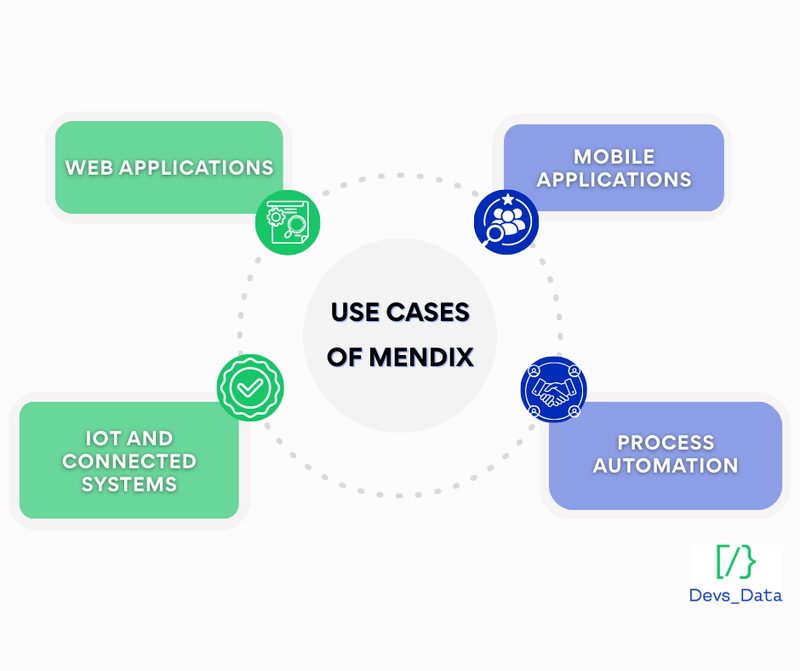
Mendix supports a wide variety of application types, from simple internal tools to large, connected systems. Its flexibility makes it suitable for organizations that want to modernize existing processes or introduce new digital services without building everything from scratch.
Many teams use Mendix to create responsive web applications that work consistently across browsers and devices. These applications can support customer portals, data dashboards, or internal management systems. The visual modeling tools allow teams to build interfaces, workflows, and logic in one environment, reducing the time required for both development and maintenance.
Mendix can generate native mobile applications using the same shared logic and data models as web projects. This makes it possible to deliver reliable mobile tools for field workers, sales representatives, or customer engagement without maintaining separate codebases for different operating systems.
Organizations developing connected products use Mendix to link data from sensors and devices with analytics or control dashboards. The platform’s integration capabilities allow teams to monitor equipment, track performance, and visualize key data points in real time.
Beyond user interfaces, Mendix is often applied to automate business workflows. Teams can design approval systems, data collection processes, and task-tracking tools to reduce manual work and improve accuracy.
By combining these capabilities, Mendix helps organizations move from isolated tools to complete digital ecosystems that are easier to maintain, scale, and adapt to changing requirements.
Mendix follows a subscription model that scales with the size and complexity of a project. Pricing is typically calculated per application, with costs influenced by the number of environments (such as development, test, and production), users, and the features included in each plan.
| Plan | Intended for | Approximate cost per month (per app) | Typical scope and limits | Main features |
|---|---|---|---|---|
| Free plan | Individual users or small test projects | €0 | Build and test a single application in a limited environment, suitable for learning and prototyping | Basic tools for creating and publishing simple applications |
| Standard plan | Growing organizations | Starting at €900/month | Run a production-ready application with multiple users, standard integrations, and a limited number of environments | Multi-user access, integration options, analytics |
| Premium plan | Large businesses and institutions | Custom pricing | Support mission-critical applications across multiple environments with advanced governance, scalability, and compliance needs | Advanced governance, scaling, security, and support |
These figures are approximate and may vary depending on contract terms. The subscription model allows organizations to begin with a small setup and expand as their requirements grow. Larger organizations may also choose an Unlimited Apps license, which supports multiple applications under a single contract at higher pricing.
When compared with traditional development, the total cost of building and maintaining applications with Mendix can be lower by roughly 30% to 50%. The reduction comes mainly from shorter development cycles, fewer specialized coding tasks, and easier long-term maintenance.
In practice, Mendix offers an affordable entry point for small teams and a cost-effective option for enterprises managing multiple applications. To place these numbers in context, it helps to compare them with both traditional coding and other low-code platforms.
While Mendix reduces long-term development effort, its financial model differs from both traditional coding and other low-code platforms. The table below provides a general overview:
| Cost aspect | Mendix (low-code) | OutSystems (alternative low-code) | Traditional full-code development |
|---|---|---|---|
| Subscription cost | From $0 to custom enterprise pricing | Typically higher at mid-tier levels | None |
| Time to build | Shorter, visual development | Shorter, visual development | Longest |
| Team size required | Smaller, mixed-skill teams | Smaller, mixed-skill teams | Larger, senior-heavy teams |
| Lifecycle cost | Lower due to simplified updates | Lower but can rise with scaling | Highest due to manual maintenance |
| Flexibility | High within the platform structure | Similar flexibility | Maximum customization |
This comparison shows where Mendix sits within the broader cost landscape. Traditional development offers the most control but typically requires a higher engineering budget. Low-code platforms reduce manual development and maintenance work, making them more cost-effective for organizations that build and maintain multiple internal applications.
Security and compliance are central components of the Mendix platform, especially for organizations operating in regulated industries such as finance, healthcare, and public administration. The platform provides built-in features that help teams protect data, manage user permissions, and maintain compliance with standards like GDPR.
Mendix supports role-based access control, allowing organizations to define who can view or modify specific pages, workflows, and data elements. Access can be managed at a granular level, including attribute-level security, which restricts visibility of individual fields based on user permissions. This helps ensure that sensitive information is only accessible to authorized roles.
For auditing and governance, Mendix includes audit trails that record key application events and changes. These logs assist with monitoring user activity and verifying compliance requirements without relying on separate tracking tools. The platform also supports encryption for data in transit and at rest, and can be deployed in cloud environments that meet industry security standards.
These capabilities enable teams to utilize Mendix in environments where data protection and regulatory compliance are crucial, while still reaping the benefits of low-code development speed and flexibility.
While Mendix offers clear advantages in speed and accessibility, it also presents certain considerations that organizations need to evaluate before adoption. These are not necessarily drawbacks but factors that influence how well the platform fits different technical and business goals.
Mendix works best when applications follow standard business logic and structures. For projects that require complex algorithms, advanced integrations, or highly specific performance tuning, developers may find that traditional coding offers more flexibility.
Although the platform reduces development time and maintenance expenses, subscription fees can rise with the number of applications and users. For large organizations running multiple enterprise systems, this can become a significant part of the technology budget.
Applications built on Mendix rely on its ecosystem and runtime environment. If a company decides to move to a different stack later, it may need to rebuild or reconfigure parts of the system to achieve the same functionality.
Even though Mendix is designed for accessibility, effective use still requires understanding data models, workflows, and integrations. Teams new to low-code development often need a short period of training and adjustment.
For projects handling large volumes of data or real-time analytics, the platform may not match the performance of fully optimized, hand-coded solutions. However, most business applications run effectively within their standard architecture.
In short, Mendix trades some degree of technical control for development speed and simplicity. For many organizations, this trade-off is practical, but it remains important to match the platform’s strengths with the project’s long-term requirements.
Do you have IT recruitment needs?
Choosing between Mendix and traditional software development depends on the level of control, speed, and scalability a project requires. Both approaches can produce reliable applications, but they differ in how development is carried out and maintained over time.
| Aspect | Mendix (low code) | Traditional coding |
|---|---|---|
| Development speed | Applications can be created several times faster through visual modeling and reusable modules. | Development takes longer since all logic, interfaces, and integrations must be written manually. |
| Required skills | Suitable for developers and business users with limited coding experience. | Requires professional programmers and specialists in multiple languages or frameworks. |
| Collaboration | Allows technical and non-technical team members to collaborate in a single environment. | Collaboration is mostly technical, with limited direct input from business users. |
| Flexibility | Works well for standard business processes and integrations, but is less suited for highly specialized systems. | Offers full control over structure and logic, allowing any type of customization. |
| Maintenance | Updates and changes can be made visually with built-in lifecycle tools. | Maintenance is manual and requires ongoing development effort. |
| Cost efficiency | More predictable long-term costs, especially when maintaining multiple internal applications. | Higher due to longer development cycles and a larger workforce. |
| Scalability | Cloud-native and easy to scale within supported environments. | It can scale widely but requires more setup and management. |
| Performance | Strong for most business needs, but not ideal for highly intensive processing. | It can be fully optimized for performance and complex data operations. |
In practice, many organizations use a combination of both methods. Mendix is applied for quick development, prototypes, and business applications, while traditional coding is used for modules that require advanced customization or performance optimization. This combined approach allows teams to balance speed with precision and maintain long-term flexibility.
Whether Mendix is the right choice depends on an organization’s size, development capacity, and the frequency with which new applications need to be delivered. Smaller companies with fewer than 50 employees often benefit from Mendix because it reduces the reliance on senior engineers and allows limited teams to build internal tools more quickly. Mid-sized organizations in the 50-500 range tend to see the strongest results, as Mendix supports the steady stream of portals, dashboards, and workflow applications they typically maintain across different departments. Large enterprises with more than 500 employees also gain value, especially when they want to modernize legacy systems gradually or standardize how internal applications are created.
The platform delivers the most value when new applications must be produced on a recurring basis and when business and technical teams need to collaborate closely during development. It also works well for standard business logic, integration with existing systems, and projects that benefit from short delivery cycles.
However, organizations building systems with highly specific backend logic, intensive real-time processing, or complex custom algorithms may still prefer traditional development for those components. Many companies combine both approaches, using Mendix for rapid delivery and business applications while relying on full-code development where deeper customization is required.

Website: www.devsdata.com
Team size: ~65 employees
Founded: 2016
Headquarters: Brooklyn, NY, and Warsaw, Poland
DevsData LLC specializes in low-code and Mendix development, helping organizations design and scale digital solutions that meet modern business needs. With more than ten years of experience in the software market, the company has built a strong reputation for technical precision and reliability.
The team includes US-based specialists and Google-level in-house engineers who bring deep technical knowledge and industry insight to every project. DevsData LLC has successfully completed over 100 projects for more than 80 clients worldwide, ranging from large corporate enterprises to fast-growing startups across the United States, Israel, and Europe.
DevsData LLC’s developers have over ten years of experience in low-code and Mendix technologies, as well as in complementary areas such as cloud infrastructure, system integration, and data engineering.
This expertise allows the company to provide tailored solutions that combine the flexibility of low-code platforms with the reliability of traditional engineering standards. In addition to application development, DevsData LLC helps organizations adopt Mendix effectively across their operations. This includes advising on licensing and purchase strategy, configuring the platform for use on company infrastructure, integrating it with legacy systems, and preparing secure production environments.
The team also supports internal onboarding by teaching analysts, developers, and process owners how to work within Mendix. This practical guidance allows companies to begin using the platform with minimal disruption to ongoing work.

Beyond development, DevsData LLC offers IT recruitment and team augmentation services, helping organizations hire skilled Mendix professionals quickly and efficiently. Each candidate is screened through detailed technical interviews and problem-solving evaluations to ensure strong communication skills and technical depth.
By combining strategic recruitment capabilities with hands-on development experience, DevsData LLC delivers the people and technology needed to make Mendix projects successful from concept to implementation and long-term maintenance.
If your organization is planning to explore low-code or evaluate Mendix for upcoming projects, DevsData LLC can support both development and recruitment needs. Reach out to discuss your goals and learn about the type of technical setup that would work best for your case.
Do you have IT recruitment needs?
Stay connected with us at www.devsdata.com or drop a message at general@devsdata.com for additional information.
Low-code platforms have changed how organizations approach software development. They make it possible to deliver working applications in less time and with smaller teams, while keeping quality and structure under control. Mendix stands out in this space because it combines accessibility with the technical depth required for enterprise use.
For many companies, adopting Mendix means being able to turn ideas into products faster and involve more people in the process. It also allows teams to modernize legacy systems gradually, avoiding the disruption that often comes with full rewrites.
At the same time, the platform’s success depends on thoughtful implementation and experienced guidance. This is where partnerships with specialists such as DevsData LLC can add real value. Through technical expertise, proven recruitment capabilities, and a strong understanding of low-code platforms, DevsData LLC helps businesses create solutions that are practical, scalable, and sustainable.
Mendix continues to gain ground as organizations look for efficient and reliable ways to build applications. Used with the right strategy and expertise, it offers a clear path toward faster innovation and more flexible digital development.
Discover how IT recruitment and staffing can address your talent needs. Explore trending regions
like Poland, Portugal, Mexico, Brazil and more.
 Frequently asked questions (FAQ)
DevsData – your premium technology partner
DevsData is a boutique tech recruitment and software agency. Develop your software project with veteran engineers or scale up an in-house tech team of developers with relevant industry experience.
Free consultation with a software expert
🎧 Schedule a meeting
FEATURED IN


DevsData LLC is truly exceptional – their backend developers are some of the best I’ve ever worked with.”

Nicholas Johnson
Mentor at YC, serial entrepreneur


 Build your project with our veteran developers.
Explore the benefits of technology recruitment and tailor-made software.
Learn how to source skilled and experienced software developers.
Build your project with our veteran developers.
Explore the benefits of technology recruitment and tailor-made software.
Learn how to source skilled and experienced software developers.

Rebecca Botvin

Commercial Director

Tom Potanski
Manager




Categories: Big data, data analytics | Software and technology | IT recruitment blog | IT in Poland | Content hub (blog)
















careers@devsdata.com









general@devsdata.com

"I interviewed about a dozen different firms. DevsData LLC is truly exceptional – their backend developers are some of the best I've ever worked with. I've worked with a lot of very well-qualified developers, locally in San Francisco, and remotely, so that is not a compliment I offer lightly. I appreciate their depth of knowledge and their ability to get things done quickly."

Nicholas Johnson
CEO of Orange Charger LLC,
Ex-Tesla Engineer,
Mentor at YCombinator
"DevsData reached out to us, as we've been looking to grow our engineering team in Europe and Poland. Communicating efficiently and professionally, DevsData made a strong impression with their understanding of the recruitment challenges we were facing. They designed a tailored recruitment process for our needs. I was impressed with the technical depth of their approach."

Karim Butt
Co-Founder & CTO at GlossGenius, Inc.
"Out of all the vendors we work with, DevsData clearly stands out. The quality of developers they deliver is beyond what we've received from any other vendor, and they've been able to send profile recommendations very quickly. I'm happy to be their reference for other companies from Israel and talk about their recruitment abilities and what they delivered for us."

Ran Eyal
Senior Manager at
ZIM Integrated
Shipping Services Ltd.
"DevsData demonstrated a strong degree of proactivity, taking time to thoroughly understand the problem and business perspective, and continuously suggesting performance and usability enhancements. Their app exceeded my expectations. I've worked with DevsData on numerous projects over the last 3 years and I'm very happy. Being both responsive and honest in communication."

Jonas Lee
Partner & Executive VP of Verus,
Financial LLC, Investor,
& Serial Entrepreneur
Acknowledgments