Thanks for subscribing.
Your gift is on the way.



Mobile has become the default interface for digital products. The global mobile application market reached $298 billion in 2025 and is projected to grow to $330 billion in 2026, exhibiting a CAGR of 15.1% through 2034 Fortune Business Insights. That growth creates constant pressure on engineering teams to ship faster across both iOS and Android without doubling headcount or infrastructure. The result is a structural shift: companies are moving away from maintaining separate native codebases toward shared-codebase delivery models that consolidate effort across platforms.
Building separate iOS and Android apps means double the work: two codebases, higher engineering costs, longer release cycles, and more coordination overhead. As products scale, this duplication becomes a bottleneck. React Native offers a practical alternative by allowing teams to deliver one shared mobile codebase, cutting development effort while maintaining consistent functionality across platforms.
Industry data reflects this momentum. According to the Stack Overflow Developer Survey 2024, React Native remains one of the most commonly used cross-platform mobile frameworks among professional developers, reinforcing its position as a mainstream, enterprise-ready technology rather than a niche choice.
The broader market context explains why outsourcing React Native development has accelerated. Mobile continues to absorb a growing share of digital interaction, commerce, and enterprise workflows, placing pressure on engineering teams to support both platforms without doubling headcount. Statista’s 2024 analysis of cross-platform mobile development shows that React Native is used by a significant share of developers building mobile apps worldwide, driven by pressure to reduce time-to-market and control engineering costs while still supporting complex product roadmaps.
Building stable, high-performing React Native applications requires engineers who understand native platform constraints, bridge optimization, state management, performance profiling, and long-term maintainability. Many companies struggle to assemble this level of expertise internally, particularly in competitive local markets where senior mobile engineers are scarce or expensive. This gap is one of the primary reasons organizations turn to React Native development outsourcing as a way to access experienced talent without slowing product execution.
At DevsData LLC, we’ve supported startups and established companies in outsourcing React Native development teams that can ship reliably, scale codebases responsibly, and collaborate effectively within distributed product environments. In this article, we share our hands-on experience with React Native development outsourcing, outline common challenges we see across projects, and provide practical guidance for building high-quality mobile teams that deliver real business value.
A React Native development outsourcing partner acts as an extension of your internal product and engineering team, aligning mobile development with product goals, delivery timelines, and technical standards. The role goes beyond supplying developers on demand.
At the core, an outsourcing partner assembles React Native engineers with proven cross-platform experience across JavaScript and native iOS and Android layers. This includes designing shared business logic, implementing platform-specific components when required, and maintaining performance close to fully native applications. Strong partners understand when React Native abstractions are sufficient and when native code is necessary to avoid performance or UX issues.
Beyond implementation, experienced partners support architecture and technical decision-making, change management across teams, structured project delivery, and interpretation of customer feedback into product priorities. This covers state management, navigation, API integration, and testing strategies that scale over time. Early architectural choices in React Native have long-term impact, and outsourcing partners help reduce technical debt by applying patterns proven in production environments.
Outsourcing teams also integrate into existing delivery workflows, adapting to agile sprints, CI/CD pipelines, and release processes. Responsibilities often include automated testing setup, app store submissions, versioning, and coordinated iOS and Android releases to minimize risk.
Finally, a React Native development outsourcing partner contributes to ongoing optimization and maintenance. This includes performance tuning, dependency updates, framework upgrades, and proactive monitoring of crash reports and user feedback.
As mobile ecosystems evolve rapidly, outsourcing partners help ensure your application remains stable, secure, and compatible with new OS versions without placing additional strain on internal teams.
When done well, React Native outsourcing is not a task handoff. Whether a company opts for direct recruitment support, a fully managed delivery team, or a hybrid engagement where external engineers integrate alongside internal staff, the goal stays the same: embedding senior mobile talent that brings architectural discipline, release reliability, and predictable delivery capacity into your product team.
React Native is often evaluated alongside other cross-platform frameworks when teams decide how to build and scale mobile products. While all aim to reduce duplication between iOS and Android, they differ significantly in ecosystem maturity, performance trade-offs, and suitability for large, long-lived applications.
The comparison below highlights how React Native stacks up against its closest alternatives in production environments.
| Criteria | React Native | Flutter | Xamarin / .NET MAUI |
|---|---|---|---|
| Primary language | JavaScript / TypeScript | Dart | C# |
| Code sharing | Shared business logic with native rendering | Shared UI rendered via custom engine | Shared logic with native UI bindings |
| Performance profile | Near-native when optimized; native modules available | High, consistent performance via compiled UI | Strong performance, closer to native |
| Native integration | Direct access to iOS and Android native APIs | Possible, but requires platform channels | Deep native access via .NET ecosystem |
| Ecosystem maturity | Very large ecosystem, strong community, long production history | Growing rapidly, Google-led ecosystem | Smaller mobile-focused ecosystem |
| Hiring availability | Broad global talent pool | More limited Dart/Flutter talent pool | Concentrated among .NET specialists |
| Suitability for complex apps | High, especially with mixed native + RN architecture | High, but less flexible with native UI | High for teams already invested in .NET |
| Typical use cases | Consumer apps, enterprise apps, long-term products | UI-consistent apps, greenfield projects | Enterprise apps within Microsoft stack |
React Native is often chosen when teams need cross-platform delivery without abandoning native platform capabilities, especially for products that evolve over years and require frequent releases, third-party SDK integration, and performance tuning. Flutter tends to be a stronger fit for greenfield projects that prioritize pixel-level UI consistency across platforms, while .NET MAUI appeals to teams already invested in the Microsoft ecosystem and C# tooling. React Native’s ecosystem depth and hiring availability, rooted in the size of the global JavaScript talent pool, make it a common default for scalable, long-term mobile products that require frequent iteration and broad third-party integration.
Do you have it outsourcing needs needs?
React Native development costs vary significantly depending on where your engineering team is located. The table below uses Glassdoor data for the Software Developer role (all levels) in each country, converted to annual USD figures using March 2026 exchange rates.
| Region | Average annual salary (USD) |
|---|---|
| United States | ~$121600 |
| United Kingdom | ~$58400 |
| Czech Republic (CEE) | ~$49000 |
| Poland (CEE) | ~$37900 |
| Brazil | ~$13600 |
| India | ~$6800 |
Each outsourcing destination brings a different mix of advantages beyond cost. Central and Eastern Europe, including Poland and the Czech Republic, pairs strong computer science education with cultural alignment to Western European and US product teams, plus working hours that partially overlap with both regions. This makes CEE a natural fit for React Native projects that depend on tight collaboration between mobile engineers, Designers, and backend teams. India provides the deepest talent pool at the lowest salary baseline, a strong option when a company needs to scale React Native capacity fast without extended recruiting cycles. Brazil and the wider South American region offer near-complete time-zone alignment with North American business hours, which reduces the asynchronous communication overhead that often slows mobile release coordination.
Most companies evaluating outsourcing for the first time lack direct visibility into these regional differences. Experienced outsourcing agencies bring accumulated knowledge of local talent markets, salary benchmarks, communication norms, and regulatory considerations across geographies. Translating that knowledge into tailored sourcing recommendations gives clients a strategic advantage: they hire from the right region for their product’s collaboration model, budget, and release cadence rather than defaulting to the most visible or cheapest option.
When outsourcing React Native development, companies typically choose between onshore, nearshore, and offshore delivery models. Each approach affects cost, collaboration, time-zone overlap, and delivery speed.
Geographic models
Onshore outsourcing involves working with teams located in the same country as the client. This model offers the strongest cultural alignment and real-time collaboration but usually comes at the highest cost.
Nearshore outsourcing places teams in neighboring or nearby regions with partial time-zone overlap. It often balances cost efficiency with smoother communication and faster feedback loops, making it a popular option for companies that value collaboration without fully local pricing.
Offshore outsourcing relies on teams located in distant regions with significant time-zone differences. While typically the most cost-effective option, it requires stronger process discipline, documentation, and delivery management to maintain velocity and quality.
Engagement models
Staff augmentation adds individual React Native engineers to an existing internal team. The client retains full control over priorities, workflows, and delivery management, making this a good fit when the in-house structure is already strong and the gap is purely capacity or specialization.
A dedicated development team provides a self-contained unit, typically including Developers, QA, and sometimes a Technical Lead or Project Manager, that operates as an extension of the client’s organization. The outsourcing partner handles recruitment, onboarding, and team continuity, while the client directs product priorities and roadmap decisions.
Full project outsourcing transfers end-to-end delivery responsibility to the partner, covering architecture, development, testing, release management, and ongoing maintenance. This model works best when a company needs a complete mobile product built from scratch or lacks internal capacity to manage day-to-day engineering execution.
Each combination of geographic and engagement model can work well for React Native development when aligned with the company’s product complexity, release cadence, internal capacity, and collaboration needs.
Do you have it outsourcing needs needs?
When the partner has deep React Native production experience, a structured vetting process, and proven ability to integrate into distributed product teams, you gain speed, specialized mobile expertise, and delivery capacity that’s hard to replicate through ad-hoc hiring.
Even before you narrow the scope to “senior mobile + React Native,” the broader pipeline pressure is clear. The US Bureau of Labor Statistics projects 15% employment growth for software developers, QA analysts, and testers from 2024 to 2034, with ~129200 openings per year on average. Outsourcing is one of the most practical ways to bypass local bottlenecks and add capacity quickly, without waiting through long recruiting cycles.
React Native outsourcing works best when collaboration is already distributed. The Stack Overflow Developer Survey 2024 reports 42% of developers work hybrid, while 20% work fully in-person, meaning the majority are already operating outside a strictly office-only setup. A partner that is set up for remote delivery (process, documentation, handoffs, overlap hours) can integrate smoothly into your workflow and keep velocity stable.
Mobile apps are not isolated, they rely on backends, APIs, credentials, and release pipelines. Verizon’s 2024 Data Breach Investigations Report (DBIR) found that stolen credentials were the top initial action in breaches at 24%, with ransomware close behind at 23%. A mature outsourcing partner typically brings stronger baseline practices (secure CI/CD, access controls, code review standards, dependency hygiene, release discipline), which reduces avoidable risk, especially when timelines are tight.
Outsourcing React Native development, done well, is a leverage move. It compresses delivery timelines by consolidating iOS and Android into a single release stream.
It expands access to senior mobile talent in markets where local hiring cycles would take months. It fits naturally into distributed product organizations where remote collaboration is already the norm. And it raises process maturity around release discipline, security baselines, and dependency management, areas where ad-hoc internal practices often fall short under delivery pressure.
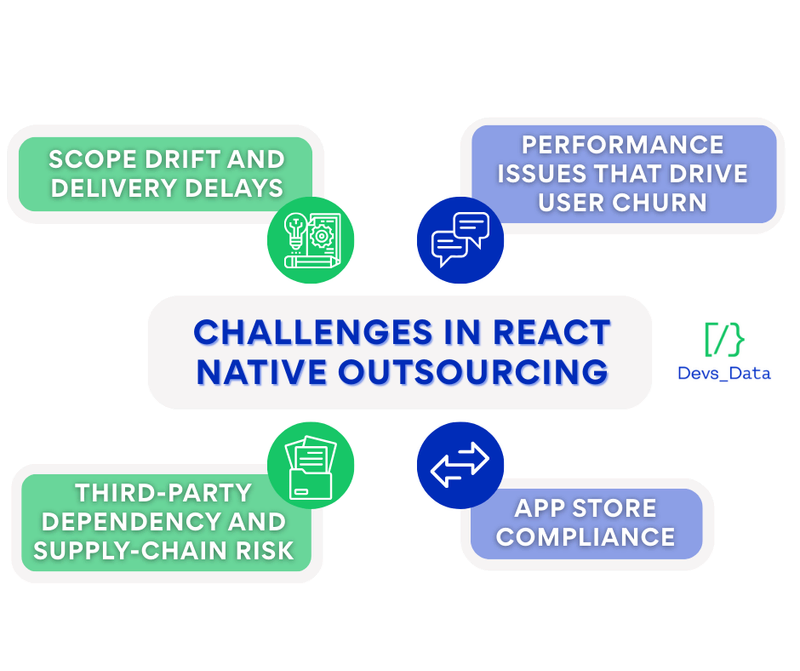
Even when React Native is the right technical choice, outsourcing can still fail if the engagement isn’t structured tightly. Mobile delivery adds extra pressure: release cycles are public, app stores enforce strict rules, and performance issues hit retention fast. Below are the most common challenges we see in React Native outsourcing, and how DevsData LLC reduces risk through clear scope, disciplined engineering practices, and predictable delivery routines.
Outsourced mobile work often breaks down when requirements evolve faster than the delivery plan. This isn’t unique to mobile, execution risk is widespread. A BCG survey 2024 found that nearly half of respondents said more than 30% of their technology development projects suffer delays or budget overruns, showing how easily delivery can slip without tight governance.
The DevsData solution
We lock an explicit delivery contract around scope: sprint-level acceptance criteria, definition of done, and change-control rules (what triggers re-estimation and what doesn’t). We also force thin vertical slices early (end-to-end flows) so hidden complexity appears in week 1-2, not near launch.
On mobile, slightly slower often becomes deleted. Even strong marketing can’t compensate for a buggy app experience. AppsFlyer’s App Uninstall Report 2025 edition shows uninstalls remain extremely high: 46.9% in 2023 vs. 46.1% in 2024.
The DevsData solution
We treat performance as a release gate: profiling on real devices, strict crash and Application Not Responding (ANR) monitoring, and regression tests around startup time, navigation, and API-heavy screens. We also enforce native escape hatches (when to write native modules) instead of forcing everything through React Native abstractions.
Outsourcing teams can ship features, yet still get blocked by store rules (privacy, permissions, metadata, UX, payment, content). Apple reports that in 2023, more than 1.7 million app submissions were rejected for various reasons, including privacy and fraudulent activity. On Google Play, enforcement has also tightened. Reporting summarized by The Verge notes Google blocked 2.36 million policy-violating apps from being published (context: strengthened reviews and quality enforcement).
The DevsData solution
We include compliance as part of delivery: privacy checklist, permission minimization, store-metadata review, and pre-submission QA that mirrors store checks. Release planning includes buffers for review cycles, rollback plans, and a clear hotfix lane so urgent fixes don’t derail the roadmap.
React Native apps rely heavily on third-party packages, Software Development Kits, and build tooling. That expands the attack surface and introduces hidden operational risk, especially when vendors or dependencies are compromised. ENISA’s Threat Landscape 2024 documents 70 supply-chain attacks in its reporting window, underscoring how common this class of risk has become.
The DevsData solution
We run dependency governance as standard: SBOM-style tracking, version pinning, security reviews for high-risk SDKs, and controlled upgrade cycles. CI checks block known-vulnerable packages, and access to signing keys / release credentials is tightly scoped and audited.
React Native outsourcing can be a major advantage, but only when execution is structured. Scope drift, performance regressions, store compliance, and dependency risk are the failure points that most often turn outsourcing into rework. DevsData LLC addresses each of these through sprint-level scope governance, real-device performance gates, pre-submission compliance reviews, and automated dependency auditing. Combined with an acceptance rate below 6% and a track record of 100+ successful projects across the US, Europe, Israel, and LATAM, this operational discipline is what separates a reliable delivery partner from a staffing vendor. Companies that treat outsourcing as a strategic function rather than a cost play consistently see better outcomes, and that distinction starts with choosing a partner whose process matches the complexity of mobile delivery.
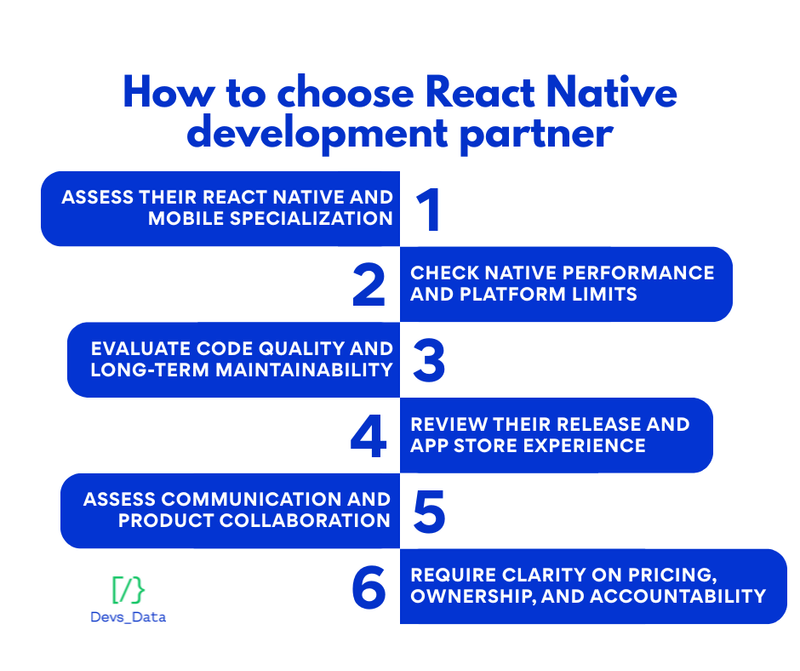
Choosing the right React Native development partner has a direct impact on delivery speed, app quality, and long-term maintainability. Mobile products are less forgiving than web apps: performance issues are visible, releases are public, and mistakes can immediately affect ratings and retention.
A strong partner brings more than React Native familiarity, they understand mobile architecture, platform constraints, and product-driven execution. Here’s what to look for.
A credible partner should demonstrate deep, hands-on React Native experience, not just general JavaScript knowledge. This includes proven work with TypeScript, navigation patterns, state management, and integration with native iOS and Android components. They should be able to show real, shipped mobile apps, ideally by providing App Store and Google Play listings or direct product links, and clearly explain how platform-specific logic was handled, including when shared React Native code was sufficient and when native modules were introduced.
React Native projects vary widely depending on performance needs, offline behavior, device capabilities, and third-party SDK usage. A capable partner understands these differences and has delivered production apps comparable in complexity to yours.
React Native success depends on knowing its boundaries. A strong partner can explain how they handle performance profiling, bridge optimization, startup time, memory usage, and crash monitoring. They should be comfortable discussing trade-offs, when React Native is sufficient, and when native code is necessary to maintain a smooth user experience.
Partners who treat React Native as “write once, run anywhere” without acknowledging platform realities often introduce hidden technical debt, for example by overusing shared abstractions for performance-sensitive features like navigation, media playback, or background processing, which eventually require native rewrites to stabilize.
Mobile apps live for years, not months. A reliable React Native partner prioritizes clean architecture, testability, and upgrade paths. This includes modular code structure, predictable state handling, automated testing, CI/CD pipelines, and disciplined dependency management. They should also be able to explain how they manage framework upgrades, OS version changes, and third-party SDK updates without destabilizing the app.
If a partner cannot clearly articulate their architectural decisions, maintenance costs tend to surface later.
React Native development does not end at feature complete. App Store and Google Play submission processes introduce additional risk. A strong partner understands review guidelines, privacy requirements, permission handling, versioning, and rollback strategies. They should demonstrate experience planning releases, coordinating hotfixes, and managing store approvals without disrupting the product roadmap.
This operational knowledge often separates teams that ship consistently from those that stall at the finish line.
React Native development is tightly connected to product design and backend systems. An effective partner communicates clearly, works within defined sprint cadences, and flags risks early. They should integrate smoothly with your Designers, Backend Engineers, and Product Owners, ensuring that technical decisions support user experience and business goals rather than working against them. Beyond day-to-day collaboration, the partner should demonstrate structured team management practices: clear ownership of tasks, capacity planning aligned to delivery milestones, and accountability for meeting agreed deadlines. Tooling matters as well. Shared project management platforms, version control workflows, CI/CD dashboards, and real-time communication channels should be established from the start, giving both sides full visibility into progress, blockers, and release readiness without relying on status meetings alone.
Trustworthy partners operate with transparent pricing models, clear delivery expectations, and explicit terms around intellectual property and code ownership. You should understand exactly how scaling works, what guarantees are offered for delivered work, and how post-launch support is handled. Ambiguity at this stage often leads to friction later.
Choosing the right React Native development partner means selecting a team that combines mobile-specific expertise, disciplined engineering practices, clear communication, and product awareness. With the right partner, React Native becomes a strategic advantage, enabling faster delivery and consistent quality, rather than a source of risk or rework.
Website: www.devsdata.com
Company size: ~60 employees
Founding year: 2016
Headquarters: Brooklyn, NY, and Warsaw, Poland
Over the years, we’ve supported companies across the US, Europe, Israel, and LATAM in building React Native-based mobile products that require both technical depth and long-term stability. From consumer-facing mobile apps to internal tools and platform extensions, our work has shown how critical experienced React Native engineers are for predictable delivery, especially when performance, native integrations, and release reliability matter. This exposure allows us to match clients with talent whose experience aligns closely with their product complexity, platform constraints, and collaboration model.
Our vetting process for React Native developers mirrors real production work rather than theoretical exercises. Candidates go through multi-stage assessments covering React Native architecture, TypeScript proficiency, debugging and performance optimization, and interaction with native iOS and Android layers. We evaluate practical concerns such as rendering efficiency, state management, third-party SDK integration, testing strategy, and handling platform-specific behavior. With an acceptance rate below 6%, our shortlists consistently consist of senior-capable engineers who can contribute from the first sprint. Beyond talent sourcing, DevsData LLC also delivers full development engagements, assembling and managing complete React Native teams that handle architecture, implementation, testing, and release coordination end to end. Whether a client needs a single Senior Developer embedded into an existing squad or a self-contained delivery pod responsible for an entire mobile product, the same vetting rigor and production-readiness standards apply.

This structured approach has led to 80+ satisfied clients, 100+ successful projects, and consistent 5.0 ratings on Clutch and GoodFirms. Supported by a network of over 95000 vetted IT professionals, including a strong cohort of React Native specialists, we can provide individual senior engineers or full delivery pods spanning mobile, backend, QA, and DevOps. In practice, this enables clients to scale React Native development with confidence, maintaining code quality, delivery speed, and clear communication throughout the lifecycle of their mobile products.
Strengthening mobile delivery for a global digital business
A US-based digital company needed React Native engineers who could integrate quickly and support frequent mobile releases without disrupting an active product roadmap. We sourced senior React Native developers who were able to contribute from the first sprint, reducing onboarding time to 1-2 weeks. By assigning engineers already experienced with production React Native codebases, native module integration, and release workflows, the client accelerated feature delivery cycles and stabilized release cadence across iOS and Android.
Key learning: React Native outsourcing succeeds when engineers are vetted for real production readiness, enabling them to deliver usable features within the first sprint rather than spending weeks ramping up on mobile-specific constraints and release workflows.
Building a large-scale mobile platform for a US enterprise
A major US organization required support for a complex, multi-screen, mobile-first platform with high reliability standards. We assembled a production-ready React Native team and managed delivery across platforms, enabling consistent execution and predictable release cycles at scale.
Key learning: enterprise mobile products demand disciplined architecture and strong release coordination from React Native teams.
Delivering a premium mobile-first eCommerce experience
A private client needed a high-quality, mobile-first eCommerce experience with advanced features and strict performance expectations. We sourced senior React Native developers with proven experience in UX-critical mobile flows, performance-sensitive features, and complex third-party integrations.
Key learning: high-end mobile products benefit most from senior React and mobile engineers who understand long-term maintainability.
Not sure whether outsourcing React Native development is the right move for your mobile product? Use this quick self-assessment to evaluate your fit. Answer each question with “Yes” or “No.”
Mostly yes: outsourcing React Native development can significantly improve delivery speed, app stability, and long-term maintainability. DevsData LLC helps companies access rigorously vetted React Native engineers, design scalable mobile architectures, and deliver production-ready apps with predictable release cycles.
Mostly no: your current setup may be sufficient for now. As your mobile product grows in complexity, performance demands, or platform scope, consider revisiting React Native outsourcing to reduce delivery friction and prevent technical debt from compounding.
Do you have it outsourcing needs needs?
Outsourcing React Native development is a strategic decision that helps companies deliver high-quality mobile applications faster while controlling complexity and long-term maintenance costs. As mobile products evolve and user expectations rise, teams need more than basic cross-platform knowledge, they need engineers who understand native constraints, performance trade-offs, and disciplined release processes across iOS and Android.
Success, however, depends on structure. Effective React Native outsourcing requires rigorous technical evaluation, clear delivery ownership, transparent communication, and partners who treat mobile development as a production system, not an experiment.
At DevsData LLC, we help companies build and scale React Native capabilities through two paths: sourcing individually vetted engineers who integrate into existing teams, and delivering full mobile projects end to end with dedicated development pods covering architecture, implementation, QA, and release management. Backed by a vetted network of 95000+ IT professionals and 100+ successful projects across the US, Europe, Israel, and LATAM, we provide the technical rigor and operational discipline needed to deliver stable, scalable mobile products regardless of engagement model.
Learn more at www.devsdata.com or contact us at general@devsdata.com.
Discover how IT recruitment and staffing can address your talent needs. Explore trending regions
like Poland, Portugal, Mexico, Brazil and more.
 Frequently asked questions (FAQ)
DevsData – your premium technology partner
DevsData is a boutique tech recruitment and software agency. Develop your software project with veteran engineers or scale up an in-house tech team of developers with relevant industry experience.
Free consultation with a software expert
🎧 Schedule a meeting
FEATURED IN


DevsData LLC is truly exceptional – their backend developers are some of the best I’ve ever worked with.”

Nicholas Johnson
Mentor at YC, serial entrepreneur


 Build your project with our veteran developers.
Explore the benefits of technology recruitment and tailor-made software.
Learn how to source skilled and experienced software developers.
Build your project with our veteran developers.
Explore the benefits of technology recruitment and tailor-made software.
Learn how to source skilled and experienced software developers.

Rebecca Botvin

Commercial Director

Tom Potanski
Manager




Categories: Big data, data analytics | Software and technology | IT recruitment blog | IT in Poland | Content hub (blog)
















careers@devsdata.com









general@devsdata.com

"I interviewed about a dozen different firms. DevsData LLC is truly exceptional – their backend developers are some of the best I've ever worked with. I've worked with a lot of very well-qualified developers, locally in San Francisco, and remotely, so that is not a compliment I offer lightly. I appreciate their depth of knowledge and their ability to get things done quickly."

Nicholas Johnson
CEO of Orange Charger LLC,
Ex-Tesla Engineer,
Mentor at YCombinator
"DevsData reached out to us, as we've been looking to grow our engineering team in Europe and Poland. Communicating efficiently and professionally, DevsData made a strong impression with their understanding of the recruitment challenges we were facing. They designed a tailored recruitment process for our needs. I was impressed with the technical depth of their approach."

Karim Butt
Co-Founder & CTO at GlossGenius, Inc.
"Out of all the vendors we work with, DevsData clearly stands out. The quality of developers they deliver is beyond what we've received from any other vendor, and they've been able to send profile recommendations very quickly. I'm happy to be their reference for other companies from Israel and talk about their recruitment abilities and what they delivered for us."

Ran Eyal
Senior Manager at
ZIM Integrated
Shipping Services Ltd.
"DevsData demonstrated a strong degree of proactivity, taking time to thoroughly understand the problem and business perspective, and continuously suggesting performance and usability enhancements. Their app exceeded my expectations. I've worked with DevsData on numerous projects over the last 3 years and I'm very happy. Being both responsive and honest in communication."

Jonas Lee
Partner & Executive VP of Verus,
Financial LLC, Investor,
& Serial Entrepreneur
Acknowledgments