Thanks for subscribing.
Your gift is on the way.



Odoo has become one of the most adaptable ERP solutions for companies seeking to connect daily operations with strategic growth. Its modular design supports finance, HR, sales, inventory, and project management under a single platform while allowing firms to activate only what they need. This flexibility aligns with the growing global investment in ERP systems, where the average spend per employee is projected to reach $15.08 by 2025. Odoo’s open-source structure gives organizations freedom to expand, integrate, and manage data without being tied to rigid licensing models, appealing to both cost-conscious and growth-oriented businesses.
Across industries, Odoo’s ‘on-premise’ deployment has become the most installed business software worldwide, with over 13000000 users spanning startups to large enterprises.
Competing systems such as Zoho ERP, SAP, Oracle NetSuite, and Microsoft Dynamics often entail higher costs or require extensive customization, positioning Odoo as a practical alternative for diverse corporate needs. The following sections explain what Odoo is, where it can be used, how it compares with other ERP systems, and how to identify qualified developers to implement it effectively.

Enterprise resource planning systems link accounting, logistics, human resources, and other operational areas under one interface. They unify data and automate repetitive work, which reduces administrative overhead. Unlike fragmented tools, they maintain consistency across departments.
Odoo follows this principle with a structure built on individual applications that scale with business growth.
In 2024, Odoo generated $650 million in revenue and served more than 11000 enterprise customers worldwide.
The platform allows organizations to activate only the relevant modules and extend them later as new needs arise.
Typical use cases include synchronized financial reporting and tighter control over inventory operations. Many companies also rely on it for structured project monitoring and measurable task accountability. Its open source foundation supports a community of more than 1500 active members who have contributed 50000+ apps for specialized needs. Each module functions independently or links with others, creating one continuous operational system.
The table below makes it easier to see how Odoo operates in distinct industry settings and company scales.
| Function | Description |
|---|---|
| Sales and CRM | Manage pipelines and customer records to ensure smooth handoffs from inquiry to sale. |
| Inventory management | Track stock movement and plan replenishment through real-time visibility. |
| Accounting | Generate invoices and handle transactions while maintaining accurate financial data. |
| Human resources | Store employee details and oversee payroll with clear attendance monitoring. |
| eCommerce | Operate an online store linked directly to internal product and customer databases. |
| Project management | Set timelines and monitor project progress at every stage. |
| Manufacturing | Define production steps and follow progress through material flow and order tracking. |
Odoo provides several deployment options so companies can select the setup that fits their goals and technical skills. Each version offers a different level of control and investment, helping organizations choose the right balance between simplicity and customization as they expand.
Odoo Community – a free, open-source edition that includes essential modules. It works best for small businesses seeking full control over customization and development.
Odoo Enterprise – a licensed version offering extra modules such as mobile access, accounting, and extended support. It fits medium and large organizations that need a complete business management platform.
Odoo.sh – a managed hosting environment for Enterprise users. The platform automates backups, testing, and deployment tasks while Odoo handles technical administration.
Odoo SaaS (Software as a Service) – a fully hosted, cloud-based setup managed directly by Odoo. It suits companies that prefer easy access and no infrastructure maintenance.
Odoo On-Premise – a locally hosted solution where the company runs Odoo on its own servers. This approach provides complete control over data and configuration but demands higher technical capacity and ongoing maintenance.
Do you have software development needs?
Odoo introduces a modular framework that contrasts sharply with the rigidity of older ERP systems. Instead of enforcing one large suite, it lets teams start with essential applications and expand step by step. This flexibility encourages gradual adoption and limits early investment risk.
As of 2025, Odoo ranks as the most-starred open source ERP system on GitHub, reflecting sustained Developer engagement and frequent technical contributions from its community.
Deployment adds another layer of choice. Some companies install Odoo on their own infrastructure, while others prefer the managed cloud. The platform’s open APIs support direct connections to tools like Shopify and Stripe, enabling functionality extensions without rebuilding existing workflows or accepting vendor lock-in. The table below summarizes how Odoo compares with each in terms of overall approach and business suitability.
| Platform | Key characteristics | Approximate starting price (per user/month) |
|---|---|---|
| SAP | Known for its scalability and extensive functionality, yet its pricing often limits use by smaller firms. | $150 |
| Oracle NetSuite | Offers advanced features, though setup and customization require significant time and expense. | $99 + setup fees |
| Microsoft Dynamics | Aligns well with organizations already within Microsoft’s environment, but adds complexity during rollout. | $70 |
| Zoho ERP | Provides a lower-cost path but lacks the depth and expandability Odoo delivers. | Variable, generally below $50 |
| Odoo Enterprise | Includes additional tools and hosting options suitable for scaling businesses. | $24 plus optional hosting and app costs |
| Odoo Community | Free open-source version offering core functionality ideal for small teams. | Free |
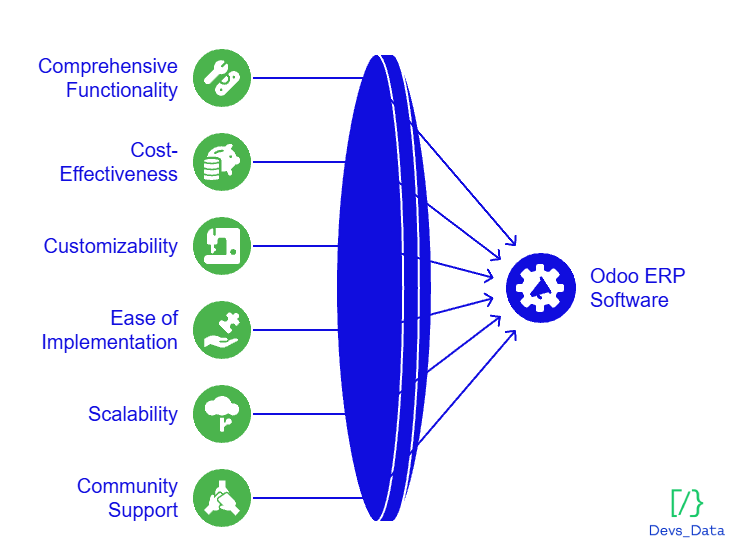
Many ERP tools emphasize functionality but leave usability behind. Odoo instead focuses on simplicity that encourages adoption. The interface keeps actions straightforward, reducing the time users need to become productive. New employees adjust quickly because the layout mirrors familiar business logic rather than forcing technical steps.
Teams without an IT background can manage the platform comfortably. This independence reduces reliance on consultants and shortens the training phase. As projects expand, configuration stays organized instead of becoming complex.
Odoo’s steady release schedule, around 55 updates each year, keeps processes improving while avoiding the disruption of major overhauls.
To clarify what sets Odoo apart, the points below outline its most practical strengths.
Odoo functions as an integrated suite covering sales, finance, inventory, HR, and operations. The app store contains more than 50000 extensions built by community members and certified partners, covering diverse industries.
The system’s open architecture limits initial and recurring costs. Community remains license-free, while Enterprise offers full support and features at a lower price than most comparable platforms.
Certified partners adapt modules to match specific workflows. When needs exceed available extensions, developers can build tailored features, ensuring the software aligns with the company’s actual structure.
The modular layout allows gradual adoption. Businesses can launch a single function and continue expanding at a manageable pace.
Odoo grows alongside the organization. Teams can add users, expand modules, or migrate to cloud hosting as global operations develop.
The open-source foundation continues to improve. Developers contribute fixes and new tools that become part of Odoo’s regular releases, maintaining progress without disruptive upgrades.
Do you have software development needs?
Odoo brings together a wide range of business applications under an open-source model, so developers must balance technical precision with adaptability. Success in this environment depends on connecting engineering skills with a clear understanding of business workflows. The role requires practical knowledge rather than theoretical familiarity.
ERP-related roles are expanding rapidly. Job postings for such skills are expected to rise by 550% in 2024, showing how fierce the competition for capable developers has become.
In this context, Odoo specialists need a well-rounded technical foundation to respond quickly to shifting project demands.
Proficiency in Python stands at the center of Odoo development. Since the platform relies on this language, developers must write reliable and testable code. Debugging and optimization should come naturally, as small inefficiencies can affect the stability of integrated modules. Developers who understand Python’s broader ecosystem can also adapt Odoo to match complex business cases and extend functionality safely.
Practical experience with the Odoo framework separates capable developers from beginners. Understanding modules, ORM structures, views, and controllers helps create consistent, maintainable builds. Skilled developers follow Odoo’s design principles to align their code with the official architecture, thereby preventing future compatibility issues. Familiarity with version migrations and modular updates keeps projects stable even as new releases appear.
Strong Odoo developers bridge backend logic with user interface improvements. HTML and CSS enable layout customization, while judicious use of JavaScript ensures dynamic, accessible forms. A grasp of modern web standards improves usability and keeps the software responsive across devices. When teams collaborate, a clear separation between design and code enhances long-term maintainability.
Since Odoo operates on PostgreSQL, developers should understand how to design efficient schemas and fine-tune queries. They often create custom modules to expand core functionality or integrate with third-party systems. This process calls for methodical data modeling and attention to version control so teams can build upon one another’s work without friction.
Developers face complex technical puzzles daily. Identifying the cause of performance drops or broken dependencies requires analytical discipline. Yet technical skill alone is not enough. Clear communication ensures alignment between engineers and clients. Explaining solutions in plain language helps bridge the gap between development work and business goals.
Technology never stops moving, and neither can Odoo specialists. Keeping pace with new releases and security updates protects both project quality and professional growth. Many developers contribute to the Odoo community or follow its forums to test new ideas early. Those who prioritize learning tend to deliver more stable and future-proof systems.

Once Odoo becomes a core platform, identifying qualified developers requires clear criteria and disciplined validation. A specialist recruiter brings structure to screening and steady access to vetted talent. Recruiters track active pools and remove duplicate steps that slow internal hiring.
Many teams engage IT recruitment partners to guide assessments and present candidates matched to project goals. Selecting an agency for Odoo roles adds documented checks and visible progress at each stage. The target is straightforward: secure developers whose skills align with the stack and the delivery timeline. The points below outline how third-party involvement improves accuracy and speeds decision-making.
Start by mapping out the exact capabilities you need. What technical abilities does your project demand? Write down the level of experience that makes sense for your team. This clarity becomes your foundation when you begin conversations with agencies.
Begin your search by identifying firms that focus on technology placements. Look specifically for those with a history of placing Odoo specialists. Their portfolio reveals whether they’ve filled similar positions before. Build a shortlist of three to five agencies that demonstrate expertise in your domain.
Verify each agency’s reputation through multiple channels rather than relying on a single source. Past client testimonials offer one perspective, while the case examples they publish reveal how they approach real challenges. Independent reviews online add context that internal materials cannot provide.
Schedule initial conversations with each shortlisted firm, where you outline your technical needs comprehensively. Your team’s work style influences candidate success as strongly as technical abilities do in practice. Describe your company’s values to help the agency understand what drives decisions in your organization. A greater workflow context helps them determine which candidates will adapt effectively to your environment.
Ask each firm to explain its recruitment methodology in detail. Their sourcing strategies reveal how they find potential hires, while their evaluation methods show how they separate strong candidates from weak ones. Request specifics about their interview structure so you understand how they assess fit. An agency with a rigorous, well-defined approach will consistently deliver better results than one relying on vague procedures.
Odoo development requires specialized knowledge that general recruiters often lack. The agency should employ recruiters who understand Python development and the Odoo framework’s architecture. Ask how they test technical capabilities during screening rather than accepting resume claims at face value. Without this expertise, an agency will struggle to identify truly skilled developers among those who merely list buzzwords on their resumes.
Discuss pricing structures upfront so both parties understand the financial arrangement. Some agencies tie their fees to successful placements, while others charge fixed amounts regardless of outcomes. Clarify any costs that might arise beyond the base fee to prevent unexpected expenses. Compare their rates against your budget constraints carefully, then agree on terms that balance the value they deliver with your financial parameters.
Set expectations for how often you’ll receive updates based on what works best for your team’s workflow. Email provides a written record that some teams prefer, while phone calls allow for immediate clarification when issues arise. Project management tools create transparency by letting everyone track progress in real time. Make sure the agency commits to specific response timeframes rather than vague promises of availability. Regular, predictable contact prevents surprises during the search and keeps both parties aligned on progress.
Review each profile the agency sends. Examine work history for relevant projects. Does their experience match your needs? Consider how each person might mesh with your existing team. Send feedback to the agency about what’s working in their selections. Be specific about what needs adjustment.
Participate directly in concluding interview rounds. Test their problem-solving approach with real scenarios from your work. Gauge their technical depth through practical questions. How do they communicate complex ideas? This final evaluation reveals whether they’ll succeed in your actual work environment.
After selecting your hire, coordinate with the agency to complete all paperwork. Work through the offer details together. Plan the first week’s activities. Set up their workspace and system access. A coordinated start helps your new developer become productive quickly.
Website: www.devsdata.com
Team size: ~60 employees
Founded: 2016
Headquarters: Brooklyn, New York, and Warsaw, Poland
Selecting the right recruitment partner determines whether your Odoo hiring process runs smoothly or stalls. DevsData LLC brings over ten years of specialized experience, backed by a 60-person team that maintains an active database of more than 95000 candidates. The firm operates across major markets, including the US, while serving both established enterprises and fast-growing technology companies. What sets their track record apart? Consistent 5/5 ratings on Clutch and GoodFirms reflect the disciplined approach that clients experience throughout each engagement.
Transparency shapes how this company runs its engagements. Decision-makers receive documentation from every stage of the Odoo hiring cycle, with evaluation notes kept accessible rather than filtered through agency gatekeeping. This level of visibility differs from the limited reporting that many staffing firms offer, allowing clients to follow progress as it happens.
The screening process targets Odoo-specific competencies with precision. Each candidate completes a 90-minute technical assessment that tests proficiency in Python alongside knowledge of frameworks. Structured interviews follow to measure problem-solving speed under realistic conditions. How do they evaluate soft skills? Communication style gets assessed separately to confirm that developers explain technical decisions clearly. This multistage system, refined over five years, consistently surfaces specialists who deliver results on Odoo projects. US-based technical reviewers lead these evaluations to maintain standards across time zones.
DevsData LLC extends beyond placement services into strategic HR support. The firm assists with compliance questions related to labor law. Tax considerations get addressed before contracts are signed. Employer of Record arrangements allow companies to bring on Odoo talent in new jurisdictions without establishing legal entities first. These capabilities reduce administrative friction when scaling development teams across borders.
A recent engagement with BNP Paribas demonstrates this approach in practice. The bank needed to expand its technology workforce rapidly while maintaining strict security standards. DevsData LLC coordinated with stakeholders across Paris to identify role requirements, then sourced developers with financial services experience who understood regulated environments. Pre-vetted candidates arrived within weeks. Placements were completed on schedule, allowing BNP Paribas to meet project deadlines without compromising on technical quality or compliance requirements.
To accelerate your Odoo hiring timeline, contact DevsData LLC at general@devsdata.com or visit www.devsdata.com.
Do you have software development needs?
Hiring qualified Odoo developers starts with recognizing that technical skills alone don’t guarantee project success. Does a candidate understand Python syntax? That matters less than whether they can architect scalable modules that adapt to shifting business requirements. Companies often rush the vetting stage, then discover mid-implementation that their new hire struggles with version migrations or fails to grasp how custom workflows interact with core Odoo functions.
Structured evaluation prevents these gaps. When recruitment partners maintain documented screening methods, they surface specialists who solve problems rather than create dependencies. The difference shows up weeks into a project when one developer debugs integration issues independently while another escalates every configuration question. Organizations that invest in rigorous hiring processes reduce deployment friction. They build teams capable of turning Odoo’s modular framework into operational infrastructure that supports growth instead of limiting it.
DevsData LLC brings over ten years of specialized recruitment experience to Odoo hiring, supported by a team that includes US-based technical specialists who maintain rigorous evaluation standards. The firm serves global corporate clients and high-growth startups worldwide, including those in the US and Israel, drawing from an active database of more than 95000 candidates. With a government-approved recruitment license and documented success placing developers in regulated environments, DevsData LLC delivers precision screening that connects Odoo project requirements with vetted technical talent.
To discuss Odoo hiring needs, reach DevsData LLC at general@devsdata.com or visit www.devsdata.com for service details.
Any questions or comments? Let me know on Twitter/X.
Discover how IT recruitment and staffing can address your talent needs. Explore trending regions like Poland, Portugal, Mexico, Brazil and more.
 Frequently asked questions (FAQ)
DevsData – your premium technology partner
DevsData is a boutique tech recruitment and software agency. Develop your software project with veteran engineers or scale up an in-house tech team of developers with relevant industry experience.
Free consultation with a software expert
🎧 Schedule a meeting
FEATURED IN


DevsData LLC is truly exceptional – their backend developers are some of the best I’ve ever worked with.”

Nicholas Johnson
Mentor at YC, serial entrepreneur


 Build your project with our veteran developers.
Explore the benefits of technology recruitment and tailor-made software.
Learn how to source skilled and experienced software developers.
Build your project with our veteran developers.
Explore the benefits of technology recruitment and tailor-made software.
Learn how to source skilled and experienced software developers.

Rebecca Botvin

Commercial Director

Tom Potanski
Manager




Categories: Big data, data analytics | Software and technology | IT recruitment blog | IT in Poland | Content hub (blog)
















careers@devsdata.com









general@devsdata.com

"I interviewed about a dozen different firms. DevsData LLC is truly exceptional – their backend developers are some of the best I've ever worked with. I've worked with a lot of very well-qualified developers, locally in San Francisco, and remotely, so that is not a compliment I offer lightly. I appreciate their depth of knowledge and their ability to get things done quickly."

Nicholas Johnson
CEO of Orange Charger LLC,
Ex-Tesla Engineer,
Mentor at YCombinator
"DevsData reached out to us, as we've been looking to grow our engineering team in Europe and Poland. Communicating efficiently and professionally, DevsData made a strong impression with their understanding of the recruitment challenges we were facing. They designed a tailored recruitment process for our needs. I was impressed with the technical depth of their approach."

Karim Butt
Co-Founder & CTO at GlossGenius, Inc.
"Out of all the vendors we work with, DevsData clearly stands out. The quality of developers they deliver is beyond what we've received from any other vendor, and they've been able to send profile recommendations very quickly. I'm happy to be their reference for other companies from Israel and talk about their recruitment abilities and what they delivered for us."

Ran Eyal
Senior Manager at
ZIM Integrated
Shipping Services Ltd.
"DevsData demonstrated a strong degree of proactivity, taking time to thoroughly understand the problem and business perspective, and continuously suggesting performance and usability enhancements. Their app exceeded my expectations. I've worked with DevsData on numerous projects over the last 3 years and I'm very happy. Being both responsive and honest in communication."

Jonas Lee
Partner & Executive VP of Verus,
Financial LLC, Investor,
& Serial Entrepreneur
Acknowledgments