Thanks for subscribing.
Your gift is on the way.



With growing demand for faster delivery of digital products, companies are under pressure to scale development without overloading internal teams or driving up costs. Nearshore development offers a practical solution. By working with teams in neighboring countries and overlapping time zones, businesses can accelerate delivery, maintain high code quality, and cut development costs, often by as much as 50% compared to onshore alternatives.
Today’s market conditions are making nearshoring a strategic necessity. Global skill shortages, especially in areas like AI, data science, and cloud engineering, are intensifying competition for top talent. At the same time, developer salaries in key tech hubs such as the US and Western Europe continue to rise sharply, putting pressure on margins. According to Deloitte, 50% of executives cite talent availability as the most significant barrier to digital transformation, while Korn Ferry projects a shortfall of over 85 million skilled workers by 2030.
Nearshoring also enables real-time collaboration, better cultural alignment, and easier team integration, which accelerates Agile workflows and reduces miscommunication. According to a McKinsey study, teams working in overlapping time zones achieved 30% shorter delivery cycles and higher stakeholder satisfaction compared to offshore setups. For businesses, this reduction in delivery time can mean launching products ahead of competitors, gaining a first-mover advantage, and capturing a larger share of the market.
This guide explores the fundamentals of nearshore software development, highlights its distinctions from offshore practices, and explores how it reshapes business operations globally. Whether looking to enhance productivity or streamline project execution, nearshore development offers a compelling pathway to success.
Nearshore software development involves partnering with teams in neighboring countries, often within the same or a similar time zone as your business. Modern remote collaboration tools and video conferencing platforms have made managing these distributed teams more efficient and accessible than ever.
“Nearshore development is a strategic necessity, not just a cost-saving tool. It supports agile transformation and global expansion initiatives without sacrificing collaboration.” – Gartner IT Sourcing Insights, 2024
Businesses can access highly skilled developers in adjacent nations by outsourcing nearshore software. This approach reduces costs while providing access to diverse technical talent and fresh ideas. It enables businesses to develop high-quality, customized applications while benefiting from improved communication and operational efficiency.
The growing adoption of nearshore outsourcing reflects its advantages. According to Clutch, 90% of small businesses planned to outsource various functions, including IT and software projects, in 2022. Notably, 21% of those businesses intended to collaborate with a nearshore outsourcing provider, up from 15% in 2021. This trend underscores the growing recognition of nearshore development as a cost-effective and strategic solution for contemporary businesses.
Do you have software development needs?
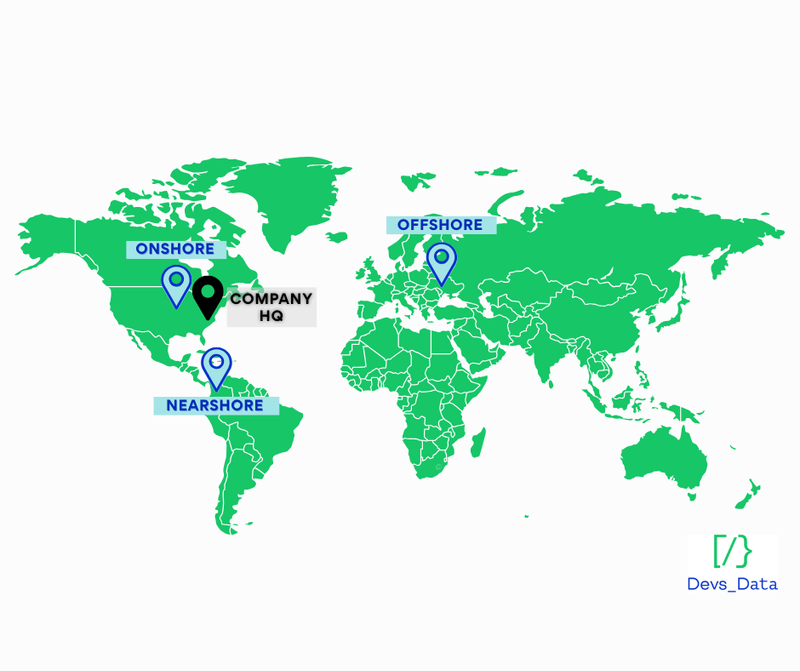
When considering external development support, businesses typically choose between onshore, offshore, or nearshore models. Each offers distinct advantages and trade-offs in terms of cost, communication, and team integration. The table below provides a quick comparison to help you select the most suitable approach based on your project’s goals and constraints.
| Model | Description | Best for | Key challenges | Risk vs. reward |
|---|---|---|---|---|
| Onshore | Hiring developers within your own country or region. Offers excellent communication and easy in-person collaboration, but at the highest cost. | – Projects with strict data privacy; – frequent in-person collaboration; – IoT/physical systems. |
– Talent shortages; – long hiring cycles. |
Low risk / high cost |
| Offshore | Outsourcing to distant regions like Asia or Eastern Europe. Cost-effective, but comes with time zone and communication hurdles. | – Repetitive tasks; – IT maintenance; – low-collaboration projects. |
– Time zone gaps; – cultural / language barriers; – high turnover. |
High risk / low cost |
| Nearshore | Partnering with teams in nearby countries with overlapping time zones (e.g., US–LATAM, EU–Eastern Europe). Balances cost and collaboration. | – Agile projects; – SaaS, B2B/B2C apps; – real-time decisions; – legacy modernization. |
– May still require alignment on tools, culture, and workflow. | Balanced risk / balanced cost |
“Companies that adopt nearshore software development reduce delivery timelines by up to 30% compared to offshore counterparts.” – McKinsey Digital.
Selecting between onshore, offshore, and nearshore outsourcing comes down to aligning the model with your project’s complexity, collaboration needs, and budget.
Ultimately, nearshore development has become a popular choice for businesses looking for cost savings without sacrificing collaboration or project efficiency. While each outsourcing model has its strengths and challenges, the right choice depends on aligning your project’s specific needs with the capabilities of each approach.
Nearshore software outsourcing gives businesses access to skilled development teams in nearby or time-aligned regions. This model supports smooth communication, cultural compatibility, and efficient integration with internal teams – ideal for organizations seeking to scale quickly without sacrificing collaboration. Depending on your goals, there are three common engagement models in nearshore outsourcing.
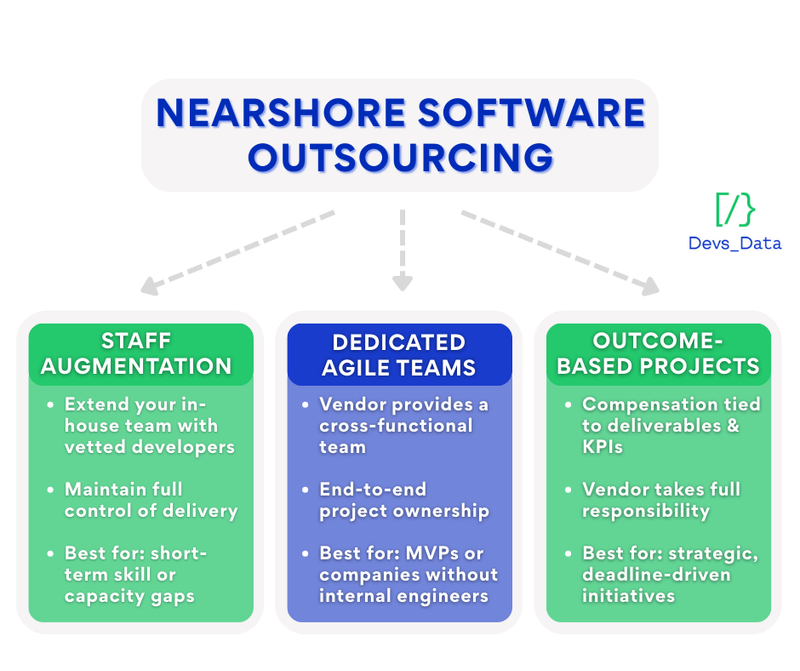
This model allows you to plug vetted developers directly into your in-house team. You retain full control over project delivery, while external engineers work as an extension of your staff.
Best suited for:
Here, the nearshore vendor assembles a cross-functional team that handles the project from end to end. The team is tailored to your needs, follows Agile methodologies, and integrates seamlessly with your processes.
Best suited for:
This results-driven model ties compensation and success to predefined goals or deliverables. The nearshore team takes full ownership of execution, freeing your internal resources.
Best suited for:
Each model supports different needs. Choosing the right one depends on how much control you want, how fast you need to move, and whether you already have an internal team in place. In the next section, we’ll cover why working with a specialized nearshore agency can further streamline your success.
Nearshore software development offers numerous proven benefits, making it an attractive option for businesses seeking to streamline operations, reduce costs, and access specialized talent. The following are the primary benefits of nearshoring as an effective strategy for modern software development.
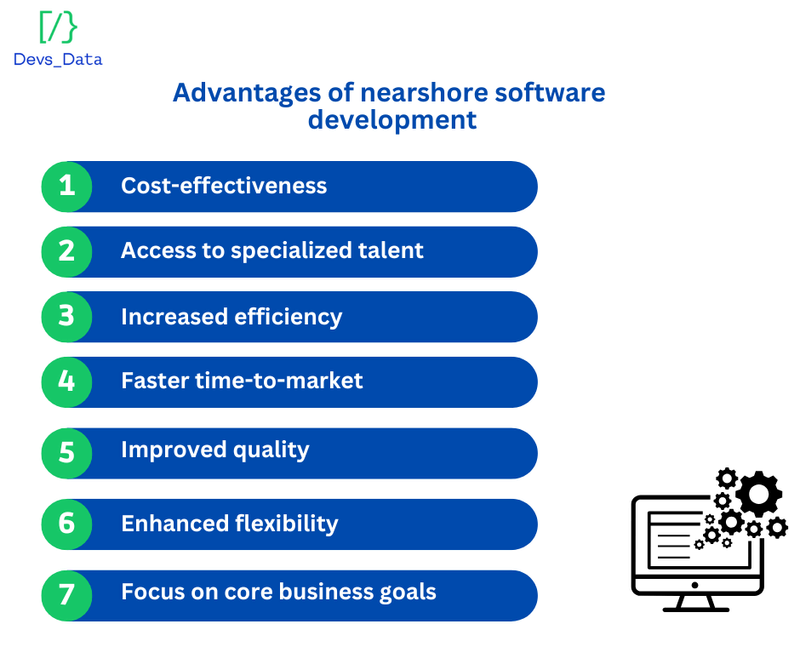
Nearshore software development is a cost-efficient alternative to in-house development. Businesses can leverage the lower labor costs in nearshore regions to access highly skilled professionals without compromising quality. This is particularly beneficial for small and medium-sized enterprises (SMEs) that may lack the resources for a full-time, in-house team. Many nearshore providers also offer bundled services that include project management, testing, and quality assurance, further reducing expenses while maintaining high standards.
Nearshore development gives companies access to top-tier talent in tech hubs like Argentina, Mexico, and Eastern Europe. These regions offer skilled developers with expertise in modern tools and frameworks, enabling faster team scaling and high-quality delivery. With fewer time zones and cultural barriers than offshore models, nearshoring streamlines collaboration and accelerates hiring, making it a smart choice for companies seeking specialized talent and agility.
Working with nearshore developers can significantly accelerate the software development process. Operating within the same or similar time zones ensures real-time communication, streamlining workflows, and enhancing collaboration. The alignment in working hours reduces delays and development errors, resulting in faster project execution and better productivity.
Nearshore teams excel in completing projects quickly, allowing firms to get their products to market faster. A nearshore partner may complete a prototype or full-scale product in a fraction of the time that it would take an in-house team. This agility allows organizations to remain competitive while responding to market needs with increased speed and efficiency.
Nearshore outsourcing gives businesses access to experienced developers who adhere to industry best practices. This ensures that software products meet high-quality standards. Additionally, the cost savings from nearshoring can be reinvested in thorough testing and quality assurance processes, resulting in more reliable solutions and improved user satisfaction.
Nearshore software development offers unmatched flexibility. Businesses can scale their teams up or down depending on project requirements. This adaptability enables companies to respond quickly to changing market conditions or customer needs, providing a competitive advantage in dynamic industries.
Outsourcing software development to a nearshore partner frees businesses to focus on their strategic objectives. By delegating complex software development tasks, companies can reallocate resources to core business functions, such as growth initiatives, marketing, or customer acquisition, ultimately driving long-term success.
Do you have software development needs?
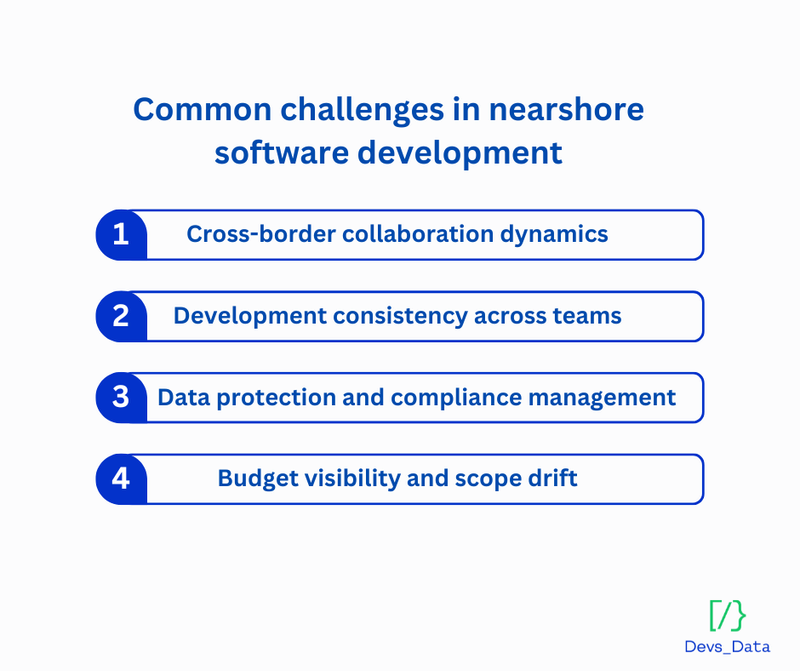
While nearshoring offers many strategic advantages, successful execution depends on navigating certain operational and organizational complexities. These challenges don’t negate the benefits but rather underscore the importance of thoughtful planning, alignment, and partner selection.
Even with aligned time zones, collaborating across borders requires deliberate coordination. Misaligned expectations, scheduling difficulties, and occasional language or cultural differences can slow momentum if not proactively addressed. Ensuring that both sides share a common understanding of goals, timelines, and workflows is critical. Establishing clear documentation, communication protocols, and using real-time collaboration tools (e.g., Slack, Zoom, JIRA) helps maintain transparency and momentum.
When working with distributed teams, ensuring a consistent development process and coding standard across geographies can be complex. This isn’t necessarily a quality issue, but rather a coordination challenge, especially when teams come from diverse engineering cultures or tool preferences. To mitigate this, companies should define and enforce shared technical guidelines, invest in onboarding, and assign senior leads to oversee code cohesion and best practices across the project.
While many nearshore regions adhere to global data security standards, their legal and regulatory landscapes can vary. Ensuring compliance with privacy regulations like ISO 27001 or GDPR requires attention, not just from developers, but also from legal, compliance, and security teams. Businesses should verify that their nearshore partners follow secure development protocols, conduct regular audits, and have the appropriate legal safeguards (e.g., NDAs, IP transfer agreements) in place.
Although nearshoring is generally cost-efficient, projects can still run into budgeting issues, especially when goals aren’t clearly defined upfront. Scope changes, evolving requirements, and differences in estimation methods can impact both cost and timelines. Managing this requires transparent planning from the outset, clearly defined deliverables, and regular checkpoints to assess progress against expectations. Using fixed-price models for well-defined milestones can also reduce ambiguity.
Maximizing the benefits of nearshore software development requires a thoughtful approach to planning, communication, and collaboration. When evaluating a potential nearshore partner, business leaders should ask the following questions:
Before coding begins, does the vendor run a structured scoping and discovery process to define project goals, timelines, scope, and budget? This step prevents costly misalignments later and ensures stakeholders are aligned on priorities.
Will an onshore product manager (or equivalent role) help bridge business goals with technical execution? This role ensures the development team stays aligned with strategic objectives and cultural context.
Does the partner use reliable platforms like JIRA, Trello, or Asana to track tasks, priorities, and progress? Can you access these tools for full transparency and real-time feedback?
What are the expected rhythms of collaboration – daily stand-ups, sprint reviews, strategy calls? Are reporting formats and KPIs defined from the outset to keep both sides accountable?
Does the vendor encourage occasional in-person workshops or milestone meetings to build trust, improve cohesion, and strengthen long-term collaboration?
Do they have processes in place to minimize team churn and provide stable, long-term developers for your project? Continuity is critical to avoiding knowledge loss and delivery delays.
The cost of nearshore software development varies significantly depending on multiple factors, including the project’s scope, complexity, and the expertise of the developers. While nearshore development is generally more cost-effective than onshore alternatives due to lower living and wage costs in nearshore countries, understanding the variables that influence overall expenses is essential to ensuring value and quality.
The size and complexity of a project significantly determine its costs. Larger projects with advanced functionality, custom integrations, or scalability requirements demand a broader skill set and longer development timelines, which can drive up costs.
The level of expertise required directly impacts pricing. Developers with specialized skills in niche technologies or industry-specific experience often command higher rates. Choosing a team with the proper knowledge ensures the project is completed efficiently and to a high standard.
While nearshore development is cost-effective, managing remote teams comes with additional expenses. These may include costs for communication tools, time zone coordination, and occasional travel for in-person meetings to strengthen collaboration.
Quality is a significant factor in determining cost-effectiveness. Partnering with a credible team with a proven track record can help you avoid the hidden expenses of revisions, delays, or poor deliverables. Investing in quality early ensures that the finished product meets your expectations and performs as needed.
Establishing a well-defined project scope minimizes uncertainties, helps manage expectations, and prevents unnecessary expenses by providing a clear roadmap for the team. It ensures all stakeholders are aligned, reducing the risk of miscommunication and project delays.
The discovery phase is crucial for identifying project requirements, anticipating potential challenges, and setting a realistic budget. This upfront investment ensures a smoother development process and reduces risks.
Using reliable project management and communication platforms, such as Slack, Zoom, and JIRA, enhances collaboration, minimizes miscommunication, and reduces costs associated with remote team management.
Choose experienced nearshore development teams that align with your budget and quality expectations. Evaluate client reviews, case studies, and success stories to make an informed decision. A trusted partner can help you achieve optimal results while staying within budget.
By carefully considering these factors and working with a trusted partner, businesses can maximize the cost-effectiveness of nearshore software development while achieving high-quality results.
Partnering with a nearshore agency goes beyond hiring developers. It means gaining a structured, full-service team aligned with your goals. Here’s what sets a qualified agency apart:
Agencies handle everything from recruiting and vetting engineers to onboarding, legal compliance, and day-to-day oversight. You get a cohesive team that includes project managers, QA specialists, and other roles as needed, without the overhead of building and managing it yourself.
Unlike freelancers or ad hoc contractors, agencies bring in-house delivery frameworks, documentation standards, performance tracking, and scalable infrastructure. This reduces friction and accelerates delivery timelines.
Agencies have access to top talent pools and deep regional knowledge. Their hiring processes prioritize both technical skills and cultural fit, ensuring stronger collaboration and long-term success.
Many agencies provide legal and operational support, including NDAs, IP transfer clauses, E&O insurance, and security audits, adding a layer of confidence and compliance to your partnership.
A reliable partner doesn’t disappear after delivery. DevsData LLC provides ongoing maintenance, technical support, and even strategic consultations to ensure long-term success. This continuity minimizes downtime, extends the lifecycle of your applications, and supports your evolving business goals.
Reputable agencies showcase their experience through client case studies and verified reviews on platforms like Clutch or GoodFirms. These insights help you assess their technical expertise, communication style, and reliability.

Website: www.devsdata.com
Team size: ~60 employees
Founded: 2016
Headquarters: Brooklyn, NY, and Warsaw, Poland
For businesses seeking dependable and cost-effective nearshore software outsourcing solutions, DevsData LLC stands out as a top choice. With a proven track record and a team of highly skilled professionals, they provide comprehensive services tailored to meet specific business needs.
The company’s certified experts, including Google-level in-house engineers, bring extensive experience across various software development methodologies. Having engineers who have operated at the highest standards of global tech firms gives clients the ability to tackle more ambitious, complex projects with confidence. Whether it’s scaling a high-traffic SaaS platform, modernizing legacy systems, or implementing cutting-edge AI solutions, DevsData LLC’s senior experts provide the technical depth and problem-solving capacity needed to turn bold ideas into reality.
Their specialties include full-cycle software development, custom solutions, mobile and web app development, software maintenance, and support. By partnering with DevsData LLC, businesses benefit from high-quality deliverables, time zone alignment, cultural compatibility, and strong data security and privacy measures.
DevsData LLC collaborates globally with innovative startups and high-growth companies from the US and Israel. Their flexible, personalized approach ensures competitive pricing and premium-quality outcomes. With over 100 successful projects across various industries, they have consistently earned top ratings on platforms like Clutch and GoodFirms.
DevsData LLC supported a Silicon Valley FinTech company in building a high-performance nearshore development team to deliver a next-generation cross-border payment platform. The client faced challenges recruiting experienced engineers who understood both US compliance standards and Latin American payment infrastructure. DevsData LLC stepped in to source and vet top-tier developers from LATAM, assembling a bilingual team aligned with the client’s time zone, security requirements, and Agile workflows.
Thanks to this nearshore strategy, the company was able to accelerate its development cycle, cut transaction processing times by over 60%, and reduce cross-border operational costs significantly. The team delivered a robust, scalable platform that now enables faster, lower-cost financial transactions between the US and Latin America. This case highlights how DevsData LLC’s regional expertise and rigorous recruitment approach turned a complex international project into a seamless, high-impact success.
Their development teams, composed of professionals with an average of 10+ years of specialized experience, consistently set new benchmarks in nearshore software development. This excellence is reflected in their extensive portfolio and client success stories.
DevsData LLC also provides comprehensive Employer of Record (EoR) solutions, covering payroll, compliance, and administrative support across multiple regions. In practice, this means DevsData takes full responsibility for navigating local employment laws, handling payroll and taxes, and managing HR operations on the client’s behalf. By removing these legal and administrative burdens, businesses can expand into new markets quickly and confidently, without the risk of non-compliance. Clients are free to focus entirely on building their product and scaling their operations, while DevsData ensures that all employment, tax, and regulatory requirements are seamlessly managed in the background.
DevsData LLC’s reliable services and unique approach make it a trusted partner for nearshore software outsourcing, whether your organization is a startup or an established enterprise. For more information, contact DevsData LLC at general@devsdata.com or visit their website at www.devsdata.com.
Do you have software development needs?
Nearshore software development has become a game-changer for businesses seeking to optimize costs and access top-tier talent without compromising quality. By partnering with teams in nearby countries or those in similar time zones, companies can benefit from smoother communication, cultural alignment, and enhanced operational efficiency. This approach addresses challenges like time zone misalignment and cultural differences commonly associated with offshore outsourcing while delivering cost advantages over onshore models.
A key advantage of nearshoring is its ability to provide access to thriving tech hubs with skilled professionals adept at the latest technologies. This enables businesses to expedite project timelines, maintain high-quality output, and lower development costs. Nearshoring is particularly effective for Agile projects, SaaS applications, and the modernization of legacy systems, enabling companies to scale teams and respond more flexibly to evolving market demands.
While nearshoring has advantages, success depends on finding the right partner to assure quality, security, and smooth communication. Businesses can utilize nearshore outsourcing to focus on their strategic objectives and produce high-quality products more efficiently by carefully planning and fostering clear communication.
For organizations exploring nearshore outsourcing, DevsData LLC provides a trusted solution. With a strong track record of over 100 successful projects, they offer comprehensive services, from full-cycle software development to administrative support, ensuring smooth integration and consistent delivery. What sets DevsData LLC apart is its combination of Google-level engineering talent, rigorous vetting processes, and a client-first approach that goes beyond staffing to deliver long-term business impact.
Learn more by contacting general@devsdata.com or visiting their website at www.devsdata.com.
Discover how IT recruitment and staffing can address your talent needs. Explore trending regions
like Poland, Portugal, Mexico, Brazil and more.
 Frequently asked questions (FAQ)
DevsData – your premium technology partner
DevsData is a boutique tech recruitment and software agency. Develop your software project with veteran engineers or scale up an in-house tech team of developers with relevant industry experience.
Free consultation with a software expert
🎧 Schedule a meeting
FEATURED IN


DevsData LLC is truly exceptional – their backend developers are some of the best I’ve ever worked with.”

Nicholas Johnson
Mentor at YC, serial entrepreneur


 Build your project with our veteran developers.
Explore the benefits of technology recruitment and tailor-made software.
Learn how to source skilled and experienced software developers.
Build your project with our veteran developers.
Explore the benefits of technology recruitment and tailor-made software.
Learn how to source skilled and experienced software developers.

Rebecca Botvin

Commercial Director

Tom Potanski
Manager




Categories: Big data, data analytics | Software and technology | IT recruitment blog | IT in Poland | Content hub (blog)
















careers@devsdata.com









general@devsdata.com

"I interviewed about a dozen different firms. DevsData LLC is truly exceptional – their backend developers are some of the best I've ever worked with. I've worked with a lot of very well-qualified developers, locally in San Francisco, and remotely, so that is not a compliment I offer lightly. I appreciate their depth of knowledge and their ability to get things done quickly."

Nicholas Johnson
CEO of Orange Charger LLC,
Ex-Tesla Engineer,
Mentor at YCombinator
"DevsData reached out to us, as we've been looking to grow our engineering team in Europe and Poland. Communicating efficiently and professionally, DevsData made a strong impression with their understanding of the recruitment challenges we were facing. They designed a tailored recruitment process for our needs. I was impressed with the technical depth of their approach."

Karim Butt
Co-Founder & CTO at GlossGenius, Inc.
"Out of all the vendors we work with, DevsData clearly stands out. The quality of developers they deliver is beyond what we've received from any other vendor, and they've been able to send profile recommendations very quickly. I'm happy to be their reference for other companies from Israel and talk about their recruitment abilities and what they delivered for us."

Ran Eyal
Senior Manager at
ZIM Integrated
Shipping Services Ltd.
"DevsData demonstrated a strong degree of proactivity, taking time to thoroughly understand the problem and business perspective, and continuously suggesting performance and usability enhancements. Their app exceeded my expectations. I've worked with DevsData on numerous projects over the last 3 years and I'm very happy. Being both responsive and honest in communication."

Jonas Lee
Partner & Executive VP of Verus,
Financial LLC, Investor,
& Serial Entrepreneur
Acknowledgments